How Much Should a Pediatric Dental Practice Website Cost in 2026?

Oct 29, 2026 · 16 min read
The American Dental Association counted 4,213 pediatric dentists working in the United States in 2001. Its count for 2025 is 9,521, an increase of 126 percent, while orthodontists grew 17 percent over the same years and periodontists 10. Of the specialties with more than a thousand dentists, none has grown nearly as fast. If you run a pediatric practice and it feels as though a new kids' office opens near you every year, the data agrees with you, and the website is where those practices now compete for the same parents.
On 29 October 2026 we costed that website in two ways. We gathered the sellers that publish a fee for a dental practice website or a pediatric marketing program and projected each one across 36 months. We also read 178 independent pediatric dental practice websites in 18 American metro areas to see what a parent actually finds there: insurance answers, sedation pages, credentials, booking routes and prices.
The 30-second answer: pediatric dental website prices
Expect roughly $2,000 to $7,500 for a pediatric dental practice website if you pay a one-time build fee to a dental website company, or $249 to $599 a month on the managed plans we found, where the seller builds and runs the site for a monthly fee. Marketing programs that work on a pediatric practice's search visibility run $750 to $8,000 a month at published rates, or $27,000 to $288,000 across 36 months with advertising still to pay. Three of the six sellers below have written a page aimed at pediatric dentists. We took every figure from the seller's own site on 29 October 2026.
The census is the more useful half for most practices. Nearly every site we read has a phone link and a booking route, and 152 of 178 mention sedation. Only 33 say on the pages we read whether they take Medicaid, and only 18 print what a first visit costs.
Sellers that print a number
Six companies selling websites or marketing to dental practices print a fee on their own sites. Figures that appeared only in a competitor's comparison article, or only as a range on an inquiry form, were left out.
| Seller | What the price buys | Price, as printed | Terms worth reading |
|---|---|---|---|
| Cre8 My Site (pediatric page) | A website plus Google Business Profile work and local SEO | $599 a month | Month to month, no contract; the page says you keep the website if you cancel |
| SEOteric (pediatric page) | Website as a service, 5 to 10 pages; separate marketing plans | Website from $249 a month; plans from $1,500, $3,000, $5,000 and $8,000 a month | The $249 site has no upfront fee and a 12-month minimum; extra design work is $150 an hour |
| DDSRank (pediatric page) | Local search and AI visibility; ads on the top plan | $1,495, $2,495 or $3,495 a month | Onboarding $995 or $1,500, waived on a 6-month agreement; 3-month minimum; a website rebuild is quoted separately |
| DocSites | A dental template website | $1,999, $2,999 or $3,999 setup | $89 a month, month to month, covering hosting and up to an hour of requested updates |
| Website Design for Dentists | A custom dental website build | $1,997 Starter or $3,997 Growth, one time; Authority $7,500 | Monthly SEO is optional on Growth; the page lists pediatric among the specialties it has built for |
| Lasso MD | A custom website inside a marketing plan | $750, $1,250, $1,500 or $2,000 a month | Every plan lists custom website design; ads are billed at your ad budget plus 25 percent |
The first three rows are the interesting ones, because each has written a page for pediatric dentists specifically, and each has priced it differently. Cre8 My Site folds the website into one flat monthly plan. SEOteric rents you a site for $249 a month and sells marketing on top. DDSRank sells only the marketing and quotes the website as a separate project. Three sellers, three different answers to what the monthly fee actually pays for, and that is the first thing to settle on any sales call.
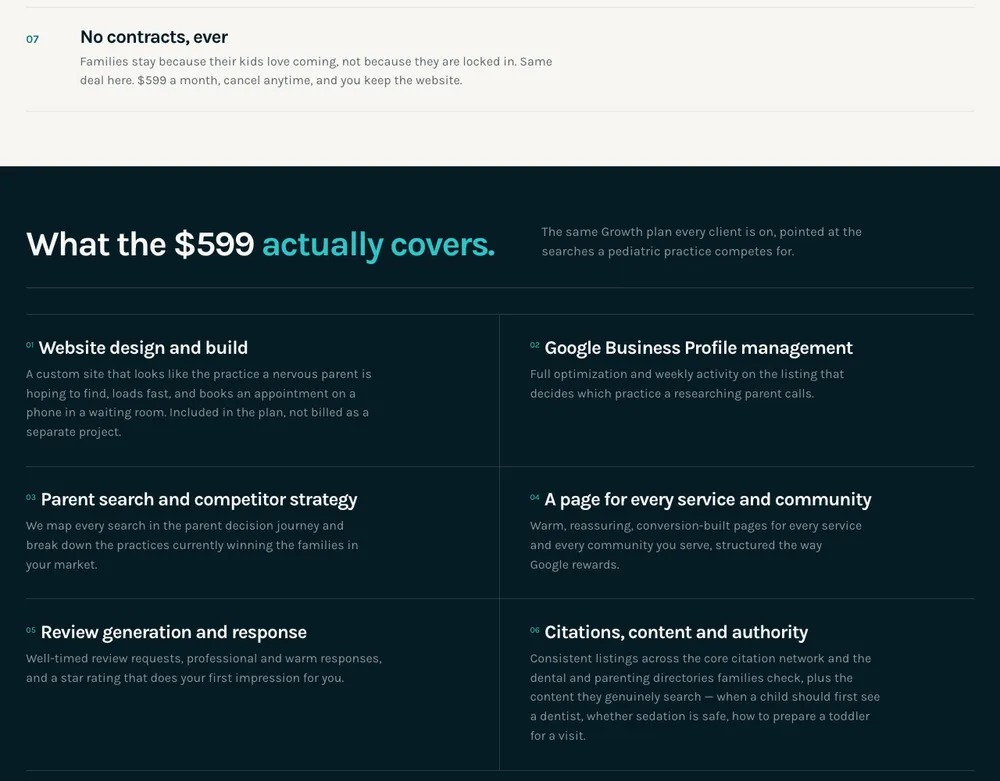
We show that page because it states the terms where a parent-facing business would want them stated: in plain sentences, next to the price. That is not an endorsement. The page promises Map Pack movement within 60 to 90 days, and like every claim on a seller's own site, it is a claim. Ask for three live client sites in markets like yours and call one of the practices.
Thirty-six months of a website offer
Held for 36 months, the website offers land between about $2,000 and $9,000, and the plan that bundles local SEO reaches about $21,600. We added any setup fee to three years of the monthly charge printed beside it. The Website Design for Dentists price cards show no monthly charge, so those two bars are the build fee alone.
The cheap end of that chart is a fair choice for a lot of pediatric practices. A well-referred practice in a town with two competitors may need a clean site, honest photos of the office and a booking button, and $2,000 to $7,000 buys that. Rental models need one extra question. A website as a service is cheap to start because the seller carries the build cost, and the minimum term exists to recover it. Before you sign one, get in writing what happens to the pages, the domain and the content when you stop paying.
Thirty-six months of a marketing program
Programs that go after search rankings and new patients cost $27,000 to $288,000 over three years at published rates, before a dollar reaches Google or Meta. The bars below are 36 months of each printed monthly fee, with onboarding left out because DDSRank waives it on a six-month agreement.
Read the chart with two cautions. The bars buy different things: Lasso's plans include a website; DDSRank prices the website separately and says so, and SEOteric's marketing plans sit on top of whatever site you have. And no bar includes the ad budget. Lasso bills ads at the budget plus 25 percent, and DDSRank's top plan assumes you spend at least $1,500 a month with Google.
For scale, the 18 practices in our census that print a new patient visit price charge $79 to $179 for it, with a median of $127. Those are entry offers, not what a family is worth over a decade of checkups and siblings, and no practice publishes that number. They are still a useful reality check when an agency pitches a program by the number of new patients it will bring.
Who the website is really for
A pediatric dental website has two audiences and only one of them reads it. The patient is a toddler; the reader is a parent, usually on a phone, often worried about something specific. The Centers for Disease Control and Prevention puts that worry in numbers on its oral health facts page. By age 9, half of American children have had a cavity in their baby or permanent teeth. Among children aged 6 to 9, those from lower income households were more than twice as likely to have untreated cavities, 25 percent against 10 percent.
The other timing question is the first visit, and the pediatric dentists' own academy is clear about it. The American Academy of Pediatric Dentistry's definition of the dental home says: "The dental home should be established no later than 12 months of age." A parent whose child just turned one is therefore searching for a dentist for the first time, with no habit, no loyalty and usually no idea what a first visit involves. In our census, 105 of 178 sites explain the first visit by age one somewhere on the pages we read. On the other 73, we did not find it.
That is why the parts of a pediatric site that convert are not the parts a designer would put first. The questions a parent brings are concrete: will you see a one-year-old, do you take our insurance, can I come back with my child, what happens if she needs sedation, and who is the dentist. A homepage that answers those in the first two screens is worth more than one that only looks friendly.
What 178 pediatric dental websites show
Most pediatric practice sites have the mechanics in place and leave the hard questions half answered. The method, briefly. On 29 October 2026 we ran searches for children's dentists across 18 metros, from Seattle and San Diego to Boston, Tampa and Raleigh, and kept 232 independent practice domains, excluding directories, hospitals, universities and national chains. For each, we pulled the homepage and up to seven internal pages with words such as insurance, first visit, sedation, doctor or forms in the address. 178 sites gave us readable pages, and 54 blocked our requests or timed out. We coded Medicaid statements, prices and staff titles by hand. Since we did not read whole sites, treat each count as a minimum.
Sedation is close to universal as a topic: 152 sites mention it, and 122 mention nitrous oxide or laughing gas by name. Special needs care appears on 143. Those pages exist because parents search for them, and they are among the pages most worth getting right, since a parent reading about sedation for a four-year-old reads every word.
The weak spots are the plain answers. Only 21 sites say in words we could find that a parent can stay with the child during the visit, though many practices surely allow it. Thirty-one mention Spanish or bilingual care. And 32 homepages load Meta's advertising pixel. A pixel is a small script that reports page visits to an ad platform. On a page where a parent books care for a child, that is a choice worth making on purpose, with your privacy counsel, rather than by default because a template shipped with it.
The builders are fragmented. 33 sites carry a linked footer credit to an outside company, 28 companies in all and most of them web or marketing firms, and the most frequent, Wonderist Agency, appears on four. Its homepage, read the same day, prints no fee. Lasso MD, from the seller table above, is credited on one.
The Medicaid line most sites leave out
Whether a practice takes Medicaid is the first filter for a large share of families, and 141 of the 178 sites we read do not answer it on any page we collected. Thirty-three say they accept Medicaid or a state children's plan, such as TennCare in Tennessee or AHCCCS in Arizona, one of them by dentist referral only. Four say plainly that they do not.
Both answers help a parent. A single line saying you are a PPO-only practice that does not accept Medicaid saves a family a wasted call and saves your front desk the same call. The ADA's Health Policy Institute, in a December 2025 report covered by ADA News, put the share of US dentists participating in Medicaid or CHIP at 41 percent in 2024, about where it was in 2015, and said Medicaid fee-for-service payment in most states falls far below 50 percent of dentists' charges. Plenty of practices have good reasons to limit Medicaid patients. The website should still say which side of the line you are on, near the top of the insurance page, in one sentence.
The best examples we read did more than list plans. A Utah practice used its homepage to tell families that a letter about their Medicaid plan changing name did not change their coverage at the practice. A Houston practice states that it takes Medicaid and CHIP right beside its link to the full insurance list. Both are a sentence of copy, not a design project.
The word specialist, used correctly
Pediatric dentistry is a recognized dental specialty, which means a pediatric dentist may call themselves a specialist and a general dentist may not. The ADA Code of Ethics, 2026 edition, names pediatric dentistry among the specialties recognized by the National Commission on Recognition of Dental Specialties and Certifying Boards, and tells specialists to use the words "specialist in".
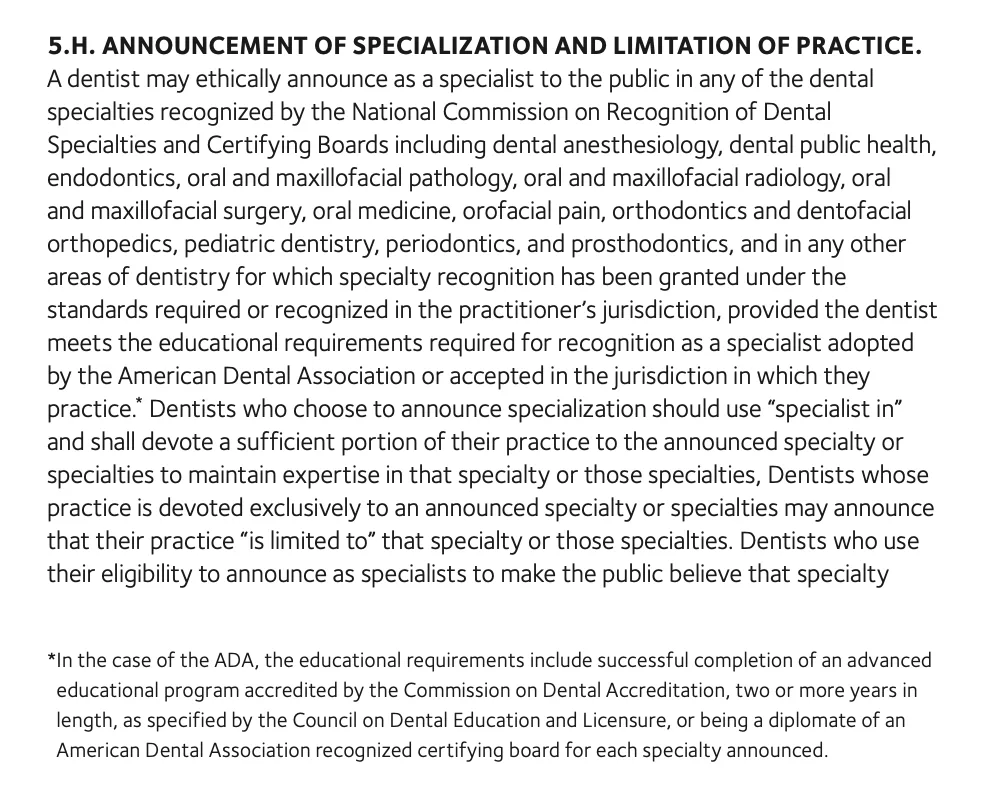
The part that catches pediatric practices is the sentence that follows on the next page of the code. It puts the burden on specialists to avoid any suggestion that general dentists working alongside them are specialists too, and section 5.I asks general dentists to state that their services are provided by general dentists. Some pediatric groups employ a general dentist, and in two sites we read the stated reason was to care for teenagers or for older patients with special needs. In our census, at least nine sites identify a team member as a general dentist, which is what the code asks for. A team page headed with the word specialists that includes a general dentist's photo in the grid is the version to avoid.
Strictly, the code governs ADA members, and each state board writes its own advertising rules, so read yours; this is not legal advice. For the website, 142 of the 178 sites mention board certification or diplomate status, and 98 name the American Board of Pediatric Dentistry. When the credential is real, name the board in full. A parent can look it up, and the words "board certified" alone do not say which board.
Questions to put to any pediatric dental web company
Get written answers to these from any seller, cheap or expensive. The last column says why each one matters more for a children's practice.
| Ask this | A good answer | Why it matters for pediatric practices |
|---|---|---|
| Does the monthly fee include the website, or only the marketing? | A yes or no, plus the price of whichever part is not included | Of the three sellers with pediatric pages, one bundles the site, one rents it and one quotes it separately |
| What are the minimum term, onboarding fee and expected ad spend? | Three figures on one page | The published terms here range from no contract to a 12-month minimum |
| If we stop paying, what do we keep? | The domain, the pages and the content, in writing | A rented site is cheap to start because the seller owns the build |
| Where will our insurance and Medicaid status appear? | A draft insurance section with a one-line Medicaid answer near the top | 141 of the 178 sites we read did not say either way |
| How will each dentist's training be worded? | Draft team copy naming each person's degree, specialty or board | The ADA code limits the word specialist and asks general dentists to be labeled |
| Which scripts load on the appointment request form? | A written tag inventory, with no ad pixel on the form unless you chose it | 32 of the homepages we read load Meta's pixel |
| Who writes the sedation and first visit pages? | A named writer working from your own protocols, reviewed by the dentist | These are the pages a worried parent reads in full |
| Do you work for other pediatric practices in our area? | Yes or no, with any exclusivity in the contract | DDSRank, for one, takes one practice per specialty in each market |
If you want the general version of this list, our guide to questions to ask a dental website company covers contracts and ownership in more depth.
Where KhanWork fits, and when to buy the cheaper site
A pediatric practice with a full schedule from pediatrician referrals and word of mouth does not need us. A $2,000 to $4,000 build with a strong first visit page, real photos and a clear insurance section will serve it for years, and the savings belong with the team.
We print our fees too, on the pricing page, so hold us to the same test. Foundation is a one-time build, paid in full upfront: $1,000 for a brand refresh and one landing page, say the first visit page your ads send parents to, live within 14 business days of receiving your content and assets, or $2,500 for the full website with no page limit, live within 21 business days. Growth, at $2,500 a month, is the ongoing team that keeps building the whole website. Scale, at $5,000 a month, runs two requests at once for groups with several offices. Those two monthly plans are paid each month ahead, with no minimum, and you can pause or cancel whenever you choose. Your hosting stays in your own name, outside our fee. Foundation is paid once, so it has no 36-month total; held for 36 months, Growth comes to $90,000.
We suit a practice that is already buying traffic, from ads or a new location, and is not getting the calls it expected. That is conversion work: the first visit page, the insurance answer, the sedation page and the booking route, rebuilt and judged by appointments requested. Whatever we build belongs to you: domain, pages, design source files. Our dental practice page describes how we work with dental and pediatric practices, and our free funnel review looks at the page parents land on, which for most practices is the homepage, and names the single change we would test first, at no charge. For general dentistry prices, see our dentist website cost guide; for practices that also offer braces, our orthodontist website cost guide covers that market.
The car-line test
Run this before you pay anyone. Sit where a parent sits when they search for a children's dentist: in a car, waiting for school pickup, with one free thumb and about ten minutes. Use your phone, not the office computer.
- Search. Type "pediatric dentist" plus your town and the name of a local insurer or your state's Medicaid program. See where you rank, then open your own listing.
- Age. Without scrolling past two screens, find whether you see one-year-olds and what a first visit involves.
- Coverage. In two taps or fewer, find whether you take that insurer and whether you take Medicaid. A no counts as an answer.
- The room. Find whether a parent can stay with the child, and what happens if the child needs sedation.
- Book. Request an appointment for a 14-month-old using a second phone number, then time how long until someone replies.
Then do the same on the two practices that rank above you. If your site failed on coverage or the room, you need two paragraphs and a better insurance page, not a rebuild. If it passes all five and new families are still thin, that is when the prices above are worth comparing.
Frequently asked questions
Plan on about $2,000 to $7,500 for a one-time build from a dental website company, or $249 to $599 a month on managed plans where the seller builds and runs the site. Published marketing programs for pediatric practices charge $750 to $8,000 a month, roughly $27,000 to $288,000 over three years before ad spend. We read every figure on the sellers' own websites on 29 October 2026.
A few do. Cre8 My Site, SEOteric and DDSRank each publish a page aimed at pediatric dentists with prices on it, from $249 a month for a rented website to $8,000 a month for a full marketing plan. Many others quote only after a call, including the web firm most often credited in our census of 178 pediatric practice sites.
Yes, in one sentence near the top of the insurance page, whichever the answer is. Of 178 pediatric practice sites we read, 33 said they accept Medicaid or a state children's plan, 4 said they do not, and 141 did not say either way on the pages we collected. A clear no saves a family and your front desk a wasted call.
Yes, if they meet the educational requirements, because pediatric dentistry is a recognized dental specialty. The ADA Code of Ethics tells specialists to use the words specialist in, and puts the burden on them not to imply that general dentists working with them are specialists too. General dentists on the team should be labeled as general dentists. State dental board rules also apply.
It should answer a parent's practical questions in the first two screens: the age you start seeing children, what a first visit involves, which insurance and whether Medicaid you take, whether a parent can stay in the room, how sedation works, and who the dentists are and what their training is. Add a phone link and a booking route that work on a phone.
It can be, for a small practice that wants a clean site with no upfront cost, but read the terms first. SEOteric's $249 website as a service carries a 12-month minimum and charges $150 an hour for new design work. Over three years it costs $8,964, more than any one-time build we priced, so ask what you keep if you stop paying.
Yes. The ADA counts 9,521 pediatric dentists working in the US in 2025, up from 4,213 in 2001, an increase of 126 percent. Orthodontists grew 17 percent over the same period. More practices in the same towns means more of them competing for the same parents on search results and on their websites.
 Healthcare
Oct 25, 2026 · 17 min
How Much Should a Dental Implant Practice Website Cost in 2026?
General dental sellers print implant-ready websites from $1,997, and implant marketing programs run $750 to $9,000 a month. We priced both over three years and read 192 implant practice sites.
 Healthcare
Oct 24, 2026 · 17 min
How Much Should a Plastic Surgery Practice Website Cost in 2026?
Six sellers print a plastic surgery website price, from $500 to $40,000. We turned each into a three-year total, then read 202 practice sites for prices, consultation fees, galleries and who built them.
 Healthcare
Oct 23, 2026 · 16 min
How Much Should a Dermatology Practice Website Cost in 2026?
Four sellers print a dermatology website price, one of them only in its page code. We turned each into a three-year total, then read 142 dermatology practice sites for prices, booking, galleries and the Good Faith Estimate notice.