
Questions to Ask a Dental Website Company Before You Sign

Oct 11, 2026 · 17 min read
Most questions a dentist asks a website company happen before the first payment: what will it look like, how long will it take, what does it cost. The answers that decide whether the practice is happy two years later are in the terms, and they are mostly about the way out. Who owns the site when you leave, whose name is on the domain, how many weeks of notice the contract wants, and whether your Google Ads history leaves with you or stays behind.
So on 11 October 2026 we went looking for those terms. We checked the websites of 42 companies that sell websites to US dental practices, found the 14 that publish the agreement a client signs, and read every one. This article is the list of questions to ask, built from what those agreements actually say.
The short answer: ask about the exit first
Before you sign with a dental website company, ask six things in writing: who owns the design and code when you leave, whose name is on the domain, how long the first term is and exactly how notice is given, what you owe if you leave early, who owns the ad accounts and tracking numbers, and what happens to your leads and files afterward. These are not edge cases. Of the 14 dental website companies we found that publish their client terms, 7 say the vendor keeps the design and code, 7 say the agreement renews or continues on its own, 5 reserve the right to delete your data after you go, and 3 keep the advertising accounts. A good company will answer all six in one email.
How we read 42 dental website companies
We started from the dental website and marketing companies that come up most in searches and roundups for dental web design, removed publishers, consultancies and general agencies with no dental focus, and ended with 42 companies that sell websites to dental practices in the US. For each one we read the links on the homepage and tried nine common addresses for legal pages, such as /terms and /legal. ProSites returned an empty page to plain requests, so we read its terms in an ordinary browser.
What we were looking for was narrow: the terms that govern a paying client, not the terms for browsing the company's own website. Twelve companies published only the second kind, or text message terms, or a line saying the real terms live in a private service agreement. Eleven had no terms page we could find. Five blocked our requests or did not load. That left 14 with client terms in public: Adit, Amplify360, Delmain, Dental SEO Services Company, Doctor Multimedia, Golden Proportions, Officite, Optimized360, Patient News, Progressive Dental Marketing, ProSites, SEO Dentals, VivioSites and WEO Marketly.
Two cautions before the findings. First, a published agreement is a template. Your order form can override it, and a company can negotiate. Second, a company that does not publish its terms is not hiding anything bad by default; it simply means you will see them only at the signing stage, which is why the questions below matter more for those 28 than for the 14. We report what the text says, not how any company behaves day to day, and this article is not a substitute for a lawyer reading your actual order form.
Who owns the website the day you leave?
Ask this first, because the answer splits the market down the middle. Of the 14 agreements, 7 say the vendor keeps the design and the code, 4 say the practice owns the work once it has paid, 2 say both things at once or tie ownership to staying on the vendor's platform, and 1 does not address it. The content you write and the photos you supply stay yours in almost every case; the argument is over everything the vendor built around them.
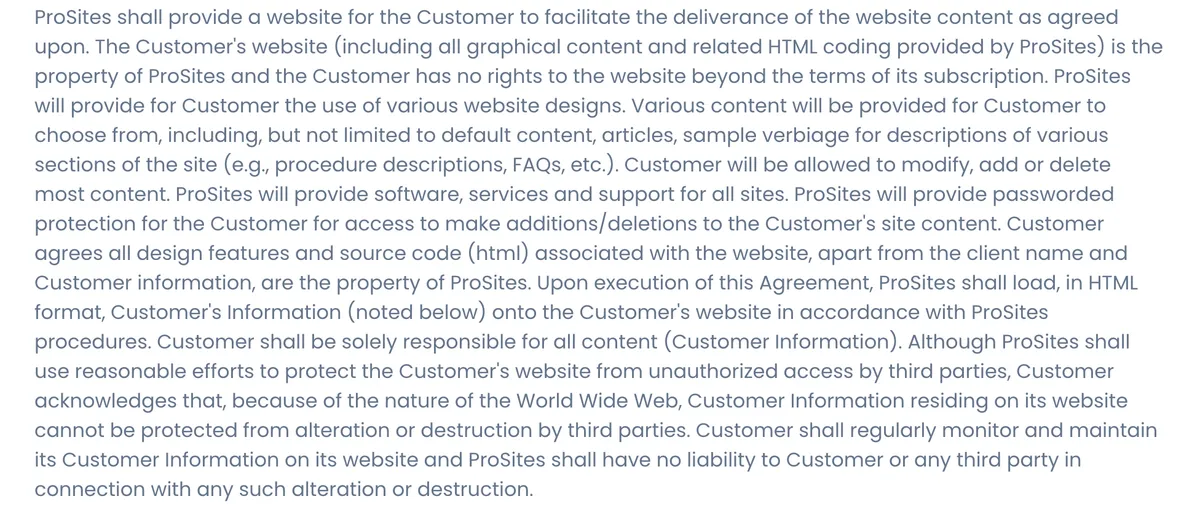
ProSites is the plainest. Its license agreement says the site, including the graphics and HTML it provides, belongs to ProSites, and that "the Customer has no rights to the website beyond the terms of its subscription." Officite's terms list design, look and feel, layout and the photos it supplies as its own materials, licensed to you while you subscribe, and the license ends with the agreement. Optimized360 says the fees for membership and design buy no ownership of content, design elements or images. Patient News says the plug-ins, stock imagery, licenses and new patient form become its property when the agreement ends.
That model is not a scam. It is rent, and rent can be the right deal: a low monthly fee, someone else keeping the site running, no capital outlay. The cost shows up only when you want to leave, because you leave with your words and your logo and start the build again. If you are signing a rental, sign it knowing that, and keep your own copy of every page of text.
On the other side, Golden Proportions says the work product becomes the client's once it is accepted within two months and paid for. WEO Marketly says you own the website, files and images included, after full payment. Delmain transfers property and materials when the agreement ends and the bill is settled. Doctor Multimedia packages the files, database and content for download at termination, although it keeps ownership of the library content pages it supplies.
Two agreements pull in both directions. Progressive Dental Marketing's terms acknowledge the client's ownership of website deliverables in one section and, a few sections later, keep title to the website design project and its copyrights with the agency. Adit says ownership of content and graphics passes to the client after the first term, and in the next sentence requires the site to stay on Adit's own WordPress platform permanently, with an export allowed at Adit's discretion. If you are offered either, ask which sentence wins and get the answer in writing.
The law explains why the wording matters. Copyright starts with the author, says section 201(a) of the Copyright Act, and for a site built by an outside company the author is that company. Moving it to you takes a signed writing, per section 204(a). Many agency contracts call the site a "work made for hire", but the statute's list of commissioned works that can qualify covers things like contributions to a collective work, translations and atlases, and a website is not on it. Golden Proportions' clause handles this correctly: it uses the work-for-hire language and then assigns the rights anyway if the label fails. That fallback sentence is the one to look for. We cover the copyright side in more depth in who owns your website.
Whose name is on the domain?
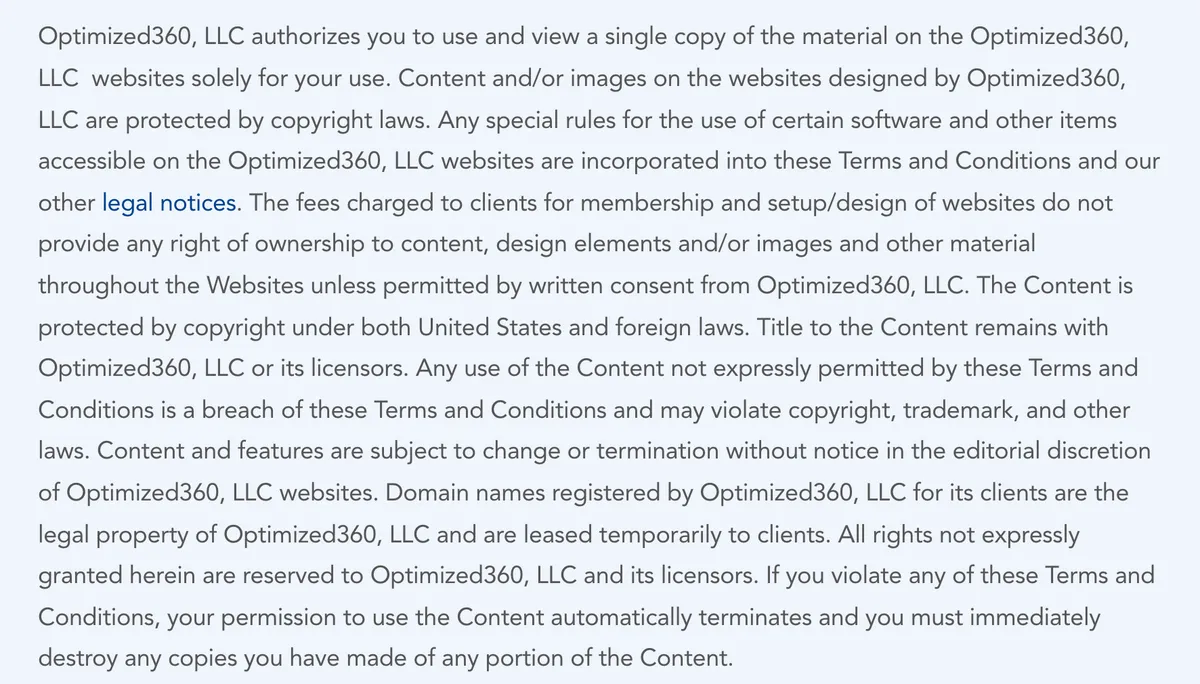
Ask for the registrar's name and the name of the registrant, and check both yourself. Lose control of the domain and you lose the website, the practice email and the landing page of every ad in one stroke. One of the 14 agreements says outright that domain names Optimized360 registers for clients are its legal property and leased to them temporarily, and that original design content and images, domain names included, cannot be transferred without its written permission.
Most of the others are fine on this point or say nothing. Progressive Dental Marketing states that the client keeps ownership of the URL. Officite's domain agreement treats the client as the registrant, which is the right answer, and then prices the exits: $15 to transfer a .com to another registrar, $35 for a .co, and $100 to redeem a name after a lapsed renewal. It also says a domain cannot move to another registrar within 60 days of purchase. That domain agreement was last updated in October 2014, which tells you how rarely anyone reads it.
The rules underneath come from ICANN. Its Transfer Policy gives the registered name holder the final say over a transfer when it disagrees with the administrative contact, and lets a registrar refuse a transfer requested within 60 days of the domain's creation. In practice: if the registrant field shows the agency's name, the agency holds the authority, whatever the sales call said. Ten minutes in a WHOIS lookup tool before you sign settles it.
How long am I committed, and how do I get out?
Ask for three things: the length of the first term, what happens at the end of it, and the exact steps and dates for notice. The terms we read run from month to month to 12-month renewals, and the notice mechanics are where practices get caught. Seven of the 14 say in writing that the agreement renews or carries on by itself unless you act.
The details vary more than the headline. ProSites runs month to month and wants written notice 30 days before the next billing date. Golden Proportions takes 30 days' written notice and does not prorate the last month; its own example has a client cancel on 20 June and pay through 31 July. Delmain requires six months of digital marketing after launch, then goes month to month with 30 days' notice. WEO Marketly asks for 180 days on marketing services, and after a 30-day notice, services run to the end of the following calendar month. Patient News runs 12 months from the first payment, then month to month, with 45 days' written notice.
Three agreements deserve a calendar reminder the day you sign. Officite processes a cancellation form received between the 1st and the 16th that month; send it on the 17th and the contract ends at the close of the following month. Progressive Dental Marketing renews for another 12 months unless non-renewal notice arrives no earlier than 90 days and no later than 30 days before the term ends, a 60-day window once a year. Doctor Multimedia renews every 12 months unless you give written notice 30 days before, and charges a $999 early termination fee on top of any balance if you agreed to a minimum term.
Leaving early costs money in three of the 14. Officite holds you to the fees for the rest of the initial term, Doctor Multimedia adds its fee, and Progressive Dental Marketing keeps management fees due for the full term even if you cancel the ad budget. None of this is unusual in marketing contracts. It is only a problem when nobody mentioned it on the call.
Who owns the ad accounts, the phone numbers and the Google profile?
Ask whose login sits at the top of each account, because the website is not the only thing that can stay behind. Three of the 14 agreements keep the advertising accounts or the campaigns. Delmain says it owns the Google Ads and Meta Ads accounts it creates and will not hand over access when the relationship ends. Progressive Dental Marketing runs ads through its own business accounts and calls the ads, copy and landing pages its property. Adit calls the campaigns its intellectual property and limits access to the ad and analytics accounts to its own staff.
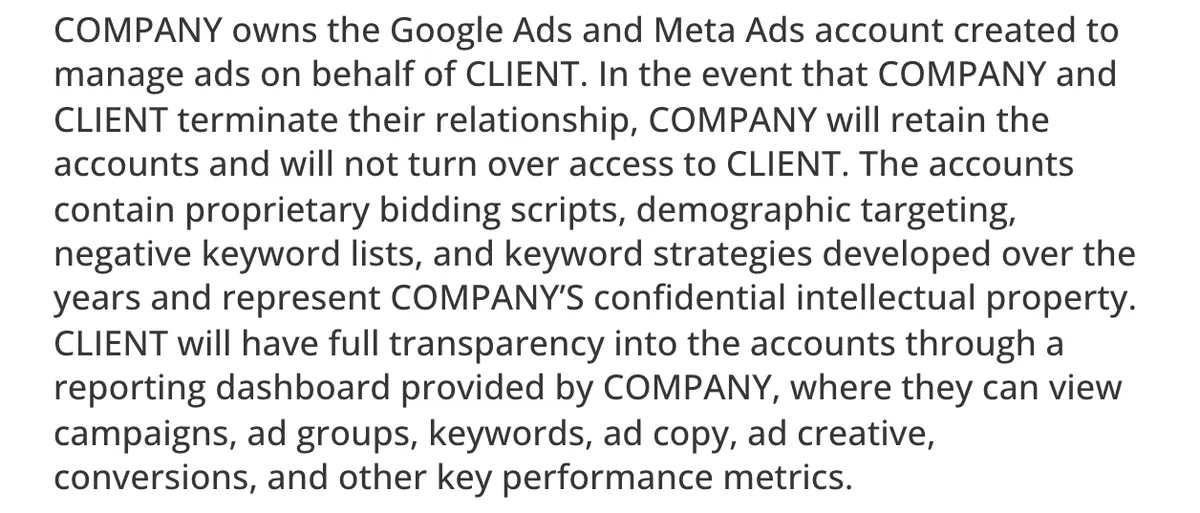
The reasons given, protecting bidding scripts and keyword lists, are real. The cost to a practice is real too: years of conversion history, audiences and negative keywords stay with the agency, and the next agency starts a new account cold. Google's own third-party policy requires agencies to use a separate account for each advertiser they manage and asks them to be honest about their costs, but it does not settle who owns the account, so the contract has to.
Phone numbers are the quieter version. Amplify360's terms say its call tracking numbers are its property, leased rather than sold, and not transferable. If those numbers are printed on your postcards and listed in directories, they leave with the agency. The fix is simple: keep your main number on your own phone system and let tracking numbers forward to it.
The same goes for your Google Business Profile. Google gives a profile owners and managers. Owners can add and remove people and delete the profile; managers can do almost everything else. An agency needs manager access to do its job. It does not need to be the primary owner.
What happens to my leads, files and patient data?
Ask for the export, not the promise. Five of the 14 agreements reserve the right to delete client data once the relationship ends. Officite says it may delete all data and files stored in the account on termination, and Dental SEO Services Company says it may delete your data afterward. VivioSites says your content may be removed and deleted from its servers once you close the account. Progressive Dental Marketing gives 30 days from the last billing date to export leads from its lead platform before the account is deleted. WEO Marketly removes a departing client from its systems within 30 days and bills one more month of hosting if the site has not moved.
Then ask about patient information, because a dental contact form asking who you are and why you want an appointment is usually collecting protected health information. Under 45 CFR 164.502(e), a practice can let a vendor create, receive, maintain or transmit that information only once the vendor has given written, contractual assurances that it will safeguard it: a business associate agreement. Only 2 of the 14 agreements refer to one in the terms themselves, Officite and Adit. Progressive Dental Marketing goes the other way and has the client warrant that the website complies with HIPAA. What the form itself has to do is covered in our HIPAA website guide.
Two data clauses are worth reading twice. Officite's terms assign to Officite the de-identified information it makes from your patients' health information, to use or sell without restriction, and describe that right as the principal consideration for its services. Patient News takes a perpetual, exclusive license to client data in aggregated, anonymized form. Both are legal arrangements. Whether your practice is comfortable with them is a decision for you, and you cannot make it if nobody points the clause out.
One more: Amplify360's terms say clients cannot edit content on its servers and that, due to HIPAA regulations, it cannot grant backend access to the client or third parties. The HIPAA provisions on business associates quoted above set conditions for sharing patient data with a vendor. We are not aware of one that stops a practice from editing its own marketing pages, so if you hear this reason, ask which provision is meant.
What can change after I sign?
Ask what the vendor can change on its own. Three of the 14 reserve the right to raise prices: ProSites after the first year with 30 days' notice, Amplify360 on any renewal with 30 days' notice, and Golden Proportions through an annual adjustment to its prevailing rates. Several also say the terms can be revised by posting a new version, which is ordinary, but it means the document you read today may not be the one you are held to next year.
Look, too, for clauses that outlive the contract. Three restrict you from hiring or approaching their staff after you leave: Progressive Dental Marketing for one year, Golden Proportions for two, and Adit for ten years after termination. Progressive Dental Marketing also has a mutual non-disparagement clause that runs for a year after the agreement ends and covers social media. For a practice that might want to leave an honest review of a vendor, that one is worth knowing before you sign, not after.
The questions, with the answer you want
Send these ten questions to every company on your shortlist and compare the replies side by side. The middle column is the answer that protects a practice; the right column is what the 14 published agreements actually say.
| Ask this | The answer you want | What the 14 published agreements say |
|---|---|---|
| Who owns the design and code on the day I leave? | We do, once the invoices are paid, and the contract says so in a signed assignment | 4 hand the work over after payment, 7 keep it, 2 say both or tie it to their platform, 1 is silent |
| Can I get a full copy of the site and move it to another host? | Yes, as a file export on a date you name, at no charge beyond the current month | Doctor Multimedia packages the files for download; Adit may allow an export at its discretion; most do not say |
| Whose name is on the domain registration? | The practice, in a registrar account the practice logs into | 1 says domains it registers are its own property; Officite charges $15 to move a .com to another registrar |
| How long is the first term, and how do I give notice? | Month to month, or a short first term, with notice by email and no calendar trap | From month to month at ProSites to 12-month renewals at Progressive Dental and Doctor Multimedia |
| What do I owe if I leave early? | The current month and nothing after it | 3 bill the rest of the term or a fee; Doctor Multimedia's exit fee is $999 on top of the balance |
| Whose names are on the Google Ads account, the call tracking numbers and the Business Profile? | The practice's, with the agency added as a user or manager | 3 keep the ad accounts or campaigns; Amplify360 says its tracking numbers are its property |
| What happens to my leads, forms and files after I leave? | A full export on request, and nothing deleted until you confirm receipt | 5 reserve the right to delete client data after the relationship ends, some within 30 days |
| Will you sign a business associate agreement before any form collects patient details? | Yes, before launch, naming who stores the submissions | 2 of the 14 refer to a business associate agreement in the terms themselves |
| Can the price or the terms change after I sign? | Not during the term, and only with written notice after it | 3 reserve the right to raise prices; several say the terms can be updated by posting a new version |
| Does anything in the contract outlive it? | Confidentiality, and nothing that limits what you say or who you hire | 3 bar hiring their staff for 1 to 10 years; 1 bars negative comments for a year |
A company that answers all ten in a few lines, without a meeting, is usually one that has nothing awkward in its terms. A company that will only discuss them on a call is telling you something too. For what each of these models costs per month and over two years, see our dental website cost breakdown.
Where KhanWork fits, and when to sign with someone else
A rented site from a dental platform is a sensible choice for a practice that wants a low fixed fee, has no plans to move, and is happy to keep its own copy of its text. If that is you, pick the platform whose exit terms you can live with and stop there. You do not need an agency.
We build for practices that have outgrown that: a group adding a second location, a cosmetic or implant practice paying for ads to a homepage that does not convert, or an office that wants its site, domain and ad history in its own name. Our dental practice work starts from the pages patients land on, through our design service. The answers to our own six questions are short. Everything we build belongs to the practice. The hosting account is the practice's own, and its bill never passes through us. Our prices are listed openly on our pricing page; every plan is charged a month ahead, carries no minimum commitment, and can be paused or ended when you decide.
Three tiers, each a flat monthly fee. Foundation, at $1,000, covers a refreshed brand and a single landing page designed to turn visitors into booked patients, launched 14 business days after your copy, photos and logins reach us, with a fresh page added each month from then on. Growth, at $2,500, takes on the entire website; add requests to the list whenever you want and we finish them in order. Scale, at $5,000, keeps two requests in progress side by side, the right shape for a group with several offices. Our studio has delivered 200+ projects, and calls with Ali run 30 minutes. Want a second opinion before any of that? Send us the page most new patients land on, and the free funnel review will name the first thing we would change.
Write the cancellation email before you sign
The quickest way to test a contract is to rehearse leaving it. Before you sign, take twenty minutes and do this.
- Draft the notice. Write the email you would send to cancel, dated two years from now. Address it to whoever the contract names, using the method it names: email, a portal form or certified mail.
- Find the deadline. Work out the last day that email could arrive without triggering another month, another quarter or another year. If you cannot find that date in the contract, that is the first question for the vendor.
- List what you expect to receive. Site files or an export, the domain, admin access to the ad accounts, the call tracking numbers, the leads, the form submissions. Next to each, write the clause that promises it.
- List what you expect to owe. The final month, any exit fee, any remaining term, any transfer charge. Add them up.
- Send the draft to the vendor. Ask them to confirm, in writing, that this email on that date would end the agreement and that you would receive everything on your list. Keep the reply with the contract.
If any line on either list has no clause behind it, or the vendor's reply differs from what the sales call promised, fix it in the order form before you sign. Nobody negotiates an exit after they have already decided to leave.
Frequently asked questions
Ask the exit questions first: who owns the site, the domain and the ad accounts when you leave, and what leaving costs. Then ask how long the first term is, how notice works, and what happens to your leads and files. In our reading of 14 published dental website agreements, 7 keep the design and code with the vendor and 7 renew or continue automatically.
Not the design and code, according to their published terms. ProSites' license agreement says the website, including the graphics and HTML it provides, is ProSites' property, and Officite licenses its design, layout and supplied photos to you only while you subscribe. The text and photos you supply yourself remain yours, so keep your own copy.
The practice should, as the registrant, in a registrar account it can log into without the vendor's help. Under ICANN's Transfer Policy the registered name holder has the final say over transfers, so if the agency is listed as registrant it holds that authority. One of the 14 agreements we read says domains it registers for clients are its own property.
Usually 30 days in writing, but the timing rules matter more than the number. Officite processes cancellations received by the 16th of the month that month, Patient News asks for 45 days, and Progressive Dental Marketing only accepts non-renewal notice between 90 and 30 days before each 12-month term ends.
No, ideally the account is in the practice's name with the agency added as a user, so the conversion history stays with you. Three of the 14 published agreements we read keep the ad accounts or campaigns with the agency, and one of them says it will not hand over access when the relationship ends.
Yes, if it hosts or receives patient information from your forms, booking or messaging. 45 CFR 164.502(e) allows a practice to give a vendor access to protected health information only when the vendor's safeguards are promised in a written agreement. Only 2 of the 14 agreements we read refer to a business associate agreement in the terms themselves.
Not on its own. Under 17 U.S.C. 101, a commissioned work qualifies as made for hire only in listed categories such as contributions to a collective work, translations and atlases, and a website is not among them. What transfers ownership is a signed written assignment, which section 204(a) of the Copyright Act requires, so look for an assignment sentence alongside any work-for-hire language.
No, renting suits a practice that wants a low fixed monthly fee and has no plans to move. The cost appears when you leave, because a rental usually means rebuilding the site elsewhere with only your own text and photos. Choose the platform whose exit terms you can accept, and keep a copy of your content.
 Healthcare
Oct 10, 2026 · 16 min
Mental Health Practice Websites: Group Practice vs Solo
We read 307 therapy practice websites from 15 US metros and sorted them into solo and group practices. Here is what each kind of site has to do, what they actually carry, and the Google rules and software prices that make a group site a different build.
 Healthcare
Aug 28, 2026 · 16 min
How Much Should a Dentist Website Cost in 2026?
We tried the pricing page of 39 dental vendors. Nineteen would not load, and of the twenty that did, five stated a price and not one of the five sells websites. So this is built on the numbers that are published, which belong to the software your booking button plugs into.
 Healthcare
Aug 23, 2026 · 15 min
How Much Should a Med Spa Website Cost in 2026?
Every guide answers this with a range it cannot source. Aesthetics is one of the few fields where the software vendors publish their prices and the industry association publishes what a patient is worth, so this one answers with numbers you can open and check, including ours.