
How Much Should a Med Spa Website Cost in 2026?

Aug 23, 2026 · 15 min read
Ask the internet what a med spa website costs and you get a range. Eight hundred to fifteen thousand. Two thousand to ten thousand. Five hundred to ten thousand and up. The ranges do not agree with each other, none of them shows its working, and the widest of them is so wide it tells you nothing you did not already suspect.
There is a better way to answer this, and it is available because the aesthetics industry is unusually generous with numbers. The software companies your practice already runs on publish their prices. The industry association publishes what a med spa earns per visit and what a new patient costs to acquire. Put those two sets of figures next to each other and the question stops being a guess. Prices here come from the seller's own page, statutes from the statute, and the industry numbers from the association that collected them, all checked on 23 August 2026. Where a number is our arithmetic rather than somebody else's, the text says so. We sell websites, so this is a page written by one of the companies you would be paying, and you should read it in that light.
The 30-second answer
For a single-location med spa, a website you own outright is a one-time build in the low thousands, and the recurring money goes to the practice software underneath it rather than to the site. Published list prices for that software run from about $75 a month for a five-person practice on Aesthetic Record up to $520 a month for Boulevard's full aesthetics bundle, and at one vendor the entry price for a med spa is more than two and a half times the entry price for a salon. None of the major booking platforms sells you a website; they sell booking that sits on one. Agencies that publish prices put a med spa build between $2,000 and $10,000, rising past $15,000 once a site passes about fifty pages. Our own package is monthly, at $1,000, $2,500 or $5,000 a month, with pause or cancel anytime. Judge any of those against the two numbers the industry publishes: an average visit worth $527 and a new patient costing $132 to acquire.
What page one actually publishes
Before the numbers, a word on why they are so hard to find. We took the five pages ranking for med spa website cost on 23 August 2026, pulled the body text of each, and counted two things: how many distinct dollar figures each page states, and where each page sends you for evidence.
Between them the five pages state 78 distinct dollar figures. Not one of the five links to a vendor price list, a survey or a dataset. The page carrying the most numbers, 37 of them, is also the only one that links to an industry analysis at all, and that link sits beside a claim about marketing budgets rather than beside any of its prices. We have not named the five, partly because one of them publishes its own rates honestly enough to be quoted later in this article, and partly because the pattern matters more than the culprits.
| Page one result | Distinct dollar figures | Links to a price list or dataset |
|---|---|---|
| Guide A, agency blog | 3 | None |
| Guide B, agency blog | 11 | None. Links to Wikipedia and two blogs |
| Guide C, industry portal | 37 | None. Links to one association analysis |
| Guide D, agency service page | 7 | None |
| Guide E, agency blog | 20 | None |
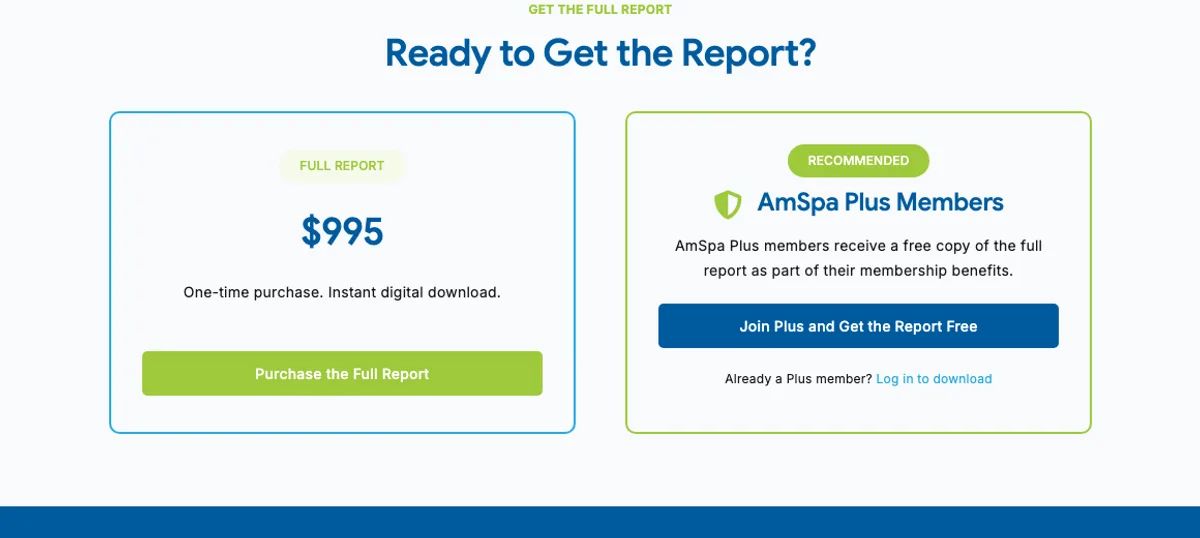
Part of the reason is structural rather than lazy. The authoritative dataset for this industry is the American Med Spa Association's Medical Spa State of the Industry Report, and AmSpa sells it for $995 as a one-time purchase, free only to its Plus members. When the good numbers sit behind a four-figure paywall, the pages competing for a free search result fill the gap with estimates, and the estimates get copied.
What the software actually lists at
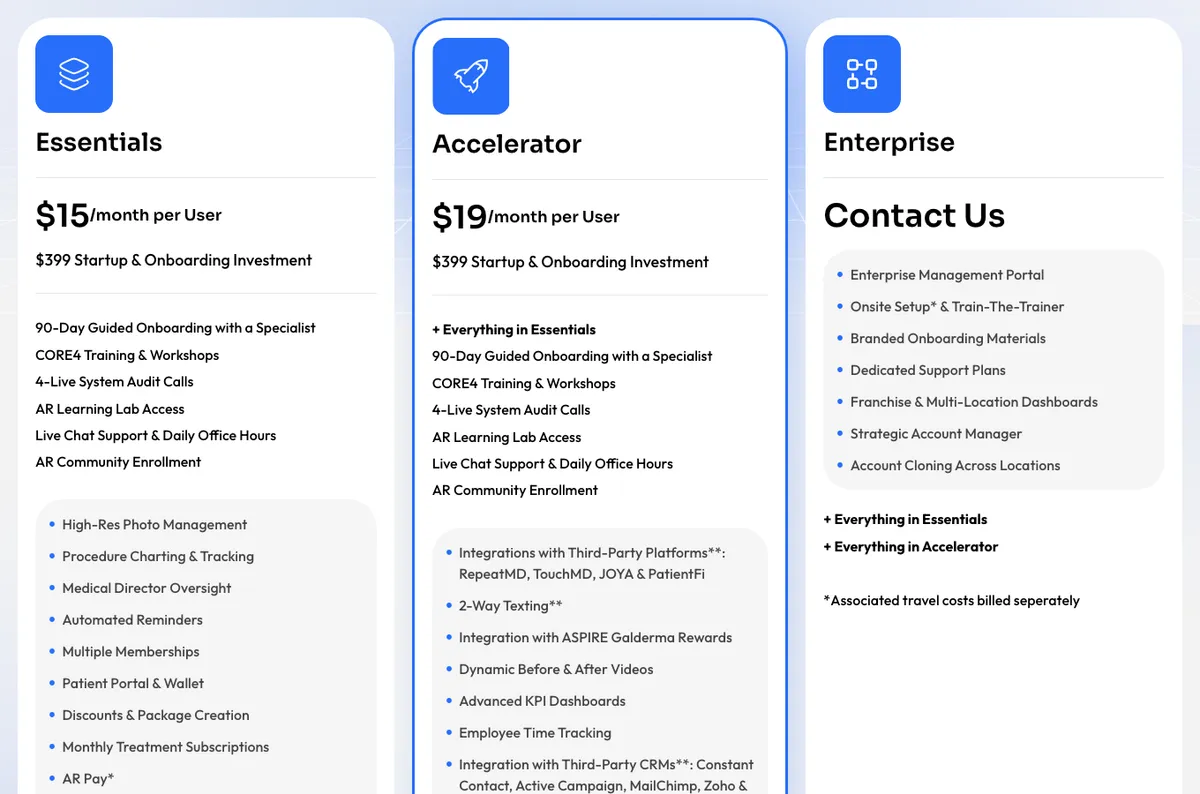
Start with the recurring bill, because for most practices it is larger than the website and it arrives every month forever. Three platforms dominate quotes in this space and all three publish prices. Their pricing units differ, so the chart below converts each to the same case: one location, five people who need a login.
Read across the bars and the pricing models matter as much as the totals. Aesthetic Record charges per seat, $15 on Essentials and $19 on Accelerator, so five seats come to $75 or $95 and the bill scales linearly as you hire. Mangomint splits the difference with a $120 base and $10 per user, which puts a five-person practice at $170. Boulevard prices the location rather than the people, which is why its salon Essentials plan lands at $176 for the same practice and stays there as you grow. If you are planning to double your team, the per-seat models are the ones to model out before you sign.
Two of those bars deserve their own section, because the gap between them is not about features.
The word that doubles the bill
Boulevard's pricing page has a toggle above the plan cards. Set it to Salon and Spa and you are offered three plans: Essentials, Premier and Prestige, at $176, $293 and $410 a month per location. A limited-time discount was running on the day we looked, and every price in this section is the normal one printed on Boulevard's own cards beside the offer. Set it to Medspa and the three plans disappear. You are offered two, the Aesthetics Starter Bundle and the Aesthetics Bundle, at $455 and $520 a month per location on monthly billing, or $410 and $468 if you commit to a year.
Read those two lists next to each other. The cheapest plan a med spa can buy costs more than the most expensive plan a salon can buy. The entry tier is gone entirely, and the discount for paying annually only brings the med spa floor down to the salon ceiling. Whatever the extra software does, the pricing tells you plainly that this vertical is expected to pay, and that expectation will follow you into every quote you request, including ours.
This matters for a website budget in a specific way. If your booking platform already takes $455 a month, a $399 a month website subscription on top of it is $854 a month, or $30,744 over three years, for a practice that could have bought the site once. That is the trade the rest of this article is really about.
The lines that are priced separately
Every platform in this market prices a base plan and then meters the things a med spa actually does daily. These are all published rates, not estimates, and they are the reason a quoted monthly figure and an actual monthly bill diverge.
The two largest bars are the ones practices underestimate. A phone line with calling and texting is $70 a month per line at Mangomint, and payroll starts at $50 a month plus $8 per worker, so a five-person practice running both adds $160 a month before anyone has sent a marketing message. Neither is optional in the way an integration is.
Three of those deserve a note. Client forms are not a nice extra for a med spa: intake, consent and medical history are the paperwork the treatment cannot legally happen without, and Boulevard prices them from $65 a month per location. Texting is how aesthetics practices confirm appointments, and it is metered almost everywhere; Boulevard's plans include 100, 250 and 2,500 free texts and charge a cent per email beyond the allowance, while Mangomint states plainly that unlimited text and email appointment confirmations and reminders are included at no extra cost. And card processing is a percentage, not a line item: Mangomint publishes 2.45% plus 15 cents and 2.90% plus 30 cents, while Boulevard offers a program in which the client pays a 3% fee on card transactions and the practice pays 1%.
Which of these hands you a website
None of them. That one word is worth more to a budget than any other sentence in this article, and a demo will never surface it.
Boulevard, Mangomint and Aesthetic Record all sell booking, charting, payments, memberships and marketing. Read their own feature lists and you will find online booking, a patient portal, eCommerce and gift cards. You will not find a website, because a website is not what they make. Mangomint says so directly in its own pricing FAQ: its online booking sits on your website, and you keep every appointment booked through it. That is a good arrangement, and it is also an admission that the website is your problem.
So the practice needs two purchases, and the mistake we see most often is buying one and assuming it covered both. The booking platform is the machine. The website is the shop it sits in. Whoever sells you the second one is quoting for design, content, treatment pages, the consent and intake flow, and the wiring that connects your menu to the booking widget without dumping the patient onto a different company's domain halfway through.
What agencies publish for the build
Very few will tell you before a call. Of the med spa specialists we checked, most of the pricing pages either do not exist or return a contact form. Three exceptions are worth reading.
SERPreme publishes the clearest tiering in the field. Its medical spa page is titled around a $2,000 quick launch, and its own FAQ states that medical spa website projects typically run $4,000 to $10,000 or more depending on whether it is a build or a makeover, and that a site already fifty pages or larger is closer to $15,000 to $20,000. It also publishes a monthly marketing range of $1,000 to $8,000, with most of its clients between $2,000 and $4,000.
GMR Web Team answers the cost question on its own med spa page with a single number: $399 a month buys a medical spa website with patient intake forms, hosting, reputation management and acquisition optimization, with content creation charged extra.
Growth99 will not publish a plan price, but it does something almost as useful: it publishes scope. Its Accelerator plan includes a custom website of up to 15 pages, Elite goes to 25 pages, and both specify one opportunity for layout changes and two rounds of revisions on image selection. That is the most honest description of a productized website we found in this market, and you should ask every vendor for the same three numbers.
| What is published | Price, as stated | What that price is attached to |
|---|---|---|
| SERPreme, quick launch | From $2,000 | A launch-speed build, per its page title |
| SERPreme, typical project | $4,000 to $10,000+ | Build or makeover, by size and customization |
| SERPreme, large site | $15,000 to $20,000+ | An existing site of 50 pages or more |
| GMR Web Team | $399 per month | Website, intake forms, hosting, reputation, acquisition. Content extra |
| Growth99 Accelerator | Not published | Custom site up to 15 pages, 1 layout change, 2 image revisions |
| Growth99 Elite | Not published | Custom site up to 25 pages, same revision terms |
| KhanWork | $1,000, $2,500 or $5,000 a month | Three published monthly tiers. Pause or cancel anytime |
Our Foundation Partner is $1,000 a month rather than a starting point, and it exists because a single-location med spa with a clear treatment menu does not need a fifty-page site. Growth Partner at $2,500 and Scale Partner at $5,000 are for practices where the work does not stop at launch. All three are published on our pricing page for the same reason we are publishing everyone else's here.
What the industry actually spends
The best free dataset on this question comes from AmSpa itself. In an article published on 9 January 2026, drawing on its own data and on Growth99's 2026 State of Aesthetic and Elective Wellness Marketing Report, the association reported that 52% of med spa practices still invest less than $2,500 a month in marketing, and that only 25% meet or exceed $5,000. It puts the working benchmark at 5% of revenue, and the average practice at $1.39 million a year, which makes the benchmark roughly $5,800 a month.
The two published bands leave 23% of practices unaccounted for, and by subtraction that is the group sitting between $2,500 and $4,999 a month. Nobody publishes that band directly, so treat it as arithmetic rather than a finding, but it does tell you the shape of the market: a large low-spending majority, a small high-spending minority, and a thin middle.
Two honest caveats. That spend covers every channel, so a practice at $2,500 a month is buying ads and content as well as anything a website costs. And the benchmark is a rule of thumb rather than a finding. What the chart is good for is scale: if half the market runs on under $2,500 a month across everything, a website subscription at $399 a month is consuming a sixth of the entire marketing budget before a single ad runs.
What the website has to be worth
The same AmSpa article publishes the three numbers that turn this into arithmetic instead of taste: an average cost per lead of $39, an average new patient acquisition cost of $132, and an average visit value of $527. It also reports average profit margins of 38%.
Take the $527 visit at a 38% margin and one additional visit contributes about $200 of profit. A one-time build has to pay for itself once, over the entire life of the site. Anything monthly has to keep paying for itself: a $399 subscription needs two extra visits a month, and our own $1,000 a month needs five, in every month you stay. That is the question to put to any monthly vendor, including us: what arrives each month for it.
Do the same on the acquisition side and it gets sharper. At $132 per new patient, a site that lifts booking conversion enough to save you thirty acquisitions a year has returned about $3,960 a year in avoided cost, before any of those patients books a second time. That is the honest case for spending on a website: not that it conjures demand, but that it stops you paying twice for traffic you already bought.
Your gift card page is a legal document
Now the parts of a med spa site that cost more to build than the equivalent page on a salon site, starting with the one that surprises people.
Gift cards and prepaid packages are a serious revenue line in aesthetics, and every platform in this market sells them. Aesthetic Record lists eGift cards, discounts and package creation, and monthly treatment subscriptions among its base features. The moment you sell those on your own website, the product copy on that page is governed by federal law.
Under 12 CFR 1005.20, the funds on a store gift card have to stay valid for at least five years from the date of issue or the date money was last loaded. A dormancy, inactivity or service fee is allowed only if there has been no activity for a full year, and only one such fee may be charged in a calendar month. The rule carves out loyalty, award and promotional cards, and cards not marketed to the general public, so a free birthday credit is treated differently from a card someone bought.
State law can be stricter, and in the biggest med spa market it is much stricter. California Civil Code 1749.5 makes it unlawful to sell a gift certificate to a purchaser that contains an expiration date at all, with narrow exceptions for promotional and donated certificates that must print the date in capitals of at least 10 point on the front. The same section requires a gift certificate with a cash value under $15 to be redeemable in cash.
So the line reading "valid for 12 months" that sits under most med spa gift card products is, in California, on the wrong side of a statute, and everywhere else it is at odds with a five-year federal floor. Fixing it is not expensive. Discovering it after you have sold four hundred of them is. This is what people mean when they say a med spa site costs more than a salon site: not that the pixels are harder, but that more of the copy is regulated.
Two words that need a co-star
The second regulated element is the phrase practices most want in their hero section. In California, Business and Professions Code 651 makes it unlawful for a licensee to disseminate any public communication carrying a false, fraudulent, misleading or deceptive statement, claim or image, and it then lists what an advertisement may contain. Subdivision (h)(5)(C) deals with board certification: a physician may use the term board certified only where the full name of the certifying board appears with comparable prominence, and the board has to be an American Board of Medical Specialties member or an equivalent approved before 1 January 2019.
Comparable prominence is a design instruction. It means the certifying board's full name cannot be relegated to the footer or set in gray eight point under a 64 point headline. If your hero says board certified, the board's name belongs in the same visual breath. We have written before about how testimonial and review copy carries similar constraints, and about the patient data question that sits behind any intake form. The pattern is consistent: on a medical site, the copy deck is part of the compliance surface, and it is cheaper to build it correctly than to rewrite it later.
Where the money should go, in order
If you are budgeting from scratch, this is the order we would spend in, and the reasoning is the arithmetic above rather than preference.
- The treatment pages. One page per treatment you actually want more of, each carrying what it is, who performs it, what it costs or how pricing works, and a booking link. This is the only part of the site that ranks and the only part that converts.
- The booking path. Two taps from any treatment page, on a phone, without leaving your domain. If your platform's widget cannot embed, that constraint belongs in the brief before anyone quotes.
- Intake and consent. You are paying for forms somewhere already. Decide whether they live in the platform or the site, and make sure only one of them is collecting the same medical history.
- The gift card and membership pages. Revenue, and the two places where the copy is regulated.
- Photography. Real rooms, real staff. Stock photography of a model who does not work at your clinic is the fastest way to make a good site read as a franchise.
- Everything else. Blog, team bios, an about page. Useful, rarely urgent, and the first thing a vendor will pad a page count with.
Our offer, and the practices we are wrong for
Our package is monthly, $1,000, $2,500 or $5,000 a month, for practices that need continuous work rather than a launch, and a practice can pause or cancel anytime. A focused build usually takes 14 business days from kickoff, though that is what typically happens rather than a promise. Partnership inquiries get an answer inside 48 hours. Two outcomes we can point to: a treatment center rebuild that ended with 20% more website conversions for Cornerstone Healing Center, and Eden Digital, which we built and which grew revenue tenfold. More on how we work with clinical practices sits on our healthcare page.
Now the part that costs us work. A brand new single-room practice with one injector, no memberships and no gift cards does not need a custom site yet, and $399 a month for a hosted med spa website with intake forms folded in is a defensible purchase while you find out whether the business works. If you are opening in six weeks and have no photography, no treatment menu and no price list, a template will beat a custom build because the bottleneck is your content, not your code. And if what you want is somebody buying and managing your Google and Meta ads every month, hire a med spa marketing agency, because that is their product and it is not ours.
Where we are the right call is narrower and easier to describe. A practice with a real treatment menu that ranks for nothing. A multi-location group whose locations cannot be found separately. A rebuild where the current vendor holds the domain. A practice that has outgrown a booking-platform microsite and needs the site to carry the explaining that the booking widget cannot.
Write the spec before you ask for a price
Here is the thing nobody tells you about collecting quotes: the reason three quotes for a med spa website come back at $2,000, $8,000 and $399 a month is not that one vendor is honest and two are not. It is that all three were asked a different question, because you did not write the question down. Fix that and the quotes become comparable in an afternoon.
Write one page. Not a brief, not a strategy document, one page, and send the identical page to everybody. Six lines is enough.
- Page count, named. Not "a small site". List the pages: home, six treatments, about, contact, gift cards, memberships. Fourteen. Now every quote is pricing the same object.
- The booking platform you use, by name, and where the widget must sit. On your domain or theirs. This single line moves more money in a quote than anything else on the list.
- Who writes the words. If you are not writing the treatment pages, somebody is billing for them, and copy is the item most often quietly excluded.
- Revisions, as a number. Growth99 publishes one layout change and two image revision rounds. Ask every vendor to state theirs the same way, before you sign rather than after.
- What you are handed at the end. The domain, the hosting account, the files, the accounts. State that you keep all four.
- What happens in month two. Who edits a price, who adds a treatment, and what that costs. A build price with no answer here becomes a subscription by accident.
Send that page to four vendors including us. The quotes that come back will differ by thousands, and for the first time you will be able to see exactly which line each difference is hiding in. That is worth more than any range on any page you have read today, including this one.
Frequently asked questions
A one-time custom build sits in the low thousands and a subscription site runs a few hundred dollars a month. Agencies that publish prices put a med spa project between $2,000 and $10,000, rising past $15,000 for a site of fifty pages or more, while one vendor publishes $399 a month for a hosted med spa website with intake forms and hosting folded in. Our own package is monthly, $1,000, $2,500 or $5,000 a month, with pause or cancel anytime. The larger recurring cost for most practices is the booking and charting software underneath, not the site.
Yes, and the software vendors price it that way openly. Boulevard offers salons three plans at $176, $293 and $410 a month per location, and offers med spas two plans at $455 and $520. The cheapest med spa plan costs more than the most expensive salon plan. On the build side the difference is real work rather than a label: treatment pages, intake and consent, memberships and gift cards all carry copy that is regulated, and regulated copy takes longer to write and review.
Almost certainly not. Boulevard, Mangomint and Aesthetic Record all sell booking, charting, payments, memberships and marketing, and none of them sells a website. Mangomint states in its own pricing FAQ that its online booking sits on your website. Read this as two separate purchases, and check before you sign whether the booking widget can live on your own domain or whether patients get handed to the vendor's.
The American Med Spa Association's published benchmark is 5% of revenue, which on its stated average practice revenue of $1.39 million a year works out at roughly $5,800 a month. Actual behavior is well below that: AmSpa reported in January 2026 that 52% of practices invest under $2,500 a month and only 25% reach $5,000. A website is a one-time item inside that budget rather than a rival to it.
Divide the quote by the profit on one extra visit. The industry's published average visit value is $527, and its published average profit margin is 38%, so one additional visit is worth roughly $200 of profit at the average practice. Use your own two numbers rather than those, then ask the vendor which page of the site is supposed to produce the visits. A quote without an answer to that is a price without a plan.
Not the way most med spa sites word it. Federal rules at 12 CFR 1005.20 require the funds on a store gift card to remain valid for at least five years from issue or from the last time money was loaded, and permit an inactivity fee only after a full year of no activity and only once a calendar month. California goes further: Civil Code 1749.5 makes it unlawful to sell a gift certificate containing an expiration date at all, with narrow exceptions, and requires one with a cash value under $15 to be redeemable in cash.
In California you can, but only with the certifying board named beside it. Business and Professions Code 651(h)(5)(C) allows a physician to use the term board certified where the full name of the certifying board appears with comparable prominence, and the board is an American Board of Medical Specialties member or an equivalent approved before 1 January 2019. Comparable prominence is a layout instruction, so the board's name cannot be shrunk into a footnote under a large headline.
Around twelve to fifteen for a single location, and you should decide the number before you ask for quotes. One page per treatment you want more of, plus home, about, contact, gift cards and memberships, gets most practices there. Growth99 publishes its productized tiers as up to 15 pages and up to 25 pages, which is a useful yardstick, and naming your own page count is the fastest way to make three quotes comparable.
 Healthcare
Aug 28, 2026 · 16 min
How Much Should a Dentist Website Cost in 2026?
We tried the pricing page of 39 dental vendors. Nineteen would not load, and of the twenty that did, five stated a price and not one of the five sells websites. So this is built on the numbers that are published, which belong to the software your booking button plugs into.
 Healthcare
Aug 17, 2026 · 14 min
How Much Should a Therapy Practice Website Cost in 2026?
Published plans for therapist websites run from about $830 to $4,200 in the first year. Here is what each one buys, why a $29.95 directory listing beats all of them at finding clients, and the three rules that apply to a therapy website and almost nothing else.
 Healthcare
Aug 3, 2026 · 14 min
HIPAA Compliant Website: What Your Practice Actually Has to Do in 2026
There is no HIPAA certificate for a website. There are four narrow places where the rules actually bite, a tracking-script problem that has cost health companies millions, and an accessibility deadline that quietly moved in May 2026.