How Much Should a Hospice Website Cost in 2026?

Nov 6, 2026 · 18 min read
Nobody shops for a hospice the way they shop for a dentist. The search usually starts within hours of a doctor saying the word, often on a phone in a hospital corridor, by a son or daughter who has never had to know what the Medicare hospice benefit is. A second reader arrives the same afternoon from the other direction: a hospital case manager with three discharges to place before five o'clock, looking for a fax number, a referral form and proof that you can admit tonight.
That is the job a hospice website does, and it shapes what one should cost. On 6 November 2026 we priced it from both sides. First, any hospice website offer whose seller prints the fee on its own site, added up over thirty-six months. Then we read 186 hospice websites across 40 US metro areas, 154 of which our script could load, to see what a family and a referral source actually find there.
The 30-second answer: hospice website cost
At the prices sellers publish, a hospice website costs from about $357 over three years for a free template on paid hosting, through about $6,200 to $12,500 for a small agency build with a monthly care plan, up to about $26,360 for the largest published build and care package we found. A design subscription with no upfront fee runs $10,260 over the same three years. Few firms that market themselves to hospices print a price at all. The cheaper sites can carry a phone number and a list of services. What the money buys at the top is speed for the family, a working referral door for case managers, and pages that survive the scrutiny hospices are now under.
Why a hospice website is a different purchase
A hospice website has less time to work than almost any other healthcare site, two very different readers, and a market that regulators are watching closely.
Time first. MedPAC reports that in 2024 the median Medicare decedent who used hospice had a lifetime stay of 19 days, while the average was 99.6 days because a minority of patients stay for months. Half of those patients spent 19 days or fewer in hospice, so the choice of provider is usually made in a hurry. A page that makes them hunt for the phone number, or for whether care can start this week, has lost them to the next result.
Then the two readers. A family wants to know what hospice is, whether Medicare pays, who comes to the house and how soon. A referral source wants none of that. They want your service area, the referral form, the intake line, and some sign that you answer it. Most hospice sites are written for one reader and leave the other to phone.
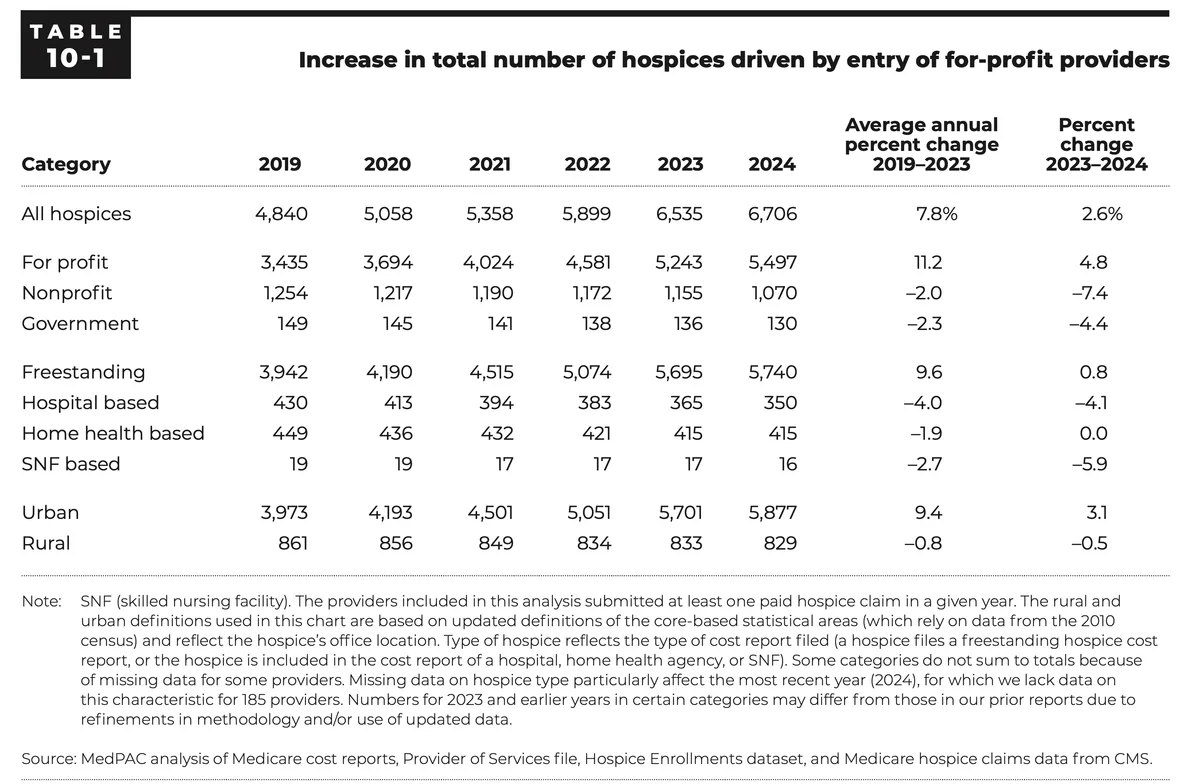
Last, the market. In 2024, 6,706 hospices billed Medicare, up from 4,840 in 2019, and MedPAC counts about 82 percent of providers as for profit. The growth has come with scrutiny. Since July 2023, CMS has run a provisional period of enhanced oversight for newly enrolled hospices in Arizona, California, Nevada and Texas, reviewed claims from 668 of them, and revoked the Medicare enrollment of 122 as of June 2025. A family who has read about that in the news is reading your site with more suspicion than they would bring to a dental practice, and the site has to earn trust with checkable facts rather than adjectives.
Who prints a price for a hospice website
Four website sellers that pitch hospices, or say they have built for one, print their own fees. We list a firm only when the figure is its own price on its own site, checked on 6 November 2026. Several agencies with hospice pages ask you to request a proposal instead, and their budget dropdowns are not prices, so they are left out of the table.
| Firm | The offer | Its printed fee | Worth reading closely |
|---|---|---|---|
| Brazzell Marketing | Websites for home care, home health and hospice, written and hosted by the firm | Pre-designed site free with hosting and domain at $118.99 a year; custom design from $519; standard custom package $699 for the first year, all-inclusive | After year one you pay only for hosting and domain; the page recommends a separate service for HIPAA forms and email. |
| 702 Pros | WordPress builds sold on a page titled hospice website design | Builds from $299.99 (3 pages), $1,599.99 (7), $3,499.99 (15) or $7,999.99 (20); care plans from $29.99, $127.99, $249.99 or $509.99 a month | Every figure is a "starting at" price shown under a higher struck-through one; hosting is a separate plan from $12.99 a month. |
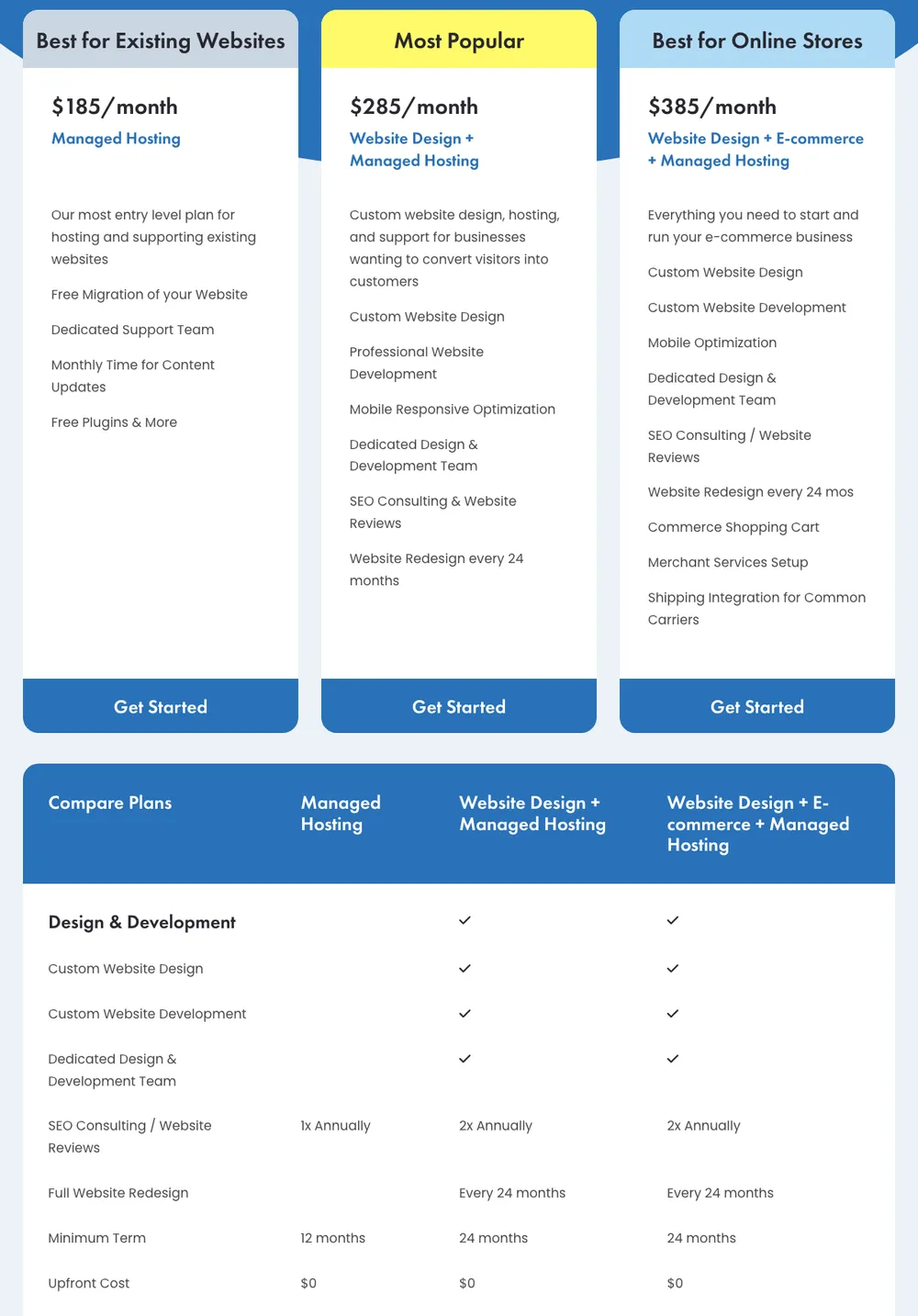
| Links Web Design | Custom design, hosting and support as one subscription; its portfolio includes a hospice | $285 a month, $0 upfront | A 24-month minimum term, one hour of support a month, and a full redesign every 24 months. |
| Healthduck | Custom websites for healthcare practices | $3,500 (up to 5 pages), $5,500 (up to 10), $8,000 and up | No hosting or care fee is printed, so we could not total it over three years. |
The firms that market hardest to hospices are the ones missing from the table. ClicksGeek runs a page on web design for hospice care and GMR Web Team a page on hospice marketing, and neither prints a fee for a hospice website. ClicksGeek's inquiry form starts its monthly budget options at $1,000 to $2,500, which tells you who it expects to hear from, not what a site costs.
Three years side by side
Over thirty-six months the published offers run from $357 to about $26,360, and the gap comes almost entirely from the monthly fee rather than the build.
Two details hide in those bars. The first is how far apart the bottom two bars are from everything else. Brazzell's template and custom packages are real websites with your name on them, but they start from the firm's own designs and its own writers, so read the order form for what later changes cost. For a new hospice that needs a credible presence before its first patient, that can be the right call.
The second is that the subscription and the care plans cost about the same as a mid-priced build once you add three years of fees. Links Web Design's $10,260 includes the design, hosting, an hour of support each month and a redesign at month 24. 702 Pros' Standard pairing reaches $12,500 and still leaves hosting to buy. Ask any seller what happens to the site when you stop paying. If the site disappears when the payments stop, you were renting it, and only the contract tells you which kind of deal you have.
What 154 hospice websites show
The typical hospice website is written for the grieving family after the death, not the frightened one before admission, and only a small minority give both a family and a referral source what they need on the pages we read.
Method, briefly: we searched for hospice care in 40 US metro areas and kept provider websites, dropping directories, review sites and agencies offering only non-medical home care. That gave 186 domains: 132 independent hospices, 24 national chains and 30 hospices run by health systems. On 6 November 2026 a script read each homepage and up to eight linked pages about referrals, eligibility, Medicare, levels of care, grief support and contact details, 1,099 pages in all. 154 sites could be read; 32 refused the script, mostly health-system sites behind bot protection. We hand-checked samples of every signal and tightened the rules where they caught the wrong thing. This is not a random sample of the country's 6,706 hospices, and it leans toward sites that rank in big cities.
Four findings matter for a buyer. Grief support is close to universal: 135 of 154 sites mention bereavement or grief support, and 143 talk about volunteers. The practical first-hour answers are thinner. 43 sites have no tap-to-call number on the homepage, 61 never say on the homepage that someone answers around the clock, and only 73 explain the Medicare hospice benefit anywhere we read. The referral side is thinner again. 82 sites offer some path for referral sources, but 36 of those show no fax number on any page we read, and only 21 sites carry a referral form that asks for patient details. Combine the basics a family and a case manager both need (around-the-clock wording on the homepage, the Medicare benefit explained, a referral path and a fax number) and just 13 of the 154 sites have all four.
Trust signals are sparse too. 44 sites name an accrediting body (CHAP on 23, the Joint Commission on 15, ACHC on 9), 16 point to Care Compare or a CMS rating, and only 12 say in so many words that the hospice itself is Medicare-certified, although every hospice that bills Medicare has to be. Only 18 offer anything in Spanish. None of these gaps is expensive to close. They are content and structure decisions, and they explain more of the difference between a site that admits and one that only exists than anything in the price chart above.
The first hour: what a family needs to find
A family arriving from a search wants four answers before they will pick up the phone: is someone there now, does Medicare pay, what happens at home, and how do we start.
On the sites we read, those answers were often missing from the place a family looks first. 111 of 154 homepages carry a tap-to-call number and 93 say the line is answered around the clock, but only 72 do both. 82 sites have a page on eligibility or when to call, 73 explain the Medicare hospice benefit, and 42 include a plain line that care comes at no cost to the family for covered services. 49 name at least three of the four levels of care; respite is the one most often named, on 104 sites.
The Medicare answer is simpler than most sites make it. Under the benefit, two physicians certify a life expectancy of six months or less if the illness runs its normal course, and the patient agrees to palliative care from the hospice for that illness in place of other care aimed at it. Medicare pays the hospice a daily rate at one of four levels of care. MedPAC reports that routine home care made up 98.8 percent of Medicare hospice days in 2024, and that 16 percent of patients had at least one day of general inpatient care, 4 percent respite and 2 percent continuous home care. A family does not need the rate tables. They need to read, in plain words, that most care happens where the patient lives, that a nurse can stay through a crisis, and that the caregiver can get a break.
Where those answers live matters as much as what they say. The family reader is on a phone, often outside, and frightened. A good hospice page puts the phone number, the hours it is answered and one sentence on cost above the first scroll, and keeps everything else one tap away.
The referral door: what case managers need
For many hospices the referral source, not the family, is the reader who decides the census, and the website either shortens their call or replaces it.
In our read, 82 of 154 sites offer referral sources some path of their own, such as a refer-a-patient page or a section for physicians. 86 show a fax number somewhere, but 36 of the 82 with a referral path show none on any page we read, which leaves a case manager to phone for it. Only 21 sites have a form that asks for patient details, and several referral pages load their forms with scripts our crawler could not run, so that count is a floor.
A referral page that works is short. It names the counties you cover, the intake phone and fax, the hours intake is staffed, whether you take weekend and evening admissions, the information you need to start (face sheet, history and physical, recent notes), and a form that sends to a monitored inbox. If the form collects patient details it is collecting protected health information, so it needs a form vendor that signs a business associate agreement and storage that is not a general marketing inbox. That one requirement rules out a surprising number of default form plugins.
Star ratings and what you can claim
Medicare publishes a family caregiver survey rating for hospices on Care Compare, and a hospice's website is where families check whether its claims match it.
The rating is built from the CAHPS Hospice Survey, which asks the family member or other informal caregiver about the experience after the patient's death: communication, timely help, respect, emotional support, help with pain and symptoms, and training to give care at home. CMS's August 2026 refresh calculates the star ratings from surveys covering the fourth quarter of 2023 through the third quarter of 2025. Not every hospice gets one. Small and new hospices are exempt from the survey, and CMS does not publish scores built on fewer than 30 completed surveys, so MedPAC counts just over 3,100 hospices with publicly reported scores, which is less than half of all hospices.
Those medians are useful for one thing on a website: context. A hospice that scores above them on timely help or pain management can say so, link to its own Care Compare page and let the family check. A hospice that writes "five-star care" in a banner without a five-star rating is making a claim the family can disprove in two minutes, at the moment trust matters most. In our read, 16 of the 154 sites mention Care Compare, a CMS star rating or the caregiver survey at all.
Two rules that shape the build
Accessibility and tracking are the two parts of a hospice website most likely to cause trouble later, and both are cheaper to settle at the build than after launch.
On accessibility, the HHS Section 504 regulation makes WCAG 2.1 Level AA the yardstick for websites run by organizations that receive HHS federal financial assistance. HHS pushed the deadlines back by a year in May 2026: the date is now 11 May 2027 where a recipient employs 15 or more people, and 10 May 2028 below that size. Your counsel can say whether your hospice counts as a recipient, but a site built today should meet that standard from the start, because the people who read hospice sites skew older and many use larger text, screen readers or both. Only 23 of the 154 homepages we read link to an accessibility page or statement.
On tracking, an advertising pixel on a page about end-of-life care sends a visitor's browsing to a third party, and nearly every hospice is a HIPAA covered entity. In American Hospital Association v. Becerra, decided in June 2024, a Texas federal court threw out one piece of HHS's tracking guidance: its view that pairing a visitor's IP address with a visit to a public, unauthenticated page about a condition creates protected health information on its own. Tracking on forms where a family or a referral source enters patient details was never part of that dispute. In our read, the Meta pixel appears in the homepage code of 13 of the 154 sites and a Google tag on 107; tags loaded later through a tag manager are invisible to our method, so those are minimums. The practical answer is the same either way: decide on purpose what loads on which pages, and keep ad pixels off the referral form and any page that collects patient details.
Eight questions for any hospice website seller
Put these to every firm on your shortlist, including us. The middle column shows how often the 154 hospice sites we read already get each one right, which tells you where the bar actually sits.
| Put to the firm | What we saw on 154 sites | Why it matters |
|---|---|---|
| If we cancel, what do we keep: domain, pages, content? | Not visible from outside | A subscription can end with nothing in your hands |
| Will the homepage say who answers the phone tonight? | 24/7 wording on 93 homepages | Families call the hospice that says it is awake |
| Where will a family read what Medicare covers? | Benefit explained on 73; a no-cost line on 42 | Cost is the first fear, even when the answer is good |
| What goes on the referral page? | Referral path on 82; 36 of those with no fax we could find | Case managers place patients with whoever is quickest to send to |
| Which form vendor will sign a business associate agreement? | Patient-detail referral form on 21 | A referral form collects protected health information |
| How will our quality ratings be shown and checked? | Care Compare or CMS rating on 16 | A claim a family can verify beats one they cannot |
| Will the build meet WCAG 2.1 Level AA? | Accessibility link on 23 homepages | The HHS Section 504 rule and an older readership |
| What tracking loads, and on which pages? | Meta pixel on 13 homepages, Google tag on 107 | Pixels near patient details raise HIPAA questions |
Where KhanWork fits, and who should not hire us
A hospice in its first year, waiting on Medicare certification and with no census to speak of, should not spend much on a website. A template like Brazzell's at $118.99 a year, with a clear phone number and an honest page on what the hospice does, is enough until referrals start to arrive. The same goes for a hospice that belongs to a hospital network or a national brand: someone at headquarters owns those pages, and we would only be adding a layer.
Our work suits an established independent hospice that already admits well through referral relationships but has a site that leaves families guessing about cost and timing, or a referral page that is a contact form with no fax number on it. What we charge sits on our pricing page for anyone to read. The Foundation build is paid once. At $1,000 it covers a brand refresh plus a single conversion page, launched 14 business days from the day your content and logins arrive; at $2,500 it covers the refresh plus every page of the site, launched within 21 business days. A hospice usually spends that single page on referrals, or on the page families reach when they search for hospice in your county. After launch, Growth runs $2,500 a month and Scale, built for hospices with several offices, $5,000 a month. Both are paid a month at a time in advance, carry no lock-in, and stop or pause whenever you say. Hosting is between you and your host, and every file we make, plus the domain, stays yours.
Our healthcare industry page explains how we run projects for providers outside addiction treatment, and when a site draws visits but few calls, the fix usually starts with conversion work rather than a redesign. If you would rather start with an outside view, ask us for the free funnel review. We study the first page your visitors see and name the single fix that should come first. If your organization also runs home health, our home health agency website costs do the same sums for that side, and our notes on who owns your website are worth reading before you sign any subscription.
The hospital-hallway test
Do this on your own site and on the two hospices that rank above you for "hospice" and your county. Use a phone, stand somewhere noisy, and give yourself ten minutes, which is roughly what a family member has between conversations with a doctor.
- Reach. From the result, how many taps until you could call someone, and does the site say whether that line is answered tonight?
- Cost. Can you find a sentence saying what Medicare covers and what, if anything, the family pays?
- Home. Does a page explain who visits, how often, and what happens in a crisis at 2 a.m.?
- Start. Can you tell how quickly care can begin and what the first visit involves?
- Refer. Pretend to be a case manager: is there a fax number, a referral form and a list of counties within two taps?
- Check. Does anything on the site point you to Care Compare, or to another way to verify what it claims?
Score one point for each clear answer. Five or six on your site, and your website is not the reason families choose someone else; spend the money on the referral relationships instead. Three or fewer, and the hospice that beats you in that corridor is winning on a phone screen, not on care.
Frequently asked questions
At published prices, a hospice website costs about $357 over three years for a free template on paid hosting, $6,000 to $12,500 for a small agency build with a monthly care plan, and about $26,360 for the largest published build and care package we found. A no-upfront design subscription at $285 a month comes to $10,260 over three years.
Most agencies that target hospices sell monthly marketing programs priced by proposal, so their pages ask for a budget instead of quoting one. In our check on 6 November 2026, the hospice pages of ClicksGeek and GMR Web Team printed no fee for a website.
A hospice website should show a phone number that is answered around the clock, a plain sentence on what Medicare covers, a page on what care at home involves, and a referral page with counties served, intake hours, a fax number and a secure form. Only 13 of the 154 hospice sites we read had around-the-clock wording, a Medicare explanation, a referral path and a fax number together.
Yes. Case managers and physicians need different information from families: service area, intake hours, what to send, a fax number and a form that reaches a monitored inbox. Putting that on its own page shortens their call and makes weekend referrals possible.
Yes, and linking to its own Care Compare page lets families check it. Only a hospice with enough completed CAHPS Hospice surveys has a family caregiver survey rating; MedPAC counts just over 3,100 hospices with publicly reported scores, less than half of all hospices.
If the hospice is a recipient of HHS federal financial assistance, its website must meet WCAG 2.1 Level AA under the Section 504 rule. Since a May 2026 extension, the deadline is 11 May 2027 for organizations employing 15 or more people and 10 May 2028 for smaller ones; ask counsel whether your hospice is a recipient.
It can on general pages, with care, but not on forms where a family or referral source enters patient details. A 2024 court ruling narrowed HHS guidance on public pages, but tracking that captures patient information still falls under HIPAA, so ad pixels should be kept off referral and intake forms.
 Healthcare
Nov 4, 2026 · 17 min
How Much Should a Cosmetic Dentist Website Cost in 2026?
Dental website sellers print three-year costs from $5,203 to over $40,000. We priced them, then read 245 cosmetic practice sites for veneer prices, gallery consent and specialist claims.
 Healthcare
Nov 3, 2026 · 19 min
How Much Should a Primary Care Practice Website Cost in 2026?
Primary care web sellers print plans from $79 to $299 a month, and one says its sites cannot be exported. We priced three years of each and read 225 practice websites, membership and insurance-based.
 Healthcare
Nov 1, 2026 · 17 min
How Much Should a Home Health Agency Website Cost in 2026?
Home care web sellers print builds from $249 to $2,497 and rentals up to $1,750 a month. We totalled three years of each, pulled CMS star data for 12,409 agencies and read 156 agency websites.