How Much Should a Primary Care Practice Website Cost in 2026?

Nov 3, 2026 · 19 min read
A primary care website has a strange job. Most of the people who land on it already have a doctor, or think they do, and they are only checking one thing: are you taking new patients, and will it work with how I pay. If the answer is buried, they go back to the search results and try the next practice. Nobody calls an office to ask whether the office is worth calling.
That makes the price of the website a question about how fast it answers a stranger, and the answer differs for the two kinds of practice that now call themselves primary care. An insurance-based family or internal medicine office has to say which plans it takes. A direct primary care practice, paid by a monthly membership instead of insurance claims, has to say what the membership costs and what it covers. On 3 November 2026 we looked at both sides. First the vendors: any website offer pitched at primary care or membership practices whose fee is printed by the vendor itself, multiplied out to three years. Then we read the websites of 225 independent practices across 22 US metro areas, 127 membership practices and 98 insurance-based ones, to see what they actually tell a new patient.
The 30-second answer: primary care website cost
Rented from the vendors that publish fees for these practices, a primary care website runs $79 to $299 monthly, which is $2,844 to $10,764 over three years. Adding local search work from the same sellers lifts three years to roughly $12,700 to $63,000. If you would rather own it, one cost estimator puts a small-practice build between $5,000 and $12,000, rising to $12,000 to $30,000 once a patient portal is involved. The cheapest offers are rentals, and at least one of them will not hand you the site if you leave. For a membership practice, the most important line on the site is the price, because a federal tax rule now turns on it.
Two kinds of primary care practice, two different websites
The first decision is not about vendors. It is which of two businesses you run, because they need different pages.
The insurance-based practice is still the one most Americans use. In the National Center for Health Statistics brief published in April 2026, 90.3% of adults said they had a usual source of care in 2024, and 77.5% named a doctor's office or health center as that source. The gap by age is the part that matters for a website. Only 67.7% of adults aged 18 to 34 named a doctor's office, against 88.8% of those 65 and older, and 12.2% of the youngest group pointed to an urgent care center or an in-store clinic. The patients a practice most needs to win next are the ones least attached to a regular doctor, and they shop on a phone. The Milbank Memorial Fund's 2026 scorecard, which uses a different survey, puts the share of adults with no usual source of care at 29.7% in 2023. The two numbers measure different things, but both say the same thing to a practice owner: a large group of adults is choosing, and choosing online.
The membership practice is smaller and growing. A survey by the Direct Primary Care Alliance, reported by Medical Economics on 29 July 2026, drew 465 physician responses, which the authors put at about 13% of an estimated 3,600 practices. Two of its findings change what a website has to do. The average membership is now $98.46 a month, well above the $77 figure the movement quoted for a decade. And more than 30% of respondents run their practice with no staff at all. For those physicians the website is the front desk. It explains the model, prints the price, takes the enrolment and books the first visit, because there is nobody else to do it.
So an insurance-based practice is buying a site that sorts callers quickly: new or existing, which plan, which location. A membership practice is buying a site that sells a subscription to someone who has never paid a doctor that way before. The price ranges below overlap, but the work inside them does not.
Who prints a price for a primary care website
Three sellers aimed at primary care or membership practices print their own fees. We only list a vendor when the figure is its own fee, stated on its own website. Blog estimates of what practices typically spend tell you about the market but not about any one firm, so they get their own paragraph after the table.
| Seller | What is sold | Published price | The line to read twice |
|---|---|---|---|
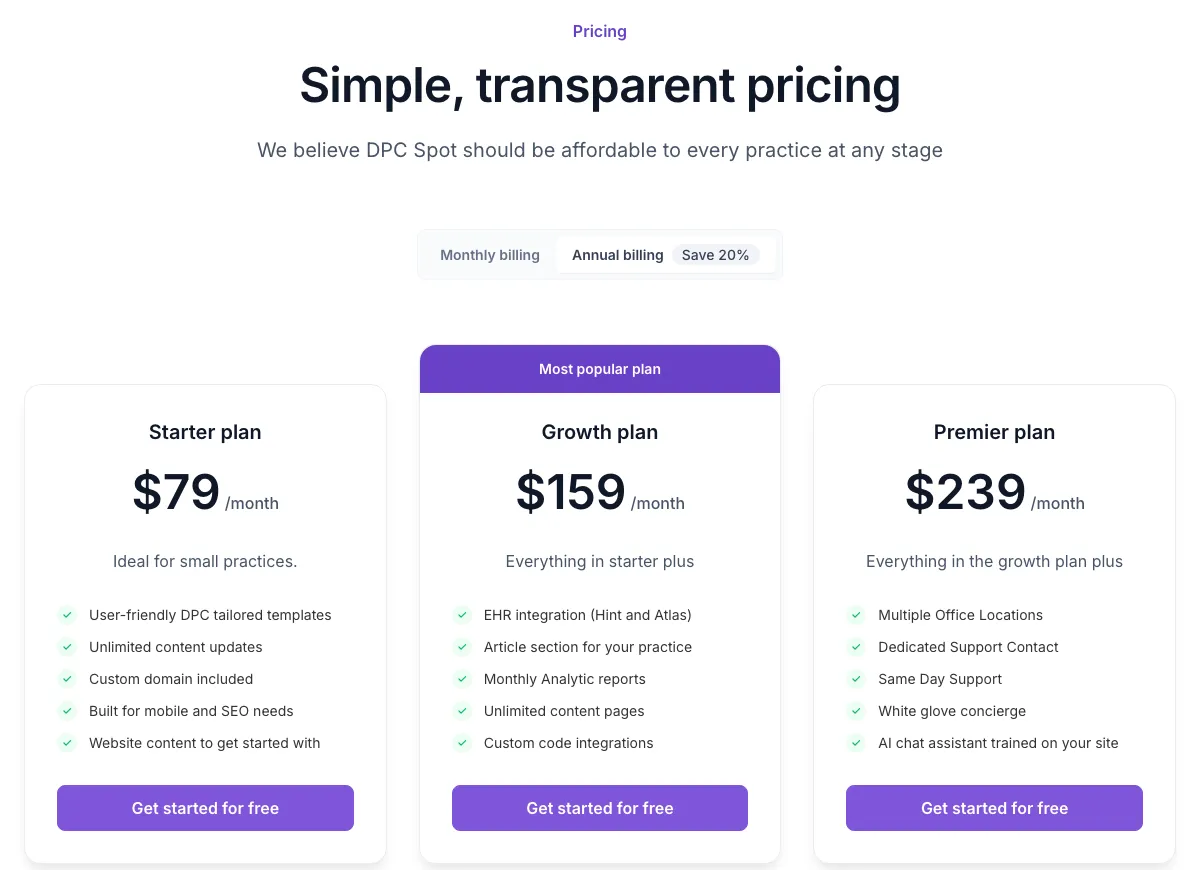
| DPC Spot | Templates built for direct primary care practices, with hosting and an editing dashboard | $99, $199 or $299 a month billed monthly; $79, $159 or $239 a month billed yearly | Its FAQ says the site code cannot be exported. The page shows the yearly prices by default, and its toggle promises 20% off yearly billing while its FAQ describes the yearly discount as one month. |
| GMR Web Team | Medical practice websites, plus search marketing and add-ons | From $149 a month; Google and AI search marketing from $999 a month | The $149 covers a small site of about 10 to 15 pages with one or two forms. Business Profile and reputation work is $199 to set up plus $199 a month per provider or location. |
| alwaysdobetter | A hand-built practice site with hosting and an AI tool that answers after-hours inquiries | $249 monthly, or $597 monthly including SEO; its pediatrician page adds a tier from $1,750 | Month to month, and its primary care page says the practice owns the site and the domain. |
Two sources publish market estimates rather than prices. ProjectCostEstimator, a calculator site that bases its healthcare page on what it describes as 600-plus quotes, gives $5,000 to $12,000 for a small practice and $12,000 to $30,000 where a patient portal is part of the job. alwaysdobetter's primary care marketing page says most independent practices spend $500 to $3,000 a month on marketing, and its primary care SEO page puts medical SEO at $500 to $1,500 a month from a freelancer and $1,000 to $5,000 from an agency. Treat both as what sellers say the market charges, which is useful context and nothing more.
Many agencies have built family medicine sites and show them off. Without a printed fee they stay out of the table, which says nothing about their quality and everything about how much a practice owner can compare from a laptop.
Three years of a rented website
Monthly prices look small until you multiply them, so we did. At published prices, three years of a rented primary care site runs from $2,844 to $10,764.
The chart is honest about fees and silent about the one thing that separates these offers: what you hold when you stop paying. DPC Spot says plainly that its sites are rendered by its own engine, like Squarespace, and that the code cannot be exported. That is not a trick, and the company tells every practice to own its domain name rather than let anyone buy it on their behalf. But it means leaving DPC Spot is a rebuild, not a move. GMR Web Team's pricing page tells practices that they own the website it builds. alwaysdobetter says you own the site and the domain and the plan is month to month.
For a new membership practice with no staff and a small launch budget, $99 a month for a template written for the model is a sensible way to open. The risk arrives later, when the practice has a full panel, a waitlist page and two years of articles, and wants something the template does not do.
Buying the site outright instead
The alternative to renting is paying once for a site you own and then paying separately for hosting and changes. ProjectCostEstimator's range of $5,000 to $12,000 for a small practice is a reasonable description of what agencies quote for a custom build. Over three years, a $5,000 build plus a modest monthly running cost will often land in the same place as the middle of the rental chart. The difference is that the files are yours, so the next vendor starts from your site instead of from nothing.
Ownership matters more in primary care than in most specialties, for a dull reason: a primary care site accumulates pages. Each provider gets a profile. Each location gets hours and a map. Each service a practice adds, from Medicare wellness visits to weight management, gets its own page because patients search for it by name. A rented template with a page limit, or one you cannot export, becomes more expensive to leave every year you stay.
The patient portal is the other line item that moves price. Most practices do not need the website to be the portal. The portal belongs to the electronic health record, and the website only needs a clear, well-placed link to it. The $12,000 to $30,000 band is for practices that want scheduling, intake or payments built into the site itself. Ask any vendor quoting that band which of those it is building, and which it is only linking to.
Website plus local search work
Both sellers that sell more than a website price the next layer too, and three years of it runs from about $12,700 to $63,000 before any ad spend.

Read GMR's Business Profile line closely: $199 a month is priced per provider or per location. A four-physician practice on two sites could be quoted more than once for the same service, so ask how the count works before you sign. Ad management is its own line, with a $300 floor or a 15% cut of spend if that is larger, so the fee climbs as the budget does.
Whether you need any of this depends on capacity, not on ambition. A practice with a closed panel and a three-week wait for new patients has nothing to gain from more search traffic, and should spend on the website only. A practice that just hired a nurse practitioner, or opened a second location, has empty appointment slots that cost money every day they sit open, and that is when search work earns its fee.
The price on your page now decides an HSA question
For a membership practice, the most consequential sentence on the website is the price, and since January 2026 it carries a tax consequence for patients. The One, Big, Beautiful Bill Act changed the rules for health savings accounts, and the IRS explained the change in Notice 2026-5. A direct primary care arrangement no longer disqualifies a patient from contributing to an HSA, for months beginning after 31 December 2025, as long as the arrangement meets the definition.
Three parts of the definition belong on your website, because patients will ask about all three. First, the fees for all such arrangements cannot exceed $150 a month for one person, or $300 for an arrangement covering more than one person, with the limit adjusted for inflation after 2026. Second, the fixed periodic fee must be the only compensation for the care: the notice says a membership that bills separately for the same services, through insurance or otherwise, does not qualify. Third, yearly or quarterly billing is allowed if it stays inside the monthly limit, and the notice's own example is $1,800 a year, $900 for six months or $450 for three months for one person in 2026.
On these averages, most memberships for a single adult sit under the limit. That is good news for a practice and a reason to say so clearly. A page that prints $95 a month for adults next to a line explaining that the membership is designed to keep members eligible to contribute to an HSA answers a question that, before 2026, had no good answer for a patient with an HSA. Practices that charge more than $150, add family tiers above $300, or bill some services to insurance should not make that claim, and should have it checked by someone qualified before they print anything about tax. The notice also says that fees above the limit can still be reimbursed from an HSA, but the patient loses the right to contribute while enrolled. That is a nuance worth a sentence of its own.
None of this is a website problem in the sense of code. It is a website problem in the sense of copy, and it is the kind of change a rented template's editor can handle. The point is to know it needs making.
What 225 primary care websites show
The two kinds of practice build almost opposite websites. Membership sites lead with the price and bury the question of whether they have room; insurance-based sites talk about new patients and leave the cost to a phone call. Each is missing the half the other does well.
How we counted: independent practices in 22 metro areas were gathered from ordinary search results, with hospital systems, national chains and community health centers excluded. On 3 November 2026 our script fetched each homepage plus as many as six internal pages whose addresses mentioned pricing, membership, insurance, appointments or new patients. Of 253 domains, 225 could be read: 127 membership or concierge practices and 98 insurance-based ones. Pattern matching found the signals and we checked samples by hand. Anything a practice explains on a page the script skipped counts as missing, so read every share as a minimum.
Membership practices are good at the hardest part. 93 of 127 print a monthly price we could find, and 60 mention HSAs somewhere. But only 33 say anything about new patients on the homepage, and a membership practice with a full panel or a waitlist is exactly the place a visitor needs to know that before paying. HSA language is also where the most care is needed. Only 11 sites put the figure $150 anywhere near the word HSA, and on some of those it is a membership tier rather than the legal limit. We also found at least one practice with tiers well above $150 a month telling visitors that all its services are HSA-eligible, which is the kind of sentence Notice 2026-5 makes risky.
Insurance-based practices do the reverse. 72 of 98 mention new patients on the homepage, and 66 link a patient portal. But only 40 name a single insurer on the pages we read, and 5 print a monthly price, almost all of them for a concierge or membership option sitting alongside insurance. For a new patient, "do you take my plan" is the first question, and on most of these sites the answer is a phone call.
Three things are thin on both sides. The Good Faith Estimate notice appeared on 4 insurance-based sites and 0 membership sites, even though the rule asks for it to be prominent on the website. An accessibility link sat on 80 of 225 homepages. And a Meta tracking pixel loads on 30 homepages, which is worth a question to whoever installed it, given what a health practice's visitors are searching for.
Two rules with dates on them
Two federal rules put specific words on a primary care website, and both apply to practices of every size.
The first comes from the No Surprises Act. Under 45 CFR 149.610, a patient paying without insurance must be told an estimate of charges can be had, and the notice has to be "prominently displayed (and easily searchable from a public search engine)" online as well as at the front desk. Most practices see at least some self-pay patients, and a membership practice is built around them. Whether a membership fee needs an estimate of its own is something to ask your lawyer. Publishing the notice costs an afternoon, and leaving it off is visible to any regulator with a phone.
The second is accessibility. HHS's Section 504 regulation, 45 CFR 84.84, holds organizations that take HHS financial assistance to WCAG 2.1 at levels A and AA, starting 11 May 2027 for an employer of 15 people or more and 10 May 2028 below that. Whether payment arrangements make your practice one of those organizations is, again, a legal call, but an accessible site is also simply a usable one, and adults 65 and older, 97.5% of whom have a usual source of care in the NCHS brief, are a large share of who reads it.
Questions to ask before you sign
Whatever you pay, these eight questions sort a good offer from an expensive one. The right-hand column is what we saw on the 225 practice sites, so you know which answers are rare.
| Ask the vendor | What we saw | Why it matters |
|---|---|---|
| Is the site's code and content exportable if we leave? | At least one DPC website seller says its code cannot be exported | Rebuild cost if you outgrow the plan |
| Who registers and owns the domain name? | Not visible from outside; DPC Spot itself tells practices to own it | The single hardest thing to recover |
| Where does a new patient learn whether we have room? | Homepage mention: 33 of 127 membership, 72 of 98 insurance-based | The first question every visitor has |
| Where do we name the insurers we take, or print the membership price? | Insurer named: 40 of 98; price printed: 93 of 127 | The second question every visitor has |
| Can a stranger start a first visit without calling? | Some online path: 105 of 127 and 87 of 98 | After-hours inquiries you lose today |
| Which page carries the estimate notice for self-pay patients? | Found on 4 of 225 sites | A federal requirement, cheap to fix |
| Who checks accessibility before launch, and against which standard? | Accessibility link on 80 of 225 homepages | Dates in 2027 and 2028 under the 504 rule |
| What tracking will load, and what does it send? | Meta pixel on 30 of 225 homepages | What a health site shares about its visitors |
Where KhanWork fits, and when to go elsewhere
A solo physician launching a membership practice this quarter should probably not call us. DPC Spot's $99 template already speaks the model's language, and those launch dollars do more good covering rent until the panel grows. Practices owned by a health system or a national group should skip us too, since their web pages are controlled by a corporate team and change happens there.
Where we earn our fee is with independent practices, insurance-based or membership, that have patients already and open slots they want filled, and with membership practices that have hit the ceiling of a template. Our pricing page shows the same numbers you will read here. Foundation is paid once. The landing page option is $1,000 and goes live 14 business days after your copy, photos and logins reach us; the full website option is $2,500, has no page cap, and goes live in 21 business days from that same point. In primary care the landing page we build is usually the new-patient page, or for a membership practice, the page that explains how membership works and what it costs. After launch, ongoing work is Growth at $2,500 a month, or Scale at $5,000 a month for groups running several locations. Both are billed a month ahead, carry no minimum term, and can be paused or stopped whenever you choose. Hosting is never on our invoice, and you hold the code, the design files and the domain from day one.
Read how we approach clinic projects on our healthcare practice page. A site that draws visitors but not new-patient calls or enrolments has a conversion problem, and that is the work we do best. To start without spending anything, ask for the free funnel review: we study whichever page most of your visitors hit first, often the homepage, and tell you the one fix we would make before any other. If your practice also takes walk-ins, set these numbers beside our urgent care website costs, and if a do-it-yourself builder is on the table, our builder versus designer comparison does the same sums for any small business.
The new-in-town test
Give your own website this test first, then give it to the two practices that sit above yours in local search. Imagine you moved here a week ago, a prescription runs out in ten days, and it is Sunday evening with only a phone to hand.
- Find. Search "family doctor near me", tap through to your practice, and start a stopwatch.
- Room. Does the first screen tell you whether the practice is taking new patients?
- Pay. Within two taps, can you find your insurer by name, or the membership price?
- Book. Can you book or request a first visit with no phone call?
- Who. Can you tell which clinicians have openings, and whether each is a physician, nurse practitioner or physician assistant?
- Existing. If you were already a patient, is the portal link easy to spot?
Check the stopwatch. Under sixty seconds for all six means the website is not the bottleneck, and choosing between the offers above is mostly about convenience. Stuck on two or more means the practice that clears this faster is collecting the new patients your marketing is paying to send.
Frequently asked questions
Vendors that publish fees for primary care and membership practices charge $79 to $299 monthly, or $2,844 to $10,764 across three years. A custom site you own is estimated at $5,000 to $12,000 for a small practice and $12,000 to $30,000 when a patient portal is built in.
Renting is cheaper at the start and can match buying within two or three years. The bigger difference is ownership: one direct primary care website seller says its site code cannot be exported, so leaving means rebuilding, while an owned site moves with you to the next vendor.
DPC Spot, which builds templates for direct primary care, charges $99, $199 or $299 a month billed monthly, or $79, $159 or $239 a month billed yearly. A custom build costs more upfront, and the right choice depends on whether you expect to outgrow a template.
Yes. The price is the first thing a prospective member looks for, and since January 2026 it also tells patients whether the membership can sit alongside an HSA: IRS Notice 2026-5 sets a limit of $150 a month for one person, or $300 for an arrangement covering more than one person.
It needs a way to start a first visit without a phone call, whether that is real-time booking, an appointment request form or an enrolment form. Younger adults are the least attached to a regular doctor and the most likely to choose on a phone, so a call-only path loses them.
Almost certainly, because nearly every practice has some patients paying without insurance. The federal rule at 45 CFR 149.610 says the notice that estimates are available must be prominent and findable by search engines on the website, as well as posted in the office.
Published prices start around $597 a month for a site with SEO included and $999 a month for search marketing alone. alwaysdobetter estimates medical SEO at $500 to $1,500 a month from a freelancer and $1,000 to $5,000 from an agency.
The HHS Section 504 rule at 45 CFR 84.84 sets 11 May 2027 for organizations with 15 or more staff that take HHS financial assistance, and 10 May 2028 for smaller ones, with WCAG 2.1 levels A and AA as the bar. Your lawyer can say whether your practice is covered.
 Healthcare
Nov 1, 2026 · 17 min
How Much Should a Home Health Agency Website Cost in 2026?
Home care web sellers print builds from $249 to $2,497 and rentals up to $1,750 a month. We totalled three years of each, pulled CMS star data for 12,409 agencies and read 156 agency websites.
 Healthcare
Oct 31, 2026 · 16 min
How Much Should an Urgent Care Website Cost in 2026?
Urgent care web sellers print plans from $199 to $1,897 a month, and one does not hand over the site if you cancel. We priced three years of each and read 164 urgent care websites.
 Healthcare
Oct 30, 2026 · 17 min
How Much Should a Trauma and PTSD Treatment Center Website Cost in 2026?
Treatment center web firms print builds from $3,500 to $25,000, and the one agency with pages written for PTSD prints no fee. We priced each offer over three years and read 142 trauma program websites.