How Much Should a Trauma and PTSD Treatment Center Website Cost in 2026?

Oct 30, 2026 · 17 min read
Avoidance is one of the defining symptoms of post-traumatic stress disorder. People with PTSD steer away from the places, conversations and reminders tied to what happened, and a phone call to a treatment program is all three at once. So the website of a trauma program has a job most healthcare websites do not: it has to be read by someone who is, quite literally, trying not to think about the reason they are reading it.
That makes the price question harder than it looks. On 30 October 2026 we answered it in two parts. First we gathered the published price of every website or marketing package we could find that is sold to treatment programs, then totalled each one across 36 months. Second, we used FindTreatment.gov, the federal treatment locator, to pull private programs with a dedicated PTSD track from 28 metro areas, and read 142 of their websites to see what someone looking for trauma care actually finds.
The 30-second answer: trauma program website prices
Building a website for a trauma or PTSD program runs about $3,500 to $25,000 going by what rehab and behavioral health web firms put in writing. Add the maintenance fees they list and three years comes to $3,500 to $52,000. Buy the site as part of a monthly marketing retainer instead and three years costs roughly $31,800 to $360,000, ads not included. No seller we found prices trauma or PTSD work as its own product, and the one agency with pages written for PTSD providers prints no fee at all. A program that treats addiction alongside trauma and wants to run Google ads should also budget for LegitScript certification, which starts at $1,395 to apply and $2,550 a year per facility. For scale: one month of partial hospitalization at a program in our sample is $10,000 on its flat-fee rate.
Who prints a price, and the PTSD specialist who does not
Four firms in the treatment center market put a number on their website work in public. Our rule for the table: the figure has to be the firm's own price, stated on the firm's own site. Budget dropdowns on contact forms and "most clients invest" market averages do not count, because they tell you nothing about what that seller charges.
| Firm | Product | Published fee | Read the fine print |
|---|---|---|---|
| DrugRehab.Agency | A treatment center website | $3,500 to $6,000 | Its web design page says conversion optimization is included in that range |
| Lead to Recovery | A custom site build | From $4,800 | Search work is billed apart, monthly: local from $750 a location, regional from $1,500, national from $7,500; consulting is $200 an hour, 10 hours minimum |
| Webserv | Three fixed-scope builds, paid once | $8,000, $15,000 or $25,000 | Upkeep is optional, monthly: $250, $450, or $750 to $950; the tiers stop at 10, 20 and 40+ pages and 1, 3 and 5+ locations |
| Treatment Center Agency | A managed website with hosting and local listing care, billed monthly | Growth Care from $6,800 a month, Professional $10,000 to $12,000, Premium $13,500 to $15,000 | Landing pages from $1,200 each; Google Ads setup from $3,500 with a $10,000 a month minimum ad budget |
All four sell to treatment centers in general. Nobody sells a trauma edition, so a PTSD program orders off the list a detox unit uses. The firm that aims at this buyer most directly is ClicksGeek, which runs a web design page and a marketing page for PTSD therapists. Neither prints a fee for its own work. The marketing page says starting budgets for PTSD practices run $2,500 to $5,000 a month across local SEO and Google Ads, and its contact form asks you to pick a budget band. That is a description of the market, not a price list, so ClicksGeek sits outside the table.
Read past Webserv's price cards to the FAQ further down the same page, because it is more candid than the cards. It says most addiction treatment builds run $25,000 to $80,000, that centers with several sites and programs often reach $50,000 to $120,000, and that the hidden money sits in integrations: the CRM, call tracking and insurance verification. The cards start at $8,000. A trauma program that wants a separate route for veterans, a verification form, and call tracking that can tell a TRICARE caller from a commercial-insurance caller should plan from the FAQ, not the cards.
Three years of a website, at printed prices
Over 36 months the cheapest published website is $3,500 and the dearest $52,000. Every bar combines the one-off build with three years of whatever upkeep that firm advertises. Where a firm lists no upkeep, the bar shows the build alone, which flatters it: someone still has to update the site, and that person costs money.
The spread is wider than it looks. The $3,500 site and the $52,000 site are not the same product at different margins. The first is a template filled with your copy. The second is a 40-page build with integrations and three years of someone on call. For a single-location trauma program with two or three levels of care, we would expect the realistic range to be the middle of the chart: the Webserv Core and Growth totals, $17,000 to $31,200 over three years.
Three years of a monthly program
When the website comes inside a monthly marketing retainer, the three-year bill runs from $31,800 to $360,000 before you spend a dollar on ads. Each bar is 36 months of the lowest fee the seller prints, plus any one-time build fee.
The high bars are not overpriced by definition. Treatment Center Agency's Growth Care fee includes hosting, monthly optimization, Google Business Profile management, reporting and a monthly call, and its higher tiers add an account manager and medically reviewed articles. The question is whether your program has the admissions capacity to absorb what that spend produces. A 12-bed residential trauma program with a waiting list does not need $6,800 a month of marketing. A new PHP that opened three months ago with empty chairs might.
What one admission is worth to a trauma program
Very few programs publish what care costs, which makes the one that does worth reading closely. Rainbow Hill Recovery, a Los Angeles program in our sample, lists both an insurance rate and a flat fee for each level of care on its insurance page.
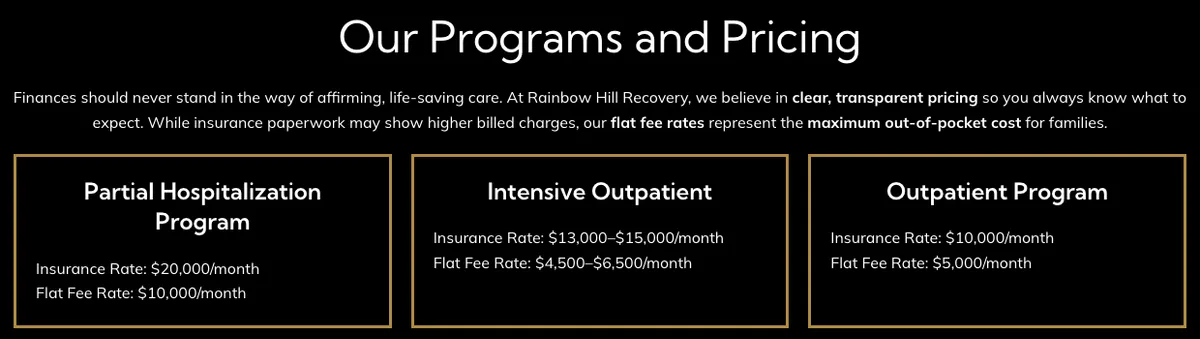
Its flat fee for partial hospitalization is $10,000 a month, against an insurance rate of $20,000. Intensive outpatient runs $4,500 to $6,500 a month on the flat fee. Newport Institute, another program in the sample, says the average out-of-pocket cost for young adult residential treatment is $500 a week, with insurance covering the rest. Neither figure is your revenue per admission, and we would not pretend to know yours. They do give a sense of proportion: at those rates, one extra month of PHP pays for a mid-priced website, and the arithmetic for a monthly program depends almost entirely on how many extra admissions it produces.
Only 4 of the 142 sites we read print their own program price. Seven more print a general market range instead, such as what PHP typically costs per day across a state, which answers a question nobody asked. A person weighing whether to call is asking what it costs here.
Who is reading a trauma program's website
The reader is more often a woman than a man, and veterans are overrepresented. The National Institute of Mental Health puts past-year PTSD among U.S. adults at 3.6%, with 5.2% of women and 1.8% of men, and lifetime prevalence at 6.8%. Of adults with PTSD in the past year, NIMH estimates 36.6% had serious impairment. The VA's National Center for PTSD gives a rounder version: about 5 of every 100 adults have PTSD in a given year, about 13 million Americans in 2020, and 8 of every 100 women against 4 of every 100 men at some point in life.
Veterans are a distinct and larger slice. The same VA source says 7 of every 100 veterans will have PTSD at some point, and that of the 5.8 million veterans VA served in fiscal year 2024, about 14% of men and 24% of women were diagnosed with PTSD. That is why TRICARE appears so often in this market. On FindTreatment.gov, 232 of the 421 programs in our sample list federal military insurance such as TRICARE as a payment they accept, and 110 list VA funds.
Two design decisions follow. A trauma program's site should never assume the reader's trauma is combat, assault or childhood abuse, because its readers include all three and more. And a program that takes TRICARE or VA community care should say so in words, on the page a veteran lands on, rather than leave it to a logo strip or a phone call.
What 142 trauma program websites show
Most of these sites handle the basics. Where they fall short is on the three things a trauma reader needs that other readers do not: the names of the therapies, a crisis line, and a price.
The method, briefly. We asked FindTreatment.gov for mental health and substance use facilities within 25 miles of 28 metro areas, which returned 4,516 unique facilities. Of those, 1,849 list a special program for persons with PTSD. We kept the 421 that are private for-profit and offer residential care, partial hospitalization or intensive outpatient care, which yielded 270 websites. Of those, 209 were readable on 30 October 2026, and 142 named trauma or PTSD on the homepage and at least three times across the homepage and up to nine pages it links to. Those 142 are the census.
The phone link is nearly universal: 138 of 142 homepages carry a phone number you can tap to dial. So is the insurance offer, at 126. Those are the habits of the addiction treatment market, where many of these programs also work, and they carry over well. The gaps are elsewhere, and the next three sections take them in turn.
Two more numbers from the census are worth having. 99 sites use the phrase "trauma-informed," and 66 mention complex PTSD. The phrase is now so common that it has stopped telling a reader anything; what tells them something is the detail behind it, such as which therapies, who delivers them, and how long a stay lasts.
Naming the therapies that work
The VA is unusually direct about which talk therapies have the most research behind them, and it names three.
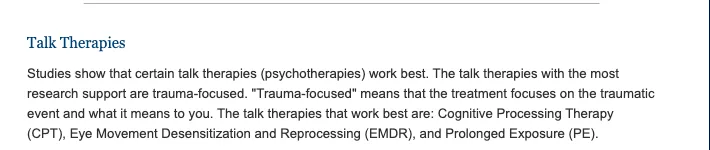
Cognitive Processing Therapy, EMDR and Prolonged Exposure. A person who has read anything about PTSD treatment, or who has been through the VA system, will look for those names. In our census, 90 of 142 sites name EMDR, 43 name Cognitive Processing Therapy, and 28 name Prolonged Exposure. Only 20 name all three. And 46 sites, about a third, name none of them, describing their trauma work only as "trauma-informed care" or "evidence-based therapy."
Not every program offers all three, and a site should not claim what the clinical team does not deliver. But if your therapists are trained in CPT or PE, that training is your strongest piece of trust copy and most of your competitors are not using theirs. Put the therapy names on the trauma program page, say which clinicians deliver them, and say roughly how many sessions a course takes. The VA's own page says these talk therapies usually last about 8 to 16 sessions, which gives a reader a sense of what they are signing up for.
Why remarketing will not rescue a weak page
In most industries a weak landing page is partly rescued by remarketing: the visitor leaves, an ad follows them, some come back. Trauma programs lose most of that safety net. Google's personalized advertising policy lists "Abuse and trauma" and "Health" among its sensitive interest categories, and says advertisers promoting products and services in those categories "are unable to use advertiser-curated audiences." In plain terms, you cannot build your own list of past visitors to a PTSD page and follow them around with ads.
That puts more weight on the first visit. The page someone lands on has to answer enough on its own that they call or fill in the form then, because there may not be a second touch. It is also one more reason to be careful with tracking scripts: 25 of the 142 homepages load the Meta pixel, which sends visit data to Meta from pages that are, by their nature, about a health condition.
Programs that also treat substance use have a further gate. Google requires LegitScript certification to advertise addiction treatment in the U.S., and LegitScript's own page says addiction treatment provided as part of a co-occurring program qualifies. Applying costs $1,395 to $1,595 for each facility; once approved, each facility pays $2,550 to $3,095 a year, and faster review is an optional $2,500 extra. In our census, 72 of the 142 sites mention LegitScript, which tells you how many trauma programs also run addiction services. Our LegitScript website checklist walks through the pages a reviewer reads.
The crisis line, and the one with an extra digit
A trauma program's site will be read by some people in crisis, and only 34 of 142 mention 988, the national suicide and crisis line, anywhere we looked. We checked each of the 34 by hand. Seven sites still print the old 1-800 Lifeline number, and some of them print it next to 988.
For a program that serves veterans there is a second line to give. The Veterans Crisis Line is reached by dialing 988 and then pressing 1, or by texting 838255, according to the Veterans Crisis Line's own site. Seven sites in our census mention it. The line costs nothing to add. Put it in the site-wide footer and at the top of any page about suicidal thoughts or self-harm, written as a sentence a person can act on: call or text 988, and veterans press 1.
What to ask a web firm before signing
These are the questions we would ask any seller, including the ones in the table above, and including us. The census column shows how many of the 142 sites already pass on that point, so you can see where a firm's answer matters most.
| Ask | A good answer | Census: sites that pass, of 142 |
|---|---|---|
| Which therapies will the trauma page name, and who confirms them? | Only what your clinicians deliver, confirmed by your clinical director before launch | 20 name CPT, PE and EMDR; 46 name none |
| Where will the crisis line appear? | 988 on every page, plus "press 1" for veterans if you serve them | 34 give 988 |
| How will a veteran find out whether you take TRICARE or VA community care? | A sentence on the program page and a filter or field in the verification form | 73 name TRICARE |
| Will the site say what care costs? | A self-pay rate or a typical out-of-pocket figure, if your program can stand behind one | 4 print their own price |
| What tracking scripts will run on the trauma pages, and who signs a business associate agreement? | A written list of tags, with no third-party pixels on condition pages unless a BAA covers them | 25 homepages load the Meta pixel |
| Can someone tell, from the first screen, that you treat PTSD and at which levels of care? | PTSD named, and residential, PHP or IOP stated, on the first phone screen | 126 name PTSD, not only trauma |
| Who owns the domain, the site files and the design source? | You do, in writing, from day one | Not visible from outside |
| What does maintenance cost after launch, and what happens if you leave? | A printed monthly fee, and a handover of everything with no exit charge | Not visible from outside |
Where KhanWork fits, and the programs that should not hire us
If your trauma program is full, takes most admissions from referrals, and has a site that names its therapies and its crisis line, you do not need a new website. Spend a day on the copy using the table above and keep your money for clinicians.
KhanWork belongs in the comparison too, and our pricing page lists the figures. Foundation is a single invoice. $1,000 covers a brand refresh and one landing page, typically the trauma program page that paid search points at, and it goes live 14 business days from the day your copy, photos and logins reach us. $2,500 covers the entire site, however many pages it needs, and goes live 21 business days from that day. If you want us to keep going after launch, that is Growth at $2,500 a month, working through your requests one at a time, or Scale at $5,000 a month, two at a time, which suits operators with several sites. Both plans are charged a month ahead, carry no contract term, and can be paused or ended at any time. The hosting account stays in your name and we do not charge for it. Over 36 months Growth adds up to $90,000. Foundation, a one-off payment, has no 36-month figure.
We are the right call for a program that is already paying for traffic and not seeing calls, because then the problem is conversion, not visibility: the trauma page, the verification form, the TRICARE answer and the first phone screen, rebuilt and judged by inquiries. Everything we build is yours, including the domain and the design files. Our mental health treatment page explains how we work with mental health programs, and our addiction treatment page covers programs that treat both. Before any of that, our free funnel review examines whichever page your visitors arrive on, which for most programs is the homepage, and names one change worth testing. For related pricing, see what a dual diagnosis program website costs, and how the eating disorder treatment market prices the same work.
The avoidance test
Do this before signing with anybody. Read your own site the way your reader does: as someone who has put this off for a long time and will close the tab at the first thing that feels like pressure. Use your phone, at night, with the sound off.
- The search. Search "PTSD treatment" with your city, then "trauma therapy near me." Open your own result and start the clock.
- The words. Within the first two screens, can you tell that this program treats PTSD, not only addiction or general mental health?
- The how. Can you find which therapies you use, named, without opening a menu?
- The money. Can you find whether your insurer, TRICARE or Medicaid is accepted, and what self-pay costs, in two taps or fewer?
- The exit. If you were in crisis right now, is 988 on this page?
- The ask. Is there one way to make contact that does not require a phone call, for the reader who cannot face one yet?
Score one point for each yes and stop the clock. Repeat all six on whichever two competitors outrank you. If you lose on the words or the how, you have a copy problem that a good afternoon can fix. If you lose on the exit, fix it today. If you pass all six and the phone still does not ring, then, and only then, start comparing the prices above.
Frequently asked questions
Expect about $3,500 to $25,000 for the build, going by what rehab and behavioral health web firms print, and $3,500 to $52,000 over three years with their listed upkeep. Bought inside a monthly marketing retainer, three years runs about $31,800 to $360,000 before ads. No seller we found prices trauma or PTSD work separately.
A few market themselves to PTSD providers, but none we found publishes a price for that work. ClicksGeek runs web design and marketing pages for PTSD therapists, and its pages describe market budgets rather than its own fees. The firms that do print prices, such as DrugRehab.Agency, Lead to Recovery, Webserv and Treatment Center Agency, sell to treatment centers in general.
It should name the trauma-focused therapies your clinicians actually deliver, starting with the three the VA National Center for PTSD says work best: Cognitive Processing Therapy, EMDR and Prolonged Exposure. In our census of 142 trauma program sites, 90 named EMDR, 43 named Cognitive Processing Therapy, 28 named Prolonged Exposure, and 46 named none of the three.
Yes, on every page, because some readers will be in crisis when they arrive. Programs that serve veterans should add that the Veterans Crisis Line is reached by dialing 988 and pressing 1, or texting 838255. Only 34 of the 142 trauma program sites we read gave 988, and 7 still printed the old 1-800 Lifeline number.
Not with its own visitor lists on Google. Google's personalized advertising policy lists Abuse and trauma and Health as sensitive interest categories, and advertisers promoting products and services in them cannot use advertiser-curated audiences. That means the page a visitor first lands on has to do more of the work, because you may not get a second touch.
Only if it advertises addiction treatment on Google in the US, which many trauma programs do because they also treat substance use. LegitScript says addiction treatment delivered as part of a co-occurring program qualifies, and it charges $1,395 to $1,595 a facility to apply, then $2,550 to $3,095 a facility annually. A program that advertises only trauma or mental health care does not need it for Google.
Yes, in plain words on the program page, if you accept it. On FindTreatment.gov, 232 of the 421 private PTSD programs in our sample list federal military insurance such as TRICARE, yet only 73 of the 142 program websites we read name TRICARE. Saying so in words costs nothing.
 Healthcare
Oct 29, 2026 · 16 min
How Much Should a Pediatric Dental Practice Website Cost in 2026?
Dental website sellers print builds from $1,997, and three sellers price pediatric marketing at $249 to $8,000 a month. We priced three years of each and read 178 pediatric dental practice sites.
 Healthcare
Oct 25, 2026 · 17 min
How Much Should a Dental Implant Practice Website Cost in 2026?
General dental sellers print implant-ready websites from $1,997, and implant marketing programs run $750 to $9,000 a month. We priced both over three years and read 192 implant practice sites.
 Healthcare
Oct 24, 2026 · 17 min
How Much Should a Plastic Surgery Practice Website Cost in 2026?
Six sellers print a plastic surgery website price, from $500 to $40,000. We turned each into a three-year total, then read 202 practice sites for prices, consultation fees, galleries and who built them.