How Much Should an Eating Disorder Treatment Center Website Cost in 2026?

Oct 22, 2026 · 17 min read
Eating disorder programs shop for websites in a market where almost nobody says what anything costs, on either side. On 22 October 2026 we searched for every seller that builds sites for eating disorder providers, therapists or treatment centers and shows a figure anywhere on its own site. Two sellers that name eating disorders publish a figure. A handful more sell to therapists or rehab centers generally. Below, each printed offer is converted into what it costs across three years, since that is the only way to set a build fee beside a subscription honestly.
Then we read the programs themselves. We went through 35 eating disorder treatment websites, 219 pages in all, from the members of the Residential Eating Disorders Consortium to small outpatient group practices found through searches in 20 metros. We wanted to know what a parent or an adult patient actually finds when they go looking. The short version: almost every program talks about insurance, almost none says what care costs, not one had a page in Spanish, and the one daily rate we found is there only because a state licenses that facility as a hospital.
The 30-second answer: what an eating disorder program website costs
On printed prices alone, an eating disorder website runs from nothing to $25,000 up front, then $35 to $950 monthly. Across three years, that lands at about $1,300 to $3,700 for a solo clinician on the entry plan of a therapist website platform, $5,700 to $12,200 for a specialist studio that builds for the eating disorder care team, and $17,000 to $52,000 for a treatment center build with upkeep, priced by pages and locations. Marketing retainers that bundle the site with search and ads start at $4,500 a month and are a different purchase. Before comparing totals, check three things: whether the seller has written for eating disorder care before, what you keep if you leave, and which tracking tags go on pages a patient reads.
What eating disorder website sellers publish
Six sellers that market to eating disorder providers, therapists or treatment centers print a website price on their own pages, and a seventh, Allgood Marketing, prints a marketing retainer and a maintenance fee. We counted only figures shown by the seller itself. Prices that turn up in listicles, search previews or a competitor's comparison chart did not count. Every page was read on 22 October 2026.
| Seller | Up front | Per month | Included, as the seller describes it |
|---|---|---|---|
| Declet Designs (names the eating disorder care team) | $2,498 or $3,498 for Website in a Week; $8,998 for Signature Brand + Website | Care plans $89, $129 or $349; first 60 days free | A 4-page WordPress site on a chosen layout, with brand work on the higher tier; Signature is a custom site of up to 8 to 10 pages with strategy and copy editing |
| Allgood Marketing (has an eating disorder clinics page) | Build price not published | Marketing plans from $4,500; site maintenance from $500 | Plans with no annual contract; maintenance month to month |
| Webserv (treatment centers) | $8,000, $15,000 or $25,000 one time | Optional upkeep: $250, $450, or $750 to $950 | Up to 10, 20 or 40+ pages for 1, 3 or 5+ locations; CRM integration from the middle tier |
| TherapySites (therapists) | $199 setup | $69 to $336 | Hosting, domain, HIPAA features and scheduling on Core; search add-ons on the higher plans |
| Brighter Vision (therapists) | $100 setup on Start | $99, $179 or $349 billed monthly | A managed therapist site; HIPAA forms on the top plan; no refunds on monthly billing |
| Therapy Site Builder (do it yourself) | None | $35 or $75 | A template builder with a 14-day trial; cheaper when billed yearly |
| Albright Labs (healthcare and wellness) | Build included | $495 or $695 on a 12-month term | A managed site; leaving early means paying the rest of the build balance |
Only two of these name eating disorders, and they sit at opposite ends. Declet Designs builds for registered dietitians, therapists, family-based treatment providers and what it calls eating disorder organizations, so its packages are sized for a practice of one to a few clinicians. Allgood Marketing runs a page for eating disorder clinics and prices the marketing, not the site. Webserv is in the table because it prints a treatment center build price by tier, which is rare. The three therapist platforms are the floor for a solo outpatient clinician who mostly needs to be found and booked.
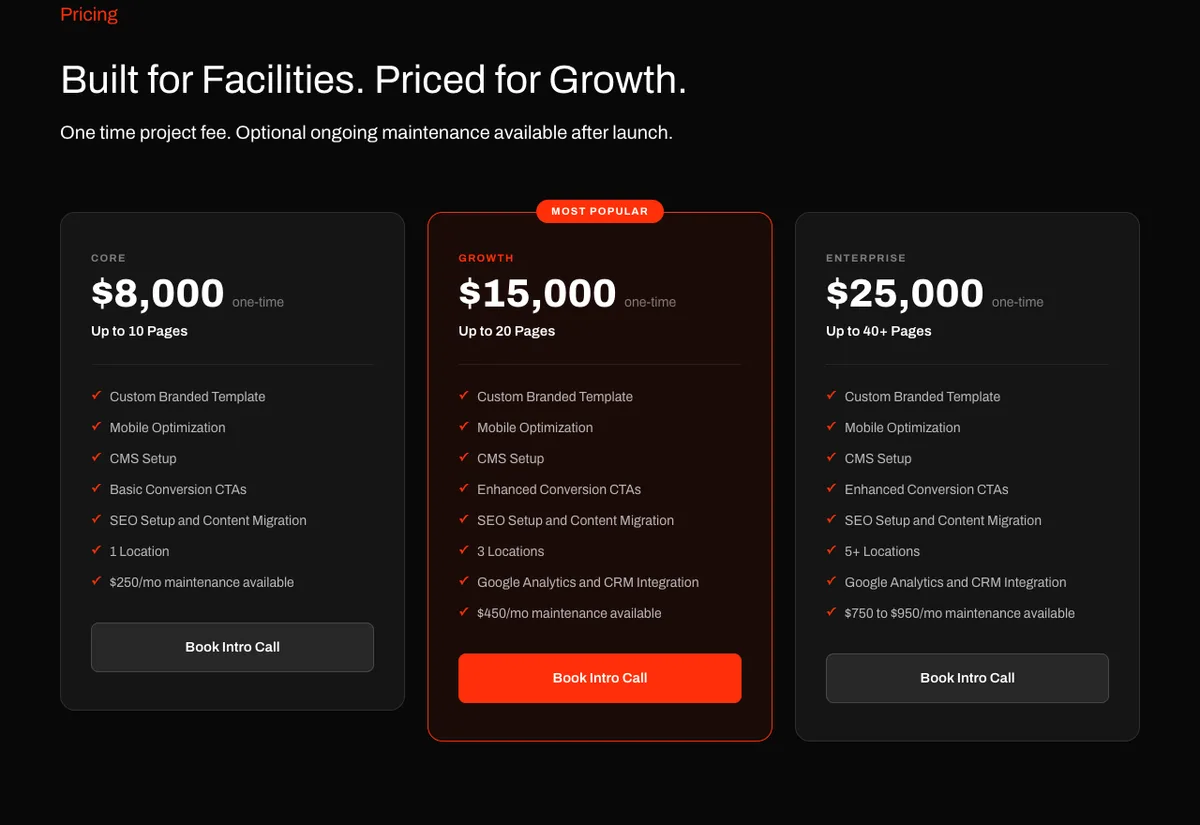
Read Webserv's page to the bottom and it argues with its own price cards. Its own FAQ puts a typical addiction treatment build at $25,000 to $80,000, and that builds under $20,000 usually use pre-built templates. That is not a contradiction so much as a warning about what the $8,000 tier is. Ask any seller with a cheap entry tier which of its recent clients actually bought it.
The 36-month view
Over three years, the printed offers run from $1,260 to $52,000, and the spread is about who the site is for as much as what it costs. Each bar uses one formula: what the seller asks on day one, plus three years of the monthly fee it prints, and nothing we guessed.
Two offers are left off on purpose. Allgood's marketing plans start at $4,500 a month, which is $162,000 over three years, and that money buys search, ads and reporting with the website inside them. Albright Labs' managed site at $495 a month comes to $17,820 over 36 months, but it sells to healthcare and wellness businesses in general, with no mental health wording left on the page. Both are fair benchmarks for a specific question. Neither is a like-for-like website price.
For scale, set those totals against what the care costs. The 2020 report on the social and economic cost of eating disorders, by Deloitte Access Economics with Harvard's STRIPED program and the Academy for Eating Disorders, used $1,237 as the average cost of one day of residential treatment. On that figure, three years of Declet's Signature build and care plan costs less than ten residential days. The website is not the expensive part of running a program. Getting it wrong is.
A practice website and a program website are different jobs
A solo dietitian or therapist needs a site that says who they help, shows their training, and lets a person book. A program with residential, PHP and IOP levels needs a site that explains each level, verifies insurance, takes calls at all hours, speaks to parents and adult patients separately, and gives referring clinicians what they need to send someone. The first job fits a $35 to $349 monthly platform. The second does not, and squeezing it onto one is where most of the cost of a cheap build hides.
Signs you are buying for the second job, whatever your size:
- More than one level of care. Each level is a separate decision for a family, with its own admission criteria and insurance questions. Our guide to PHP and IOP program pages covers what families read on those pages.
- Two audiences who need different words. In our census, 27 of 35 sites mention adolescents or children and 30 mention adults. A parent of a 14-year-old and a 34-year-old with binge eating disorder are not reading the same page.
- Clinician referrals. Outpatient therapists, dietitians and pediatricians send many admissions. They want admission criteria, a direct referral line and fast answers, not a hero video.
- Insurance verification. If your admissions team checks benefits before the first call, the website should start that process, not just print a list of logos.
Who is buying
The buyers are a small number of programs serving a large, mostly untreated population. Deloitte's report estimated that 28.8 million Americans alive in 2018 to 2019 will have an eating disorder at some point in their lives, that about 10,200 deaths a year are associated with eating disorders, and that the financial cost came to $64.7 billion in a year. On the supply side it counted roughly 1,473 adult and 601 adolescent residential beds among consortium members, enough for close to 19,200 people a year at average stays of 31.3 days for adults and 40.6 for adolescents.
The gap between those two numbers is the job a program website does. The National Institute of Mental Health reports that only about a third to under half of adults with an eating disorder sought treatment specifically for it:
Someone searching for eating disorder help may not be sure they are sick enough to deserve it, and every page has to work for that person too. A site that opens with a phone number and a "call now" button is built for someone ready to admit. Most first visitors are not there yet, and the site has to give them a reason to come back.
Competition for those searches is lopsided. In our searches across 20 metros, the same multi-site brands came back again and again: Center for Discovery, Renfrew, Eating Recovery Center, Monte Nido, The Emily Program and Alsana. An independent program will not outspend them on the same phrases, so its site has to win on what a big brand's location page rarely offers: named clinicians, a clear local answer, and a faster reply.
What 35 eating disorder program websites show
Almost every program site makes it easy to call and says it takes insurance; very few tell a family what care costs, how to book without calling, or how the program measures results. Our list started with the 17 programs on the Residential Eating Disorders Consortium's member page and added programs and specialist practices found through searches in 20 metros (Los Angeles, San Diego, Denver, Phoenix, Dallas, Houston, Austin, Chicago, Minneapolis, Atlanta, Miami, Tampa, Charlotte, Philadelphia, New York, Boston, Seattle, Portland, Nashville and Salt Lake City), plus single searches in 18 more cities. We removed directories, single pages inside hospital systems, and general mental health or addiction providers whose sites are not mainly about eating disorders. That left 41 domains, 35 of which we could read. One caution: search results favor the big brands, so this is a census of the most visible eating disorder sites, not of every small practice.
Findings a buyer can use:
- Insurance is everywhere, verification less so. 33 sites mention insurance and 29 name a specific insurer, but only 22 offer to check a family's benefits. The other 11 leave that to a phone call.
- Booking runs through the phone. 33 sites have a tap-to-call link and only 2 let a person pick a time online. For an adult who is not ready to talk out loud, a short form or a scheduled callback is the difference between contact and none.
- Outcomes are a real differentiator. 16 sites link an outcomes page or publish their own outcome or satisfaction numbers. Referring clinicians ask for this, and the other 19 programs give them nothing to point to.
- Men are almost absent. Only 3 sites name men or boys as a group they serve. Deloitte's report estimated 1.09 million males had an eating disorder in 2018 to 2019, and almost no program site speaks to them directly.
- Nobody wrote a Spanish page. None of the 35 has a Spanish page or says "se habla español". One offers a machine translation menu.
- Most run on WordPress. 25 of 35 homepages are built on it, with Squarespace and Webflow next. A program on WordPress can change agencies without starting over, which matters in any negotiation.
- Builders stay quiet. Only 6 of the 35 show an agency credit, each a different small studio. Unlike orthodontics or chiropractic, no specialist agency dominates this niche.
The price nobody prints
Only 4 of the 35 programs print what their own care costs, and three of them are small outpatient practices listing a fee per therapy session. No residential or PHP program in the sample published a day rate voluntarily. The one exception is a hospital disclosure: Monte Nido publishes standard and negotiated daily rates for Monte Nido Walden in Dedham, Massachusetts, and says on the same page that it does so because that site holds a hospital license and falls under federal and state price transparency rules. Its other locations publish nothing comparable.
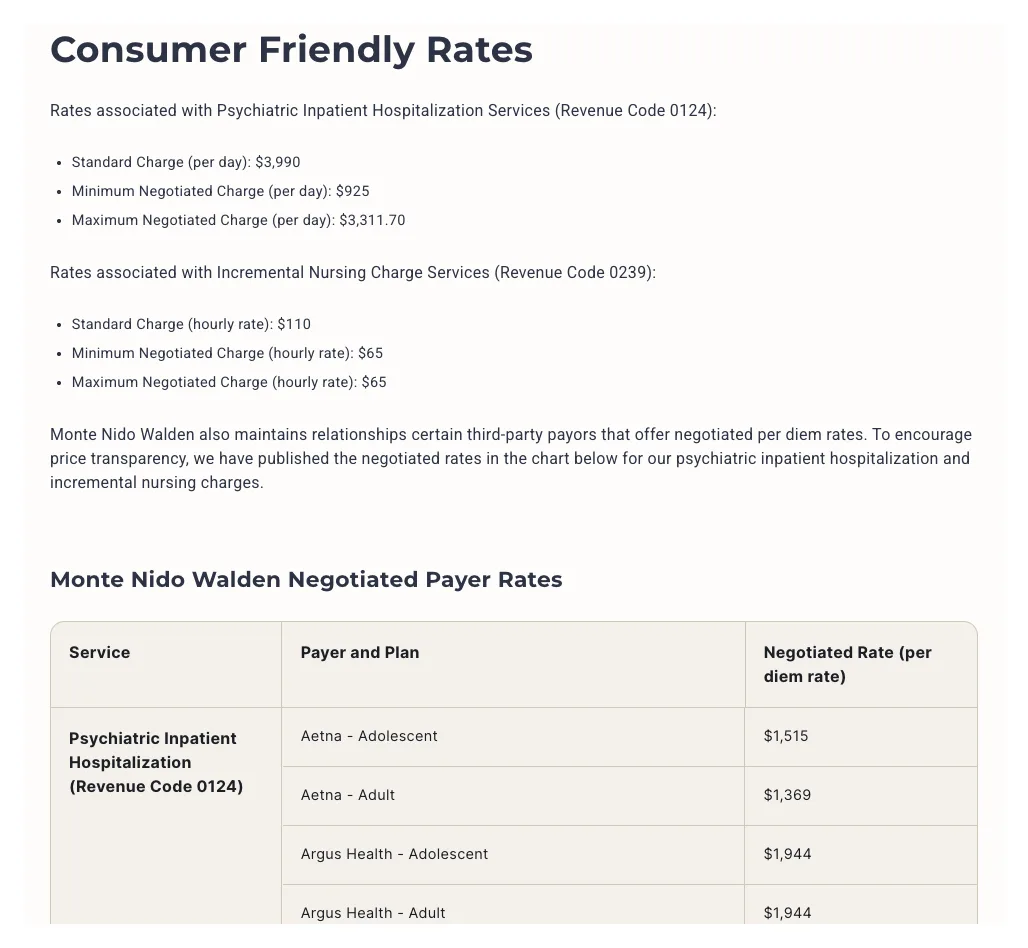
The page is worth reading as a buyer of websites, not just of care. It shows a standard charge of $3,990 a day, negotiated rates from $925 to $3,311.70, and a table of per diem rates by insurer. That is more cost information than any other program in our sample gives a family, and it exists because a regulation forced it. A program that chose to publish a plain cost page, with a typical daily range, what insurance usually covers and whom to call about financial help, would be the only voluntary one we found.
There is a reason programs hesitate. Daily rates frighten people, and the real cost depends on the insurer, the level of care and the length of stay. But a family that cannot find any number assumes the worst. A careful page that explains how cost works, gives ranges, and puts the benefits check one tap away does better than silence. If you want a model of how to structure it, our insurance verification page guide was written for addiction programs and carries over almost line for line.
Insurance, parity and the page families read twice
Federal law says that if a health plan covers eating disorder benefits, including residential treatment, it must cover them on the same terms as medical benefits. That sentence comes from section 13007 of the 21st Century Cures Act, signed in December 2016, which ties eating disorder coverage to the existing parity rules in the Public Health Service Act, ERISA and the tax code. It does not force a plan to cover eating disorder care in the first place, and it does not settle every denial. It does give families and admissions teams a footing when a plan treats residential care for anorexia differently from a comparable medical stay.
For the website, that means the insurance page is not a logo wall. The useful version says which plans you are in network with, what happens if you are out of network, that you can help with appeals and single case agreements if you do, and how long a benefits check takes. It names the levels of care each plan has covered for you before, in plain words. It never promises coverage. And it is the page a parent reads twice, usually the second time with the insurance card in hand, so the verification form belongs on it.
Writing for a reader who may be ill
An eating disorder website has readers that most healthcare sites do not: people in the middle of the illness, some of whom read recovery content in a way that can harm them. The National Eating Disorders Association's guidelines for its own guest writers put the rule bluntly, "Don't play the numbers game", and warn against specific calories, weights and detailed descriptions of behaviors. NEDA's guidance also steers writers away from before-and-after comparisons and from praising thinness or willpower.
That guidance was written for bloggers, but it is the right standard for a program's own pages. In our census, one site's homepage testimonial gave a patient's weight loss in pounds; everyone else kept numbers out of their stories. Ask any writer or agency how they handle this before they draft a word. A seller who has never heard the question will learn it on your site.
Practical rules we would hold any eating disorder site to:
- No weights, BMIs, calorie counts or sizes in testimonials, blog posts or image captions.
- No before-and-after photos, and no stock photos of very thin bodies, scales, tape measures or empty plates.
- No diet language anywhere, including recipe or nutrition posts. Food is described as part of recovery, not as good or bad.
- Diverse bodies, ages and genders in every photo set, because the illness does not look one way and a reader who does not see themselves assumes the program is not for them.
- A crisis line on every page, so someone in danger can find help without reading anything else.
Tracking pixels and referral trust
Every program that advertises online wants to know which ads bring admissions, and the tools that answer that question can leak health information. The Federal Trade Commission's 2024 case against Cerebral, an online mental health company, alleged that tracking tools on its website and apps passed health-related details of close to 3.2 million people to platforms including LinkedIn, Snapchat and TikTok; the proposed order required it to pay $7 million and banned most use of health data for advertising. Cerebral was not an eating disorder program, but the pages it tracked look a lot like an eating disorder program's intake pages.
In our census, Google's analytics or tag tools appear on 33 of 35 sites, and 4 carry a Meta pixel directly in the page source. A pixel loaded by way of a tag container is invisible to that check, so the true number of ad trackers can only be higher. A program does not need to give up measurement. It needs a written list of every tag, which pages each one runs on, and a rule that nothing fires on assessment, insurance or contact forms without an agreement in place. Our HIPAA website guide walks through the setup.
Referrals carry their own trust problem. In 2016, researchers from Columbia, Johns Hopkins and the University of Pittsburgh's Western Psychiatric Institute, writing in Psychiatric Services, described how residential eating disorder programs market to clinicians with gifts, meals, travel and continuing education credits, and called for transparency about those payments. A decade later, the programs that earn referrals on their websites do it with information: admission criteria, a referral form that returns a call the same day, outcome data, and named clinical staff. In our census, 16 sites publish something about outcomes, which means 19 do not. That is a gap any program can close without spending on dinners.
Questions to ask any seller
Print this and hand it to every agency you talk to, us included. Someone who has worked in eating disorder care can answer each row without stalling.
| Question | A good answer | Why it matters |
|---|---|---|
| What will this cost over 36 months, every fee included? | One number, in writing | The printed offers above range from $1,260 to $52,000 over three years |
| Which eating disorder providers have you built for? | Names you can visit, ideally at your level of care | Only 2 of the priced sellers we found name eating disorders at all |
| How do you write about bodies, weight and food? | No numbers, no before-and-after, no diet language, with an example | NEDA's writing guidance; one site in our census put weight loss in a testimonial |
| Where does insurance verification go, and who receives it? | A short form on the insurance page, routed to admissions only | 22 of 35 program sites offer a benefits check; the rest rely on a phone call |
| Which tracking tags will you install, and where? | A written list, with nothing on intake forms unless an agreement covers it | The FTC's Cerebral case turned on tracking tools on a mental health site |
| If we part ways, what do we keep? | The domain, content, design files and a working export | Some managed plans charge the remaining build balance if you leave early |
| How will a referring clinician send us a patient? | A clinician page with admission criteria and a referral form | Referrals drive admissions, and only 16 of 35 sites publish outcome information |
| Can our team update a program page the same day? | Yes, without filing a ticket | Levels of care, insurers and staff change often in this field |
Where KhanWork fits, and when a $35 platform is smarter
A solo therapist or dietitian specializing in eating disorders should not hire us. A therapist platform at $35 to $349 a month, or a specialist studio like Declet Designs at $2,498 to $8,998, will do the job well, and the money left over is better spent on training or on your own time. If what you mainly want is someone to run ads and search, compare the marketing retainers with each other before you compare them with a website.
What we charge is public on our pricing page: three subscriptions, each paid a month ahead with no lock-in: Foundation is $1,000 a month, Growth $2,500 and Scale $5,000, each one free to pause or end. Foundation covers brand cleanup and one landing page made to earn that first call or form, typically the page your ads or referral partners point to. That page is up 14 business days after your copy and assets arrive, and another page follows every month. Building out the whole site, residential through outpatient, belongs to Growth. No tier includes hosting. Foundation for three years adds up to $36,000, above most of the bars in our chart, so if we are worth it, it is because pages ship fast and keep getting tested, not because we are cheaper.
The program we suit runs more than one level of care, gets traffic from ads or referrals, and loses too many families between the first visit and the first call. Our mental health and eating disorder program page describes that work, and so does our conversion optimization service. You own all of it: domain, copy, design files. For a lower-stakes first step, point us at the page where most of your visitors arrive, and the free funnel review comes back with the one change we would test first.
The three-reader test
Before you spend anything, read your own site as the three people who decide whether you get an admission. Give each one five minutes on a phone:
- A parent at 11 at night. Their 15-year-old has stopped eating at dinner. Can they tell, from your homepage, whether you treat teenagers, what the first step is, and whether their plan is likely to pay? Can they start a benefits check without calling?
- An adult who has never told anyone. They are 38 and think binge eating disorder is not serious enough for treatment. Does any page say it is? Is there a way to reach you that does not start with a phone call?
- A dietitian deciding where to refer. They have a patient who needs a higher level of care this week. Can they find your admission criteria, a referral line, your outcome data and the name of a clinician to talk to, in under two minutes?
Write down where each reader got stuck. Most of the fixes are words and one or two forms, not a rebuild. Fix those first. If the calls still do not come, then it is time to put the three-year figures from the chart side by side.
Frequently asked questions
An eating disorder treatment center website costs about $17,000 to $52,000 over three years at the treatment center build prices sellers print: $8,000 to $25,000 up front plus $250 to $950 a month in upkeep. A solo clinician can spend far less, about $1,300 to $3,700 over three years on a therapist platform, or $5,700 to $12,200 with a specialist studio. We read each price on the seller's own page on 22 October 2026.
Publishing a typical range is worth it, because families who find no number assume the worst. In our census of 35 eating disorder program sites, only 4 printed their own prices, and the one daily rate came from a hospital disclosure that Massachusetts rules require. A cost page with ranges, what insurance usually covers and a benefits check one tap away would stand out.
Not always, but if a plan covers eating disorder benefits, including residential treatment, federal law says it must cover them on terms consistent with mental health parity rules. That comes from section 13007 of the 21st Century Cures Act (2016). Your insurance page should explain this plainly without promising coverage to anyone.
A solo outpatient clinician can, and should, since platforms cost $35 to $349 a month. A program with residential, PHP or IOP levels usually outgrows one, because it needs separate pages per level of care, an insurance verification form, a clinician referral path and pages for parents and adult patients.
An eating disorder site should avoid weights, BMIs, calorie counts, before-and-after photos and diet language, in testimonials and blog posts alike. NEDA's guidance for its own writers warns against exactly these, because numbers and comparisons can harm readers who are ill. One site in our census of 35 put a weight loss figure in a testimonial.
Tracking pixels are risky on any page where someone shares health details. The FTC's 2024 case against Cerebral, an online mental health company, alleged that tracking tools sent sensitive data about nearly 3.2 million people to platforms such as LinkedIn, Snapchat and TikTok. Keep a written list of every tag and keep ad trackers off assessment, insurance and contact forms.
An eating disorder program site needs one page per level of care, an insurance page with a benefits check, separate paths for parents and adult patients, a page for referring clinicians with admission criteria, and an outcomes page. In our census, 22 of 35 sites offered a benefits check and 16 published anything about outcomes.
 Healthcare
Oct 21, 2026 · 17 min
How Much Should an Orthodontist Website Cost in 2026?
We turned every orthodontic website price we could find into a three-year total, then read 123 orthodontic practice sites to see who built them, what they charge patients, and how they advertise payment plans.
 Healthcare
Oct 19, 2026 · 17 min
How Much Should a Psychiatry Practice Website Cost in 2026?
We turned every published psychiatry website price we could find into a three-year total, then read 181 psychiatry practice sites for fees, telehealth, the Good Faith Estimate and ad pixels.
 Healthcare
Oct 18, 2026 · 17 min
How Much Should a Fertility Clinic Website Cost in 2026?
Most fertility marketing agencies publish no price. We found six sellers that do, turned each into a three-year total, then read 217 SART member clinic websites for prices, success-rate pages and financing.