
Insurance Verification Pages: Why Yours Is Losing Admissions

Oct 6, 2026 · 17 min read
The insurance verification page is where a family stops reading and starts handing over details. Someone has decided this center might be the one, and the money question is the last thing standing between them and a phone call. On most rehab websites that question is answered by a form that asks for a birth date and a member ID and then promises a call back.
That handoff is where admissions leak, and mostly not for the reasons centers worry about. On 6 October 2026 we read the verification pages of 43 addiction treatment providers, counted every field on the 23 forms we could read in full, and logged which third-party code each page loaded before anyone clicked. The pattern held across cities and company sizes: long forms, thin answers, and a surprising amount of advertising code on the one page where people type in their insurance details.
The short answer on verification pages
An insurance verification page loses admissions when it asks for more than it gives. A good one tells a family, before the form, which plans the center is in network with, which it cannot take, what happens out of network or without insurance, how fast someone will reply, and that a benefits check is an estimate rather than a promise. The form itself needs a name, a phone number and the insurer; the rest can wait for the call. Because the page collects details about paying for addiction treatment, it should also carry no advertising pixels. Most of the 43 pages we read missed on at least two of those counts.
How we read 43 verification pages
We searched for insurance verification pages from rehab providers in a dozen US metros, Phoenix, Denver, Houston, Austin, Atlanta, Nashville, Los Angeles, San Diego, Boston, Chicago, Philadelphia and Delray Beach among them, and added providers that had turned up in our earlier studies of this market. Those searches return mostly directories, so we kept treatment providers only, confirmed each site by the title of its homepage, and followed the homepage link labeled for verifying insurance, or for insurance where no verify link existed. Forty-nine providers had such a link. Five were unusable for this study: four would not render for our browser, and one led to a blog article. That left 43.
Each page was loaded in desktop Chrome with no clicks. We saved the text a visitor would see, every visible form field, and every network request the page made. Twenty-three pages had a single-page form we could read field by field; the rest used step-by-step forms that reveal one question at a time, forms inside frames we could not open, or a phone number with no form. Our own clients were left out and no provider is named here. Two cautions. What loaded in our browser is a floor, since some sites hold their tags until a visitor accepts cookies. And what a page promises is not proof of what the admissions team does on the phone.
What a family needs to read before the form
Before it asks for anything, a verification page should tell people whether they are likely to be covered here. Most pages did half of that job. Twenty-five of the 43 named at least one insurer in the page text, in words rather than only in logos. Only 9 said which plans or programs they cannot take, almost always Medicare, Medicaid or both. That second list does more work than it looks. A family on Medicaid who reads "most major insurance accepted" and fills in the form will get a call that ends in a no, after giving a stranger a birth date and a member ID. One honest sentence would have saved both sides the call.
Out-of-network coverage came up on 16 pages, ranging from a clear explanation of what out-of-network benefits mean to a single phrase in a list. Self-pay, financing or a sliding scale came up on 17. One page put a number on its own cost: a detox provider whose page says the check comes back with what you would owe for a stay, usually between $0 and $5,000, before you agree to anything. No other page gave a figure.
Then the clock. Eleven pages said how soon an answer would come, and the promises do not line up. Nine said it would take seconds, minutes or happen instantly. Two said within hours, one of them within about one business hour. Two of the nine that promised minutes also said, further down the same page, that results typically arrive within one business day. A family cannot tell from that which clock to believe, and the one they remember is the one that was broken.
A benefits check is an estimate, and the page should say so
The word "verify" promises more than the process delivers. What admissions staff get back from an insurer is eligibility and a summary of benefits: whether the plan is active, the deductible and coinsurance, and whether the stay needs prior authorization. That is not the same as the plan agreeing to pay for a particular stay. One of the 43 pages said in so many words that verification is not a guarantee of payment. Two more carried a narrower disclaimer, one about a price estimate and one under a coverage table. Four pages went the other way, promising that a family would know exactly what the plan covers or exactly what to expect.
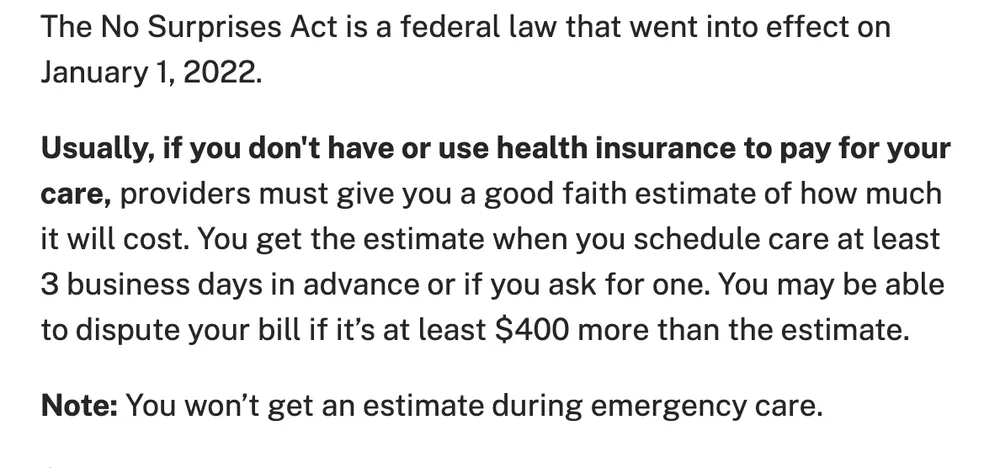
That is a trust problem with a delay on it. A family told they were "verified" who later gets a denial, or a bill for an out-of-network balance, remembers the website that said exactly. It is also a problem the law already partly addresses for one group. Under the No Surprises Act, in force since 1 January 2022, providers usually must give people who are uninsured, or who choose not to use their insurance, a good faith estimate of expected charges when care is scheduled at least three business days ahead or when they ask for one. If the bill comes in at least $400 above the estimate, the patient can start a dispute within 120 days of the first bill, for a $25 fee, according to CMS's consumer guidance.
The law's protections for insured patients are narrower than many families assume. CMS lists them as unexpected out-of-network bills for emergency room visits, for non-emergency care connected to a visit to an in-network hospital, hospital outpatient department or ambulatory surgical center, and for air ambulance services. A stay at a stand-alone residential treatment center that is out of network is not on that list. So a verification page that mentions out-of-network benefits should add one sentence: the family may owe the difference between what the plan pays and what the center charges, and the admissions team will put the expected amount in writing before admission. Several pages already explain deductibles and coinsurance with worked examples. Taking that one step further, to what it means for a month at this center, is where a page starts to earn trust instead of asking for it.
It is also worth saying what most plans do cover. HealthCare.gov states that all Marketplace plans cover substance use disorder treatment as an essential health benefit, and that they cannot deny coverage or charge more for a pre-existing substance use condition. That is a reassuring line for a family who assumes rehab is never covered, and it costs nothing to print.
The form: nine fields is the median, and most of them can wait
A verification form should ask for what admissions needs to call back and start the check: a name, a phone number and the insurance company. Member ID and date of birth speed the check up, so offer them as optional. Everything else belongs on the call.
The 23 forms we could read in full had a median of 9 fields, from a single phone number field to 22. Four had five fields or fewer, nine had six to nine, five had ten to fourteen, and five had fifteen or more. The long ones read like an intake packet: patient and policyholder names and birth dates asked separately, the home address, the insurer's phone number, the policyholder's employer and, on one form, the last four digits of a Social Security number. Two forms built from the same template ran to 21 questions, 17 of them required, before a family could press submit.
Across the 23: a member ID or policy number on 19 (11 made it required), a date of birth on 18, a group number on 10, the insurer's phone number on 8, a home address on 5, an employer or employment question on 3. A step-by-step form outside the 23 asked for the last four of the Social Security number as a required field on its first screen, before a single question about insurance. No form asked for a photo of the insurance card, though one center invites families to text a picture of it to admissions instead.
At the other end, four forms asked nothing about the plan at all: contact details only, never more than a name, a phone number and an email, plus in one case a yes or no on whether to run the check. That looks thin on paper. It is also the version most likely to get a phone ringing, and the call is where a good coordinator collects the member ID anyway, with a human voice explaining why it is needed. When we studied admissions page design, the general inquiry forms on those pages had a median of seven fields. Verification forms ask for more, at the point where a family has the least reason yet to trust the site.
Every extra field is a trust test
Fields are not only friction. Each one is a piece of information a frightened person has to decide to give a website they found twenty minutes ago. A birth date, a member ID and the name of an addiction treatment center, together, say a great deal about someone. Asking for part of a Social Security number on top of that, to check benefits, asks for trust the page has not earned.
Eight forms carried a checkbox for consent to calls or text messages, and four would not send until it was ticked. Consent wording is a matter for your counsel. Still, a box that has to be ticked before a family can learn whether their plan covers addiction treatment is a choice they notice.
The machinery behind the check is not what slows things down. The 2025 CAQH Index, built on data from more than 600 provider organizations and from health plans representing 63% of insured lives, puts medical plan adoption of fully electronic eligibility and benefit verification at 96%. On the insurer's side, the lookup is close to automatic. So when a family fills in a long form and then waits a day for an answer, the wait is happening inside the center, not at the plan.
The tracking problem on verification pages
This is the finding that should worry an operator most. Of 43 verification pages, before any click, 29 loaded Google Tag Manager, 29 loaded Google Analytics and 29 loaded call tracking software that swaps the phone number for each visitor. Fifteen loaded Google Ads code, 12 loaded a session recording tool that can replay what a visitor does on the page, and 6 loaded Meta's pixel. Microsoft's Bing ads tag showed up on 6, TikTok's and LinkedIn's on one each. All told, 19 of the 43 pages loaded code from at least one advertising network, and the median page made requests to 12 outside hosts.
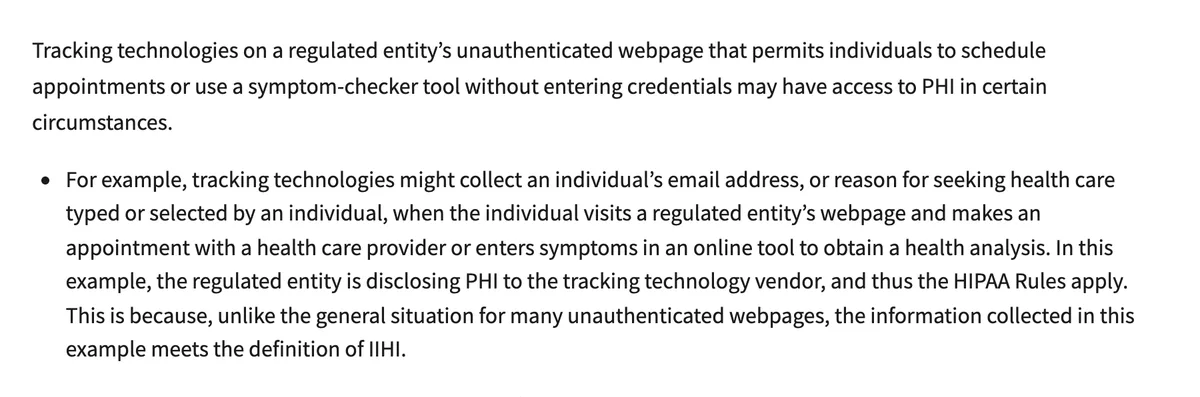
Why it matters on this page in particular: guidance from HHS's Office for Civil Rights on online tracking technologies says trackers on a public page that lets people schedule appointments without logging in may have access to protected health information. Its example is a tracker collecting an email address, or the reason someone is seeking care, that the person typed or selected. In that case, the guidance says, the HIPAA Rules apply. A verification form for addiction treatment sits very close to that example: a name, a birth date, an insurer and a member ID, typed on a page whose whole subject is paying for substance use treatment.
Two caveats, stated plainly, and none of this is legal advice. A Texas federal court ruling of 20 June 2024 struck down one piece of that guidance, the piece saying HIPAA kicks in whenever a tracker ties an IP address to someone landing on a public page about particular health conditions or providers. HHS says it is evaluating its next steps. The appointment example is about information a person types in, which is a different situation from a bare page visit. Second, a tag loading on a page does not prove that form entries reach the vendor; that depends on how each tag is configured. Which is exactly why someone should check, tag by tag, on this page before anything else.
Federal enforcement has already shown the stakes. In April 2024 the FTC announced a proposed order against Cerebral, an online mental health company, alleging it passed sensitive information about nearly 3.2 million consumers to third parties such as LinkedIn, Snapchat and TikTok through tracking tools, including names, birthdates, and pharmacy and health insurance information. The order bans Cerebral from using or disclosing health information for most advertising, and came with nearly $5.1 million for refunds tied to its cancellation practices plus a $10 million civil penalty suspended after a $2 million payment. The complaint also charged violations of the Opioid Addiction Recovery Fraud Prevention Act.
Addiction treatment carries an extra layer. Under 42 CFR Part 2, a "patient" includes any individual who "has applied for" diagnosis, treatment or referral for treatment for a substance use disorder at a covered program. Whether submitting a verification form counts as applying is a question for your attorney, but it is a good reason to treat that form's data as treatment data from the first keystroke. And the pixel buys less than it seems to. Google's health policy for personalized ads lists counseling for alcohol addiction among its sensitive examples and says advertiser-curated audiences, such as Customer Match and your data segments, cannot be used when promoting in those categories. The audience you would build from verification page visitors is largely one you are not allowed to target anyway.
The verification page, part by part
Here is what we would put on the page, in order, with what the census found next to each part. A center can run this against its own page in fifteen minutes with a phone in one hand.
| Part of the page | What it should say or do | What we found |
|---|---|---|
| The first lines | The plans you are in network with, written as words, not only as logos | 25 of 43 named an insurer in the text |
| What you cannot take | Programs and plan types you cannot bill, such as Medicaid, Medicare or certain HMOs | 9 of 43 said which plans they do not take |
| Out of network | That the family may owe the difference, and that you will put the expected amount in writing before admission | 16 of 43 mentioned out-of-network coverage |
| What a check means | That a benefits check is an estimate, not a promise of payment | 1 of 43 said it plainly |
| No insurance | Self-pay and financing options, and that a written good faith estimate is available | 17 of 43 mentioned self-pay or financing; 1 gave its own figure |
| The clock | One honest reply time, the one your team actually works to after hours | 11 of 43 gave a time; 2 gave two different ones |
| The form | Name, phone and insurer required; member ID and birth date optional | Median 9 fields across 23 forms; 11 required a member ID |
| Consent | Contact consent that is not a condition of getting the check | 4 of 23 forms required a consent box to send |
| Tracking | No ad pixels or session recording on the page; analytics only with form data kept out | 19 of 43 loaded advertising code; 12 loaded session recording |
| A person and a lifeline | A phone number with the hours it is answered, and 988 and 911 for anyone who cannot wait | 42 of 43 had a phone link; 5 showed 988 or 911 |
Two of these rows cost nothing and change the most. Saying which plans you cannot take stops calls that were never going to convert and tells everyone else you are being straight with them. Taking ad pixels and session recording off the verification page removes the largest privacy exposure on most rehab sites without touching a single campaign, because the conversion you care about can be counted from the thank-you page or the call itself. Our guide to HIPAA and practice websites covers the wider setup; for verification, the rule of thumb is simple: if the page asks about insurance, it does not report to an ad network.
What we would change, and when you do not need us
Much of this is not a design job. If your forms are already short and the gaps are tags, a developer or your current agency can remove pixels from one page in an afternoon. If the problem is that nobody answers verification requests after 6 p.m., that is staffing, and no page fixes it. We do not run benefits checks, bill insurers or manage ad spend, so if those are the weak links, hire for them first.
Where we come in is the page itself and the pages around it: plan lists written as text, a clear line on what you cannot take, an honest clock, a short form with the optional fields marked, consent that is not a toll gate, and a tag inventory that keeps advertising code off anything that collects insurance details. If the verification page is the page your ads land on, our Landing Page Sprint rebuilds that one page on your existing brand in two weeks for $1,200. Broader work runs on three monthly tiers shown on our pricing page: Foundation costs $1,000 a month and delivers a refreshed brand plus one high-converting landing page, with another page added each month after that; Growth at $2,500 for the whole website; and Scale at $5,000 for operators with several locations. Every tier pauses or cancels month to month, and we commit to a 14-business-day launch, counted from the day your copy and photos reach us; miss it and your following month is free.
For context on who is saying this: we have shipped more than 200 projects, five of them for treatment centers. At Cornerstone Healing Center, conversions on the website rose 20% after the redesign we delivered. The addiction treatment websites we build start from pages like this one, because it is where the money question gets asked. If you want a second opinion first, ask for a free funnel review: we study whichever page your visitors reach first, and on rehab sites that is often where we would begin.
Verify yourself, with a stopwatch
The fastest way to see your verification page the way a family does is to use it. It takes one evening and one colleague.
- Submit it for real, after hours. Ask a colleague with a commercial plan, with their permission, to fill in your verification form from their phone at 7 p.m. on a weekday. Start a timer when they press submit.
- Record the first contact. Note how long it took, whether it was a call, a text or an email, and whether the person who reached out knew what had been submitted.
- Ask three questions. Are we in network or out? Roughly what would we owe for the first 30 days? Is that guaranteed? Write down the answers word for word, then compare them with what your page promises.
- Watch where the data goes. On a laptop, open the page with Chrome DevTools on the Network tab, submit the form with made-up details, and filter the requests for facebook, doubleclick, googleadservices, bing, clarity and hotjar. Anything that fires after submit is a question for whoever set up your tags.
- Read the page to someone on Medicaid. Or to a colleague playing that part. Do they learn in thirty seconds whether you can take their plan, without typing anything?
If the timer, the answers and the network tab all match what your page says, you are ahead of most of the 43 sites we read. If they do not, the page is promising something the process does not deliver, and the family finds out before you do.
Frequently asked questions
It should list your in-network plans as plain text, say which plans or programs you cannot take, explain what happens out of network or without insurance, give one honest reply time, and state that a benefits check is an estimate rather than a guarantee of payment. Then comes a short form and a phone number with the hours it is answered. In our census of 43 rehab verification pages, only 9 said which plans they cannot take and only one said a check does not guarantee payment.
Three are enough to start: a name, a phone number and the insurance company, with member ID and date of birth offered as optional. The 23 rehab verification forms we read had a median of 9 fields and ran as long as 22. Four forms asked nothing about the plan at all and left that to the call, which is where an admissions coordinator collects the details anyway.
It is the riskiest place on the site to put one. HHS guidance says trackers on public pages where people schedule care may have access to protected health information, in which case HIPAA applies, and the FTC's 2024 order against Cerebral involved health insurance information shared through tracking tools. Google also bars advertiser-curated audiences in sensitive health categories, so the pixel buys little. Ask counsel, but the safe default is no ad code on any page that collects insurance details.
No. A benefits check confirms that a plan is active and summarizes what it says it covers, such as the deductible, coinsurance and any prior authorization rules. Whether a particular stay is paid is decided later, when the claim is reviewed. A verification page should say so plainly; in our census only one of 43 pages did.
Usually less time on the insurer's side than the website suggests. The 2025 CAQH Index puts medical plan adoption of fully electronic eligibility and benefit verification at 96%, so the lookup itself is close to automatic. The delay is the center's process: of the rehab pages we read, nine promised an answer in seconds or minutes, two within hours, and two of the fast promisers also said results typically take one business day.
Usually, yes. Under the No Surprises Act, providers generally must give people who are uninsured or not using insurance a good faith estimate when care is scheduled at least three business days ahead, or on request. If the bill is at least $400 above the estimate, the patient can dispute it within 120 days of the first bill, for a $25 fee, according to CMS.
Generally not for a stay at a stand-alone residential center. CMS describes the insured-patient protections as covering out-of-network bills for emergency room visits, non-emergency care connected to an in-network hospital, hospital outpatient department or ambulatory surgical center, and air ambulance services. State laws can add protections, so families should ask the center for the expected out-of-network amount in writing before admission.
We would not. Asking for even the last four digits on a first-contact form asks a frightened family for trust the page has not earned yet. In our census, one of 23 single-page forms asked for it, and one step-by-step form required it on its first screen before any question about insurance.
 Recovery
Oct 5, 2026 · 17 min
Treatment Center Website Checklist: 31 Things to Fix Before You Run Ads
A 31-point checklist for rehab and treatment center websites, built from Google, Meta, LegitScript and HHS rules and tested against 37 provider homepages. Fix these before the first ad dollar is spent.
 Recovery
Oct 1, 2026 · 17 min
How ChatGPT and Perplexity Recommend Treatment Centers: What 24 Answers Show
We asked ChatGPT where to find rehab in 12 US cities, recorded every center it named and every source it cited, then read 75 treatment center websites. Here is how the recommendation gets made.
 Recovery
Sep 30, 2026 · 17 min
How to Choose a Treatment Center Marketing Agency: What 27 Agency Websites Show
We read the websites of the agencies that rank for treatment center marketing, including in Denver, and the Google, Meta and federal rules they work under. Here is what to check before you sign.