
How to Choose a Treatment Center Marketing Agency: What 27 Agency Websites Show

Sep 30, 2026 · 17 min read
Search for a treatment center marketing agency and you will get two kinds of result: agencies describing themselves, and "best agency" lists that someone published about them. Neither tells you the things that decide whether a marketing contract goes well. Who owns the ad account. Whether the fee is written down before you pay it. Whether the agency will sign a business associate agreement before it touches a family's call recording. Whether it can even run ads for an addiction treatment provider in the first place.
So on 30 September 2026 we read the websites of the agencies that rank for the searches an owner types when shopping for one, including two searches with Denver in them, and counted what each one actually says. We also read the rules Google, Meta and federal law put on the relationship. KhanWork is one of the agencies you might be comparing, so read our section near the end with that in mind. The counts and the rules do not depend on who you hire.
What to look for, in brief
Choose a treatment center marketing agency on five checks you can verify, not on rankings lists or badges. It should know that Google and Meta only run US addiction treatment ads for providers certified by LegitScript, and have done that work before. It should put its management fee in writing, separate from ad spend, and give you your own login to the Google Ads account, which Google's third-party policy requires. It should sign a business associate agreement before handling call recordings or form data. It should never be paid per admission. And it should know your market, which is not the same as having an office in your city. Of the 27 agency websites we read, 14 mentioned HIPAA but only 2 said they sign a business associate agreement, and only 4 published their own prices.
What we read, and how
We ran ten US web searches: "treatment center marketing agency", "addiction treatment marketing agency", "rehab marketing agency", "behavioral health marketing agency", "drug rehab marketing company", "addiction treatment center SEO agency", a search for rehab PPC agencies, "best marketing agency for addiction treatment centers", and two Denver searches, "treatment center marketing agency denver" and "treatment center marketing denver". From the results we kept every page that belonged to a marketing agency and dropped the rest: ranking lists, directories, press releases, social media profiles, treatment providers, and two pages written only for med spa marketing.
That left 30 agencies. For each, we downloaded the page that ranked, the homepage, up to 14 linked pages whose addresses mentioned pricing, cost, plans, about, contact or case studies, and any linked page about HIPAA. Three agencies refused our requests entirely, so the counts below are out of 27. Two more refused the ranking page but served their homepage and other pages, and they are counted on what we could read. Every count was checked by hand against the sentence that produced it, because a word like "guarantee" turns up in cookie banners too.
A website is not a contract. An agency that says nothing about contracts online may offer excellent terms on a call. What the census measures is how much a buyer can learn before the first sales conversation, and which questions will need to be asked out loud.
Treat the "best agency" lists as advertising until proven otherwise
Most ranking lists for this niche are not independent reviews, and several are hosted on websites that have nothing to do with marketing or addiction. For the search "best marketing agency for addiction treatment centers", half of the ten results were lists rather than agencies. Four of those five sat on unrelated websites: one about COVID-19 wastewater testing in the Bay Area, one for a colon cancer podcast, one about a heart-and-lung support risk score used in hospitals, and one listing fast-food menu prices. The fifth was an agency's own list, which put that agency first.
Three of the four unrelated sites ranked the same agency at number one, in lists built the same way, and none of the three pages explained how its ranking was made or said whether any agency on it had paid to be included. We are not suggesting that the agency in first place commissioned them. We cannot know that from outside. What we can say is that a list on a cancer podcast's website tells you nothing about which agency will fill your beds.
Google has a name for this pattern. Its site reputation policy covers third-party content placed on a host site "mainly because of that host's already-established ranking signals". One of the examples Google gives is a medical site hosting a low-quality third-party page about "best casinos". Swap casinos for rehab marketing agencies and you have most of this search result.
Agency-written lists are more honest about what they are, since the author's name is on the domain, but they are still sales pages. In the census, two agencies' own lists ranked themselves first and a third ranked itself second. We publish a list of our own, comparing seven rehab web design firms, and we kept ourselves out of the comparison and described our own offer separately. Read any list, ours included, as a set of names to check, never as the check itself.
What 27 agency websites actually tell you
Agency websites talk about compliance far more than they document it. HIPAA came up on 14 of the 27. Only 2 said they sign a business associate agreement, the document HIPAA actually requires of a vendor handling patient information, and neither of those two specializes in addiction treatment.
A few of these deserve a sentence each.
LegitScript appeared on 8 sites. That is fewer than a third, for the certification without which Google and Meta will not run a US treatment center's ads at all. Some agencies that skip the word online certainly know the process. But an agency that sells paid media to addiction treatment providers and never mentions the gate in front of it has left you to find out whether it knows.
Nine sites claimed Google Partner status, and eight linked to a Google profile page to prove it. That link is the right habit. The next section explains what the badge measures, which is less than most buyers assume.
Seven sites named their contract terms. Six of those said month to month or no long-term contract. One published minimums: a 90-day commitment on its SEO work and a 10-hour minimum on consulting. A stated minimum is not a red flag. An unstated one that appears in the contract is.
Seven sites reported results as cost per admission. That is the number that matters to an operator, and it is better than cost per lead or cost per click. It is a way to measure an agency, and it must not become a way to pay one, which we come back to below.
Two sites promised guaranteed results. One offered results "in thirty days or less". Google's page on hiring an SEO is blunt about this: nobody can promise the top spot in its results, and a firm that says its changes will put you first is a firm to walk away from.
The certification gate, and what a Google badge does and does not prove
Before an agency can run a single treatment ad for you, you need LegitScript certification, and Google needs to approve you as well. Google's healthcare policy says that to advertise recovery-oriented drug and alcohol addiction services in the United States, you must be certified as an addiction services provider by LegitScript, and must also be certified with Google. Meta's policy for addiction treatment ads aimed at people in the US asks for LegitScript certification plus written permission from Meta.
That shapes the first conversation. A capable agency will ask whether you are certified before it quotes a paid media plan. If you are not, it should tell you how long certification is likely to take and what it will check on your website, and it should not promise ads by a date it does not control. The website side of the application is covered in what LegitScript reviews on your website.
LegitScript also shapes which agencies you should be wary of. Its certification FAQ lists lead generation websites, and organizations that redirect prospective patients to treatment providers in exchange for compensation, as generally not eligible. An agency whose business includes a directory or a "free helpline" that sends callers to whichever center pays is running the kind of operation the certification was built to keep out of the ad auction. Ask whether the agency owns any directories, hotlines or referral sites, and whether it would ever route a caller to a center other than yours.
The Google Partner badge is real, but it measures Google Ads skill and spend, not treatment center experience. According to Google's own requirements, a company earns Partner status by keeping an optimization score of at least 70% in its manager account, managing at least $10,000 of ad spend across client accounts over 90 days, and having at least half of its account strategists certified in Google Ads. Premier Partner goes to roughly the top 3% of Partners in a country each year, judged on client growth, client retention, product mix and annual spend. None of that tells you whether the agency has ever run an account through LegitScript certification, written ad copy under Google's healthcare rules, or explained a call recording to a compliance officer. Treat the badge as a floor for competence in paid search, and ask about treatment accounts separately.
Prices, contracts and the fee Google makes agencies disclose
Only 4 of the 27 agencies published what they charge, and their starting points ran from $750 to $6,800 a month before any ad spend. That spread is less a disagreement about price than a difference in what is being sold: a single-location local SEO package at one end, a managed website and search program at the other.
The published pages show how differently agencies package the same work. Lead to Recovery lists local SEO from $750 a month per location, regional SEO from $1,500, national SEO from $7,500, PPC management from $1,000 and website builds from $4,800. Beacon's packages start at $4,500 and $6,500 a month and run to $10,000 or more. Treatment Center Agency lists monthly care plans from $6,800 to $20,000 or more, a one-time Google Ads setup from $3,500, and a $10,000 monthly ad budget minimum for its PPC management. So when two proposals differ by $5,000 a month, check that both cover the same number of locations, the same channels and the same content volume before you compare the totals.
Whatever the number, Google's rules say how an agency must present it if it manages your Google Ads. Its transparency requirements for third-party partners say that a management fee charged on top of the ad cost has to be disclosed to new customers in writing before the first purchase and shown on every invoice. When it reports Google costs to you, it must show the exact amount Google charged, with its own fees kept out of that figure. And the agency must give you the customer ID of your Google Ads account when you ask, so that you can contact Google about it directly.
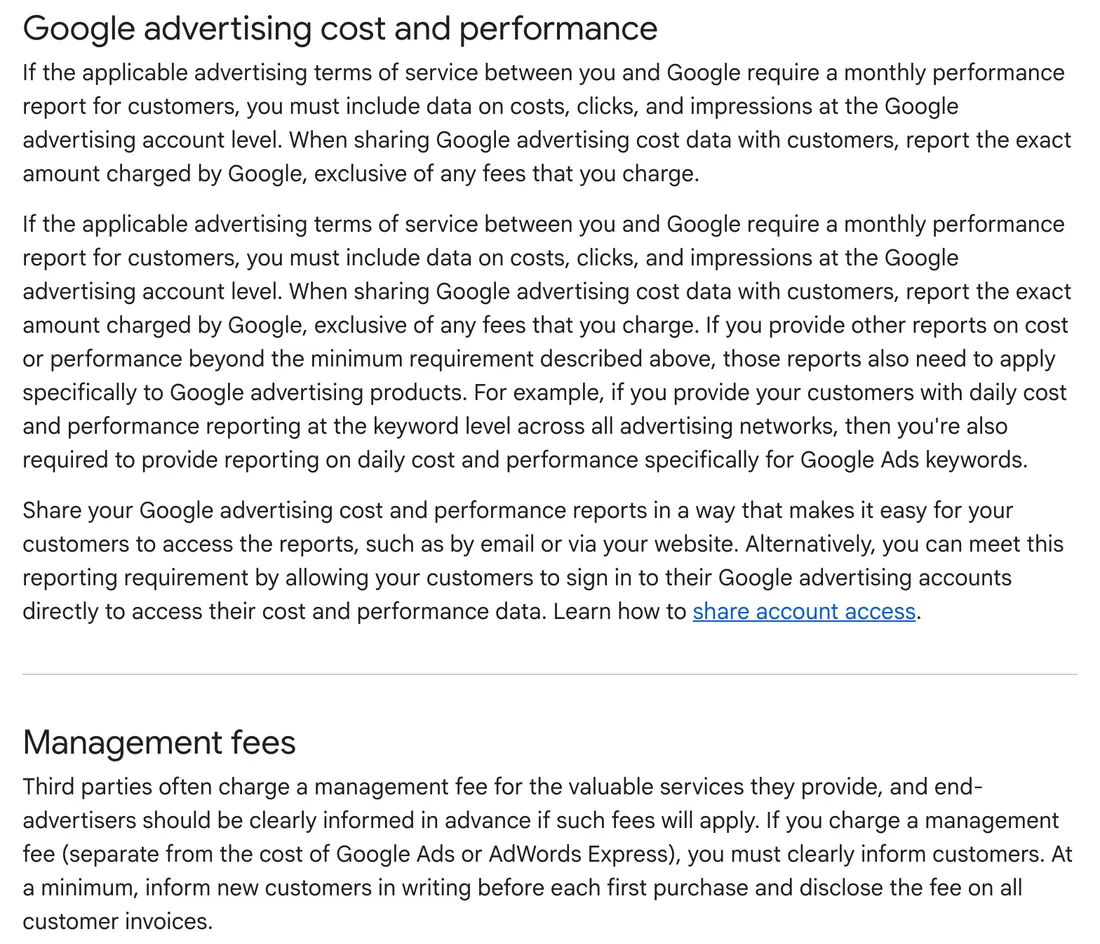
Put the practical version in your contract. The Google Ads account is created in your name, or transferred to it. The agency joins it as a manager, and you keep administrator access. The management fee is a separate line from ad spend. That last point matters most with bundled pricing such as "$8,000 a month, all in", where you cannot tell how much reached Google. Ask for the split in writing. Google's rule means a legitimate agency should not object.
How an agency can be paid, and the arrangement to refuse
Pay a marketing agency a flat fee or a fee for defined work, and never a fee that rises with the number of patients admitted. Under 18 U.S.C. 220, the federal law known as EKRA, it is a federal crime to pay or offer anything to induce a referral to a clinical treatment facility or recovery home, or in exchange for someone using its services. Each occurrence carries up to $200,000 in fines and up to 10 years in prison. The carve-out for staff and contractors holds only while their compensation stays flat, unaffected by how many people they send or how much gets billed for them.
In practice that turns a pitch that sounds commercially sensible, "we only get paid when you get admits", into the arrangement to refuse. None of the 27 agencies in our census advertised per-admission pricing, which is reassuring. The seven that talk about cost per admission use it the right way round, as a measure of how well your money is working. If an agency proposes a bonus per admission, a share of collections, or a rate per "qualified patient", thank it and end the call, or put the proposal in front of your healthcare attorney before anything else.
State law can reach further than federal law, and it varies. A 2024 study in the Substance Use & Addiction Journal by Garrido and colleagues at Boston University and the VA reviewed state patient brokering and deceptive marketing laws in effect at the end of 2022. It found that every deceptive marketing law bans false or misleading claims about the services on offer, but that states differ widely on whether they also ban lead generation and indirect inducements. An agency that works across states should be able to tell you which rules it checks your campaigns against in yours. For the wider picture of filling beds without buying referrals, see rehab marketing without buying leads.
The responsibility for claims does not move to the agency either. Google's hiring guidance makes the point directly: whatever a firm you hire does on your behalf, the responsibility stays with you. If your ads or pages overstate outcomes, the complaint lands on the center's name, not the agency's.
Who handles patient data, and the agreement no website mentioned
An agency that handles your patients' health information is, in HIPAA's terms, a business associate, and it needs a signed business associate agreement before it starts. The definition at 45 CFR 160.103 reaches any outside party that makes, takes in, stores or passes along protected health information for a covered entity, as long as it is not part of that entity's own staff. That is a broader net than most marketing contracts assume.
A treatment center's marketing stack collects health information all day. Call tracking records conversations in which a mother describes her son's drinking. Inquiry forms ask about insurance and substance. CRMs and chat tools store both. If your agency owns the call tracking account, reads the recordings to score leads, or has the form entries sent to its inbox, it is handling that information for you. For a program covered by 42 CFR Part 2, the confidentiality rules are stricter again.
That is why the gap in our chart matters. Fourteen agency websites used the word HIPAA, often as "HIPAA-compliant marketing". Two said plainly that they sign the agreement that makes a vendor accountable under HIPAA: one publishes its business associate addendum, the other lists signing BAAs with every client among its HIPAA commitments. Two more explain BAAs at length in guides without saying whether they sign one. Many of the rest may well sign when asked. Ask, and ask early: before the kickoff call, before the tracking is installed, before anyone sends a sample recording. If an agency hesitates, it is telling you it has not done this before, or that it plans to handle your data without taking responsibility for it. Which website data counts as protected, and how to keep it out of the wrong tools, is covered in our guide to HIPAA-compliant websites goes further.
Do you need a local agency? What the Denver searches show
A treatment center rarely needs an agency based in its own city, and the Denver results show why that search is a poor way to find one. Across the two Denver searches, 11 agencies had a page aimed at Denver. Only 2 of them published a Denver street address. Three were in California, one each in Utah, Illinois and Connecticut, and three listed no address at all on the pages we read. One of the three with no address links to more than a dozen city pages like its Denver one.
Only one of the 11 specializes in addiction treatment. Most of the rest are general healthcare or medical practice agencies, and two of the pages were written for med spas. Meanwhile two agencies from the wider census that do list Colorado offices, both with a behavioral health practice, did not appear in the Denver searches at all. In other words, the Denver searches mostly surfaced agencies that are good at ranking city pages, which is a real skill but not the one you are buying.
An agency's address also does nothing for your own local ranking. Google says local results are based mainly on relevance, distance and prominence, where distance is how far your business is from the person searching. Your agency's office is not part of that sum. Google adds that a higher local position cannot be bought or requested, which is worth remembering when an agency hints otherwise.
What does matter locally is knowledge. Google's own interview list for hiring an SEO includes "What's your experience in my country/city?" right after "What's your experience in my industry?". An agency in another state that has run campaigns for three Colorado treatment centers will usually serve a Denver program better than a Denver agency whose healthcare clients are orthopedic practices. Ask for the markets it has worked in, the competitors it expects you to face there, and whether it knows the state licensing and marketing rules that apply to you.
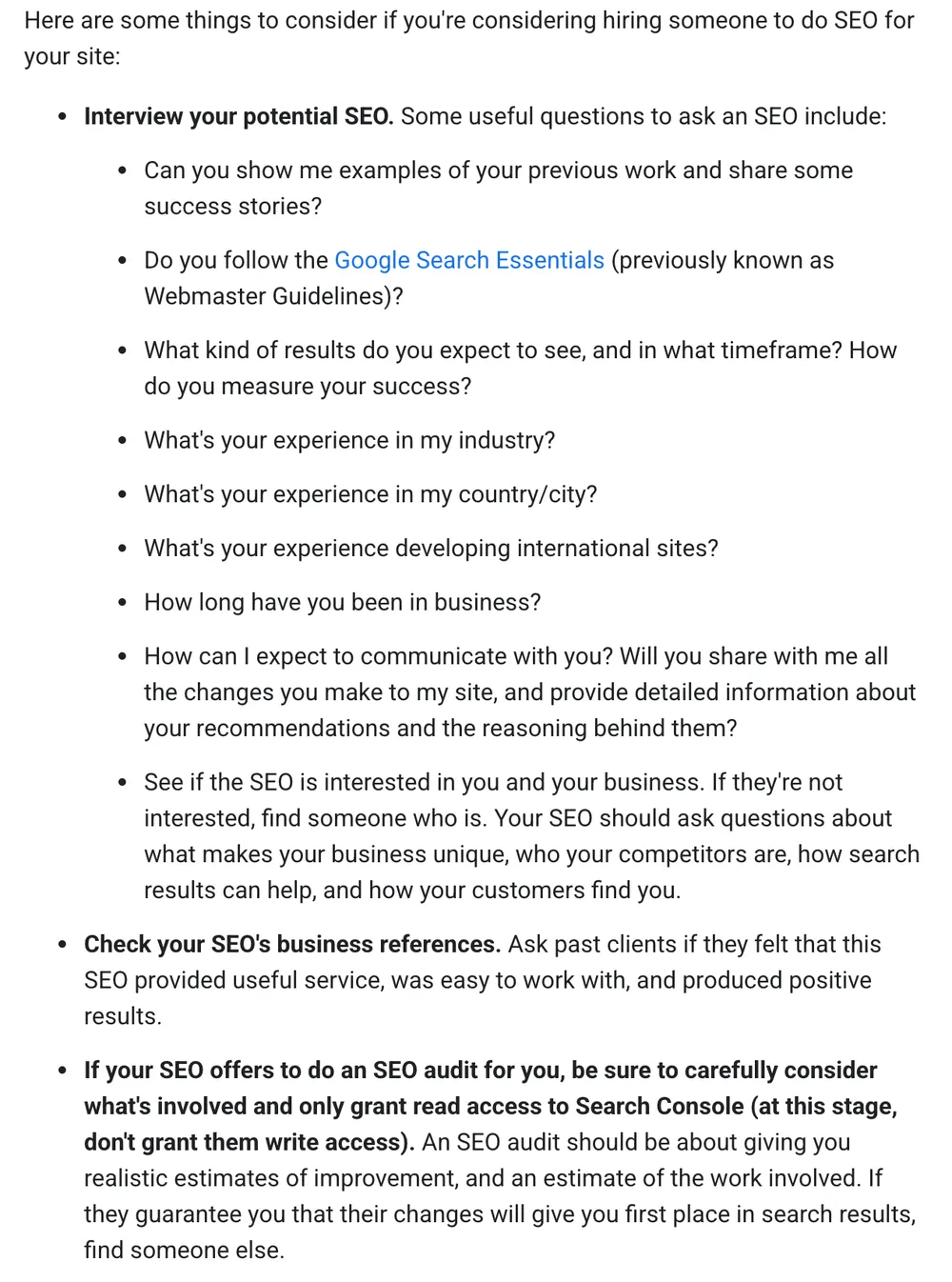
Google's list ends with two points worth borrowing for any marketing hire, not only SEO. During an audit or trial, give the agency read access to Search Console, not write access. And check references by asking past clients whether the agency was useful, easy to work with and produced results. In this niche, ask for a reference from a treatment center of your size and level of care, and call it yourself.
Twelve questions for any shortlist, and what a weak answer sounds like
Use this table on every agency you talk to, including us. The middle column is where to check the answer yourself, so you are not relying on the sales call.
| Ask | Where to verify it | A weak answer | What our census found |
|---|---|---|---|
| Are we LegitScript certified, and have you taken a center through it? | LegitScript's public certification lookup; the agency's named past clients | "We will get your ads running next week" | 8 of 27 mentioned LegitScript |
| Whose name is on the Google Ads, Meta and analytics accounts? | Your own login with administrator access | "We run everything from our account" | Not visible from outside |
| What is your management fee, separate from ad spend? | The written proposal and every invoice | One all-in number with no split | 4 of 27 published their prices |
| What is the minimum term and the notice period? | The contract, not the website | "Standard terms", unseen until signing | 7 of 27 stated terms online |
| Will you sign a BAA before you touch recordings or form data? | A signed agreement in your files | "We are HIPAA compliant" and nothing signed | 2 of 27 said they sign one |
| How are you paid, and does it ever vary by admissions? | The fee schedule in the contract | Any bonus per admit or share of revenue | 0 of 27 advertised per-admission pricing |
| Do you own directories, hotlines or referral sites? | A search of the agency's name and phone numbers | A vague "we have partners" | Not measured |
| Which treatment centers like ours have you worked with, and may we call one? | A reference call you make yourself | Only anonymous case studies | Not measured |
| How will you report results: calls, admissions, or clicks? | A sample monthly report | Impressions and rankings only | 7 of 27 reported cost per admission |
| What results do you expect, and by when? | The proposal, with its assumptions stated | Guaranteed rankings or admissions | 2 of 27 promised guaranteed results |
| What is your Google Partner status, and what have you run for treatment centers? | The Partner profile the badge links to | A badge with no link, or the badge as the whole answer | 9 of 27 claimed Partner status |
| If we leave, what do we keep and how long does handover take? | A handover clause in the contract | "We will sort that out if it happens" | Not measured |
An agency does not need a perfect score. It needs clear answers to the rows about accounts, fees, the BAA and how it gets paid, because those are the four that are expensive to fix after signing. The contract wording for ownership is set out in who owns your website, and what to check before signing.
Where KhanWork belongs on a shortlist, and where it does not
We are a design and development partner for treatment centers, not a full-service media buyer, and that should decide whether we belong on your list at all. None of our three tiers includes managing your ad spend. If what you need is someone to run a Google Ads budget, hire a paid media specialist that passes the table above, and bring us in only if the pages those ads land on are the weak link.
What we do: the website and the landing pages, the brand, the LegitScript check on every page we build, analytics and call and form tracking installed before launch, and a snapshot of what AI assistants say about your center, repeated monthly on Growth and Scale. Our prices are public on our pricing page. Foundation runs $1,000 monthly, Growth $2,500, Scale $5,000. Each is billed a month at a time, carries no minimum, and can be paused or stopped whenever you like. On every tier the first landing page ships inside 14 business days, counted from the day your assets reach us, or the following month is free. The accounts sit in your name and the files are yours.
On proof: 200+ projects shipped, and 5 treatment centers served. Cornerstone Healing Center, an addiction treatment client, recorded 20% more website conversions following its redesign with us. How we approach addiction treatment work is on our addiction recovery page. If you are not sure whether your problem is the ads or the page they land on, the free review of your landing page, which is usually the homepage or the page your ads point to, is a quick way to find out before you hire anyone.
The same-brief test: send one page to three agencies
The fastest way to compare agencies is to give them identical information and compare what comes back. Write one page, and send it to your three shortlisted agencies on the same morning.
- Put your real numbers in it. Levels of care, locations, whether you are LegitScript certified, current monthly ad spend, admissions last quarter, and the payers you accept. Say who owns your ad and analytics accounts today.
- Ask for four things in writing. The management fee separate from ad spend, the minimum term and notice period, whether they will sign a BAA, and how they would report results each month.
- Score the replies on what they asked you. A good agency comes back with questions about your census, your intake process and your certification before it proposes anything. A reply that jumps straight to a package is telling you how the account will be run.
- Note what nobody mentioned. Did anyone raise LegitScript unprompted? Did anyone promise rankings? Did anyone propose being paid by the admission? Each of those is worth more than the price.
- Time the replies. An agency that takes a week to answer a sales brief will not answer a disapproved ad on a Friday any faster.
Lay the three replies side by side with the twelve-question table. By the end of the week you will know which agency understood your business, which one sent a template, and which one should not be trusted with your families' phone calls.
Frequently asked questions
Check five things you can verify rather than trusting rankings lists: experience taking centers through LegitScript certification, a written management fee separate from ad spend, ad and analytics accounts in your own name, a signed business associate agreement before it handles patient data, and a fee that never varies with admissions. In our September 2026 read of 27 agency websites, only 4 published prices and only 2 said they sign a business associate agreement, so most of these answers have to be asked for directly.
No. Google only allows recovery-oriented drug and alcohol addiction services ads in the United States from providers certified by LegitScript, who must also be certified with Google. Meta's policy for US addiction treatment ads likewise requires LegitScript certification plus written permission from Meta. A good agency asks about your certification before quoting a paid media plan.
It is the arrangement to avoid. EKRA, the federal anti-kickback law for addiction treatment at 18 U.S.C. 220, criminalizes paying anything to induce a referral to a treatment facility, and it only spares contractor pay that stays the same however many patients arrive. Paying a flat or scoped fee and measuring cost per admission is the safe way round. Ask a healthcare attorney about your specific contract.
Yes, if it creates, receives, stores or transmits protected health information for you, such as call recordings, inquiry form entries or CRM records. That is the work HIPAA's business associate definition, at 45 CFR 160.103, was written to capture. Get the agreement signed before tracking is installed or any recording is shared.
The agencies in our census that publish prices start between $750 and $6,800 a month, before ad spend. Lead to Recovery lists local SEO from $750 a month per location and PPC management from $1,000, Beacon's packages start at $4,500, and Treatment Center Agency's monthly care plans start at $6,800. Compare proposals only after confirming they cover the same locations, channels and content volume.
Not necessarily. Of 11 agencies with Denver-targeted pages in our September 2026 searches, only 2 published a Denver address and only 1 specializes in addiction treatment. Google's local ranking depends on relevance, distance from the searcher to your business, and prominence, so the agency's office does not affect it. Ask instead about experience with treatment centers in Colorado and the state rules that apply to you.
Treat them as advertising until proven otherwise. For the search "best marketing agency for addiction treatment centers", four of the five lists on the first page sat on sites unrelated to marketing or addiction, such as a colon cancer podcast and a fast-food menu site, and none explained its method. The fifth was an agency's own list that ranked itself first. Use lists only as a source of names to check.
 Recovery
Sep 29, 2026 · 16 min
Who Hosts and Maintains a Treatment Center Website? What 60 Rehab Sites Show
We looked up the host, domain, certificates and software behind 60 ranking rehab websites to show who should host and maintain a treatment center website, what it costs, and where HIPAA changes the answer.
 Recovery
Sep 28, 2026 · 17 min
Drug and Alcohol Rehab Website Design: Build It Around What Families Search
We read 73 ranking rehab pages and 67 alcohol and opioid pages to show how a drug and alcohol rehab website should be worded, structured and designed for the family searching at night.
 Recovery
Sep 27, 2026 · 17 min
Addiction Treatment Website Development: What Actually Gets Built
We read the code, headers and sitemaps of 45 ranking rehab websites to show what a treatment center build contains, layer by layer, and what to put in writing before you hire a developer.