How Much Should an IOP Website Cost in 2026?

Nov 8, 2026 · 17 min read
An intensive outpatient program is the level of care built for people who still go to work, still pick up their kids and still sleep at home. That makes its website a strange thing to price. The visitor is often reading at night, on a phone, after a shift, and the questions are blunt: which evenings, how many hours, will my insurance cover it, and can I start next week without telling my boss.
So on 8 November 2026 we priced an IOP website from three directions. First, the treatment-center web sellers that put a fee on their own pricing pages. Second, what a single IOP client is actually paid, using the 2026 Medicare rates and two programs' own self-pay prices. Third, we pulled every for-profit, outpatient-only IOP program within 25 miles of 28 US metro centers from the federal FindTreatment.gov locator, and read the 272 websites that talk about IOP.
The 30-second answer: IOP website cost in 2026
An IOP website costs $3,500 to $6,000 from the cheapest rehab-specialist sellers that print a price, $8,000 to $25,000 one-time from mid-market builders, and $6,800 a month or more when the site is bundled into a full marketing retainer. Over three years with upkeep, published options run from about $3,500 to $52,000. Medicare pays $319.38 to $418.45 for a single IOP day in 2026, so one client attending three days a week for eight weeks is worth more than any of the cheaper builds. The money should buy a printed weekly schedule, an evening or virtual track page, an insurance check that gets answered, and a site that passes LegitScript.
Why an IOP site is its own job
An IOP website sells time, not a bed. A residential site has to make a stranger comfortable sleeping somewhere for thirty days. An IOP site has to convince someone that treatment fits around a life they are trying to keep, and the proof is a schedule.
The federal definition is specific about this. Medicare's rule at 42 CFR 410.44 says intensive outpatient programs are for patients who need a minimum of 9 hours of therapeutic services a week, who do not require 24-hour care, and who have an adequate support system while they are not in the program. Partial hospitalization, one rung higher, starts at 20 hours a week under the neighbouring section. The clinical world uses a parallel ladder: the fourth edition of the ASAM Criteria keeps Level 2.1 as IOP, replaces the old PHP model with a Level 2.5 called High-Intensity Outpatient, and adds a new Level 2.7 that combines clinical and medical services for 20 or more hours a week, as NAATP's implementation summary puts it.
Three consequences follow for the website. The schedule is the product, so it has to be on the page in text. Most programs run more than one track, so the site needs a page per track rather than one page that says "flexible scheduling". And the visitor is usually still at home with the problem, which means the site is read in private, often late, often by someone deciding whether to tell anyone. We wrote about the content side of those pages in what families read on PHP and IOP program pages. This article is about the budget.
IOP is also crowded. Of the 2,903 substance use facilities FindTreatment.gov lists within 25 miles of our 28 metro centers, 1,530 list intensive outpatient treatment, a little over half. Of those, 1,298 have no residential or inpatient setting at all, so the IOP is the whole business, and 747 of those are for-profit. Your website is competing with every one of them in the same few miles.
Who prints a price
Four treatment-center web sellers print a fee you can compare, and none of them sells an IOP-specific package. That is normal. An IOP site is built from the same parts as any rehab site, with fewer rooms to photograph and far more schedule to explain.
| Seller | What the price covers | Printed fee | Upkeep or monthly |
|---|---|---|---|
| DrugRehab.Agency | A rehab website with conversion work, live within 30 days | $3,500 to $6,000 | Not printed |
| Lead to Recovery | Website design and development for treatment centers, projects from 5 weeks | From $4,800 | Separate programs: local SEO from $750 a month per location, CRO from $1,000, PPC from $1,000 |
| Webserv | Rehab builds in three sizes: up to 10, 20 or 40+ pages; 1, 3 or 5+ locations | Core $8,000, Growth $15,000, Enterprise $25,000 one-time | Optional maintenance $250, $450 or $750 to $950 a month |
| Treatment Center Agency | Website and hosting care with monthly SEO and conversion work | Landing pages from $1,200 a page | Growth Care from $6,800 a month; Professional $10,000 to $12,000 |
The cheapest printed offer is DrugRehab.Agency at $3,500 to $6,000, with a promise to have the site live within 30 days. Lead to Recovery starts website projects at $4,800 and says projects start at 5 weeks; its search and conversion work is priced separately, from $750 a month per location for local SEO. Webserv prints three one-time builds at $8,000, $15,000 and $25,000, sized by page count and number of locations, with optional maintenance from $250 to $950 a month. Treatment Center Agency sells care plans rather than builds: Growth Care starts at $6,800 a month, and a single landing page starts at $1,200.
Read the chart with the caption in mind. The two cheapest bars look cheap partly because those sellers do not print an upkeep fee, so three years of hosting, edits and plugin updates are not in the number. Webserv is the only seller in the set that prints both halves, and it shows how upkeep adds up: $250 a month is $9,000 over three years, more than the Core build itself.
What the estimators and sellers say a build "really" costs
The range widens once you read the fine print. ProjectCostEstimator's rehab center page says a site costs $5,800 to $15,950 through a freelancer, or $13,750 to $37,700 through an agency, and puts the middle of the market near $10,850. The same page also gives the agency floor as $13,800 in its table and a median freelancer build of $7,500, so treat it as a rough band rather than a quote. For running costs it allows $80 to $400 monthly, and another $150 to $350 monthly once admissions and insurance-verification tools are added.
Webserv's FAQ tells a different story from its own price cards: in its words the typical addiction-treatment build lands between $25,000 and $80,000, and four add-ons (CRM integration, call tracking, a verification-of-benefits form workflow, HIPAA-compliant analytics) cost $3,000 to $10,000 apiece. An outpatient-only program usually does not need all four on day one. It does need two of them: call tracking, because the phone is the step IOP sites push hardest (251 of the 272 sites we read lead with a phone link on the homepage), and a verification form that lands somewhere private and gets answered.
Our reading of all this: a single-location IOP with one or two tracks can get a sound website for $4,000 to $15,000 built, and should budget something every month to keep the schedule current. Above $25,000, you should be buying multiple locations, real integrations, or both.
What one IOP client is worth
The fairest way to judge a website budget is against what one admission brings in, and IOP has a public benchmark. Since 1 January 2024, Medicare has covered IOP as its own benefit, created by Section 4124 of the Consolidated Appropriations Act, 2023. For 2026, CMS pays $319.38 for an IOP day with three or fewer services and $418.45 for a day with four or more, and pays federally qualified health centers the same rate as hospitals.
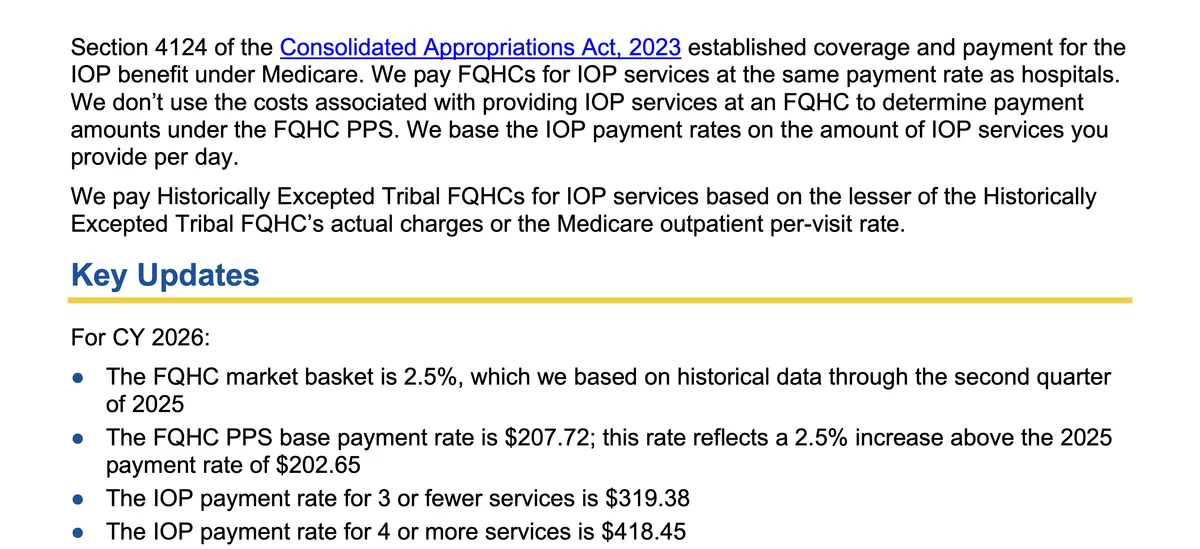
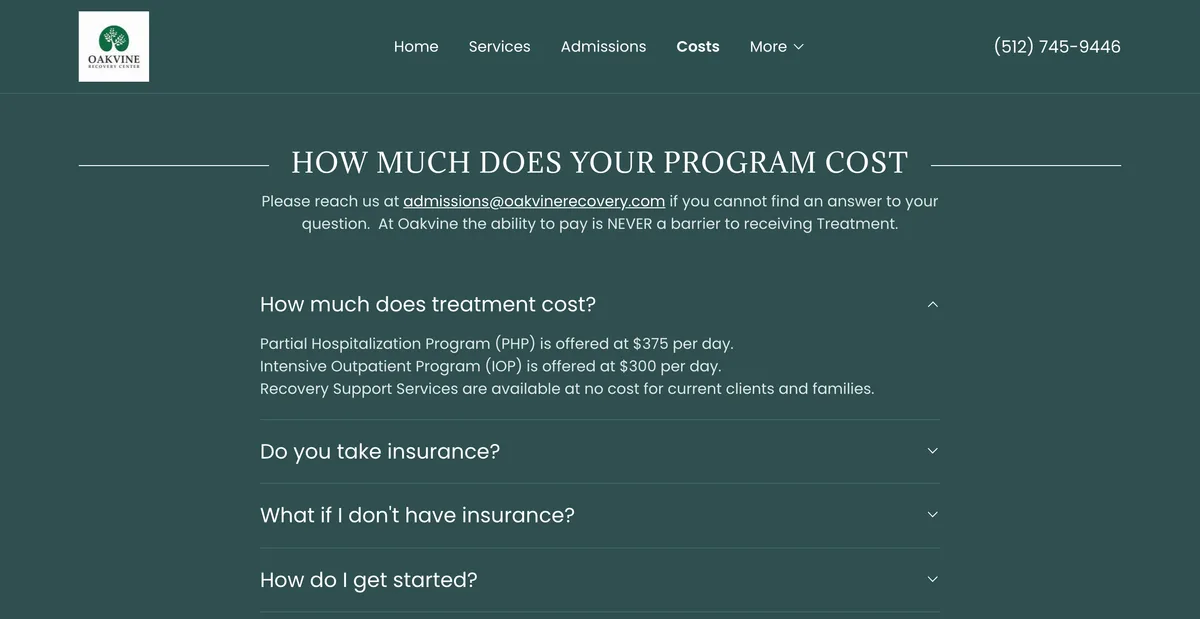
Some programs print their own number. In our sample, Oakvine Recovery Center in Texas offers IOP at $300 a day and PHP at $375. Great Care prints $200 for an IOP program day. Divine Counseling Service prices its IOP as a package, $1,420 for 18 classes including individual sessions, and Practical Recovery in San Diego quotes $3,000 to $4,000 a week for its intensive program, plus food and lodging.
Now the arithmetic, at Medicare's lower rate, as an illustration rather than a forecast. Three days a week comes to $958.14 a week. Eight weeks of that is $7,665.12. At the four-service rate the same eight weeks is $10,042.80. Commercial plans pay their own negotiated rates and cash prices vary, but the shape holds: one IOP client who completes a standard course is worth roughly what a mid-priced IOP website costs to build. Most programs need the site to bring in more than one person a year, which is why the cheapest build is not automatically the cheapest choice.
It also changes how to read a monthly retainer. Treatment Center Agency's Growth Care at $6,800 a month is $81,600 a year before any advertising. At the Medicare figures above, that is somewhere between eight and eleven completed eight-week courses a year just to cover the fee. Some programs will clear that easily. A two-clinician IOP with one evening track probably will not.
What 272 IOP websites actually show
We started from the federal locator rather than a search engine, so the sample is not shaped by who buys ads. Of the 747 for-profit, outpatient-only IOP programs, 500 listed a website domain. Our script loaded 448 of them, and 272 talked about IOP enough to count: IOP had to appear on the homepage, and three or more times in total once we added up to eight linked pages on programs, insurance, admissions or cost.
The listings themselves say how these programs get paid. Of the 747, 628 accept private health insurance, 448 accept Medicaid and 233 accept Medicare, and 341 also run a PHP. So the typical IOP website is talking to insured adults, and in many cases to people on Medicaid too.
The basics are mostly there. 251 of 272 homepages have a phone number you can tap, and 201 sites invite visitors to check or verify insurance. 131 mention LegitScript, which matters because it gates Google advertising for addiction services, and 190 also describe a PHP.
The gaps sit exactly where an IOP visitor needs answers. Only 63 sites, 23 percent, print how many hours a week the program takes. 168 give some schedule detail, but often only a phrase like "three days a week" with no hours. 117 print actual session times. Just over half do not mention an evening option anywhere we looked, even though evening is the reason many working adults choose IOP. Only 58 name a virtual or online IOP. And 4 sites print their own IOP price, while three others print a generic industry range of $3,000 to $10,000 that says nothing about their own program.
The schedule is the product page
If you take one thing from the census, take this: the most valuable paragraph on an IOP website is the schedule, and three quarters of programs leave the hours out. A visitor deciding whether IOP fits around a job needs four facts: how many days, which hours, how many weeks, and whether there is an evening or virtual option. Each one is a sentence. Together they answer the objection that stops most working adults from calling.
The better sites in our sample did it plainly. One Texas program writes that IOP typically involves 9 hours a week, three groups and one individual session. A Colorado provider says at least 10 hours a week for 12 weeks. Another program says group treatment steps down to 1 to 3 nights a week, 4 to 9 hours a week. None of that is marketing copy. It is information, and it does more work than any headline about "personalized care".
Build the schedule as text, not as an image of a timetable, so search engines and AI assistants can read it, and so a staff member can change it without calling a developer. If you run an evening track, give it its own page with its own times. If you run virtual IOP, say which states you can serve, because clinicians generally have to be licensed where the client is, and say how sessions happen. A program that runs three tracks and describes them on one page is asking every visitor to do the sorting themselves.
Price, insurance and the money question
The second thing an IOP visitor wants to know is what it will cost them, and the sample shows most programs dodge it. 201 sites ask visitors to verify insurance, but only 123 name a single commercial insurer anywhere we looked. A verify button with no named plans asks the visitor to trust you before you have told them anything.
Prices are rarer still. 4 of 272 print their own IOP price, and even the clearest of them, Oakvine, hides the number inside a closed accordion. Only 2 sites mention a Good Faith Estimate at all, the written estimate federal rules require for uninsured and self-pay patients. Your site does not need a full rate card. It does need one honest line for the self-pay visitor: either a price, or how to ask for a written estimate and how fast it arrives.
The insurance form itself deserves budget. It collects health information, so the form tool and the inbox it feeds should be covered by a business associate agreement, and someone should answer it the same day. We cover the mechanics in why insurance verification pages lose admissions. The tracking that runs around that form matters too: 36 homepages in our sample load Meta's advertising pixel, and the safe default is to keep advertising pixels off any page where people type health details.
The rules that gate the build
Four rules change what an IOP website has to do, and each one has a cost.
LegitScript and Google Ads. Google restricts the promotion of recovery-oriented drug and alcohol addiction services, and in the US an advertiser needs LegitScript certification before Google will certify it. LegitScript's published fees are $1,395 to $1,595 per facility to apply, nonrefundable, and $2,550 to $3,095 per facility each year once approved; a program with one to nine facilities pays the top rates, $1,595 and $3,095. The website is part of the review, so a build that will run ads should be written to pass it; we list what reviewers look at in what LegitScript actually reviews on your website.
Virtual IOP and prescribing. If your virtual track includes medication for opioid use disorder, the DEA and HHS have extended the pandemic telemedicine flexibilities for prescribing controlled medications through 31 December 2026. A virtual IOP page written today should not promise a prescribing model that may change in eight weeks.
Accessibility for programs that take HHS funding. HHS's Section 504 web accessibility rule applies to recipients of its financial assistance, which includes programs paid through Medicaid. An interim final rule published 11 May 2026 moved the compliance date to 11 May 2027 for recipients with 15 or more employees and 10 May 2028 for smaller ones. With 448 of 747 programs in our pull accepting Medicaid, that date belongs in the build plan.
The Medicare criteria themselves. If you bill Medicare, your program page should not describe IOP in a way that contradicts the benefit, for example by implying someone in active danger to themselves is a fit. The 410.44 criteria are a useful checklist for the "is IOP right for me" section.
Questions to ask any IOP web designer
These work on any vendor, us included. The last column is our census: how the 272 IOP sites we read measure up on each point.
| Ask the vendor | A good answer sounds like | What our sample found |
|---|---|---|
| Where will the weekly schedule live, and who updates it when a group moves? | A schedule block your staff can edit in minutes, printed in text on the IOP page | Hours per week printed on 63 of 272 sites |
| How will an evening or virtual track get its own page? | One page per track you actually run, with its own times and its own call to action | Evening named on 128, virtual IOP on 58 |
| What happens after someone submits the insurance form? | A named person, a reply time, and a form that is covered by a business associate agreement | Verify wording on 201 |
| Will you print our self-pay price, or explain why not? | Either the number, or a plain line on how to get a Good Faith Estimate | Own price on 4; Good Faith Estimate on 2 |
| How do you handle LegitScript and Google's addiction ad policy? | They check every new page against the certification before it goes live | LegitScript on 131 |
| Which tracking runs on the IOP and insurance pages? | A specific list, with no advertising pixel on pages where people type health details | Meta pixel on 36 homepages |
| Who owns the domain, the code and the hosting account at the end? | You do, in writing, with no fee to leave | Not visible from outside |
| What does a change cost after launch? | A printed monthly fee or an hourly rate, not "we will quote it" | Webserv and Treatment Center Agency print monthly fees |
Where KhanWork fits
KhanWork is a design and development team that works with addiction treatment and behavioral health programs; 5 treatment centers have hired us so far. Cornerstone Healing Center, one of them, converted 20 percent more of its website visitors once our redesign went live. Every figure we charge is listed on our pricing page, and those figures land in the middle of the ranges in this article.
Our Foundation Partner tier is paid once and comes in two sizes. The $1,000 option refreshes your brand and builds one landing page meant to convert, live in 14 business days from the day your content and assets land. The $2,500 option refreshes your brand and builds every page of the site, live in 21 business days. For a single-site IOP, the landing-page option suits a program that already has a working site and needs one strong page for its evening or virtual track; the full-website option suits a program rebuilding from scratch. Both include a LegitScript check, GA4, and call and form tracking with a recorded baseline.
Work after launch moves to Growth Partner at $2,500 a month: send as many requests as you like and we work through them one by one. Operators running several sites use Scale Partner at $5,000 a month. Neither has a contract length; each month is invoiced at its start, and a pause or a cancellation takes effect whenever you ask. Hosting is not included, and the code, content and domain stay yours.
Who should not hire us: a program that needs a CRM, an EHR integration and a call center wired together in one project should talk to a larger integrator such as the mid-market builders above. And a brand-new IOP with no clinical schedule yet should finish that first, because the schedule is what the website sells.
Our addiction treatment website work shows how we approach these sites, and our conversion optimization service covers the forms and calls in detail. If you are comparing full-site budgets across levels of care, our addiction treatment center website cost guide covers residential and detox. If you would rather start without a budget, the free funnel review is the place: for an IOP that usually means your homepage or the program page your ads point at, and we send back the first fix we would prioritise there.
The Tuesday-evening test
Run this yourself before you hire anyone. Wait until 9 p.m. on a weekday, pick up your phone, and pretend you work days and drink most nights. Search for "IOP near me" plus your town, then tap the first listing that belongs to you.
- Hours. Can you find how many hours a week your IOP takes, in text, within two taps?
- Evenings. Can you tell whether there is an evening track and which nights it runs?
- Weeks. Does the site say roughly how many weeks the program lasts?
- Virtual. If you offer virtual IOP, is there a page that says how it works and which states you serve?
- Plans. Can you see at least one named insurance plan you accept?
- Self-pay. Is there a price, or a plain line on how to get a written estimate?
- Reach. If you call the number now, does a person answer, and if you fill in the form, does the page say when you will hear back?
Seven questions, one point each. Score 6 or 7 and your website is doing its job; spend on reach rather than a rebuild. Score 3 or less and the website is the reason working adults are not calling, and the price ranges in this article are your starting budget. Most of the 272 sites we read would lose their first point on question one.
Frequently asked questions
An IOP website costs $3,500 to $6,000 from the cheapest rehab-specialist sellers that print a price, and $8,000 to $25,000 one-time from mid-market builders such as Webserv. Bundled marketing retainers start around $6,800 a month. Over three years with upkeep, published options run from about $3,500 to $52,000.
A template can work for a single-location IOP if it carries the schedule in text, a page per track, a working insurance check and a LegitScript-ready program description. The risk is not the template, it is what it leaves out: in our sample of 272 IOP sites only 63 printed hours per week.
It should at least tell self-pay visitors how to get a written estimate, and a price is better. Only 4 of the 272 IOP sites we read printed their own IOP price, and only 2 mentioned a Good Faith Estimate, so either one sets a program apart.
Yes, if the program plans to run Google ads for addiction treatment in the US, because Google requires LegitScript certification first. The published fees are $1,395 to $1,595 per facility for the application and $2,550 to $3,095 per facility a year after approval, and the program's website is reviewed during the process.
Medicare pays $319.38 for an IOP day with three or fewer services and $418.45 for a day with four or more in 2026. CMS pays federally qualified health centers the same IOP rate as hospitals, under the benefit created by Section 4124 of the Consolidated Appropriations Act, 2023.
A virtual IOP does not need a separate website, but it needs its own page. That page should say how sessions run, which states you can serve, and whether medication is prescribed, noting that the federal telemedicine prescribing flexibilities currently run through 31 December 2026.
Published timelines for an IOP website run from about three weeks to fourteen. DrugRehab.Agency promises launch within 30 days, Lead to Recovery says projects start at 5 weeks, and ProjectCostEstimator puts a typical freelancer build at 6 to 14 weeks. KhanWork's Foundation build is live in 14 business days for a landing page or 21 for a full website, counted from the day content and assets land.
 Recovery
Nov 2, 2026 · 17 min
How Much Should a Luxury Rehab Website Cost in 2026?
Treatment center web firms print builds from $3,500 to $25,000, while one private-pay month at a luxury center runs $21,000 to over $100,000. We priced both and read 190 residential center websites.
 Recovery
Oct 27, 2026 · 17 min
How Much Should a Dual Diagnosis Treatment Center Website Cost in 2026?
Treatment center web firms print builds from $3,500 to $25,000, and the one dual diagnosis specialist prints no price at all. We priced each offer over one and three years and read 315 dual diagnosis program websites.
 Recovery
Oct 26, 2026 · 17 min
How Much Should an Adolescent Treatment Center Website Cost in 2026?
Treatment center web firms print builds from $3,500 to $25,000, and none prices teen programs separately. We priced three years of each offer and read 137 adolescent program websites to see what parents find.