How Much Should an Adolescent Treatment Center Website Cost in 2026?

Oct 26, 2026 · 17 min read
In 2023, four in ten American high school students told the CDC's Youth Risk Behavior Survey they had experienced persistent feelings of sadness or hopelessness in the past year. Ten years earlier it was three in ten. Two in ten had seriously considered suicide, and almost one in ten had tried. Behind those numbers is a parent at a kitchen table with a laptop, reading program websites late at night and trying to decide where to send their child.
The programs that parent is reading about, adolescent residential treatment, partial hospitalization and intensive outpatient for mental health and substance use, buy websites from the same agencies that sell to adult rehabs. So on 26 October 2026 we did two jobs. We priced every treatment center website offer we could find with a fee printed on the seller's own page and turned each into a three-year cost. Then we used SAMHSA's FindTreatment.gov locator to list every private program in 28 metro areas that accepts children and adolescents at an intensive level of care, and read the 137 websites of those programs that put teens on their homepage.
The 30-second answer: adolescent program website prices
An adolescent treatment center website costs about $3,500 to $25,000 to build at the prices treatment center web firms publish, and about $3,500 to $52,000 over three years once upkeep is added. Programs that bundle the website with search marketing run $750 to $7,500 a month at published rates, which comes to roughly $32,000 to $275,000 across 36 months, and the ad budget is on top of that. None of the sellers we found prints a price for an adolescent program in particular, and the agency that markets itself most plainly to adolescent residential centers prints no fee at all.
The better measure is admissions. Cenikor, one of the programs in our sample, publishes a private pay rate of $400 a day for its adolescent treatment program, with an expected stay of 4 to 12 weeks. That is $11,200 to $33,600 for one teenager. A site that brings in two extra families a year pays for most of the offers below, and a site that loses two pays for none of them.
Sellers that print a number, and the one that does not
Four firms that build websites for treatment centers show a fee on a page they control. We held them to the same test as every cost guide on this site: a figure only counts if the seller printed it, on its own page, as a price for the work. Budget brackets on an inquiry form do not count.
| Seller | What the price buys | Price, as printed | Terms worth reading |
|---|---|---|---|
| DrugRehab.Agency | A rehab website build | $3,500 to $6,000 | Includes conversion work and staff training on updates; the page says there is no monthly management fee |
| Lead to Recovery | Website design and development | From $4,800 | Sold beside monthly SEO from $750 a month per location, with a 90-day minimum on the SEO plans |
| Webserv | A treatment center website, one time | $8,000 Core, $15,000 Growth, $25,000 Enterprise | Optional upkeep of $250, $450 or $750 to $950 a month; its FAQ calls $25,000 to $80,000 typical for a rehab build |
| Sweet Media | Monthly SEO, with or without a new site | $3,000 a month Core, $5,000 a month Growth | Growth includes a full redesign; on Core, a site is a separate $3,000 to $10,000 invoice; month to month |
None of the four sells only to adolescent programs. They sell to treatment centers in general, adult and youth alike. The firm we found that speaks most directly to youth programs is Allgood Marketing, whose residential treatment center page describes separate funnels for adult and adolescent admissions and "parent-decision landing pages" for teen residential care. It prints no fee. The only dollar figures on that page are the brackets of a form asking what you spend on marketing now, starting at $3,000 to $5,000 a month, so it stays out of the table.
Read Webserv's FAQ beside its price cards. The cards begin at $8,000. The FAQ names $25,000 to $80,000 as the usual range for an addiction treatment build, $50,000 to $120,000 for a multi-location center, and $3,000 to $10,000 apiece for each integration (CRM, call tracking, a verification of benefits form, analytics set up for HIPAA). An adolescent program that wants a parent portal, an online referral form for school counselors and a verification tool is shopping in the FAQ's range, not the price cards'.
Three years of each offer, priced from the sellers' pages
Held for 36 months, these build-only offers cost from $3,500 to $52,000. Each bar is the one-time fee plus 36 months of the monthly charge the seller lists. Where the seller lists no monthly charge, the bar is the build alone.
Hosting is billed on top in most of these, usually by the hosting company rather than the agency, and none of the bars includes the integrations Webserv prices separately. Read the chart as a floor for a program that already has its own admissions process, call tracking and forms in place.
Monthly programs that come with a website
When the website is sold inside a search marketing program, three years costs about $32,000 to $275,000 before a dollar goes to Google or Meta. Lead to Recovery prices search by geography: local at $750 a month per location, regional at $1,500 and national at $7,500. Sweet Media prices it by scope: $3,000 a month without a new site, $5,000 with one.
National search is the bar that matters most for adolescent residential care. Families travel for it. A parent in Ohio may send a daughter to a program in Arizona because that is where the right bed was, which is why residential teen programs compete for search terms well beyond their own county. A local outpatient program for teens does not need any of that. It needs to be found by parents and school counselors within a half hour's drive, and the cheapest bars on both charts are built for exactly that job.
What one teen admission is worth
Two programs in our sample print what treatment costs, and both are worth reading before you set a website budget. Cenikor publishes a full table of private pay rates. Newport Academy, a program built around teens, publishes an average family out-of-pocket figure.
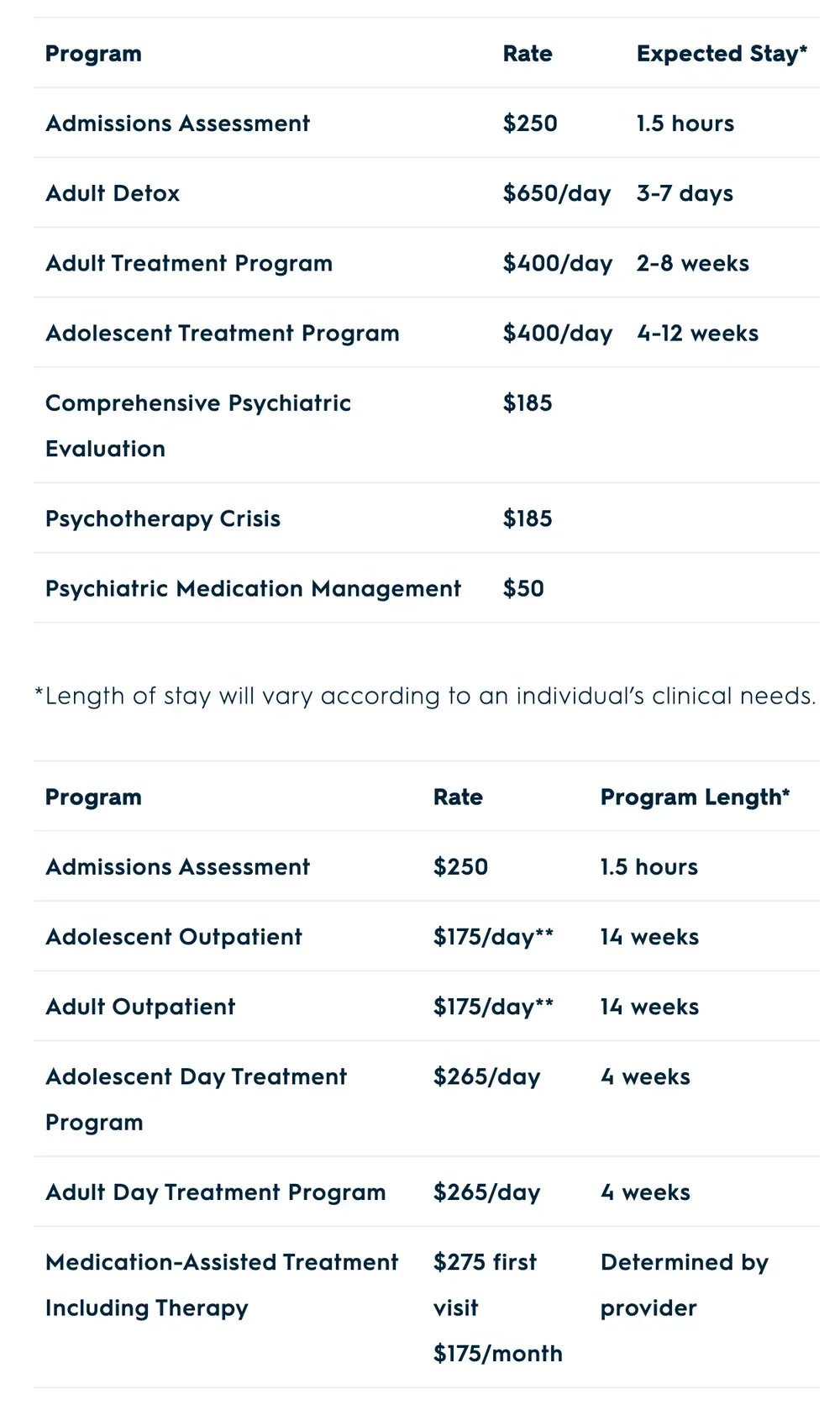
The arithmetic from that table is plain. The adolescent treatment program at $400 a day for 4 to 12 weeks comes to $11,200 to $33,600. Adolescent outpatient is $175 a day, and a footnote on the same page defines the program as four days or evenings a week for eight weeks, then three a week for six, which is 50 treatment days, or $8,750. These are private pay rates; an insured family pays a share set by its plan.
Newport's residential page answers the same question from the family side. It says that on average, families' out-of-pocket cost for teen residential treatment there is $500 a week, with the rest covered by insurance. Both figures point the same way. A teen admission is worth thousands of dollars to the program and costs a family real money even with insurance, which is why parents read so carefully, and why a vague website costs more than a plain one.
What 137 adolescent program sites show
Most adolescent program sites cover the basics a worried parent needs first and skip the details that settle the decision. We built the sample from FindTreatment.gov, the locator SAMHSA runs, rather than from search results, so it reflects what exists rather than what ranks. Across 28 metro areas the locator listed 4,493 substance use and mental health facilities within 25 miles of each city center. Of those, 2,033 accept children and adolescents, and 702 are private programs that also offer intensive outpatient, partial hospitalization or residential care. Those 702 listings point to 443 websites. We read 367 of them (the rest blocked automated visits or failed to load), each homepage plus up to eight linked pages about teens, admissions, insurance, cost, family or school, and kept the 137 that mention teens or adolescents at least twice on the homepage.
The top of the chart is reassuring. Close to nine in ten have a tappable phone number on the homepage and talk about insurance, and seven in ten talk to the parent directly. The bottom of the chart is where families get stuck. Only two of 137 print what their own teen program costs. Only 25 say anything about visits, phone calls home or how the family stays in contact during a stay, which for a residential program is often the question a parent asks first on the phone. Only 25 give the 988 Suicide and Crisis Lifeline anywhere on the pages we read, on sites whose readers include parents of teenagers in crisis.
The middle of the chart is the most useful to a program planning a rebuild. Half of the sites describe how a teen keeps up with school during treatment, and half do not. Fewer than half name a private insurer in words. Barely half offer any kind of insurance check online. Each of those is a page or a section, not a redesign, and each answers a question that otherwise costs an admissions coordinator a phone call.
Two readers on one website
An adolescent program site has two audiences, and most are written for one of them. The parent is deciding and paying. The teenager is often reading too, sometimes over the parent's shoulder and sometimes alone, and decides how hard they will resist going. Writing that serves both is harder than writing for adults, and it changes the build in four places.
- Age and fit, stated early. 93 of the 137 sites state an age range somewhere. A parent of a 12-year-old and a parent of a 19-year-old need different programs, and the ones that put the range on the homepage save both a call.
- School. 70 describe academic support in some form, from an accredited on-site school to coordination with the teen's own school. A parent's second question after safety is usually whether their child will fall behind.
- Family contact. Visiting rules, phone calls and family therapy schedules belong on the site in plain words. The 25 programs that publish them are answering the question that keeps a parent from signing.
- A page the teen can read. A short page in the teenager's own register, what a day looks like, what they can bring, what happens with their phone, does more to lower resistance than any photo of a pool.
Our guide to IOP and PHP program pages covers the day-level detail families look for, and most of it applies to teen programs with the school and family sections added.
Consent, privacy and ad rules that change the build
Three sets of rules shape an adolescent program site in ways an adult rehab site never meets, and a web firm that has not worked with minors may not know them.
The first is who may consent to what. Under 42 CFR Part 2, which governs addiction treatment records, specifically 42 CFR 2.14, if state law lets a minor apply for treatment alone, only the minor can consent to disclosure of their records, including to a parent for billing. Where state law requires parental consent to treatment, both the minor and the parent must sign. HIPAA's rule on parents as personal representatives, at 45 CFR 164.502(g), has a similar exception when a minor lawfully consents to their own care. In practice this decides what your intake forms ask, who receives the confirmation email, and whether a referral form submitted by a 16-year-old should go anywhere a parent can see it. It is a legal question for your counsel, but it is a design question for whoever builds the forms.
The second is advertising. Google's healthcare policy lets US advertisers promote recovery-oriented drug and alcohol addiction services only if they hold LegitScript certification and are certified with Google. The same policy puts other services, such as treatment for behavioral addictions, outside that rule. So an adolescent substance use program that wants to run search ads needs LegitScript, while a teen depression and anxiety program generally does not. Forty-one of the 137 sites show or mention LegitScript. Our LegitScript checklist covers what its reviewers read on a site.
The third is tracking. Eighteen of the 137 homepages load Meta's advertising pixel. On a site about a child's mental health or drug use, a pixel that also fires on an inquiry form can send an advertising platform the fact that a family asked for help. Before launch, get every tag that runs on those forms listed on paper by whoever installed it.
A sector Congress has asked to measure
Youth residential programs are under more federal scrutiny than any other part of this market, and that is a website question too. The Stop Institutional Child Abuse Act became Public Law 118-194 on 23 December 2024. It directs the Secretary of Health and Human Services to contract with the National Academies of Sciences, Engineering, and Medicine for a study of youth in residential programs, with a first report due within three years and further reports every two years for ten years.
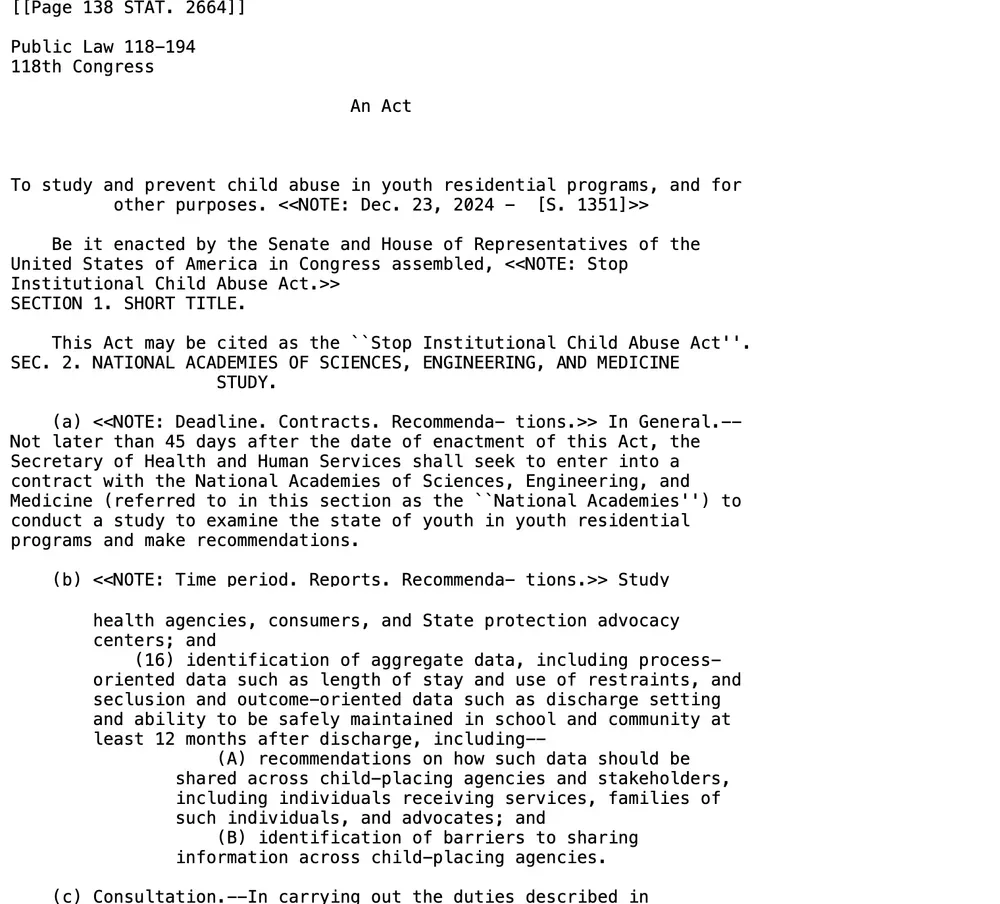
Look at the data the study is told to identify in section 2(b)(16): length of stay, use of restraint and seclusion, discharge setting, and whether a young person is safely maintained in school and the community a year after leaving. The law also defines a youth residential program broadly enough to include residential treatment centers, therapeutic boarding schools and wilderness programs. Those are the questions an informed parent already asks. A program that publishes its typical length of stay, its approach to restraint and its follow-up outcomes is answering them before it is asked, and in our census almost none do.
The scrutiny is not new. In 2008 the Government Accountability Office reported on deaths, abuse and deceptive marketing in residential programs for youth, after investigators posing as parents of troubled teenagers called 14 programs and related services. A website that makes vague promises to frightened parents is the kind of marketing that report examined. A website that states ages, prices, rules and outcomes in plain words is the opposite, and it is cheaper to build than most programs assume.
Questions to put to any web firm before a teen program signs
Whatever a seller charges, it should be able to answer each row below in writing before you sign. The right-hand column says why the answer matters more for adolescent care than for adults.
| Ask this | A good answer | Why it matters for teen programs |
|---|---|---|
| Have you built for a program that treats minors? | A live adolescent site you can visit and a person there you can call | None of the four sellers above prints a price for adolescent work specifically |
| Who receives a form submitted by a 16-year-old? | A routing plan your counsel has approved, in writing | Consent rules for minors decide who may see a referral; 42 CFR 2.14 is one of them |
| Which scripts load on the inquiry and referral forms? | Each tag named in writing, and nothing from an ad network on a page where a family describes a child | 18 of the 137 homepages we read load Meta's ad pixel |
| Will the site say how families stay in contact? | A drafted section on visits, calls and family therapy | Only 25 of 137 sites explain it |
| Where does school support appear? | A named section or page, linked from the program pages | Half the sites we read say nothing about it |
| Is LegitScript in scope, and who handles the application? | A clear yes or no based on your services, and a named owner | Google requires it for addiction services ads in the US, not for most mental health services |
| What does three years cost, all in? | Build, upkeep, hosting and any monthly plan on one page | Published offers run from $3,500 to about $275,000 over three years before ads |
| Who holds the domain, the code and the design files when we part ways? | The program does, stated in the contract | A program that changes agencies should not lose its parent guides and photos |
Where KhanWork fits, and who should buy something smaller
A small teen outpatient program that gets most of its families from school counselors and pediatricians does not need us. A $3,500 to $6,000 build with a strong page for parents, a school section and a clear phone number will serve it well, and the rest of the budget belongs to clinicians.
We print our own numbers on the pricing page, so the test we applied to everyone else applies to us. There are three monthly tiers, paid a month ahead: $1,000 (Foundation), $2,500 (Growth) and $5,000 (Scale). Nothing locks you in; you can pause or stop in any month. Foundation is a brand refresh plus the one page parents land on from your ads or referrals, launched no later than 14 business days after your copy and photos arrive, with the next month free if we miss that date, and after launch it adds a page each month. Growth is the full site, with no cap on requests, worked on one after another. Scale works two requests side by side, which suits a program with more than one campus. You keep hosting under your own account; no tier bills for it. Kept for three years, Foundation totals $36,000: above Webserv's Growth bar on the first chart, below its Enterprise bar, and close to the cheapest bar on the second.
We fit a program that already has demand and suspects the website is where families drop away: parents call with the same five questions, referrals stall at the form, ads bring visits and not admissions. That is conversion work, page by page, judged on admissions. After we rebuilt its site, Cornerstone Healing Center, one of five treatment centers we have served, recorded 20 percent more website conversions. Our page for addiction treatment and recovery centers and our mental health page explain how we work with programs like yours. For an outside read before any of that, the free funnel review reads the page your parents and referrers arrive on and names the one fix we would start with. For adult rehab prices, our treatment center website cost guide covers sellers and terms this article does not.
The kitchen-table read
Before you price anyone, read your own site the way a family does. It takes half an hour and two people: a parent you trust who has never seen your site, and ideally a teenager, yours or a staff member's, who is willing to help.
- Find it. On a phone, search for teen treatment and your city the way a parent would at night. Note where you appear and tap through.
- The parent's five. Give the parent ten minutes to find: the ages you treat, what it costs or what insurance pays, how school is handled, how often they can see or call their child, and what happens after discharge. Score one point for each answer found on the site, none for "call us".
- The teen's three. Give the teenager five minutes to find what a normal day looks like, what happens to their phone, and whether anyone there seems to be talking to them rather than about them.
- The crisis line. Ask both where they would look if things got worse tonight. If neither finds a 988 or emergency instruction in under a minute, add one to every page.
- Do the same for two competitors. Run steps two to four on the two programs that rank above you, and compare scores.
If your site scores lower, the fix is usually a few pages and sections, not a rebuild, and any seller above can write them. If it scores well and admissions are still thin, the problem is probably traffic or follow-up, and only then do the monthly programs on the second chart start to earn their fees.
Frequently asked questions
Expect about $3,500 to $25,000 to build at the prices treatment center web firms publish. Over three years, with listed upkeep, that becomes $3,500 to $52,000. Programs that bundle a website with search marketing run $750 to $7,500 a month, or about $32,000 to $275,000 across 36 months before ads. We found no seller that prints a separate price for adolescent programs.
A program needs LegitScript certification if it wants to advertise drug and alcohol addiction services on Google in the US, because Google requires it for recovery-oriented addiction services. Programs that treat only mental health conditions such as depression or anxiety generally fall outside that rule. Of 137 adolescent program sites we read, 41 show or mention LegitScript.
It should state the ages served, the cost or what insurance covers, how school is handled, how families stay in contact, and what happens after discharge. In our census of 137 adolescent program sites, 93 stated an age range and 70 described school support, but only 25 explained visits or family contact and only 2 printed their own program price.
Yes, publishing a price or an honest range answers a question every family has before they call. Only 2 of 137 adolescent program sites we read printed their own teen program price. Cenikor, one of them, lists $400 a day for its adolescent treatment program and $175 a day for adolescent outpatient.
A teenager can, and the program needs a plan for who sees that inquiry. Federal rules for substance use disorder records (42 CFR 2.14) say that where state law lets a minor seek treatment alone, only the minor can consent to disclosure, including to a parent. Have counsel approve how forms from minors are routed before the site launches.
It is risky on any page with a health inquiry form, because the pixel can tell an advertising platform that a family asked about treatment for a child. Eighteen of the 137 adolescent program homepages we read loaded Meta's ad pixel. Have your web firm name every tag on those forms in writing.
It has two readers, the parent who decides and pays and the teenager who is often reading too, and it is shaped by consent rules for minors. It needs sections adult sites skip: school support, family contact and visiting, age ranges, and a page written for the teen. The build cost is similar; the content plan is not.
 Recovery
Oct 9, 2026 · 17 min
Detox Center Website Design: Speed, Trust, and the Call Button
We tested 228 private detox provider homepages on a phone-sized screen, read 185 of their detox pages and ran Lighthouse on 58. Here is what slows families down, what earns their trust, and where the call button goes wrong.
 Recovery
Oct 7, 2026 · 17 min
PHP and IOP Program Pages: What Families Actually Read
We read 66 intensive outpatient and partial hospitalization pages from 36 rehab providers and checked them against the questions families ask. Here is what the pages answer, what they leave out, and how to fix it.
 Recovery
Oct 6, 2026 · 17 min
Insurance Verification Pages: Why Yours Is Losing Admissions
We read the insurance verification pages of 43 rehab providers, counted every field on 23 forms and logged the tracking code on each page. Here is why these pages lose admissions, and what to fix first.