
Detox Center Website Design: Speed, Trust, and the Call Button

Oct 9, 2026 · 17 min read
Most people who land on a detox center's website are not browsing. They are sick, or they are watching someone who is, and many of them are holding a phone at an hour when the admissions office is the only place still open. A detox site has a short list of jobs in that moment: load before they give up, show a number they can tap, prove the place is real and medically run, and answer the few questions that decide whether they call at all.
On 9 October 2026 we tested the homepages of 228 private detox providers on a phone-sized screen, read 185 of their detox pages, and ran a speed audit on a random sample of 58. This piece is what we found, sorted by what a detox center can fix.
Detox website design, the short version
A detox website should do three things on the first phone screen: load fast enough that a person in withdrawal does not leave, put a tap-to-call number in reach of a thumb, and show the medical and licensing signals that make a stranger trust you with a family member. In our census, 178 of 228 homepages showed a number you could tap within the first screen; 39 showed no number at all. In the speed sample, 1 of 58 met Google's 2.5-second target for the main content to appear. On the detox pages themselves, 62 of 185 said how long detox usually takes, 37 named a withdrawal medication, and 13 told a reader what to do in a medical emergency.
Where the 228 sites came from
We did not pick the sites. We pulled them from FindTreatment.gov, the federal treatment locator run by SAMHSA, which lets anyone search for facilities that list detoxification as a service. We searched within 50 miles of 28 US metro areas and got 1,028 detox-listed facilities. Of those, 584 offered residential or hospital inpatient detox, and 372 of the inpatient ones were private for-profit organizations, the operators who market a website and buy ads against it. They used 287 different web domains between them.
We opened every domain in a headless Chrome browser set to an iPhone-sized screen, 390 by 844 pixels, with an iPhone user agent, waited nine seconds, captured the first screen and logged every phone link on the page and its position. Forty-four sites refused the automated browser with a bot check, three served a certificate or encryption error, three never finished loading, and we dropped six that were parked, blank, geo-blocked or belonged to an unrelated business. After merging domains that redirect to the same site, 228 homepages from 22 states were left. We then followed each homepage's link to its main detox page and read the 185 that returned readable text, coding each one by hand on six set questions. Our own clients are not in the sample and no provider is named.
A homepage is not the whole site, and a nine-second snapshot on a fast office connection flatters slow sites. Where that matters, we say so below.
The first screen: can someone call without hunting?
Most detox homepages pass the most basic test, and a meaningful minority fail it. Of the 228, 178 put a tappable phone link inside the first phone screen. Eleven showed a phone number there but as plain text, so a visitor had to copy it or retype it. Thirty-nine showed no number in the first screen at all, which means scrolling, opening a menu, or guessing that a button labeled "Get help" leads somewhere useful.
Eight of those 39 were still a blank page or a loading spinner nine seconds after we asked for them. That is a speed problem showing up as a call problem, and it is the version of the failure a family is most likely to see, because it happens on the slowest connections.
The better pattern was a call bar that stays on screen. On 106 homepages the phone link sat inside a fixed or sticky element, usually a header or a bar along the bottom edge, so it followed the reader down the page. On a detox site this is not decoration. Someone who reads the first paragraph about alcohol withdrawal and decides to call should not have to scroll back to the top to do it.
The button has to be big enough to hit
A link a person can see is not always a link they can tap. Apple's design guidelines say a button needs a hit region of at least 44 by 44 points. The web's own accessibility standard, WCAG 2.2, sets a lower floor at 24 by 24 CSS pixels in its target size criterion, a Level AA requirement. On an iPhone at normal zoom, a CSS pixel is drawn at the size of one point, so the two numbers can be compared directly.
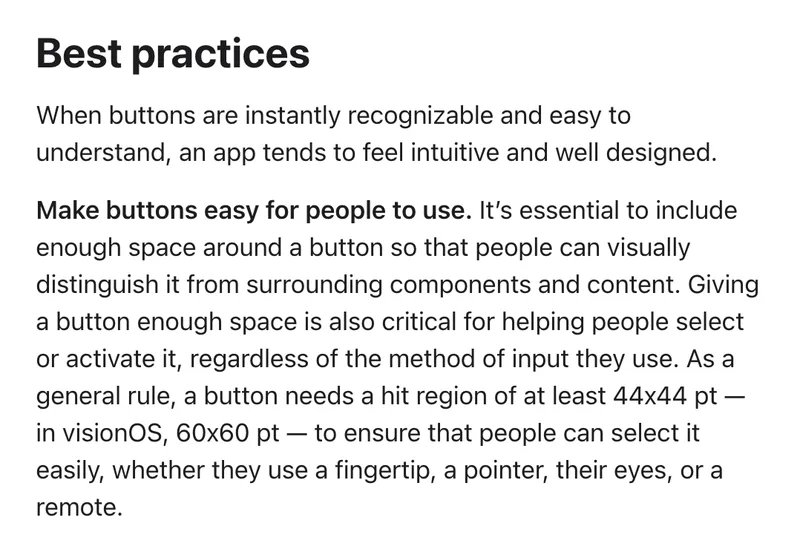
We measured the biggest call link visible without scrolling on each of the 178 homepages that had one. The median was 50 pixels on its shorter side, which is fine. But 57 of the 178 had no first-screen call link reaching 44 pixels, and on 16 every call link up there was smaller than 24, usually a phone number in small type along the very top of the screen, or a phone icon about 20 pixels tall. Someone in withdrawal, or someone holding a phone for a person who is, is the visitor least able to aim at a target that small.
Buttons that say call and do not dial
A smaller group had the opposite problem: a large button with the word "call" on it that did not start a call. Five homepages built on the same template used a "Call 24/7" button that opened a pop-up showing the number, so the visitor needed a second tap. One labeled its main button "Call admissions now" and sent it to a contact page. Each of those is one more step between a decision and a ringing phone.
Seventy-four homepages, about a third, carried two or more different phone numbers in their tap-to-call links. Some of that is deliberate, separate lines for admissions and for current patients' families, and some is call tracking: 120 of the 228 loaded scripts from a call tracking vendor, which changes the number each visitor sees so the center can tell which ad or page brought the call. Tracking is reasonable. Showing a visitor two different numbers on one screen with no label is not, because a person in a hurry will not know which one reaches admissions.
Speed on a mid-range phone
Speed is where detox sites fall furthest short. We ran Google's Lighthouse tool, version 12.8.2, in its default mobile mode on a random sample of 58 of the 228 homepages. That mode emulates a mid-range Android phone screen and slows the network and processor: Lighthouse's own source code sets 150 milliseconds of round-trip time, about 1.6 megabits per second of download speed and a processor slowed by a factor of four. A comment in that code describes the network settings as roughly matching the 75th percentile of 4G connections, so it is a weak connection, not a worst case.
The figure that matters most is Largest Contentful Paint, the moment the biggest piece of content on the first screen, usually the hero image or headline, finishes appearing. Google's web.dev guidance calls 2.5 seconds or less good and anything over 4 seconds poor.
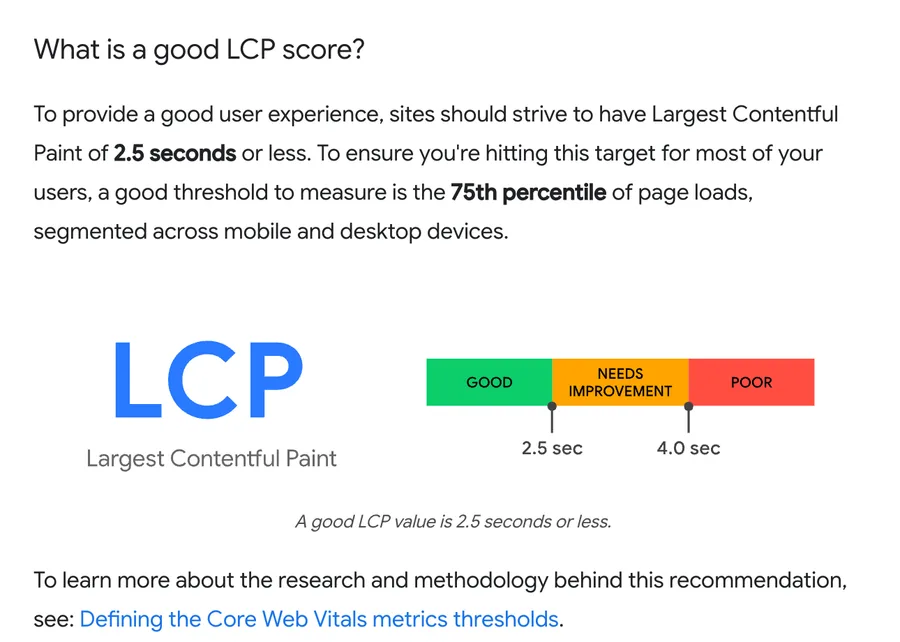
Only 1 of the 58 homepages we tested reached that line. Nine landed between 2.5 and 4 seconds, and 48 took longer than 4 seconds, which Google classes as poor. The median was 9.4 seconds, and 27 homepages needed more than 10 seconds for their main content to appear on the simulated phone. These are lab results from a single run per site, so treat any one number with caution, but a pattern this lopsided does not come from measurement noise.
The overall Lighthouse performance scores looked less alarming, a median of 60 out of 100, with 2 sites at 90 or better and 9 below 50. That is because most pages held still once they loaded: 50 of the 58 kept layout shift within Google's 0.1 limit, and most did not lock up the browser for long. The trouble is concentrated in the first screen. On 9 of the 58, the element Lighthouse identified as the largest piece of first-screen content was a background video or an image slideshow. The median homepage transferred 2.6 megabytes of data, and 10 transferred more than 5. Across the full census, 118 of the 228 homepages were built with Elementor, a WordPress page builder, which is not a problem in itself but makes it very easy to stack heavy sections at the top of a page.
The usual causes are not exotic: a full-width video or slideshow at the top of the homepage, several chat and tracking scripts competing to load first, and image files far larger than a phone screen needs. None of them makes a family more likely to call. A single compressed photograph, the phone number in real text rather than inside an image, and scripts that wait until the first screen has drawn are the first things to try, and none of them changes how the page looks.
Lab scores are not the same as what real visitors experience, and Lighthouse's performance score is a weighted blend: Total Blocking Time carries 30 percent of it, Largest Contentful Paint and Cumulative Layout Shift 25 percent each, and two other paint metrics 10 percent each, according to Chrome's scoring documentation. That is why we report the Largest Contentful Paint time itself rather than only the score. It is the number that maps most closely to the experience of staring at a blank screen.
Trust signals: what a stranger and Google both check
A detox center asks a family to hand over a sick person for several days, so the homepage has to establish quickly that the place is licensed, medically staffed and allowed to advertise. The signals that do that most efficiently were common but far from universal in our census.
LegitScript appeared on 144 of the 228 homepages, either as the certification seal or as a reference in the page code. That matters beyond reassurance. Under Google's healthcare advertising policy, a US center needs LegitScript certification for addiction services, plus Google's own healthcare certification, before it can run addiction treatment ads at all; we covered what the reviewers look at in our guide to what LegitScript reviews on your website. A center that has the certification and does not show the seal is leaving its most specific trust signal off the page.
The Joint Commission appeared on 118 homepages and CARF on 42. A medical director was mentioned by role on 21 homepages. Phrases such as "medically supervised" or "medical detox" appeared on 132. The census cannot tell whether those phrases are true, only whether they are present, but a page that never says who is responsible for medical care is asking a family to assume it.
What gets in the way of the signals
At least 24 homepages opened with a cookie or privacy banner covering a large part of the first phone screen, sitting over the headline and buttons until the visitor dealt with it. Consent prompts have a real legal purpose and we would not tell anyone to remove one without advice. They can still be placed along the bottom edge at a modest height instead of over the middle of the screen. Two homepages opened with promotional pop-ups, one for an award and one for a diagnostic service, and one opened a full-screen chat form.
The three sites that served certificate or encryption errors are the starkest case. A phone browser shows a full-page warning instead of the site, and almost nobody clicks past a warning that says the connection is not private. Certificate and encryption faults are usually quick to fix once someone knows about them, yet they can quietly shut a center's website off for every new visitor, and staff who only open the site on a familiar office computer may never see the warning.
Smaller signals add up. Only 5 of the 228 homepages mentioned 988, the suicide and crisis lifeline, which some people looking for detox need more urgently than a bed. Insurance verification links were common at 145 of 228, and we have written separately about how those insurance verification pages perform.
What the detox page itself leaves out
Once the homepage has earned a second click, the detox page carries the conversation, and most of the ones we read describe detox in general rather than answering what this center does. SAMHSA's clinical quick guide on detoxification, based on its Treatment Improvement Protocol 45, defines detox as three parts: evaluation, stabilization, and fostering the patient's readiness for and entry into treatment. A good detox page maps onto that sequence. It says what happens at intake, what the days of withdrawal will be like and how long they last, and what comes next.
We read 185 detox pages and checked six concrete answers. Sixty-two gave a typical length in days, most often a range such as three to seven or five to ten. Thirty-seven named at least one medication used to manage withdrawal, such as buprenorphine for opioids or a benzodiazepine taper for alcohol. Seventeen said how soon someone could be admitted, whether the same day, within 24 or 48 hours, or as a walk-in. Thirteen told readers what to do in a medical emergency. Nine said what to bring. One gave an out-of-pocket cost range for its own program, and two more quoted general industry ranges.
The emergency line deserves more attention than it gets. SAMHSA's guide calls the course of alcohol withdrawal unpredictable and warns that "it is impossible to tell who will or will not experience life-threatening complications." A person reading a detox page at home may already be in withdrawal. One sentence telling them that seizures, confusion or hallucinations mean calling 911 or going to an emergency department is not a liability; it is the most responsible line on the page, and the 13 pages that had it showed it can be written without frightening anyone.
Length and medication are the questions families ask first, and they are easy to answer honestly with a range. "Most people stay five to seven days; alcohol and benzodiazepines can take longer because the taper is slower" tells a reader what to plan for without promising anything. "Our physicians use medications such as buprenorphine for opioid withdrawal and a tapered benzodiazepine for alcohol, chosen after an assessment" tells them they will not be left to suffer, which is the fear behind most of the calls.
Admission timing is the answer most tied to conversion. FindTreatment.gov itself advises people to try another facility if one cannot see them within 48 hours. A center that admits the same day and does not say so on its detox page is losing the comparison to a center that does.
Questions to ask before anyone rebuilds your detox site
Whoever builds the site, including us, should be able to answer these plainly. If a designer cannot, the site will probably look better and convert the same.
| Ask | A good answer sounds like | Why it matters on a detox site |
|---|---|---|
| What is the Largest Contentful Paint of the new homepage on Lighthouse mobile? | A number under 2.5 seconds, measured on the real page with its real scripts, and a plan for what happens when marketing adds another tag | Only 1 of 58 homepages we tested met that target; the median was 9.4 seconds |
| Where is the phone number on the first phone screen, and does it stay there when I scroll? | A tap-to-call link in a fixed header or bottom bar, at least 44 points tall | 39 of 228 homepages showed no number in the first screen; 106 kept the call link on screen while scrolling |
| How will call tracking work without showing two numbers? | One visible admissions number per page, swapped by the tracking script, with other lines labeled | 74 of 228 homepages carried two or more different numbers in their call links |
| Where do the LegitScript seal and accreditation sit? | Near the top on the homepage and on every admissions and detox page, linked to the verification page | LegitScript appeared on 144 of 228 homepages; Google ties addiction advertising to certification |
| What does the detox page say about length, medication and admission timing? | A typical range in days, medications named in plain language, and how soon someone can be admitted, all written with your medical director | Of 185 detox pages, 62 gave a length, 37 named a medication and 17 said how soon someone could start |
| What will the page tell someone in a medical emergency? | One clear line about 911 and emergency departments, plus 988 for a mental health crisis | 13 of 185 detox pages had emergency guidance; 5 of 228 homepages mentioned 988 |
| Where will the cookie banner sit on a phone? | Along the bottom edge, short enough that the call button and headline stay visible | At least 24 homepages opened with a banner covering much of the first screen |
| Who renews the security certificate, and who gets the alert if it fails? | Automatic renewal through the host, with an uptime monitor that emails a named person | 3 of the sites we tried served certificate or encryption errors |
For a wider pre-launch list, our treatment center website checklist covers the advertising and compliance items that sit around these, and our breakdown of admissions page design covers the page most detox traffic should eventually reach.
What we would build, and when a smaller fix is enough
Several of these problems do not need a designer. An expired certificate, a phone number typed as plain text, a cookie banner placed over the middle of the screen, and a missing emergency line on the detox page can each be fixed by whoever already maintains the site, usually in an afternoon. If your homepage loads in under 2.5 seconds in Lighthouse and the call link is large and fixed, a rebuild is probably not where your next admission comes from, and we would tell you that.
Where the speed problem is structural, such as a theme loading a video and a dozen plugins before anything appears, or where the detox page needs rewriting with your clinical team, that is the work we take on. The websites we build for addiction treatment centers start from the first phone screen and work down. Foundation costs $1,000 a month. It starts with refreshed branding and one landing page designed around the call, live 14 business days after your content and assets arrive, and after that it adds a page every month, so a center can rebuild its detox page first and its program pages after. For $2,500 a month, Growth handles every page of the site, with no cap on requests and one worked at a time. Scale, at $5,000, works two requests in parallel for operators running several sites. All three bill monthly, can be paused or canceled whenever you like, and are listed on our pricing page.
Our record is more than 200 projects, five for treatment centers. Cornerstone Healing Center is the one we point to: its website brought in 20 percent more conversions once our redesign went live. If you want an outside read before deciding anything, request our free funnel review: we study the single page most of your visitors arrive on, which for a detox center is usually the homepage seen on a phone.
The 2 a.m. test
The fastest way to find your detox site's weak points is to use it the way your callers do. It takes about ten minutes and needs no tools beyond a phone.
- Test on mobile data, not the office network. Turn Wi-Fi off and open a private browser tab so nothing is cached. Search for your center's name plus "detox" and tap your own result.
- Count out loud from the tap. Note the second the headline and photo appear. If you reach five before anything useful shows, a person in withdrawal has already had time to go back to the results.
- Find the number without scrolling. Is it on the first screen, is it a link, and can you hit it cleanly with your thumb on the first try? Scroll halfway down the page and check whether it is still there.
- Tap it and let it ring. Note who answers, how many rings it takes, and whether the person on the line could admit someone tonight. Try once more at night or on a weekend.
- Open the detox page and look for five answers. How long does it usually take? Which medications might I get? How soon can I come in? What do I bring? What do I do if this gets dangerous before I arrive?
- Write down every step that slowed you down. Then rank them by how many visitors they touch. The homepage first screen touches nearly all of them, so fix that before anything deeper in the site.
If the test turns up a slow homepage or a number that is hard to tap, neither needs a new brand to fix. Both cost admissions every night they stay broken.
Frequently asked questions
A detox center website should load quickly on a phone, show a large tap-to-call number on the first screen, display its licensing, LegitScript and accreditation signals, and answer how long detox usually takes, which medications may be used, how soon someone can be admitted and what to do in an emergency. In our census of 185 detox pages, 62 gave a typical length in days and only 13 said what to do in a medical emergency.
The main content should appear within 2.5 seconds on a phone, which is Google's threshold for a good Largest Contentful Paint. In our Lighthouse tests of 58 detox homepages on default mobile settings, 1 met that target, 48 took longer than 4 seconds, and the median was 9.4 seconds, most often because of background videos, slideshows and heavy page-builder sections at the top of the page.
Place a tappable phone number where it shows without scrolling on a phone, ideally in a header or bottom bar that stays visible as the visitor moves down the page. Make it at least 44 by 44 points, Apple's guideline for a tappable button. In our census, 178 of 228 homepages had a call link in the first screen, 106 kept it visible while scrolling, and 39 showed no number at all.
Yes, give a typical range in days and say what makes it longer. A sentence giving your own range, for example five to seven days, with a note that alcohol and benzodiazepines can take longer, answers the first question families ask without promising anything. Only 62 of the 185 detox pages we read gave a length in days.
Yes, in plain language and written with your medical director, because fear of an unmanaged withdrawal is behind many calls. Name the medications your physicians may use, such as buprenorphine for opioid withdrawal or a benzodiazepine taper for alcohol, and say that the choice follows an assessment. Of the 185 detox pages we read, 37 named at least one withdrawal medication.
Yes, in the US. Google's healthcare advertising policy requires addiction treatment providers to hold LegitScript certification for addiction services and Google's own healthcare certification before they can advertise. In our census, LegitScript appeared on 144 of 228 detox homepages, so a center that holds the certification should check that the seal is visible on its own site.
Use a phone on mobile data in a private browser tab, search for your center plus detox, and time how long the page takes to show its main content. Then check that the number is large, tappable and visible before you scroll, call it at night, and look for length, medication, admission timing, what to bring and emergency guidance on the detox page.
 Recovery
Oct 7, 2026 · 17 min
PHP and IOP Program Pages: What Families Actually Read
We read 66 intensive outpatient and partial hospitalization pages from 36 rehab providers and checked them against the questions families ask. Here is what the pages answer, what they leave out, and how to fix it.
 Recovery
Oct 6, 2026 · 17 min
Insurance Verification Pages: Why Yours Is Losing Admissions
We read the insurance verification pages of 43 rehab providers, counted every field on 23 forms and logged the tracking code on each page. Here is why these pages lose admissions, and what to fix first.
 Recovery
Oct 5, 2026 · 17 min
Treatment Center Website Checklist: 31 Things to Fix Before You Run Ads
A 31-point checklist for rehab and treatment center websites, built from Google, Meta, LegitScript and HHS rules and tested against 37 provider homepages. Fix these before the first ad dollar is spent.