How Much Should a Luxury Rehab Website Cost in 2026?

Nov 2, 2026 · 17 min read
A luxury rehab sells a month of care that costs a family more than most cars. Alta Mira, a California program, says on its own site that its residential program runs about $3,500 a day. Apex Recovery prints a luxury tier of $25,000 to $78,000 a month. Whoever reads those pages is about to make one of the largest and most private purchases of their life, often on behalf of someone who does not yet agree they need it.
That makes the website question unusual. The site does not have to be cheap, but it has to be right, because one admission it wins or loses is worth more than the build. On 2 November 2026 we looked at it from three sides. First, the treatment center web offers whose sellers print a fee on their own page. Second, the federal FindTreatment.gov locator, which listed 2,825 substance use facilities across 28 US metro areas, 312 of them private for-profit programs with a residential setting. Third, the websites of those 312: 190 loaded, and we split them into the 72 that call themselves luxury and the 118 that do not.
The 30-second answer: luxury rehab website cost
A luxury rehab website costs $3,500 to $25,000 as a one-time build from the treatment center agencies that publish prices, and one estimator puts a full agency build at up to $37,700. Monthly marketing programs from the same specialists start at $750 and climb past $20,000 a month. Price is the wrong first filter, though. One self-pay month at a luxury center runs $21,000 to over $100,000 at the prices centers print themselves, so one extra admission covers most builds on our list. Spend on what moves that decision: real rooms and staff on camera, a price or price range, a private way to ask, a Good Faith Estimate notice for self-pay families, and LegitScript certification so you can advertise at all.
What a luxury rehab website has to do
It has to justify a price that the reader can find elsewhere for a fraction. A family comparing programs will see standard residential care advertised in the low five figures and a luxury program at three or four times that. The site's job is to make the difference concrete: the private room, the staffing ratio, the psychiatrist who sees the client this week rather than next month, the chef, the location that keeps a public figure out of sight.
Our census shows the market knows this. Of the 72 for-profit residential sites that use the word luxury, 58 percent describe private rooms and 60 percent mention a chef. Among the other 118 sites those figures are 9 percent and 14 percent. Luxury sites are also far more likely to talk about executives: 29 percent use phrases like "executive program" or "executive track", against 4 percent of the rest.
What the word does not do is change what the program is clinically. "Luxury" is a description of the setting and the service. Licensing, accreditation and the level of care are separate facts, and the families paying the most tend to ask about them first. A good luxury site leads with the experience and then proves the medicine underneath it.
Who prints a price for a treatment center website
Only a handful of firms that build sites for addiction treatment centers publish a fee, and none of them sells a separate luxury package. We found no seller with a price list written for high-end or private-pay programs, so the useful comparison is the general treatment center market. The rule for this table is strict: the number has to appear on the seller's own page as its own fee, read on 2 November 2026.
| Seller | What is sold | Published price | Worth knowing |
|---|---|---|---|
| DrugRehab.Agency | Treatment center website | $3,500 to $6,000 | Its page bundles conversion work into the same fee |
| Lead to Recovery | Website design and development; SEO, PPC and CRO programs | Website from $4,800; local SEO from $750 a month per location; regional from $1,500; national from $7,500; PPC and CRO each from $1,000 a month | SEO plans carry a 90-day minimum; consulting is $200 an hour with a 10-hour minimum |
| Webserv | Facility website, one-time project | Core $8,000; Growth $15,000; Enterprise $25,000 | Optional maintenance $250, $450, or $750 to $950 a month by tier |
| Treatment Center Agency | Website care, SEO and CRO bundled monthly | Growth Care from $6,800 a month; Professional $10,000 to $12,000; Premium $13,500 to $15,000; Enterprise $20,000 and up | Landing pages from $1,200 each; Google Ads setup from $3,500 with a $10,000 a month minimum ad budget |
| ProjectCostEstimator (estimate, not a seller) | Rehab center website, US ranges | Freelancer $5,800 to $15,950; agency $13,750 to $37,700 | Says it draws on 600+ project quotes; adds $150 to $350 a month for admissions and verification tools |
The pattern is plain. Published one-time builds sit in a narrow band, $3,500 to $25,000, while the monthly programs run from three figures into five. Meanwhile Webserv's own FAQ says most addiction treatment builds run $25,000 to $80,000, which starts at its own top tier and runs far past it. That is a useful reminder that a published price buys a defined scope. Video, photography, many locations and deep integrations are where quotes leave the price list.
What a one-time build costs, side by side
On printed prices alone, a treatment center can buy a finished site for anywhere from $3,500 to $25,000, and estimators put a full custom agency build at up to $37,700. The chart puts the published figures on one scale. It shows the build only: no hosting, no photography, no ad spend.
Webserv is the clearest example of how the tiers are cut. The price rises with page count and number of locations, not with how premium the program is. A single-campus luxury center with ten pages sits in the same tier as a ten-page outpatient clinic.
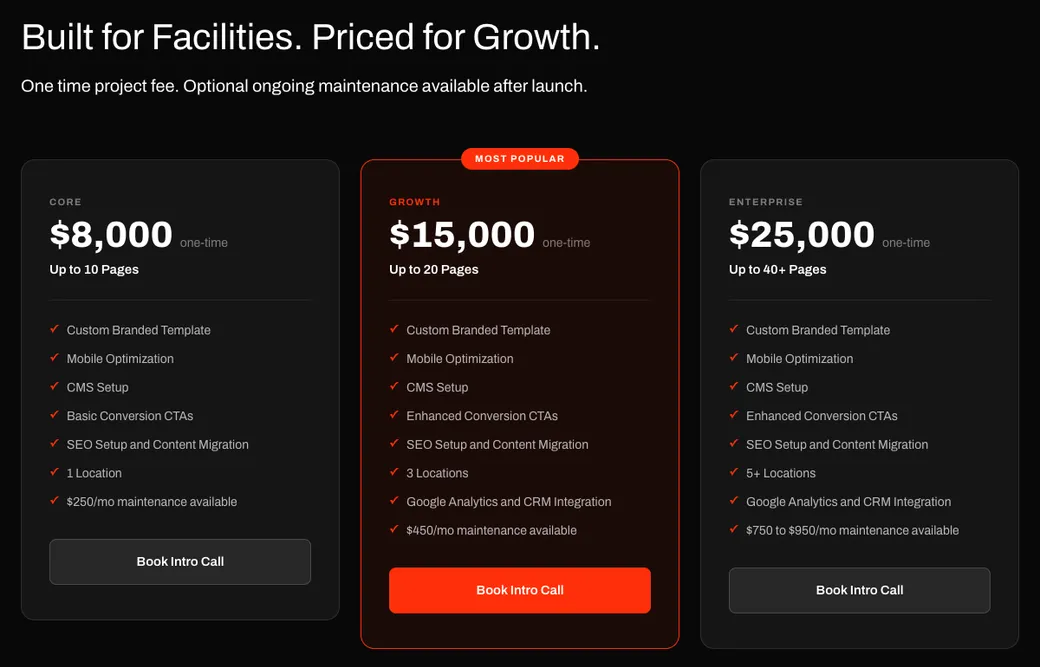
For a luxury program, the scope that drives cost is rarely page count. It is the media: professional photography of every room, short video of the clinical team, a tour that shows the grounds honestly. ProjectCostEstimator prices a facility tour and full clinical content at $1,000 to $3,000 on top of a build. In our census, 18 percent of luxury sites mention a virtual tour or embed one, against 9 percent of the rest.
The value of a single private-pay admission
One self-pay month at a high-end center is worth $21,000 to more than $100,000 at the prices the centers publish, which is why a website build is a small line in this business. Eight of the 190 sites we read print their own residential price. Seven of them price a month or a day, and the chart shows 30 days at each one's published rate (the eighth, Spencer Recovery Centers, prices a 10-day detox and short-term residential program at $9,000), with the private room or executive upgrade added where the center prices it separately.
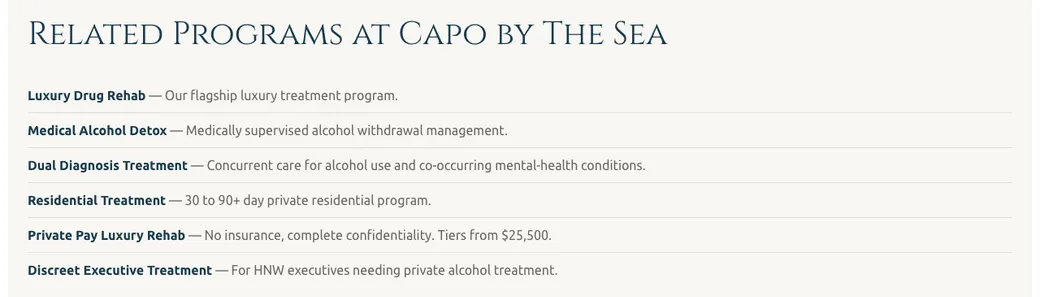
Set that next to the build prices and the arithmetic is blunt. At Capo by the Sea's starting private-pay tier, one admission covers Webserv's Enterprise build. The question a luxury operator should ask a web firm is not "what does this cost" but "how will this site win the second and third private-pay admission each quarter that it is not winning now."
Price disclosure is rare on both sides of the luxury line. Three of the 72 luxury sites print their own residential price, and five of the other 118 do. Another 13 sites quote someone else's averages ("luxury rehab typically costs between...") without saying what they charge. A family that reads three of those pages in a row learns the national range three times and still has to call to learn your number.
What 190 residential sites show
Luxury sites do more of almost everything: more insurance language, more amenity proof, more accreditation badges. The census method was simple. From the 312 for-profit residential programs listed on FindTreatment.gov within 25 miles of 28 metro centers, we took the 220 unique domains, fetched every homepage along with as many as eight internal pages whose URLs mentioned cost, insurance, admissions, amenities or luxury, and counted 190 that returned a readable page.
Three readings matter for anyone planning a site. The amenity gap is real, and it is the thing luxury buyers pay for, so it deserves the best photography budget you have. The insurance gap is the surprise, covered next. And the Meta pixel row is a privacy question that luxury clients, who pay partly for discretion, will eventually ask about.
Luxury sites still sell insurance
Almost every luxury program in our sample takes insurance, and its website says so. Of the 312 for-profit residential facilities in the federal listing, only 5 accept cash or self-payment without listing private insurance, Medicaid, Medicare or TRICARE. Most of the rest, 180 of them, list private insurance but not Medicaid. On the websites, 96 percent of luxury sites offer an insurance verification form and 57 percent use the phrase out-of-network, compared with 67 percent and 31 percent of the rest.
That is a sensible business choice. A family with a strong PPO plan may get part of a luxury stay reimbursed, and verification is how the admissions team qualifies the call. The website problem is that the verification form often becomes the only door. A spouse who intends to pay privately, or an executive who will not run a claim through the employer's plan, sees a form asking for a member ID and leaves. Give that person a second path: a short "paying privately?" line with a direct number, and a price or range on the page.
The form itself has its own rules, set out in our insurance verification page guide. For luxury centers, the rule is to build two doors of equal weight: one for insured families, one for private payers.
The Good Faith Estimate notice nobody shows
Not one of the 190 sites we read displays the phrase "Good Faith Estimate", and for a center that serves self-pay clients that is a compliance gap, not a style choice. Under the federal No Surprises Act rule at 45 CFR 149.610, providers and facilities must tell uninsured or self-pay individuals that a Good Faith Estimate of expected charges is available. The notice must be "prominently displayed (and easily searchable from a public search engine)" on the provider's website, in the office and wherever scheduling or cost questions happen.
The definition is what makes this a luxury issue. A self-pay individual includes someone who has coverage but "does not seek to have a claim for such item or service submitted" to the plan. That describes the executive who keeps treatment off the employer's insurance, which is exactly the client many luxury programs court. The same section sets deadlines: when a service is scheduled at least 10 business days ahead, the estimate is due within 3 business days of scheduling, and on request within 3 business days.
Our crawl had limits. It covered homepages and at most eight money-related pages per site, so a notice buried in a footer page we did not open would not count. But the rule asks for prominent display, and on the pages where centers talk about money, the phrase did not appear once. A one-paragraph notice on your cost or admissions page fixes this, and it reads as transparency to a family weighing a five-figure bill.
Discretion is a design requirement
Privacy is part of what a luxury client buys, so the website has to behave as discreetly as the facility. Google treats "Health" as a sensitive interest category, and its personalized advertising policy says advertisers in sensitive categories "are unable to use advertiser-curated audiences." Put simply, a center cannot target Google ads at remarketing lists built from visitors to its treatment pages, so following a visitor around the web with Google ads is off the table for these pages.
Third-party trackers raise the same question from the other side. In our census, 14 percent of luxury homepages load Meta's tracking script, against 9 percent of the rest. Whether that is lawful depends on what data flows and what agreements exist, which is a question for counsel, not a web designer. The design point is simpler: a client who pays for a secluded campus should not be followed by retargeted ads after one visit to your detox page. Decide what the site tracks before launch, and say it plainly in the privacy policy.
Small design choices carry the same message. A contact form that asks only for a first name and a phone number. A callback option with a chosen time. Page titles that read "Admissions" rather than naming a substance, because browser tabs and history are visible to whoever shares the laptop.
LegitScript decides whether you can advertise
A luxury center that wants paid search needs LegitScript certification first. Google restricts the promotion of recovery-oriented drug and alcohol addiction services, and its policy announcement says US advertisers "will need to be certified by LegitScript as addiction services providers" and then by Google. In our census, 78 percent of luxury sites mention LegitScript, against 45 percent of the rest.
The fee is small next to the stakes. LegitScript's own page lists an application fee of $1,595 per facility and an annual certification fee of $3,095 per facility for organizations with 1 to 9 facilities, with expedited review for an extra $2,500 per application. LegitScript reviews the website as part of certification, so the build and the application should be planned together. Our LegitScript website checklist walks through what reviewers look at.
High prices invite hard questions
The more a program charges, the more its marketing claims will be tested, by families and by regulators. Researchers who called 613 residential programs while posing as uninsured, cash-paying patients found that one-third offered admission before any clinical evaluation, usually within a day, and that for-profit programs asked for up-front payments averaging $17,434, more than twice the $5,712 at nonprofits. The study, published in Health Affairs in February 2021, found these practices even among accredited, licensed programs.
Regulators act on this. The Federal Trade Commission's first case under the Opioid Addiction Recovery Fraud Prevention Act, announced in May 2022, ended in a $3.8 million civil penalty judgment, suspended for inability to pay, against a referral service that claimed a "rigorous evaluation process conducted by an expert" chose its treatment centers.
For a luxury site, the lesson is to make every claim checkable. Name the medical director and their credentials. Show the real staffing ratio if you advertise one. If you say "evidence-based", name the therapies. If you print a success rate, link the method. A family paying $50,000 will read the fine print, and the better your proof, the shorter the sales call.
Questions to ask any web firm
Use these on every proposal, including ours. The last column is what our census found, or what you can only learn by asking, so you can see where a plan beats the market.
| Ask | Why it matters | Census note |
|---|---|---|
| Will the site show our own price or price range? | Private-pay families compare cost before they call | 8 of 190 sites print their own residential price |
| Where will the Good Faith Estimate notice live? | Federal rule requires it on the website for self-pay clients | 0 of 190 show the phrase on pages we read |
| Is there a separate path for private payers? | A verification form scares off people who will not use insurance | 96% of luxury sites lead with insurance verification |
| Who shoots the rooms, grounds and team? | The amenity gap is what the price pays for | 58% of luxury sites describe private rooms; 18% mention a virtual tour |
| What scripts will load on treatment pages, and why? | Discretion is part of the product | 14% of luxury homepages load the Meta pixel |
| Will the build pass a LegitScript review? | No certification, no Google ads | 78% of luxury sites mention LegitScript |
| Who owns the domain, code and photos if we leave? | Rented sites can vanish with the contract | Not visible on most sites; get the answer in the contract |
| How will you measure admissions, not visits? | Call and form tracking decide whether the site is working | Not visible from outside; ask for a baseline recorded before launch |
Where KhanWork fits, and when to hire someone else
Look elsewhere if your program is part of a national group with an in-house marketing team. Those sites run on shared templates and approvals, and the fix is internal. A brand-new program without photos, licensing or a medical director in place should also wait: the website cannot prove what does not exist yet.
We fit an independent luxury or private-pay center that already has the clinical product and wants the site to sell it honestly. Every figure here also appears on our pricing page. Foundation is paid once: $1,000 covers a brand refresh plus one high-converting landing page, launched within 14 business days, and $2,500 covers a brand refresh plus the full website, however many pages it has, launched within 21 business days. Both clocks start when your copy, photos and logins arrive. For a luxury center the landing page is usually the admissions page or the private-pay page. Growth, at $2,500 a month, gives you a team for the whole site with unlimited requests worked one at a time, and Scale, at $5,000 a month, runs two at once for operators with several locations. Each bills a month ahead, carries no minimum term, and stops or pauses when you say so. Hosting is not part of any plan, and the domain, code and design files belong to you.
The one result we can point to in this field is Cornerstone Healing Center, which saw 20 percent more website conversions after we redesigned its site. Our addiction treatment website page explains how we build for centers, and the design service covers the photography-led layouts luxury programs need. Before you commit to anyone, start with the free funnel review: we look hard at the page where your visitors arrive, which for most centers is the homepage or an ad landing page, and name the single change most likely to bring more calls. For the wider market, our breakdown of addiction treatment center website cost and the dual diagnosis website cost post compare the same sellers for other programs.
The boardroom-laptop test
Before paying anyone, run your own site through the eyes of the person most luxury centers want to reach: a senior executive, searching for help for themselves, on a work laptop between meetings. Do it on your site and two competitors.
- The tab. Open your admissions page. Would the browser tab title embarrass someone if a colleague glanced at the screen?
- The price. Can you find your own price, or at least a range, without filling in a form?
- The private door. Is there a way to ask about paying privately that does not start with an insurance member ID?
- The proof. Can you see the medical director's name, the license or accreditation, and real photos of a room within two taps?
- The notice. Search your own site for "Good Faith Estimate". Does anything come up?
- The follow. Visit your detox page, then browse a news site for ten minutes. Do your ads appear?
Pass all six and your admissions problem lives somewhere other than the website. If it fails two or more, a confident, discreet buyer is already reading a competitor's page, and fixing it usually costs less than the admission you are losing.
Frequently asked questions
Treatment center web firms that publish prices charge $3,500 to $25,000 for a one-time build, and one estimator puts a full agency build at up to $37,700. Monthly marketing programs from the same specialists start at $750 a month and run past $20,000. No seller we found publishes a separate luxury package, so scope, photography and video set the real price.
Yes, because they sell the setting and the service as well as the treatment. In our census of 190 for-profit residential sites, 58 percent of luxury sites described private rooms and 60 percent mentioned a chef, against 9 and 14 percent of the rest. The design has to prove those things with real photos and named staff.
Publishing at least a range helps, because private-pay families compare cost before they call. Only 8 of the 190 residential sites we read printed their own price, so a clear number or range is a way to stand out. Riverside Recovery of Tampa, for example, prints a daily self-pay rate for each level of care.
Yes. Under 45 CFR 149.610, providers and facilities must tell uninsured or self-pay clients that a Good Faith Estimate is available, and the notice must be prominently displayed and searchable on the website. Self-pay includes insured people who choose not to file a claim. None of the 190 sites we read showed the phrase on the pages we checked.
Only after LegitScript certification and Google's own approval, because Google limits ads for addiction treatment in the US to approved, certified advertisers. LegitScript charges $1,595 to apply and $3,095 a year per facility for organizations with 1 to 9 facilities. It reviews the website as part of certification, so plan the build with the application in mind.
Most do. Of 312 for-profit residential programs in the federal FindTreatment.gov listing across 28 metro areas, only 5 accepted self-payment without listing any insurance. On the websites, 96 percent of luxury sites offered insurance verification and 57 percent mentioned out-of-network benefits.
At prices centers publish themselves, 30 days of residential care ranges from about $21,000 to over $100,000. Apex Recovery prints a luxury tier of $25,000 to $78,000 a month, and Alta Mira says its residential program is about $3,500 a day. That is why one extra admission usually pays for a website.
 Recovery
Oct 27, 2026 · 17 min
How Much Should a Dual Diagnosis Treatment Center Website Cost in 2026?
Treatment center web firms print builds from $3,500 to $25,000, and the one dual diagnosis specialist prints no price at all. We priced each offer over one and three years and read 315 dual diagnosis program websites.
 Recovery
Oct 26, 2026 · 17 min
How Much Should an Adolescent Treatment Center Website Cost in 2026?
Treatment center web firms print builds from $3,500 to $25,000, and none prices teen programs separately. We priced three years of each offer and read 137 adolescent program websites to see what parents find.
 Recovery
Oct 9, 2026 · 17 min
Detox Center Website Design: Speed, Trust, and the Call Button
We tested 228 private detox provider homepages on a phone-sized screen, read 185 of their detox pages and ran Lighthouse on 58. Here is what slows families down, what earns their trust, and where the call button goes wrong.