How Much Should a Dual Diagnosis Treatment Center Website Cost in 2026?

Oct 27, 2026 · 17 min read
About a third of American adults with a mental illness also have a substance use disorder. That is how the National Institute on Drug Abuse summarizes the 2023 National Survey on Drug Use and Health, and it is why so many addiction programs now call themselves dual diagnosis programs. The term is on the sign. The question for an owner is what the website behind it should cost, and what it has to do that an ordinary rehab site does not.
On 27 October 2026 we answered that in two parts. First we gathered every website and marketing offer aimed at treatment centers whose seller publishes a fee, and worked out what each one costs after twelve months and after thirty-six. Second, we used FindTreatment.gov, the federal treatment locator, to list substance use programs in 28 metro areas that offer a program for clients with co-occurring disorders, and read 315 of their websites to see what a person with both problems actually finds.
The 30-second answer: dual diagnosis website prices
Building a dual diagnosis treatment center website costs roughly $3,500 to $25,000, going by the fees web firms in this niche publish, or $3,500 to $34,000 across the first year once their listed upkeep is added. If the site comes inside a monthly marketing program, published fees run from $750 to $10,000 or more a month, or about $32,000 to $360,000 across 36 months, ad spend excluded. No seller we found prices dual diagnosis work separately. The one firm with a web design page written for dual diagnosis centers has a pricing page with no prices on it. Budget also for LegitScript if you advertise addiction treatment: its published fees for one facility come to $10,880 over three years.
Weigh those numbers against one admission. A dual diagnosis program in our sample, Riverside Recovery of Tampa, publishes self-pay rates of $1,000 a day for residential care, or $30,000 for 30 days. Two extra admissions a year cover most of the offers below.
Who prints a price, and the specialist who does not
Five firms that sell to treatment centers print a fee on a page they own. We counted a figure only when the seller published it as the price of the work, on its own site. Ranges in a budget dropdown, and averages a seller quotes for the whole market, do not count.
| Seller | What the fee buys | Printed price | Terms to check |
|---|---|---|---|
| DrugRehab.Agency | A rehab website build | $3,500 to $6,000 | Conversion optimization is included in the build, per its web design page |
| Lead to Recovery | A custom website | From $4,800 | SEO is sold separately by reach: $750 a month per location, $1,500 regional, $7,500 national |
| Webserv | A one-time website project | $8,000, $15,000 or $25,000 | Maintenance optional at $250, $450 or $750 to $950 a month; the 10, 20 and 40+ page tiers cover 1, 3 and 5+ locations |
| Sweet Media | Monthly SEO and answer engine work | $3,000 or $5,000 a month | The $5,000 Growth plan adds a full redesign; both plans are month to month and exclude ad spend |
| Treatment Center Agency | Monthly website and Google Business Profile management | From $6,800 a month; $10,000 to $12,000; $13,500 to $15,000 | Hosting options included; landing pages from $1,200 each; its pricing page says clients own their assets |
None of the five sells to dual diagnosis programs only. Each sells to treatment centers in general, and a dual diagnosis program buys from the same menu as a detox or a sober living house. The firm that targets this buyer most directly is Funnel Boost Media, which runs a web design page titled for dual diagnosis treatment centers, plus matching SEO and pay-per-click pages. Its site has a page called Pricing. That page explains the firm's custom proposal process, says most clients start on a three to six month plan, and asks you to request a quote. It prints no figure, so it sits outside the table.
Webserv's own FAQ is the most useful paragraph in this market and is worth reading next to its price cards. The cards start at $8,000. The FAQ puts the usual addiction treatment build at $25,000 to $80,000, says centers with several locations and programs commonly spend $50,000 to $120,000, and prices each integration (call tracking, a CRM, a benefits-verification workflow, HIPAA-ready analytics) at $3,000 to $10,000. A dual diagnosis program that wants its own route for mental health inquiries, an insurance check, and call tracking that can tell those callers apart should budget from the FAQ, not the cards.
Year one, from each seller's printed fees
Over twelve months the cheapest published offer is $3,500 and the dearest $81,600. For a build, a bar adds any maintenance fee the seller prints, times twelve, to the one-time price; a build with no printed maintenance shows its price only. For a monthly plan, a bar is twelve times the lowest fee on the page.
The bars measure different things, and that matters more than their length. The first six buy a website. The last two buy a monthly service that includes one: Sweet Media's Growth plan bundles search work with a redesign, and Treatment Center Agency's Growth Care manages an existing site, one page of search and conversion work a month, and your Google listing. A program comparing a $15,000 build with a $6,800 monthly plan is comparing an asset with a service, and should decide which it needs before it compares prices.
Three years of the monthly programs
Kept for 36 months, the monthly programs total about $32,000 to $360,000, and that is before any ad budget. Lead to Recovery charges by geography. Sweet Media prices it by scope. Treatment Center Agency prices by how much it manages, and its higher tiers add articles, admissions call review and coaching.
The reach question decides which end of that chart a dual diagnosis program belongs at. Residential dual diagnosis care draws people from out of state, because the right program for someone with bipolar disorder and an alcohol problem may be a flight away. Those programs compete for national search terms. An outpatient program that treats depression and drinking in one county competes with the clinics in that county, and the cheaper bars were built for that.
The cost most website quotes leave out
A dual diagnosis program that wants to run Google ads for its addiction services needs LegitScript certification, and the fee is published. Under Google's healthcare policy, anyone advertising addiction treatment for drugs or alcohol in the US needs LegitScript certification as an addiction services provider, plus Google's own certification on top. LegitScript's own page settles the question a dual diagnosis owner usually asks next.
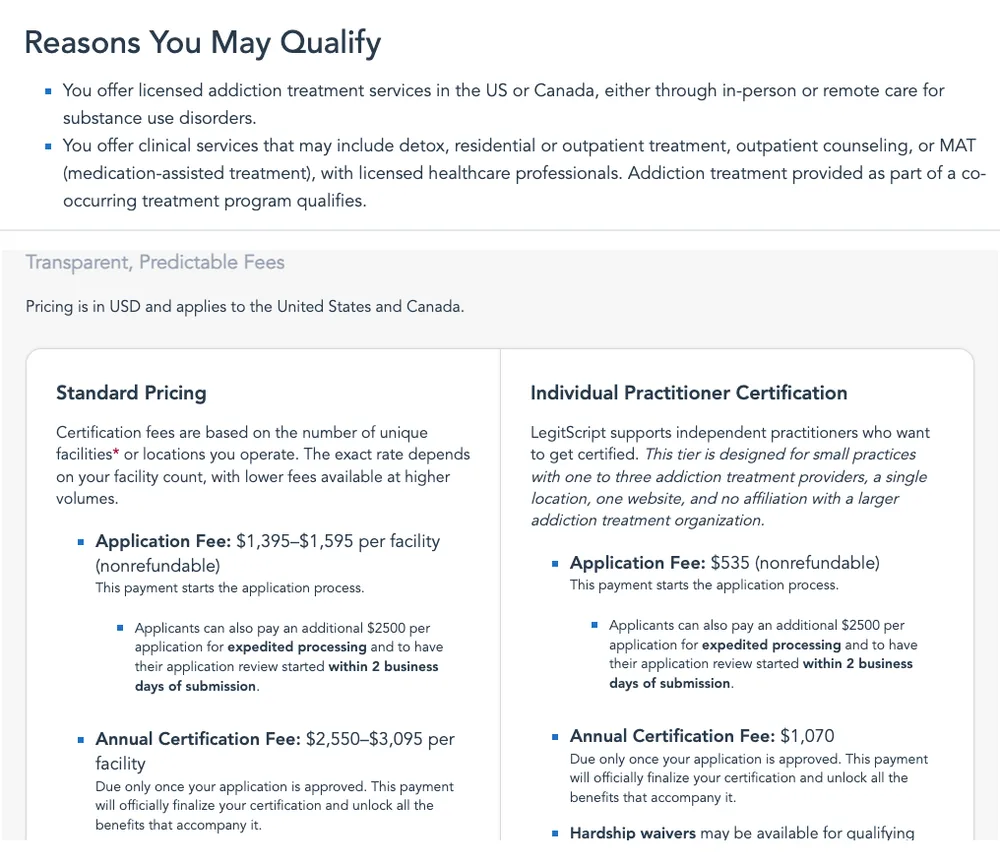
For a program with one to nine facilities, LegitScript's detailed tiers set a $1,595 application fee and a $3,095 annual fee after approval. One facility certified for three years therefore pays $1,595 plus three annual fees, or $10,880, and $2,500 more if it pays for expedited review. That is larger than two of the build prices in the first chart. It is not a website fee, but the website is what gets reviewed. What reviewers look at on the site itself is in our LegitScript checklist.
Dual diagnosis programs face a wrinkle here that single-focus programs do not. Google's addiction policy covers drug and alcohol treatment. A page about treating anxiety or depression on its own is not an addiction services ad. A program that treats both should know which of its pages it intends to advertise under which policy, and whoever builds the site should keep those pages distinct enough that an ad reviewer can tell. In our census, 176 of 315 dual diagnosis sites show or mention LegitScript.
What one dual diagnosis admission is worth
Most program websites in our sample say nothing about price. Riverside Recovery of Tampa, which lists dual diagnosis care for depression, bipolar disorder, anxiety, PTSD, panic disorder and OCD alongside its addiction programs, publishes a full self-pay table instead.
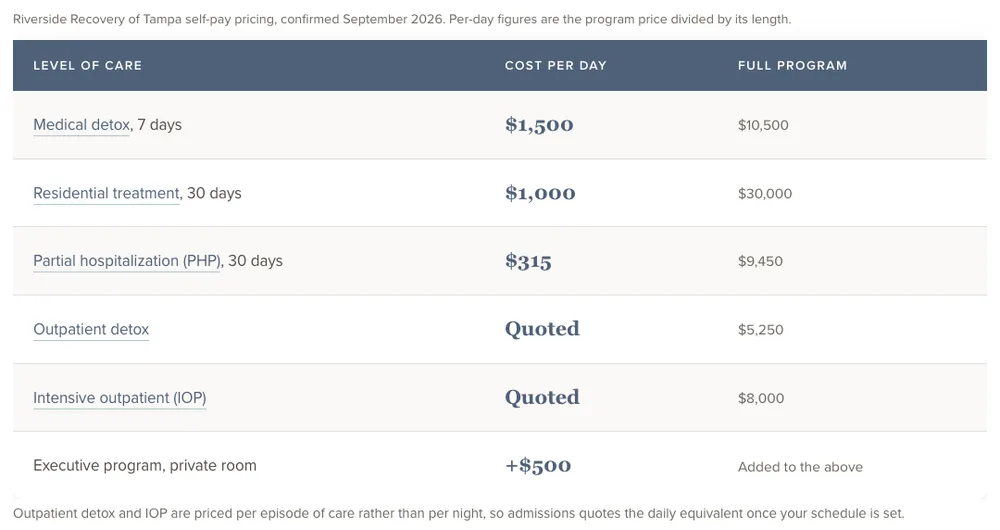
The numbers make the budget case without help. A 30-day residential stay at Riverside is $30,000 self-pay. A month of partial hospitalization is $9,450, and intensive outpatient is $8,000 for the program. Crosspointe Recovery in Sherman Oaks, another program in our sample that names co-occurring disorders on its homepage, states self-pay rates of $1,000 to $2,500 a day. Insured clients pay their share under their plan, and what the insurer pays depends on the program's contract, but either way a single admission still brings the program thousands of dollars.
Against that, a website that wins two more residential admissions a year has paid for any build in the first chart. A website that loses two, because a person with panic attacks and a drinking problem could not tell whether you treat both, has cost more than any bar on it.
What 315 dual diagnosis program websites show
Most dual diagnosis websites name the conditions they treat and make the phone easy to find. Very few say what anything costs, and fewer than one in five gives a crisis line. The sample comes from FindTreatment.gov, not from Google, so it reflects the programs that exist instead of the ones that rank. Within 25 miles of the center of 28 metro areas, the locator listed 2,917 substance use facilities. Of those, 2,162, or 74 percent, list a program or group for clients with co-occurring mental and substance use disorders. We kept the 1,526 private programs among them that offer intensive outpatient, partial hospitalization, day treatment or residential care. Those listings point to 984 websites. We read the 864 that loaded, taking the homepage and as many as eight internal pages per site on programs, conditions, admissions, insurance or cost, and kept the 315 that mention dual diagnosis or co-occurring disorders on the homepage and at least once more.
The upper bars show a sector that has learned the basics. Nine in ten homepages carry a tappable number, and as many sites discuss insurance. Nearly as many name at least three mental health conditions, so the reader with PTSD or bipolar disorder can see their diagnosis written down. Three in four offer some kind of insurance check online, and seven in ten mention medication management, which for a person already on psychiatric medication is often the first worry.
The short bars are where the dual part gets thin. Just 58 of 315 sites mention the 988 Suicide and Crisis Lifeline on any page we read, although they are written for people living with depression, bipolar disorder and trauma. Only eight print a price of their own, and 11 others print national or state averages for rehab in general, so a reader on those sites learns what treatment costs elsewhere and not what it costs here. And Meta's ad pixel runs on 37 homepages of sites that discuss mental illness and drug use in the same breath.
One program, two front doors
A dual diagnosis site has to work for two people who arrive by different words. One searches for drug or alcohol treatment and has never been told they have an anxiety disorder. The other searches for help with depression and does not yet call their drinking a problem. Clinicians use "co-occurring", and 303 of the 315 sites do too. People searching use "dual diagnosis" or simply name their two problems, and 259 sites use that phrase. Most sites, 247, use both, which is the right call.
That changes the build in four places.
- A page for each pairing that matters. 192 of the 315 homepages link to a page about dual diagnosis. The stronger sites go one step further, with a page for depression and alcohol, another for PTSD and opioids, written for the person who has that pair. Each is a page, not a redesign.
- Psychiatric care, named. 248 sites mention psychiatric care, but only 97 use the word psychiatrist and 35 mention a psychiatric nurse practitioner. Someone choosing a dual diagnosis program wants to know who will prescribe and adjust their medication, and how often they will see that person.
- A clear answer on mental health admissions. Some programs take clients whose primary problem is mental illness. Others require a substance use diagnosis. A sentence on the admissions page saying which saves calls in both directions.
- A crisis line on every page. It costs nothing to add and belongs in the footer of any site written for people with depression and suicidal thoughts.
The form most of these sites already have is the subject of our guide to insurance verification pages. On a dual diagnosis site it should also ask, gently, whether the person is looking for mental health care, addiction care or both, so the admissions team calls back with the right answer.
Two sets of privacy rules on one form
A dual diagnosis program holds records that fall under two federal regimes, and the forms on its website are where that starts. Mental health records sit under HIPAA. Substance use disorder records from a federally assisted program also sit under 42 CFR Part 2, which is stricter about disclosure. The 2024 revision of Part 2 brought the two closer: under 42 CFR 2.33(a)(2), when a patient gives a single consent for all future uses and disclosures for treatment, payment and health care operations, a Part 2 program, covered entity or business associate may use and disclose those records as the HIPAA rules allow, until the patient revokes it in writing.
For the website, three things follow, and each is a design decision before it is a legal one. The inquiry form should ask for no more than admissions needs to return the call, because a free-text box where someone types their diagnosis and their drug of choice is creating a record. Whoever installed the site's tags should list, in writing, every script that runs on that form. And the confirmation email should say nothing a family member reading over a shoulder should not see. Your counsel decides the policy; your web firm has to build it.
The 37 homepages loading Meta's pixel are the warning here. If that pixel fires on an inquiry or insurance form as well, an ad platform may learn that a visitor asked about care for both a mental illness and an addiction. Before any rebuild, ask for the tag list.
Why the integrated part is the selling point
The reason to spend on this site at all is that integrated care is what a dual diagnosis program sells, and the research backs it. NIDA's page on co-occurring disorders says it is usually better to treat these conditions at the same time rather than separately, and that people with a substance use disorder and another mental disorder typically have a harder time staying in treatment. 181 of the 315 sites describe integrated treatment in some form.
The sites that do it well show the integration rather than claim it: one treatment team, a named psychiatric provider, therapy for the mental health condition inside the same schedule as addiction treatment, and a discharge plan that covers both. A reader who has been sent back and forth between a psychiatrist and a rehab before is looking for exactly that, and a page that explains it in plain words is worth more than any photograph of the grounds.
Questions to ask any web firm before a dual diagnosis program signs
Any seller in this article, at any price, should answer these in writing. The third column says why each matters more for dual diagnosis care than for a program that treats one condition.
| Question | What a good answer looks like | Why it matters here |
|---|---|---|
| Have you built a site for a program that treats mental illness and addiction together? | A live site you can open and a client you can phone | No seller we found prices dual diagnosis work separately, and the specialist prints no price |
| How will the site serve someone who searches for depression, not rehab? | Condition pages and pairing pages, drafted, with their search terms named | 303 sites say co-occurring; searchers type their two problems |
| Which pages will we advertise, and under which Google policy? | A page map that separates addiction services pages from mental health pages | LegitScript covers addiction treatment in a co-occurring program; it costs $10,880 over three years for one facility |
| What does the inquiry form collect, and where does it go? | A field list and routing plan your counsel has signed off | Part 2 and HIPAA both reach these records |
| Which scripts load on the form pages? | Every tag named, and no ad network where a person describes a diagnosis | 37 of 315 homepages load Meta's pixel |
| Where will the crisis line appear? | On every page, in the footer at minimum | Only 58 of 315 sites give 988 |
| What is the three-year total, all in? | Build, upkeep, hosting, integrations and any monthly plan on one line | Published offers span $3,500 to roughly $360,000 across 36 months, ads excluded |
| Who owns the domain, code and content if we leave? | The program, in the contract | Condition pages take time to write and to rank; losing them starts that over |
Where KhanWork fits, and when to hire someone cheaper
A single-site outpatient program that fills from therapist and physician referrals, with a waiting list already, does not need a monthly agency. A build in the $3,500 to $6,000 range, with honest condition pages, a named prescriber, a crisis line and an insurance form that works, is enough, and the money saved belongs in clinical staff.
Our own prices are published on the pricing page, so we hold ourselves to the same test as the sellers above. We sell three monthly subscriptions, each billed a month in advance with no minimum term, which you can pause or cancel in any month. Foundation is $1,000 a month. It refreshes your brand and ships one conversion-focused landing page inside 14 business days of receiving your content and assets (if we are late, your next month is free), then adds one page a month. Growth, at $2,500 a month, handles the whole website; requests are unlimited and worked one after the other. Scale costs $5,000 a month and keeps two requests moving in parallel, which suits a group with more than one campus. Hosting stays in your own account and none of the tiers charges for it. Over three years Foundation comes to $36,000 and Growth to $90,000, which places Foundation just above Webserv's Enterprise year-one figure and Growth below Sweet Media's Growth plan over the same 36 months.
We are the right hire for a program that has the census to fill beds and suspects the site is where people give up: callers ask whether you treat their diagnosis, insurance checks arrive without a phone number, ads bring traffic and few admissions. That is conversion work, judged in admissions. Website conversions at Cornerstone Healing Center, one of the five treatment centers we have worked with, went up 20 percent once we had redesigned its site. How we serve both halves of a dual diagnosis program is set out on two pages: one for addiction treatment and recovery centers, one for mental health providers. For an outside opinion first, our free funnel review studies the one page most of your visitors land on, usually the homepage or whatever page your ads point to, and names the first change we would make. For prices and contract terms on general rehab builds, see our treatment center website cost guide.
The second-diagnosis read
Before you collect a single quote, read your own site as the person you most want to admit. It takes about forty minutes and one helper who has never seen the site.
- Pick two people. Write two short profiles on a card: someone whose first problem is drinking and who has never been diagnosed with anything else, and someone whose first problem is depression or panic and who drinks to cope.
- Search as each. On a phone, search the words each would use, such as rehab near your city for the first and help for depression and drinking for the second. Note whether you appear for both.
- The four answers. Give your helper ten minutes per profile to find: whether you treat that person's mental health condition, who prescribes and adjusts medication, the price or what their insurance would cover, and where to turn tonight if the situation worsens. One point per answer found on the site; a phone number does not count as an answer.
- The form. Fill in your inquiry or insurance form as each profile. Note what it asks, and whether anything suggests where the answers go.
- Two competitors. Run steps two and three for the two programs ranked above you and set the scores side by side.
Where your site trails on the second profile, the repair is usually a set of condition pages, a named prescriber and a crisis line, work any seller in this article can do. When both profiles score well and admissions are still thin, look at traffic and at how quickly admissions returns calls; that is the point where the monthly programs in the second chart can justify what they charge.
Frequently asked questions
Plan on roughly $3,500 to $25,000 for the build, going by the fees rehab web firms publish, or $3,500 to $34,000 for the first year once upkeep is counted. Monthly programs that include a website run from $750 to $10,000 or more a month, roughly $32,000 to $360,000 over three years before ads. No seller we found prices dual diagnosis work separately.
It needs LegitScript certification to advertise its addiction treatment services on Google in the US, and LegitScript states that addiction treatment provided as part of a co-occurring program qualifies. For one to nine facilities its fees are $1,595 to apply plus $3,095 each year, so one facility pays about $10,880 over three years. Ads about mental health care alone fall outside Google's addiction services rule.
It should name the mental health conditions you treat, say who prescribes and manages medication, explain integrated treatment, state whether you admit people whose primary problem is mental illness, show insurance or price, and give the 988 crisis line on every page. In our census of 315 dual diagnosis sites, 273 named three or more conditions but only 58 gave 988 and only 8 printed their own price.
Use both. Co-occurring is the clinical term and appears on 303 of the 315 program sites we read, while dual diagnosis is the phrase many people search for and appears on 259. The strongest sites also write pages for the pairs people actually type, such as depression and alcohol, or PTSD and opioids.
It can, because a federally assisted program's substance use disorder records fall under Part 2 while mental health records fall under HIPAA. Under 42 CFR 2.33(a)(2), a single patient consent for treatment, payment and health care operations lets those records be used as the HIPAA rules allow. Keep inquiry forms short, list every script that runs on them, and have counsel approve where submissions go.
For most programs, one admission brings in thousands of dollars. Riverside Recovery of Tampa, which lists dual diagnosis care, publishes self-pay prices of $30,000 for 30 days of residential treatment, $9,450 for a month of partial hospitalization and $8,000 for intensive outpatient. Crosspointe Recovery in Sherman Oaks lists self-pay rates of $1,000 to $2,500 a day.
Often, yes. A single-site outpatient program that fills from referrals can do well on a build costing $3,500 to $6,000, provided it has honest condition pages, names its prescriber, shows a crisis line and has a working insurance form. Monthly marketing programs make sense when the program needs reach beyond its own area, such as residential care that draws from other states.
 Recovery
Oct 26, 2026 · 17 min
How Much Should an Adolescent Treatment Center Website Cost in 2026?
Treatment center web firms print builds from $3,500 to $25,000, and none prices teen programs separately. We priced three years of each offer and read 137 adolescent program websites to see what parents find.
 Recovery
Oct 9, 2026 · 17 min
Detox Center Website Design: Speed, Trust, and the Call Button
We tested 228 private detox provider homepages on a phone-sized screen, read 185 of their detox pages and ran Lighthouse on 58. Here is what slows families down, what earns their trust, and where the call button goes wrong.
 Recovery
Oct 7, 2026 · 17 min
PHP and IOP Program Pages: What Families Actually Read
We read 66 intensive outpatient and partial hospitalization pages from 36 rehab providers and checked them against the questions families ask. Here is what the pages answer, what they leave out, and how to fix it.