
PHP and IOP Program Pages: What Families Actually Read

Oct 7, 2026 · 17 min read
A family reading an intensive outpatient page is usually trying to fit treatment into a life that has not stopped. Someone has to keep a job, pick up children, or get home from residential care and not fall apart in the first month. The program page is where they work out whether that is possible, and the first things they look for are plain: how many hours, which days, what time, for how long, what it costs, and who drives.
On 7 October 2026 we read 66 intensive outpatient (IOP) and partial hospitalization (PHP) program pages published by 36 addiction treatment providers and checked each one against those questions. Most pages describe the level of care well. Far fewer describe their own program, the schedule a family would actually have to live with.
What a program page has to answer, in brief
An IOP or PHP page should tell a family what this provider's program asks of them: the days and hours for each track, the start and end times, the typical length in weeks, how soon someone can start, what it costs or which plans cover it, how medication and family sessions fit in, and how people get there. In our census of 66 pages, 42 gave hours for their own program and only 13 printed session times. Twenty-four said how long their program usually lasts. None said how soon a new client could begin, none gave a price for the program, and only two said when family members can take part.
How we read 66 program pages
We started from the homepages of the addiction treatment providers in our earlier studies of this market, across Arizona, California, Colorado, Georgia, Tennessee, Texas, the Northeast and the Midwest. On each homepage we collected every link labelled for intensive outpatient or partial hospitalization care and kept the main page for each program, skipping blog posts, insurance guides, city variants and virtual-only versions where an in-person page existed. Thirty-eight providers linked to at least one such page. Two dropped out: one site's program links now return its homepage after a change of owner, and one refused our browser. That left 66 pages from 36 providers: 32 IOP pages, 32 PHP pages and 2 pages that covered both levels.
We opened every page in a desktop browser and scrolled it to the end, so that sections loaded late would still be counted. We saved the visible text and coded it by hand against a fixed list of questions, most of them taken from the federal treatment locator described below. We counted a number as the provider's own only when the page tied it to this program, so a sentence like "IOPs typically involve nine hours a week" counted as an industry-wide figure, not a schedule. Our own clients were excluded and no provider is named. What a page says is not proof of what the program does, and a page can be right about a schedule that changes next month.
The time question: hours, days and the clock
The single most useful fact on an IOP page is the weekly shape of the program, and roughly a third of the pages we read did not give it. Forty-two of the 66 put a number on their own program, whether hours per day, hours per week or session times. Fifteen used only words like "several hours a day, several days a week". Six gave numbers that described IOP or PHP in general, often citing a guideline, without saying what this provider runs. Three said nothing about time at all.
The vague pages are not hiding anything. They are written to cover every client, because schedules really are set after an assessment. The trouble is that a working parent cannot plan around "several". They need to know whether the evening track is three nights or four, whether it ends at 8:30 or 9:00, and whether Saturdays are involved. Twenty-one of the 34 IOP pages said an evening option existed. Only 13 of all 66 pages printed the clock times of any session, which is the detail that settles whether a shift worker can attend.
The pages that did this well were not long. One Atlanta-area provider listed a morning IOP from 9:00 to 12:00 and an evening IOP on three named weeknights from 5:30 to 8:30, and its PHP page said Monday to Friday, 9:00 to 3:00. A Philadelphia provider printed a day group, an evening group and its PHP hours in a short block under the heading. A Colorado provider put three tracks in a small table with hours per week, days per week, hours per day and maximum length. Each of those took one paragraph or one table, and each answers the question a family would otherwise have to call to ask.
IOP pages and PHP pages fall short in different places
PHP pages were weaker on the facts and stronger on the story. Of the 34 PHP pages, 19 gave hours for their own program and 9 gave their own typical length, against 24 and 15 for the IOP pages. But PHP pages were more likely to walk the reader through a day: 8 did, against 6 IOP pages. The likely reason is that PHP is easy to describe as a day, from morning check-in to afternoon groups, while IOP is sold on flexibility, and flexibility is hard to put on a timetable without seeming to take it away.
That is a missed opportunity in both directions. A PHP page that says "full days, most days of the week" leaves a family guessing whether that means five six-hour days or something closer to an office job. An IOP page that promises flexibility without listing its tracks leaves the reader unsure whether the flexibility is real. The best page in our census did both: a sample week labelled as a sample, with times, and a line saying the actual schedule is set at intake.
What the rules say IOP and PHP are
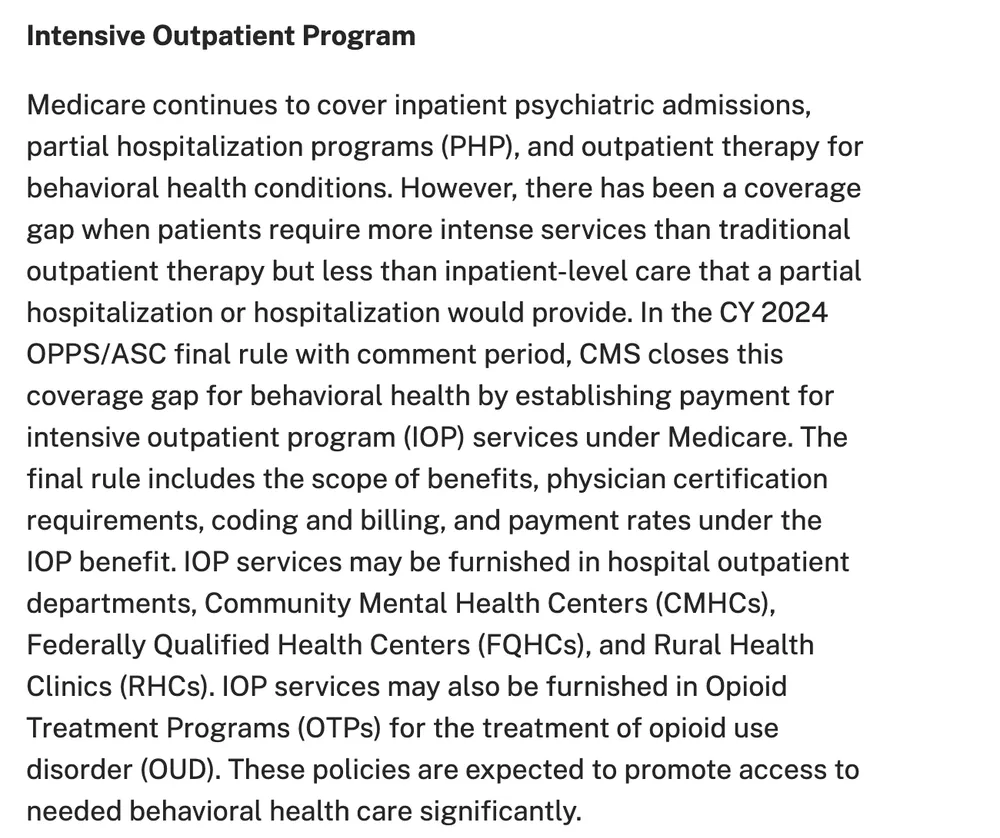
There is now a federal definition of both levels, and it is written in hours. Medicare began paying for intensive outpatient services on 1 January 2024. In its fact sheet on the 2024 outpatient rule, CMS describes a coverage gap for patients who needed more than outpatient therapy but less than partial hospitalization, and says the rule closes it. The benefit can be delivered in hospital outpatient departments, community mental health centers, federally qualified health centers, rural health clinics and, for opioid use disorder, opioid treatment programs.
The hours live in the regulations. Under 42 CFR 410.44, intensive outpatient programs are intended for patients who need a minimum of 9 hours a week of therapeutic services. The partial hospitalization rule next to it, 42 CFR 410.43, sets the minimum at 20 hours a week. For IOP, a physician has to certify that need and recertify it at least every 60 days, according to 42 CFR 424.24. These are Medicare's billing rules, not a law about what a private program must offer, but they are the closest thing the field has to a shared definition, and they make the hours on a page easy to check.
Checked against those lines, a few pages contradicted themselves. One PHP page described a minimum of three days a week in six-hour blocks, which is 18 hours, under the 20-hour line in the same paragraph that cited it. A virtual IOP page asked for a commitment of 6 to 12 hours a week, which starts below the 9-hour floor. Neither is necessarily wrong clinically. Both are the kind of number a careful parent or a referring clinician notices, and both would read better with one more sentence explaining it.
The clinical side is moving too. The fourth edition of the ASAM Criteria, the placement framework published by the American Society of Addiction Medicine, was published in December 2023, and the Los Angeles County implementation page lists the updated levels: 2.1 Intensive Outpatient, 2.5 High-Intensity Outpatient, and 2.7 Medically Managed Intensive Outpatient. Level 2.5 is where partial hospitalization used to sit. The same summary says every level of care should be capable of treating co-occurring conditions and should offer access to addiction medications. Only one of the 66 pages told readers which ASAM level its own program was. Families do not need the numbering, but referral sources and insurers do, and the rename means many PHP pages now use a label the standard itself has moved away from.
How long it lasts, and why one page gave two answers
Program length was the question most often left open: 35 of the 66 pages gave no length at all, and 7 more gave only a general range for IOP or PHP as a category. The 24 that gave their own figure ranged widely. PHP figures ran from 10 to 15 days at one provider to as long as six weeks at others, with "up to 30 days" and "two to four weeks" the most common shapes. IOP figures ran from about eight weeks to three to six months, and one men's program asked for a minimum commitment of 90 days.
The federal locator gives families a wider frame. FindTreatment.gov, run by SAMHSA, says outpatient care usually lasts from about two months to one year, and that frequency depends on the program, with some requiring daily attendance and others meeting one to three times a week. A family that reads that and then reads a program page with no length on it has no way to tell where this program sits in that range.
One PHP page in our census said its program typically runs two to six weeks, and further down said PHPs last between four and eight weeks. Both sentences are defensible on their own. Side by side, they suggest that nobody has read the page from top to bottom recently, and they leave the reader with two answers to the question they came to ask. The fix is cheap: decide on one figure for your own program, put it near the top, and label any industry-wide range as exactly that.
The questions SAMHSA tells families to ask
SAMHSA has already written the checklist families should bring to a call, and most program pages answer very little of it. The Calling a Facility section of FindTreatment.gov suggests asking when you can get an appointment, how much treatment will cost and whether your insurance is accepted, what to bring and not bring, how to get to the facility and whether someone can pick you up, and then, where they matter, whether the facility is smoke-free, whether there is childcare, which medications are allowed, and what family contact is allowed and when. It also says that if a facility cannot see you within 48 hours, you should try another one.
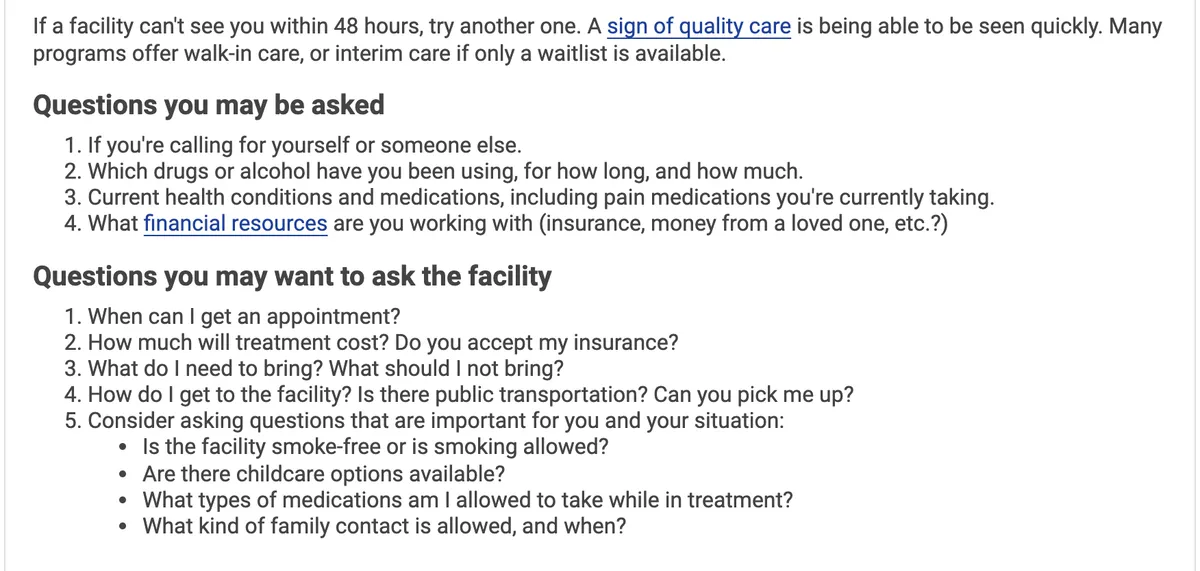
We checked all 66 pages against that list. Thirteen named at least one insurance company in words; the rest relied on logos, a verification form, or the phrase "most major insurance". Ten said where they stood on Medicaid: seven said they do not accept it, three said they do. No page gave a price for its own program. Three pages from two providers printed an out-of-pocket range, and one of those ranges ran from $5,000 to $60,000 across several levels of care, which tells a family very little. Four pages offered transportation in some form. None offered childcare, none said what to bring, and none mentioned smoking.
Most striking, given the 48-hour advice, no page said how soon someone could start. Three described a start date being set after admission is confirmed. Several had a "start today" button, but that is a call to action, not an answer. A sentence like "most people start within two business days of their first call" is the single line on this list a center can most easily add, provided it is true.
Medication, family and the rest of the week
Medication and family involvement are the two places where pages most often said the right words without the useful detail. Thirty-two of the 66 mentioned medication-assisted treatment, usually in a list of services or with a phrase like "when clinically appropriate". Only four named a medication, such as buprenorphine, naltrexone or Sublocade. FindTreatment.gov lists three FDA-approved medications for opioid addiction, methadone, buprenorphine and naltrexone, and lists FDA-approved medication among its signs of quality treatment. For a family whose relative already takes buprenorphine, "MAT available" does not answer whether they can keep taking it while attending.
Family work looked the same. Thirty-seven pages mentioned family therapy, family sessions or family education. Two pages, both from one Arizona provider, said when it happens: a family therapy session and family workshop on Saturdays. SAMHSA's locator says families should be included in the treatment process and suggests asking what kind of family contact is allowed, and when. The "when" is the part that decides whether a parent who works weekdays can come.
Getting there is the quiet deal-breaker for outpatient care. FindTreatment.gov says outpatient treatment works best for people with a stable place to live, reliable transportation and supportive family or friends. Our census found 13 pages that raised transportation in some way, but most did so as something the reader should think about. Only four, from three providers, offered help: arranged rides, free transport from the provider's sober living houses, or transport depending on location. Two pages mentioned parents with childcare duties as a group the program suits, and neither said what the program does about it.
Safety information was nearly absent. One page out of 66 told readers to call 911 or 988 in an emergency. On a page read by people who are often deciding between levels of care because things are getting worse, a single line on what to do tonight belongs near the phone number.
The program page, section by section
This is the layout we would use, top to bottom, set beside the census count for each section. Any center can hold its own IOP and PHP pages up against it and mark each row yes or no. Most of the rows are one sentence or one small table, not a redesign.
| Section of the page | What it should tell a family | What we found |
|---|---|---|
| Top of the page | Which level this is, in plain words, and who it suits: someone stepping down from residential care, someone who needs more than weekly therapy, someone who has to keep working | 46 of 66 had a who-it-is-for passage; 1 named its ASAM level |
| The weekly shape | Days, hours and start and end times for every track you run, including the evening one | 42 of 66 gave hours for their own program; 13 printed session times |
| How long | A typical length in weeks, what decides it, and what happens at the end | 24 of 66 gave their own typical length |
| A real day | One sample day or week, with times, labelled as a sample | 14 described a day; 4 printed a timed schedule |
| Starting | How soon someone can begin after the first call, and what the first day involves | 0 of 66 |
| Money | In-network plans named in plain text; whether you take Medicaid or Medicare; a self-pay price or range for this program | 13 named an insurer; 10 stated a Medicaid position; 0 priced the program |
| Medication | Which medications people can continue or start while in the program | 32 mentioned medication-assisted treatment; 4 named a medication |
| Family | When family sessions happen and how relatives join, in person or online | 37 mentioned family therapy; 2 said when |
| Getting there | Address, parking, transit, rides, a virtual option, and childcare if you have it | 4 offered transportation; 0 offered childcare |
| Safety | What to do tonight if things get worse: 988, 911, or your own after-hours line | 1 of 66 |
Two notes on using the table. First, write each answer for your own program and keep any industry-wide figure clearly labelled, so that the page never says two different things about length or hours. Second, if your schedule really does vary, publish the tracks you run today and say they are adjusted at intake. That is honest, and it is far more useful to a family than no schedule at all. Our admissions page anatomy covers the page most of these readers move to next, and our study of insurance verification pages covers the money step in detail.
What we build, and what you can fix this week without us
A good share of this needs no agency. Adding your session times, a typical length, one line on how soon people start, the insurers you take and an emergency line is an afternoon of copy work for whoever edits your site. If those answers are not settled inside the clinical team, that is the real job, and it comes before any page. We also do not run admissions, set schedules or bill insurers, so if the problem is that the evening track is full or nobody answers after 5 p.m., a better page will only send more people into the same wait.
Where we help is turning the answers into pages that read clearly on a phone: a schedule block for each track, a who-it-is-for section, a sample day, money and medication answered in words, and program pages that link to each other so a family can compare IOP with PHP without calling. On our Foundation tier, $1,000 a month, the first month delivers refreshed branding plus a landing page built to convert, and each month after that adds one new page, which suits a center that wants its program pages rebuilt one at a time. The $2,500 Growth tier takes on the entire site, and the $5,000 Scale tier exists for groups with more than one location. All three are listed on our pricing page and can be paused or cancelled in any month.
We have worked with five treatment centers among more than 200 projects, and the websites we design for addiction treatment providers are built around the questions in the table above. If you want to know which of your pages a family is most likely to land on, and what it is missing, ask for our free funnel review, which studies that one page. Where the program pages are the ones carrying your traffic, our conversion work starts there.
The three-minute family read
The quickest test of an IOP or PHP page is to hand it to someone who has never seen it and give them three minutes. It works best with a person outside your team who has a job and a family of their own.
- Give them a phone, not a laptop. Open your IOP page and set a timer for three minutes. Ask them to read as if their brother had just been told to step down from residential care.
- Ask eight questions when the timer stops. Which days and what times? For how many weeks? How soon could he start? Is our insurance taken, and would Medicaid be? Roughly what would it cost without insurance? Can he keep taking his medication? When could I join a family session? How would he get there?
- Score only what the page said. One point per question answered from the page itself. "I would have to call" scores zero, and so does an answer found only on a different page.
- Repeat on the PHP page. Then put both pages side by side and check that they agree with each other on hours, length and insurance.
- Fix the lowest scores first. Most will be single sentences. Write them for the program as it runs today, and put a date on the schedule block so it gets reviewed.
A page that scores six or more is ahead of nearly everything we read. A page that scores two is not failing because it is badly designed. It is failing because the answers a family needs are still sitting in the admissions office, and every one of them costs a phone call that some families will not make.
Frequently asked questions
It should give the days, hours and session times for each track, a typical length in weeks, how soon someone can start, which insurers you take and whether you take Medicaid, how medication and family sessions work, and how people get there. In our census of 66 IOP and PHP pages, 42 gave hours for their own program but only 13 printed session times, and none said how soon a new client could begin.
Medicare's rule describes intensive outpatient programs as being for patients who need at least 9 hours of therapeutic services a week, under 42 CFR 410.44. Private programs set their own schedules. Where the IOP pages we read gave their own weekly figure, most of those figures fell between 9 and 15 hours, often as three-hour sessions on three to five days.
The main difference is time: partial hospitalization is close to a full day on most weekdays, while intensive outpatient is a few hours on several days a week. Medicare's rules put the PHP minimum at 20 hours a week and the IOP minimum at 9. In the fourth edition of the ASAM Criteria, published in December 2023, the level that used to be called partial hospitalization is now named High-Intensity Outpatient, level 2.5.
Yes, since 1 January 2024. CMS created the benefit in its 2024 outpatient payment rule to close a gap between outpatient therapy and partial hospitalization, and it can be delivered in hospital outpatient departments, community mental health centers, federally qualified health centers, rural health clinics and, for opioid use disorder, opioid treatment programs. A physician has to certify the need for at least 9 hours a week and recertify it at least every 60 days.
Yes, publish the tracks you run now and say that the final schedule is set at intake. A working parent cannot plan around several hours a day, and the session times decide whether they can attend at all. Only 13 of the 66 pages we read printed any session times, so a center that does stands out.
A self-pay price or range for that specific program helps families more than a range covering every level of care. None of the 66 IOP and PHP pages we read gave a price for its own program; three pages printed out-of-pocket ranges, one of them $5,000 to $60,000 across several levels. If you will not publish a figure, say that a written estimate is available before admission.
It varies by program and by person, and most pages do not say. FindTreatment.gov says outpatient care usually lasts from about two months to one year. Of the 66 pages we read, 24 gave their own typical length: PHP figures ran from 10 to 15 days to as long as six weeks, and IOP figures from about eight weeks to three to six months.
 Recovery
Oct 6, 2026 · 17 min
Insurance Verification Pages: Why Yours Is Losing Admissions
We read the insurance verification pages of 43 rehab providers, counted every field on 23 forms and logged the tracking code on each page. Here is why these pages lose admissions, and what to fix first.
 Recovery
Oct 5, 2026 · 17 min
Treatment Center Website Checklist: 31 Things to Fix Before You Run Ads
A 31-point checklist for rehab and treatment center websites, built from Google, Meta, LegitScript and HHS rules and tested against 37 provider homepages. Fix these before the first ad dollar is spent.
 Recovery
Oct 1, 2026 · 17 min
How ChatGPT and Perplexity Recommend Treatment Centers: What 24 Answers Show
We asked ChatGPT where to find rehab in 12 US cities, recorded every center it named and every source it cited, then read 75 treatment center websites. Here is how the recommendation gets made.