How ChatGPT and Perplexity Recommend Treatment Centers: What 24 Answers Show

Oct 1, 2026 · 17 min read
A parent who cannot sleep types a question into ChatGPT: which rehab should we call? Within a few seconds the answer arrives with a map pin, a star rating, five names and a short list of sources. Treatment center owners want to know how those five names were chosen, and why theirs was or was not one of them.
We stopped guessing. On 1 October 2026 we asked ChatGPT two questions about rehab in each of 12 US cities, recorded every center it named and every source it cited, and then read the websites of 75 treatment providers that rank in those same cities. We also read what OpenAI and Perplexity publish about how their search works. This is what we found, and what a center can change because of it.
How the recommendation gets made, in brief
ChatGPT does not pick rehabs from memory. When web search is on, it rewrites the question into search queries, sends them to search partners, and builds its answer from what comes back: a local business listing for the map card, plus a handful of cited pages. In our 24 answers, those cited pages were mostly rehab directories, insurance companies' provider directories, government agencies and accreditors. A treatment center's own website was cited 7 times out of 56. Perplexity documents a similar crawl-and-cite model. So the levers a center controls are its business listing, its directory profiles, its accreditation and insurer records, and a website that states plainly what it treats and which plans it takes.
What we asked, and how we recorded it
We used chatgpt.com in a browser without signing in, which OpenAI says still has web search, and opened a fresh conversation for every question. The 12 metros were Atlanta, Boston, Chicago, Dallas, Denver, Houston, Los Angeles, Miami, Nashville, Philadelphia, Phoenix and San Diego. Each got two questions, with the state spelled out:
- The shopping question: "What is the best drug rehab in [city, state]?"
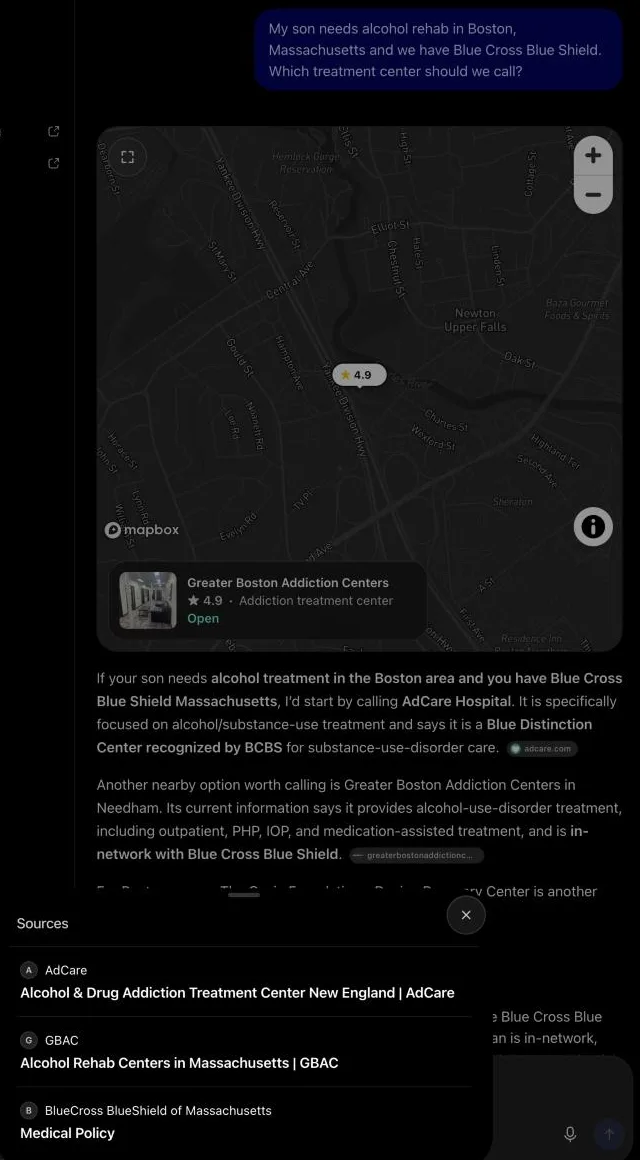
- The parent's question: "My son needs alcohol rehab in [city, state] and we have Blue Cross Blue Shield. Which treatment center should we call?"
That made 24 answers. For each one we saved the centers named, the place card shown above the text, and every entry in the answer's Sources panel. We also asked the shopping question for Denver four times, three of them without the state, to see how much one answer can be trusted to repeat.
We wanted Perplexity in the same test. On the same morning it asked us to sign in before it would answer, and we do not create accounts for research like this, so the Perplexity sections below rest on the company's own documentation rather than on answers we captured.
The second half of the study is the websites. For each metro we ran an ordinary web search for "drug rehab [city state]", kept the treatment providers and dropped directories, hospitals, government pages and a duplicate that redirected to another result. That left 75 provider sites. For each we downloaded the robots.txt file, which tells crawlers what they may read, and the homepage. Our own client, which ranked in one city, was left out.
What happens between the question and the answer
OpenAI explains the pipeline in its help article on searching the web with ChatGPT, and three parts of it matter to a treatment center.
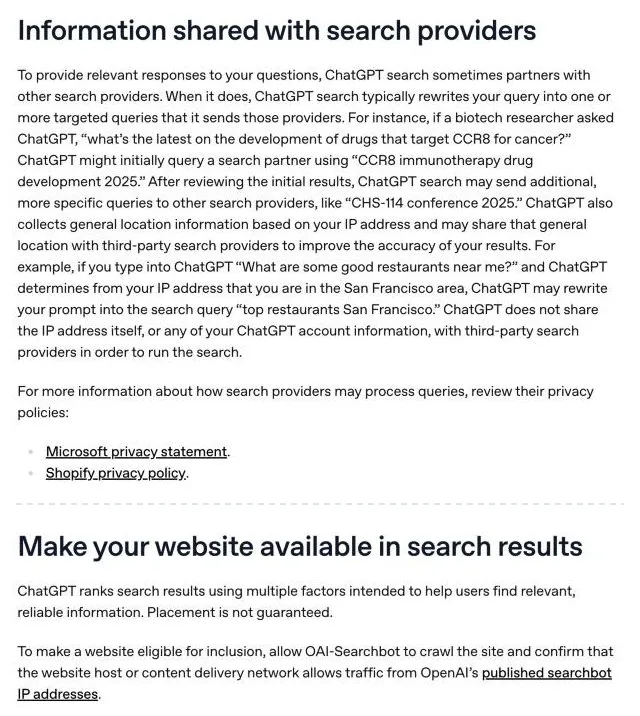
First, your question is not what gets searched. OpenAI says ChatGPT typically rewrites a question into one or more targeted queries and sends them to search partners, and may then send more specific follow-up queries. The help page links the privacy policies of Microsoft and Shopify as providers that may process those queries. A parent's long, frightened sentence becomes something closer to "alcohol rehab Denver Blue Cross" before any page is fetched.
Second, location shapes the result. ChatGPT may estimate a general location from the user's IP address and pass that general location to search partners. In our first tries we typed only the city name. Denver and Phoenix still got full answers, but for Dallas and Houston ChatGPT replied with a clarifying sentence and named nobody. With the state added, both cities got full answers. Families who type "rehab near me" from a phone are relying on that location guess.
Third, the website has to be readable by OpenAI's search crawler. The same help article says that to be eligible a site should allow OAI-SearchBot and make sure its host or content delivery network lets OpenAI's published IP addresses through. OpenAI's crawler documentation adds that sites that opt out of OAI-SearchBot "will not be shown in ChatGPT search answers", though they can still appear as navigational links, and that a robots.txt change takes about 24 hours to register. That crawler is separate from GPTBot, which collects training data, so a center can stay out of model training and still be eligible for search.
Perplexity publishes the same kind of rule. Its crawler documentation says PerplexityBot is designed to surface and link websites in Perplexity's search results and is not used to collect training data for AI models. A second agent, Perplexity-User, fetches a page when a user's question calls for it, and because a person asked, Perplexity says that fetcher generally ignores robots.txt. Changes can take up to 24 hours to show.
Google's AI Overviews and AI Mode work differently, because they sit on Google's own index. Google's Search Central page on AI features says there are no extra requirements to appear in them. A page needs to be indexed and eligible to show with a snippet, and that is all. If your center already does the basics of SEO well, the Google side of this is mostly covered. The ChatGPT side is where our test found the surprises.
Who gets named: a map pin, a star rating and about five centers
Every shopping answer named between four and six centers, five in most cities, and most of them opened by saying there is no single best rehab and that the right one depends on the level of care, the substance and the insurance. That framing is sensible. What sat above it is the part owners should look at.
23 of the 24 answers showed a map card with a star rating. The card carried the center's listing name, a rating out of five, a category such as "Addiction treatment center", and whether it was open or closed. The map itself carried Mapbox and OpenStreetMap credits. The ratings on screen ran from 3.0 to 5.0, and in two answers the card shown to the family said the center was closed. OpenAI does not say in its help pages where those ratings come from, and we could not find out from outside, so treat every public listing of your center as a possible source.
The listing names were revealing. Several cards showed names padded with keywords, the kind that read like a brand name followed by "Drug & Alcohol Rehab" and a city. Whatever directory ChatGPT pulled them from, Google's own guidelines for Business Profiles say the name should reflect the real-world business name, and that adding unnecessary information to it is not permitted and can get a profile suspended. A padded name may help on one platform and cost you the listing on another.
ChatGPT's list and the web's list overlap, but not much. Of the 62 center names in the 12 shopping answers, 25 also appeared among the providers in a regular web search for the same city. The other 37 came from somewhere else: directories, listings, accreditation records. Ranking on page one helps, and it is not the whole story.
The answer is not stable. We asked about Denver four times on the same morning. Across those four answers ChatGPT named eight different centers. Three appeared every time. The center on the map card changed between runs, and the cited sources were different in every single answer: a federal facility directory in one, two hospital systems and a rehab directory in the next, a state Medicaid document in the third, and an accreditor, a directory and two providers in the fourth. One run is an anecdote. If you are measuring your visibility, ask the same question several times and count how often you appear.
What ChatGPT cited, and how rarely it was a center's own website
The 24 answers cited 56 sources between them, and the biggest single group was rehab directories. Directories were cited 16 times and appeared in 11 of the 24 answers. Insurance companies' own provider directories came next with 14 citations, almost all of them in answers to the parent's question. Government agencies and standards bodies had 9, including the federal treatment facility directory, a state Medicaid agency and a state drug and alcohol department.
Treatment centers' own websites were cited 7 times, in 6 answers. Accreditors such as The Joint Commission and CARF International had 6 citations, and hospital systems had 4. Read that chart from a center's point of view: most of what ChatGPT said about specific providers came from pages written by someone other than the provider.
That changes where the work is. Your directory profiles are no longer a side chore for the admissions team. When a directory says a center accepts a plan or offers detox, ChatGPT repeated it in our answers, attributed it to current listings, and cited the directory, not the center. An out-of-date directory profile is now an out-of-date AI answer. Your accreditation record and your insurer's provider directory work the same way, which is one more reason to keep them accurate.
It also explains why some well-known centers were missing from answers in their own city. A center can have a strong website and still be absent if the directories, listings and insurer records that ChatGPT leaned on that day did not surface it. We covered the general version of this problem in our guide on getting recommended by ChatGPT and Google AI. In addiction treatment, the third-party layer carries even more weight.
The insurance question changes everything
Add a health plan to the question and ChatGPT stops browsing and starts checking. The parent's question produced shorter lists, a median of two or three centers rather than five, and in two cities ChatGPT recommended a single center to call first. In 10 of the 12 answers it cited an insurance company's own page, most often the Blue Distinction Centers for Substance Use Treatment and Recovery list that the Blue Cross Blue Shield Association publishes. Blue Cross describes that program as recognizing providers across the full continuum of care for substance use disorder, including opioid use disorder.
All 12 answers told the parent to confirm that the center is in network for the family's exact plan, not merely that it "accepts" Blue Cross. Several suggested calling the number on the back of the insurance card first, and several included a word-for-word script for the call. That is good advice, and it tells you what the family will ask your admissions line within minutes of reading the answer.
The most useful finding for a center is which websites got cited for insurance. In 3 of the 12 answers ChatGPT cited a treatment center's own website. In San Diego and Boston, it named a center and said that the center's own website states it accepts the plan or is in network with it, and those websites were in the Sources panel. In Phoenix, it cited one center's Blue Cross page while sending the family to a different center listed elsewhere.
In each case ChatGPT was paraphrasing a plain statement on the page, not reading a logo. So we checked how the 65 homepages we could read present a Blue Cross Blue Shield plan. Only 5 stated in a sentence that the center accepts the plan or is in network with it. Another 13 named it only in a menu or a list of insurer names, 18 only in the alternative text of a logo image, and 29 did not mention it on the homepage at all.
A logo strip is a design choice built for a human glancing at a page. A sentence such as "We are in network with Anthem Blue Cross for detox and residential care" is a claim a search system can quote, with the plan and the levels of care in one place. The homepage is not the only place for it. Every insurer you accept deserves its own page that says, in plain sentences, which plan types you are in network with, which levels of care that covers, and how a family checks its own benefits. Our census found most centers already have an insurance page. Few of those pages read like answers.
What the answers left out
The answers were careful about insurance and quieter about crisis help. Not one of the 24 mentioned the SAMHSA National Helpline, the free federal line at 1-800-662-HELP (4357) that FindTreatment.gov lists on its homepage. None mentioned 988. In the parent's answers, 8 of 12 warned that stopping heavy drinking suddenly can be dangerous, and 6 said to call 911 for severe symptoms such as seizures or confusion. The shopping answers pointed to SAMHSA's facility directory or locator in 5 of 12 cases, as a place to check licensing.
It is still better than it was. In a study published in JAMA Network Open in 2023, researchers put 23 public health questions to ChatGPT in December 2022, 14 of them about addiction. Only 2 of the addiction questions got a referral to a specific resource. ChatGPT in 2026, with web search on, named real centers in every answer we recorded and cited insurers in most of the family answers. It just does not volunteer the safety net unless the question pushes it there.
No answer mentioned LegitScript either. That matters less for the family than for the center, because certification decides whether you can advertise, not whether ChatGPT names you. Our LegitScript website checklist covers that side.
The gap is an opening for treatment center websites. If ChatGPT does not tell a frightened parent what to do tonight, your site can, and a page that answers "what if he needs help right now" with the helpline, 988 and the signs that mean an emergency room is exactly the kind of plain, factual page that gets read and cited.
Can AI assistants read your site? Usually yes
Robots.txt is almost never the reason a rehab is missing from ChatGPT. We read the robots.txt files of 63 of the 75 provider sites and checked them against ten crawlers, including OAI-SearchBot, ChatGPT-User, GPTBot, PerplexityBot, Perplexity-User and Googlebot. Not one file blocked any of them from the homepage. Six files named AI crawlers explicitly, and none of the six blocked them.
The firewall is a different matter. 45 of the 75 sites answered through Cloudflare, and Cloudflare announced on 1 July 2025 that it was changing its default to block AI crawlers unless they pay. Ten of the 75 homepages would not load for our ordinary browser-style request: nine refused it and one timed out. That proves nothing about OpenAI's crawler, which comes from published IP addresses that a firewall can allow, and two of those ten centers were named by ChatGPT in our test anyway. But it is exactly the setting OpenAI tells site owners to check.
The test takes five minutes. Open your firewall or CDN dashboard, find the bot or AI crawler settings, and confirm that OAI-SearchBot and PerplexityBot are allowed even if training crawlers are not. If your host or agency manages the CDN, ask them for a screenshot of the setting. We explain who usually holds those keys in our piece on who hosts and maintains a treatment center website.
What a center can change this quarter
Most of the fixes are unglamorous, and almost none of them involve writing more blog posts. Use this table as a worksheet: the first column is what ChatGPT drew on in our answers, and the last is how to check your own position without any tools.
| What ChatGPT used | What to fix | How to check it yourself | What our test found |
|---|---|---|---|
| The map card and its listing name | One real business name, correct category, current hours, the admissions number | Search your center's name on Google Maps, Apple Maps and Bing Maps; compare the name and hours | 23 of 24 answers showed a rated card; 2 cards said "closed" |
| Star ratings | A steady, honest review request after discharge or alumni events | Count reviews in the last 90 days on each map platform | Ratings shown ran from 3.0 to 5.0 |
| Rehab directories | Every directory profile matches your site: levels of care, plans, phone | Read your profiles on the directories that rank for your city | 16 of 56 citations; in 11 of 24 answers |
| Insurer directories | Your record with each plan is current; designations listed if you hold them | Look yourself up in each insurer's provider finder | Cited in 10 of 12 insurance answers |
| Accreditation records | Accreditor listings and your site name the same programs | Search your center on The Joint Commission and CARF lookups | 6 of 56 citations |
| Your insurance pages | One page per plan, with the plan types, levels of care and a sentence saying you are in network | Can a stranger answer "do they take my Blue Cross plan for detox" in ten seconds? | 5 of 65 homepages said it in a sentence |
| Crawler access | OAI-SearchBot and PerplexityBot allowed at the firewall, not just in robots.txt | Read your CDN's bot settings, or ask whoever holds the account | 0 of 63 robots files blocked AI search; 45 of 75 sites behind Cloudflare |
| The family's next question | A plain "need help tonight" page: helpline, 988, emergency signs, admissions line | Ask ChatGPT a crisis version of your question and see what it leaves out | 0 of 24 answers gave the SAMHSA helpline |
Two warnings. Do not try to game the map card with a keyword-stuffed name, which the platforms' rules forbid and which tends to cost more than it earns. And do not buy "AI ranking" packages that promise placement. OpenAI's own help page says placement is not guaranteed, and the answers we recorded changed between identical runs.
OpenAI says more than 300 million people a week ask ChatGPT health questions, in its July 2026 announcement of health features for US users. Some of those questions are a family looking for a bed. The work above is how a center shows up in that conversation with accurate facts, whether or not it ends up first on the list.
Where KhanWork helps, and what you can do without us
Most of the table above is work an admissions director or office manager can do in an afternoon a month: directory profiles, insurer records, map listings, reviews. You do not need an agency for that, and we would rather you did it yourself than paid someone to do it slowly.
Where we come in is the website half: insurance and program pages written as plain answers, structured data, a crawlable build, and the measuring. Foundation includes an AI visibility snapshot at launch, a record of what ChatGPT, Claude, Perplexity and Google's AI say about your center. Growth repeats it every month with the fixes we made and the competitors named instead, and Scale runs it for every location. The tiers are monthly subscriptions with prices on our pricing page: Foundation is $1,000 a month, Growth $2,500 and Scale $5,000. None of them locks you in: pausing or stopping is your call in any month. Whichever tier you pick, if the first page is not live 14 business days after your photos and copy reach us, the following month costs nothing. The detail of the AI side is on our AI search visibility service page.
For context on fit: we have shipped more than 200 projects and worked with 5 treatment centers, and after Cornerstone Healing Center's redesign its website conversions rose 20%. Our approach to addiction treatment work is laid out on the addiction and recovery industry page. Want a second opinion before anything else? Ask for our free funnel review of the page families land on, usually your homepage or the page behind your ads, and we will say so plainly when the real problem is your listings rather than your site.
The kitchen-table test
You can run a smaller version of our study tonight, from your own kitchen table, in about twenty minutes. Do it logged out, in a private browser window, so your history does not shape the answer.
- Ask three questions the way a family would. The shopping question with your city and state. The parent's question with the plan you see most often. And one with your level of care in it, such as detox or an intensive outpatient program.
- Ask each one three times, in fresh chats. Write down whether you were named, and in which position, each time. Three out of nine is a different situation from nine out of nine.
- Open the Sources panel every time. List which pages ChatGPT used to describe you. If it is a directory, read that profile next. If it is your own site, note which page.
- Check the card. Your name, rating, hours and open or closed status, exactly as a family would see them.
- Check the phone number. If ChatGPT gives a number for your center, call it. Make sure it reaches your admissions team and not a line you stopped paying for.
Repeat the test every month and keep the notes. The answers will move, and the notes are how you tell whether your changes moved them or the weather did.
Frequently asked questions
ChatGPT does not choose from memory when web search is on: it rewrites the question into search queries, sends them to search partners, and builds the answer from a local business listing plus a few cited pages. In our 24 answers from 1 October 2026, most citations came from rehab directories, insurance companies, government agencies and accreditors. A treatment center's own website was cited 7 times out of 56.
Usually because the pages ChatGPT leans on do not surface you, not because it cannot read your site. Check your map listings, directory profiles, insurer records and accreditation listings first. In our census, none of 63 rehab robots.txt files blocked OpenAI's search crawler, but 45 of 75 sites sat behind Cloudflare, so confirm your firewall allows OAI-SearchBot too.
No. We asked ChatGPT the same Denver question four times on one morning and it named eight different centers across the four answers, with only three appearing every time. The center on the map card and the cited sources changed between runs, so measure your visibility over several attempts, not one.
Make sure PerplexityBot can crawl your site, then publish pages that answer a family's questions in plain sentences. Perplexity's documentation says PerplexityBot surfaces and links websites in its search results and is not used for AI model training, and that robots.txt changes can take up to 24 hours to apply. Check your firewall as well as robots.txt.
Partly. When we added a Blue Cross Blue Shield plan to the question, all 12 answers told the family to confirm the center is in network for their exact plan, and 10 cited a page from a Blue Cross Blue Shield company. It also repeated insurance claims from directories and from centers' own websites, so a center's insurance pages should state its plans and levels of care plainly.
Block training crawlers if you want, but keep the search crawlers allowed if you want to be recommended. OpenAI treats GPTBot, which collects training data, separately from OAI-SearchBot, which surfaces sites in ChatGPT search, and says sites that opt out of OAI-SearchBot will not be shown in ChatGPT search answers, apart from navigational links.
No. Google's Search Central documentation says there are no additional requirements to appear in AI Overviews or AI Mode: a page needs to be indexed and eligible to show in Google Search with a snippet. The usual SEO basics cover it, which is why the ChatGPT side, with its listings and directories, is where most centers have work to do.
 Recovery
Sep 30, 2026 · 17 min
How to Choose a Treatment Center Marketing Agency: What 27 Agency Websites Show
We read the websites of the agencies that rank for treatment center marketing, including in Denver, and the Google, Meta and federal rules they work under. Here is what to check before you sign.
 Recovery
Sep 29, 2026 · 16 min
Who Hosts and Maintains a Treatment Center Website? What 60 Rehab Sites Show
We looked up the host, domain, certificates and software behind 60 ranking rehab websites to show who should host and maintain a treatment center website, what it costs, and where HIPAA changes the answer.
 Recovery
Sep 28, 2026 · 17 min
Drug and Alcohol Rehab Website Design: Build It Around What Families Search
We read 73 ranking rehab pages and 67 alcohol and opioid pages to show how a drug and alcohol rehab website should be worded, structured and designed for the family searching at night.