How Much Should a Psychiatry Practice Website Cost in 2026?

Oct 19, 2026 · 17 min read
A psychiatrist shopping for a website meets two kinds of seller. One prints a price on the page. The other asks for a call. On 19 October 2026 we read every seller we could find that builds sites for psychiatrists or mental health practices and shows a dollar figure on its own site, and the spread is wide: from $69 a month on a therapist template to $1,750 a month for a site with a custom CRM attached. Below, each published offer becomes a three-year total, so you can compare a cheap monthly plan with a one-time build fairly.
Price is half the decision. The other half is what a psychiatry site has to carry that most medical websites never deal with: self-pay fees, insurance lists that change, a telehealth promise tied to a federal prescribing rule with a 31 December 2026 date on it, and a line about the Good Faith Estimate that federal regulation says belongs on your website. So we also read 181 independent psychiatry practice websites in 14 US metros, 915 pages in all, to see what the market actually publishes. This article is both halves, plus a ten-minute check for the site you already have.
How much a psychiatry practice website costs, in short
From sellers that publish prices, a psychiatry practice website costs $0 to $5,000 to set up, plus $69 to $597 a month to run. Across 36 months that is roughly $2,700 for a therapist template plan to about $21,500 for a managed site with monthly SEO, and a one-time custom build with a care plan lands near $7,400 to $14,300. An outside estimator puts a US psychiatrist site at $3,600 to $23,200 for the build alone. Before you compare totals, check three things: whether the plan includes a HIPAA-covered intake form, whether the plan lets you post self-pay fees and the Good Faith Estimate notice, and who keeps the domain and design files if you walk away.
What psychiatry website sellers publish
Six sellers that market to psychiatrists, therapists or medical practices publish a price we could read on their own pages; most agencies in this niche publish none. We kept a price only when it appeared on the seller's site, not in a search snippet or a review roundup, and we read every page on 19 October 2026.
| Seller | Setup or build | Monthly, as published | What the price covers, in the seller's words |
|---|---|---|---|
| alwaysdobetter (psychiatrist page) | No build fee | $249, $597, or from $1,750 | Site, inquiry capture, hosting and updates at $249; monthly SEO content and lead attribution at $597; custom CRM and review automation from $1,750. Month to month |
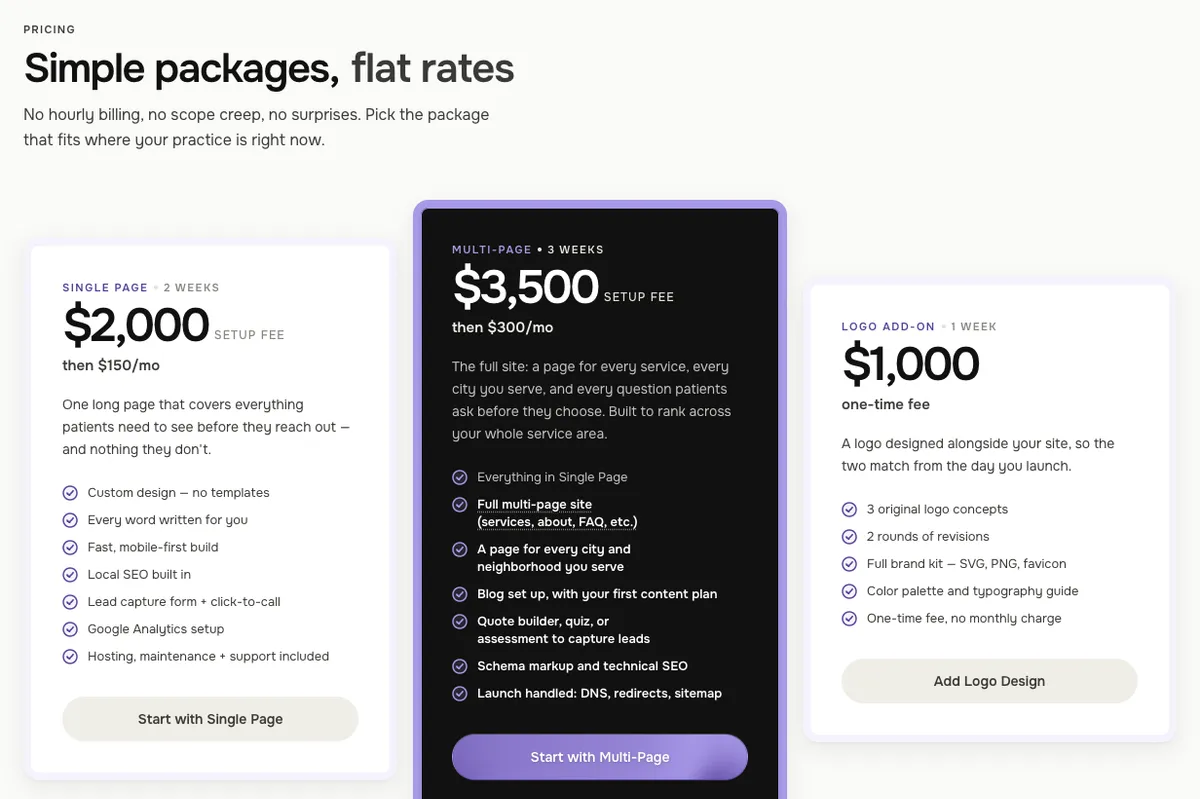
| Psychiatrist Website Design | $2,000 one page; $3,500 full site | $150 or $300 | Hosting, maintenance and support included; two weeks for one page, three for the full site; a logo is a further $1,000 |
| TherapySites | $199 design fee | $69 Core up to $336 Elite Plus | Domain management, a secured site, online scheduling and live support on Core, which it lists as HIPAA-compliant; SEO, AI search and social tiers above it |
| Brighter Vision | $100 setup on Start and Grow; none on Flourish | $99, $179 or $349 ($78, $143, $299 billed yearly) | Design team build and hosting; Hushmail HIPAA forms plus five secure Hushmail inboxes on Flourish |
| WebPath (medical practices) | From $5,000 | Care from $99; growth plans from $499 | Custom build launching in four to eight weeks; care plans cover hosting, security patches and edits |
| Albright Labs (healthcare page) | Build included | Managed website from $495 | Hosting, security, backups and monthly reporting |
| ProjectCostEstimator (an estimate, not a seller) | $3,600 to $10,150 freelancer; $8,700 to $23,200 agency | Not applicable | A modelled US range for a psychiatrist site, about $6,900 median for one with telehealth, self-pay rates and secure intake |
Only two of those are built for psychiatry specifically. alwaysdobetter has a psychiatrist landing page with its prices on it, and Psychiatrist Website Design is a firm whose whole site is about psychiatric practices. TherapySites and Brighter Vision are therapist platforms; plenty of psychiatric nurse practitioners and solo psychiatrists use them, and they are the cheapest credible floor, but their templates and content libraries are written for therapy, not for medication management. WebPath and Albright Labs sell to medical practices in general.
Read the estimator row with care. ProjectCostEstimator says its figures come from more than 600 project quotes and rate benchmarks with a 1.45 multiplier for the US, and its own page quotes the freelancer floor as $3,600 in the text and $3,650 in a table. It is useful for one thing: noticing when a quote sits far outside every published number. It is not a price anyone will charge you.
What three years actually cost
Over 36 months the published offers run from $2,683 to $21,492, and the order changes once the monthly fee runs for a while. A $249 plan with no build fee looks cheaper than a $2,000 build on day one; by month 36 they are within a few hundred dollars of each other. Here is each offer turned into a three-year total: setup or build fee plus 36 months of the seller's own monthly price, nothing assumed.
Two cautions. First, the bottom two bars are therapist products. If your practice is mostly medication management with a nurse practitioner or two, a therapist template will need rewriting from the first page, and that labour is not in the price. Second, a plan that bundles hosting is a different purchase from a build you can move. Ask any monthly seller what happens to the site, the domain and the content if you stop paying; the answer decides whether those 36 payments bought an asset or a rental.
Who is buying, and why price pages matter here
The buyers are a small, well-paid specialty with an unusual relationship to insurance. The Bureau of Labor Statistics counted 27,980 psychiatrists in wage employment in May 2025, with a mean annual wage of $269,940. Of those, 8,680 worked in offices of physicians, where the mean was $294,060. Those figures exclude the self-employed, so the private practice owners most likely to buy a website are under-counted, but the scale is right: this is a field of thousands, not hundreds of thousands, and many practices are one or two prescribers.
The insurance pattern is older but still shapes how practices present themselves. A national survey analysis in JAMA Psychiatry found that in 2009 and 2010 only 55.3% of office-based psychiatrists accepted new patients with private insurance, against 88.7% of physicians in other specialties, and 54.8% accepted Medicare against 86.1%. That is the reason so many psychiatry websites carry both an insurance list and a self-pay rate card, and the reason a patient arrives already asking two questions: do you take my plan, and if not, what will this cost me?
What 181 psychiatry practice websites show
Most psychiatry practice sites now sell telehealth and give a tap-to-call number, but only about a quarter print a self-pay price, and one in six mentions the Good Faith Estimate at all. We built the sample from searches for private psychiatry and psychiatric nurse practitioner practices in New York, Los Angeles, Chicago, Houston, Phoenix, Philadelphia, Dallas, Atlanta, Denver, Seattle, Miami, Boston, Minneapolis and Nashville, leaving out directories, hospital and university systems, national telehealth companies and therapy-only practices. Of 201 domains, 183 returned a readable homepage and 181 were clearly psychiatric practices. On every one we opened the homepage plus as many as six linked pages whose address suggested fees, insurance, telehealth, services or policies.
A few findings worth stating plainly:
- WordPress dominates. 93 of the 181 sites run on it, then Squarespace (20) and Wix (19). That matters for cost: most of these practices could move to almost any seller above without rebuilding on an unfamiliar system.
- Scheduling sits off the site. 75 link out to scheduling or EHR software, led by Tebra or Kareo (13), athenahealth (12), AdvancedMD (12), IntakeQ (11) and SimplePractice (10). Another 20 send patients to Zocdoc and 27 link a Psychology Today profile. The website is a front door to software you already pay for, which is why a website seller does not need to sell you a booking engine.
- Treatment-resistant care is now a website category. 57 sites mention TMS, 54 mention ketamine and 50 mention Spravato. Each of those is a separate page with its own questions about cost, insurance and time in the chair.
- Nurse practitioners are everywhere. 110 of the 181 sites mention a nurse practitioner or PMHNP. Several price NP and psychiatrist visits separately, which a fee page has to show clearly.
The fee page patients compare
Where psychiatry practices do publish a self-pay rate, the first visit clusters at $300, and the follow-up at $175. We read the rate card on each of the 49 sites that print one and took the first adult evaluation price; where a site lists a psychiatrist and a nurse practitioner, we used the lower figure. The range is $149 for a telehealth first visit to $1,700 for a 90 to 120 minute evaluation with a senior psychiatrist.
Look at that chart from a patient's side. Someone without in-network coverage is comparing a few tabs at once, and nearly three-quarters of the practices in our sample give them nothing to compare. The practices that do publish tend to do it well: a short table, one line per visit type, the length of the visit next to the price, and a sentence about superbills for out-of-network reimbursement.
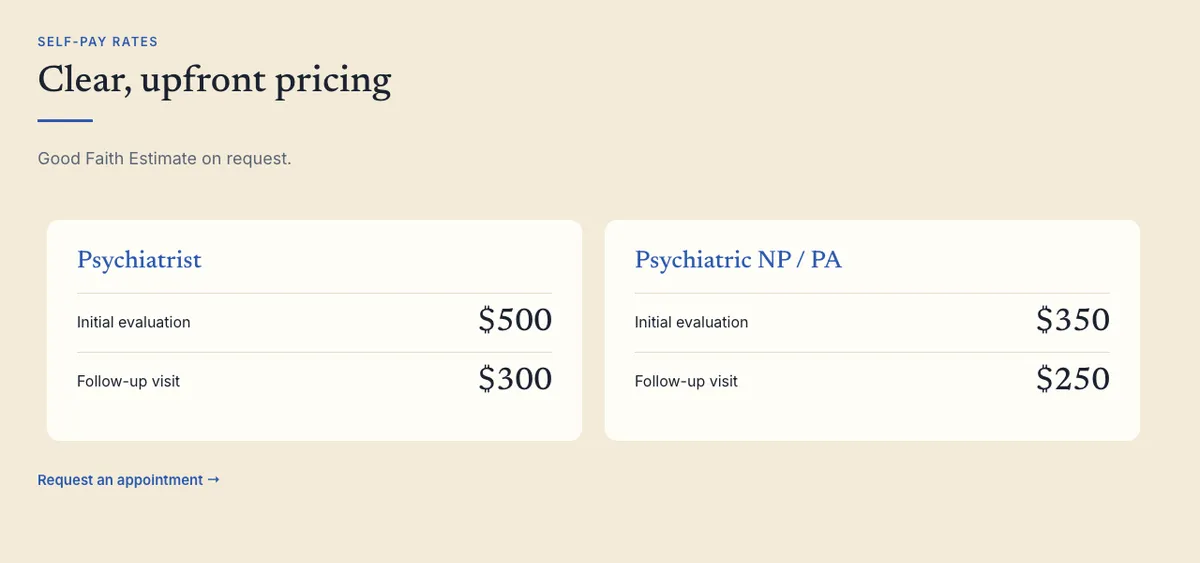
This is the cheapest improvement on the list: it costs an hour of writing. If your practice takes insurance for some patients and self-pay for others, one page with both answers will save your front desk a call per inquiry. If you will not publish a number, say how a patient gets one and how fast.
The website line federal rules ask for
If you see self-pay or uninsured patients, federal regulation expects information about the Good Faith Estimate to be on your website, not only in the office. Under 45 CFR 149.610, a provider must tell uninsured or self-pay patients that a good faith estimate of expected charges is available, and that information must be written clearly, prominently displayed on the provider's website, and easy to find from a public search engine, as well as posted in the office and given orally when scheduling.
Our census found Good Faith Estimate language on 31 of 181 sites, 14 of them on the homepage itself. Some of the other 150 may carry it on a page we did not open, so we are not calling anyone out of compliance. But it is a clear signal for buyers: if a seller's template has no place for the notice, or the seller has never heard of it, you will be paying for that education. It costs nothing to add when the site is built and something to retrofit later.
Telehealth pages and the 2026 prescribing deadline
Telehealth is now the default promise on psychiatry websites, and for practices that prescribe controlled medications that promise rests on a federal rule that currently expires on 31 December 2026. The DEA and HHS issued a fourth temporary extension of the pandemic telemedicine flexibilities, published in the Federal Register on 31 December 2025, which lets DEA-registered practitioners prescribe controlled medications by telemedicine without a prior in-person visit through the end of 2026. A proposed rule from January 2025 would create special registrations for telemedicine; as of our check of the Federal Register on 19 October 2026, no final version had been published.
That matters for the website more than most practices realise. 149 of the sites we read mention telehealth, 51 mention controlled medications somewhere, and only 12 mention the DEA or the Ryan Haight Act. A handful already say exactly where they draw the line: eight put a limit in writing, whether that is no controlled medications at all, none by video alone, none at the first visit, or none from a particular prescriber. If the rules change at the end of the year, every telehealth page, every ADHD page and every FAQ that says "we can start treatment online" needs to change the same week. Ask any seller how fast you can edit those pages yourself, or how fast they will.
Pixels on pages that name a condition
Of the 181 sites, 21 load a Meta advertising pixel and 126 load a Google Analytics or Tag Manager script. Whether a given setup breaks HIPAA depends on what the tag collects and on a 2024 court ruling that narrowed federal guidance; our security page sets out what that ruling did and did not change. The buying point is simpler. Ask any seller which tags their sites install by default, whether they will sign a business associate agreement, and where your intake form sends its data. Brighter Vision answers part of this in its pricing by bundling HIPAA forms from Hushmail into its Flourish plan; most sellers in the table say nothing on the page, which is a question for the call, not a reason to rule them out.
What a psychiatry site needs, and what to skip
A psychiatry practice site needs fewer pages than most sellers propose, but each one has to answer a specific question. In order of what patients and referrers ask:
- Insurance and fees on one page. The plans you take, the ones you do not, your self-pay rates, the superbill process and the Good Faith Estimate notice.
- Who prescribes. Psychiatrist and nurse practitioner profiles with credentials, the ages each sees, and the states each is licensed in for telehealth.
- A condition or service page for what you want more of. ADHD evaluations, TMS, Spravato or perinatal psychiatry each deserve their own page if you offer them; a single "services" list will not rank for any of them.
- A written medication policy. Controlled medications, refills between visits, and what happens if telehealth rules change.
- A new-patient path. Whether you are accepting new patients, the current wait, and one clear way to start. In our sample 47 sites say they are accepting new patients and 22 mention a waitlist or a pause.
What to skip: a blog you will not maintain, a stock-photo gallery, and a chatbot that collects symptoms before a human has spoken to the patient.
Questions to ask any seller
Use this table on every call, including ours. A good seller answers each question in a sentence.
| Ask | A good answer | Why it matters |
|---|---|---|
| What is the three-year total, setup included? | A single number, in writing | Monthly plans and builds only compare over the same period |
| Who owns the domain, the content and the design files? | You do, and you can export them | Otherwise the monthly fee is rent on your own site |
| Will you sign a BAA covering the intake form? | Yes, or the form runs on a HIPAA tool that does | Intake forms in psychiatry collect health information on day one |
| Which tracking tags do you install by default? | A short list, and none on condition pages without your sign-off | 21 of 181 sites we read load a Meta pixel |
| Where do the Good Faith Estimate notice and the fee table go? | A named page, linked from the footer | 45 CFR 149.610 asks for the notice on your website |
| Can I edit the telehealth and medication policy pages myself? | Yes, same day | The DEA telemedicine extension currently ends on 31 December 2026 |
| Is the template written for therapy or for psychiatry? | Psychiatry, with prescriber profiles and medication pages | Rewriting a therapy template is labour the price does not show |
| How do patients book: your form, my EHR, or Zocdoc? | Your existing software, linked cleanly | 75 of 181 practices already send patients to scheduling or EHR software |
Where KhanWork fits, and who should skip us
Most solo psychiatrists should not hire us. If you are one or two prescribers and need a tidy site, a fee page and an intake form that works, buy a $2,000 to $3,500 build with a $150 to $300 plan, or a $249 managed site, and spend the difference on your front desk. For that job we cost too much.
We publish our numbers on the pricing page so this comparison is honest. There are three subscription tiers, each paid monthly in advance: Foundation is $1,000, Growth $2,500 and Scale $5,000, and none carries a minimum term, so a practice can stop or pause whenever it likes. Foundation covers a refreshed brand and a single landing page designed to convert, which for a psychiatry practice is normally the homepage or the ADHD or TMS page your ads send people to. It launches 14 business days after we have your content and assets in hand, and a new page follows each month. A full site built out page by page belongs to Growth, and no tier includes hosting. Over three years Foundation totals $36,000, which tops every bar in the chart above; the reason to pay it is pace and testing, not price.
The practice we suit is a group: several prescribers, insurance panels that shift, TMS or Spravato services that need their own search traffic, paid ads, and an intake form that draws visits but too few first appointments. That is what our mental health practice work is shaped around, and turning visits into booked evaluations is the point of our conversion optimization service. In 200+ projects the domain, the files and the accounts have remained the client's. If you would rather begin small, send us the page with the most visits and our free funnel review will name the first fix we would make on it.
Related reading: for the therapy side of the same market, see what a therapy practice website costs, and for how solo and group sites differ, group practice versus solo websites.
The referral coordinator test
Many psychiatry patients arrive by referral, and the person reading your site first is often a primary care office trying to place them. Give yourself ten minutes, open your site on a phone, and answer these as that coordinator would:
- Do you take this patient's plan, or Medicare? Find the answer without calling. If it takes more than one tap from the homepage, move it.
- What will it cost if you do not? Find a self-pay figure for the first visit, or a sentence saying how to get one.
- How long is the wait? Look for a date, a range, or an honest "we are not taking new patients until".
- Can the patient be seen by video, and in which states? Check that the answer matches what your prescribers are licensed for today.
- Will you manage the medication the patient is already on? If you have a controlled-medication policy, it should be findable before the first call, not explained during it.
- Where is the Good Faith Estimate notice? Search your site for the phrase. If nothing comes back, that is the first edit, and it is free.
Any question you could not answer in under a minute is a page to fix before you spend anything on a new site. If you fix them and inquiries still do not turn into first appointments, then it is time to compare the totals above.
Frequently asked questions
A psychiatry practice website costs $0 to $5,000 to set up and $69 to $597 a month to run, from sellers that publish prices, which comes to about $2,700 to $21,500 over three years. A one-time custom build with a care plan lands near $7,400 to $14,300 over the same period. Prices were read on sellers' own pages on 19 October 2026.
A therapist platform is good enough if you only need a simple, low-cost site and will rewrite the content yourself. TherapySites and Brighter Vision start at $69 and $99 a month, but their templates and content libraries are written for therapy, so prescriber profiles, medication policies and fee pages for evaluations and follow-ups usually need building from scratch.
Yes, in most cases publishing self-pay fees helps, because patients without in-network coverage compare practices before they call. In our census of 181 psychiatry sites, only 49 printed a self-pay price; the median first evaluation was $300 and the median follow-up $175.
Yes, for any practice that treats uninsured or self-pay patients. Under 45 CFR 149.610, information that a good faith estimate of expected charges is available must be clearly written and prominently displayed on the provider's website, as well as in the office. We found the notice on 31 of 181 psychiatry practice sites.
Yes, through 31 December 2026, under the DEA and HHS fourth temporary extension of telemedicine flexibilities published on 31 December 2025. A January 2025 proposal for special telemedicine registrations had no final rule as of 19 October 2026, so practices should keep telehealth and medication policy pages easy to update.
A psychiatry practice website needs five pages before anything else: insurance and fees, prescriber profiles with licensed states, a page for each service you want more of, a written medication policy, and a clear new-patient path that says whether you are accepting patients. Blogs and galleries can wait.
The practice should own the domain, the content and the design files, and be able to export them. Several monthly plans bundle hosting with the site, so ask in writing what happens to the site and domain if you stop paying before you sign.
 Healthcare
Oct 18, 2026 · 17 min
How Much Should a Fertility Clinic Website Cost in 2026?
Most fertility marketing agencies publish no price. We found six sellers that do, turned each into a three-year total, then read 217 SART member clinic websites for prices, success-rate pages and financing.
 Healthcare
Oct 17, 2026 · 17 min
How Much Should a Physical Therapy Website Cost in 2026?
Published PT website offers start at $97 to $750 a month, and the two biggest PT-only firms would not load for us. We read every price we could, then checked what 114 real clinic homepages run, from booking software to self-pay rates.
 Healthcare
Oct 16, 2026 · 16 min
How Much Should a Chiropractic Website Cost in 2026?
Six of eight chiropractic website companies publish a price, from $64.95 to $375 a month. We read every plan card and term, then worked out what each one costs over three years and what you keep when you leave.