
Mental Health Practice Websites: Group Practice vs Solo

Oct 10, 2026 · 16 min read
A solo therapist's website and a group practice's website look alike at a glance: a calm photo, a list of specialties, a button to get in touch. They are doing different jobs. A solo site has to introduce one person well enough that a stranger books a consultation. A group site has to help that stranger pick one clinician out of nine or twenty, get them onto a calendar with an opening, and quietly recruit the next associate at the same time.
On 10 October 2026 we read the homepages of 307 therapy practice websites found through ordinary searches in 15 US metros, sorted them into solo and group practices, and counted what each kind actually carried. Below is what turned up, alongside the published prices and Google rules that shape both builds.
Group practice vs solo websites, the short version
A solo practice website sells one clinician, so it needs a strong about page, plain fees or insurance information, and one clear way to book; for many solo clinicians a $29.95-a-month Psychology Today listing does more of the finding than the website does. A group practice website sells a practice and then has to route each visitor to the right clinician, so it needs a clinician directory with real profiles, a way to filter or be matched, scheduling that knows who has openings, separate Google profiles for each clinician, and a hiring page. In our census, 148 of 261 group homepages linked to a careers page and 90 offered help choosing a clinician. Of 35 solo homepages, 4 linked to a careers page and none offered matching.
Where the 307 sites came from
We searched for "therapist", "private practice therapist", "counseling group practice" and "therapy practice accepting new clients" in each of 15 metro areas, from New York and Los Angeles to Charlotte, Nashville and Portland. Most results were directories and marketplaces, so we kept only the websites of individual practices and dropped directories, national chains, hospitals, universities and community mental health centers. That left 340 practice domains. Twenty-seven blocked our requests or failed to load, and six more returned a bot check or an almost empty page, leaving 307 homepages.
Next, from each homepage we opened the page that introduces the clinicians and counted the people listed with a license credential. We classed a site as a group practice when it named three or more clinicians, or two plus clear group language, and as solo when it spoke in the first person about one clinician. Every site we could not settle automatically was read by hand. The result: 261 group practices, 35 solo practices and 11 we could not classify with confidence. We looked at the homepage, plus the team page where noted, so a feature that lives deeper in the site is undercounted. No practice is named.
Search results lean heavily toward groups
The first finding came before we read a single page. Even among sites found through searches that never mentioned a group, such as "therapist Denver", 183 were group practices and 34 were solo. Our read is that group sites simply give a search engine more to match against: more pages, more clinician names, more location detail. A solo clinician who expects the website alone to fill a caseload is competing with practices that have ten times as many pages.
That does not mean solo practices struggle for clients. Demand is not the problem in most of the country. As of 30 September 2026, HRSA counted 7,127 designated mental health professional shortage areas covering 154,557,656 people, with 26.24 percent of the need for providers met, according to its quarterly shortage area summary. A solo clinician with a good directory profile and a few referral sources often fills a caseload without the website doing much at all.
The economics shift once a practice hires. The Bureau of Labor Statistics' occupational outlook for psychologists puts the occupation at about 209,400 jobs in 2025, with 23 percent of psychologists self-employed. For marriage and family therapists, 33 percent work in offices of other health practitioners, the industry category that includes private therapy offices, and 11 percent are self-employed. An owner who employs or contracts associates is paying for their time whether or not their calendars are full, so the group website stops being a business card and becomes the thing that keeps those calendars moving.
What a solo practice website has to do
A solo site has one product, the clinician, and one conversion, a first consultation. Everything on it should help a stranger decide whether this particular person is right for them. Concretely, that is a homepage that says who you work with and what changes for them, an about page written in your own voice with a real photo, a clear answer on fees or insurance, and one booking path a thumb can use.
The tools for that are cheap and published. A Psychology Today membership costs $29.95 monthly and can be canceled at any time, according to its membership signup page. SimplePractice's solo plans are $49, $79 and $99 a month for Starter, Essential and Plus. Brighter Vision, a website builder for therapists, starts at $99 a month, or $78 billed annually. A solo clinician can run the finding, booking and website layers for well under $200 a month before any designer is involved.
The solo sites in our census reflected that. Of the 35, 19 had a tap-to-call phone link on the homepage, 19 mentioned telehealth or online sessions, 16 had a clear booking or appointment button, and 7 linked to the clinician's Psychology Today profile. Only 4 named an insurer on the homepage and only 1 listed a session fee there. Fees and insurance are the first two questions most callers ask, so a solo site that answers both above the fold saves a phone call for every visitor who would not have been a fit.
Google treats a solo clinician simply. Its guidelines for representing your business say that when a practitioner is the only public-facing practitioner at a location and represents a branded practice, it is best to share one Business Profile, named with the brand, a colon and the practitioner, such as Practice Name: Jane Doe. One profile, one website, one name. Most solo clinicians do not need more structure than that.
What a group practice website has to do
A group site has to do the solo site's job for every clinician, plus four jobs a solo site never has: help a visitor choose between clinicians, show who actually has openings, keep each clinician findable in local search, and recruit. The census showed how unevenly groups handle those.
The clinician directory is the real homepage
Nearly every group, 255 of 261, linked from its homepage to a page introducing its clinicians. That page does the work a solo site's about page does, multiplied. Where the team page listed names with license credentials, we could count the clinicians: 160 group sites gave us a usable count, and the median was 9.
A practice with 11 to 20 clinicians, the most common band, cannot rely on a grid of headshots. A visitor scanning 15 faces has no way to tell which one takes their insurance, works with teenagers, or has an evening opening this month. The groups that handled this well gave every clinician a full profile page with specialties, populations, license states, insurance panels, session formats and availability, and let the directory be filtered by those same fields. A headshot grid with a "read more" link is the version most sites shipped.
Helping someone choose
Ninety of the 261 group homepages offered some form of help choosing a clinician: a "get matched" form, a free matching call, an intake coordinator, or a line saying the practice would match the visitor with the right therapist. That is the single feature that most separates a group site from a solo one, and none of the 35 solo homepages offered it, because a solo practice has nobody to match.
Matching is a service, not a widget. A form that promises a match within one business day is only as good as the person reading it, and a visitor who submits it at 9 p.m. and hears nothing by Thursday has probably booked somewhere else. If your practice offers matching, say on the page who does it, how fast they reply and what the visitor will be asked, and give a direct booking path for people who already know which clinician they want.
Showing real openings
Only 60 of the 261 groups linked to an online scheduling tool from the homepage or team page, whether a practice management system's booking page, a scheduling service or a marketplace profile. Most others used an appointment request form or a phone number. That is often deliberate, because many group owners want a person to screen fit and insurance before a first session is booked. The cost is that a visitor cannot see whether anyone is actually available.
A middle path works for many groups: show availability status on each clinician's profile, such as "accepting new clients", "waitlist" or "evenings full", and update it weekly. It does not require live calendar integration, and it stops a visitor from spending ten minutes choosing a clinician whose caseload has been full since spring.
One Google profile per clinician
Google's rules change once more than one clinician sees clients at an address. For multiple practitioners at one location, Google's guidelines say the organization should have its own Business Profile, separate from the practitioners', and that each practitioner's profile title should include only the practitioner's name, not the organization's.
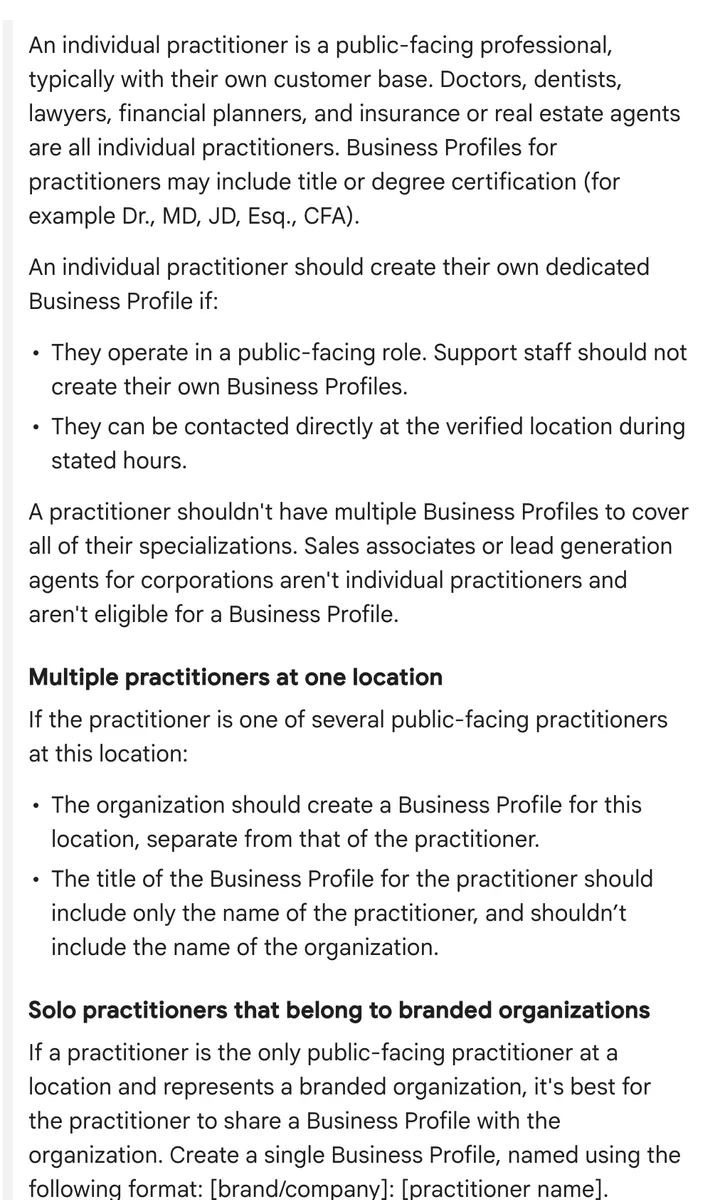
For a group website, that has a practical consequence. Each clinician's Google profile needs a page to link to, and the clinician's own profile page on the practice website is the natural target. A group whose directory is one long page with anchor links has nowhere good to send that traffic. Separate, indexable clinician pages give each Google profile, each directory listing and each referral source one address that belongs to that person.
The website is also a hiring page
The most lopsided number in the census was recruiting. Of the 261 group homepages, 148 linked to a careers, employment or join-our-team page. Four of the 35 solo homepages did, mostly clinicians beginning to add associates. A group website has two audiences who never overlap: people looking for therapy and clinicians looking for a place to practice. Both need to find their door quickly without the other one getting in the way. A small "careers" link in the header or footer that leads to a page with roles, pay structure, supervision and caseload expectations does that without cluttering the client-facing pages.
The software bill grows with every clinician
The other structural difference is cost per seat. Many of the tools that make a solo site work are priced per clinician, so a group's monthly bill scales with its headcount in a way a solo practice never sees. SimplePractice is a clear example because it publishes both sets of prices on one page.
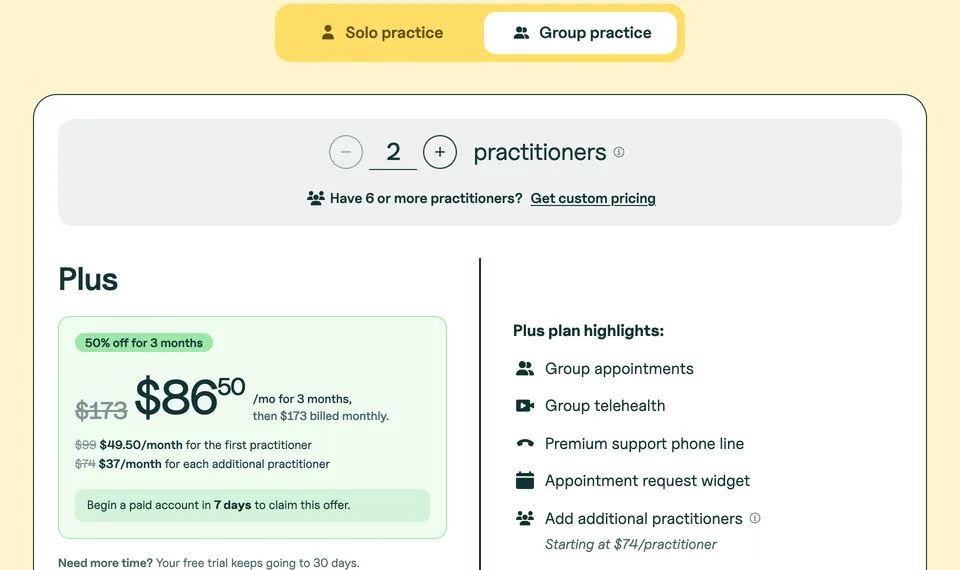
On its group tab, SimplePractice prices Plus at $99 a month for the first practitioner and $74 for each additional one, and practices with six or more practitioners are directed to custom pricing. Its Plus plan is also the one that lists the appointment request widget. At the published rates, two practitioners cost $173 a month and five cost $395, before the introductory discount and before any add-ons.
Directory listings add up the same way when every clinician keeps a paid profile of their own: nine clinicians at $29.95 each is $269.55 a month. We are not arguing against those tools. It is a reason a group website deserves a budget and an owner, because by the time a practice has nine clinicians it is already spending real money every month on getting clients to them, and the website is where that spending either lands or leaks.
Rules that apply to solo and group sites alike
Some obligations do not care about practice size. The most specific is federal. The No Surprises Act rules at 45 CFR 149.610 require providers to tell self-pay and uninsured clients that a good faith estimate is available, and on the website that notice has to be "prominently displayed (and easily searchable from a public search engine)". It also belongs in the office and wherever scheduling happens. Only 26 of the 261 group homepages and 6 of the 35 solo homepages mentioned a Good Faith Estimate. Many practices keep the notice on a fees or policies page instead, which our homepage count would miss, so treat those numbers as a floor. The rule still asks for the notice to be easy to find, and a footer link costs nothing.
Crisis information is the second. Only 24 group homepages and 3 solo homepages mentioned 988, 911 or an emergency room. Therapy websites are not crisis services, and most say so somewhere, but a visitor who arrives on the homepage in a bad moment should not have to find the FAQ to learn what to do. One sentence beside the contact options, pointing to 988 and to emergency services, is the standard we would hold any practice to.
Money is the third. Fees and insurance were rare on both kinds of homepage: 58 of 261 groups and 4 of 35 solo practices named an insurer, and 18 groups and 1 solo practice listed a session fee. Every practice has reasons to be careful with prices, and we covered the published costs of the tools themselves in our guide to what a therapy practice website costs. But a visitor who cannot tell whether you take their plan, or roughly what a self-pay session costs, has to call to find out, and many will not. The vendor agreements behind intake and contact forms are covered in our HIPAA website guide.
Solo or group: what each site needs
This is the comparison we use when scoping a mental health practice site. The census columns show how many homepages in our sample carried each item.
| Job | Solo practice site | Group practice site | What the census found |
|---|---|---|---|
| Introduce the clinicians | One about page in the first person, with a real photo | A directory with a full profile page for every clinician | 255 of 261 groups linked to a team page; median 9 clinicians where countable |
| Help someone choose | Not needed; the visitor is choosing you | Filters by specialty, population, insurance and format, plus a matching option with a stated reply time | 90 of 261 groups offered matching help; 0 of 35 solo practices |
| Booking | One consultation or booking path that works on a phone | Booking per clinician, or availability status on every profile | 60 of 261 groups linked to an online scheduler; 4 of 35 solo practices |
| Google Business Profile | One shared profile, named with the practice brand and your name | One profile for the practice and one for each public-facing clinician, each linking to that clinician's page | Google's guidelines set different rules for each case |
| Recruiting | Usually none | A careers page with roles, pay structure, supervision and caseload expectations | 148 of 261 groups linked to careers; 4 of 35 solo practices |
| Fees and insurance | Your fee or panels, stated plainly | Panels per clinician, self-pay ranges, and a clear route for out-of-network clients | 58 groups and 4 solo practices named an insurer; 18 and 1 listed a fee |
| Good Faith Estimate notice | Required for self-pay clients; a footer link is enough | The same, once, sitewide | 26 groups and 6 solo practices mentioned it on the homepage |
| Typical monthly tools | Directory listing $29.95; practice software $49 to $99 | A directory listing for each clinician who keeps one; practice software $99 plus $74 per added clinician on SimplePractice Plus | Published prices, read 10 October 2026 |
Who should pay a designer, and who should not
If you are a solo clinician with a full caseload or a short waitlist, you probably do not need us or any agency. A strong directory profile, a builder site with an honest about page, your fees and insurance stated plainly, and a booking link will do the job. Spend the difference on supervision or a day off.
A designer earns their fee when a practice has outgrown that setup: a group with associates whose calendars are not full, a clinician directory that has become a wall of faces, Google profiles that point at the homepage, or a site that cannot tell a parent looking for a teen therapist where to go. Practices in that position are who we build for in mental health, and our conversion work starts from the routing problem described above rather than from a new color palette.
What we charge is on our pricing page, and all three are billed monthly in advance with no minimum, and any of them can be paused or canceled. For $1,000 a month, Foundation gives the practice a brand refresh plus one landing page built to convert, launched within 14 business days of the day your copy, photos and logins arrive, and one more page every month after that. In a group, we would usually spend that first page on the clinician directory. Growth costs $2,500 a month and takes on the whole site, every clinician profile included, and you can queue as many requests as you like while we work through them in order. Scale, the $5,000 tier, keeps two requests moving in parallel and gives each office its own full set of pages, which is the fit for practices running several locations. Unsure which page loses you the most clients? The free funnel review is the quickest way to find out: point us at the page most visitors land on and we will tell you what we would change first.
Route three strangers through your site
For a group practice, the quickest test of the website is whether a stranger can get from your homepage to a specific clinician who fits them and has room. Budget twenty minutes and recruit a friend who has never seen your site.
- Write three short client briefs. Make them real and different, for example: a parent looking for a therapist for a 15-year-old who takes Aetna; an adult who can only do evening telehealth and will pay out of pocket; a couple who want someone trained in a specific method.
- Hand your friend a phone and the first brief. Ask them to start on your homepage and stop when they have found one clinician they would book with and a way to book. Do not help.
- Time it and count the taps. Note where they hesitated, which pages they opened and closed, and whether they ever learned if that clinician is accepting new clients.
- Repeat with the other two briefs. If any brief takes more than three minutes or ends at a contact form with no clinician chosen, your directory is not doing its job.
- Check the money questions on the way. Could your friend tell, without calling, whether the clinician takes their insurance or what a self-pay session costs?
- Fix the slowest brief first. It usually points at one missing filter, one thin profile, or one booking path that goes nowhere, and each of those is a page, not a redesign.
A solo clinician can run a shorter version: one brief, one friend, one question. Could they tell within a minute whether you are the right person and how to book you? If yes, your website is already doing what it needs to.
Frequently asked questions
A solo therapist website introduces one clinician and gets a visitor to book a consultation, while a group practice website has to help the visitor choose among many clinicians, show who has openings, and recruit new clinicians. In our census of 307 therapy practice homepages, 148 of 261 group sites linked to a careers page and 90 offered help choosing a clinician; among 35 solo sites, 4 linked to careers and none offered matching.
A solo therapist with a full caseload can often rely mainly on a directory profile, but a simple website still helps with credibility, fees, insurance and booking. Psychology Today charges $29.95 a month, and a basic builder site plus practice software can cover the rest for well under $200 a month.
Yes, each clinician should have their own indexable profile page with specialties, populations, insurance, session formats and availability. Google's guidelines let each public-facing practitioner at a location have their own Business Profile, separate from the practice's, and that profile needs a page on your website to point to.
Offer filters for specialty, age group, insurance and session format on the clinician directory, plus a matching form or call with a stated reply time for people who want help choosing. Ninety of the 261 group practice homepages in our census offered some form of matching help; the best ones said who does the matching and how quickly they respond.
Show online booking where your practice can support it, or at least show each clinician's availability status so visitors do not choose someone who is full. In our census, 60 of 261 group practices and 4 of 35 solo practices linked to an online scheduling tool from the homepage or team page; most others relied on request forms or phone calls.
It does whenever the practice sees self-pay or uninsured clients. Under 45 CFR 149.610, the notice that a good faith estimate is available must be easy to see on the practice website and findable through a search engine. Only 26 of 261 group homepages and 6 of 35 solo homepages in our census mentioned it, though some practices keep it on a fees page.
On SimplePractice's published pricing, solo plans cost $49, $79 or $99 a month, while the group Plus plan costs $99 for the first practitioner plus $74 for each additional one, so two practitioners pay $173 and five pay $395 a month. Practices with six or more practitioners are offered custom pricing.
 Healthcare
Aug 28, 2026 · 16 min
How Much Should a Dentist Website Cost in 2026?
We tried the pricing page of 39 dental vendors. Nineteen would not load, and of the twenty that did, five stated a price and not one of the five sells websites. So this is built on the numbers that are published, which belong to the software your booking button plugs into.
 Healthcare
Aug 23, 2026 · 15 min
How Much Should a Med Spa Website Cost in 2026?
Every guide answers this with a range it cannot source. Aesthetics is one of the few fields where the software vendors publish their prices and the industry association publishes what a patient is worth, so this one answers with numbers you can open and check, including ours.
 Healthcare
Aug 17, 2026 · 14 min
How Much Should a Therapy Practice Website Cost in 2026?
Published plans for therapist websites run from about $830 to $4,200 in the first year. Here is what each one buys, why a $29.95 directory listing beats all of them at finding clients, and the three rules that apply to a therapy website and almost nothing else.