
How Much Should a Dentist Website Cost in 2026?

Aug 28, 2026 · 16 min read
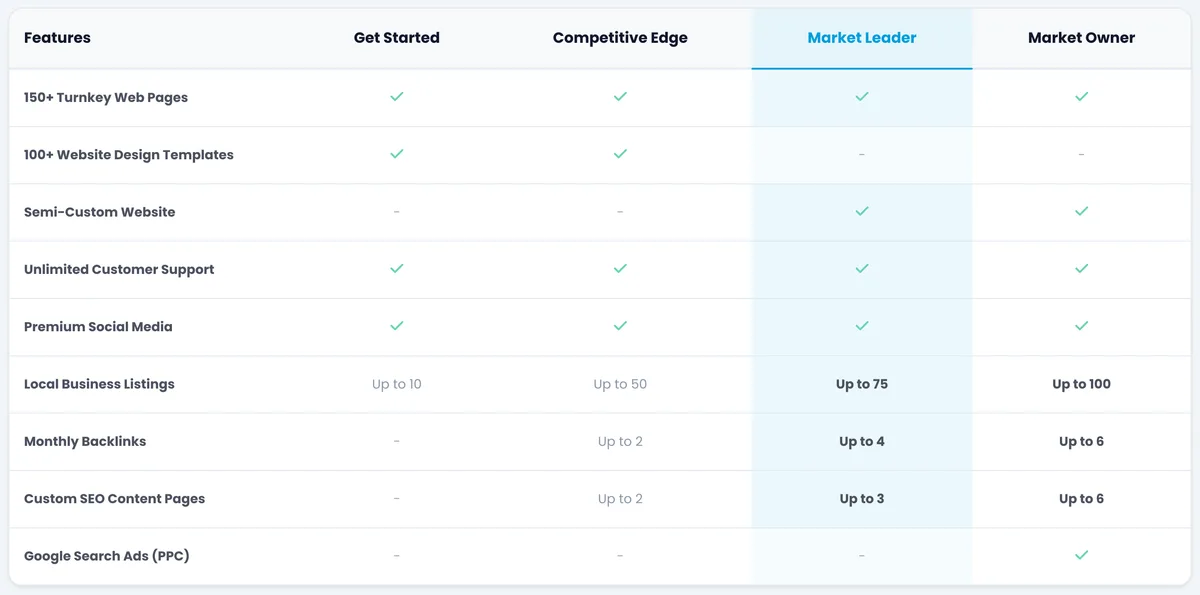
ProSites publishes a page called Pricing. It names four plans, compares them across nine features, and answers thirteen questions about which one to pick. It prints no price. Officite's page is called Packages and Pricing, and the only dollar figures on it are the monthly rates for desk phones. Curve Dental's page is titled Affordable and Transparent Pricing, and the only dollar amounts on it sit inside quotations from customers describing what they saved.
That is not three unlucky pages. On 28 August 2026 we tried the pricing page of 39 companies that sell United States dental practices a website, practice management software or patient communication software. Nineteen returned a 404 or a 403. Of the 20 that opened, five named a price for the product the page was selling, and not one of the five was a website company. Every cost guide ranking for this question is therefore built on numbers nobody published. This one is built on the numbers somebody did, and they turn out to belong to the software your website has to plug into. We sell websites as well, so our own figures are in here with everyone else's.
The 30-second answer
A dentist website in 2026 is two purchases that arrive as one bill, and only one of them has a public price. The build is quoted privately: of the eight dental website companies whose pricing pages we could open, not one named a price for a website, and the guides ranking for this query fill that silence with ranges running from $499 to $50,000. The recurring half is published and checkable. Open Dental charges $199 a month per location for the first 12 months and $149 after that, plus $75 a month for the online scheduling that makes a booking button work. Practice-Web charges $179 then $129, with online scheduling at $119 and online forms at $49. tab32 is $125 a month in year one and $225 from year two. CareStack folds online appointments, forms and the patient portal into $829 a month. We publish our own price too: a monthly partnership at $1,000, $2,500 or $5,000 a month, with no minimum. Budget for that every month, and for the subscriptions that make the site function, for as long as the practice exists.
What the pages ranking for this question say
They say seven different things, and the disagreement is not small. On 28 August 2026 we opened seven guides returned for this query and recorded the headline range each one leads with. Rosemont Media says $3,500 to $30,000. Emizentech says $2,500 to $20,000. Flamingo Agency says $4,000 to $8,000 for most small practices, rising to $8,000 to $20,000. The Dental Signal says $3,000 to $15,000. Bemo Design splits into $2,500 to $6,000, $6,000 to $15,000 and $15,000 to $40,000. Dentive lands on $5,000 to $10,000. Top Dental Websites opens with $499 to $50,000.
Line those up and the low ends vary by a factor of ten and the high ends by a factor of six. A reader who visits all seven learns that a dental website costs somewhere between five hundred dollars and fifty thousand, which is the question restated rather than answered. None of the seven cites a dental website company's published price, for the good reason that there are almost none to cite.
There is a second problem underneath the first. Every one of those ranges prices a project, as though the website were a thing you buy once and own. For a dental practice the working parts of the site, the booking, the forms, the reminders, the payment link, are almost always billed by a different company on a monthly subscription tied to the practice management software. A range that stops at the build has stopped counting before the recurring bill starts.
We tried 39 pricing pages
The result was lopsided enough to be the answer to the whole question. We took 39 companies that sell dental practices a website, practice management software or patient communication software, and opened the page each one calls Pricing. Nineteen of the 39 never returned a readable page. Thirteen gave us Page Not Found: Smile Marketing, WEO Media, Delmain, Wonderist Agency, Studio 8e8, Pain-Free Dental Marketing, Doctor Genius, Great Dental Websites, Sesame Communications, Dentist Identity, RevenueWell, Dental Intelligence and Dentrix Ascend. Four blocked us with a 403: PBHS, DentiMax, Firegang and Titan Web Agency. Two, TNT Dental and Rosemont Media, timed out.
Of the 20 pages that did open, five stated a price for the product on sale. All five sell software. None sells websites.
Some of the near misses are worth naming, because they show how the silence is dressed. Officite's page does carry a price table, for phone lines, at $24.72 a line a month falling to $18.54 at higher line counts, with no figure anywhere for the website the page is selling. Practice Cafe's pricing page contains two dollar amounts, both rhetorical, in a passage explaining that it cannot compete with cheap logos. Curve Dental's and Podium's pages price nothing and quote customers describing what they saved or earned. Adit's Pricing Plans page carries three dollar amounts and all three are sign-up incentives, including a gift card. Dental Marketo is the one page that does print figures, for advertising, search, social and reputation retainers, though it shows what look like annual totals in a per month slot and names no price for a website at all.
ProSites is the clearest example, because the page is genuinely useful right up to the point where a number would go. It sets out four tiers, Get Started, Competitive Edge, Market Leader and Market Owner, and compares them feature by feature so you can see exactly what moving up a tier buys. Thirteen questions at the foot of the page help you choose between them. What none of it tells you is what any tier costs.
We are not claiming anything sinister. Agency pricing genuinely varies with scope, and a quote-only model is a normal way to sell custom work. The consequence is still real: when nobody in a market publishes, every guide written about that market has to invent, and the numbers at the top of Google for this query are inventions.
The prices you can check belong to the software
Two dental software companies publish complete, itemized fee schedules, and between them they answer most of what a practice actually wants to know. Open Dental lists every fee it charges on one page, from the software licence to a single text message. Practice-Web does the same, and says out loud why its competitors do not. Its pricing page asks: why is it that other vendors don't even disclose pricing on their websites?
Open Dental's licence and support is $199 a month per location for the first 12 months, dropping to $149 a month from the thirteenth. That covers every computer in the office for up to three providers, with each dentist beyond three adding $20 a month, hygienists not counted. Canada is $164 falling to $137, other countries are $89, and dental schools pay nothing. Practices that signed up before 2 February 2026 keep the old $179 initial rate for their first year, which is how you can tell the price moved this year.
Open Dental also publishes its own price history, which almost nobody does. The 2003 prices were $139 for the first year and $99 from the thirteenth month, with increases in 2008, 2015, 2018, 2022 and 2026. The company notes that the 2003 prices adjusted for inflation to December 2025 would be $247 and $176, so the 2026 prices are about 19 and 15 percent lower in real terms than the ones it charged twenty-three years ago.
Practice-Web sits $20 below Open Dental at both stages, at $179 a month falling to $129, and it uses the same shape: 12 month initial term, same $20 for each dentist past three. Its list prices, the ones it calls regular rather than special, are $199 and $149, which are Open Dental's numbers exactly. Two independent vendors, one structure, one twenty-dollar gap.
Above them sit the all-in cloud platforms. tab32 publishes $125 a month for Alpine in year one, described as a start-up rate for up to three providers, and $225 from year two for up to five, with claims at 20 cents each, attachments at 50 cents and eligibility checks at $1.25. CareStack publishes $829 a month for Essentials and $1,299 for Intelligence, and its Essentials tier includes online appointments, the digital patient portal and forms in the price. Weave, which sells the messaging layer rather than the record system, says its plans start from $199 a month. Everything else we opened, including Denticon, Oryx and NexHealth, asks you to book a call.
What a booking button costs every month
Between $75 and $119 a month at the two vendors that will tell you, on top of the software itself, and it is the single line item most often missing from a website quote. The button lives on your site, so it feels like part of the website. It is sold by the company that owns your appointment book, because that is the only place a real appointment can be written.
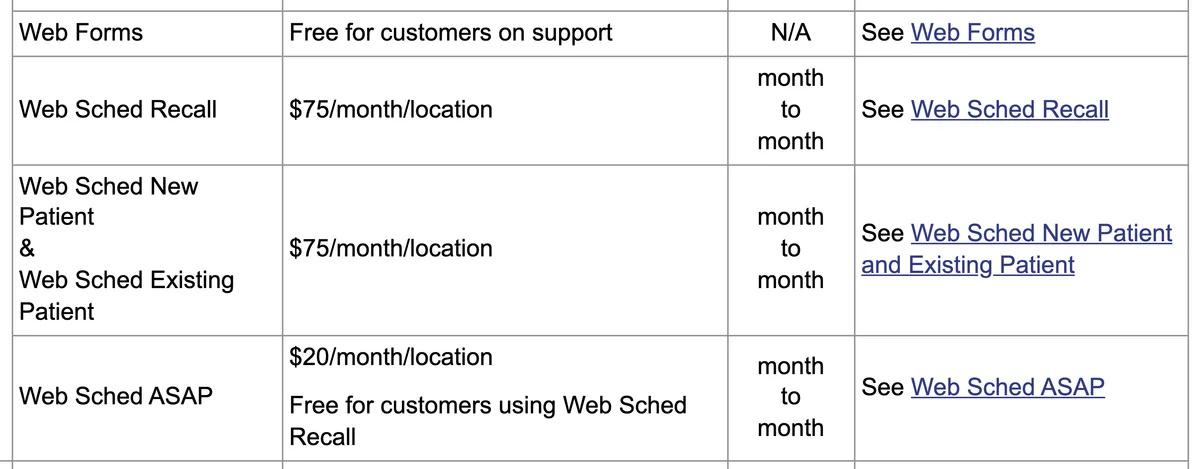
Open Dental prices it plainly. Web Sched New Patient and Web Sched Existing Patient together are $75 a month per location. Web Sched Recall, the one that texts patients who are due, is another $75. Web Sched ASAP is $20, or free if you already have Recall. Directly above those rows, Web Forms is free for customers on support, as are the Patient Portal, the Payment Portal, eReminders and automated thank-you messages.
Practice-Web charges more for the same job and less for others, which is why comparing whole vendors rather than line items is misleading. Its Online Scheduling is $119 a month, with online forms broken out at $49, patient reviews at $69, tablet patient forms at $65, teledentistry at $49 and two-way texting at $90 including 2,000 outgoing messages. Every one of those is an advertised special against a regular price roughly double it, and every one carries a $199 setup fee that the page says is waived.
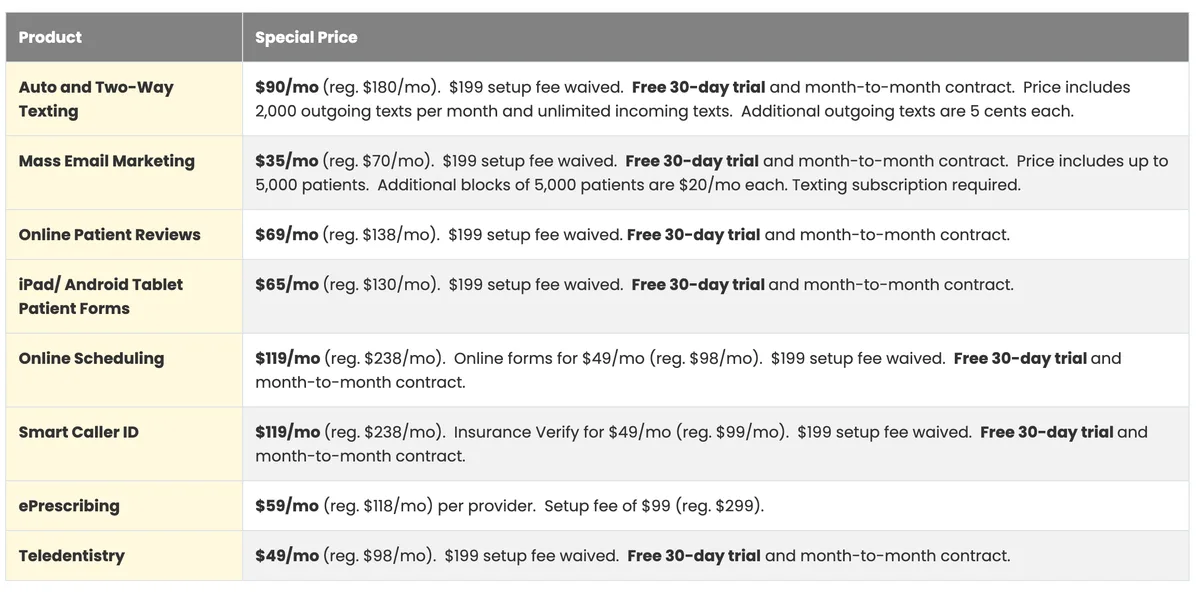
Add the four rows most practices end up with and the picture is concrete. On Open Dental, scheduling at $75 plus texting at $5 plus e-prescribing at $57 for one provider is $137 a month on top of the $199 licence, with forms and the portal included. On Practice-Web the same four are $119 plus $49 for forms plus $90 plus $59, which is $317 on top of $179. Same category of practice, same website, a difference of $180 every month that no website quote will ever mention.
The price changes in month 13
Two of these vendors cut your price after a year and one raises it, so the cheapest quote in month one is not reliably the cheapest in month thirteen. Open Dental drops from $199 to $149 once you have been on support for 12 consecutive months. Practice-Web's special drops from $179 to $129 on the same schedule. tab32 moves the other way: its published Alpine rate is $125 for year one as a start-up price covering up to three providers, and $225 from year two as an established-practice price covering up to five.
Over 24 months, and ignoring every add-on, Open Dental is $2,388 then $1,788, so $4,176. Practice-Web is $2,148 then $1,548, so $3,696. tab32 is $1,500 then $2,700, so $4,200. The vendor that is 37 percent cheaper in month one finishes the two years as the most expensive of the three. CareStack does not move at all, and at $829 a month it is $19,896 across the same two years, which buys a genuinely different product with the booking, forms and portal inside it.
Open Dental also publishes discounts almost nobody asks about: prepay six months for 5 percent off, a year for 10 percent, two to three years for 15 percent. On the $199 rate a one-year prepayment saves $238.80. It also runs a 90 day money-back guarantee on support fees, and one on the add-on services, provided you stop using them.
What it costs to take your data with you
Between $1,195 and $1,450 for a typical single-database United States practice, before images, and this is the number that decides how free your next website decision really is. Open Dental publishes $1,450 per database as the typical United States conversion fee, plus $400 for each additional clinic sharing that database. Scanned documents and patient pictures are a separate $850, x-rays another $900, neither included in the data conversion. A Canadian conversion is typically $1,100. Practice-Web publishes $1,195 against a regular price of $1,295.
Test conversions are free at both, which is worth knowing before you commit. Open Dental also prices the awkward jobs it will not discuss over the phone: merging two databases runs $500 to $1,100 depending on size, splitting one runs the same, renumbering patient IDs is $200, and if you are in a jurisdiction whose privacy law forbids sending patient data to the United States, the quote adds $400 because the conversion has to run on your machine.
This matters to a website buyer for one reason. If your site's booking, forms and reminders are all provided by the record system, then changing record systems changes your website, and the price of changing record systems includes a four-figure data conversion and a scanned-image bill on top. Anything the agency has built directly against that vendor's system gets rebuilt. It is the same class of decision we set out in what to check before you sign a web design contract, applied to the software rather than the site.
Your new patient offer is regulated content
In several states the "Free Exam and X-Rays for New Patients" banner is not a design decision, it is a compliance document with required wording, and the rules are state by state. The American Dental Association publishes its own guide to the federal and state advertising rules that apply to dentists, and reading it changes what you brief an agency to build.
Florida is the strictest of the examples the ADA sets out. Under the Board of Dentistry's rule on advertising of fees and discounted services, any advertisement containing fee information must carry a disclaimer that the fee is a minimum fee only. It must state a period during which the fee applies, or the service must stay available at or below that fee for at least 90 days after the final advertisement. Each advertised service must be described using the exact wording from the ADA's Code on Dental Procedures and Nomenclature, or by its specific code number. And any advertisement of a free or discounted service must carry this, in capital letters, clearly distinguishable from the rest of the text:
That is four separate requirements on one landing page, and a designer who has never built for a Florida practice will produce none of them. Other states impose different ones.
| State | What a fee or discount page has to carry |
|---|---|
| Florida | Minimum fee disclaimer, a stated period or 90 day availability, exact ADA procedure wording or code number, and the capital letter 72 hour statement above |
| Indiana | A stated period or 90 day availability, all components of the service with no unstated restrictions, and for a fee range, the range plus every factor that makes it vary. Discounts must show full price, discounted price and the offer window |
| California | Fee advertising must disclose every service customarily included, naming diagnosis, radiographs, restorative treatment, drugs, local anesthesia, materials, laboratory fees and post-operative care, plus any extras and their fees. Discounts must show the non-discounted amount, the discount, the duration and who qualifies |
| Illinois | Unlawful to charge a new patient a fee for any dental service provided at the time the free service is provided |
| New Jersey | Complimentary or discounted services must be offered equally to every patient the advertisement identifies as eligible, regardless of their insurance |
The penalties are real rather than theoretical. New York can fine a licensed dentist up to $10,000 for each violation of its rules on false or unsubstantiated claims, alongside censure, suspension or revocation. Arkansas can fine up to $1,000 per violation and impose probation of up to 18 months per violation. Several states go further on the claims themselves: Idaho restricts advertising that a procedure is painless, Florida prohibits superiority claims whether or not you can substantiate them, and Missouri restricts claiming a procedure is curative or preventative. The word "painless" in a hero headline is a state law question in some places.
Testimonials are their own topic, governed federally as well as by state boards, and we have written about the federal side separately in what you can and cannot publish in a testimonial. The practical instruction for a dental build is short. Before anyone writes the homepage offer, get the current rule from your own state board in writing, and put the required wording in the brief rather than discovering it after launch.
The word that is not yours to use
Most dentists cannot describe themselves as a specialist in the thing they are best at, and the services menu is where practices get this wrong. The National Commission on Recognition of Dental Specialties and Certifying Boards recognizes exactly 12 dental specialties: dental anesthesiology, dental public health, endodontics, oral and maxillofacial pathology, oral and maxillofacial radiology, oral and maxillofacial surgery, oral medicine, orofacial pain, orthodontics and dentofacial orthopedics, pediatric dentistry, periodontics and prosthodontics.
Cosmetic dentistry is not on that list. Neither is implant dentistry, sedation dentistry or sleep dentistry. Those four are, in our experience, among the most common items in a dental site's navigation.
By the ADA's own workforce data, 21.2 percent of professionally active dentists reported an ADA-recognized specialty in 2024. The other four in five are general dentists, and before they advertise the ADA points them at three sections of its Code: 5.F on advertising, 5.H on announcing specialization and limitation of practice, and 5.I on general practitioner announcement of services. Read those three with your own state board's rule open beside them, because the board is the one that can act.
State boards enforce the same idea with sharper teeth. Tennessee bars a dentist from claiming to be a specialist, to be specially qualified in a branch of dentistry, or even to be giving special attention to one, until the board has certified them. Michigan bars advertising as limiting practice to, or being specially qualified in, a branch of dentistry without board certification. The ADA's guide records a Maine case in which the board found a dentist's advertisements touted professional specialties, imposed a $1,500 civil penalty, suspended his permit for 15 business days, added a year of probation with an ethics course, and required board approval in advance for every future advertisement.
None of that stops a general dentist marketing implants or veneers. It changes the words. "Implant specialist" is a risk in many states. "We place implants, and our dentists are general dentists" is not.
What these numbers sit next to
All of it is small against what a dental practice turns over, which is the real argument for getting the website right rather than cheap. National dental expenditure in the United States was $189 billion in 2024, 3.6 percent of all health spending, according to the ADA Health Policy Institute's analysis of CMS data released in January 2026. There were 202,485 professionally active dentists that year, 59.5 for every 100,000 people.
One divided by the other puts the average working dentist in front of about $933,000 of annual dental spending. That is an average across every professionally active dentist rather than any one practice's revenue, and it is a blunt instrument, but it sets the scale. Spread across roughly 250 working days it is about $3,700 a day.
Against that, a year of Open Dental's online scheduling at $75 a month is $900, or about a quarter of one working day. The $180 a month gap we found between two software vendors' add-on stacks is $2,160 a year, a little over half a day. A $6,000 website is under two days. None of which means spend carelessly. It means the question worth arguing about is whether the site fills chairs, not whether the build quote is $4,000 or $6,000.
What we charge
Ours are on the page, which is more than this article could get out of the website companies above. We work as a monthly partnership at $1,000, $2,500 or $5,000 a month, billed monthly in advance, no minimum, pause or cancel anytime, and what we deliver is yours to keep. Launch for a focused build usually lands 14 business days after content and assets arrive, a pattern across the 200-plus projects we have shipped rather than a guarantee, and partnership requests get an answer inside 48 hours.
What that does not include is the software. We do not sell practice management systems, we do not resell Open Dental or Practice-Web or CareStack, and we take no margin on any of it. If your site needs a booking button, one of those vendors will bill you $75 or $119 a month for the scheduling behind it, and that bill has our name nowhere on it. We think that separation is the right way round, and it is also the reason our number can be flat.
We are the wrong choice for a few practices, and it is cheaper for everyone if we say so here. If you want one company to own the website, the phones, the reviews, the ads and the record system on a single invoice, buy from a dental platform, not from us. If your practice is on a system whose only integration path is a proprietary partner program, the platform's own website product will plug in more cleanly than anything we build. And if what you actually need this quarter is a state-compliant fee page and nothing else, ask your board first and a lawyer second, not a design agency. Our work in this sector sits on the healthcare side of our practice, and our full price list is on the pricing page.
The renewal calendar
Before you sign anything, build a one-page calendar of every recurring charge attached to your website, because in this market the total is a stack of subscriptions with different clocks, not a single annual fee. Most practices we talk to can name the website invoice and nothing else. The exercise takes twenty minutes and it is the closest thing to a decision aid this article can give you.
One row per recurring charge. Fill it in from invoices rather than memory.
| What it does | Who bills it | Per month | Term | Renews | Notice to cancel | Who holds the login |
|---|---|---|---|---|---|---|
| Domain name | ||||||
| Hosting and the site itself | ||||||
| Practice management software | ||||||
| Online scheduling | ||||||
| Online patient forms | ||||||
| Reminders and two-way texting | ||||||
| Review requests | ||||||
| Online payments | ||||||
| SEO, ads or content retainer |
Four rules keep it honest. Put the price you will pay in month 13 in the per month column, not the one you are quoted today, because on the evidence above it changes in both directions. Write the notice period even when you have to phone and ask, since a rate you cannot leave for two more years is a different product from the same rate month to month. Mark every row where the same company appears twice, because that is your real switching cost rather than the individual line. And put the login column in, because a renewal you cannot see is a renewal you cannot cancel.
Then total the monthly column and multiply by 24. That number, not the build quote, is what you are actually deciding. On the published figures above, a solo practice running scheduling, forms, texting and e-prescribing pays $336 a month in year one and $286 in year two on Open Dental, against $496 and $446 on Practice-Web. Identical websites, $7,464 against $11,304 over two years, a gap of $3,840 that no website quote contains.
The four things worth paying for first
Spend on the things a person in pain at 9pm needs, and defer everything else until those work. In this market the order is unusually clear, because three of the four are gated by decisions outside the website.
Booking comes first, and it comes with a decision attached. A form that emails the front desk is not booking, it is a message; real booking writes into the appointment book and needs the scheduling module your software sells. Decide which one you are buying before the site is designed, because the button, the confirmation and the reminder all hang off it. If the $75 or $119 a month is not in the budget, say so early and design an honest request form instead of a fake booking flow.
Second, the money page for whatever you actually want more of: implants, orthodontics, sedation, whatever the practice is built around. One page, written in the words patients use, with the fee language your state board requires and no specialty claim you are not certified to make. This is the page most likely to be both the highest value and the highest risk on the site.
Third, the boring facts, correct and structured: hours including the ones that differ, address, parking, which insurances you take, whether you see children, what happens in an emergency after hours. These are what a search engine and an AI assistant read to answer someone's question about you, and they are the cheapest thing on this list.
Fourth, forms, and only after you have checked who bills for them. On Open Dental they are included with support, on Practice-Web they are $49 a month, and a patient who can complete intake before arriving is worth more than most of what a redesign changes. Everything else, the photography, the video, the animation, is worth real money once these four work and worth nothing while the booking button emails the front desk. The recurring bills behind all of it are the same species of cost we broke down in what website maintenance actually pays for.
Frequently asked questions
The build is quoted privately by almost every dental website company, and the recurring half is published. Of eight dental website companies whose pricing pages we could open on 28 August 2026, none stated a price, and the guides ranking for this query claim ranges from $499 to $50,000 without citing a vendor's published figure. What you can verify is the software the site plugs into: Open Dental at $199 a month per location falling to $149 after 12 months, Practice-Web at $179 falling to $129, tab32 at $125 in year one and $225 from year two, and CareStack at $829 a month with online booking included. Our own price is published as well: a monthly partnership at $1,000, $2,500 or $5,000 a month, with no minimum.
Most sell custom scoped work and prefer to quote after a call, which is a normal way to sell design services. The effect is that the market has no public reference price at all. ProSites publishes a page called Pricing with four named tiers and a nine row feature comparison and no dollar figure. Officite's Packages and Pricing page prices phone lines. Curve Dental's page is titled Affordable and Transparent Pricing and its only dollar amounts appear inside customer quotations. Practice-Web, which does publish, says on its own pricing page that other vendors asking you to call is code for expensive.
Between $75 and $119 a month at the two vendors that itemize, charged by your practice management software rather than by your web designer. Open Dental lists Web Sched New Patient and Web Sched Existing Patient together at $75 a month per location, with Web Sched Recall another $75 and Web Sched ASAP $20. Practice-Web lists Online Scheduling at $119 a month against a regular price of $238. CareStack includes online appointments in its $829 Essentials plan. A booking button that writes into your appointment book needs one of these; a form that emails the front desk is not the same product.
At two of the three vendors that publish, yes, and at the third it gets more expensive. Open Dental charges $199 a month per location for the first 12 months and $149 from the thirteenth. Practice-Web's advertised special drops from $179 to $129 on the same schedule. tab32 runs the other way, publishing $125 a month as a year one start-up rate for up to three providers and $225 from year two for up to five. Over 24 months that puts tab32 at $4,200 against Open Dental's $4,176, despite being 37 percent cheaper in month one.
Roughly $1,200 to $1,450 for a typical single database United States practice, with images billed separately. Open Dental publishes $1,450 per database as its typical United States conversion fee, plus $400 for each additional clinic in that database, $850 for scanned documents and patient pictures and $900 for x-rays, none of which is included in the data conversion. Practice-Web publishes $1,195 against a regular $1,295. Test conversions are free at both. Since your booking, forms and reminders usually come from the record system, switching software also changes your website.
Usually yes, but several states dictate exactly what the page must say alongside it. Florida requires any advertisement of a free or discounted service to carry a capital letter statement giving the patient a right to refuse or cancel payment for anything performed within 72 hours of responding to the offer, and any advertisement containing fee information to carry a minimum fee disclaimer, a stated period or 90 day availability, and the exact ADA procedure wording or code number. Illinois makes it unlawful to charge a new patient for any service provided at the time the free service is given. New Jersey requires the offer to go to every patient the advertisement says is eligible regardless of their insurance. Get the current wording from your own state board before the page is written.
Not for anything outside the 12 recognized specialties, and in several states not at all without board certification. The National Commission on Recognition of Dental Specialties and Certifying Boards recognizes dental anesthesiology, dental public health, endodontics, oral and maxillofacial pathology, oral and maxillofacial radiology, oral and maxillofacial surgery, oral medicine, orofacial pain, orthodontics and dentofacial orthopedics, pediatric dentistry, periodontics and prosthodontics. Cosmetic, implant and sedation dentistry are not on that list. Only 21.2 percent of professionally active dentists reported a recognized specialty in 2024, so the rule applies to most practices. Tennessee bars claiming even to give special attention to a branch of dentistry without board certification, and a Maine dentist drew a $1,500 civil penalty and a 15 business day suspension over specialty claims in advertising.
Make the two decisions separately on paper first, because bundling them raises your switching cost on both at once. The record system owns the appointment book, so the booking, forms and reminders on your site will be billed by whoever that is, whatever your website costs. Write down what the software has to do, what the website has to do, and the price and contract term of each, before anyone shows you a bundle. If one company holds the site, the domain, the phones and the patient data, the cost of leaving is every one of those at the same time, plus a four figure data conversion.
 Healthcare
Oct 12, 2026 · 16 min
When a Family Asks ChatGPT for a Therapist: AI Visibility for Behavioral Health
We asked ChatGPT 24 questions a worried family would ask about therapy, in 12 US cities, and traced every recommendation back to its source. Practices with a page about the exact situation got named, and kept getting named.
 Healthcare
Oct 11, 2026 · 17 min
Questions to Ask a Dental Website Company Before You Sign
We read the published client terms of 14 dental website companies, out of 42 we checked. Here are the questions to ask before you sign, built from what those agreements say about ownership, domains, notice periods, ad accounts and your data.
 Healthcare
Oct 10, 2026 · 16 min
Mental Health Practice Websites: Group Practice vs Solo
We read 307 therapy practice websites from 15 US metros and sorted them into solo and group practices. Here is what each kind of site has to do, what they actually carry, and the Google rules and software prices that make a group site a different build.