
When a Family Asks ChatGPT for a Therapist: AI Visibility for Behavioral Health

Oct 12, 2026 · 16 min read
Families rarely type "therapist near me" into a chatbot. They type the whole situation: a daughter, an age, a symptom, a city, sometimes the name on an insurance card. And the answer that comes back is not a page of links to sort through. It is three to five names, a phone number for each, and a sentence explaining why the assistant chose them.
We wanted to see where those sentences come from. On 12 October 2026 we put two family-style questions about therapy to ChatGPT in each of 12 US cities, without logging in, and coded all 24 answers: every practice and clinician named, every link, every fee, age range and insurance claim, and every mention of a crisis line. Then we downloaded the robots.txt file of each practice website the answers sent people to. Here is what decides who gets named, and what a mental health practice can do about it.
What decides who ChatGPT names, in short
When a family describes a specific situation, ChatGPT names the practices whose own websites describe that situation. All 12 of our teen anxiety answers said they had prioritized providers whose published information mentioned teenagers or anxiety, and 38 of the 46 links in those answers went to the provider's own website, 25 of them to a page about that exact service or clinician. Add an insurance plan to the question and directories take a larger share: Psychology Today, Grow Therapy, Zocdoc and insurer search pages supplied 24 of 49 links. The practice that gets named has one plain page per population, condition and plan, and lets OpenAI's search crawler read it.
The 24 questions we asked
We used chatgpt.com in an ordinary browser, signed out, starting a new chat each time. The cities were Austin, Charlotte, Columbus, Denver, Indianapolis, Kansas City, Minneapolis, Nashville, Phoenix, Portland, Sacramento and Tampa, each written with its state. Every city got the same two questions, phrased the way a worried relative writes, with only the city changed:
- The teen question: "My 15-year-old daughter has been dealing with anxiety and panic attacks. Can you recommend a therapist in Columbus, Ohio who works with teenagers?"
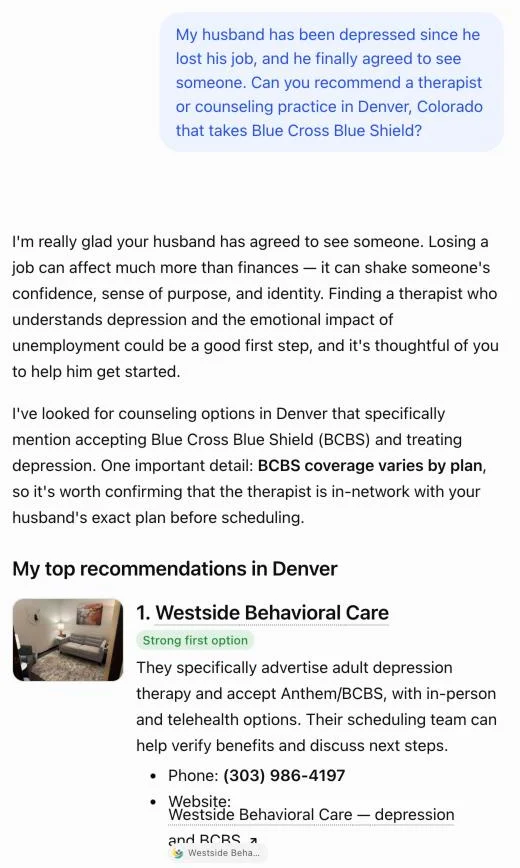
- The insurance question: "My husband has been depressed since he lost his job, and he finally agreed to see someone. Can you recommend a therapist or counseling practice in Columbus, Ohio that takes Blue Cross Blue Shield?"
For each answer we logged the providers it recommended, where each link pointed, any fee, age range, insurance or free consultation it quoted, and whether it gave 988, the US crisis line for suicide and mental health emergencies. To test how much an answer repeats, we asked the Columbus teen question three times and the Denver insurance question twice. Finally we requested robots.txt from the 62 provider domains the answers linked to; 55 returned a file we could read.
Three limits are worth stating up front. This is logged-out ChatGPT on one day, and one Kansas City answer carried a note that it came from the basic model offered to signed-out visitors. Answers change between runs, as the repeat tests show. And we did not test Google's AI answers, Gemini, Claude or Perplexity, so nothing here is a claim about them.
Families are already asking a chatbot first
This is ordinary behavior now, and it skews young. KFF surveyed 1,343 US adults between 24 February and 2 March 2026 and found that 32% had used an AI chatbot for health information or advice in the past year, and 16% had used one for their mental health. Among adults aged 18 to 29 the mental health figure was 28%, against 8% for those 50 and older. Seven percent of all adults said they had used AI to help decide whether to seek professional mental health care at all.
Pew Research Center's survey of 3,488 adults, fielded 22 to 28 June 2026, puts the share who use chatbots for at least one health reason at 34%, with 15% using them to help decide whether to see a doctor. By OpenAI's own count, upward of 300 million people put a health question to ChatGPT every week. You can read the full KFF poll and the Pew report for the detail.
Two findings in those surveys matter for a practice. First, Americans are wary of chatbots as a substitute for care: 36% told Pew that chatbots do more to hurt than help people who use them for depression, against 17% who said they help more. Finding a human therapist is a different job, and it is the job our questions tested. Second, 42% of the adults KFF found using AI for mental health said they later followed up with a mental health professional. For those people the chatbot comes before the phone call, and it shapes which number gets dialled.
Where the answers sent people
The 24 answers linked out 95 times, and the two questions behaved very differently. For the teen question the provider's own website dominated, with 38 of 46 links; Psychology Today profiles took 5, online booking portals 2 and an American Psychological Association locator profile 1. For the insurance question, practice websites took 23 of 49 links, Psychology Today 13, Grow Therapy's directory 7, insurers' provider search pages 3, Google search result pages 2 and Zocdoc 1.
That first result is close to the reverse of what we found when we asked ChatGPT about rehab on 1 October. In our treatment center study, treatment centers' own sites made up just 7 of the 56 sources cited, and directories, insurers and regulators carried the answers. The questions were different, so this is not a controlled comparison. But the gap is wide enough to act on: for outpatient therapy, a practice's own pages are a primary source for ChatGPT, not a footnote behind the directories.
The mix of who got named is also worth a look. Of the 46 teen recommendations, 19 were individual clinicians and 27 were practices or programs: 22 independent practices, 4 hospital, university or nonprofit programs, and 1 virtual therapy company. Where a named clinician worked inside a group, the group's own bio page did the job a directory listing would otherwise do. Seven named clinicians were linked to a bio page on their own practice's or hospital's website, against 4 linked to Psychology Today. If you run a group, each clinician's page is a doorway in its own right, which is one reason we argued for them in our comparison of group and solo practice websites.
Why a page about teenagers beats a page about therapy
The answers told us how they chose, in plain words. Every one of the 12 teen answers said it had prioritized providers whose published information mentioned teens or anxiety; the Phoenix answer put it as "I've prioritized providers whose published services specifically mention teenagers". Then it repeated the specifics those pages contained.
- Age ranges. 15 of the 46 teen recommendations came with an age range the provider publishes, such as 13 to 17 or 13 to 18. A family with a 15-year-old can rule a practice in or out from that one line.
- Fees. 8 recommendations quoted a price from the provider's page or profile, from $135 a session at a Denver practice to $300 for a first appointment with a Portland psychologist.
- Free consultations. 7 mentioned a free consultation, usually 10 to 25 minutes, as a reason to call first.
- Network status. One Phoenix practice was named with a note that it describes itself as out of network, taken from its own site. Honest information did not stop it being recommended.
Of the 38 teen-question links to providers' own sites, 25 went to a specific page rather than the homepage: a teen therapy page, an adolescent program page, an anxiety page, a clinician's bio. Most of the 13 homepage links went to practices whose whole business is the specialty: anxiety and OCD clinics, child and adolescent practices, or a solo clinician's own site.
The repeat runs show why the specific page matters. Across three runs of the Columbus question, ChatGPT named six different providers. Two were in all three answers: Ohio Center for Adolescent Wellness, linked each time to its teen therapy page, and Colvin Psychological Services, linked each time to its child and teen psychology page. A clinician recommended through a Psychology Today profile in the first run did not come back in the next two.
Three runs is a small sample, so treat this as a pattern to test rather than a rule. It is, though, exactly what you would expect if the system is matching the family's words to pages: the providers with a page that says "teenagers, anxiety, Columbus" kept matching, and the ones that needed a lucky search result came and went.
Add an insurance card and the directories move in
The insurance question changed the answers in three ways. Directories and marketplaces supplied nearly half the links, and Grow Therapy's Blue Cross directory pages turned up in 6 of the 12 answers, sometimes with a count of therapists attached. The answers also turned cautious: all 12 warned that coverage varies by plan, and all 12 asked which Blue Cross plan the family had, often naming the state's own brand, such as Anthem, Florida Blue, Regence or Blue KC.
And the practices that made the list were mostly those that publish their plans. Of the 35 practices and clinicians named for the insurance question, 25 came with a line saying Blue Cross was listed as accepted, taken from the practice's own site or its directory profile. The other 10 were named with a warning that their insurance could not be confirmed. In Austin, all four practices named came with that warning; in Tampa, all three that were confirmed were confirmed through Psychology Today profiles. Being named with a caveat is better than not being named, but it hands the family a reason to skip you.
The clearest winner was in Denver. Westside Behavioral Care was the first recommendation in both runs of the Denver question, and both times the link went to a page on its site about adult depression therapy in Denver with Anthem Blue Cross Blue Shield. That page is the family's question, written down. In Portland, a practice with a page about Blue Cross mental health care in Portland was the first one the answer told the family to call.
This is not an argument for a page per insurer per suburb. Most practices need one honest insurance page: which plans you take, which you do not, what a session costs out of network, whether you provide superbills, and how a family can verify benefits before the first visit. A dedicated page for a single plan earns its place only when that plan is a large share of your caseload and you have something specific to say about it.
What the answers got wrong or left out
ChatGPT was careful in most answers, but not consistent, and some of the gaps are ones a practice can close from its own side.
- Crisis guidance was patchy where it mattered most. 988 appeared in 15 of the 24 answers: 10 of the 12 insurance answers but only 5 of the 12 teen answers. Four teen answers gave no crisis or emergency guidance of any kind. We have no evidence that crisis information helps a practice get named. It belongs on a teen page anyway, because for some families that page is the first place they will see it.
- Contact details drifted. Ohio Center for Adolescent Wellness was given an 888 number in two runs, the number its teen page shows, and a local 614 number in the third. If your number differs between your site, your Google profile and your directory listings, expect the assistant to pick one at random.
- Some links went to the wrong place. Two answers linked a practice's client booking portal instead of its website, two linked a Google search instead of a site, and one linked a domain that had no DNS record when we checked it the same day.
- Every answer asked a follow-up question. All 24 closed by asking for something more: the part of town, the insurance plan, in person or online. The second answer is where a list of four becomes a shortlist of one or two, so your pages should already say which neighborhoods you serve, whether you offer telehealth and in which states, and which plans you take.
Can ChatGPT read your site at all?
Start with the file that can shut you out entirely. OpenAI runs separate crawlers for separate jobs. OAI-SearchBot finds pages for ChatGPT's search answers; GPTBot collects content that may be used to train OpenAI's models. OpenAI's crawler documentation says the two settings are independent, and that a site which refuses OAI-SearchBot is left out of ChatGPT's search answers.
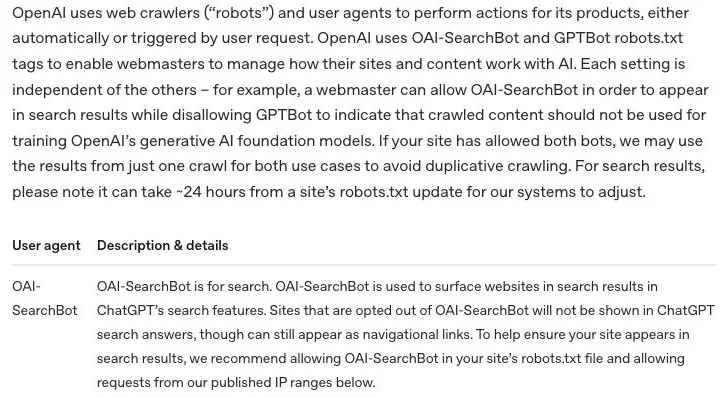
Of the 55 robots.txt files we could read from the named practices, none blocked OAI-SearchBot. One blocked GPTBot: Ohio Center for Adolescent Wellness disallows GPTBot, Common Crawl's CCBot and Google-Extended, and was named in all three Columbus runs anyway. That is the configuration a practice wants if it would rather stay out of model training but stay in the answers. Thirteen of the files were Squarespace's default, which lists GPTBot and other AI crawlers by name; it looks like a block, but those names share a group with every other crawler and are only kept out of admin and search pages.
Robots.txt is not the only wall. A firewall or bot-protection setting can turn away OpenAI's crawler even when the file allows it, which is why OpenAI recommends allowing requests from the IP ranges it publishes. If your hosting company or security plugin offers a switch to block AI bots, check which ones it means before you flip it. Our AI search visibility work starts with exactly that check.
The pages a family's question needs
Here is the census turned into a page list. The second column is what ChatGPT lifted from pages like these; the third is what we counted; the last is a check you can run on your own site in a few minutes.
| Page | What ChatGPT took from it | What we counted | Check your site |
|---|---|---|---|
| One page per population you treat: children, teens, adults, couples, families | Who the care is for, with an age range | 15 of 46 teen recommendations quoted an age range | Does the first paragraph state the ages in numbers? |
| One page per condition you specialize in | The condition and the method, such as CBT or exposure therapy for panic | 25 of 38 teen links to practice sites went to a specific page, not the homepage | Search your site for the exact words a parent uses. Does one page answer? |
| A bio page for every clinician | Name, license, ages seen, approach | 7 named clinicians were linked to a bio on their employer's site, 4 to Psychology Today | Does each bio say who the clinician sees, not only their training? |
| Insurance and payment | Plans accepted, network status, how to verify | 25 of 35 insurance-question picks were listed as taking Blue Cross; 10 came with a warning | Are your plans written as text on a page, not only shown as logos? |
| Fees | Session price and any free consultation | 8 teen recommendations quoted a fee; 7 mentioned a free consultation | Is the self-pay price on the site, and is it current? |
| Locations and telehealth | Address, neighborhood, telehealth states | All 24 answers asked a follow-up, most about area or insurance | Could a stranger tell which suburbs and states you serve? |
| Contact and crisis | One phone number; crisis guidance | One practice got two different numbers across three runs; 988 in 5 of 12 teen answers | Is the same number on your site, Google profile and directories? |
| Directory profiles | Insurance and specialties when your site is silent | 18 of the 95 links went to Psychology Today | Do your profiles match your website, plan by plan? |
| robots.txt and firewall | Permission to read any of the above | 0 of 55 readable files blocked OAI-SearchBot | Open yoursite.com/robots.txt and look for OAI-SearchBot. |
None of this is a trick aimed at a chatbot. Every row is something a parent on the phone would ask the front desk anyway. The difference now is that the answer has to be written down where software can find it, before anyone calls.
Where KhanWork fits, and when a profile is enough
A one-clinician practice whose calendar is already full does not need to buy anything because of this article. Keep your Psychology Today profile accurate, make sure your own site states who you see and which plans you take, and leave it there. The practices that should care are groups adding clinicians or new populations, practices that want more of a particular kind of client, and anyone whose ad spend lands on a homepage that never says who the practice is for.
That is the work on our mental health practice page: population pages, clinician pages, an insurance page families can act on, and a site OpenAI's crawler can read. Pricing is published on our pricing page and works the same way for every plan: a flat monthly fee, billed in advance, which you can pause or stop whenever you choose, with no minimum term.
Foundation, $1,000 a month, refreshes the brand, launches the landing page your ads and searches feed into, 14 business days after we have your copy, photos and logins, comes with a launch-day read of how the main AI assistants describe your practice, and adds a new page every month after that. Growth, $2,500 a month, builds out the full site one request at a time and repeats the AI check every month, including which competitors were named in your place. Scale, $5,000 a month, keeps two pieces of work moving in parallel and repeats that AI check location by location. We have shipped 200+ projects. If you would like a second pair of eyes first, our free funnel review costs nothing: point us at the page families reach first and we reply with the single fix we would make before any other.
Start from your intake log, not from a keyword tool
The best source for these pages is already in your office. Set aside an hour and work through it.
- Pull 30 recent inquiries. Phone notes, contact form submissions, voicemail transcripts. Recent matters more than complete.
- Write each one as a single sentence in the caller's words. "My 15-year-old, panic attacks, after school." "My husband, depression since his layoff, Blue Cross." Leave out names.
- Group the sentences. Most practices find four to six that repeat.
- For each group, find the page that answers it. It should say, near the top, who the care is for, what you treat and how, where and whether online, which plans, and what it costs. If you have to send the family to three pages, you do not have the page yet.
- Write the missing page first. Then fix the pages that bury the answer under a mission statement.
- Ask the sentence to ChatGPT. Signed out, in a fresh chat, two or three times. Note who is named and which page is linked, and repeat in a month.
A practice that does this for its five most common calls will have done most of what our 24 answers rewarded. It will also have a website that answers the phone a little before the phone rings.
Frequently asked questions
It searches the web and names providers whose published pages match the situation the family describes. In our 12 October 2026 test, all 12 answers to a teen anxiety question said they had prioritized providers whose published information mentioned teens or anxiety, and 38 of the 46 links in those answers went to the providers' own websites, most often to a page about that specific service.
No, but it matters more when the question includes insurance. Psychology Today took 5 of 46 links in our teen answers and 13 of 49 in our Blue Cross answers, often as the source for which plans a practice accepts. Keep the profile, and make sure it matches your own site plan by plan.
No. OpenAI says GPTBot, which gathers content that may be used for model training, and OAI-SearchBot, which fetches pages for ChatGPT search, are switched on and off independently. One practice in our sample blocks GPTBot and was still named in all three runs of the same question. Blocking OAI-SearchBot is what keeps a site out of ChatGPT search answers.
Usually not. One clear insurance page, listing which plans you take, which you do not, the out-of-network cost and how to verify benefits, covers most practices. A page for a single plan is worth writing when that plan makes up a large share of your caseload, as with the Denver practice ChatGPT ranked first with a page about depression therapy and Anthem Blue Cross.
Not reliably. In our 24 answers, 988 appeared 15 times: in 10 of 12 answers about an adult with depression but only 5 of 12 answers about a teenager with panic attacks, and four teen answers had no crisis guidance at all. Practices that treat teens should put 988 and emergency guidance on their teen pages themselves.
About one in six US adults, according to a KFF poll fielded in February and March 2026: 16% had used AI tools for mental health information or advice in the past year. The figure was 28% for adults aged 18 to 29 and 8% for those 50 and older, and 7% of all adults used AI to help decide whether to seek professional care.
Ask it the way a family would, in a full sentence with the age, the problem, your city and an insurance plan, signed out and in a fresh chat. Ask two or three times, because answers vary: three runs of one Columbus question named six different providers, and only two appeared every time. Note which page of yours, if any, it links.
 Healthcare
Oct 11, 2026 · 17 min
Questions to Ask a Dental Website Company Before You Sign
We read the published client terms of 14 dental website companies, out of 42 we checked. Here are the questions to ask before you sign, built from what those agreements say about ownership, domains, notice periods, ad accounts and your data.
 Healthcare
Oct 10, 2026 · 16 min
Mental Health Practice Websites: Group Practice vs Solo
We read 307 therapy practice websites from 15 US metros and sorted them into solo and group practices. Here is what each kind of site has to do, what they actually carry, and the Google rules and software prices that make a group site a different build.
 Healthcare
Aug 28, 2026 · 16 min
How Much Should a Dentist Website Cost in 2026?
We tried the pricing page of 39 dental vendors. Nineteen would not load, and of the twenty that did, five stated a price and not one of the five sells websites. So this is built on the numbers that are published, which belong to the software your booking button plugs into.