
How Much Should a Fertility Clinic Website Cost in 2026?

Oct 18, 2026 · 17 min read
Ask ten fertility marketing agencies what a clinic website costs and nine will offer you a call. That is not a figure of speech. A trade publication that reviewed 20 outside agencies doing fertility web work this year found that only one printed a rate. On 18 October 2026 we went looking for the rest: every seller with a fertility or healthcare website page that shows a dollar figure, read on its own site. We found six, and they run from $1,999 for a build to $3,000 a month for a marketing plan.
Prices are half the question. The other half is what a fertility site has to do that a dental or physical therapy site does not, and for that we read the market itself. We pulled every clinic in the CDC's latest national fertility data, then every member clinic in SART's public directory, and read the 217 clinic websites that answered: what they publish about price, success rates, financing and booking. A fertility website is shaped by rules most web designers have never read. This article is both halves, and a ten-minute test for your own site.
How much a fertility clinic website costs, in short
From sellers that publish prices, a fertility clinic website costs $2,000 to $18,000 to build, plus $199 to $500 a month to keep running. Across 36 months the website alone lands near $10,000 to $30,000. Monthly programs that bundle the website with marketing start at $1,000 a month and run to $3,000 a month or more, which is $36,000 to $108,000 over three years before ad spend. The build price matters less than three checks: whether success-rate pages follow SART's advertising policy, whether you can publish your own self-pay prices and financing clearly, and who owns the domain and files when you leave.
What fertility website sellers publish
Six sellers with a fertility or healthcare website page publish a price we could read; most of the field publishes none. Our list came from a clinic owner's own searches for fertility website design and pricing; for every firm on it, we opened the firm's own page. A price that only appeared in a search snippet or someone else's summary was dropped.
| Seller | Published price | Upkeep, as published | Included, in the seller's words |
|---|---|---|---|
| Wowbix (fertility web design page) | Packages start at $1,999 | Not stated; design free with select monthly marketing plans | Responsive design, SEO structure and branding |
| Redefine Web (healthcare website design) | $2,500 Starter, $4,500 Growth, $7,500 Scale, Enterprise from $12,000, one time | Care plans at $199, $299 and $499 a month | Up to 8, 15 and 25 pages; scheduling integration from Growth; a BAA on every care plan |
| Social Animal (IVF clinic page) | From $8,000; $8,000 to $18,000 per site | From $500 a month, no contracts | Treatment pages, doctor profiles and forms at $8,000; success-rate pages, portals and financing toward $18,000 |
| Social Animal (fertility clinic page) | From $12,000, fixed fee | From $500 a month | HIPAA compliance and 30 days of support; 10 to 14 weeks to launch |
| SearchPod | $1,000 USD a month, Platform plan | Included; $0 setup, month to month | Website, hosting, booking, CRM and a dashboard |
| WebFX (fertility clinics page) | Marketing plans from $3,000 a month | Part of the plan | A custom digital marketing plan, not a website-only price |
Read the two Social Animal rows together. The same firm says $8,000 on its IVF page and $12,000 on its general fertility page. Neither is wrong, exactly, but it is the kind of gap you close in writing before you sign. And notice what is missing: the agencies most often named in fertility marketing, including Cardinal, Healthcare Success, Envisionit, MediaBoom, Fertility Bridge and Sagapixel, show no price at all, and several only offer a budget dropdown on a contact form. Web Tonic, the trade blog that reviewed the field, counted the same pattern: of 20 outside agencies with fertility build work, one published a rate, and it was the $8,000 to $18,000 figure above.
There is also an estimate you will meet early in any search. ProjectCostEstimator puts a US fertility clinic site at $5,800 to $15,950 with a freelancer and $13,050 to $37,700 with an agency, from a model of hours, hourly rates and multipliers. It is a useful sanity check and nothing more: it is a calculator, not a seller, and its own page quotes both a $10,850 median and a $7,500 median freelancer build. Use the published prices above for budgeting, and the estimate to notice when a quote is far outside both.
What three years actually cost
Three years of a fertility website costs $9,664 to $30,000 at the published website-only prices, and $36,000 or more once marketing is bundled in. A one-time build price hides most of the bill, because the care plan runs every month after launch. Here is each published offer turned into a 36-month total: the build fee plus 36 months of that seller's own upkeep, nothing assumed.
Two cautions on that chart. First, the cheap end is not like for like. Redefine Web's Starter is a template-based site of up to eight pages, and a fertility clinic offering IVF, egg freezing, donor programs and gestational carriers will outgrow eight pages quickly. Second, some costs sit outside every quote. A HIPAA-eligible form tool is one of them: Jotform's Gold plan, the first tier its pricing data marks as HIPAA compliant, is listed at $129 billed monthly, or $1,188 for a year, so $3,564 across 36 months. Formstack publishes a $99 a month entry plan and lists HIPAA as a separately priced add-on. If a quote says secure forms are included, ask which tool and whose account it sits in.
The market you are building for
The US fertility market is small, concentrated and unusually well measured, which changes what a good website looks like. In the CDC's most recent final data, for 2022, 457 clinics reported 435,426 assisted reproductive technology cycles, and those cycles led to 98,289 infants. Another 54 clinics are listed as non-reporters. Federal law requires every clinic to report its success rates through the CDC each year, and the CDC must publish the name of any program that fails to.
Three things follow for the website. First, your outcomes are public whether or not you publish them. A patient comparing clinics can pull your reported results from the CDC or SART in a minute, so a site that dodges the subject reads as hiding something. Second, the big operators set the bar. The largest tenth of clinics performed 42 percent of cycles in 2022, and many belong to networks that run one website for many clinics: in SART's directory, Kindbody's site serves 18 member clinics, Shady Grove Fertility's and CCRM's serve 14 each, and Pinnacle Fertility's serves 11. An independent clinic with 300 cycles a year competes for the same search with a network site built by a large in-house team. Third, the services are broad. Of the 457 reporting clinics, 404 offered donor eggs and 413 worked with gestational carriers, and each of those programs needs its own page, its own audience and often its own intake.
What 217 clinic websites actually show
Most fertility clinic sites already cover the basics: a tap-to-call number, a consult prompt, and financing names. Far fewer publish a price. SART's public directory listed 386 member clinics across 684 locations on 18 October 2026. Those clinics point to 318 distinct websites. We read every one that answered with a page, set aside 26 that were pages on a hospital or university system's main site, and kept 217 sites run for fertility care. For each we read the homepage and up to 15 linked pages about cost, financing or success rates.
The platform question is mostly settled: 112 of the 217 sites run on WordPress, 17 carry HubSpot, 9 Drupal, and 6, 6 and 5 run on Squarespace, Webflow and Wix. What separates the sites is content, not platform. Financing is close to universal: 147 sites name at least one patient lender or fertility benefit company, most often CapexMD (90 sites), Future Family (81) and Progyny (73), followed by LendingClub (41), Carrot (24), Prosper Healthcare Lending (22) and Sunfish (16). LGBTQ+ family building shows up on 148 sites, which tracks SART's own directory, where 267 of 386 member clinics list LGBTQIA care as a specialization. Spanish appears on 48.
Two numbers deserve attention. 155 sites load Google Analytics or Tag Manager in the homepage code we read, and 21 hard-code a Meta pixel. Pixels loaded through Tag Manager do not show in that count, so 21 is a floor. Every one of those trackers sends something about a visitor's session to a third party, and on a fertility site the page itself can reveal a diagnosis. If you run ads, the tracking setup belongs in the build scope, not bolted on afterwards; our guide to a HIPAA compliant website covers what the rules ask of the forms and analytics.
The price page patients look for
At least 54 of the 217 clinic sites publish a self-pay price for an IVF cycle or package, and they are the exception that patients notice. Fertility is one of the few corners of US medicine where a patient often pays most of the bill, compares several clinics, and arranges a loan before the first consult. A clear price page answers the question that otherwise ends a visit.
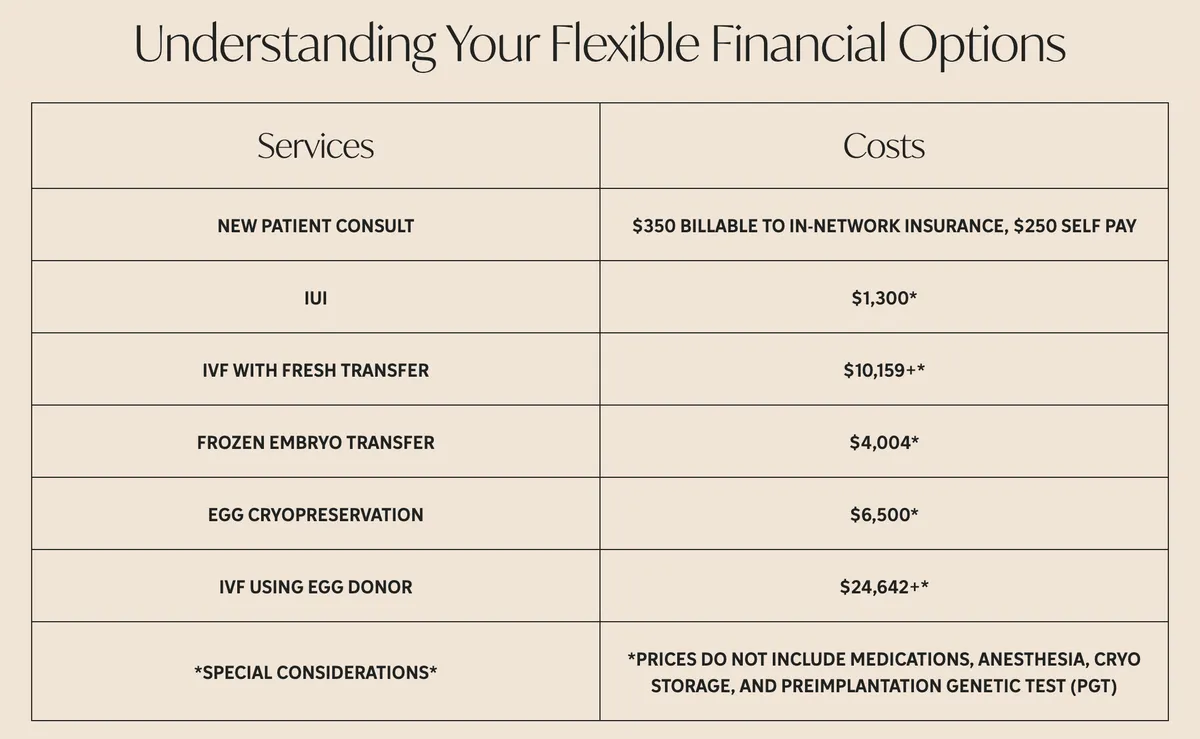
The good price pages share a pattern. They name the lowest fee for a cycle, say what it includes, and list what it does not in plain words: medications, anesthesia, storage, genetic testing. Main Line Fertility publishes IVF without genetic testing from $14,300 and with it from $17,300, and states that ultrasounds and blood monitoring are included. CNY Fertility leads with an IVF package at $6,999. NYU Langone's fertility center states that an IVF cycle with fresh eggs and no genetic testing starts at $17,600. These are not cheap or expensive by themselves; the point is that a patient can compare.
The weaker pattern is a page titled cost that quotes national averages, or a discount banner with no price behind it. Several sites in our census quoted a range for IVF in their state or in the US rather than their own fee. That is honest but unhelpful: a patient who already knows IVF is expensive came to learn what your clinic charges. If your clinic will not publish a fee, publish what the consult costs, which financing partners you accept, and how quickly a financial counselor will call back. A price page is design work, copy work and a decision your practice director has to sign off, which is why it rarely ships in a template build.
SART's advertising policy is a website spec
If your clinic is a SART member, its advertising policy decides how your success-rate pages must be built, and most designers have never read it. The policy, revised in July 2022, says adherence is a condition of membership and applies to websites, blogs and social posts. Publishing success data is optional. Publishing it badly is not.
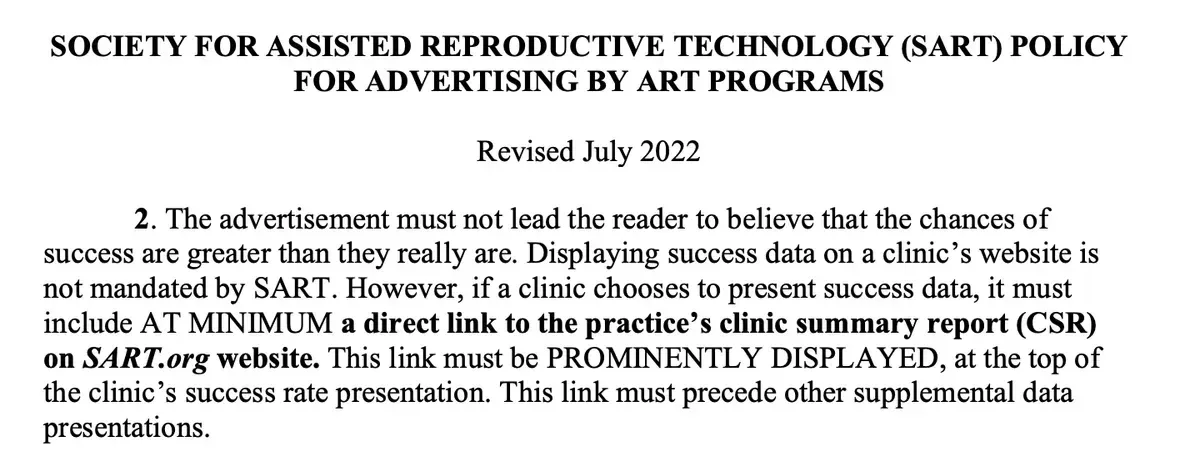
Here is what the policy asks of a website, in order. If you show success data, a direct link to your clinic summary report on SART's site must sit at the top of that presentation, before anything else. Any extra data has to follow SART's format, with live births per cycle start shown first, and both numerator and denominator when a figure rests on fewer than 20 cycle starts. Supplemental figures must be updated within 30 days of each year's public SART release. Ranking clinics, claiming superiority and linking to sites that rank IVF programs are all prohibited. A clinic that is new or part of a parent clinic may not borrow the parent's numbers. Pages quoting program statistics must carry SART's standard sentence warning that clinic-to-clinic comparisons may not be meaningful; copy its exact wording from the policy. And the medical director is responsible for all of it, including work outsourced to an agency.
Compliance is uneven. A study published in Fertility and Sterility reviewed all 361 SART member clinic websites against the 2018 version of the policy and found that about a third reported success statistics directly, only 52.6 percent of those were current, 67.5 percent carried the required disclaimer, and only 10.5 percent were fully compliant on supplemental data. Our own check was narrower and should be read that way. Among 82 clinic pages about success rates in our census, 69 link to SART or a clinic report in the page code, and 25 contain the disclaimer wording. Not every one of those pages quotes statistics, so this is not a count of violations. It is a count of how often the safe pattern is in place.
For a buyer, the practical point is short. Ask any web designer to show you a success-rate page they built for a SART member, and ask them where the clinic summary report link goes. A designer who has not heard of the CSR link will build you a dashboard of percentages, which is the one thing the policy most carefully restricts.
What a fertility site needs that others do not
A fertility clinic site needs more pages, more sign-off and more care with data than a typical medical practice site, and that is where the extra cost goes. The list below is what we would expect any serious quote to cover. If a quote is cheap, check which of these it leaves to you.
- A page per program. IVF, IUI, egg freezing, donor eggs, donor embryos, gestational carriers, LGBTQ+ family building and fertility preservation each have different patients and different questions. The CDC data shows most clinics offer most of them.
- A success-rate section built to SART's policy, or a deliberate decision to link only to your SART report, which the policy itself suggests.
- A cost and financing page your practice director signs: from prices or consult fees, exclusions, named financing and benefit partners, and how insurance verification works.
- Consult booking that reaches a person fast. 153 of the sites we read prompt visitors to book or schedule a consult; the question is what happens after the form, and who answers.
- Forms and tracking that respect what the page reveals. A form that asks about diagnosis or treatment history belongs in a HIPAA-eligible tool under a signed agreement, and the ad pixels should not see it.
- Physician pages that stand on their own. Patients choose a doctor as much as a clinic, and physician names are what they search after a referral.
- A plan for each location. 117 of SART's 386 member clinics list more than one location, and SART asks that success rates be attributed to the lab that did the work.
Nine questions for any fertility website seller
These questions sort sellers faster than a portfolio. The answers you want are in the middle column; the right column is how to check without trusting the pitch.
| Ask | The answer you want | How to check it |
|---|---|---|
| Have you built a success-rate page for a SART member? | Yes, with the clinic summary report link at the top | Open the live page and click the first link |
| What is the total over 36 months? | A single figure: build plus every monthly line | Multiply it out yourself; compare with the chart above |
| Which form tool handles patient enquiries, and whose account is it? | A named HIPAA-eligible tool, in the clinic's own account | Ask for the plan name and the agreement |
| Do you sign a BAA, and when? | Yes, before any access to patient data | Get it in the contract, not a sales email |
| Who owns the domain, the files and the ad accounts? | The clinic, from day one | Check the domain registrant record |
| How many pages does the price cover? | Enough for every program you offer | Count your programs and locations first |
| Who writes the cost and program copy? | A named writer, reviewed by your medical director | Ask to see a draft from a past client |
| What tracking will you install, and where will it fire? | A written list, with no ad pixels on treatment or form pages | Ask for the tag map before launch |
| What happens if we leave after a year? | You keep everything; a clear notice period | Read the termination clause before the price |
The contract clauses that cost clinics most when they switch vendors are covered in who owns your website.
Where KhanWork fits, and when it does not
If your clinic needs a clean, compliant site and has someone in-house to write the program and cost pages, a fixed-fee build from one of the sellers above is likely the better buy. A $2,500 to $12,000 build with a $199 to $500 care plan will serve a single-location clinic well, and our pricing would not be good value for that job.
Our own rates sit on the pricing page for anyone to compare. KhanWork works as a subscription in three steps (Foundation $1,000 a month, Growth $2,500, Scale $5,000), paid a month ahead, with no lock-in: you may pause or end it in any month. Be clear on what the entry tier buys. Foundation gives you a refreshed brand plus a single landing page built to convert, normally the homepage or an ad destination, which goes live 14 business days after your content and assets arrive; a further page follows every month. The complete site, with a page per program, sits in Growth. Thirty-six months of Foundation is $36,000, higher than every website-only bar in the chart above, so buy it for pace and for conversion work, never because it is cheaper.
The clinics we fit best are the ones the market data describes in the middle: a few hundred to a couple of thousand cycles a year, competing in search with a network site, with ads running and a price or financing page nobody has tested. You can see how we approach that on our healthcare practices page, and a clinic whose consult form gets traffic but too few bookings is what our conversion optimization work exists for. Across 200+ shipped projects the files, domain and accounts have stayed with the client. To start smaller, point our free funnel review at the one page that gets most of your visits, typically the IVF cost page or your homepage, and you will get back the single fix we would make first, free of charge.
Related reading: the same monthly-versus-build arithmetic for another specialty is in our physical therapy website cost guide.
The night-one test
Most fertility patients first read your site late in the evening, on a phone, after a hard appointment somewhere else. Before you buy anything, run this test on your current site the same way. It takes ten minutes and costs nothing.
- On your phone, find what IVF costs at your clinic. Time it. If you cannot find a number, a consult fee or a named financing partner within a minute, neither can a patient.
- Find your success rates. Is the first thing you see a link to your SART clinic summary report? If you see percentages first, read section 2 of SART's policy before your next renewal.
- Find the program you are least known for. Donor eggs, a gestational carrier, fertility preservation before cancer treatment. If it has no page of its own, that search goes to someone else.
- Book a consult. Fill in the form as a patient would, then note how long until someone calls and whether the form asked anything it should not have.
- Open the page source of your treatment pages and search for "fbq" and "gtag". If you find an ad pixel on a page that names a diagnosis, put it on the list for whoever builds your next site.
Write down what failed. That list, not a portfolio, is the brief for any quote, and the quickest filter between a $2,500 seller and an $18,000 one is to ask each what it would change first.
Frequently asked questions
A fertility clinic website costs about $2,000 to $18,000 to build, plus $199 to $500 a month for hosting and care. Those are the published prices we read on sellers' own pages on 18 October 2026. Across 36 months the website alone lands near $10,000 to $30,000. Monthly programs that bundle marketing start at $1,000 and reach $3,000 a month or more.
Most fertility agencies quote after a call because scope varies with the number of programs, locations and ad budgets. A 2026 review of 20 outside agencies with fertility build work found only one that printed a rate, and in our own check most of the best-known names showed none, offering a contact form or a budget dropdown instead.
No. SART says displaying success data on a clinic website is not mandated, but a member clinic that does show it must put a direct link to its SART clinic summary report at the top of the presentation and follow SART's format rules. Separately, federal law requires every clinic to report its success rates to the CDC each year, so the figures are public either way.
Publishing at least a from price usually helps, because many fertility patients pay out of pocket and compare several clinics. In our census, at least 54 of 217 SART member clinic websites publish a self-pay IVF price; the clearest pages state a from price, what it includes, and what it excludes, such as medications, anesthesia, storage and genetic testing.
A fertility clinic website needs a page for each program it offers, plus success rates, cost and financing, physician profiles, locations and consult booking. Most clinics offer several programs: in CDC data for 2022, 404 of 457 reporting clinics offered donor eggs and 413 worked with gestational carriers, and each of those deserves its own page.
A fertility clinic should keep ad pixels off pages that reveal a diagnosis or treatment and off patient forms, and treat tracking as part of the build scope. In our census, 21 of 217 clinic sites had a Meta pixel in the homepage code, and pixels added through Tag Manager would not show in that count. The rules for health data on websites are covered in our HIPAA guide.
A builder can work for a small clinic with one or two programs, and a handful of clinics in our census run on Squarespace, Webflow or Wix. It gets harder once you need a SART-compliant success page, HIPAA-eligible forms under a signed agreement, and a page per program and location; at that point a fixed-fee build with a care plan is usually the better value.
 Healthcare
Oct 17, 2026 · 17 min
How Much Should a Physical Therapy Website Cost in 2026?
Published PT website offers start at $97 to $750 a month, and the two biggest PT-only firms would not load for us. We read every price we could, then checked what 114 real clinic homepages run, from booking software to self-pay rates.
 Healthcare
Oct 16, 2026 · 16 min
How Much Should a Chiropractic Website Cost in 2026?
Six of eight chiropractic website companies publish a price, from $64.95 to $375 a month. We read every plan card and term, then worked out what each one costs over three years and what you keep when you leave.
 Healthcare
Oct 12, 2026 · 16 min
When a Family Asks ChatGPT for a Therapist: AI Visibility for Behavioral Health
We asked ChatGPT 24 questions a worried family would ask about therapy, in 12 US cities, and traced every recommendation back to its source. Practices with a page about the exact situation got named, and kept getting named.