
How Much Should a Physical Therapy Website Cost in 2026?

Oct 17, 2026 · 17 min read
A physical therapy clinic shopping for a website in 2026 will find prices faster than a chiropractor or a dentist would, and they will make less sense. On 17 October 2026 we read every pricing page we could reach from sellers that market websites to physical therapists, and the lowest monthly figures ran from $97 to $750. One of those is a website. One is a marketing program with a website inside it. One is a range published as a guide rather than a price. And the two best-known PT-only firms would not load for us at all.
So we did a second thing. We collected 151 independent and small-group clinic websites across 12 US metros, read the 114 that answered, and counted what they run: which platform, which booking software, whether a patient can book, call, or learn that no referral is needed. What clinics actually have tells you more about what a PT website needs to cost than any rate card does. Here is both halves, and a way to compare quotes that does not depend on the headline price.
How much a physical therapy website costs, in short
Expect $100 to $250 a month for a managed website from a seller that publishes prices, or a one-time build from about $2,500 plus around $99 a month for care. Over 36 months that is roughly $3,500 to $9,000 for the website alone. Adding lead follow-up, reviews and local SEO moves the same sellers to $297 to $597 a month, and published PT marketing programs start at $595 to $750 a month at entry level, roughly $21,000 to $27,000 over three years before ad spend. Before signing, check three things: whether booking writes to your scheduling software or only sends a request, who owns the domain and files, and whether there is a minimum term.
What PT website sellers publish
Five sellers that market websites to physical therapists publish a price we could read; several of the best-known names do not, or would not load. We started from the firms that appear when a clinic owner searches for physical therapy website pricing, kept the ones with a page aimed at PT clinics, and read the pricing each one shows on its own site. Where a page draws prices with scripts, we rendered it in a real browser as well.
| Seller | Entry price, as published | Build or setup fee | Term, as published | What the page says you get |
|---|---|---|---|---|
| PRceptive | $97 a month (Website); $297 and $497 tiers | None; the build is free | Cancel anytime, monthly or yearly | Hosting, domain and SSL included; lead follow-up, review funnel and local SEO start at $297 |
| alwaysdobetter | $249 a month; $597; from $1,750 | None stated | Month to month, no contracts | Condition pages, online scheduling and hosting at $249; you own the site, domain and leads |
| Creative Marketing AI | $99 a month website care; plans from $297 | $2,500 for five core pages; the same page also says new PT builds start at $5,500 | Not stated on the page | A recommended page structure for providers, services, locations and insurance |
| Behind the Practice | $595 a month flat | None on the flat plan; $2,500 on its pay-per-evaluation plan | 90-day commitment ($1,785), then cancel any time | A custom conversion website, Google Business Profile and SEO; or $200 per new patient who shows for an evaluation |
| PT Marketing Pros | $750 to $1,000 a month entry range | Not stated | Month to month | Basic website, SEO setup and one or two blog posts at the entry range |
| Optimized360 (O360) | Not shown | Not shown | Page title promises no contract | Pricing page is a contact form |
| E-rehab | Could not read | Could not read | Could not read | Site refused our connection from outside the US |
| Practice Promotions | Could not read | Could not read | Could not read | Site refused our connection from outside the US |
Three things in that table matter more than the numbers. First, the two firms most associated with physical therapy websites, E-rehab and Practice Promotions, returned a refusal page every time we tried, from a plain download, a page-fetching tool and a real browser. We have left their prices out rather than repeat figures from someone else's article. If you are in the US you can read their pages yourself, and you should, with the questions further down in hand.
Second, not every PT page belongs to a PT specialist. PRceptive's physical therapy page sits on a site whose footer describes it as an agency built for contractors and home service businesses. That is not a reason to avoid it: a fast, managed site at $97 a month is a fair offer for a referral-fed clinic. It is a reason to ask what it knows about direct access, plans of care and the scheduling software you already use.
Third, read the whole page. Creative Marketing AI's physical therapy page gives two different prices for a new build, $2,500 in its opening paragraph and $5,500 lower down. Its free audit promises a firm price, which is the number to get in writing.

The four deals behind every quote
Strip away the branding and each offer is one of four deals. Knowing which one you are looking at matters more than the number on it.
- Managed subscription, no build fee. PRceptive and alwaysdobetter build the site for nothing and charge monthly for hosting, updates and support. Cheap to start, and only cheap overall if you can leave with the site.
- Build fee plus care plan. Creative Marketing AI publishes a one-time build and $99 a month of website care. You pay more up front and less every month, and a build you paid for outright is easier to own.
- Marketing program with a website inside. Behind the Practice, PT Marketing Pros and, by reputation, the PT-only firms price the website as part of a monthly marketing service. The site is often free; the commitment is not.
- Pay for results. Behind the Practice is the one seller we found that publishes a per-patient price: a $2,500 build, then $200 for each new patient who shows for an evaluation. Cheaper in a slow quarter, pricier in a busy one, and it only works if both sides agree on what counts as a showed evaluation.
There is a fifth route: build it yourself on a website builder. A therapist opening a first clinic, with evenings to spare, can get a long way that way; the trade-offs are laid out in website builder versus hiring a designer. Our census suggests plenty of clinics do exactly that.
What 114 clinic websites actually run
Most physical therapy clinics are on WordPress, and most do not let a patient book straight into the schedule from the homepage. We gathered 151 clinic websites from searches in 12 metros (Tampa, Charlotte and Nashville in the Southeast; Columbus, Indianapolis, Minneapolis and Kansas City in the Midwest; Austin, Phoenix and Denver; Sacramento and Portland in the West), skipping hospitals, directories and health-system pages. 114 homepages loaded for us; the rest refused the connection or sat behind a bot check. We read the HTML of each one.
Platform first. Of the 114, 65 run WordPress, 13 Squarespace, 9 Wix, 7 Webflow, 3 HubSpot and 3 GoDaddy's builder, with a handful on other systems and 10 we could not identify. Roughly a quarter are on a do-it-yourself builder, which fits a profession where the Bureau of Labor Statistics counts 36% of physical therapists working in offices of physical, occupational and speech therapists and audiologists. Small practices build small sites.
Who built them is harder to see. Only 13 homepages carry a readable builder credit, and they name 12 different firms; one PT practice-growth firm, Rehab CEOs, appears twice. No single vendor dominates the sites we could read. There is a catch, though. Eight of the 37 sites that refused us resolve to exactly the same server address as e-rehab.com and return the same refusal page. That is a strong sign E-rehab hosts them, not proof, and it means the vendor most likely to be on your shortlist is also the one an outside census sees least.
Booking is where the price difference hides
Ninety-two of the 114 homepages use booking or appointment wording, but only 37 link to scheduling software where a patient might pick a time. Thirty-four say "request an appointment" and link to no scheduling tool at all, which usually means a form that someone at the front desk calls back. A request form is not wrong. It is a different product from self-scheduling, and the gap between them is often the gap between a $97 tier and a $297 one.
The scheduling links we found were spread across 17 tools. Jane appeared on 10 homepages, Prompt on 7, PtEverywhere on 4, Stride, Strive and Tebra on 3 each, and Raintree and SimplePractice on 2. WebPT, which many clinics use for documentation, showed up as a booking link on just one. That spread is the practical reason to ask any website seller one question first: does your booking button write to my scheduling software, or does it send me an email? A site that books into Jane or Prompt needs that system's booking page or widget wired in and tested; a seller who has done it before will say so without looking it up.
The phone still matters as much as the form. In 84 homepages the phone number is coded as a link a phone can dial directly. Another 20 show the number as plain text, which leaves it to the visitor's phone to recognize and make tappable. Ten showed no phone number in the page code we fetched at all; on some of those it is probably drawn by a script, which works for a visitor but hides the number from crawlers and AI tools that read raw HTML.
Direct access and self-pay: the pages most clinics skip
Every state now lets patients see a physical therapist without a referral in some form, yet only 41 of the 114 homepages say so. The American Physical Therapy Association states that as of 1 July 2025 all 50 states, the District of Columbia and the US Virgin Islands have either provisional or unrestricted direct access, while some states keep limits on treatment without a referral. A patient with a sore shoulder who thinks they need a doctor's note first may never call. A sentence on the homepage and a page explaining your state's rule cost almost nothing to add.
Insurance is handled the same way. Seventy-four homepages mention insurance, but only 19 name an insurer such as Medicare, Aetna, Cigna or a Blue Cross plan. The question a new patient actually has is "do you take mine?", and a vague mention does not answer it.
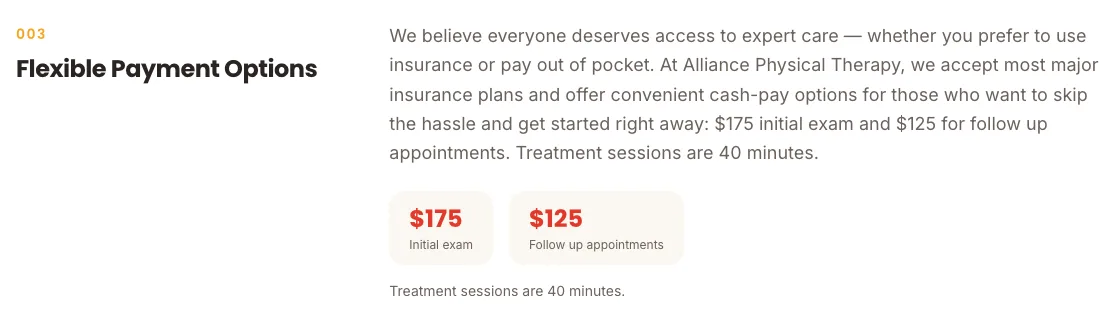
Prices are rarer still. Seven of the 114 homepages publish what a visit costs. Those that do are specific: one Scottsdale clinic lists a $175 initial exam and $125 follow-ups for cash-pay patients, an Indianapolis pelvic health practice lists a $190 evaluation and $150 follow-ups, and a Minneapolis sports clinic lists $200 for an evaluation with treatment and $175 for follow-ups. Under federal rules, a provider must usually hand an estimate of expected charges to a patient who is not using insurance and schedules at least three business days ahead, according to CMS. A clinic that publishes its self-pay rates has done half of that work in public, and it answers the question cash-pay patients are most likely to leave over.
One more finding belongs on any shortlist conversation. Seventeen of the homepages load Meta's advertising pixel and 81 load Google's analytics or tag manager. Neither is a problem on its own. Both become a question once a page carries an intake form or a booking flow, because what those tags send matters for patient privacy. Ask every seller how they configure tracking on form and booking pages; the way we handle it is written up on our security page, and our HIPAA guide covers what a practice itself has to do.
What three years cost
Multiply each entry offer by 36 months and the spread widens from about $3,500 to $27,000. PRceptive's Website plan comes to $3,492 over three years. Creative Marketing AI's five-page build plus $99 a month of care reaches $6,064, or $9,064 if the $5,500 build figure on the same page is the one that applies. alwaysdobetter's clinic site comes to $8,964. Behind the Practice's flat plan reaches $21,420, and the low end of PT Marketing Pros' entry range reaches $27,000.
The chart is honest about cost and silent about value, so read it with two cautions. The bars on the right buy local SEO, review requests and follow-up, not just pages, so compare them with each other, not with a $97 site. And none of these figures include your scheduling or documentation software, which is a separate subscription, or ad spend, which goes to Google or Meta.
A useful yardstick is what a new patient is worth to you. The BLS puts the median pay of a physical therapist at $102,760 in May 2025 and projects employment to grow 12% from 2025 to 2035, much faster than average. A clinic adding therapists has evaluation slots to fill, and the question is not whether $595 a month is a lot. It is how many extra evaluations a month that plan must bring before it pays for itself, which you can only answer with your own collections per plan of care.
The six things a PT site must get right
The test of a physical therapy website is simple: does a person with a sore knee, or a surgeon's discharge sheet, end up on your schedule? On local search, Google names three ranking inputs (relevance, distance and prominence) and says prominence reflects things like the number of reviews a business has and the number of sites linking to it. Hold every quote, cheap or expensive, to these six:
- One tap to book, one tap to call. Both visible above the fold on a phone, and the booking button landing in your actual scheduler.
- A plain statement about referrals. If your state lets patients come straight to you, say it near the top and link to a short page on the rules.
- Insurers by name, and a cash rate. The networks you belong to, and what a self-pay evaluation and follow-up cost.
- Condition pages for the work you want. Post-surgical knee and shoulder rehab, low back pain, dizziness, pelvic health, running injuries: one page each, in the words patients use.
- A routine for reviews. A request after discharge, every time, because reviews are the prominence signal you control.
- Intake that respects health data. Forms that gather symptoms or history belong with a vendor willing to sign a business associate agreement.
A clinic can meet all six on a modest budget. What it cannot skip is a builder who understands how a PT patient decides.
Nine questions for any PT website seller
Put these to every seller, us included, and keep the answers in writing. The right-hand column shows what the pricing pages and our census turned up, as a benchmark for what a good answer looks like.
| Ask | Why it matters | What we found |
|---|---|---|
| Does the booking button write to my scheduler, and which ones have you connected before? | A request form and self-scheduling are different products | 37 of 114 homepages link to scheduling software, across 17 different tools |
| Is there a minimum term? | A free build is usually paid back through the months you stay | Behind the Practice: 90 days. PRceptive and alwaysdobetter: cancel anytime |
| Whose name is the domain in, and what leaves with me? | No contract does not mean you keep the site | alwaysdobetter states you own the site, domain and leads. Most pages do not say |
| Is the build price on this page the one I will pay? | Some pages show more than one | Creative Marketing AI: $2,500 and $5,500 on the same page |
| What is in this tier and what is one tier up? | Lead follow-up and SEO often start at the second tier | PRceptive: follow-up, reviews and local SEO begin at $297, not $97 |
| How do you set up tracking on form and booking pages? | Pixels near intake forms raise privacy questions | 17 homepages load the Meta pixel; 81 load Google tags |
| Which form tool do you use, and will its vendor sign a BAA? | Symptoms and history are health information | Not addressed on the pricing pages we read |
| Does the monthly fee include any money paid to Google or Meta? | The largest marketing cost often sits outside the quote | None of the marketing offers we read include ad spend |
| Can I see three live PT sites you built and book on one? | A gallery screenshot does not test a booking flow | Try to book a slot on each, from a phone |
Where KhanWork fits, and who should not hire us
A referral-fed clinic with one or two therapists does not need us. A managed site at $97 to $249 a month from one of the sellers above will cover it, and paying our rates for that job would be poor value. Our figures are public on the pricing page: three monthly tiers, with Foundation at $1,000, Growth at $2,500 and Scale at $5,000. Each is billed monthly in advance with no minimum term, and you may pause or cancel in any month. Thirty-six months of Foundation adds up to $36,000, which is above every website-only total in this article. And Foundation is a brand refresh plus a single high-converting landing page, which goes live within 14 business days once your content and assets are with us, followed by a new page each month. A complete website is the Growth tier.
The clinics we are built for look different: a group adding locations, a cash-pay service like pelvic health, vestibular rehab or sports performance that has to sell itself, or a Google Ads budget sending people to a page no one has ever measured. Our healthcare practices page describes that work, and conversion optimization is the service for a clinic with steady traffic and too few evaluations. Across 200+ projects the rule has not changed: what we build is the client's to keep. Not ready to talk? Send us the page your ads or your Google profile point at, and the free funnel review will come back with the first fix we would make. There is no charge.
Two companion reads: the chiropractic market runs on the same monthly model at different prices, covered in our chiropractic website cost guide, and the contract terms worth checking before you sign are in who owns your website.
Price a quote per evaluation, not per month
A monthly price tells you what a website costs. It does not tell you whether it is cheap. Do this for every quote, using your own numbers, in about half an hour.
- Count last quarter's new evaluations that came from the website. Your front desk or scheduler can usually tag the source. If nobody records it, start this week; the rest of this list depends on it.
- Work out a 36-month total for each quote. Build fee, plus the tier that includes booking into your scheduler, times 36, plus any add-ons.
- Divide by 12 to get a quarterly cost, then divide that by the website evaluations you expect per quarter. That is the price of one new evaluation through the site.
- Set it against what one plan of care collects at your clinic. If one evaluation through the site costs a small fraction of a plan of care, the cheap offer and the pricier one may both be bargains, and the difference is how many more evaluations the pricier one has to bring.
- Ask each seller what they expect that number to do, and how they would show it to you. A seller who answers in evaluations, not impressions, has thought about your clinic.
A clinic that prices every quote this way stops comparing $97 against $595 and starts comparing what each one has to deliver, which is the only comparison that matters.
Frequently asked questions
A managed physical therapy website from a seller that publishes prices costs about $97 to $249 a month, or a one-time build from about $2,500 plus around $99 a month for care, based on the pricing pages we checked on 17 October 2026. Over three years that is roughly $3,500 to $9,000 for the website alone. Plans adding local SEO, review requests and lead follow-up cost $297 to $597 a month, and published PT marketing programs start at $595.
Most price after a sales call so the quote fits your clinic size and services. Of the PT-facing sellers we checked, Optimized360 puts its pricing behind a contact form, and E-rehab and Practice Promotions refused connections from outside the US, so we could not read their current pages. If you are in the US, read them yourself and ask for the term and ownership terms in writing.
The build is free; the months you stay pay for it. Sellers such as PRceptive and alwaysdobetter charge nothing up front and bill monthly for hosting and updates. Check whether there is a minimum term and whether the domain, design and files leave with you when you cancel, since being free to stop paying is not the same as keeping what was built.
Yes, if your scheduling software supports it and you can staff the slots. In our census of 114 clinic homepages, 37 linked to scheduling software such as Jane, Prompt or PtEverywhere, while 34 offered only a request form. Ask any website seller whether their booking button writes to your scheduler or just emails you a request.
If it is true in your state, yes. APTA says all 50 states, Washington DC and the US Virgin Islands have provisional or unrestricted direct access as of 1 July 2025, with some limits in certain states. Only 41 of the 114 clinic homepages we read mentioned it, so a clear sentence and a page explaining your state rule set you apart.
Publishing self-pay rates answers the question cash-pay patients most often leave over, and few clinics do it. Seven of the 114 homepages we read listed a visit price, such as a $175 initial exam and $125 follow-ups. CMS rules already require a good faith estimate for most uninsured or self-pay patients who schedule three or more business days ahead.
Yes, and many clinics do. In our census, roughly a quarter of the 114 readable clinic homepages ran on Squarespace, Wix, GoDaddy or a similar builder. A builder suits a new solo clinic with time to spare; the work you take on is condition pages, a booking link that writes to your scheduler, and keeping insurance and hours current.
 Healthcare
Oct 16, 2026 · 16 min
How Much Should a Chiropractic Website Cost in 2026?
Six of eight chiropractic website companies publish a price, from $64.95 to $375 a month. We read every plan card and term, then worked out what each one costs over three years and what you keep when you leave.
 Healthcare
Oct 12, 2026 · 16 min
When a Family Asks ChatGPT for a Therapist: AI Visibility for Behavioral Health
We asked ChatGPT 24 questions a worried family would ask about therapy, in 12 US cities, and traced every recommendation back to its source. Practices with a page about the exact situation got named, and kept getting named.
 Healthcare
Oct 11, 2026 · 17 min
Questions to Ask a Dental Website Company Before You Sign
We read the published client terms of 14 dental website companies, out of 42 we checked. Here are the questions to ask before you sign, built from what those agreements say about ownership, domains, notice periods, ad accounts and your data.