
How Much Should a Chiropractic Website Cost in 2026?

Oct 16, 2026 · 16 min read
A chiropractor shopping for a website in 2026 can find a price in under a minute, which is more than most healthcare buyers can say. Of the eight chiropractic website companies we checked on 16 October 2026, six put a number on their own site. The trouble is that the numbers are not measuring the same thing. One $150 a month is a website you cannot leave for a year. Another $149 a month is a marketing bundle you can cancel tomorrow. A $69 plan includes unlimited edits; a $64.95 plan may or may not include online booking, depending on which part of the same page you read.
We read every pricing page, every plan card and every FAQ, rendered each one in a real browser so nothing hidden by scripts was missed, and turned the result into what a practice actually pays over three years. Here is what a chiropractic website costs, what the cheap plans leave out, and which questions decide whether a quote is a bargain or a lease.
How much a chiropractic website costs, in short
Most chiropractic websites are now rented, not bought. Chiropractic-only vendors publish website plans from $64.95 to $199 a month with no setup fee, and one healthcare firm charges $2,500 up front plus $375 a month. Over 36 months that is roughly $2,300 to $16,000 for the site alone. Marketing tiers that add local SEO, reviews and ads management run from $899 to $3,997 a month before ad spend. A do-it-yourself Squarespace site costs $11 to $16 a month plus your evenings. Before signing, check three things: the minimum website term, who owns the site and domain when you leave, and whether online booking is in the tier you are buying.
What eight chiropractic website companies publish
Six of the eight vendors we checked publish a website price; two do not. We started from the companies that show up when a chiropractor searches for website pricing, kept the ones that sell websites to chiropractors specifically or have a dedicated chiropractor offer, and read the pricing page each one links from its own menu. Every page was loaded in headless Chrome as well as fetched directly, because a price drawn by a script is invisible to a simple download, and we have been burned by that before.
Here is what each published price buys, in the vendor's own words where it matters:
| Vendor | Entry website price | Setup fee | Term, as published | Note from the page |
|---|---|---|---|---|
| ChiroHosting | $64.95 a month (Launch) | None listed | Month to month, no contracts | Migration from your old provider included, described as a $499 value |
| ChiroPage | $69 a month | None | Month to month, no contract | Unlimited updates included; lifetime price lock on your design |
| CHIROBASIX | $150 a month (website-only program) | $0 | Website term 1 year | You buy your own domain; CRM and ads not included |
| Rocket Chiro | From $150 a month | None listed | No long-term contracts | Website clients get its NEXT Step coaching membership ($89 a month on its own) at no extra cost |
| The Chiro Website Pro | From $199 a month (Level 1) | None | No contracts | Level 2 from $397, Level 3 from $597; 10% off for US military veterans |
| Profit Zombies | From $375 a month | $2,500 | 12-month website plans | Healthcare-only firm; local SEO included in every plan, by its own comparison page |
| ChiroMatrix | Not shown | Not shown | Not shown | Plan grid ends in contact buttons, no prices |
| Perfect Patients | Not shown | Not shown | Not shown | Pricing offered after a quiz or a discovery call |
Two details from that table say more about the market than the prices do. ChiroMatrix's pricing page carries a row of prices in its code that is switched off, so a visitor sees three plans with a contact button under each. And Perfect Patients asks a practice to take a quiz to get a plan recommendation and pricing. Neither is unusual in healthcare marketing. Both mean the first number you hear will come from a salesperson who already knows your practice size, which is the opposite of how the other six sell.
Three ways a chiropractic website gets priced
Every quote you will see fits one of three models, and the model matters more than the headline number.
- Subscription with no setup fee. ChiroHosting, ChiroPage, CHIROBASIX, Rocket Chiro and The Chiro Website Pro all charge a monthly fee and nothing up front. The vendor builds the site, hosts it, keeps it updated and earns its money back over the months you stay. This is the dominant model in chiropractic, and it is why the published floor is so low.
- Setup fee plus subscription. Profit Zombies publishes $2,500 setup plus from $375 a month on 12-month website plans. The setup fee pays for the build directly, so the monthly fee has to cover less of it. Expect more custom design and more included work, and expect to pay for it.
- Custom quote. ChiroMatrix and Perfect Patients price after a conversation. Some practices like that, because the quote fits their situation. It does make comparison shopping slower, since you cannot rank a quote you have not been given.
There is a fourth option outside the chiropractic niche: build it yourself. Squarespace lists its Basic plan at $11 to $16 a month depending on billing term. For a new practice with one doctor and a tight budget, that is a reasonable start, and we say so in more detail in our comparison of builders and designers. The cost you do not see on the invoice is your time, plus the chiropractic-specific pieces a niche vendor ships ready-made: condition pages, a new patient form, a booking button wired to your scheduling software.
What the cheapest tier leaves out
The entry tiers are real websites, but each one stops somewhere, and the line is drawn at the features a growing practice wants next. The clearest example is ChiroHosting, because it publishes both plan cards and a full comparison table.
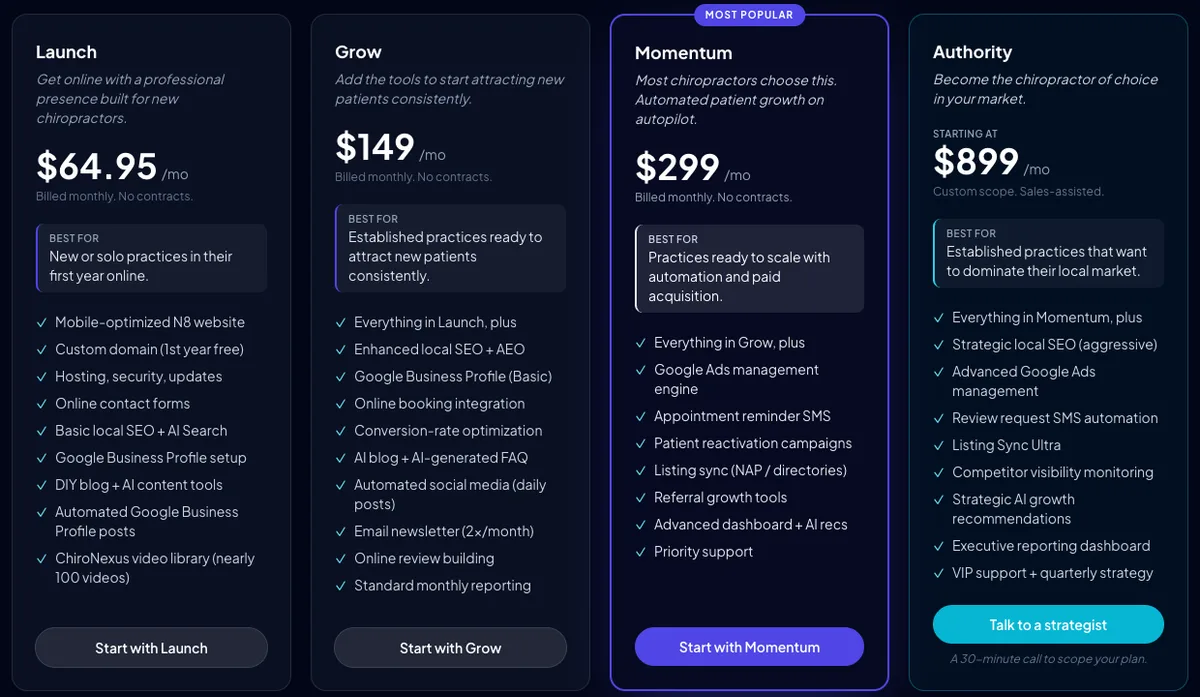
Read the cards and Launch at $64.95 gives you the website, hosting, contact forms, basic local SEO and Google Business Profile setup. Online booking appears on the Grow card at $149, listed as an addition on top of Launch, along with review building and an email newsletter. Then scroll down to the full feature comparison table on the same page, and online booking integration is ticked for all four plans, Launch included. One of those is wrong, and only the vendor can tell you which. The page also shows Launch as $64.99 in its menu and $64.95 on the card. Neither discrepancy is a scandal. Both are exactly why you should get the tier contents in writing before you choose the cheap one.
The same pattern runs through the other vendors. CHIROBASIX's $150 website-only program includes custom design, copywriting, on-page and local SEO, lead forms and online booking or appointment requests, but not its CRM and AI receptionist, which it includes only with its marketing programs. The Chiro Website Pro's Level 1 is the website; condition-specific pages built around top searches arrive at Level 2. None of this is hidden. It is simply that "a website" in a price list can mean a five-page brochure or a patient acquisition system, and the difference is usually one tier up.
For a chiropractic practice, the features worth paying a tier up for are, in order: online booking that writes to your actual schedule, review requests after a visit, and pages for the conditions you most want to treat. Google says its local results weigh three things: relevance, distance and prominence, and that prominence draws on information such as how many reviews a business has and how many websites link to it. A site that asks every patient for a review is working on the one ranking factor you can move.
The term, and who keeps the site when you leave
A monthly price with no setup fee only stays cheap if you can walk away with what you paid for. Two of the six published offers state a minimum website term, and only one says on its pricing page what you keep when you leave.
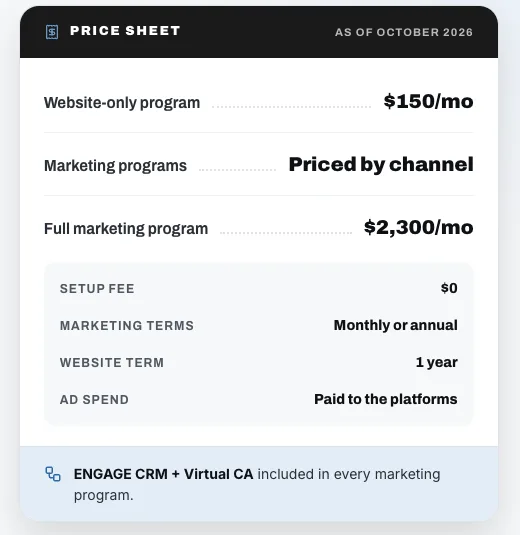
CHIROBASIX is the most explicit, and to its credit it says this on the pricing page rather than in a contract appendix. Its price sheet lists the website term as one year. Its section on leaving then says the domain, ad accounts, Google Business Profile, content, photos and videos belong to the practice, and that the website itself becomes the practice's once its one-year term is complete. That is a fair trade for a $0 setup fee, and the vendor has told you what it is. It also means a practice that cancels in month seven should expect to settle the term before the site comes with it.
Profit Zombies sells 12-month website plans, on its own comparison page. ChiroHosting, ChiroPage, Rocket Chiro and The Chiro Website Pro all advertise no contracts. A no-contract promise answers how long you must pay. It does not answer what you take with you, which is a separate question about the design, the code and the domain.
The domain is the one to settle first. Rocket Chiro's own guide to chiropractic websites warns about this exact problem: when the website company buys the domain for the practice, moving later can become "a big production to get access to the URL", for something that costs about $15 to $20 a year. CHIROBASIX tells clients to buy their own. ChiroHosting includes a custom domain with the first year free, which is generous, and is also the moment to ask whose account it is registered in. Register the domain in the practice's name, with your own login, and most of the lock-in risk goes away. We go through the rest of the ownership checklist in who owns your website.
What three years actually cost
Multiply every published entry price by 36 months and the spread is wider than the monthly prices suggest. A practice on ChiroHosting Launch pays about $2,338 over three years. ChiroPage comes to $2,484. CHIROBASIX's website-only program and Rocket Chiro's entry plan both reach $5,400. The Chiro Website Pro's Level 1 reaches $7,164. Profit Zombies, with its setup fee, reaches $16,000.
Why 36 months? Because it is a realistic life for a practice website before a redesign, and because the subscription model only beats a one-time build if you stay a while. A rough rule: if a vendor's three-year total is higher than what a local designer would quote to build the same site outright, you are paying for the hosting, updates and support, so make sure you will use them. ChiroPage's unlimited updates, at $69 a month, are worth a lot to a practice that changes its hours, offers and staff photos often, and very little to one that never touches its site.
What the chart leaves out is just as important. Ad spend is not in any of these numbers. Neither is your scheduling or practice management software, which is a separate subscription. Neither is the risk of a price rise: ChiroPage's lifetime price lock on your design is the only explicit protection against one that we found.
When the website price turns into a marketing price
Every vendor that publishes a website price also publishes a bigger number, and the bigger number is where most of the sales conversation goes. The top published tiers run from ChiroHosting's Authority, starting at $899 a month, to The Chiro Website Pro's Marketing Coach at $3,997 a month.
Ad spend sits on top. CHIROBASIX says its clients typically spend $1,000 to $1,500 a month on Facebook and Instagram ads and the same again on Google Ads, paid straight to the platforms. ChiroHosting recommends starting Google Ads at $500 to $2,000 a month depending on the market. So a practice on a full marketing program with two ad platforms running can be spending $4,300 to $5,300 a month, on CHIROBASIX's own figures, before it counts a single new patient.
For scale: the Bureau of Labor Statistics puts the median annual pay of a chiropractor at $79,200 in May 2025. CHIROBASIX's full program, at $2,300 a month, is $27,600 a year, about a third of that figure. The BLS also counts 61,700 chiropractor jobs in 2025, with 36% of chiropractors self-employed and 57% working in offices of chiropractors. This is a profession of small practices, and a marketing budget that suits a four-doctor clinic can sink a one-doctor one. Buy the website first. Add marketing when you can measure what one new patient is worth to you and how many the current site already brings in.
What a chiropractic site has to do to earn its fee
A chiropractic website has one job: turn a local search into a booked first visit. The NCHS found that 10.3% of US adults saw a chiropractor in the previous 12 months in 2017, up from 9.1% in 2012, with women more likely to go than men (11.1% against 9.4%). Whatever brings a patient to your site, it is where they decide whether to book. Whatever you pay, check that the site does these things:
- Books on the first screen. A booking button that writes to your real schedule, visible on a phone without scrolling. If booking only appears in a higher tier, price that tier.
- States the first visit plainly. What happens, how long it takes, what it costs for self-pay patients, and which insurance plans you accept. Many practices advertise a new patient offer; if you do, give it its own page with the full terms and check your state board's advertising rules before it goes live.
- Has a page for each condition you want to treat. Low back pain, sciatica, headaches, sports injuries, pregnancy care. One page each, written for the patient, not the search engine.
- Asks for reviews. Prominence is one of the three things Google says decides local results, and reviews feed it. Some vendors include review requests only in higher tiers.
- Handles intake forms carefully. A form that collects health information should go through a provider that will sign a business associate agreement. ChiroHosting, for example, sells HIPAA-compliant patient texting as a $49 a month add-on with a BAA. Ask every vendor the same question about forms. Our security page sets out how we handle it.
None of this needs an expensive site. It needs a site built by someone who knows what a chiropractic patient looks for, which is the honest case for the niche vendors over a general web designer.
Questions to ask any chiropractic website company
Use this table on every quote, including ours. The third column is what we found in the published pages, so you know which answers to expect.
| Ask | Why it matters | What the published pages showed |
|---|---|---|
| Is there a minimum term on the website, separate from the marketing? | A $0 setup fee is often paid back through a term | CHIROBASIX: 1-year website term. Profit Zombies: 12-month website plans. Four others: no contracts |
| Whose name is the domain registered in? | Moving a site without the domain means losing your address | CHIROBASIX: you buy your own. ChiroHosting: first year free, ask whose account |
| If I leave, do I get the design and files, or only the content? | A no-contract promise does not answer this | CHIROBASIX: the website is yours after its 1-year term. Most others do not say on the pricing page |
| Is online booking in this exact tier, and does it write to my schedule? | Booking is the feature that turns a visit into a patient | ChiroHosting's cards and comparison table disagree for Launch |
| Are edits unlimited, and how fast are they done? | Offers, hours and staff change monthly | ChiroPage: unlimited updates included. Ask the rest for a turnaround time |
| What happens to the price after year one? | A subscription can rise | ChiroPage: lifetime price lock on your design. Others silent |
| Will you sign a BAA for forms and texting? | Intake forms can carry health information | ChiroHosting: BAA with its $49 texting add-on. Ask about forms |
| Is ad spend inside or outside the fee? | Marketing quotes often exclude the largest cost | CHIROBASIX, ChiroHosting and Rocket Chiro all bill ad spend separately |
| Can I see three live sites you built for chiropractors, and their speed? | Templates can look alike and load slowly | Every vendor shows a gallery; test the live sites, not the screenshots |
Where KhanWork fits, and when you should buy elsewhere
If you run a one or two-doctor practice and want a good website, the vendors in this article will serve you well for less than we charge, and we would rather tell you that now. Our prices are published on our pricing page: Foundation at $1,000 a month, Growth at $2,500 and Scale at $5,000, billed monthly in advance, with no minimum term and the option to pause or cancel whenever you like. Three years of Foundation is $36,000, more than any website-only plan above. Foundation is also not a full website: it is a brand refresh and one high-converting landing page, live 14 business days after your content and assets reach us, then one new page every month. The whole website is Growth.
Where we fit is the practice that has outgrown a template: several locations, several doctors, a paid search budget that lands on a page nobody has tested, or services beyond adjustments such as physical rehab, massage or weight management that each need their own case made. That is the work on our healthcare practices page, and our conversion optimization work exists for practices whose traffic is fine and whose bookings are not. We have shipped 200+ projects, and every file we build belongs to the client. If you want a second opinion on a quote first, the free funnel review looks at the page your traffic actually lands on and tells you the one change we would make before any other. It costs nothing.
If you are comparing healthcare vertical pricing more broadly, our guide to med spa website costs shows the same subscription model working very differently in a cash-pay market.
Read a quote in this order
Most practices read a quote from the price down. Read it from the exit up instead. It takes about 20 minutes per vendor.
- Find the term. Look for the words minimum, term, annual and renew. Write down the earliest date you could leave without paying anything more.
- Find the exit. What leaves with you on that date: the domain, the design, the files, the Google Business Profile, the reviews. If the page does not say, email the question and keep the reply.
- Find the tier line. List what you actually need, booking, reviews, condition pages, and find the cheapest tier that includes all of it. That tier is your real price, not the one in the headline.
- Do the 36-month sum. Setup fee, plus the real tier times 36, plus any add-ons such as texting or extra locations. ChiroHosting, for example, charges $199 a month for each additional location on Authority.
- Then compare. Two quotes at the same 36-month total are not the same offer if one lets you leave in month two with everything and the other keeps the site for a year.
A practice that does this for three vendors will know more about chiropractic website pricing than most of the people selling it, and will usually pay less than the first quote it was given.
Frequently asked questions
Most chiropractic-specific vendors charge $64.95 to $199 a month with no setup fee, based on the six of eight vendors that published prices when we checked on 16 October 2026. One healthcare firm charges $2,500 up front plus $375 a month. Over three years that comes to roughly $2,300 to $16,000 for the website alone, before ad spend.
Only if you stay long enough to use what the monthly fee covers. Multiply the monthly price by 36 and compare it with a one-time quote for the same site plus a few years of hosting and edits. ChiroPage at $69 a month is $2,484 over three years with unlimited updates, which suits a practice that changes its site often.
Some do and some do not, and the website term can differ from the marketing term. CHIROBASIX publishes a one-year website term and Profit Zombies sells 12-month website plans, while ChiroHosting, ChiroPage, Rocket Chiro and The Chiro Website Pro advertise no contracts. Always ask what you take with you when you leave, which a no-contract promise does not settle.
It depends on the vendor, so get the answer in writing. CHIROBASIX says the domain, content, photos and Google Business Profile belong to the practice, and the website does too once its one-year term is complete. Whatever the vendor, register the domain in the practice's own name and account so you can move it.
It can make sense for a new one-doctor practice on a tight budget. Squarespace lists its Basic plan at $11 to $16 a month, far below any chiropractic vendor, but you do the building, writing and upkeep yourself, and you wire up booking and intake forms on your own.
Ad spend is billed separately by the vendors that publish it. CHIROBASIX says its clients typically spend $1,000 to $1,500 a month per platform on Facebook and Instagram or Google, and ChiroHosting recommends starting Google Ads at $500 to $2,000 a month depending on the market.
Online booking that writes to your schedule, a clear first-visit page with self-pay prices and accepted insurance, a page for each condition you want to treat, review requests after visits, and intake forms handled by a provider that will sign a business associate agreement. Check which tier includes each one before comparing prices.
 Healthcare
Oct 12, 2026 · 16 min
When a Family Asks ChatGPT for a Therapist: AI Visibility for Behavioral Health
We asked ChatGPT 24 questions a worried family would ask about therapy, in 12 US cities, and traced every recommendation back to its source. Practices with a page about the exact situation got named, and kept getting named.
 Healthcare
Oct 11, 2026 · 17 min
Questions to Ask a Dental Website Company Before You Sign
We read the published client terms of 14 dental website companies, out of 42 we checked. Here are the questions to ask before you sign, built from what those agreements say about ownership, domains, notice periods, ad accounts and your data.
 Healthcare
Oct 10, 2026 · 16 min
Mental Health Practice Websites: Group Practice vs Solo
We read 307 therapy practice websites from 15 US metros and sorted them into solo and group practices. Here is what each kind of site has to do, what they actually carry, and the Google rules and software prices that make a group site a different build.