How Much Should an Orthodontist Website Cost in 2026?

Oct 21, 2026 · 17 min read
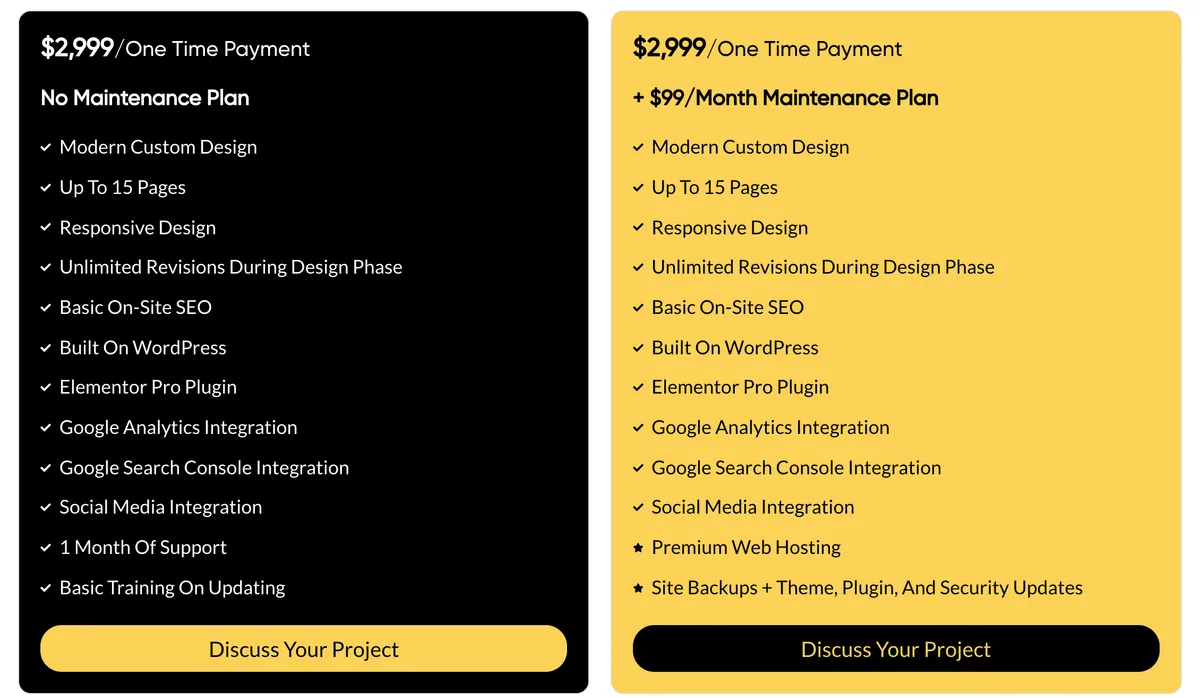
Orthodontists buy websites from a market that mostly refuses to say what it charges. On 21 October 2026 we went looking for every seller that builds orthodontic practice websites and prints a price on its own pages. We found four that print a price list, plus one agency that publishes ranges, and the printed offers run from a $2,999 one-time build to $2,000 a month for a site bundled with search marketing. Below, each one becomes a three-year total so a one-time build and a monthly plan can be compared on the same line.
Then we looked at the other side of the counter. We read 123 independent orthodontic practice websites across 14 US metros, 729 pages in all, to see who built them, what they promise parents and adult patients, and how they talk about money. That second half turned up two things a buyer should know before signing anything: the firms that build the most orthodontic sites in our sample publish no price list at all, and one in five practice sites advertises a monthly payment or a down payment, which brings a federal advertising rule into play.
The 30-second answer: what an orthodontist website costs
Going by the prices sellers print, an orthodontic practice website costs $1,999 to $3,999 to build, plus $0 to $375 a month to keep running. Over 36 months that comes to roughly $3,000 for a one-time build you maintain yourself, $5,200 to $7,200 for a template or custom site on a cheap care plan, and $16,000 for an all-in managed site. Bundles that fold monthly SEO into the price cost far more: $56,963 to $72,500 over the same three years. An outside estimator puts an orthodontist site at $4,350 to $30,450 for the build alone. Before comparing totals, check three things: what you keep if you cancel, whether the template was written for orthodontics or for general dentistry, and whether your payment-plan wording comes with the disclosures federal rules expect.
What orthodontic website sellers publish
Four sellers that market to orthodontists, or to dental practices generally, show a price list on their own websites, and a fifth publishes ranges. A figure made the table only if the seller itself printed it; prices repeated in search snippets, roundups or a rival's comparison chart were ignored. Every page was read on 21 October 2026.
| Seller | Up front | Per month | Included, as the seller describes it |
|---|---|---|---|
| Orthodontist SEO | $2,999 one time | None, or $99 maintenance; SEO plans $1,499, $1,999 or $2,499 | Custom WordPress design, up to 15 pages, one month of support; the $99 plan adds hosting, backups and updates. Each extra Google Business Profile is $499 a month on SEO plans |
| DocSites (dental and medical templates) | $1,999, $2,999 or $3,999 setup | $89, month to month | A choice of 36 designs on Standard; content migration of up to 10 pages on Plus; hosting and up to one hour of updates a month |
| Profit Zombies (orthodontist page) | $2,500 setup | From $375 | Hosting, maintenance, unlimited edits and local SEO |
| White Glove Orthodontist | $0 build; $2,500 first month | $2,000 per location, $800 per extra location | Website, hosting, SEO, local SEO and reporting in one fee; no contract; one practice per ZIP code; the practice keeps the site if it leaves |
| HIP Creative (cost article, not a price list) | $2,000 to $5,000 template; $8,000 to $15,000 custom; $15,000 to $30,000+ full service | $1,500 to $5,000 for the full-service tier | Ranges the agency publishes for the market, with photography and video adding $2,000 to $8,000 |
| ProjectCostEstimator (an estimate, not a seller) | $4,350 to $12,350 freelancer; $10,850 to $30,450 agency | None given | Its model of a US orthodontist site with consult booking, treatment pages and a gallery, median about $8,350 |
Only three of these are orthodontic by design. Orthodontist SEO and White Glove Orthodontist both sell to orthodontists by name, and Profit Zombies runs a separate orthodontist page with its pricing on it. DocSites sells templates to dentists and physicians generally, and it is here as the price floor for a template a practice adapts itself. HIP Creative belongs in the table for a different reason: it is the firm credited on more sites in our practice sample than any other, and the closest it comes to a price is an article of ranges.
Treat the estimator line as a rough yardstick. Its own page gives the freelancer top end as $12,300 in one sentence and $12,350 in another, and the agency floor as both $10,850 and $10,900. That does not make it useless. It is a fair way to notice a quote that sits far outside everything published. It is not a price anyone has offered you.
The 36-month view
Across three years the printed offers span $2,999 to $72,500, and the gap between them is mostly the monthly fee, not the build. A $2,500 setup looks close to a $2,999 build on the invoice; three years of $375 a month turns it into a $16,000 decision. The chart totals each offer the same way: what the seller charges up front, plus 36 of its own monthly fees, with no guesses added.
The two bundles off the scale are not overpriced versions of the bars. They are a different purchase. White Glove Orthodontist charges nothing for the build and $2,000 a month for the site plus search work, so the website is effectively free and the marketing is the product. Orthodontist SEO sells the same two things separately: a $2,999 site, then SEO from $1,499 a month. If a practice already has someone doing local search, the bars are the fair comparison. If it does not, compare the bundles with each other, not with a template.
One more distinction matters more than the price. A one-time build on WordPress, like the $2,999 option, is a site you can move to any host. A monthly plan that includes hosting may or may not be. White Glove says in its FAQ that a practice leaving keeps the website; ask every monthly seller to say the same in writing, because the answer decides whether 36 payments bought something you own.
Who actually builds orthodontic websites
The firms that build the most orthodontic practice sites in our sample are specialist marketing agencies, and none of the four most common publishes a price list. We looked for a builder credit in the footer of all 123 practice homepages, the small "website by" line most agencies leave behind. At least 55 sites carry one, and four firms account for 33 of them:
- HIP Creative: 13 sites. Its homepage carries no prices; its cost article gives the ranges in the table above.
- Neon Canvas: 10 sites. No prices on its homepage, and no pricing page at the usual addresses.
- TeleVox: 5 sites. The credit reads "Website Design By: Televox" on each.
- Rooster Grin: 5 sites. Credited as Rooster Grin Media or "Online Advantage by" the firm.
Behind them come Ortho Marketing on 3 sites, Orthodynamo on 2, and single sites from DOCTOR Multimedia, Ekwa, OrthoBoost and a dozen local studios. We checked the homepage and the common pricing addresses of HIP, Neon Canvas, TeleVox, Rooster Grin, Ortho Marketing and Orthodynamo on 21 October 2026 and found no price list on any of them.
That is not a criticism of those firms. Specialist agencies often price by the size of the practice and the number of locations, and a call is how they find out. It does mean a buyer has two very different markets to compare: the five sellers with printed prices, and the agencies that build most of what you will see when you look at competitors' sites. If you like a rival's website and plan to call whoever built it, budget against HIP's own published bands rather than against the template floor.
Who is buying
The buyer is a small, highly paid specialty. The Bureau of Labor Statistics put orthodontist employment at 6,210 in its May 2025 survey, at an average of $259,400 a year. The survey only covers people on a payroll, so owners who pay themselves are missing and the real buyer pool is bigger. Even so, the order of magnitude holds: a few thousand practices, and most of the sellers above name orthodontics because a narrow niche lets them reuse a lot of work.
The audience is unusual too. The American Association of Orthodontists tells parents that a child should have a check-up with an orthodontist by age 7, and it runs a consumer campaign around that milestone. So an orthodontic site speaks to two readers at once: a parent with a seven or twelve year old, comparing practices on trust, insurance and payment plans, and an adult weighing clear aligners, who cares more about price, speed and discretion. A template written for a general dental office speaks to neither.
What 123 orthodontic practice websites show
Almost every orthodontic practice site makes it easy to call, book and ask about insurance, and almost none tells a parent what treatment costs. The practices came from web searches for orthodontists in 14 metros (Raleigh, Salt Lake City, Tampa, Sacramento, Austin, Denver, Phoenix, Portland, Nashville, Charlotte, Columbus, Indianapolis, Kansas City and Minneapolis), with directories, general dentists, national chains and DSO pages removed. 123 of the 169 domains could be read. We then pulled the homepage and as many as six of its own pages with fees, financing, insurance, consultations or treatments in the address.
A few more findings a buyer can use:
- WordPress runs most of them. 95 of the 123 sites are built on it. A practice on WordPress can change sellers without starting from nothing, which strengthens its hand in any negotiation.
- Financing is outsourced as often as it is in-house. 35 sites name a third-party payment company such as CareCredit, Sunbit, Cherry or OrthoFi. Each of those has its own application link and its own wording about rates, which the site has to present accurately.
- Aligner tiers are a selling point. 22 sites name an Invisalign provider level such as Diamond or Platinum. That is a page element worth designing on purpose, not a badge dropped into the footer.
- Spanish is rare. 15 sites mention Spanish or say "se habla español". In metros like Phoenix or Tampa that is a gap a competitor can fill with one translated page and a bilingual line on the booking form.
The fee page parents compare
Only 18 of the 123 practices print what their own treatment costs, and the ones that do are easy to remember. Kunik Orthodontics in Austin lists an estimated plan cost by treatment length; Mint Orthodontics in Minneapolis prices aligner packages; Thousand Smiles in Austin says its braces start at $4,200. We counted a practice only when the price was clearly its own, not a national average quoted from an insurer or a manufacturer, which several sites use instead of their own number.
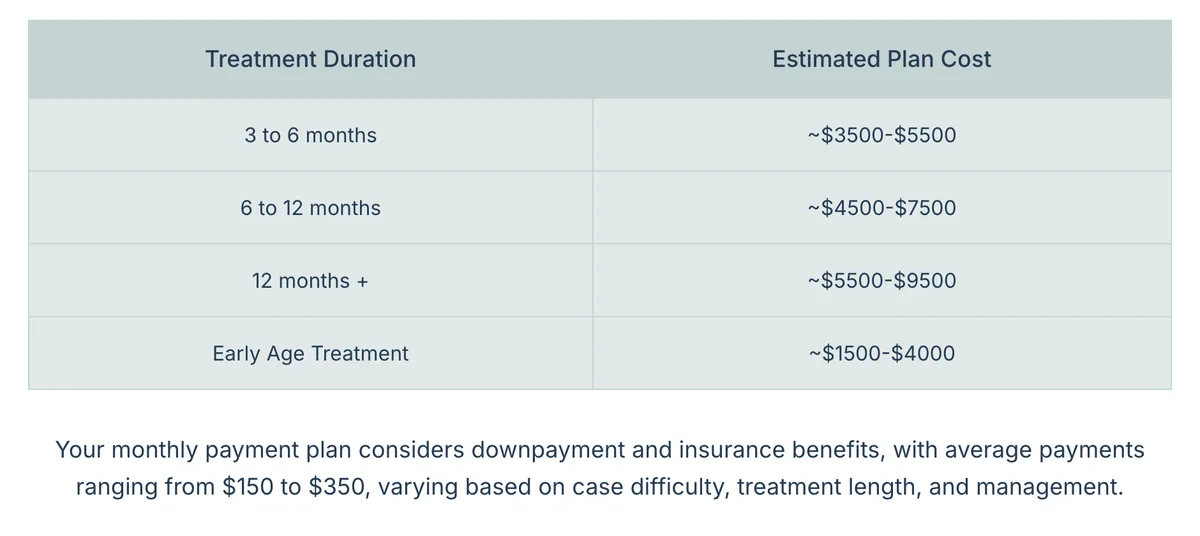
The monthly number is far more common than the total. 19 practices print a payment amount, usually in a hero banner or a financing section, and the figures cluster low. We took the lowest monthly amount each site advertises:
Look at it from a parent's side. They open three practices in three tabs. Two say "free consultation" and nothing else. The third says what a year of braces usually costs and what a typical month looks like. The third practice has not given anything away, since every case is quoted at the consult anyway, but it has answered the question the parent was too polite to ask on the phone. Publishing a range costs an afternoon of writing, and in our sample it would put a practice among the 15 percent that answer the question at all.
The "$149 a month" line and Regulation Z
An orthodontic site that advertises a monthly payment or a down payment is, in federal terms, advertising credit, and that triggers extra disclosures. Regulation Z, at 12 CFR 1026.24(d), lists four "triggering terms": a down payment amount or percentage, how many payments or how long repayment runs, any payment amount, and any finance charge amount. Put one of them in an advertisement and the same advertisement must also state the down payment, the terms of repayment, and the "annual percentage rate," using that term. The CFPB's official interpretation adds that all persons must comply with these advertising rules, not only those that meet the definition of a creditor.
In our sample, 25 sites state a monthly payment amount or a down payment, the 19 above plus six that advertise a down payment alone. Five of those 25 use the words "APR" or "annual percentage rate" anywhere on the pages we read; the other 20 do not, although many say "0% interest" or "interest-free". We are not lawyers, this is not legal advice, and the terms may sit on a page outside our crawl, so no practice is named here. Whether a given in-house payment plan falls under Regulation Z depends on facts a lawyer should look at. The website point is narrower: if your homepage says "$149 a month", the page needs a home for the full terms, and your web designer should build that home before the banner goes live, not after a letter arrives.
This is the cheapest compliance fix in the whole build. One sentence beside the payment figure, with the down payment, the number of months and the APR, or an example plan that shows all of them, covers most cases. Ask any seller whether their template has a place for it.
What an orthodontic site needs, and what to skip
An orthodontic practice site needs two paths through it, one for parents and one for adults, and five pages that carry most of the weight:
- A cost and financing page. A treatment range, a typical monthly payment with its full terms, the insurance you file, HSA and FSA use, and the payment companies you work with.
- A first-visit page for parents. What happens at the age 7 check-up, how long it takes, whether the consult is free (it is at 102 of the 123 practices we read), and why early treatment is recommended for some children and not others.
- A page for adults. Aligners, discreet braces, how many visits a year, and a straight answer on price. Adults compare like shoppers, and the page should read like it knows that.
- Doctor profiles. Board certification, training, and the provider tier for aligners if you hold one. 41 of the sites we read say board certified; it is a fact a parent understands without explanation.
- One clear way to start. Online booking for the free consult, a virtual smile check for people not ready to visit, and a phone number that works on a tap. 31 of 123 sites offer a virtual option, so it is still a way to stand out.
What to skip: a "meet the team" carousel nobody clicks, a blog of generic oral hygiene posts, and a smile gallery without consent records for every photo in it. For general dentistry, our dental website price comparison covers the same ground, and our contract checklist for dental website companies lists the clauses to read first.
Questions to ask any seller
Bring this table to every sales call, ours included. A good seller answers each line in a sentence or two.
| Question | What you want to hear | The reason |
|---|---|---|
| What does this cost over 36 months, all fees in? | One figure, written down | The published offers range from $2,999 to $72,500 over three years |
| If I leave, what do I keep? | The domain, the content, the design files and a working export | A hosted plan you cannot move is rent, not an asset |
| Was this template written for orthodontics? | Yes, with parent and adult paths and a financing page | Rewriting a general dental template is labour the price hides |
| Where do the payment-plan terms go? | Next to every monthly figure, with the APR stated | Regulation Z, 12 CFR 1026.24(d), ties payment amounts to further disclosures |
| Is my city exclusive to me, and for how long? | Yes, for as long as I pay, in writing | Orthodontist SEO, for one, grants city exclusivity only while a practice is under contract |
| How does a new patient book? | Through my scheduling software or a form you connect to it | 113 of 123 sites already push people to book or request a visit |
| Which tracking tags will you install? | A short list I approve, with a business associate agreement if any form collects health details | 16 of 123 sites we read load a Meta ad pixel |
| Can my team update fees and offers without you? | Yes, the same day | Several sites we read carried dated promotions with their own terms |
Where KhanWork fits, and when a $2,999 build is smarter
A single-doctor practice that wants a clean site and a cost page should not hire us. A $2,999 build on WordPress with a $99 plan, or a $1,999 template, will do that job, and the savings would pay for a season of local ads. If what you want is search marketing bundled with the site, compare the two orthodontic bundles above with each other first.
Our prices sit on the pricing page, so here they are plainly. All three tiers are subscriptions paid monthly in advance, with no minimum and the freedom to pause or stop: $1,000 for Foundation, $2,500 for Growth, $5,000 for Scale. Foundation pairs a refreshed brand with one landing page designed to win the booking, which for an orthodontist is usually the free-consult page or the adult aligner page your ads point at. That page is live 14 business days from the day your content and assets land with us, and a further page arrives monthly. Growth is where a complete site gets built, and hosting is not part of any tier. Three years of Foundation comes to $36,000, more than any bar in the chart above, so the case for us is speed and constant testing, not a lower bill.
The practice we suit has more than one location or more than one doctor, runs paid search into consult pages, and sees plenty of visits but not enough booked consults. That is the work behind our dental and orthodontic practice page and our conversion optimization service. Everything we deliver, from the domain to the design files, is yours to keep. If you would like to start smaller, send us the page your ads land on and our free funnel review will tell you the first change we would test there.
The side-by-side tab test
Before you spend anything, do what a parent does. Open your homepage on a phone, then open the two practices nearest you in the next tabs, and give each site the same five minutes:
- Find a price. Any treatment range or starting figure. Note how many taps it took, or that there was none.
- Find a monthly payment, and its terms. If a number is there, look for the down payment, the length and the APR beside it.
- Book the free consult. Count the taps from the homepage to a confirmed time or a sent request.
- Find the answer for a 7 year old. Does the site say what the first check-up involves and what it costs?
- Find the answer for an adult. Is there a page that talks to a 35 year old about aligners and price, or only to parents?
Write the results in three columns. Wherever a competitor wins, that is the page to fix first, and most of those fixes are copy, not a rebuild. If you fix them and consults still do not grow, that is the point at which the three-year totals above become worth comparing.
Frequently asked questions
An orthodontist website costs about $3,000 to $16,000 over three years from sellers that print prices: a $2,999 one-time build at the low end, $1,999 to $3,999 templates with an $89 monthly plan in the middle, and $2,500 setup plus $375 a month for a managed site at the top. Bundles that add monthly SEO come to $56,963 to $72,500 across those 36 months. We checked each figure on the seller's website on 21 October 2026.
Yes, a typical range is worth publishing, because parents compare practices before they ever call. Only 18 of the 123 orthodontic practice sites we read print their own treatment fees, so a short table of ranges by treatment length is enough to stand out, and every case is still quoted at the consult.
Usually, yes. Regulation Z, 12 CFR 1026.24(d), treats a payment amount or a down payment in an advertisement as a triggering term, and the same ad must then state the down payment, the repayment terms and the annual percentage rate. Of 25 orthodontic sites we read that print a payment or down payment, 5 use the term APR. Ask a lawyer how it applies to your own plans.
A general dental template works as a starting point only if you rewrite it. Orthodontic sites speak to two readers, parents of children around age 7 and adults weighing aligners, and need a cost and financing page that dental templates rarely include, so the writing is the real cost.
Specialist orthodontic marketing agencies build most of them. Of 123 practice homepages we read, at least 55 name their builder, and HIP Creative (13 sites), Neon Canvas (10), TeleVox (5) and Rooster Grin (5) account for 33. None of the four printed a price list on its homepage or a pricing page on 21 October 2026.
A virtual consult is not essential, but it is still a way to stand out. Only 31 of the 123 orthodontic sites we read offer a virtual consult or online smile check, while 102 offer a free in-person consult, so a photo-based option reaches adults who are not ready to visit.
An orthodontic site needs five pages before anything else: cost and financing with full payment terms, a first-visit page for parents, a page for adult patients, doctor profiles with board certification, and one clear way to book the free consult. Galleries and blogs come after those.
 Healthcare
Oct 19, 2026 · 17 min
How Much Should a Psychiatry Practice Website Cost in 2026?
We turned every published psychiatry website price we could find into a three-year total, then read 181 psychiatry practice sites for fees, telehealth, the Good Faith Estimate and ad pixels.
 Healthcare
Oct 18, 2026 · 17 min
How Much Should a Fertility Clinic Website Cost in 2026?
Most fertility marketing agencies publish no price. We found six sellers that do, turned each into a three-year total, then read 217 SART member clinic websites for prices, success-rate pages and financing.
 Healthcare
Oct 17, 2026 · 17 min
How Much Should a Physical Therapy Website Cost in 2026?
Published PT website offers start at $97 to $750 a month, and the two biggest PT-only firms would not load for us. We read every price we could, then checked what 114 real clinic homepages run, from booking software to self-pay rates.