How Much Should a Dental Implant Practice Website Cost in 2026?

Oct 25, 2026 · 17 min read
In 2018, a team based at the Harvard School of Dental Medicine looked at seven rounds of the national health survey and found that the share of American adults with missing teeth who had a dental implant had climbed from 0.7 percent in the 1999 and 2000 survey to 5.7 percent in the 2015 and 2016 one. Then they projected it forward to one year: 2026. Their most conservative scenario kept it at 5.7 percent. Their least conservative put it at 23 percent. That year is now, and the practices placing those implants are buying websites built to catch the patients.
What those websites cost is a strange question to research, because the companies that specialize in implant and full-arch marketing almost never print a fee. So on 25 October 2026 we did two things. We listed every seller we could find whose own website shows a fee for a dental or implant practice website or marketing program, and converted each fee into what three years would cost. Then we read 192 independent implant practice websites across 19 American cities to see what patients actually meet: prices, financing, consultation offers, credentials, and who built the site.
The 30-second answer: implant practice website prices
A dental implant practice website costs about $2,000 to $7,500 to build at the prices general dental website sellers publish, and $97 a month for the cheapest managed plan we found. Programs that bundle the website with implant marketing run $750 to $9,000 a month at published rates, which is $27,000 to $324,000 over three years before any ad spend. The firms that lead with implant and full-arch marketing sit at the expensive end, and of the seven we checked, none printed a management fee on its homepage. Every figure here comes from a seller's own page, read on 25 October 2026.
A better yardstick than the build fee is the number of accepted cases the site must bring in to cover three years of cost. Thirty practices in our census print a fixed full-arch price, with a median of about $15,250 per arch. At that price, three years of the most expensive published program, $324,000, equals about 21 arches before ad spend. The cheapest website-only offer costs less than one single implant at the median printed price of about $3,100.
Sellers that print a number
Six sellers that market websites or growth programs to dental practices show a price on a page they control. The test was strict. If a figure appeared only in a rival's roundup, or only as a budget option on an inquiry form, we left the seller out.
| Seller | What the price buys | Price, as printed | Terms worth reading |
|---|---|---|---|
| Website Design for Dentists | A dental website build | $1,997 Starter, $3,997 Growth (one time); Authority $7,500 | Domain about $15 a year and hosting about $20 a month billed to you; Authority is called a full-service engagement and its billing period is not stated |
| MyClickPage (oral surgeon page) | A managed oral surgery website | $97, in the page's structured data | No setup fee, no contract; the visible page says one simple monthly plan and does not print the number |
| DocSites | A dental template website | $1,999, $2,999 or $3,999 setup | $89 a month, month to month, which covers hosting plus an hour of edits on request |
| Lasso MD | A custom website plus marketing | $750, $1,250, $1,500 or $2,000 a month | Every plan lists custom website design; photo shoot $3,000 and video shoot $7,000 extra |
| Implant Prospect (implant only) | Local search for implant keywords | SEO $2,500 a month; ads management 20 percent of ad spend | Its full done-for-you program is a revenue share with no figure printed; one practice per market |
| DM Marketing (Dallas) | Ads, landing pages and CRM | From $3,000, $4,500 or $9,000 a month | Initial 90-day commitment, then month to month; ad spend paid to the platforms separately |
Read the second column before the third. Only the first three rows sell a website on its own, and none of the three is an implant specialist: each sells to dental practices in general. Lasso MD folds a custom site into a marketing plan. Implant Prospect and DM Marketing sell the machinery around the site, search rankings, ads and landing pages, and assume you have a website already or will build one.
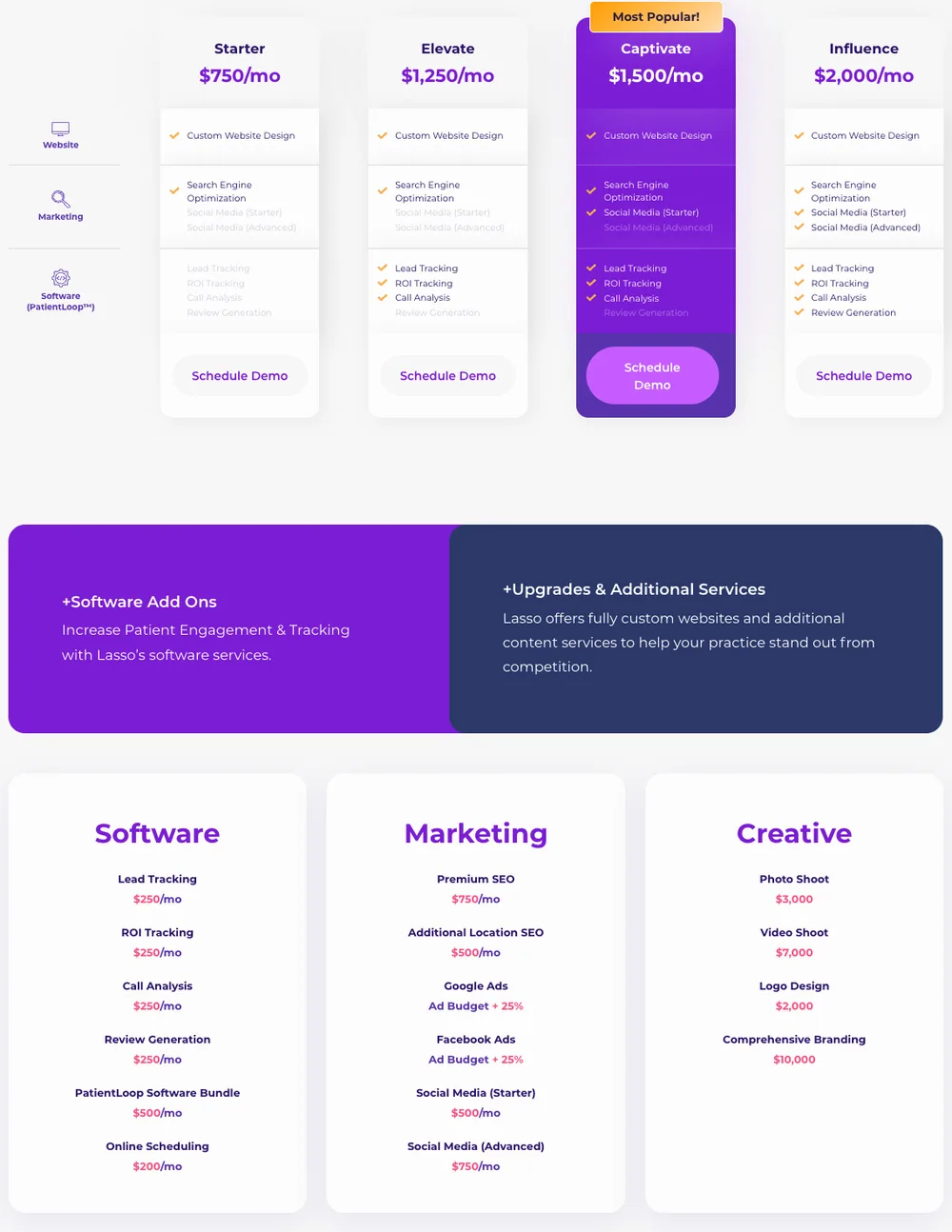
Lasso's page is the most complete dental marketing price list we found, and it is worth reading line by line for one reason. The add-ons are where an implant practice spends. A full-arch practice will want video of real patients, and that is $7,000 a shoot here. It will want to know which ads produced which calls, and call analysis is $250 a month. The $750 plan is the entry ticket, not the bill.
One more note on the first row. Website Design for Dentists prints its prices clearly, which we credit. Its testimonials, read the same day, quote a Dr. Michael Chen twice, once at Beverly Hills Smile Studio and once at Park Orthodontics, and the second is a practice name the page also gives to a different dentist in Austin. A clear price list does not settle whether a seller's proof is real. Ask for live client sites you can visit and call.
Thirty-six months, priced from the sellers' own pages
Over three years, a website-only offer from these sellers costs between about $2,000 and $7,200. Every bar is the seller's one-time fee plus three years of whatever monthly charge that seller lists. Where a seller prints no monthly fee, the bar is the build alone, and we say so.
Those are small numbers next to a single implant case, and that is the honest case for them. A general dentist adding implants to an existing practice, or an oral surgeon who gets most implant patients by referral, may need nothing more than a clean site with a strong implant page. None of these offers includes the work that fills an implant schedule from cold traffic, though: ads, landing pages built for one offer, call handling, and search rankings for implant terms in your city.
That work is what the second group sells, and it changes the scale of the conversation completely.
Read that chart with two caveats in mind. First, none of these numbers includes advertising. DM Marketing recommends at least $1,500 a month of ad spend on its Core plan and $3,000 or more on Growth, paid to Google and Meta directly. Second, the bars are not like for like. Lasso's plans include a website; Implant Prospect's SEO and DM Marketing's plans are built to send traffic to one. What they share is that the monthly fee, not the build, is where the money goes.
The implant marketers who do not print a fee
The firms that lead with implant and full-arch marketing are the ones a practice is most likely to hear from, and we could not find a management fee on any of their homepages. We opened the homepages of seven on 25 October 2026: The Implant Engine, Teraleads, Full Arch Ninja, Medical PPC Agency, Progressive Dental, SMC National and Driven Dental Marketing. Every one prints case values, client production or return on ad spend. None prints what it charges.
What they do print is revealing about the product. Teraleads describes its targets as patients shopping for a $30,000 to $60,000 case. Full Arch Ninja promises 2 to 5 new full-arch cases a month, which it values at $20,000 to $60,000 each. The Implant Engine is the most specific about its funnel: a call center that reaches every lead within 20 seconds, screens for a household income of $60,000 or more, a credit score of 650 or more and the ability to handle a $300 to $800 monthly payment, then takes a $50 deposit before the patient reaches your calendar.
Look at that list and you can see why a full-arch website costs what it does. The site is the smallest part. The landing page, the qualification steps, the financing pre-check, the deposit and the call center are the system, and the website's job is to feed it without leaking. When a specialist will not quote a fee before a call, ask for three things in writing on the call: the monthly management fee, the expected ad spend, and the minimum term. Then put the total next to the bars above.
What the market is worth now
The reason implant marketing prices like this is the size of the case and the speed of the growth. In the Harvard study we opened with, published in the Journal of Dental Research, implant prevalence among adults missing teeth rose by an average of 14 percent a year after adjusting for other factors. The largest absolute increase, 12.9 percentage points, was among people aged 65 to 74. Having private insurance, or education beyond high school, was each tied to about twice the prevalence.
That last finding matters for the website. Implant patients skew older, and access skews toward people with more money and more insurance. A site that speaks only to the patient shopping for the cheapest arch is aiming at the smallest part of the market the study describes, and the part the specialist funnels are explicitly screening out.
What 192 implant practice websites show
The typical implant practice website already has the basics down: a booking route, a tap-to-call number, All-on-4 or full-arch wording, and a financing partner. What it rarely does is tell a patient what the treatment costs. Only 38 of the 192 sites we could read print their own price for an implant or an arch.
Here is how we counted. On 25 October 2026 we searched for implant and full-arch practices in 19 metro areas, among them Phoenix, Houston, Atlanta, Denver, Seattle, Nashville and Boston, and kept 225 independent practice domains, leaving out directories, national chains such as ClearChoice and Aspen Dental, hospitals, manufacturers and agencies. For each one we pulled the homepage plus as many as seven internal pages on implants, full-arch treatment, cost, financing, consultations and the doctors. 192 sites returned readable pages; 26 of the rest sat behind a bot challenge, most of them oral surgery practices, so oral surgeons are under-counted. Every dollar figure near implant wording, 1,377 snippets in all, was read and coded by hand. We read only some pages on each site, so treat each count as a minimum.
Financing is close to universal and heavily layered. 122 sites name at least one lender, and 81 name two or more. CareCredit appears on 105, Cherry on 48, Proceed Finance on 39, LendingClub on 36 and Sunbit on 32. Sedation shows up on 155 sites, and CBCT or 3D scanning on 149, which we read as answers to the two worries a full-arch patient brings to the page, pain and not knowing what will happen.
Free consultations are common, and so is putting a dollar value on them. 80 sites use free or complimentary consultation wording, and 13 attach a stated value, from $50 to $700, to a consult or scan they give away. Only four practices print a fee they actually charge. One Philadelphia periodontal practice explains its own in a single sentence: "Our $219 consultation includes a full cone beam CT scan."
What practices print, and what they leave out
Among the 30 practices that print their own price for a fixed full arch, the lowest figure each one shows runs from $5,999 to $29,500 per arch, with a median of about $15,250. Fifteen are under $15,000, ten fall between $15,000 and $19,999, and five are $20,000 or more. Those figures include sale prices and mix acrylic and zirconia tiers, so they are list prices, not averages of what patients paid. For a single implant, 30 practices print a complete figure, from $995 (where the practice does not say whether the crown is included) to $5,995, with a median of about $3,100.
The practices that do print prices are worth studying, because several have clearly thought about the patient's confusion. A Phoenix implant center states that its from-price is the cash or check price for one arch and that a full mouth is two arches, which settles the per-arch versus full-mouth question before anyone books. A Houston practice prints its IV sedation fee as a flat $2,000 per appointment and says outright that this is above the local range. A Miami practice warns that the from-$999 implant prices in local ads usually cover the titanium post alone.
Across all the snippets we coded, national or area averages quoted on practice pages outnumbered the practices' own per-arch figures, 414 to 251. A page that says implants cost $15,000 to $35,000 nationally has answered a question the patient did not ask. The patient wants to know what this practice charges, and a range from your own fee schedule does that in one line.
Two template problems turned up more than once, and both are worth checking on your own site today. Five practice sites built on one shared template label their price tiers all inclusive while a line on the same page reads as though the All-on-4 price does not include the final prosthesis. And four sites carry a seasonal special that still says "before DATE", a placeholder nobody filled in. Neither is a reason to distrust those practices' dentistry. Both are the kind of thing a patient comparing three tabs at night does notice.
Who builds implant practice websites
The implant market is split between specialists and generalists, and the specialists who print no fee build a visible share of the sites. 79 of the 192 sites carry a footer credit to a named web or marketing company, 48 companies in all. Progressive Dental is credited on 7, Teraleads on 6, TNT Dental on 5, Web Marketing for Dentists on 4, and Ekwa and Lasso MD on 3 each. Progressive Dental and Teraleads are two of the seven implant marketers whose homepages print no fee. Lasso MD, the firm with the fullest public price list in this article, is credited on three.
The large general dental website platforms barely appear in this sample. We found no footer credit for ProSites, Officite or PBHS on any of the 192 readable sites. WordPress runs 140 of them. That fits the money: a practice chasing full-arch cases tends to hire a firm that sells the funnel, and the funnel firm builds the site to suit it.
The word specialist, and the sentence it requires
Implant dentistry is not a recognized dental specialty, and that changes what an implant website can say. The National Commission on Recognition of Dental Specialties and Certifying Boards recognizes twelve specialties. Oral and maxillofacial surgery, periodontics and prosthodontics are on the list. Implant dentistry is not.
The American Dental Association's Code of Ethics, in its 2026 edition, turns that into specific website copy. A general dentist who announces implant services must avoid anything that expresses or implies specialization, and must state that the services are provided by a general dentist. A dentist who wants to announce a credential in a non-specialty area, such as a diplomate status in implant dentistry, may do so only if the credential meets set standards and the announcement says that the area is not recognized as a specialty by the commission or by the state.
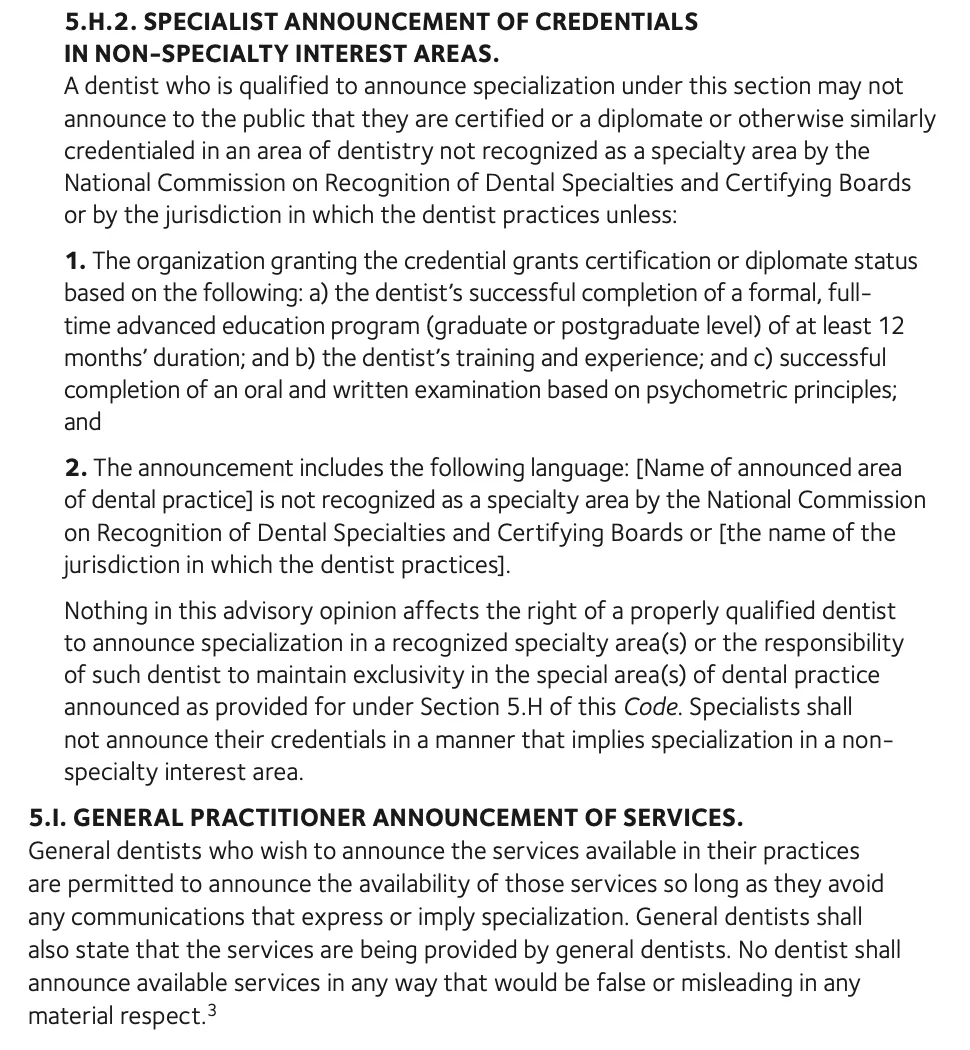
The ADA code binds ADA members, and state dental boards write their own advertising rules, which can be stricter. We are not giving legal advice, and you should check your own board's rule. The practical point for a website is narrower. "Implant specialist" in a page title, a headline or a Google Business Profile name is the phrase most likely to cause a problem, and a web company that writes implant pages for a living should know that before it drafts your homepage. In our census, 55 of the 192 sites use the phrase implant specialist, 11 of them without naming an oral surgeon, periodontist or prosthodontist anywhere on the pages we read. None of the 192 carried the sentence saying implant dentistry is not a recognized specialty.
Monthly payment ads and the APR line
An implant website that prints "$299 a month" has made a credit advertisement, and federal rules attach more text to it. The rule sits in Regulation Z, section 1026.24(d). Once an ad names a payment amount, a number of payments or a down payment, it must also give the down payment, how the loan is repaid over its whole term, and the rate, labeled as an annual percentage rate.
In our census, 33 of the 192 sites print a monthly payment next to a dollar figure, yet just 9 of those mention an APR on any page we collected. The best example we found was a Charlotte practice that puts the price, the monthly figure, the number of payments, the rate and the lender in a single sentence: $3,999, as low as $99 a month over 60 payments at 16.82 percent APR, with the lender named. The fix is usually one line under the figure, supplied by the lender, and it belongs in the brief for every implant landing page. If your financing partner gives you a representative example, use it word for word.
Questions to put to any implant web company
Whether a seller charges $97 or $9,000 a month, it should be able to answer every row below in writing. The right-hand column is why each one matters for implants in particular.
| Ask this | A good answer | Why it matters for implants |
|---|---|---|
| What is the monthly fee, the expected ad spend and the minimum term? | Three figures on one page | Over three years, the published monthly programs run $27,000 to $324,000 before a dollar of ads |
| Is the website included, or do you send traffic to mine? | A plain yes or no, with who builds the landing pages | Two of the six sellers above price the system around the site, not the site |
| How will our credentials be worded? | Draft copy that names the dentist's actual degree, specialty or board, with any required disclaimer | Implant dentistry is not a recognized specialty; the ADA code asks for specific wording |
| Where do monthly payment figures appear, and with what terms? | Next to every figure, with the APR line from the lender | Regulation Z ties a stated payment to further disclosures |
| Who answers a lead at 9 p.m., and how fast? | A named person or service and a response time in minutes | The Implant Engine, for one, sells a call within 20 seconds as part of its funnel |
| Which scripts load on the consultation form? | The tag inventory in writing, and no advertising pixel on a health form | 24 of the 192 homepages we read load Meta's ad pixel, and a pixel on a form can tell an ad platform who asked about surgery |
| Do we own the domain, the site and the patient videos? | Yes, all three, in writing | A library of case videos is the hardest asset to rebuild after a split |
| Is our market exclusive to us? | Yes or no, for how long, and on what condition | Implant Prospect, for one, takes one practice per market |
Where KhanWork fits, and when a $2,000 site is the right call
A general practice that places a few implants a month and gets them mostly from its own patients does not need us. A $1,997 or $1,999 build with a good implant page, real photos and a clear financing section will do the job, and the difference buys a lot of chair time.
We publish our own fees on the pricing page, which is the standard we just held every seller to. KhanWork runs as a monthly subscription in three tiers, $1,000 for Foundation, $2,500 for Growth and $5,000 for Scale, billed in advance monthly. There is no minimum term, and a plan can be paused or ended whenever it stops paying for itself. Foundation refreshes your brand and ships the single page your implant ads land on, typically the All-on-4 page, 14 business days after your assets arrive, or the next month costs you nothing. After that we add one new page a month. Growth is the whole website. Hosting is not included in any plan; it runs in your own account. Held for 36 months, Foundation comes to $36,000: above every website-only bar, and below every monthly program in the second chart apart from Lasso's $750 plan.
We fit a practice that already pays for implant traffic and suspects the page is where it leaks: the ads work, the phone does not ring enough, and nobody can say why. That is conversion work, built page by page and judged on consultations booked. You own all of it, the domain, the pages and the design files included. Our dental practice page explains how we work with practices like yours, and the free funnel review is a no-cost read of the landing page behind your implant ads, ending with a single change to try before anything else. For general dentistry prices, our dentist website cost guide covers the sellers that did not make this list.
The after-hours lead test
Before you pay anyone, test your own funnel the way an implant patient meets it: on a phone, in the evening, after reading about the procedure for weeks. It takes twenty minutes and you need a second phone.
- Find. At about 9 p.m., search for full-arch or All-on-4 implants and your city. Note where you appear and tap your own result.
- Price. Starting from that page, look for what one arch costs, as a fixed fee or at least a band. If the only number is a monthly payment, check whether the terms and APR sit next to it.
- Trust. Find who places the implants, what their degree or specialty actually is, and three real patient cases. Note any use of the word specialist and whether it is accurate.
- Ask. Submit the consultation form with your second phone number. Then call the main number and see what happens after hours.
- Time it. Write down when the first human reply arrives, by text, email or call. The specialist funnels promise seconds. Yours might be tomorrow afternoon.
Repeat all five steps on the two competitors ranking above you. If your page hid the price, blurred the credentials or let the form sit overnight, you need a better page and a faster reply, and probably not a rebuild. If you pass every step and cases are still thin, only then is it worth pricing the sellers above against each other.
Frequently asked questions
A dental implant practice website costs about $2,000 to $7,500 to build at the prices dental website sellers publish, or $97 a month for the cheapest managed plan we found. Programs that bundle the site with implant marketing run $750 to $9,000 a month at published rates, which is $27,000 to $324,000 over three years before ad spend. All figures come from sellers' own pages, read 25 October 2026.
Most implant marketing firms quote after a sales call because their fee is tied to ad spend, market size and case volume. Of seven firms that lead with implant and full-arch marketing, none printed a management fee on its homepage on 25 October 2026. Ask any of them for the monthly fee, expected ad spend and minimum term in writing.
Yes, printing a per-arch price, even as a range, answers the first question a full-arch patient has. Only 38 of 192 implant practice sites we read printed their own implant or arch price. Among the 30 that print a fixed full-arch price, the lowest figure per site ranged from $5,999 to $29,500, with a median of about $15,250 per arch.
Usually not without care, because implant dentistry is not one of the twelve specialties recognized by the National Commission on Recognition of Dental Specialties and Certifying Boards. The ADA Code of Ethics says general dentists must avoid implying specialization and state that they are general dentists. State dental boards set their own rules, so check yours.
Federal credit advertising rules (section 1026.24(d) of Regulation Z) say a stated payment amount brings further disclosures with it, including the down payment, how the loan is repaid and the APR. In our census, 33 implant sites printed a monthly payment figure and only 9 of them mentioned an APR on any page we collected. Treat this as background, not legal advice, and use the disclosure wording your lender approves.
A low-cost build is enough for a practice that gets most implant patients from its own patient base or from referrals. Published builds start at $1,997 and $1,999, and a managed plan at $97 a month. A practice buying full-arch traffic from ads usually needs dedicated landing pages, financing steps and fast lead response as well.
Dental and implant marketing companies built many of them. A footer credit on 79 of the 192 sites we read names one of 48 named companies, led by Progressive Dental on 7, Teraleads on 6 and TNT Dental on 5. We found no credit for ProSites, Officite or PBHS on any of the 192.
 Healthcare
Oct 24, 2026 · 17 min
How Much Should a Plastic Surgery Practice Website Cost in 2026?
Six sellers print a plastic surgery website price, from $500 to $40,000. We turned each into a three-year total, then read 202 practice sites for prices, consultation fees, galleries and who built them.
 Healthcare
Oct 23, 2026 · 16 min
How Much Should a Dermatology Practice Website Cost in 2026?
Four sellers print a dermatology website price, one of them only in its page code. We turned each into a three-year total, then read 142 dermatology practice sites for prices, booking, galleries and the Good Faith Estimate notice.
 Healthcare
Oct 22, 2026 · 17 min
How Much Should an Eating Disorder Treatment Center Website Cost in 2026?
We turned every published price we could find into a three-year total, then read 35 eating disorder program websites to see what families find when they go looking: insurance, levels of care, prices and the pages nobody builds.