How Much Should a Dermatology Practice Website Cost in 2026?

Oct 23, 2026 · 16 min read
Dermatology is two businesses sharing one front door. The medical side books skin checks, rashes and Mohs surgery through insurance and Medicare. The cosmetic side sells Botox, fillers and lasers to people paying out of pocket, who compare prices before they ever call. A website has to serve both, and the people selling those websites mostly decline to say what that costs.
On 23 October 2026 we looked for every seller that markets websites to dermatologists and shows a figure on a page it controls. We found four, plus one search agency that prices only its marketing, and one cost estimator whose own pages disagree with each other. Below, each printed offer becomes a three-year total, because that is the only fair way to put a template, a subscription and a build side by side. Then we read 142 dermatology practice websites in 16 US metros to see what patients actually find: who prints a price, who lets you book online, and who has an ad pixel on pages patients use.
The 30-second answer: what a dermatology website costs
At published prices, a dermatology practice website costs from about $358 to $27,000 over three years. The floor is a $59 Framer template that its maker will set up for a fixed $299, before you pay for hosting. Managed subscriptions built for dermatologists cost $97 to $249 a month, which comes to $3,492 to $8,964 over 36 months, and about $18,000 to $27,000 once monthly search work is bundled in. Custom builds by agencies are rarely priced in public; the one estimator that publishes dermatology figures puts them anywhere from $4,350 to $32,000 depending on which of its own pages you read. Before comparing totals, ask three things: is there a minimum term, what do you keep if you leave, and does the seller know the difference between a skin check page and a Botox page.
What dermatology website sellers publish
Four sellers that pitch websites to dermatologists put a number on a page they control, and a fifth prints only search marketing retainers. We counted only figures the seller shows itself, read on 23 October 2026. A price quoted in someone else's listicle or in a search snippet did not count, and one marketing firm whose dermatology packages page returned 403 Forbidden to us from every tool we tried is left out, because we could not read its price ourselves.
| Seller | Up front | Per month | Terms and what is included, as the seller states them |
|---|---|---|---|
| Curette by Plainware (Framer template for dermatology) | $59 template; $299 fixed if they set it up for you | Framer hosting, billed by Framer | A template made for dermatologists, skin clinics and Mohs centers, published 13 October 2026; setup in 3 business days; single-use license |
| MyClickPage (has a dermatology clinic page) | No setup fee | $97, shown only in the page code (see below) | One managed plan, no contract, medical and cosmetic services separated, managed SEO, 24-hour ticket support |
| alwaysdobetter (dermatologist website page) | None stated | $249; $597 with an SEO content engine and lead attribution | Build, hosting and AI lead capture; month to month; the site, domain and every inquiry are yours if you leave |
| SEOTERIC (dermatologists page) | No setup fee | From $249; add $250 for foundational SEO or $500 for local SEO | A 5 to 10 page brochure site on 3 layouts with hosting; minimum 12-month commitment; marketing plans from $1,500, $3,000, $5,000 and $8,000 a month; larger site work at $150 an hour |
| Think Profits (dermatology local SEO, search only) | Not a website offer | $995 to $4,995 for SEO | Says single-physician practices typically fit its $1,895 Silver tier, and multi-physician groups and Mohs centers its $3,495 or $4,995 tiers |
The cheapest real option is the template. Curette is a Framer template sold for $59 that was built for dermatology, down to a Mohs page, and its maker will install it for a flat $299 in three business days. You then pay Framer for hosting and you edit it yourself. For a solo dermatologist opening a practice, that is a serious option, and it beats paying someone $3,000 to put the same layout on WordPress.
The two $249 subscriptions look identical on the price line and are not. alwaysdobetter states month to month and says the site and domain leave with you. SEOTERIC asks for no setup fee and explains why: it carries the build cost itself, so it needs a minimum one-year commitment to cover it. That is a fair trade, but it means the first-year floor is $2,988, not $249.

The price you can only find in the source code
MyClickPage's pricing page tells visitors there is one simple monthly plan with no setup fee and no contract, and never says how much it is. The number is in the page, though. Its structured data, the code a site writes for search engines to read, describes the plan as an offer priced at 97 US dollars per month. A patient will never see that. Google and AI assistants can.
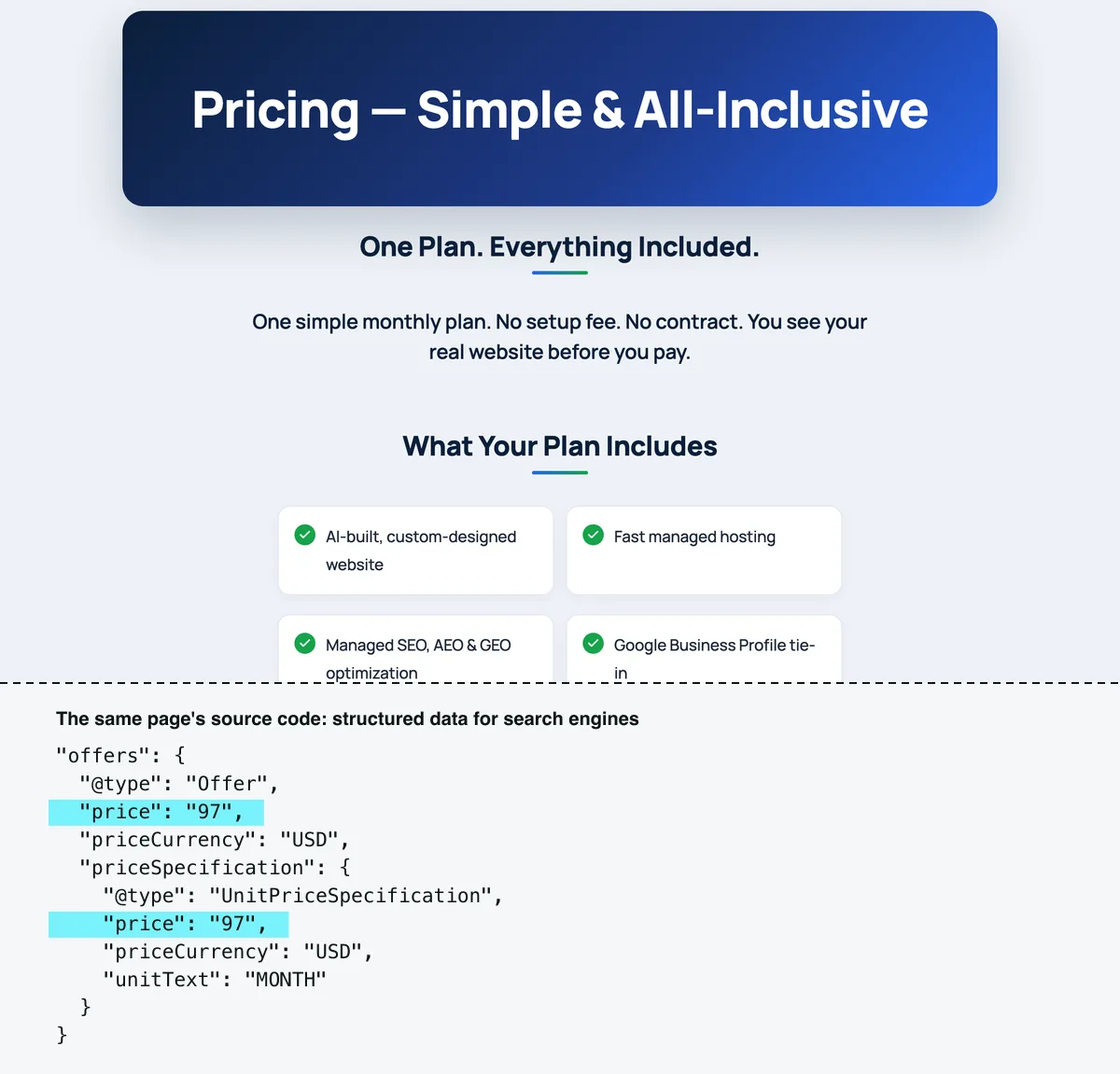
We count that as a published price, because the seller published it, and we flag it because a buyer should know the figure exists before the sales call. The structured data names the service a managed local business website, so the plan is the same one the company sells to other trades, with a dermatology page in front of it. That is not a fault at $97. It is a reason to ask what, exactly, is written for dermatology and what is shared with a plumber.
The 36-month view
Over three years, published dermatology website offers run from $358 to $26,964. Each bar adds the day-one fee to 36 payments of the stated monthly fee. Nothing in it is our estimate. The template bar leaves out Framer's hosting, since that is billed by a different company.
The chart makes one thing plain: in this market the monthly fee is the price. A $249 subscription adds up to $8,964 by month 36, above the middle tier of the estimator below. That is not an argument against subscriptions. It is an argument for knowing what the 36th payment buys that the 1st did not. The SEO add-ons are where the totals jump, and those are marketing, not a website, so compare them against search agencies rather than against a build. If your practice is mostly cosmetic, our med spa website cost breakdown covers the sellers that build for that side.
One estimator, three answers
If you search for this question, the pages that answer it come from a cost estimator, ProjectCostEstimator, and its figures do not agree with each other. Its dermatologist cost page says a freelancer build is $4,350 to $12,300 in one sentence and $4,350 to $12,350 in the next, and gives the agency range as both $10,850 and $10,900 at the low end. Its June 2026 article on dermatology practice websites gives $4,500 to $9,500 for a solo dermatologist, then prices a standard small practice, feature by feature, at $11,000 to $15,500 with a freelancer and $22,000 to $32,000 with an agency.
None of this makes the estimator useless. Its feature list is a decent checklist, and it is honest about who it is: the page carries quote tools for sale and partner links. But it shows why a range without a named seller behind it should not anchor your budget. Every bar in our three-year chart traces to a page where a company asks for that money.
Who is buying, and why the site has two jobs
The buyer is a specialist practice with real revenue and a split personality. The Bureau of Labor Statistics counted 11,370 dermatologists in salaried jobs in May 2025, earning $323,530 a year on average, and that survey leaves out self-employed owners. Set against those numbers, even the top bar in our chart is a small line in a practice budget, which is exactly why the decision should turn on fit and terms, not on the cheapest monthly figure.
The medical side of the site exists because skin cancer is common and frightening. The American Academy of Dermatology estimates that one in five Americans will develop skin cancer in their lifetime and that about 9,500 people in the US are diagnosed every day. The American Cancer Society expects about 112,000 new melanomas and about 8,510 melanoma deaths in 2026. The person who lands on your skin cancer page may have just noticed a mole that changed. They want to know three things: do you take my insurance, how soon can I be seen, and how do I book.
The cosmetic side has a different reader with a different question: how much. That is why a dermatology site is harder than it looks. One template can hold both, but the pages need different jobs, different calls to action and, as the sections below show, different rules.
What 142 dermatology practice sites show
Almost every dermatology site sells cosmetic treatments, most take insurance, and very few say what anything costs. On 23 October 2026 we collected 175 private dermatology practice domains from search results in 16 US metros, from New York to Minneapolis, leaving out directories, hospital systems and med spas without a dermatologist. 142 sites could be read; 33 blocked automated reading, 24 of them with a 403 error. For each readable site we checked the homepage and up to six linked pages about booking, insurance, prices, cosmetic services and patient forms.
Three findings stand out. First, the double life is near universal: 125 of the 142 sites sell cosmetic treatments, and 51 of those also mention Medicare. One site, two very different readers. Second, the booking machinery is mostly one vendor. 62 sites link to ModMed's EMA patient tools, 43 link to Klara, a patient messaging tool, and 15 link to Zocdoc. Whatever you build has to hand off cleanly to the system your front desk already runs. Third, the gallery is common, at 76 sites, which makes the consent question below a practical one, not a theoretical one.
On the build side, 94 of the 142 sites run on WordPress, 8 on Squarespace, 7 on Tebra's PatientPop platform and 6 on Webflow. 39 sites credit the firm that made them, and the credits are scattered: 7 say "Powered by Tebra", Studio 3 Marketing built 3, Doctor Multimedia 2, and 27 other firms one site each. No firm dominates this market, which is part of why nobody publishes a dermatology price list.
The limits are real. We read plain HTML and ran no JavaScript, so booking widgets and pixels loaded by script or through a tag manager can be missed, which means the pixel count is a floor. The sample comes from search results, not a random draw. Two of the largest investor-backed groups, Forefront Dermatology and U.S. Dermatology Partners, blocked us and are not in it.
Cosmetic prices, and the notice almost nobody posts
Only 22 of 142 dermatology sites print their own price for anything, and only 6 carry a Good Faith Estimate notice. Of the 22, 13 price a treatment or procedure and 9 price only a visit, consultation or telehealth fee. We did not count retail skincare, deposits, no-show fees, gift cards or national averages.
Botox is where prices show up, and they cluster. Seven sites gave a per-unit Botox price, from $10 to $16 with a median of $12. Only three of those were standing list prices: The Perq Dermatology and Ringpfeil Advanced Dermatology at $16 a unit, and Mandel Dermatology at $15 a unit in Boulder. The other four were specials or "approximately". Ringpfeil's page goes furthest, with a full list of peels, lasers and fillers and a calculator that multiplies units by $16. Mandel calls its page upfront pricing and gives "starting at" figures, such as Botox from $450 per area and filler from $750 per syringe.
Publishing a price is a choice. Posting the Good Faith Estimate notice is not. Under the No Surprises Act rules, a provider must let uninsured and self-pay patients know they can get a good faith estimate, and the rule says that notice must be "prominently displayed" on the website and findable through a search engine, besides being posted in the office and where appointments are made (45 CFR 149.610(b)(1)(iii)). Cosmetic patients almost always pay out of pocket. 125 of the sites in our census sell cosmetic treatments, and 6 mention a Good Faith Estimate anywhere on the pages we read. We read at most seven pages per site, so a notice tucked deeper may exist, but "prominently displayed" is the standard, and a page we could not find from the homepage and the pricing links is hard to call prominent. This is not legal advice; ask your own counsel how the rule applies to your services.
Rachel Abuav, MD, a Los Angeles practice, shows how little it takes. Its pricing page lists a $425 new patient appointment, $125 to $300 for a shave removal or biopsy on the body and $95 per pathology specimen, and the same page explains the patient's right to a Good Faith Estimate. Any website seller you hire should know where this notice goes without being asked.
Before-and-after photos and reviews
A before-and-after gallery is the most persuasive page on a cosmetic site and the one with the most rules attached. Under HIPAA, full face photographs and comparable images are among the 18 identifiers that make health information identifiable (45 CFR 164.514). Using a patient's protected health information for marketing needs that patient's written authorization, with narrow exceptions such as a face-to-face conversation (45 CFR 164.508(a)(3)). So the gallery is not a design question first. It is a consent process: a signed authorization for each photo, a record of where it is used, and a way to take it down if the patient changes their mind.
Reviews carry their own rule. The FTC's 2024 review rule (16 CFR part 465) makes it an unfair or deceptive practice for a business to write, create or sell a review that misrepresents whether the reviewer exists, whether they used the service, or what their experience was. It also covers buying reviews. A website seller that offers to "seed" your testimonials page is offering you a federal problem; our guide to the FTC rules on website testimonials covers the rest.
Ask any seller how its gallery handles consent and removal, and whether testimonials on the site come from a feed of real reviews or from text someone typed in. The cost estimator above prices a consent-handled gallery at $500 to $1,500 extra. Whatever the number, it belongs in the quote, not in a change order later.
Ads for Botox, and the tracking on the pages they land on
Google changed its rules for prescription drug terms in US ads in late 2025, which matters to any practice that sells Botox. Under the update Google began enforcing on 29 October 2025, advertisers targeting the United States may use prescription drug terms in ads and landing pages for promotion, in line with local laws, without certification. Keyword targeting those terms still requires certification. In practice, your Botox landing page can now say Botox in an ad, but bidding on the word is a separate permission. A web team that builds your landing pages should know which is which.
The other half is what the landing page sends back. In our census, 15 of the 142 sites had a Meta pixel in their plain HTML, 9 of them on sites that also mention Mohs surgery or Medicare, and 122 ran Google Analytics or Google Tag Manager, through which more tags can load unseen. A pixel on a cosmetic pricing page is ordinary marketing. The same pixel on a skin cancer page, a patient portal link or an intake form can send health information to an ad platform, and that is where HIPAA and state privacy law start to bite. Our HIPAA-compliant website guide goes deeper; the short version is to ask for a written list of every tag on the site and which pages each one fires on, and keep ad trackers off anything a patient fills in.
Questions to ask any dermatology website seller
Use this list on every seller, including us. A good seller answers each in one sentence and does not need a call to find out.
| Ask this | What a straight answer includes | The dermatology reason |
|---|---|---|
| Is there a minimum term, and what does leaving cost? | A number of months and a dollar figure, in writing | A $249 plan with a 12-month minimum is a $2,988 commitment |
| When we part ways, which files and accounts come with us? | The domain, the copy, the photos and an export of the site | Condition pages and galleries take years to build up; losing them resets your search traffic |
| Which pages are written for dermatology, and which are shared with other trades? | A list of condition, procedure and Mohs pages written for your practice | A generic local-business plan with a dermatology homepage is not the same product |
| How do medical and cosmetic visitors reach different booking paths? | Separate calls to action, and booking tied to your scheduling system | A Medicare patient with a changing mole and a self-pay Botox client need different first steps |
| Where does the Good Faith Estimate notice go? | A named page, findable in search, linked from every cosmetic price | Federal rules require the notice to be prominent on your website |
| How does the gallery handle consent and removal? | A signed authorization per photo and a takedown process | Full-face photos are identifiers under HIPAA |
| Which scripts and pixels go on the site, page by page? | A written tag map, with ad pixels kept off forms and medical pages | Pixels on health pages can send patient data to ad platforms |
| Who updates prices and providers, and how fast? | Your staff, the same day, without a ticket | Per-unit prices and provider rosters change often, and a stale price is a complaint waiting to happen |
Where KhanWork fits, and when a $59 template is the smarter buy
A solo dermatologist opening a first office should not hire us. The $59 Curette template with its $299 setup, or a $97 to $249 managed plan, will get you found and booked, and the difference is better spent on a second exam room. If what you want is search rankings, compare the SEO retainers against each other, because that is what they are.
KhanWork publishes its own numbers on the pricing page. There are three tiers, all monthly, paid in advance, with no minimum and a pause button: Foundation $1,000, Growth $2,500, Scale $5,000. Foundation is a brand cleanup and a single landing page whose job is bookings, typically the page behind your Botox or laser campaign; it is live 14 business days from the day we have your content and assets, and one new page is added every month after that. A full medical and cosmetic site is Growth territory. Hosting sits outside every tier. Run Foundation for 36 months and you have spent $36,000, which tops the highest bar in our chart, so nobody should pick us to save money. The reason to pick us is speed and testing: pages go up quickly and keep getting measured against bookings.
We are a fit for a practice that already pays for ads or runs a cosmetic line that underperforms, where visitors read a price page and then leave without booking. That work is laid out on our healthcare industry page and in our conversion optimization service. You own what we make, including the domain, the copy and the design files. To try us at no cost, tell us which page gets most of your traffic; our free funnel review of it names the first test we would run.
The two-door test
Before you pay anyone, walk into your own site twice, on a phone, with five minutes each time.
- The medical door. You are 61, on Medicare, and a mole on your shoulder has changed shape. From your homepage, can you tell in under a minute whether the practice takes Medicare, how soon a new patient skin check is available, and how to book one without calling? Does the skin cancer page say what happens at the visit?
- The cosmetic door. You are 36 and pricing Botox before a wedding. Can you find what one unit costs, or at least a typical range, who does the injecting and their credentials, real before-and-after photos, and a way to book a consultation tonight? Is there a Good Faith Estimate notice where the prices are?
Note every place each visitor stalls. Most fixes are a sentence, a price, a booking link or one page, not a new website. Make those first. If bookings still lag, that is when the three-year totals above are worth putting side by side.
Frequently asked questions
A dermatology practice website costs about $358 to $27,000 over three years at the prices sellers publish. A $59 Framer template with a $299 setup is the floor, managed plans for dermatologists run $97 to $249 a month, and plans with monthly SEO bundled in reach $499 to $749 a month. Custom agency builds are rarely priced in public. Every figure was checked on 23 October 2026 on a page the seller controls.
Publishing a per-unit Botox price or a typical range is worth considering, because cosmetic patients shop on price. Across the 142 dermatology sites we read, only 22 printed their own price for anything, and the seven per-unit Botox prices we found ran from $10 to $16, with a median of $12. A clear price page stands out in a market where most say nothing.
Yes, if the practice sees uninsured or self-pay patients, which includes nearly every cosmetic patient. Federal rules at 45 CFR 149.610 say the notice that a good faith estimate is available must be prominently displayed on the provider's website and easily searchable. Only 6 of the 142 dermatology sites we read mentioned a Good Faith Estimate on the pages we checked. Ask your counsel how the rule applies to your services.
Yes, with written patient authorization for each photo. HIPAA treats full face photographs and comparable images as identifiers, and using protected health information for marketing requires the patient's authorization under 45 CFR 164.508. Keep the signed form, a record of where each photo appears, and a way to remove it if the patient withdraws consent.
A $59 template can be enough for a solo dermatologist opening a first office. Curette, a Framer template built for dermatology practices, costs $59, its maker sets it up for a fixed $299, and you pay Framer for hosting and make edits yourself. Larger practices with separate medical and cosmetic booking paths, several providers and a gallery usually outgrow it.
Yes, in the United States, under a Google Ads policy update enforced from 29 October 2025. Advertisers may now use prescription drug terms such as Botox in ads and on landing pages for promotion, in line with local laws, without certification. Keyword targeting those terms still requires Google certification, so check which one your campaign needs before launch.
A dermatology website needs separate paths for medical and cosmetic patients: condition pages such as skin cancer and Mohs surgery with insurance and booking details, cosmetic treatment pages with prices or ranges, provider pages with board certification, a consented before-and-after gallery, a Good Faith Estimate notice and a booking link into your scheduling system.
 Healthcare
Oct 22, 2026 · 17 min
How Much Should an Eating Disorder Treatment Center Website Cost in 2026?
We turned every published price we could find into a three-year total, then read 35 eating disorder program websites to see what families find when they go looking: insurance, levels of care, prices and the pages nobody builds.
 Healthcare
Oct 21, 2026 · 17 min
How Much Should an Orthodontist Website Cost in 2026?
We turned every orthodontic website price we could find into a three-year total, then read 123 orthodontic practice sites to see who built them, what they charge patients, and how they advertise payment plans.
 Healthcare
Oct 19, 2026 · 17 min
How Much Should a Psychiatry Practice Website Cost in 2026?
We turned every published psychiatry website price we could find into a three-year total, then read 181 psychiatry practice sites for fees, telehealth, the Good Faith Estimate and ad pixels.