How Much Should a Plastic Surgery Practice Website Cost in 2026?

Oct 24, 2026 · 17 min read
A plastic surgery website has one job that most medical websites never face: it has to sell a decision worth five figures to a stranger who has been reading about it for months, mostly at night, mostly on a phone. The surgeon fee alone for a facelift averages $11,395 by the American Society of Plastic Surgeons' own figure, before anesthesia and the operating room. Against that, the cost of the website looks small. The trouble is that almost nobody who builds these sites will tell you what it is.
So on 24 October 2026 we did two things. First, we collected every seller of plastic surgery websites that prints a price on a page it controls, and turned each one into a three-year total. Second, we worked through 202 independent plastic surgery practice websites, spread across sixteen American cities, to see what the money buys: who prints prices, who charges for a consultation, who built the site, and which ones load an advertising pixel on the homepage.
The 30-second answer: plastic surgery website prices
A plastic surgery practice website costs from about $500 to $40,000 to build at the prices sellers publish, and from about $500 to $192,000 over three years once the monthly marketing those same sellers sell alongside it is added. Founder-led firms print builds from $500 to $8,500. Specialist aesthetic agencies quote $10,000 to $30,000 or $10,000 to $40,000 for the build, then $1,000 to $4,500 a month. Of the eight firms most often credited in practice website footers, only one prints a number. Each figure comes from a page the seller controls, checked on 24 October 2026.
The useful question is not the build price. It is how many booked surgeries the site needs to return to pay for three years of it. Measured in ASPS average surgeon fees of $4,875 for breast augmentation, a $2,200 site costs less than one patient's fee. A $192,000 commitment costs about forty.
Six sellers that print a number
Six companies that sell websites to plastic surgeons show a price on their own pages. Our rule was simple: the number had to be on the seller's own site. A range quoted in somebody else's comparison article did not count, and neither did the budget menu on an inquiry form.
| Seller | Build price, as printed | Monthly, as printed | Terms worth reading |
|---|---|---|---|
| Sprout Sage Solutions (founder-led) | Website from $500; landing page from $300 | SEO and local search $1,500 flat | No contract on anything; says specialist aesthetic agencies charge an estimated $3,000 to $10,000 a month |
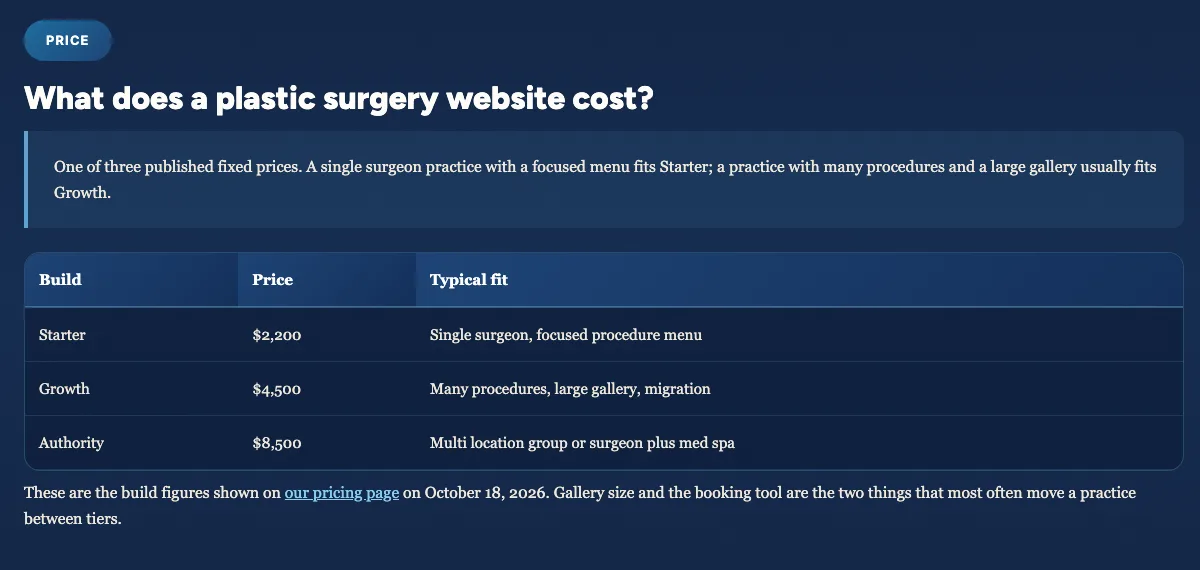
| Portland Peak SEO (Lake Oswego, Oregon) | $2,200, $4,500 or $8,500, fixed in writing | Optional SEO at $450, $950 or $2,500 | Practice owns the code; month to month; states that none of its published clients is a plastic surgery practice or med spa |
| Sagapixel | Kit site from $2,600; custom site from $4,200 | Not printed | WordPress; kit live in 4 to 8 weeks, custom in 8 to 12 |
| Ad Zombies | From $10,000; most single-location practices $10,000 to $18,000 | Managed hosting from $197, optional | You own the code, content and domain; multi-location and multi-surgeon practices run higher |
| Rosemont Media | Custom packages typically $10,000 to $40,000 | Its own 2026 cost guide budgets $1,000 to $2,000 or more for ongoing marketing | The range is printed on its plastic surgery website design service page |
| Sector45 | Packages typically $10,000 to $30,000 | Search marketing $1,750 to $4,500 per site | No long-term contracts; its before and after gallery sells separately at $500 setup plus $99 a month on a 6-month minimum |
Two things jump out. Printed builds run from $500 to $40,000, an eightyfold spread, and the low end is not all template products. Portland Peak's three tiers are hand-coded fixed-price builds, and the firm says plainly on the same page that it has not yet built a plastic surgery site. That candor deserves credit, and it is also exactly the question every buyer should ask every seller.
The specialist agencies price differently. Rosemont Media and Sector45 both publish a wide band rather than a menu, and both say the final number comes after a scoping conversation. Sector45 adds a promise worth noting: if a site takes longer than quoted it absorbs the cost, and if it takes less, the client gets a refund check. A band of $10,000 to $40,000 is not a price you can budget against, but it does tell you which end of the market you are shopping in.
Thirty-six months, priced honestly
Over three years, the same printed offers run from $500 to $192,000. Each bar below adds a seller's build price to 36 months of the monthly service that seller itself prices. Where a seller prints a range, we show both ends. Nothing in the chart is our estimate.
Be fair to the top of the chart. The Rosemont and Sector45 monthly figures pay for search marketing, content and ad management, not for keeping the website alive. A practice can buy the build and skip the retainer. But as the chart shows, wherever a seller prices both, the retainer is where most of the three-year money goes, and the build quote is the smaller half of the conversation. Ask for both numbers in writing before you compare anyone.
The bottom of the chart has a different catch. A $2,200 or $2,600 build is a real option for a surgeon opening a first office, and it leaves hosting, photography and copy to you. Before and after photography, in particular, is the most expensive content on a plastic surgery site, and none of these prices include taking it.
What the cost estimators say
Third-party estimators land in the middle of the published range and should be read as opinions. ProjectCostEstimator, which says it bases its figures on more than 600 project quotes, puts a US plastic surgeon website at $5,800 to $17,400 with a freelancer and $14,500 to $40,600 with an agency, with a median around $11,600. It adds that a large managed gallery costs $1,000 to $3,000 more than a basic image display. Its separate cosmetic surgeon page gives $5,800 to $15,950 for a freelancer, a different top for what is, from the outside, the same job.
Those bands are reasonable. They are not quotes, and no estimator can see your procedure list, your gallery or how many locations you run.
What one booked surgery is worth
Demand is growing, which is part of why the agency end of the market prices the way it does. ASPS counted 1,523,330 cosmetic surgical procedures in 2025, up 7 percent on the year, in its 2025 report released on 1 September 2026. Breast augmentation rose 11 percent to 304,234, facelifts 13 percent to 77,933, and eyelid surgery 19 percent to 118,978. Liposuction, at 317,196, was the most common procedure. Patients aged 66 and older showed the largest rise of any age group, 24 percent.
One caution if you compare years. The 2025 report lists 2024 at 1,425,390 procedures, while the 2024 release had put the year at 1,585,878. ASPS now blends member data, a complications insurer's records and a national claims dataset covering more than 3,000 board-certified plastic surgeons, so compare years only inside a single report.
The fees are the other half. ASPS publishes average surgeon fees of $4,875 for breast augmentation with implants, $8,174 for a tummy tuck and $11,395 for a facelift, each excluding anesthesia and facility costs. That is why a seller can charge $3,000 a month and still be cheap for a busy practice, and why it is ruinous for a quiet one. The math only works if the site produces consultations that turn into surgery dates.
What 202 practice sites show
The typical plastic surgery website already does the basics: a phone number you can tap, a gallery, the words board certified, and some way to request a consultation. Where sites differ is on the things patients actually shop on, price and the cost of the first visit. Few practices print either.
Here is how we counted. We searched for plastic surgery practices in sixteen cities, among them Seattle, Miami, Nashville and Minneapolis, and kept 221 independent practice domains, leaving out directories, hospital systems and multi-location chains. We fetched each homepage and up to seven linked pages about pricing, financing, galleries, consultations and contact. 202 sites returned readable pages. Prices and fees were classified by hand, reading each snippet, and national averages quoted on a practice page were not counted as the practice's own price. Because we read a sample of pages per site, every count is a floor.
A few numbers deserve a second look. 187 sites say board certified somewhere, but only 87 name the American Board of Plastic Surgery on the pages we read, and three name the American Board of Cosmetic Surgery. A patient comparing two surgeons who both say board certified cannot tell from that phrase alone which board certified them. Naming the board costs one sentence.
Financing is everywhere: 130 sites name a lender such as CareCredit, Cherry, PatientFi or Alphaeon. 110 link to RealSelf, the review and Q&A site where patients compare surgeons and prices. 77 offer a virtual consultation, which matters for practices that draw patients from out of town. And 29 load Meta's advertising pixel on the homepage, a choice that has consequences we come to below.
Who builds these sites
Plastic surgery is a specialist's market for web work. 78 of the 202 sites carry a footer link to one of 13 named healthcare or aesthetic marketing firms, and one firm alone, Studio III Marketing, is credited on 24 of them. Rosemont Media appears on 9, MyAdvice on 8, MRKT Made on 7, Plastic Surgery Studios on 6, Aesthetic Brand Marketing on 5, and Incredible Marketing and GrowthMed on 4 each.
Of those eight, Rosemont Media is the only one whose plastic surgery design page prints a price, the $10,000 to $40,000 range in the table above. We checked each of the other seven firms' homepages, plus Studio III's website design page, and found no website price anywhere. Their work may be very good, and several of these practice sites are. It does mean that a surgeon asking what the most common choice costs will hear the number on a sales call, not before it.
If you are talking to one of these firms, the census gives you a fair request: ask for the names of three practices in your size bracket, then look at what those sites print. Do they name the board? Do they show a price or a range? Does the booking flow work on a phone? A specialist's portfolio is the best evidence of what you will get.
Price pages and consultation fees
Only 25 of the 202 practices print their own surgery prices, as a from-price, a range or a fixed fee. Those that do are worth studying. One Houston practice prints a full body and face menu, tummy tuck $8,500 and mini tummy tuck $5,000. A Boston surgeon lists face surgery from $40,000, for a deep plane neck lift, up to $80,000 for full facial rejuvenation. A Philadelphia practice states its own breast augmentation range of $10,500 to $11,730, right next to the ASPS national average, so a reader can see exactly where the practice sits.
We think that is a missed opportunity. A price or a range answers the first question they have, and it filters out people who would otherwise book a consultation and walk away at the quote. Four more practices print only a monthly payment for a procedure, and five advertise a dollars-off special. Neither tells a patient what surgery will cost.
Consultation fees are more common than prices, and just as unevenly disclosed. 22 practices print a fee or deposit for the first visit, from $75 for a virtual consultation to $500 for an in-person one, with a median of $150. Nine of the 22 say the fee is credited toward surgery. 18 sites advertise a free or complimentary consultation instead.
Whichever policy you choose, the website is where it has to be stated, before the booking form, not on the confirmation call. A patient who learns about a $200 fee after filling in a form is a patient who may not show up.
The gallery rules your agency signs
The ASPS publishes a one-page agreement for exactly this situation: Advertisers Guidelines for Compliance with ASPS Code of Ethics. A member surgeon hands it to the advertising, marketing or website company they hire, and both sign. It lists what the member's advertising may not do, with examples, and it is the most practical document in this whole subject.
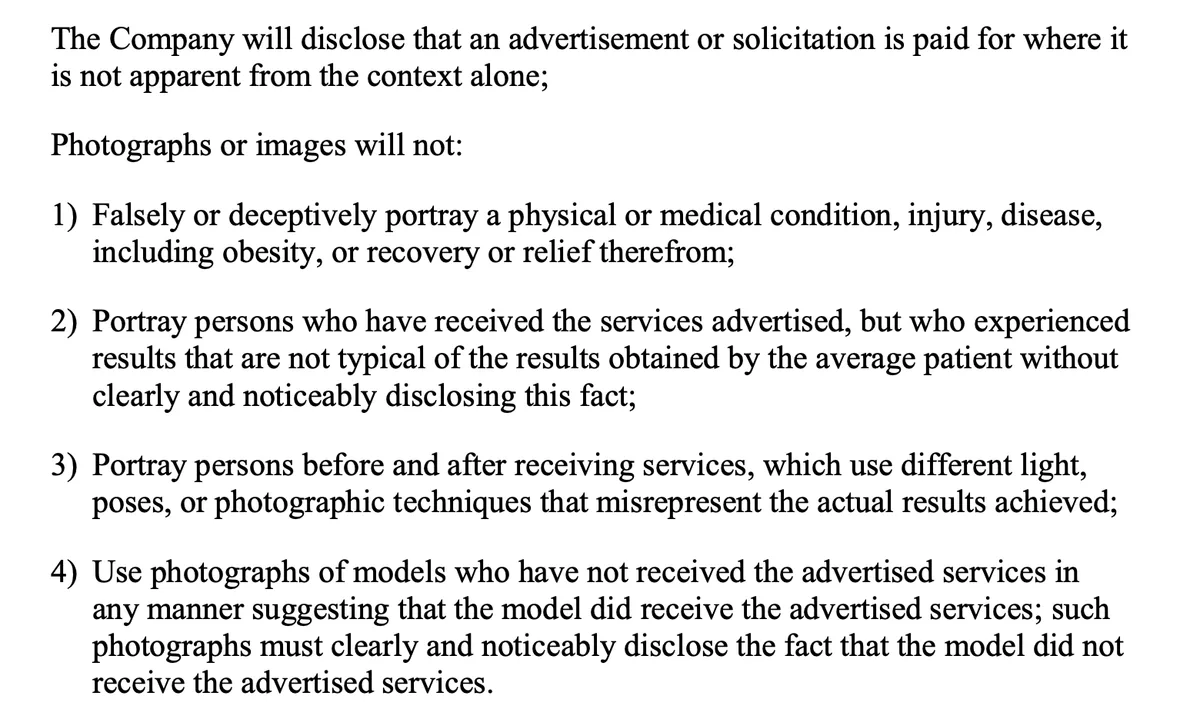
Read the photo section with your gallery open. Same light and same pose before and after. A clear note on any result that is not typical. A disclosure on any stock model who did not have the procedure, which covers a lot of hero images on aesthetic websites. The same document lists claims to avoid, among them calling a surgeon the best or the number one surgeon in a city, and it requires the company to submit all advertising to the surgeon before it goes out.
The ASPS code of ethics FAQ makes the stakes plain: members must approve every advertisement, keep a record of it for one year, and are held personally responsible for violations by any advertising firm they retain. So the question for a web company is simple. Will you sign the form? A firm that builds plastic surgery sites for a living should have no trouble with it.
Then there is privacy. Under the HIPAA de-identification rule, full face photographic images are listed as identifiers, and using patient information for marketing requires the patient's written authorization. A gallery needs a signed authorization behind every face, a way to find it, and a way to take a photo down when a patient changes their mind.
Pixels on surgical pages
29 of the 202 practices load Meta's advertising pixel on the homepage. For a practice that advertises on Instagram, that is a deliberate trade, and there is nothing wrong with measuring ads. The risk is in where the pixel fires. A pixel on a consultation form or on a page about a specific procedure can tell an ad platform that a named visitor is considering surgery, which is the kind of disclosure the authorization rule above is about.
Ask your web company for a written list of every script on the site, page by page, and keep ad pixels off forms and procedure pages unless your counsel has signed off. Where the lines fall, rule by rule, is covered in our HIPAA website article.
Questions to ask any web company before you sign
The cheapest firm and the most expensive one should both be able to answer these in writing. Silence on any of them is a cost you will pay later.
| The question | What to hear back | The plastic surgery reason |
|---|---|---|
| Which plastic surgery sites have you built? | Three named live sites, ideally in your size bracket | The census shows a specialist market; at least one low-cost seller says plainly it has none yet |
| Will you sign the ASPS advertisers guidelines form? | Yes, before work starts | ASPS members are personally responsible for their agency's advertising |
| What is the build price, and what is the monthly price, separately? | Two numbers in writing, plus any minimum term | Over three years the monthly service is often larger than the build |
| Who takes and processes the before and after photos? | A named process for same light, same pose, and consent on file | Mismatched photos breach the ASPS photo rules; full-face photos are HIPAA identifiers |
| Where will prices, ranges or the consultation fee appear? | On procedure pages and before the booking form | Only 25 of 202 practices print prices, so a clear range stands out |
| Which scripts run on which pages? | A written tag map with no ad pixels on forms or procedure pages | 29 of 202 homepages load the Meta pixel |
| If we leave, what do we take with us? | The domain, code, copy, photos and gallery data | A gallery built over years is the hardest asset to replace |
| How fast does a new procedure page go live? | Days, with your staff able to edit text without a ticket | New procedures, like the lift and fat grafting growth ASPS reported, need pages while demand is rising |
Where KhanWork fits, and when to pick a cheaper build
A surgeon opening a first practice with one or two procedures is better off elsewhere. A $2,200 fixed build or a $2,600 kit, with money saved for good photography, will serve you better. If you mainly want rankings, compare the search retainers above on deliverables, because that is the product you are buying.
Every KhanWork price is printed on our pricing page. Three monthly plans: Foundation at $1,000, Growth at $2,500, Scale at $5,000. Billing runs a month ahead, nothing locks you in, and a plan can be paused or ended at any point. Foundation covers a cleanup of your brand and a single consultation page, typically the one your breast augmentation or facelift ads point to. Launch comes 14 business days from the day your photos, copy and logins reach us, or the following month costs nothing, and after launch we add a page every month. The whole website, procedure library and gallery included, is Growth. Hosting is billed separately in every tier. Three years on Foundation totals $36,000: above every build-only bar in the chart, below the cheapest agency bar that includes marketing.
We fit a practice that already spends on ads or has a procedure line that should be booking more, where the problem is the page and not the traffic. That is conversion work: pages shipped quickly, then tested against consultations booked. Everything we make, including the domain, design files and copy, belongs to you. Our healthcare practice page explains the approach, and the free funnel review reads whichever page gets your ad clicks and names one change worth testing first. For a related price comparison, see what a med spa website costs.
The Saturday-night stopwatch test
Before you spend anything, time your own site the way a patient meets it. Use a phone, not the office computer, and start a stopwatch.
- Search. Search your top procedure and your city. Tap your own result. Stop the clock when the page has finished loading and note the time.
- Price. From that page, find what the procedure costs, or at least a range or a from-price. Count the taps. If you never get there, write that down.
- Proof. Find three before and after cases for that procedure. Check that each pair matches in light and pose, and that the surgeon is named with the board that certified them.
- First visit. Find out whether the consultation is free, what it costs if not, and whether a virtual one exists.
- Book. Request a consultation for next week. Stop the clock when you have a confirmed time or a clear promise of a call back.
Then do the same on the sites of the two practices that outrank you. If yours took longer, hid the price or failed at the booking step, you have found where the money should go. Usually it is a page or two, not a new website. If every step is fine and consultations still lag, that is when comparing the seller totals above, row by row, earns its time.
Frequently asked questions
A plastic surgery practice website costs about $500 to $40,000 to build at the prices sellers publish. Founder-led firms print builds from $500 to $8,500, and specialist aesthetic agencies quote $10,000 to $30,000 or $10,000 to $40,000. Over three years, adding the monthly marketing the same sellers price, totals run from about $500 to $192,000. All of it comes from sellers' own sites, checked 24 October 2026.
Plastic surgery websites cost more mainly because of galleries, procedure depth and the marketing sold with them. A large before and after gallery needs consistent photography, consent records and categories, and one estimator says a managed gallery adds $1,000 to $3,000. Agencies also price against what one extra surgery is worth: ASPS puts the average surgeon fee for a facelift at $11,395.
Publishing a price, a range or a from-price is worth doing for most cosmetic procedures, because it answers the patient's first question. In our reading of 202 practice websites, only 25 printed their own surgery prices. A clear range also filters out consultations that end at the quote.
Many do, though they do not always say so on the website. Of 202 practice sites we read, 22 printed a consultation fee or deposit, from $75 for a virtual visit to $500, with a median of $150, and nine of them say it is credited toward surgery. 18 advertised a free consultation.
For ASPS members, before and after photos must not use different light, poses or techniques that misrepresent results, untypical results must be disclosed, and models who did not have the procedure must be labeled. Those rules come from the ASPS advertisers guidelines that a member's web company signs. Under HIPAA, full face photos are identifiers, so each one needs the patient's written authorization.
Specialist aesthetic marketing firms build a large share of them. On 78 of 202 practice sites we read, the footer credits one of 13 named firms, led by Studio III Marketing on 24 sites, Rosemont Media on 9 and MyAdvice on 8. Of the eight most credited firms, only Rosemont Media prints a website price, $10,000 to $40,000.
A low-cost build can be enough for a new solo practice with a short procedure list. Published fixed builds start at $2,200 and kit sites at $2,600. Spend the difference on professional before and after photography and a clear consultation booking path, and ask any low-cost firm which plastic surgery sites it has already built.
 Healthcare
Oct 25, 2026 · 17 min
How Much Should a Dental Implant Practice Website Cost in 2026?
General dental sellers print implant-ready websites from $1,997, and implant marketing programs run $750 to $9,000 a month. We priced both over three years and read 192 implant practice sites.
 Healthcare
Oct 23, 2026 · 16 min
How Much Should a Dermatology Practice Website Cost in 2026?
Four sellers print a dermatology website price, one of them only in its page code. We turned each into a three-year total, then read 142 dermatology practice sites for prices, booking, galleries and the Good Faith Estimate notice.
 Healthcare
Oct 22, 2026 · 17 min
How Much Should an Eating Disorder Treatment Center Website Cost in 2026?
We turned every published price we could find into a three-year total, then read 35 eating disorder program websites to see what families find when they go looking: insurance, levels of care, prices and the pages nobody builds.