How Much Should an Urgent Care Website Cost in 2026?

Oct 31, 2026 · 16 min read
An urgent care website is read by someone who is already in the car, or about to be. A parent with a feverish kid, a contractor with a cut hand, a traveler with an ear infection. They are not comparing philosophies of care. They want four answers before they pull out of the driveway: are you open, do you take my insurance, what will it cost without insurance, and how long will I sit in the lobby.
So the price of the website is really the price of answering those four questions quickly, on a phone, for a business that lives on walk-ins. On 31 October 2026 we tackled the question from two directions. We collected every website offer aimed at urgent care centers that carries a price on the seller's own page, then totalled each one over 36 months. And we read the websites of 164 urgent care centers across 18 US metro areas, independents, regional chains and hospital-run clinics, to see how many actually answer those four questions.
The 30-second answer: urgent care website cost
An urgent care website costs about $199 to $1,897 a month if you rent it from one of the sellers that print urgent care prices, which works out to $7,164 to $68,292 over three years. Buying a site outright instead is estimated at $5,100 to $13,800 from a freelancer and $11,600 to $33,350 from an agency, plus $80 to $350 a month to run it. Search marketing from a large agency starts at $2,900 a month on top. The cheapest offers are subscriptions, and at least one of them does not hand over the site if you cancel, so read the ownership line before the price. Whatever you pay, the site has to show hours, insurance, a self-pay price and a way to check in.
Who prints a price for urgent care websites
Three firms put a monthly price on an urgent care website in public, and one large agency prints a floor for urgent care search work. The rule for inclusion: a price counts only if the seller prints it as its own fee, on its own site. A budget menu on a contact form is not a price, and neither is a "most clinics spend" average.
| Seller | What is sold | Published price | The line to read twice |
|---|---|---|---|
| GMR Web Team | Urgent care website design and hosting | Starting at $199 a month | Says you own 100% of the site after "a nominal fee or monthly payments", without printing how many payments; quotes 4 to 6 weeks to launch; paid ads from $300 or 15% of spend, whichever is higher |
| alwaysdobetter | A hand-built urgent care site with hosting and an AI question tool | $249 a month; $597 a month with SEO | Month to month, says the site and domain are always yours, and takes one urgent care per market |
| Creative Marketing AI | A custom website bundled into a marketing plan with an AI receptionist | $297, $397, $597, $997 or $1,897 a month | If you cancel you keep your domain, images and files, "but the site itself is not exported" |
| WebFX | Search marketing for urgent care centers | Custom SEO plans from $2,900 a month | SEO only; the website is priced separately on another page |
Plenty of other agencies have urgent care pages: Lifted Logic, Funnel Boost Media and Healthcare Success among them. None of the three prints a fee for its own urgent care work on those pages, so they are not in the table. That is not a judgment of their work, only of what a buyer can learn before a sales call.
Three years of a subscription website
Every urgent care-specific price we found is a monthly fee, so the honest way to compare them is to run each one for three years, the horizon we use in every cost guide on this site because it is long enough to show what a small monthly fee really adds up to. At the low end that is roughly $7,000. At the top of one seller's range it is close to $70,000.
The bars hide the real difference between these offers, which is not the fee but what you are left holding when you stop paying it. alwaysdobetter says the site and domain are always yours. GMR Web Team says the site becomes yours after payments, but does not print the number of payments. Creative Marketing AI is the clearest of the three, and the clarity cuts the other way: the plans include the website, and its pricing page says that if you cancel, you keep your domain and your files but not the site.
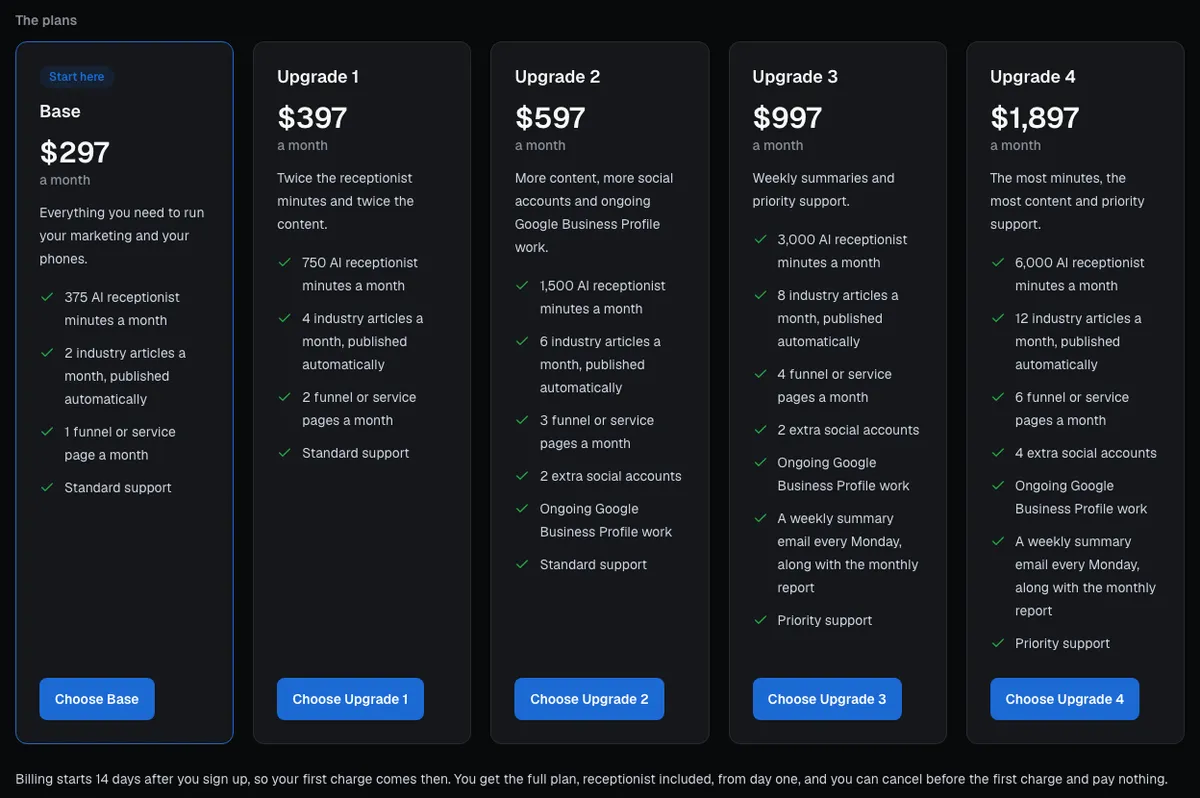
Nothing about that is hidden; it is printed on the page. It is simply the kind of line a clinic owner skims past when the monthly number looks small. Renting a website is a reasonable choice for a new clinic that wants to open in a month and conserve cash. Renting one you cannot take with you means the switching cost of leaving is a full rebuild, and that cost tends to arrive at exactly the moment you are unhappy with the vendor. Before signing, read who actually owns a website you paid for, which lists what to get in writing.
What a one-time build costs instead
If you would rather buy the site once, expect an estimated $5,100 to $13,800 from a freelancer or $11,600 to $33,350 from an agency in the US, going by the only published estimate built around urgent care. None of the urgent care sellers above prints a one-time build price, so this is the number a clinic has to work from.
Two details on that estimate page are worth more than its headline. First, it puts the median urgent care site with online check-in, wait times, insurance information and hours for several locations at about $9,400, and a typical timeline at 6 to 14 weeks. Second, it names the check-in and wait-time platform, such as Solv or Clockwise.MD, as the biggest recurring cost at an estimated $150 to $300 a month. We could not confirm that range from either vendor, because neither prints its software pricing. Get a written quote per location before you budget.
Add the running costs to the build and three years of an owned site lands somewhere between about $8,000 and $46,000: the low end is the cheapest freelancer build plus $80 a month, the high end is the top agency build plus $350 a month. That overlaps almost exactly with the subscription chart. The money is similar. What differs is who owns the thing at month 37.
When the website comes with search marketing
Search marketing is where the urgent care bill actually grows. WebFX's urgent care page starts custom SEO plans at $2,900 a month, which is $104,400 over three years before the site, the ads or the check-in software. alwaysdobetter's SEO tier is $597 a month, and its own page puts healthcare local SEO in general at $500 to $2,500 a month. GMR Web Team prices paid ad management from $300 or 15% of spend, whichever is higher.
That spread is not a sign that one of them is overcharging. A single clinic in a suburb with two competitors does not need what a ten-location group in a large metro needs. The useful question is simpler: how many "urgent care near me" searches in your area end on your Google Business Profile or your website, and how many of those turn into a check-in. If nobody can show you that number today, start by measuring it, not by buying a retainer. Our guide to local SEO for service businesses walks through the basics.
Who is searching for urgent care
More than one person in four in the US used an urgent care center in the past year, and for younger adults it is often the only doctor they have. The CDC's National Center for Health Statistics published both numbers in 2026, from its 2024 National Health Interview Survey.
- 27.6% of people had at least one urgent care visit in the past 12 months, according to NCHS Data Brief No. 562 (May 2026).
- Use was 28.5% for children, 28.9% for adults aged 18 to 64 and 21.9% for adults 65 and older.
- Among working-age adults, use was higher in large fringe metro areas (31.5%) and medium and small metros (30.6%) than in large central cities (26.6%) or nonmetro areas (26.1%).
- 8.6% of adults named an urgent care center or a retail clinic as their usual source of care, according to NCHS Data Brief No. 558 (April 2026). That share was 12.2% for adults aged 18 to 34 and 3.8% for those 65 and older.
Two things follow for the website. The suburbs are where urgent care is used most, so the person searching is likely to be driving, which means the phone screen is the whole site. And for one adult in eight under 35, an urgent care center is where they go instead of a family doctor. Those patients come back, and they judge you partly on whether the site makes the next visit easier. A website built only for the first emergency visit leaves that return business to the clinic down the road.
What 164 urgent care websites show
We asked a research assistant to collect urgent care websites from search results in 18 metros, spanning New York, Los Angeles, Kansas City and Salt Lake City among others. It returned 226 domains: 110 independent clinics, 50 chains and 66 hospital systems. We crawled each homepage and as many as six linked pages about pricing, insurance, check-in or locations. 164 sites were readable; the rest blocked automated visits or returned almost nothing. Our crawler reads the HTML a server sends and does not run scripts, so anything a site loads afterwards, like a live wait clock, is invisible to it. Treat the counts as a floor.
Most sites get the basics right. 121 put a tappable phone number on the homepage, 93 show hours there, and 79 mention X-ray on the homepage, which matters because "do you have an X-ray" is one of the questions that decides between urgent care and the emergency room. 89 run on WordPress, which means most clinics could fix what is below in an afternoon, without a rebuild.
The gaps are in the four questions from the top of this article. Only 59 offer online check-in or a save-my-spot link we could see. 57 mention wait times somewhere on the homepage, but only one site showed a minute count in its HTML, and that was a hospital's emergency room clock, not an urgent care. If your check-in widget renders wait times with a script, Google and AI assistants may never see them either, which is worth knowing before you pay for the widget partly for its search value.
Insurance is answered better than price. 70 sites name a commercial insurer such as Aetna, Cigna or Blue Cross, and 69 name Medicaid. 94 mention self-pay or uninsured patients. But only 39 print what an uninsured visit actually costs. Among those 39, the advertised base visit price ran from $50 to $260 for in-clinic care, with a median of $149 across the 32 that print a single in-clinic figure. That is a useful number in its own right if you are setting your own self-pay rate.

The self-pay price and the Good Faith Estimate line
If you treat self-pay patients, federal law already tells your website to say something about cost. The No Surprises Act regulation at 45 CFR 149.610 requires providers to tell every uninsured or self-pay patient that an advance Good Faith Estimate of charges is theirs for the asking. It is specific about where that message goes: somewhere prominent on the provider's site, findable through an ordinary web search, and also in the office. A patient who asks for an estimate is owed one within three business days.
Our crawl found the phrase "Good Faith Estimate" on 11 of the 164 sites, and nine of those 11 were hospital systems or large multi-specialty and orthopedic groups with compliance departments. Of the 39 clinics brave enough to print a self-pay visit price, only two also mentioned the Good Faith Estimate. Our crawl only reached a handful of pages per site, so some clinics may carry the notice deeper in their footer or forms. Even so, the pattern is clear: the clinics that are most open about price are, on this evidence, the least likely to show the notice that goes with it. That is a 20-minute fix, and it belongs on the same page as the price.
A note on scope: we are a web design agency, not your lawyers. Whether a given clinic is a "convening provider" for a given service is a question for counsel. We can say this much: a self-pay price page without the notice beside it is an easy thing for a regulator, or a competitor, to point at.
The 2027 accessibility deadline
Clinics that receive federal health funding, including through Medicaid, face a dated accessibility rule. Under the HHS Section 504 regulation at 45 CFR 84.84, organizations receiving HHS financial assistance must bring their websites and mobile apps into conformance with WCAG 2.1, at Levels A and AA. The deadline is now 11 May 2027 if the organization has 15 or more employees, and 10 May 2028 if it has fewer. Both dates are a year later than the rule first set: HHS moved them in an interim final rule that appeared in the Federal Register on 11 May 2026.
69 of the clinics in our crawl name Medicaid on their site, which is a reasonable sign that the rule may reach them, and only 34 of all 164 link from the homepage to an accessibility page. A link is not compliance, and the lack of one is not a violation. But WCAG work is far cheaper when it is part of a build than when it is retrofitted after a demand letter, so it belongs in the scope of any website you buy in the next 18 months. Ask the seller, in writing, whether the site will be tested against WCAG 2.1 AA and how. Our ADA website compliance guide covers what a real test looks like.
What runs in the background
20 homepages in our crawl load the Meta pixel, the advertising tag that reports page visits back to Facebook. On a homepage that is a normal marketing choice. On a check-in flow or a page about a particular condition, it can become a health privacy question, because the combination of who visited and what they looked at starts to look like health information. Before launch, ask your developer for a written list of every third-party script on the site, and keep advertising tags off check-in, intake and condition pages unless a signed business associate agreement covers the vendor. Our guide to HIPAA and websites goes deeper.
Questions to ask any urgent care web seller
This is the decision aid. Ask every seller the same questions, compare the answers in writing, and use the right-hand column to see how common the gap is.
| Ask | A good answer | In our crawl of 164 |
|---|---|---|
| If I stop paying, what do I keep? | The domain, the site files, the content and the design source, handed over with no exit fee | One of three urgent care subscription sellers says the site is not exported |
| Where will patients check in, and will search engines see the wait time? | A named check-in tool, its monthly fee, and whether wait times appear in the page HTML | 59 offer check-in we could see; 1 showed a minute count in HTML |
| Where will the self-pay price go, and the Good Faith Estimate notice beside it? | One page, linked from the homepage, with the visit price and the notice together | 39 print a visit price; 11 mention the notice |
| Which insurers, and Medicaid, will be listed, and who updates the list? | A named list on the site and a named person on your staff who owns it | 70 name a commercial insurer; 69 name Medicaid |
| Will the site be tested against WCAG 2.1 AA, and how? | A named tool plus manual keyboard and screen reader checks, with a report | 34 link to an accessibility page from the homepage |
| Which third-party scripts will run on check-in and intake pages? | A written list, with no advertising pixels on those pages unless a BAA covers them | 20 load the Meta pixel on the homepage |
| How will each location's hours, holidays and closures stay accurate? | One source that feeds the site and your Google Business Profile, edited by your staff | 93 show hours on the homepage |
| What does it cost after launch, per month, in total? | Hosting, check-in software, maintenance and marketing, itemized, with no minimum term | Not visible from outside |
Where KhanWork fits, and when to skip us
Skip us if you are a single clinic that is busy, your site already shows hours, insurance and a check-in button, and your self-pay price is printed. Spend an afternoon adding the Good Faith Estimate notice and an accessibility page, and save the money. Skip us too if you are part of a hospital system with its own web team: the bottleneck there is usually approvals, not design.
For everyone else, here is where we sit, with figures that also appear on our pricing page. The Foundation tier is paid once. $1,000 buys a brand refresh plus one landing page, which for an urgent care is usually the self-pay and insurance page or the landing page behind your ads; it goes live in 14 business days, counted from the day your content and logins arrive. $2,500 buys the whole site, with no page limit, live in 21 business days. If you want us to stay on after launch, Growth costs $2,500 a month and works through one request at once; Scale costs $5,000 a month and runs two at the same time, the usual fit for multi-location groups. Both are billed a month in advance, have no minimum term and can be paused or cancelled whenever you like. We never bill for hosting; the account stays in your name. Over three years Growth is $90,000, which makes it the wrong choice for a clinic that only needs a site, and the right one for a group that wants a team adding location pages, testing the check-in path and fixing what the data shows each month.
Everything we build belongs to you from the first day, including the code, the domain and the design files. If your clinic gets traffic but not check-ins, that is a conversion problem and it is where we do our best work. Our healthcare practice page covers how we take on clinic work. The best first step costs nothing: the free funnel review starts with the page visitors arrive on, usually the homepage, and names the one change most likely to move check-ins. If you run a specialty practice, compare these numbers with what a physical therapy website or a med spa website costs.
The parking-lot test
Try this before you pay anyone. Go out to your car, phone in hand, and pretend your child just spiked a fever on a Sunday afternoon. Do not use your office Wi-Fi or your own bookmarks.
- Search. Type "urgent care near me" and find your clinic. Start a timer when you tap through.
- Open. Can you tell, on the first screen, whether you are open right now and until when?
- Covered. Can you find your insurer, or Medicaid, in two taps or fewer?
- Price. If you had no insurance, could you find what the visit costs, and the Good Faith Estimate notice next to it?
- Line. Can you check in or hold a spot without calling?
- Drive. Can you tap once to get directions to the nearest location?
Stop the timer. If all six took under a minute, your website is not your problem, and the prices above are mostly a question of convenience. If you got stuck on two or more, run the same test on the two clinics that outrank you. Whoever passes it faster is getting the patients you are paying to attract.
Frequently asked questions
Sellers that print urgent care prices charge $199 to $1,897 a month, which is $7,164 to $68,292 over three years. Buying a site outright is estimated at $5,100 to $13,800 from a freelancer or $11,600 to $33,350 from an agency, plus about $80 to $350 a month to run it.
Over three years the ranges overlap: $7,164 to $68,292 rented at published prices, or about $8,000 to $46,000 for an owned site with running costs. The difference is ownership: at least one urgent care subscription seller says it does not export the site if you cancel, so leaving means a rebuild.
Hours for each location, the insurers and Medicaid plans you accept, a self-pay visit price with the Good Faith Estimate notice beside it, online check-in, directions and a tappable phone number. In our crawl of 164 urgent care sites, only 39 printed their own visit price.
In most cases, yes, if they see uninsured or self-pay patients. 45 CFR 149.610 requires providers to tell those patients they can get a Good Faith Estimate, with a prominent notice on the website and another in the office. Have counsel confirm how it applies to each service you offer.
It can, if the clinic receives HHS financial assistance, such as through Medicaid. The Section 504 rule requires WCAG 2.1 AA by 11 May 2027 for organizations with 15 or more staff, and by 10 May 2028 for smaller ones; HHS extended both dates by a year in May 2026.
Neither Solv nor Clockwise.MD prints its software pricing. One published estimate puts check-in and wait-time platforms at $150 to $300 a month. Ask each vendor for a written quote per location.
Published prices start at $597 a month from alwaysdobetter and $2,900 a month for custom plans from WebFX. Measure how many local searches already reach your Google Business Profile and website before buying a retainer.
 Healthcare
Oct 30, 2026 · 17 min
How Much Should a Trauma and PTSD Treatment Center Website Cost in 2026?
Treatment center web firms print builds from $3,500 to $25,000, and the one agency with pages written for PTSD prints no fee. We priced each offer over three years and read 142 trauma program websites.
 Healthcare
Oct 29, 2026 · 16 min
How Much Should a Pediatric Dental Practice Website Cost in 2026?
Dental website sellers print builds from $1,997, and three sellers price pediatric marketing at $249 to $8,000 a month. We priced three years of each and read 178 pediatric dental practice sites.
 Healthcare
Oct 25, 2026 · 17 min
How Much Should a Dental Implant Practice Website Cost in 2026?
General dental sellers print implant-ready websites from $1,997, and implant marketing programs run $750 to $9,000 a month. We priced both over three years and read 192 implant practice sites.