How Much Should a Home Health Agency Website Cost in 2026?

Nov 1, 2026 · 17 min read
Two very different people end up on a home health agency's website. One is a daughter who just heard the words "your mother can go home tomorrow, with home health." The other is a hospital case manager with a discharge list, a fax machine and about four minutes per patient. Behind both of them stands a third reader the agency needs just as badly: the nurse or aide deciding where to apply this week.
So when an agency owner asks what a website should cost, the honest answer depends on which of those three readers the site has to win. On 1 November 2026 we came at the question three ways. We collected every website offer for home health and home care agencies that prints a price on the seller's own page and totalled each over three years. We pulled the federal data that defines the market: MedPAC's March 2026 report to Congress and CMS's October 2026 file of every Medicare-certified agency. And we read 156 agency websites across 16 US metro areas to see what they actually show those three readers.
The 30-second answer: home health agency website cost
A home health agency website costs $249 to $2,497 as a one-time build from the small sellers that print home care prices, $4,350 to $12,350 from a freelancer and $10,150 to $29,000 from an agency, according to one estimator's published ranges. Rented sites run $249 to $1,750 a month, which is $8,964 to $63,000 over three years, and specialist SEO adds $950 to $4,000 a month. The low end buys pages; the money should go to the three jobs that bring revenue: a referral path for discharge planners, a careers page that turns visitors into applicants, and proof of quality, including your CMS star rating. Expect to own the site outright unless the contract says otherwise.
Home health or home care: two different websites
Start by deciding which business your site describes, because the words that sell one can mislead people about the other. Medicare-certified home health is skilled care: nursing, therapy and aide visits ordered by a clinician. Medicare.gov lists the conditions plainly. The patient has to be homebound, a provider has to see them in person and confirm the need, and the care has to come from a Medicare-certified agency. If those conditions are met, the page says the patient pays nothing for covered home health services.
Non-medical home care is the other business: companionship, bathing, meals, overnight help, usually paid privately or through long-term care insurance, Medicaid waivers or veterans' benefits. Many agencies run both under one brand. That is fine, but the website then has to keep the two apart, because a family reading "Medicare covers it" on a page about companion care will call expecting free help and hang up angry.
In our census, 87 of the 156 sites described skilled or skilled-plus-private services and 64 described non-medical care only. Their buyers differ, and so does what the site has to carry:
- Skilled home health lives on referrals. Most patients arrive from a hospital, a physician office or a skilled nursing facility, so the site has to make referring easy and make quality visible.
- Non-medical home care lives on families searching at night. The site has to explain services in plain words, answer "what does it cost," and book a free assessment.
- Both live or die on staffing. An agency that cannot hire cannot accept the referral it just won.
Who prints a price for home health websites
Seven sellers put a price on a home care or home health website, or on search work for these agencies, on their own pages. The rule we used: a number made our list only if the seller publishes it, on its own site, as its own fee. A "most agencies spend" average does not count, and neither does a quote form.
| Seller | What is sold | Published price | Worth knowing |
|---|---|---|---|
| SaltQuill | Home care agency site | $249, $449 (Custom), $849 (Elite) | Builds a working preview before you pay; one price, agreed before work starts |
| HomeCareConsulting.us | Home care site plus care plan | $299 Starter, $549 Complete Essentials; maintenance $299 a month | Starter is up to 5 pages; Essentials up to 10 |
| Brazzell Marketing Agency | Home care, home health and hospice sites | Custom from $519; standard package $699 for the first year | Also offers a template site free with $118.99 a year of hosting and domain |
| HomeCareWebs | Home care site, build only | $1,497, $1,897, $2,497 | Prices exclude hosting, domain and monthly maintenance; copywriting is a $497 add-on |
| alwaysdobetter | Rented site, then SEO, then CRM | $249, $597, from $1,750 a month; custom build $5,000 to $25,000 | Month to month, you own the site and domain, one agency per market |
| Sagapixel | Home care SEO | $950 to $4,000 a month | No long-term contracts; no published web design price for home care |
| TL Web Design (Cleveland) | General small-business site with a home care page | $475 Starter, from $950 Growth | No deposit, no retainer, optional hosting $239.40 a year |
Two things stand out. First, everyone printing a price is small. The agencies that market heavily to home health operators, the ones whose names show up in footer credits, mostly quote on a call. Second, the cheap end is truly cheap. A $249 to $849 home care site is a template with your logo, and for a brand-new private-duty agency that may be exactly right.
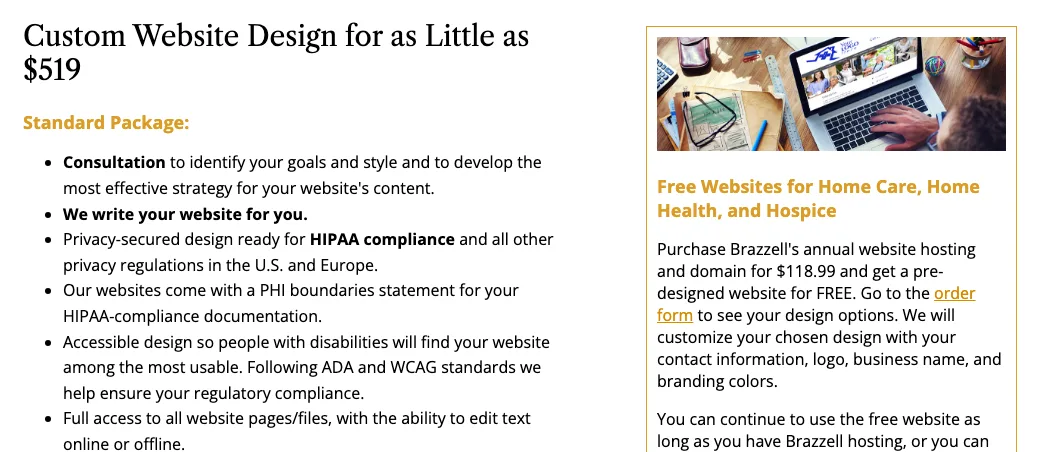
That second offer is a pattern worth recognizing. "Free website with hosting" is not a scam, but it ties the site to the host. Ask what happens to the files if you leave. Brazzell's page answers part of it: the free site stays yours to use only while Brazzell hosts it, and a custom site can be hosted anywhere.
Three years of each offer, added up
Monthly prices look small and one-time prices look final, so the only fair comparison is a total over the same period. We used 36 months, the useful life of most small-business sites before a redesign. The chart takes each seller's printed price and nothing else: no ad spend, no photography, no copywriting unless the price includes it.
The spread runs from under a thousand dollars to six figures, and the reason is not the website. Look at what changes as the bars grow: content, local search, review collection, a CRM. That is marketing labour, priced by the month. The site itself, the pages and the code, is the cheap part at every level.
The useful question is therefore not "which price is right" but "which bar matches the job." An agency with a full census and a waitlist of referrals does not need $4,000 a month of SEO. An agency in a crowded county trying to replace a hospital contract that went to a competitor may need every dollar of it.
What a one-time build buys
If you would rather own a finished site than rent one, the published estimates cluster in three bands. ProjectCostEstimator, which says its ranges draw on 600-plus quotes and rate benchmarks and was updated in July 2026, puts a US home health care site at $4,350, $8,350 or $12,350 from a freelancer and $10,150 to $29,000 from an agency, with a typical timeline of 5 to 12 weeks. It prices a careers section with an applicant tool at $800 to $2,500 and a HIPAA-safe assessment request form at $300 to $1,000 above a basic contact form. Running costs: $60 to $300 a month for hosting, tools and maintenance.
A guide from CareWebsites.com lands in the same territory with different labels: $2,500 to $5,000 for a basic site, $5,000 to $12,000 for a growth-focused one and $12,000 to $25,000 or more for an advanced lead and recruiting build. Treat both as estimates written by people who sell the work, which they are. They still agree on what moves the price up:
- Service-area pages. One page per county or city you cover, written for real, not one paragraph with the town name swapped.
- A careers section that collects applications. A job list that links to Indeed is cheap. An application that works on a phone and lands in your system is not.
- Forms that carry health information. A referral or assessment form that collects diagnoses needs a vendor who will sign a BAA (business associate agreement), which our post on HIPAA-compliant websites walks through.
- Separate paths for families and professionals. Two audiences, two navigation routes, two sets of calls to action.
The market your website competes in
The federal numbers explain why an agency website has to work harder in 2026 than it did five years ago. MedPAC's March 2026 report to Congress counts more than 12,000 agencies certified to participate in Medicare in 2024, serving about 2.7 million fee-for-service beneficiaries, with Medicare spending $16.0 billion on their care.
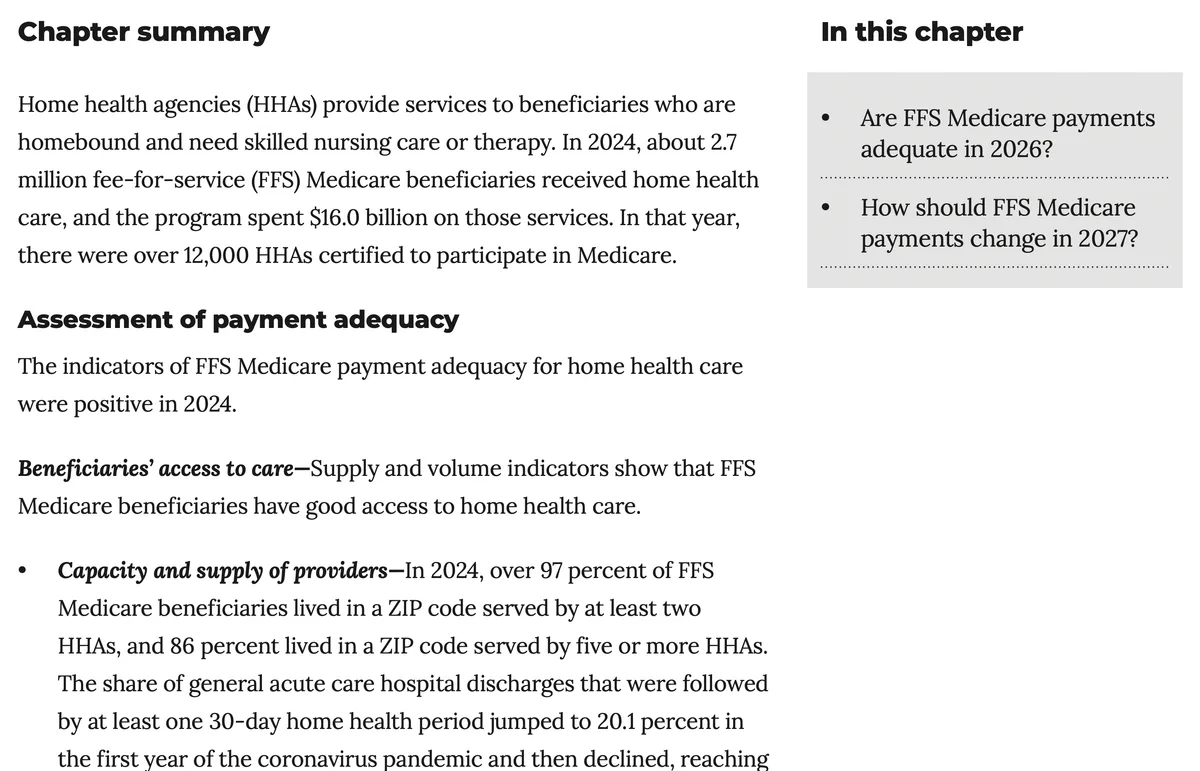
Read that last line again. Over 97 percent of beneficiaries lived in a ZIP code served by at least two agencies and 86 percent in one served by five or more. A discharge planner almost always has a choice, and a family handed a list of names will look each one up. Your website is one of five or more tabs open on someone's phone.
The supply is not growing everywhere. MedPAC found the number of certified agencies rose by more than 870 from 2019 to 2024, almost 8 percent, but the growth came entirely from California, where the count nearly doubled. Outside California, supply fell about 1 percent a year. CMS's own October 2026 provider file shows the same concentration: of 12,409 agencies listed, 3,196 are in California, 1,831 in Texas and 1,157 in Florida.
And the money is tightening. CMS's final payment rule for calendar year 2026, issued on 28 November 2025, cuts aggregate Medicare payments to agencies by an estimated 1.3 percent, about $220 million, against 2025. MedPAC went further and recommended that Congress cut the 2026 base rate by 7 percent for 2027, pointing to an average fee-for-service Medicare margin of 21.2 percent for freestanding agencies in 2024. Whether or not that recommendation becomes law, the direction is clear: per-episode revenue is under pressure, so the cost of each new referral and each new hire matters more. A website is one of the few marketing costs you pay once and keep.
The star rating families and planners check
Every Medicare-certified agency can be looked up on Care Compare, and CMS publishes two kinds of star ratings there: a Quality of Patient Care rating built from seven measures, and Patient Survey ratings built from the home health patient experience survey, first posted in January 2016. CMS updates both every quarter. Your stars exist whether your website mentions them or not, so the only decision is whether you frame them.
We downloaded the October 2026 provider file to see the spread. Of 12,409 agencies, 4,283 had no Quality of Patient Care rating, mostly because their patient count was too small to report. The other 8,126 are spread like this:
The median rated agency sits at 3.5 stars, and 2,823 agencies hold 4 stars or more. If you are one of them, that is the single most persuasive sentence your website can carry, because a discharge planner can verify it in thirty seconds. Yet in our census only 7 of 156 sites mentioned a CMS star rating or the patient survey at all, 5 stated their own Medicare star figure, and exactly one named Care Compare as the source with the month it was checked. That one, a skilled agency in Tampa, shows "4.5 out of 5 stars by Medicare," explains that every agency is scored on the same measures, and links to the full rating. It is the cheapest credibility upgrade on this list.
If your rating is low, do not hide from it with vague "five-star care" copy. Families and planners will see the real number on Care Compare. Say what you are changing, and let the next quarterly update do the talking.
Your website is also a hiring page
For most agencies the website's second job is recruiting, and for some it is the first. The Bureau of Labor Statistics counts 4,677,100 home health and personal care aide jobs in 2025, projects 18 percent growth from 2025 to 2035 and about 760,500 openings a year. The median wage was $17.21 an hour in May 2025. Every agency in your county is fishing in that same pond, often for the same people.
The census shows agencies know it: 122 of 156 sites put a careers or jobs link on the homepage. Fewer make applying easy. Only 24 linked an applicant tracking or scheduling platform where a candidate could actually apply, and just 5 printed a wage in a posting we could read. A caregiver comparing three agencies on a phone at the end of a shift will apply to the one that shows the pay and takes a short form, not the one that asks them to email a resume.
What a working careers section has:
- The roles you hire for, with pay ranges where your state allows or requires them.
- An application that takes under five minutes on a phone and does not demand a resume file.
- The facts candidates ask first: schedule flexibility, mileage, training, how soon they can start.
- A way to measure it. Count applications per month from the site, not visits to the careers page.
What 156 agency websites show
We searched for home health and home care agencies in 16 metro areas, from Phoenix and Dallas to Philadelphia and Seattle, and kept each agency's own site: 214 distinct domains. 156 returned a readable homepage. We read each homepage plus up to seven inner pages whose links mentioned careers, referrals, insurance, services, costs or contact, and counted what was there on 1 November 2026. The sample is mostly independent agencies (145), with 10 franchise locations and 1 hospital-run program.
Four findings are worth acting on.
Medicare wording is loose. Of the 87 skilled or mixed agencies, 75 mentioned Medicare, but only 40 used the words "Medicare-certified." That phrase is what a discharge planner scans for. If you are certified, say so in those exact words, near the top.
Families get no number. Private-pay home care is a priced service, yet only 3 of the 156 sites printed their own hourly rate, all three in San Diego: $40 to $44 an hour for regular shifts and $40 to $75 an hour for one to three hour visits. Three more quoted a regional market range instead of their own price. Most families searching "how much does home care cost" will call the agency that answered the question.
Accreditation is undersold. 30 sites named an accreditor such as ACHC, CHAP or The Joint Commission, 27 of them skilled agencies. Accreditation is costly to earn and easy to display.
Tracking deserves a second look. 19 homepages loaded Meta's advertising pixel, 13 of them non-medical agencies. A pixel on a page about services for people with dementia sends visit data to an ad platform. Before you add one, ask your website vendor and your compliance adviser what that page reveals and whether the vendor will sign a business associate agreement.
The page discharge planners use
For a skilled agency, the most valuable page on the site is one most families never see: the referral page. 60 of the 87 skilled or mixed agencies in our census offered a referral form, a fax number or a section for healthcare professionals somewhere on the site. The rest expect a case manager to call the main line and wait.
A referral page that earns its keep has five things, in this order:
- A direct intake phone number and fax, answered by a person during business hours.
- The counties and ZIP codes you accept, so nobody refers a patient you cannot serve.
- Services and specialty programs in clinical language: wound care, IV therapy, cardiac, orthopedic rehab.
- Insurance accepted, Medicare and named Medicare Advantage plans first.
- A secure referral form, built on a platform covered by a business associate agreement, with a promised response time.
Put your star rating and your accreditation on this page too. A planner choosing between five agencies is choosing on speed, coverage and quality, and this one page can answer all three.
Accessibility: a deadline, not a nicety
Your patients are older and more likely to have low vision or limited dexterity than almost any other audience on the web, which is reason enough to build for accessibility. There is also a rule. The Department of Health and Human Services' updated Section 504 regulation requires recipients of HHS federal financial assistance to make their websites conform to WCAG 2.1 Level AA, by 11 May 2027 if you employ 15 or more people, and by 10 May 2028 if you employ fewer. Ask your adviser whether your agency counts as a recipient; if it does, the clock is already running.
Only 20 of the 156 sites we read linked an accessibility statement or page from the homepage. Our guide to website accessibility rules covers what conformance involves; for this purchase, the practical point is simple. Write accessibility into the contract, ask for an audit report at launch, and do not pay extra for an overlay widget, which on its own does not make a site conform.
Questions to ask before you sign
Whatever you spend, these eight questions separate a site you own from a site you rent, and a site that works from one that only looks finished. The right-hand column shows how the 156 agencies in our census are doing on each point today.
| Ask the seller | Why it matters | Census: sites already doing it |
|---|---|---|
| If I cancel, what do I keep: domain, files, design? | "Free site with hosting" and monthly plans can tie the site to the vendor | Not visible from outside |
| Will you build a referral page with a secure form, and sign a BAA for it? | Discharge planners are the skilled agency's main source of patients | 82 of 156 show some referral path |
| How will my CMS star rating and accreditation appear, and who updates them each quarter? | Verifiable quality is the strongest proof you have | 7 cite a CMS rating; 30 name an accreditor |
| Can a caregiver apply on a phone in under five minutes? | Recruiting is the bottleneck for most agencies | 24 link an applicant platform |
| Will each county or city we serve get its own page? | Local search for "home health near me" rewards real service-area pages | Service areas listed on 88 |
| Does the site meet WCAG 2.1 AA, and will you show me the audit? | HHS's Section 504 deadline and an older audience | 20 link an accessibility page |
| Which tracking scripts will run, and on which pages? | Ad pixels on health pages can expose sensitive visits | 19 run a Meta pixel on the homepage |
| What will I pay in month 13, and in month 37? | The real cost of a monthly plan shows up in year three | You only learn this by asking |
Where KhanWork fits, and who should pass
Pass on us if you are opening a small private-duty agency this quarter. A $249 to $849 template from the sellers in the table will get you online, and your money is better spent on your first caregivers. The same goes for agencies inside a hospital system or a national franchise: a corporate team owns those pages, and the fix there is internal.
We are a fit for an independent agency, skilled or mixed, that already has referral sources and wants the site to win more of them, while filling the careers pipeline at the same time. Every figure below is also published on our pricing page. Foundation is a one-time build paid upfront: $1,000 for a landing page, live in 14 business days, or $2,500 for every page of the site, however many there are, live in 21 business days. Both clocks start once we have your copy, photos and logins. For an agency, the landing page is usually the referral page or the careers page. If you want a team after launch, Growth is $2,500 a month and Scale, for multi-location operators, is $5,000 a month. Both bill monthly in advance and can be paused or cancelled at any time; there is no minimum. We do not bill hosting. The code, the design files and the domain are yours from the first day.
Our healthcare industry page shows the kind of work we do for agencies and clinics, and if your site gets visits but not referrals or applicants, that is conversion work, which is where we are strongest. The no-cost first step is the free funnel review, in which we study the page most of your visitors land on first, usually the homepage, and name the one change most likely to bring in more calls. For comparison with other practices that live on local search, see what an urgent care website or a physical therapy website costs.
The discharge-planner test
Run this on your own site before you pay anyone, and then on two competitors. Imagine you are a hospital case manager. It is 3:40 on a Friday afternoon, a patient goes home tomorrow, and the family has picked your agency from a list. Use a phone, not your office computer.
- Find. Search your agency's name plus "home health." Start a timer when the site opens.
- Certified. Can you see the words "Medicare-certified" without scrolling?
- Coverage. Can you confirm, in two taps, that you serve the patient's ZIP code?
- Quality. Is your star rating or accreditation visible, with a source someone could check?
- Refer. Can you find an intake number, a fax and a referral form on one page?
- Human. Call the intake number. Does a person answer, or a menu?
Stop the timer. Under ninety seconds with a person on the line means your website is not what is costing you referrals. Stuck on two or more steps means the planner will call the next agency on the list, and the next agency is usually one tab away.
Frequently asked questions
Sellers that print home care prices charge $249 to $2,497 for a one-time template or small custom build, and one estimator puts a US home health site at $4,350 to $12,350 from a freelancer or $10,150 to $29,000 from an agency. Rented sites run $249 to $1,750 a month, which is $8,964 to $63,000 over three years.
Yes, because the buyers differ. A Medicare-certified home health agency gets most patients through referrals from hospitals and physicians, so its site needs a referral page and visible quality data. A non-medical home care agency sells to families paying privately, so its site needs plain service pages, a price or price range and an easy way to book an assessment.
If it is good, yes, with the source and the month you checked it. Families and discharge planners can look up any Medicare-certified agency on Care Compare, and CMS updates the ratings every quarter. In our census of 156 agency sites, only 7 mentioned a CMS star rating or the patient survey at all.
At minimum: a homepage that says Medicare-certified if you are, one page per service, one page per county or city you serve, a referral page for healthcare professionals with intake phone, fax and a secure form, a careers page with a short mobile application, insurance accepted, and an accessibility statement.
One estimator gives 5 to 12 weeks for a typical home health site, and template sellers advertise previews within days. Most of the delay is content: service descriptions, service areas, photos and the referral process have to come from the agency.
Many do. HHS's updated Section 504 rule requires recipients of HHS federal financial assistance to meet WCAG 2.1 Level AA by 11 May 2027 if they have 15 or more employees, and by 10 May 2028 if smaller. Ask your adviser whether your agency counts as a recipient.
Yes, and for many agencies that is its biggest job. BLS projects about 760,500 openings a year for home health and personal care aides. Show pay ranges, keep the application under five minutes on a phone, and count applications from the site each month.
You should, including the domain, the files and the design. Free sites bundled with hosting and some monthly plans tie the site to the vendor, so ask in writing what you keep if you cancel before you sign anything.
 Healthcare
Oct 31, 2026 · 16 min
How Much Should an Urgent Care Website Cost in 2026?
Urgent care web sellers print plans from $199 to $1,897 a month, and one does not hand over the site if you cancel. We priced three years of each and read 164 urgent care websites.
 Healthcare
Oct 30, 2026 · 17 min
How Much Should a Trauma and PTSD Treatment Center Website Cost in 2026?
Treatment center web firms print builds from $3,500 to $25,000, and the one agency with pages written for PTSD prints no fee. We priced each offer over three years and read 142 trauma program websites.
 Healthcare
Oct 29, 2026 · 16 min
How Much Should a Pediatric Dental Practice Website Cost in 2026?
Dental website sellers print builds from $1,997, and three sellers price pediatric marketing at $249 to $8,000 a month. We priced three years of each and read 178 pediatric dental practice sites.