How Much Should a Cosmetic Dentist Website Cost in 2026?

Nov 4, 2026 · 17 min read
A cosmetic dentist sells something nobody needs. Nobody wakes up with a toothache that only a veneer can fix. The patient chooses to spend money on a better smile, usually several thousand dollars of it, and the website is where most of that choosing happens: late at night, on a phone, scrolling through photos of strangers' teeth and trying to decide whether this practice is the one.
That changes what the website is worth and what it has to carry. A general practice site mostly answers practical questions. A cosmetic site has to make a case: these results, this dentist, this price, this way to pay. On 4 November 2026 we priced the case from both ends. First the sellers: any dental website or marketing offer that shows its own fee in public, totalled across thirty-six months. After that, the buyers' side: we read the websites of 245 independent cosmetic dentistry practices across 18 US metro areas to see what they show a patient, what they leave out, and which of the rules around before-and-after photos, specialty claims and financing ads they visibly follow.
The 30-second answer: cosmetic dentist website cost
From dental website sellers that publish their fees, a cosmetic practice site with upkeep costs about $5,200 to $9,000 over three years at the template end, and $11,459 to $40,595 over three years from a firm that bundles a custom build with monthly search work. Ongoing marketing programs aimed at dentists run $750 to $3,495 a month before ad spend, which is $27,000 to $125,820 across three years. A calculator site puts a typical dentist build at $3,650 to $10,150 with a freelancer and $8,700 to $26,100 with an agency. The cheaper sites are fine for showing work. What separates the expensive ones is whether they answer the price and payment question that most cosmetic sites still dodge.
Why a cosmetic practice site is a different purchase
The short version: a cosmetic website is a sales page for an elective, high-ticket, mostly self-paid procedure, so it carries more proof and more risk than a family dental site.
Three things make it different. The first is the gallery. Before-and-after photos are the product demonstration, and 190 of the 245 practice sites we read had one. Every photo in that gallery is a patient's face or mouth, which brings privacy law into the design brief. The second is price. Insurance rarely pays for veneers or whitening, so the patient is comparing totals across practices, and a site that hides the number sends the comparison elsewhere. The third is the credential race. Cosmetic dentistry is not a recognized dental specialty, yet practices compete hard on expertise, and the wording they use to describe it is regulated by their own professional code.
None of that is expensive to build. It is expensive to get wrong, and most of the price differences below come down to how much of it a seller handles for you.
Who prints a price for a cosmetic dental website
Six sellers aimed at dental practices print their own fees, and one of them publishes a page specifically for cosmetic dentists. We only list a firm when the figure is its own fee on its own website, checked on 4 November 2026. Agencies that build beautiful smile galleries but ask you to book a call for a number are left out, which is a comment on comparability, not quality.
| Seller | What is sold | Published price | The line to read twice |
|---|---|---|---|
| DocSites | Dental website templates in three tiers, hosted | $1,999, $2,999 or $3,999 setup, plus $89 a month | The monthly fee covers hosting plus updates on request capped at an hour; extra custom pages are $99 each. |
| alwaysdobetter | A hand-built practice site with an AI tool that answers inquiries, on a page written for cosmetic dentists | $249 a month; $597 with SEO; larger practices from $1,750 a month | Month to month, and the page says the practice owns everything. |
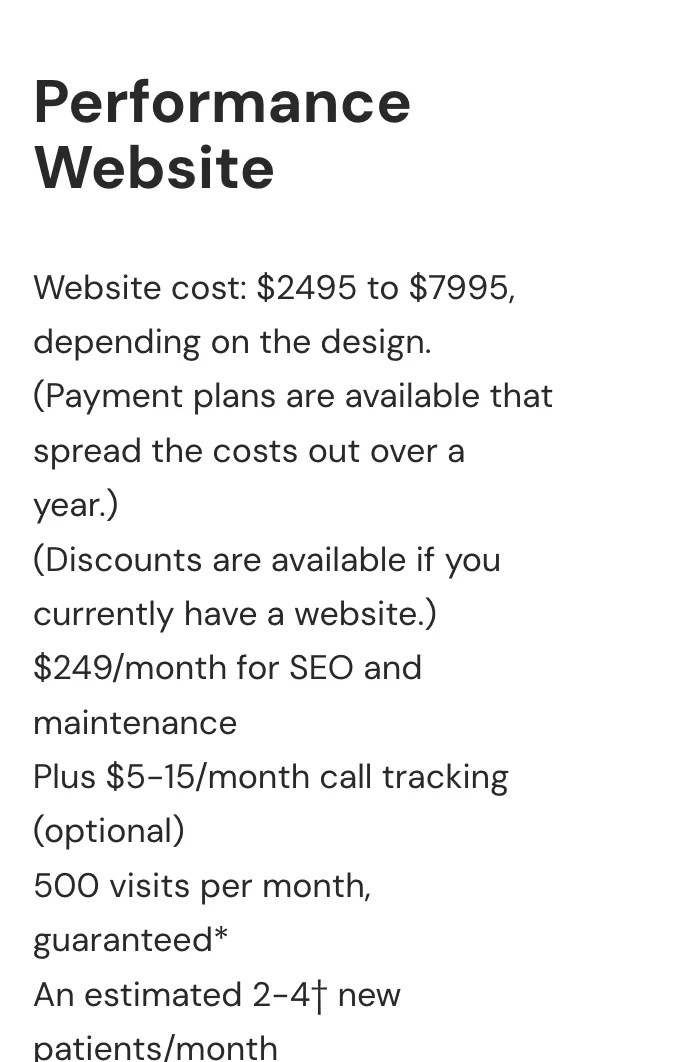
| Infinity Dental Web | Custom dental sites with search work in four tiers | Build $2,495 to $14,495 depending on tier and design, plus $249, $435, $580 or $725 a month | Each tier comes with a guaranteed monthly visit figure and a new-patient estimate; the visit guarantee is measured with a log-analysis tool it names. |
| Lasso MD | Marketing plans for practices, custom website included | $750, $1,250, $1,500 or $2,000 a month | A creative photo shoot is $3,000 extra and a video shoot $7,000. |
| DDSRank | Dental SEO and AI search programs | $1,495, $2,495 or $3,495 a month, with onboarding fees waived on six-month terms | The top program expects the practice to spend a further $1,500 or more each month on ads. |
| SEOteric | Website as a service plus marketing plans | Website from $249 a month; plans from $1,500, $3,000, $5,000 and $8,000 a month | Larger design changes are billed at $150 an hour. |
Two more sources are worth knowing, though neither sells you anything at those numbers. ProjectCostEstimator, which describes its ranges as drawn from more than 600 project quotes, gives $3,650 to $10,150 for a US dentist website with a freelancer and $8,700 to $26,100 with an agency, with a median near $6,900. Rosemont Media, an agency known for cosmetic dental work, writes that dental sites range from $3,500 to $30,000 and more, suggests a new practice budget $10,000 to $16,000, and puts one optimized page of 750 to 1,000 words at $400 to $1,200. Read both as what the market says it charges, useful for a sanity check and nothing stronger.
Three years of a website, side by side
Over three years, a cosmetic practice site from these published offers ranges from $5,203 for a template with hosting to at least $34,595 for a custom build with heavy monthly search work.
The gap is mostly not about the website. DocSites at $5,203 is a hosted template with an hour of edits a month. Infinity's tiers fold in search work, and the monthly fee is what climbs: $249 a month is $8,964 over three years before any build fee. So the useful question is not which build is cheapest. It is how much of the monthly fee buys ranking work you would otherwise buy from someone else, and whether the site itself would leave with you.
Ownership is worth asking about in writing. alwaysdobetter's cosmetic page says the practice owns everything. The other website sellers in our table do not say on the pages we read, which is a question for the contract rather than an accusation.
When the site comes inside a marketing program
Many cosmetic practices never buy a website on its own. They buy a marketing program that includes one, and those programs cost $27,000 to $125,820 over three years before a dollar of ad spend.
These are not comparable products. Lasso MD's plans include a custom website; DDSRank's programs are search and AI visibility work; SEOteric's plans are broader marketing with a separate website-as-a-service offer. What the chart does show is the scale of the commitment. A practice choosing between a $250 website and a $1,500 marketing plan is choosing between a $9,000 decision and a $54,000 one, and the second should come with tracking that proves which veneer cases it produced.
For cosmetic work that proof is unusually easy to define, because the cases are large and few. One smile makeover can be worth more than a month of any plan in that chart. Ask the seller how a booked consultation will be traced back to its source, and what happens to the fee if it cannot be.
What 245 cosmetic dentist websites show
The typical cosmetic practice site is strong on proof and booking and weak on price, credentials wording and the fine print around photos and financing.
Method, briefly: we searched "cosmetic dentist" and "veneers" in 18 metro areas and kept independent practices, dropping directories, national chains and dental service organizations. On 4 November 2026 a script read every homepage, then followed up to eight links per site that pointed at veneers, galleries, financing, prices or the dentists themselves. Of 287 domains, 245 could be read. Pattern matching found the signals, and we hand-checked the price, specialty and consent results. Anything a practice says on a page the script did not reach counts as missing, so treat every count as a floor.
Four findings stand out. Booking is solved: 236 sites offer some online booking or request path and 232 make the phone number tappable on the homepage. Proof is nearly universal: 190 run a before-and-after gallery and 108 offer some form of virtual smile preview. Financing is common: 159 name a patient financing company, CareCredit on 124 and Cherry on 75. And price is rare. Only 28 print their own per-tooth price for veneers, even though a veneer sentence with a dollar sign appears on 77 sites. Most of those 77 quote a city or national range, a financing teaser or the price of something else, which tells a patient what veneers cost in general and nothing about what they cost here.
The price question most sites dodge
Among the 28 practices that print their own per-tooth price for porcelain veneers, the lowest figure on each site has a median of $1,725, and 19 of the 28 fall between $1,000 and $1,999.
Seven more practices print a package price for a whole smile rather than a per-tooth number, and five of those seven are in the Miami area. That cluster is worth noticing. Where competitors publish a package, a practice with no number at all asks the patient to do extra work at exactly the moment another site has removed it.
There are good reasons a practice might not print a price. Cases vary, and a number can anchor a patient low. But the patient arrives with a number anyway. Of the 77 sites with a veneer dollar figure, 42 give neither their own per-tooth price nor a package price, and most of those quote a city or national average instead, so the patient has usually seen several averages before reaching yours. A site that gives the lowest figure a case starts at, what that covers, and how the final quote is built gives that shopper a reason to stay. A website build that can carry a price page is cheap. Deciding to publish one is the hard part, and no seller in the table above can make that decision for you.
Before-and-after photos: two federal rules
A before-and-after gallery is a set of patient testimonials in picture form, and it falls under the FTC's endorsement rules and, for most practices, under HIPAA's rules on marketing with patient information.
On the advertising side, the FTC's Guides on endorsements say that an ad showing a consumer's experience will likely be read as typical of what other consumers will achieve, so the advertiser needs substantiation for that, or must clearly disclose what results people can generally expect (16 CFR 255.2(b)). The same section's first example is blunt about disclaimers: a line telling readers not to expect similar results does not cure an ad that implies they will. So the "results may vary" footer is not a shield. We found that line, or a similar one, on 23 of the 245 sites, and on 19 of the 190 with galleries. Separately, the FTC's 2024 rule on consumer reviews and testimonials makes it unlawful to create or buy reviews or testimonials that misrepresent whether the person exists or what their experience was (16 CFR 465.2).
On the privacy side, HIPAA lists full-face photographs and comparable images among the identifiers that make information about a patient identifiable (45 CFR 164.514(b)(2)(i)(Q)), and it requires the patient's written authorization before a covered practice uses protected health information for marketing (45 CFR 164.508(a)(3)). A smile photo that shows a patient's face, published to win new patients, is the obvious case. Only 4 of the 245 sites say anywhere we read that their photos are used with patient permission. That does not mean the other 241 lack signed forms. It means a visitor cannot tell, and a regulator or an unhappy former patient will ask for the paperwork, not the website.
For the build, this means a gallery needs two things behind it that a template does not supply: a consent record for every image, kept where staff can find it, and copy near the photos that describes what the treatment usually achieves rather than a disclaimer that hopes for the best. Our longer guide to testimonial rules on websites covers the FTC side in more depth.
The word "specialist" and what the ADA Code says
Cosmetic dentistry is not one of the dental specialties recognized by the National Commission on Recognition of Dental Specialties and Certifying Boards, so the ADA's Code of Ethics expects general dentists offering it to avoid implying specialization and to say they are general dentists.
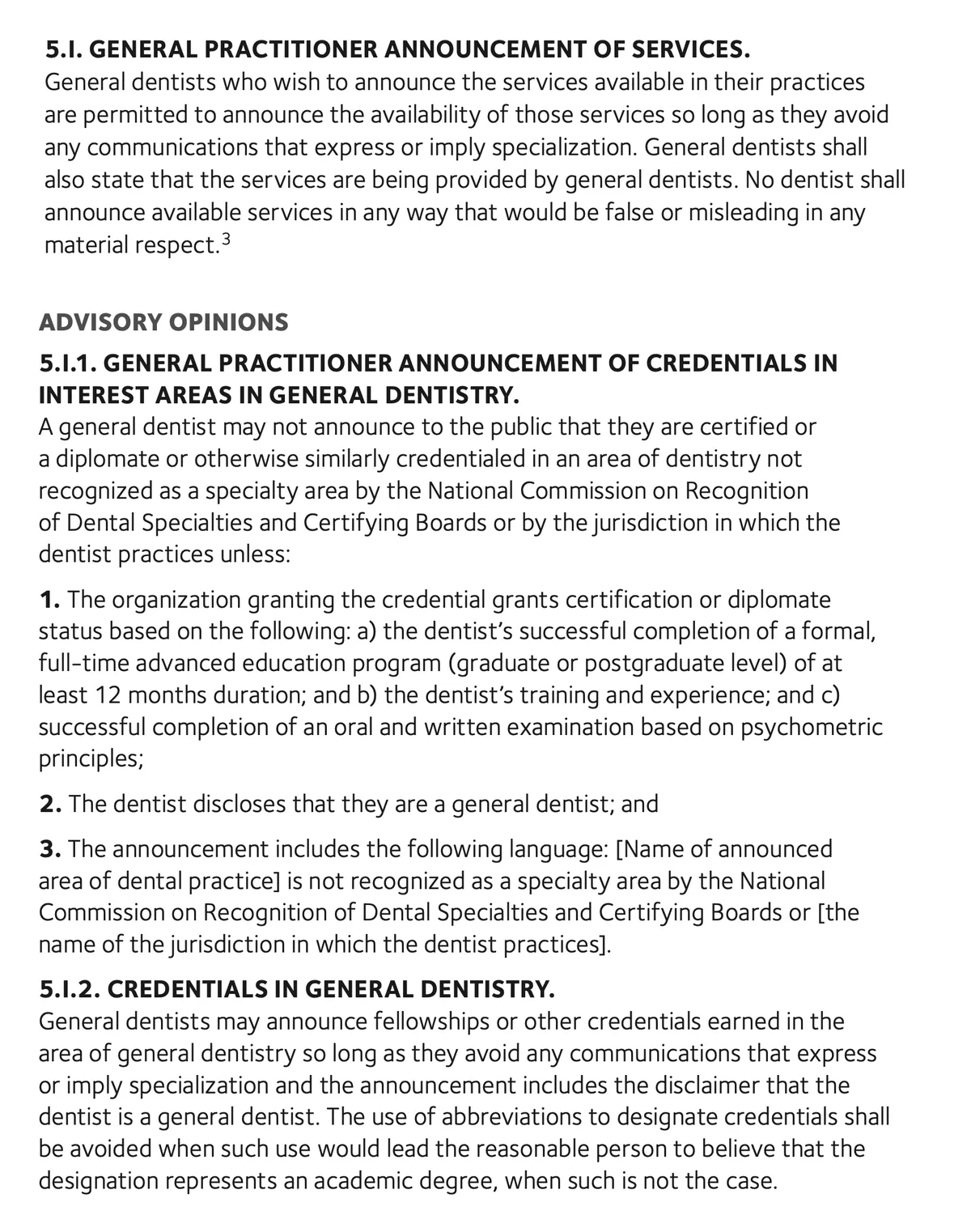
The commission's list has twelve specialties, from dental anesthesiology to prosthodontics. Cosmetic or esthetic dentistry is not among them. Section 5.I of the 2026 Code says general dentists may announce the services they offer but must avoid communications that express or imply specialization, and must make clear that a general dentist is the one providing them. Its advisory opinion 5.I.1 goes further for credentials: a general dentist announcing a certification or diplomate status in a non-specialty area must disclose being a general dentist and include a set sentence saying the area is not recognized as a specialty.
In our read, 5 practices describe their own dentists as cosmetic specialists or cosmetic dentistry specialists, and 1 prints the not-recognized-as-a-specialty sentence. Only ADA members are bound by the Code, and your state board may have its own advertising rules, so this is a question for your own counsel rather than for us. For the website, the practical point is cheap to act on: the copy describing your dentists is a compliance surface, and it should be reviewed by someone who knows the rule before launch, not rewritten by a copywriter chasing the word that converts.
The credential that most cosmetic dentists cite instead is the American Academy of Cosmetic Dentistry. 71 of the 245 sites mention the AACD and 9 say a dentist there holds its accreditation. The AACD describes accreditation as a written examination, two required workshops, a series of clinical cases and an oral examination of about two hours, completed inside a five-year window. That is a real, checkable achievement, and a site can explain it in full without calling anyone a specialist.
Financing pages and the payment-amount trigger
Printing a monthly payment is the most persuasive way to present a large cosmetic fee, and under the federal Truth in Lending rules a payment amount in an ad for credit triggers further disclosures.
Regulation Z lists the amount of any payment, the number of payments and the down payment among the triggering terms in credit advertising, and once an ad uses one, it has to add the down payment, the full repayment terms and the APR as well (12 CFR 1026.24(d)). In our read, 24 sites print a monthly payment figure and 5 of those also mention an APR anywhere we read. A dental office repeating a lender's teaser is not automatically the advertiser the rule has in mind, and whether it applies to a given page is a question for the lender and your counsel. The cheap fix is the same either way: use the lender's own approved wording and link to its terms, rather than writing "veneers from $99 a month" into a hero banner.
Questions to ask before you sign
These eight questions separate a cosmetic dental website that sells from one that only shows. The middle column is what we found on the 245 practice sites, so you can see which answers are rare.
| Ask the seller | What we saw | Why it matters |
|---|---|---|
| Who owns the site, the code and the domain if we leave? | Stated on one seller page out of six | A gallery and a decade of pages are costly to rebuild |
| Will the site carry a from-price for veneers and what it covers? | Own per-tooth price on 28 of 245 | The comparison happens with or without your number |
| How will the gallery's consent forms be stored and matched to images? | Consent statement on 4 of 245 | HIPAA marketing authorization |
| What copy appears next to the before-and-after photos? | Results line on 19 of 190 galleries | The FTC expects typical results, not a disclaimer |
| Who reviews how our dentists' credentials are described? | 5 claim a cosmetic specialist; 1 prints the specialty disclaimer | ADA Code section 5.I |
| Whose wording goes on the financing page? | Monthly figure on 24; APR also on 5 of them | Payment amounts are trigger terms |
| What tracking loads, and what does it send about visitors? | Meta pixel on 38 homepages | A cosmetic interest is still health information to many patients |
| How will a booked consultation be traced to its source? | Not visible from outside | The only way to judge a $1,500 a month plan |
Where KhanWork fits, and when not to hire us
A new associate opening a small cosmetic practice on a tight budget should look hard at a hosted template first. DocSites at $1,999 plus $89 a month will show a gallery and take bookings, and the savings can pay for a proper photographer, which matters more to a cosmetic site than anything we would add. A practice owned by a dental group should skip us as well; the group's marketing team controls those pages.
We are a better fit for an established cosmetic or comprehensive practice that already has the cases and the reviews but a site that hides its price, leans on a disclaimer, or sends veneer traffic to a homepage written for cleanings. Every figure here is also on our pricing page. Foundation, our one-time build, comes in two forms: $1,000 buys a brand refresh and one high-converting landing page, launched 14 business days from the day we have your copy, photos and logins, and $2,500 buys the refresh plus the whole website, launched in 21 business days from that same day. For a cosmetic practice the landing page is usually the veneers or smile makeover page, built around a clear from-price, a consented gallery and a financing section in the lender's own words. If you want us to keep working after launch, that is Growth at $2,500 a month; multi-location groups usually need Scale, at $5,000 a month, each paid monthly up front, with no minimum and freedom to pause or stop whenever you like. Hosting is billed by your host, not by us, and the code, design files and domain are yours.
How we run dental projects is set out on our dental industry page, and a site that gets visits but few consultation requests is a conversion problem before it is a design one. If you want an outside opinion first, ask for the free funnel review, where we study the page most of your visitors reach first and tell you which one change should come before all others. For a practice that also places implants, our implant practice website costs run the same sums for full-arch marketing, and our list of questions for a dental website company goes deeper into contracts.
The lunch-break test
Run this on your own site, then on the two cosmetic practices that rank above you. Picture someone with a wedding in four months, sitting in a car on a lunch break with twenty minutes and a phone.
- Search. Search "veneers" plus your city and tap your result. Start a timer.
- Proof. Is there a before-and-after case within two taps, with a line saying what results patients usually get?
- Price. Can you find what a tooth or a full smile costs from, and what that covers?
- Payment. Can you see which financing companies you take, in their own words?
- Dentist. Can you tell who does the work, what training they hold, and whether that is described accurately?
- Book. Can you request a consultation without calling, and see whether it costs anything?
Check the clock. Six clear answers inside two minutes means the website is not what is costing you cases, and the cheaper offers above will serve you. If two or more stalled, the patient on that lunch break is already reading the next practice's price page.
Frequently asked questions
Published dental website offers cost about $5,200 to $9,000 over three years for a hosted template, and $11,459 to $40,595 over three years from a firm that bundles a custom build with monthly search work. One estimator puts a single build at $3,650 to $10,150 with a freelancer and $8,700 to $26,100 with an agency.
A template is good enough for a new practice that mainly needs to show a gallery and take bookings. It becomes limiting when you want a dedicated veneers or smile makeover page with a price, a consented gallery and a financing section, which templates rarely lay out well.
Publishing at least the lowest price a case starts at usually helps, because patients compare totals and arrive having seen other numbers. In our read of 245 cosmetic practice sites, only 28 printed their own per-tooth veneer price, with a median starting figure of $1,725.
Yes, for a practice covered by HIPAA, using a patient's identifiable photos to market the practice needs the patient's written authorization. Full-face photographs are listed as identifiers in 45 CFR 164.514, and 45 CFR 164.508(a)(3) requires authorization for marketing uses.
No, not on its own. The FTC's endorsement guides say an ad implying typical results needs substantiation or a clear statement of generally expected results, and its own example says a disclaimer telling readers not to expect similar results does not fix a misleading ad.
Under the ADA Code of Ethics, a general dentist should not. Cosmetic dentistry is not among the twelve specialties recognized by the National Commission on Recognition of Dental Specialties and Certifying Boards, and section 5.I tells general dentists not to imply a specialty and to identify themselves as general dentists. Check your state board's rules too.
AACD accreditation involves a written examination, two required workshops, a set of clinical cases and an oral examination of about two hours, completed within a five-year window. It is a credential a practice can describe in full on its website without calling the dentist a specialist.
Published dental marketing programs run from $750 to $3,495 a month before ad spend, or $27,000 to $125,820 over three years. Some include a website and some quote it separately, so compare what each monthly fee actually covers.
 Healthcare
Nov 3, 2026 · 19 min
How Much Should a Primary Care Practice Website Cost in 2026?
Primary care web sellers print plans from $79 to $299 a month, and one says its sites cannot be exported. We priced three years of each and read 225 practice websites, membership and insurance-based.
 Healthcare
Nov 1, 2026 · 17 min
How Much Should a Home Health Agency Website Cost in 2026?
Home care web sellers print builds from $249 to $2,497 and rentals up to $1,750 a month. We totalled three years of each, pulled CMS star data for 12,409 agencies and read 156 agency websites.
 Healthcare
Oct 31, 2026 · 16 min
How Much Should an Urgent Care Website Cost in 2026?
Urgent care web sellers print plans from $199 to $1,897 a month, and one does not hand over the site if you cancel. We priced three years of each and read 164 urgent care websites.