How Much Should a Multi-Location Dental Practice Website Cost in 2026?

Nov 7, 2026 · 17 min read
A dental group with four offices does not need four times the website of a single practice. It needs one site that can tell a patient in the north suburb which office is theirs, who works there, when it is open and how to book, without making the patient in the south suburb wade through the same page. That is a different job from a single practice's site, and on 7 November 2026 we priced it from two directions.
First, every seller we could find that prints a fee for an additional office, with the totals worked out at one, three, five and ten offices. Then we built a list of 150 multi-location dental groups across 33 US metro areas, loaded the 132 sites our script could read, and opened 256 of their individual office pages to see what each one actually carries.
The 30-second answer: multi-location dental website cost
At published prices, the website for a multi-location dental group costs from about $12,000 upward as a one-off agency build, or from about $1,750 a month for three offices when the site comes bundled with marketing. The cleanest price signals are per office: Lasso MD adds $500 a month for each additional location and DDSRank adds $750, so a five-office group pays $2,750 or $4,495 a month at those two sellers. The one seller that prints both build models shows separate brand sites costing about 70 percent more than one brand with office pages at ten offices. What the money should buy is an office page that is genuinely about that office.
Why a group buys a website differently
A group's website has a routing problem that a single practice never has. Most visitors already know they want a dentist from your group or near them; what they need is the right office, quickly, and an office page that answers the questions that differ from one building to the next.
The market for that kind of site is bigger than it looks from inside a single practice. The ADA Health Policy Institute's 2025 data file places 198,110 of the country's 211,761 practicing dentists at an address and sorts them by how many offices their practice has. 28.2 percent work in practices with two or more offices. The largest single band is the very top: 11.8 percent work in practices with 100 or more offices, against 7.8 percent in practices of two to four.
The same file shows where it is heading. 17.0 percent of dentists were affiliated with a dental support organization in 2025, a figure HPI says it still slightly undercounts. HPI's earlier releases put that share at 8.8 percent in 2017, 10.4 percent in 2019 and 13 percent in 2022. Among dentists up to ten years out of school, 27.1 percent were DSO-affiliated in 2025 and 19.0 percent worked in practices with 100 or more offices.
Two different buyers sit inside those numbers, and they should not buy the same thing. A national DSO brand has a corporate marketing team, a location finder and a content system already; its offices are rows in a database. This article is mostly for the other buyer: the dentist-owned group with two to fifteen offices, often built by acquiring practices that patients still call by their old names, and often run by an owner who is also still treating patients three days a week.
Who prints a price for an extra office
Six sellers that build or market dental websites print fees on their own pages that let a group work out its cost. A seller makes the table only if the number is printed by that seller on its own pages, checked on 7 November 2026. Four of them print a separate line for each additional office or brand site, which is the number a group actually needs, and two of those four, Lasso MD and DDSRank, sell to US dental practices specifically.
| Seller | What it sells | Its printed fee | The per-office line |
|---|---|---|---|
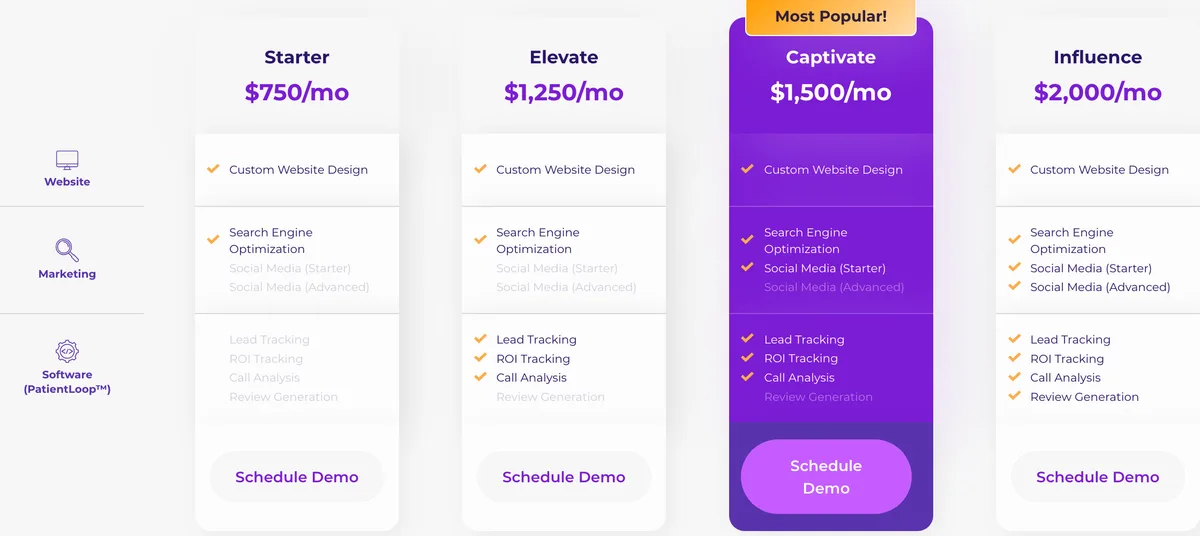
| Lasso MD | Dental marketing plans with a custom website in each | Four plans at $750, $1,250, $1,500 and $2,000 a month, from Starter to Influence | Additional Location SEO, $500 a month |
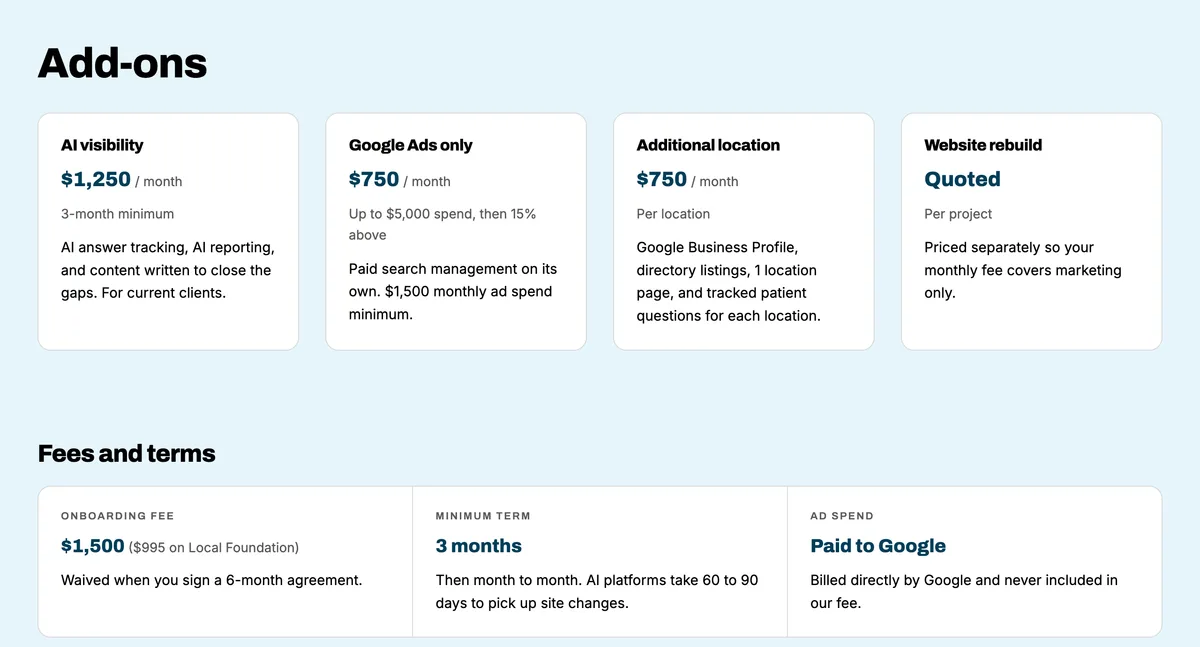
| DDSRank | Dental search and AI visibility programs; website rebuild quoted separately | Local Foundation $1,495, Patient Growth $2,495, Market Leader $3,495 a month plus ad spend; 3-month minimum, then month to month | Additional location, $750 a month: profile, listings, one location page, tracked questions |
| Redefine Web | Dental website builds, payable as a project or split into a monthly plan | Starter $2,500 (up to 8 pages), Growth $4,500 (15), Scale $7,500 (25), Enterprise from $12,000 (unlimited pages, multi-location) | None printed; multi-location sits in the Enterprise tier |
| SEOteric | Multi-location marketing plans for any industry, not dental-specific | From $3,500 a month plus a $1,500 setup, up to $7,500 a month plus a $3,500 setup | $225 to $450 a month for each location, by plan |
| Digimax Dental (UK) | Dental websites, priced in pounds before VAT | One brand: £6,500 website plus £2,000 multi-site system; separate brands: £6,500 for the first site | £1,750 per office microsite, or £3,900 per extra brand site |
| DocSites | Template and custom dental sites with hosting and updates | $1,999, $2,999 or $3,999 setup plus $89 a month, month to month | None; the pricing page describes one practice site |
Read the right-hand column first. Lasso MD sells its extra office as Additional Location SEO at $500 a month, and its plans each include custom website design. DDSRank's extra location is $750 a month and covers a Google Business Profile, directory listings, one location page and tracked patient questions for that office. SEOteric's multi-location plans are written for any chain, not dental practices, and charge $225 to $450 a month for each location on top of a base fee that starts at $3,500. Redefine Web prints project prices from $2,500 for a site of up to eight pages to $7,500 for one of up to 25, and puts multi-location work in an Enterprise tier that starts at $12,000.
The firms missing from the table matter too. Plenty of agencies that market to dental groups ask for a call or publish a blog estimate instead of a price. Estimates are not quotes, and as the next section but one shows, they do not always agree with themselves.
What each extra office adds per month
On the two sellers that print a per-office fee, the second office adds $500 or $750 a month, and the gap between them widens with every office you add.
Over three years the difference is large. A five-office group on Lasso MD's Starter plan pays $2,750 a month, or $99,000 over 36 months, with custom website design included. The same group on DDSRank's Local Foundation pays $4,495 a month, or $161,820 over 36 months, before the website rebuild, which DDSRank quotes separately so its monthly fee covers marketing only. Its onboarding fee of $995 is waived on a six-month agreement. Neither figure includes ad spend.
That is not a verdict on either seller. A per-office fee buys a profile kept tidy, listings cleaned up and a location page maintained, and for a group whose offices compete in different suburbs, that work is real. The useful thing about both price lists is that they make the marginal office visible. Before you sign with anyone, ask for that number. A group that plans to open or acquire two offices a year should know what each one adds to the bill on day one, not discover it in a change order.
One site with office pages, or a site per office?
For one brand, one domain with a page for each office is usually the right build, and it is usually cheaper. Separate sites make sense when acquired practices keep their own names and their own patients, and a separate brand is what those patients search for.
Digimax Dental, a UK agency, is the only seller we found that prints both models side by side, so its prices are the cleanest way to see the gap even for a US reader. One brand costs £6,500 for the website plus a one-off £2,000 for the multi-site system, which includes the first office, then £1,750 for each extra office microsite. Separate brands cost £6,500 for the first site and £3,900 for each additional one.
At two offices the models cost almost the same. At ten, separate brands cost £41,600 against £24,250 for one brand, and that is before anyone writes the content for ten separate sites or keeps ten separate sets of plugins updated. The rule of thumb from these prices: keep one brand and one domain unless a separate brand is earning its own searches.
Google's own rules point the same way. Its Business Profile guidelines allow one profile per physical location and say not to create more than one page for each location. They ask businesses to provide a phone number that connects to the individual location, or a website that represents the individual location, and to use a local number instead of a central call center helpline number whenever possible. They also require all locations of a business to share the one category that best represents it. A site with a real page for each office gives each profile somewhere honest to point.
The estimates that disagree with themselves
The cost guides that rank for this question mostly come from vendors and estimator sites, and the most detailed one we read gives three different ranges for the same build.
ProjectCostEstimator's guide to dental website cost in 2026 gives a DSO or multi-location build its own section, headed with a range of $18,000 to $60,000. A paragraph earlier in the same article puts the same build at $18,000 to $45,000. Its table then lists a DSO or multi-location chain at $12,000 to $25,000 with a freelancer, $22,000 to $60,000 with an agency, and $400 to $1,500 a month to run; a group practice of two to four locations sits at $5,500 to $11,000 freelance and $10,000 to $22,000 agency, with $180 to $400 a month ongoing. It adds $400 to $1,200 for each extra location's local search setup. None of that is wrong, exactly, but a buyer cannot budget from a number whose own source moves it by $15,000 between paragraphs.
The useful part of that guide is the line it draws at five offices, where it says the job stops being a website and becomes a system: one content management setup publishing every office from shared templates and office-specific data. That matches what we see on group sites that work, and it explains the price jump better than any range.
What 132 group websites show
Most dental group sites have office pages, and most of those pages carry the basics; fewer carry the details that make one office page different from the next.
Our method, so you can repeat it. We built a list of 150 dental brands whose own websites list two or more offices, across 33 US metro areas: 125 independent groups and 25 national DSO brands. Our script loaded 132 of those sites (115 independent, 17 DSO brands; the rest blocked automated requests or failed to load). For each, it read the homepage, looked for a locations page, and then fetched up to six individual office pages. It reached individual office pages for 59 groups, 256 pages in all. The other sites either list every office on one page or load their office list with scripts our crawler does not run, which is worth knowing in itself: a crawler that cannot find your office pages is roughly what some AI search tools see.
Three findings stand out. First, phones are handled well. A call link was on 56 of the 59 first office pages, and of the 56 groups where we read two or more office pages, only 3 used the same number on every office we sampled. On homepages, 83 of 132 carried two or more phone numbers, usually one per office in the footer.
Second, the details that make a page about one office are thinner. Opening hours appeared in the text of 41 first pages and at least one dentist was named on 34. Only 35 carried Dentist or LocalBusiness structured data. Just 23 of 59 had a call link, a written address, printed hours and that markup together.
Third, sibling pages often say the same thing. For 52 groups we compared the first two office pages our script found, after stripping the menus and footers, and measured how much of their text the two pages share in runs of five words. The median pair shared 36 percent. 15 pairs shared half or more, and 6 shared 80 percent or more, which on a page of about 900 words means the town, the address and the phone number change while almost everything else stays put. 15 pairs shared less than a fifth.
That third finding is the one with a rule behind it. Google's spam policies describe doorway abuse as pages "created to rank for specific, similar search queries", and one of the examples they give is a set of near-identical pages that behave more like search results than like a site a person can browse. An office page with its own staff, hours and photos is a clearly defined page. A template with the town name swapped is the example.
A few other homepage signals, for context. 108 of 132 load a Google tag and 24 load the Meta pixel. 30 mention an in-house membership or savings plan, 40 link an accessibility statement or mention accessibility, 20 offer Spanish, and 19 invite visitors to search by zip code or city.
What each office page has to carry
A good office page answers the questions that differ from one office to the next, in text, with that office's own phone number. Use this as a brief for whoever builds yours, and check your current pages against it.
| On each office page | Why it matters for a group | Census: of 59 first pages |
|---|---|---|
| That office's own phone number as a tap-to-call link | Google asks for a number that reaches the individual location, and a patient who calls the wrong office is a patient the front desk has to transfer | 56 had a call link |
| The street address written out as text, plus parking or transit notes | Text is what search engines and AI answers read; an address that lives only inside a map image is invisible to them | 51 |
| Opening hours for that office, including the evening and Saturday sessions that differ by office | Hours are the most common reason two offices of one group are not interchangeable | 41 in the page text |
| The dentists and hygienists who actually work there, with a line on each | Patients pick a person as much as a place, and named people are the content no other office page can copy | 34 named a dentist |
| Which insurance plans that office is in network with, if it differs | Network participation is often set per office or per dentist, and a wrong answer here costs a visit | Not measured; too inconsistent to count by script |
| Dentist structured data with that office's name, address, phone and hours | It tells search engines which office the page is about without them having to guess | 35 |
| A booking link that opens that office's calendar, not a group-wide form | One shared form adds a step: someone has to work out which office the patient meant | Not measured; booking widgets were too varied to count reliably |
| Something true about this office that is not true of the others | Pages that differ only by town name are what Google's doorway rule describes | Median shared text between two sibling pages: 36% |
Two notes on the last row. The point is not to hit a similarity score; nobody at Google publishes one. The point is that the content patients care about at an office level (who works there, when it is open, how to get there, what it treats) is naturally different from office to office, so a page built around those things will differ without anyone trying. And if an office has nothing different to say, that is a sign it may not need its own page yet: a satellite office open two days a week can sit on the main office's page until it does.
The rules that shape the build
Three sets of rules decide parts of a group's website before any designer opens a file.
Google Business Profile. One profile per office, linked to that office's page, with a local number rather than a central call center whenever possible, and the same primary category across every office. Dentists who see patients can have their own practitioner profiles; Google's guidelines say that where several practitioners work at one location, the organization should keep a separate profile for the location. A site that maps one page to each office profile keeps all of that straight.
Accessibility. Groups that take Medicaid or other federal health funding are covered by HHS's Section 504 disability rule, which sets WCAG 2.1 Level AA as the standard for their web content. After an interim final rule HHS published in 2026, a group whose payroll reaches 15 has until 11 May 2027 to comply, while smaller recipients have until 10 May 2028. A group with several offices is very likely over the 15-employee line. In our census only 40 of 132 homepages even mentioned accessibility.
Tracking and patient data. The more offices you run, the more tempting it is to wire every form and call into ad platforms to see which office books. Keep identifiable patient information out of pixels and analytics. Count bookings by office in your own systems, and send ad platforms only what you would be comfortable reading aloud in the waiting room.
Questions to ask before you sign
Whoever you hire, put these to them in writing. The answers matter more than the headline fee, because a group's real cost lives in the second office, the tenth office and the day you leave.
| Ask this | A good answer sounds like |
|---|---|
| What does each additional office cost, at build and every month after? | A number per office, in writing, for both. Lasso MD and DDSRank print theirs; anyone can. |
| Is the website in the monthly fee or quoted separately? | A plain yes or no. DDSRank quotes rebuilds separately; Lasso MD includes design. Both are fine if you know which you are buying. |
| One domain with office pages, or a site per office? | A recommendation tied to your brands. One brand usually means one domain; acquired practices that keep their names may need their own sites. |
| What will be different on each office page besides the town name? | Named staff, office hours, photos of that building, parking, the insurance that office takes, services only some offices offer. |
| Who writes the office pages, and who updates them when a dentist leaves? | A named person on their side and a turnaround time. Staff turnover across ten offices is a monthly event, not a yearly one. |
| How do Google Business Profiles connect to the site? | Each profile links to its own office page and carries that office's own local phone number. |
| How is a call or booking credited to the right office? | Per-office call tracking or form fields, reported by office, with no patient information sent to ad platforms. |
| On the day the contract ends, whose name is on the domain, and do the files and copy leave with us? | You own the domain and can take the files and the copy. If the answer involves a buyout, you are renting. |
| Adding an office next spring: what does it take and how long? | A fixed price and a number of days from the day the new office's details arrive. |
For contract and ownership questions that apply to any practice, see our checklist for vetting a dental website company. For a single office, our dentist website cost guide does these sums at the one-practice level.
Where KhanWork fits, and when to look elsewhere
If you run a national DSO brand with an in-house marketing team and a location database already wired into your site, you do not need us: you need your own developers to keep doing what they do. If you run a single office and plan to stay that way, a template site from a dental website company is a sensible way to start, and our single-practice guide above will tell you what to expect.
We are a better fit for a dentist-owned group of roughly two to fifteen offices whose website has fallen behind its growth: offices added one at a time, acquired practices bolted on, and office pages that differ only by town name. Anyone can read what we charge on the KhanWork pricing page. A group that only wants the build can take Foundation, a single payment with nothing monthly attached: the $1,000 option pairs a brand refresh with one landing page designed to convert, launched within 14 business days once your content and logins arrive, and the $2,500 option pairs the refresh with every page of the site, all launched together within 21 business days. The tier written for groups is Scale at $5,000 a month: a brand system across all locations, a full page set for each office, two requests worked at once with a one-business-day turnaround, an A/B test running on each office's funnel, and an AI visibility report for every location. Growth, at $2,500 a month, suits a group of two or three offices on one page set. We invoice Growth and Scale at the start of each month, there is no contract length to sit out, and a group can pause or end either plan at any time. Hosting stays with your own host rather than us, and the site, its code and the domain belong to you.
Our page for dental practices and groups walks through a typical engagement, and our website design service describes the build itself. If AI answers matter to you as much as maps results do, our AI search visibility work covers what engines like ChatGPT read on an office page. Not ready to spend? Request the free funnel review: we study the page that receives most of your visitors, which for a group is often the homepage or an office page your ads send people to, and tell you the single change worth making first.
The three-office test
Grab a phone and play patient on your own site. Pick three of your offices, ideally the busiest, the newest and the one furthest from head office. For each one, search Google for "dentist" plus the name of the town it is in, and start from whatever result of yours appears.
- Which office? Within two taps, are you on a page about this office, not the group's homepage?
- Which number? Does the call button ring this office, and would someone answer it at 5:30 on a weekday?
- When? Are this office's hours on the page in plain text, including the days it differs from the others?
- Who? Can you name one dentist who works at this office from what the page says?
- Which plans? Can you tell whether this office takes your insurance, or how to find out without calling?
- Book here. Does the booking button open this office's calendar, or a group form that asks you to pick again?
Score one point for each yes, out of 18 across the three offices. A group that scores 15 or more has office pages doing their job, and the next money is better spent on reviews and profiles than on a rebuild. Below 10, the website is the bottleneck, and the per-office prices in this article are the place to start your budget. Then open two of your office pages side by side and read them. If you could swap the town names without anyone noticing, so can Google.
Frequently asked questions
Going by the prices sellers print, a multi-location dental website costs from about $12,000 as a one-off agency build, or from about $1,750 a month for three offices when the site is bundled with marketing. Per-office fees printed by Lasso MD and DDSRank add $500 and $750 a month respectively for each additional location, so five offices cost $2,750 or $4,495 a month at those two sellers.
Usually not: one brand is best served by one domain with a real page for each office. Separate websites make sense when acquired practices keep their own names and patients search for those names. At ten offices, Digimax Dental's printed prices make separate brand sites cost £41,600 against £24,250 for one brand with office pages.
A dental office page should carry that office's own phone number as a call link, the street address in text, its opening hours, the dentists who work there, the insurance it takes, structured data for that office, and a booking link to that office's calendar. In our census of 59 group office pages, only 23 had the phone link, written address, printed hours and markup together.
Yes, they can. Google's spam policies name sets of near-identical pages built to rank for similar searches as doorway abuse. In our census, 6 of 52 pairs of sibling office pages shared 80 percent or more of their text.
In 2025, 28.2 percent of US dentists worked in practices with two or more offices, according to the ADA Health Policy Institute, and 11.8 percent worked in practices with 100 or more. HPI also counted 17.0 percent of dentists as affiliated with a dental support organization, up from 8.8 percent in 2017.
Yes, each physical office should have one Google Business Profile, and only one. Google's guidelines ask for a phone number that connects to that individual location, a local number rather than a central call center where possible, and the same primary category across every location of the business.
KhanWork's Foundation build is a single payment with no monthly fee: $1,000 for a refreshed brand and one landing page, or $2,500 for a refreshed brand and every page of the site. For groups, Scale Partner at $5,000 a month covers a page set for every office, two requests at once and per-location testing and AI visibility reports, billed monthly with no minimum. Hosting is separate, and the site and domain stay yours.
 Healthcare
Nov 6, 2026 · 18 min
How Much Should a Hospice Website Cost in 2026?
Hospice website offers that print a price run from $357 to about $26,360 over three years. We totalled them, then read 154 hospice sites for what families and case managers find.
 Healthcare
Nov 4, 2026 · 17 min
How Much Should a Cosmetic Dentist Website Cost in 2026?
Dental website sellers print three-year costs from $5,203 to over $40,000. We priced them, then read 245 cosmetic practice sites for veneer prices, gallery consent and specialist claims.
 Healthcare
Nov 3, 2026 · 19 min
How Much Should a Primary Care Practice Website Cost in 2026?
Primary care web sellers print plans from $79 to $299 a month, and one says its sites cannot be exported. We priced three years of each and read 225 practice websites, membership and insurance-based.