
How Much Should a Financial Advisor Website Cost in 2026?

Aug 14, 2026 · 15 min read
Ask four companies what an advisor website costs and you will get four numbers that do not overlap. That is not evasiveness. They are quoting different products, and only some of them are quoting the part of the job that gets a registered firm into trouble.
So here is the version built from arithmetic instead of ranges. Every price below is published by the company charging it, every rule is quoted from the rule, and every penalty is one a firm actually agreed to pay. All of it was read on 14 August 2026 and linked where it appears. We build websites for a living, including for firms in this market, so we are one of the options on this page and there is a section near the end about when to pick somebody else.
The 30-second answer
A financial advisor website costs between about $1,700 and $16,000 in its first year on a published plan, and the spread has less to do with design than with how much of the work somebody else does. Specialist platforms start near $99 a month plus a setup fee. Custom builds and full marketing retainers run into the thousands a month. What none of the cheap quotes include, and what actually decides the true cost, is the compliance work: your website is an advertisement under SEC rules, every version of it is a record you must keep for five years, and the SEC has fined firms six figures for what was on the page. Budget for the site, then budget for who is responsible for what it says.
Your website is not marketing collateral, it is a filing
Start here, because it explains every price on this page. For a registered investment adviser, the website is an advertisement in the legal sense. The SEC Marketing Rule defines an advertisement as any direct or indirect communication an adviser makes to more than one person that offers its advisory services to prospective clients. A public website is exactly that, on every page, all the time.
The rule was adopted at 86 FR 13024 and took effect on 4 May 2021, and when it adopted the rule the Commission set a compliance date 18 months after the effective date, which lands in November 2022. It has been fully in force for close to four years. That matters when a vendor tells you their template is compliant, because the template is not what the rule regulates. The words on it are.
The practical consequence for a budget is simple. In most industries a website is a design project with a marketing goal. Here it is a design project with a supervision requirement attached, and the supervision does not stop at launch. Every price below should be read as a price for a system that keeps producing compliant pages, not for a one-off delivery.
What the specialists actually charge
Four companies serving this market publish their prices in full, which makes them the only honest basis for a comparison. Their plans are not identical, so the table lists what each one says you get.
| Plan, as published | Monthly | Setup | First year | What that buys |
|---|---|---|---|---|
| Snappy Kraken Foundations | $99 | $499 | $1,687 | Basic template, up to 20 pages, one design revision, vendor branding stays on the site |
| Advisor Designs Business | $75 | $995 | $1,895 | Five custom pages, hosting and maintenance, edits at $100 an hour |
| Advisor Designs Premium | $115 | $1,395 | $2,775 | Eight custom pages, blog engine, 30 minutes of edits a month, then $75 an hour |
| FMG Essential | $178 | $994 | $3,130 | Themed website plus the core marketing tools, at the price their page starts from |
| Snappy Kraken Grow | $199 | $2,499 | $4,887 | Premium template with custom design, unlimited pages, one hour of development a month |
| FMG Premium | $418 | $3,194 | $8,210 | Tailor-made website with the advanced marketing suite |
| Paladin Advantage | $950 | None stated | $11,400 | Monthly retainer, month to month, including compliance and automatic archiving |
| FMG All In One | $1,044 | $3,494 | $16,022 | Premium website plus a done-for-you content and email program |
Snappy Kraken publishes website plans at $99 a month on an annual term with a $499 setup fee, and $199 a month with a $2,499 setup fee for a premium template with custom design. Worth knowing when you search: advisorwebsites.com, one of the oldest names in this category, now redirects to Snappy Kraken's pricing page.
FMG Suite prices in three tiers, described on its page as starting at $178, $418 and $1,044 a month, each with a setup fee between $994 and $3,494. Advisor Designs takes the opposite approach with two plans built around page count, $75 a month plus $995 for a five-page site and $115 a month plus $1,395 for eight pages, billed annually, with further edits charged by the hour. Paladin Digital Marketing sits at the top of the published market at $950, $2,950 and $4,950 a month with no onboarding fee and no annual term, and lists compliance and automatic archiving inside the monthly price.
Two things jump out of that chart. The first is that the cheapest and the most expensive published options differ by roughly ten times, and none of it is explained by how the site looks. The second is that the annual-term prices are annual-term prices. Advisor Designs states that all plans are billed annually, and Snappy Kraken's monthly figures are labeled as the annual-term rate, so treat the first-year number as the real number and ask what month 13 costs.
What a custom build buys that a template does not
Templates in this market are good and getting better. The honest case for paying more is narrower than agencies pretend, and it comes down to three things.
The first is the page count you are allowed to have. Advisor Designs prices five pages and eight pages as separate products. Snappy Kraken's entry plan allows up to 20 basic pages and its higher plan removes the limit. If your growth plan depends on writing, or on a page for each service and each town you serve, a page cap is not a detail. It is the ceiling on your search strategy, and you will hit it in year two.
The second is who can change what. Entry plans include a fixed allowance of help, then charge by the hour. Advisor Designs publishes $100 an hour on its lower plan and $75 an hour with 30 minutes included on the higher one. That is fair pricing, clearly stated, and it tells you something important: on a template plan, changes are a transaction. On a custom build you own the code and any competent developer can work on it, which is worth more the more often you expect to change things.
The third is whether the site is yours at all. A vendor plan is a rental, and rentals end. Before you sign anything, find out who holds the domain, who holds the content, and what leaves with you, which we covered in detail in our piece on who owns your website. In this market it matters more than most, because your compliance archive has to survive the move as well.
The rule that decides your testimonial page
Client reviews are the single most requested feature on an advisor website. The SEC described its own new rule as one that would permit the use of testimonials and endorsements, subject to certain conditions, which tells you plainly enough where the industry stood before it. Those conditions are design decisions before they are legal ones.
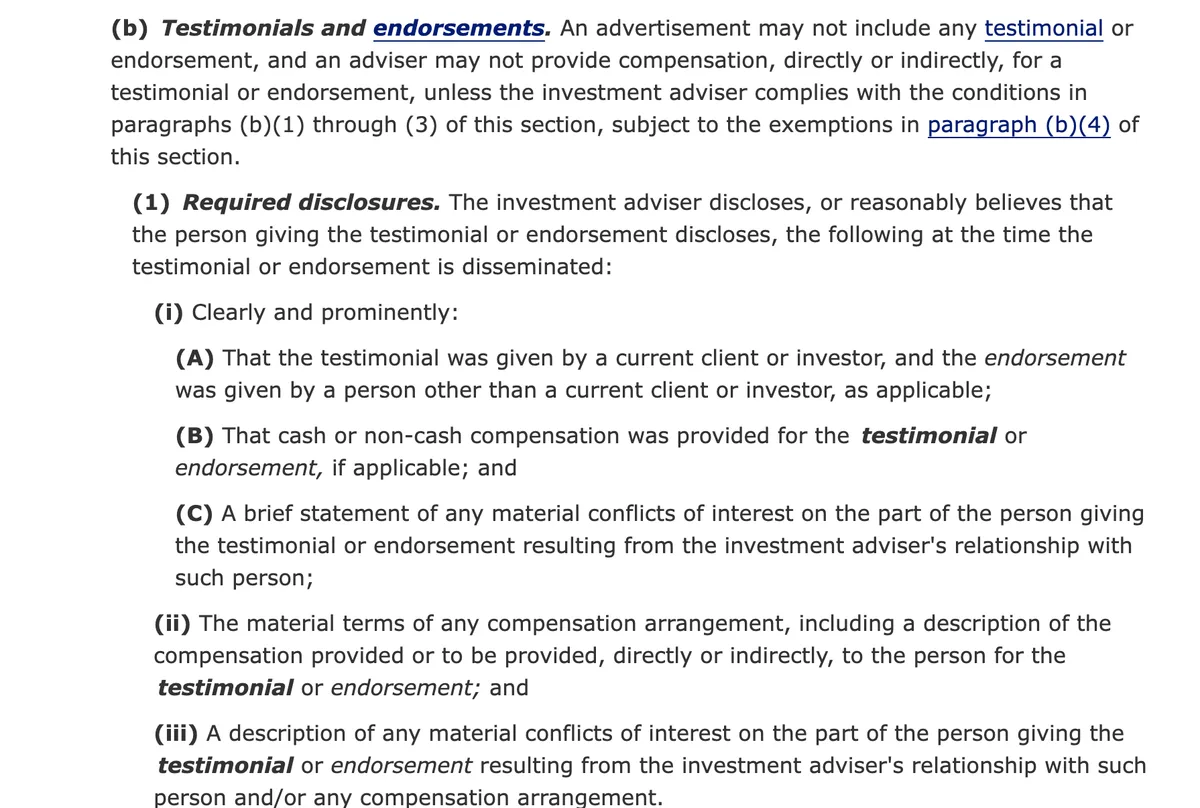
Read paragraph (b)(1)(i) again and notice what it does not say. It does not say disclose somewhere on the site. It says clearly and prominently, at the time the testimonial is disseminated, that the person is a current client, that they were paid if they were paid, and that there is a conflict if there is one. A modal, a footnote at the bottom of a long page, or a small asterisk linking to a disclosures page is a design pattern that argues with the rule.
There are two more conditions that quietly shape the build. If the testimonial is compensated in any way, the rule requires a written agreement with the person giving it, describing the scope of the activity and the terms of payment. And where no compensation, or only de minimis compensation, is involved, paragraph (b)(4) lifts some of those conditions, which is why an unpaid quote from a current client is the simplest thing to publish and a paid influencer arrangement is the most complicated.
None of that makes a review section impossible. It makes it a component with rules: the badge that says current client, the line that says paid or unpaid, the conflict statement, all rendered next to the quote rather than parked on another page. Build it once properly and it costs nothing extra to use it forever. This is a different regime from the one ordinary businesses live under, and if you also run a non-advisory brand it is worth reading our piece on testimonials and the FTC rules to see how differently the two are policed.
Awards, rankings and the badge from 2019
Third-party ratings are the other thing every advisor site wants above the fold, and they carry their own paragraph. Under paragraph (c) of the Marketing Rule, a rating may not appear unless the adviser has a reasonable basis for believing the questionnaire behind it was not built to produce a predetermined result, and unless the advertisement clearly and prominently discloses the date the rating was given, the period it covers, the identity of whoever created and tabulated it, and any compensation the adviser paid in connection with getting or using it.
In practice that turns a decorative logo strip into a small content problem. Each badge needs a year, a period and a source next to it. It is a five-minute build decision that most templates get wrong by default, because a logo row is designed to look clean rather than to carry four facts per item.
It is also, as the next section shows, one of the specific failures named when the SEC charged nine firms in 2024.
Numbers, calculators and anything that looks like a projection
Performance is where the website meets the part of the rule with the sharpest edges. Two provisions matter for a build.
Paragraph (d)(1) says gross performance may not appear unless net performance appears with at least equal prominence, in a format designed to facilitate comparison, over the same period and using the same methodology. Equal prominence is a layout instruction. It rules out the common pattern of a big number in the hero and the qualifying figure in the small print underneath.
Then there is hypothetical performance, which the rule defines broadly enough to catch things that do not feel like performance at all. It includes model portfolios, backtested results, and targeted or projected returns. A hero panel showing what a strategy would have returned since 2015 is hypothetical performance. So is a projection of what a portfolio might do.
The rule does carve out interactive tools, and the carve-out is the most useful paragraph on this page for anyone planning a retirement calculator. A tool where the visitor produces their own simulation is not hypothetical performance, provided the adviser describes the criteria and methodology including limitations and key assumptions, explains that results vary with each use and over time, describes the universe of investments considered and any selectivity where that applies, and discloses that the outcomes are hypothetical in nature. Four disclosures, attached to the tool. Build them in and the calculator is fine. Leave them out and you have published hypothetical performance to the general public, which is precisely what the SEC went looking for.
What firms have actually paid, and for what
This is not theoretical enforcement. Three separate sweeps have now ended in settled charges, and in every one of them the conduct was on a website.
In September 2023, nine advisers were charged for advertising hypothetical performance to the general public on their websites without the policies and procedures the rule requires, and agreed to $850,000 in combined penalties, ranging from $50,000 to $175,000 each. Two of those firms were also found to have failed to maintain required copies of their advertisements, which is the record-keeping point below showing up in a real case.
In April 2024, five more advisers settled for $200,000 combined over the same hypothetical performance problem. Four of the five received reduced penalties because they had fixed the issue before the SEC staff contacted them, which is the cheapest sentence in this article to act on.
Then in September 2024, nine firms agreed to $1,240,000 in combined civil penalties over advertisements with untrue or unsubstantiated claims, or testimonials, endorsements and third-party ratings that lacked the required disclosures.
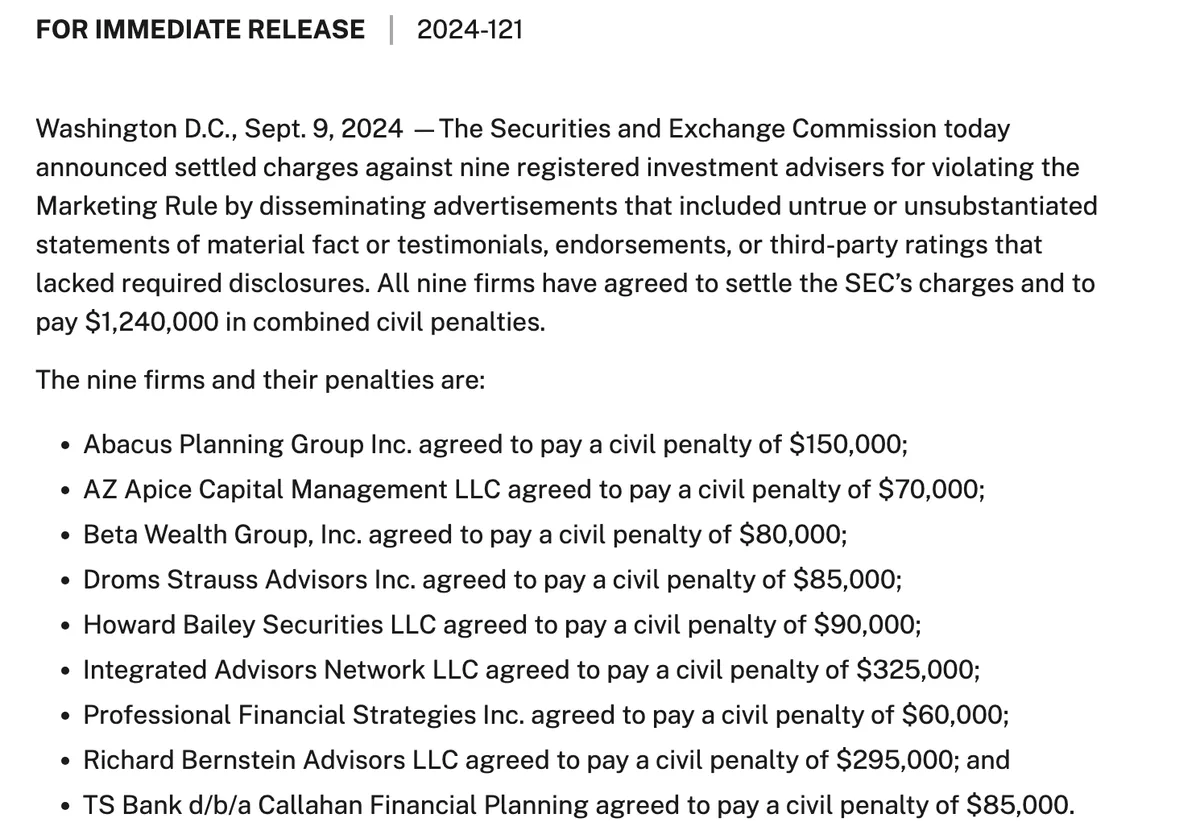
The findings are worth reading as a build checklist, because they are so ordinary. Four firms claimed to provide conflict-free advisory services and could not substantiate it. One published an advertisement claiming membership of an organization that did not exist. One presented two testimonials that did not come from current clients, and ran endorsements without disclosing that the endorser was a paid non-client. And four included third-party ratings, some of them more than five years old, without disclosing when the rating was given or what period it covered.
Not one of those is a technology failure. Every one of them is a sentence somebody wrote, or a badge somebody left in place after it went stale. That is the actual cost center in an advisor website, and no template prevents it.
The line item that never appears in a quote
Here is the part almost every published cost guide omits entirely. Under 17 CFR 275.204-2(a)(11), an adviser must keep a copy of each advertisement it disseminates. Your website is an advertisement. Therefore your website is a record.
The retention period sits a little further down the same rule: records made under that paragraph must be kept in an easily accessible place for not less than five years, the first two in an appropriate office of the adviser. Not the current version. Each version, for five years.
Think about what that means for a site that publishes a market commentary every week. Every one of those pages, in the form it appeared, needs to be retrievable. A content management system with a revision history is not the same thing as an archive, and a vendor plan that ends when you stop paying is emphatically not the same thing.
Ask any prospective vendor two questions: does the plan capture and retain page versions, and can you export the archive if you leave? Paladin lists automatic archiving inside its monthly price. Snappy Kraken and FMG both sell compliance workflow features. One thing we could not do is price the specialist archiving vendors, because none of the ones we tried publishes a rate openly. That makes this a line item you will have to price by asking, and we would rather say so than invent a range.
If you are with a broker-dealer, add three more things
Everything above applies to registered investment advisers. If you are a registered representative of a broker-dealer, FINRA's rules sit on top, and three of them have direct consequences for a website project.
First, approval. FINRA Rule 2210 defines a retail communication as any written, including electronic, communication distributed or made available to more than 25 retail investors in any 30 calendar-day period, and requires an appropriately qualified registered principal to approve each one before the earlier of its use or its filing. Your launch date is therefore not yours alone. Build the review window into the schedule instead of discovering it in launch week.
Second, and this one surprises people, new firms have to file first. For one year from the date FINRA membership became effective, a member must file with the Advertising Regulation Department at least 10 business days prior to first use any retail communication published in electronic or other public media, and the rule names a generally accessible website among them. A new broker-dealer cannot simply launch a site on a Tuesday.
Third, the BrokerCheck link. Rule 2210(d)(8)(A) requires each of a member's websites to carry a readily apparent reference and hyperlink to BrokerCheck on the initial webpage intended for retail investors, and on any page carrying a professional profile of a registered person who does business with retail investors. That is a template decision affecting your home page and every bio page.
Filing also has a price, and it scales with the size of the site. Section 13 of Schedule A to the FINRA By-Laws sets the review charge at $300 for printed or website material, plus $10 for each webpage past the first ten, with expedited review at $600 plus $50 a page and a three business day turnaround. The current schedule dates from 1 January 2025, so check the rule rather than an older article.
What turns up on the invoice later
Four costs land after the project everyone budgeted for is finished.
Edits by the hour. Every template plan meters help. If your practice generates a few changes a month, an hourly rate at $75 to $100 with a small monthly allowance is fine. If you are actively marketing, it is a slow leak, and the monthly plan one tier up is usually cheaper than the hours you will buy.
The content treadmill. A website that is finished stops earning within a year. Somebody has to write, and in this industry somebody also has to approve. The done-for-you tiers exist because that combination is the hardest part to sustain, which is why the top of our chart is dominated by content programs rather than by design.
The archive. See above. If it is not in the plan, it is a separate purchase.
Maintenance and the platform itself. This is the same set of bills every business pays after launch, and we broke it down in our piece on website maintenance cost. Nothing about being regulated makes those cheaper.
What to spend, by where you actually are
Three honest positions, with a recommendation for each.
Newly registered, no marketing budget, few clients. Buy the cheapest published plan that does not cap you below about 20 pages, spend nothing on custom design, and put the time into your disclosures and one page that explains who you serve. At roughly $1,700 for the first year, the site is not the constraint on your growth yet.
The middle case is the one people get wrong. An established practice with referrals and a website nobody visits. Here the site is doing real work and doing it badly. The published mid-tier plans cost $2,700 to $4,900 in year one, and a custom build can land in the same range or under it, so the question stops being price and becomes control: page count, edit access, and whether you own what gets built.
A firm running actual campaigns. If you are buying ads, running events, and publishing regularly, the site is one component of a system and it should be budgeted as such. That is the $11,000 to $16,000 first-year territory on the published plans, and at that level you are mostly buying labor, not pixels. Compare it honestly against hiring, which we did the arithmetic for in our comparison of in-house against agency.
One piece of context for all three. The Bureau of Labor Statistics puts the median annual wage for personal financial advisors at $105,070 in May 2025, across 266,800 people. Set any of these numbers against a year of your own time and the cheap plans stop looking like savings and the expensive ones stop looking outrageous. The real question is which one removes work from your week.
How we price this, and when to pick somebody else
Our own numbers are public and they are not tiered. A one-time build is a flat $1,499, and it is $2,499 a month when the work carries on past launch, with both figures on our pricing page so nobody has to sit through a call to hear a figure. Most focused builds are live within two weeks of kickoff. Anyone who writes in about a partnership hears back inside 48 hours. Across 200-plus projects the pattern we keep seeing in regulated markets is that the website is rarely the weak part; the review process around it is. Work we did for Cornerstone Healing Center, a treatment center, produced 20% more website conversions after the redesign.
Now the part that saves us both time. If your firm's compliance department mandates a specific vendor platform, and many broker-dealers do, buy that platform and stop reading comparison articles. You will not win that argument, and the approved platform is genuinely the cheaper path when the alternative is a review process that never ends. If what you need is a compliance archive above all else, buy from somebody who sells archiving as their product rather than as a feature. And if you have no marketing plan yet, a new website will not create one; spend the first $1,500 finding out which clients you want more of, then build a site that speaks to them.
We are a good fit when the site itself is the bottleneck: when it is slow, when it does not explain the practice, when nothing on it has changed in three years, and when you want to own the result. Firms in this market can read how we work on our finance page, and if you are weighing a rebuild against a rescue, our piece on redesigning without losing rankings covers the part where rankings are at stake.
Put one name against each of these six things
Finish with this rather than a checklist, because in every enforcement action above the failure was ownership, not knowledge. Somebody assumed somebody else was watching the page.
Write down six items, and put a single human name next to each one. Not a company, not a department. A name.
- Who approves new page copy before it goes live. If the answer is the web designer, you have a problem, because they are not the one the SEC will ask.
- Who checks that testimonials carry their disclosures. Including when a new one is added six months from now by whoever handles the inbox.
- Who owns the age of every award badge. Ratings go stale silently, and a date on the page is the whole fix.
- Who signs off anything containing a number. Performance, projections, calculators, and the marketing line that quietly implies a return.
- Who holds the archive, and where. Name the person and the system that can produce last March's version of your homepage.
- Who is responsible for the site being current in twelve months. This is the one nobody claims, and it is why so many advisor websites read like 2021.
If the same name appears six times and it is yours, that is workable but fragile. If any line is blank, that blank is the most expensive thing on your website, and it costs nothing to fill in this afternoon.
Frequently asked questions
Between roughly $1,700 and $16,000 in the first year on a plan the vendor publishes openly. The low end is a template on an annual term, around $99 a month plus a setup fee of a few hundred dollars. The middle, from about $2,700 to $4,900 a year, buys custom design, more pages and some included support. Above that you are paying for a marketing program with a website inside it rather than for a website. Custom builds vary more widely because they are priced by scope: ours is a flat $1,499 for a one-time build.
 Web Design
Aug 11, 2026 · 14 min
Who Owns Your Website? What to Check Before You Sign a Web Design Contract
Paying for a website does not transfer its copyright. Here is what United States law does by default, which clause actually moves ownership, who controls the domain, and the handover list worth putting in writing.
 Web Design
Aug 10, 2026 · 13 min
Nonprofit Donation Pages in 2026: What the Data Says to Fix First
Mobile brings most of the traffic to nonprofit websites and about a quarter of the money. Here is what 180 nonprofits reported this year, what it costs to take a gift, and the order worth fixing things in.
 Web Design
Aug 7, 2026 · 12 min
Website Builder vs Hiring a Designer: An Honest 2026 Comparison
Published plan prices, real Core Web Vitals data from millions of live sites, and what each platform's own documentation says you can take with you if you leave.