
Who Owns Your Website? What to Check Before You Sign a Web Design Contract

Aug 11, 2026 · 14 min read
The invoice is paid, the site is live, and nobody has asked the awkward question: who actually owns it. Most buyers assume the payment settled that. Under United States copyright law it usually did not, and the space between what buyers assume and what the paperwork says is where the ugly separations happen. A designer who still holds the copyright. A domain registered to an email address at a company you no longer work with. A hosting account whose password left with somebody's former employee.
We build websites for a living, so read this as an interested party setting out the rules it works under. Every legal point below links to the statute, the policy or the government page it came from, all read on 11 August 2026. None of it is legal advice. For a contract you will sign more than once, an hour with a lawyer in your state is money well spent.
The 30-second answer
Paying for a website does not transfer its copyright. In the United States, copyright in a design or in code belongs first to the person who created it under 17 U.S.C. 201(a), and it moves to you only through a written transfer signed by that owner under 17 U.S.C. 204(a). A "work made for hire" clause often fails to do it, because a website is not one of the nine kinds of commissioned work the statute allows. Ownership of the files is also a separate question from control of the domain, the hosting and the analytics, none of which copyright law touches at all.
What the law hands you by default, which is not much
By default, the person who did the work owns the work. Section 201(a) vests copyright in the author the moment something is fixed in a file, and the author is the human who made it, not the business that paid the bill. Section 201(b) creates the one big exception: for a work made for hire, the employer counts as the author from the start. That exception is doing enormous quiet work in the web industry, because almost every website is built by someone who is not your employee.
The Supreme Court settled the employee question in Community for Creative Non-Violence v. Reid, 490 U.S. 730 (1989). A charity commissioned a sculpture, directed the work closely, paid for it, and still lost the copyright fight, because the sculptor was an independent contractor rather than an employee under common law agency principles. Courts weigh a list of factors: the skill required, who supplies the tools, where the work happens, how the person is paid, whether taxes and benefits are handled like employment. A design studio working from its own machines, on its own hours, invoicing you as a vendor, lands on the contractor side of that line in almost every case.
So the starting position for a normal agency or freelance engagement is uncomfortable: they own it, you licensed it by implication, and the terms of that implied license are whatever a court later decides they were. Nobody wants to find that out during a dispute.
Why "work made for hire" in a web contract often does nothing
The phrase is in almost every template, and for websites it usually has no legal effect. 17 U.S.C. 101 allows only two routes to a work made for hire. The first is work by an employee inside the scope of employment. The second is a work "specially ordered or commissioned for use as a contribution to a collective work", plus eight other named categories, and only if both parties sign a written agreement saying so.
Here is that full list, from the statute: a contribution to a collective work, a part of a motion picture or other audiovisual work, a translation, a supplementary work, a compilation, an instructional text, a test, answer material for a test, and an atlas. Read it twice. A website is not there. Neither is a logo, a design system, an application, or a set of page templates. Some lawyers argue a site could be squeezed into "collective work" or "compilation" on particular facts, which tells you how thin the ground is.
When the category does not fit, the clause simply fails, and the copyright stays where section 201(a) put it. That is why competent agreements never rely on the phrase alone. They pair it with an assignment: this is a work made for hire, and to the extent it is not, the contractor assigns the copyright to the client. Two sentences instead of one, and the second one is the one that works.
California adds a twist worth knowing before you insist on the phrase. Under Labor Code 3351.5(c), a person engaged by a signed work made for hire agreement for a commissioned work of authorship is an employee for workers' compensation purposes, and Unemployment Insurance Code 686 makes the commissioning party an employer for unemployment insurance. California buyers who demand work made for hire language can therefore create a payroll relationship they never wanted. An assignment gets you the same ownership without that side effect.
The words that actually move ownership
The operative language is an assignment, in writing, signed. Section 204(a) requires an instrument of conveyance, or a note or memorandum of the transfer, in writing and signed by the owner of the rights being conveyed. A verbal promise, a line in a proposal deck, and a friendly email thread are all weaker than one signed sentence.
Four details separate a real assignment from a decorative one.
- Present tense. "Hereby assigns" transfers now. "Agrees to assign" is a promise to sign something later, which is only as good as the relationship on the day you ask.
- Named deliverables. Final files, layered source files, code, and content produced for you. If source files and working files are not named, expect to receive flattened exports.
- A payment trigger you can meet. Assignment on receipt of final payment is normal and fair. Assignment on some vaguer condition, or no trigger at all, is where disputes start.
- Honest carve-outs. Most studios reuse internal frameworks, component libraries and scripts across clients, and will not assign those. That is reasonable. What you need instead is a perpetual, irrevocable, transferable license to use and modify them as part of your site, so a future developer can work on it without calling anyone.
Two more clauses are worth reading closely. Portfolio rights, which let the studio show the work, are standard and harmless. A right for the studio to keep and reuse "all designs" without limit is not, because that is the clause that lets your competitor down the road get a site that looks like yours.
What that clause is worth when things go wrong
Ownership decides who holds the enforcement tools, and those tools have numbers attached. Under 17 U.S.C. 504(c), a copyright owner can elect statutory damages instead of proving lost profits: not less than $750 and not more than $30,000 for each work infringed, rising to as much as $150,000 where the infringement is proved willful, and dropping to as little as $200 where the infringer proves it had no reason to know.
Most disagreements never get near a courtroom. That is the point. The party who can credibly send a letter about statutory damages is the party who gets a fast, quiet resolution, and that party is whoever the paperwork says owns the work. If you are not the owner, none of the numbers in that chart are available to you, and the pressure runs the other way.
Registration costs less than one hour of anyone's time
Owning a copyright and being able to sue over it are two different things. 17 U.S.C. 411(a) blocks a civil action for infringement of a United States work until registration of the claim has been made. Section 412 goes further on money: statutory damages and attorney's fees are off the table for infringement that begins after publication and before registration, unless registration happens within three months of first publication. Three months from launch is a real deadline with real consequences, and it is the one nobody in the industry mentions.
The fees come from the Copyright Office fee schedule. Note the wording on the cheapest option: single author, same claimant, one work, not for hire. A genuine work made for hire does not qualify for it, which is a small, satisfying reminder that the phrase has consequences beyond the sentence it sits in.
Whether registering a whole website is worth it depends on how much of your brand lives in it and how distinctive the design is. For a bespoke site that took months, at $65 it is difficult to argue against. For a template build with stock components, there is much less to protect, and the honest answer is to skip it.
The domain is a separate argument, and it runs on a clock
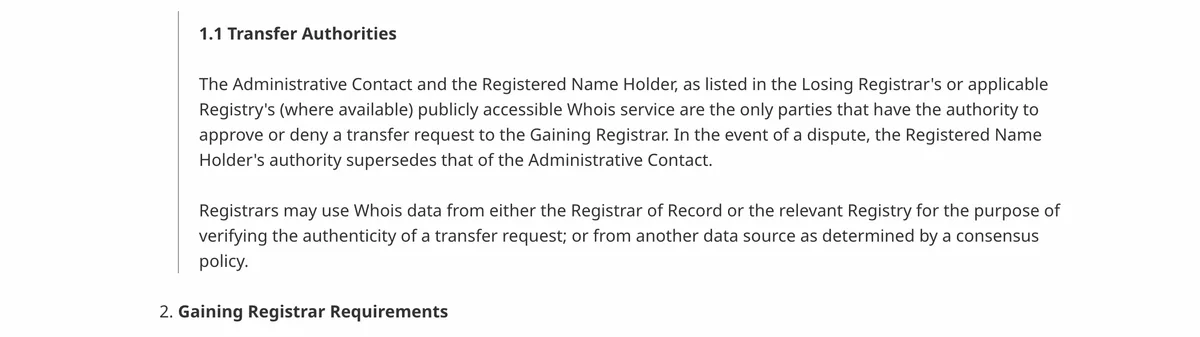
Copyright law has nothing to say about your domain name. Domains are governed by contract and by ICANN policy, and the only thing that matters is whose name sits in the registrant field. The ICANN Transfer Policy, in the version published on 21 February 2024, is explicit that the registered name holder and the administrative contact are the only parties who can approve or deny a transfer to another registrar, and that the registered name holder wins any dispute between the two.
The same policy sets out when a registrar may refuse to let a domain move at all. A transfer can be denied within 60 days of the creation date, within 60 days of a previous transfer between registrars, and during the 60-day lock that follows a change of registrant. Those windows are the practical reason to sort domain ownership at the start of a project rather than during a divorce. If you change the registrant on the day you fire your agency, you can find the name frozen for two months, right when you need to point it somewhere new.
The fix is unglamorous. Register the domain yourself, in the business name, on a card the business controls, before anyone starts designing. If it is already registered to someone else, ask for the registrar account or a change of registrant now, while everyone is friendly, and put the renewal on a calendar you own.
The accounts that never make it into the contract
A site is not one asset. It is a stack of accounts, and each one has a different owner by default. This is the part clients discover in the worst possible week, so here it is in advance.
| Asset | Who tends to hold it | What to require | How to check today |
|---|---|---|---|
| Domain name | Whoever registered it, often the agency | Registrant in your business name, your registrar account | Log in to the registrar yourself, not through anyone |
| DNS | The registrar or the host | Admin access to whichever service answers for your zone | Change a test record and see if you can |
| Hosting or platform | The agency's account, sometimes resold to you | An account in your name that you are billed for directly | Find the receipt. If you have never seen one, you do not hold it |
| Source code | The developer's repository | Assignment plus a copy of the repository, history included | Ask for read access to the repository now |
| CMS admin | Shared, often with one super admin | An owner-level account for a person who works for you | Check your own role in the user list |
| Analytics | The agency's Google account | Your Google account as an administrator on the property | Open the property's access management screen |
| Search Console | Whoever verified the site | Your own verified owner, not delegated | Check the verification method and the owner list |
| Business profile and ads | The marketing vendor | Primary ownership, vendors added as managers | Look at who is listed as owner, not manager |
| Business email | Wherever the mail is hosted | Your own admin console for the mail service | Send yourself a test from the admin account |
| Plugin and theme licenses | The agency's account or a bundle | Licenses in your name, or a written list of what expires when | Ask for the license keys and the renewal dates |
The pattern behind that table is simple. Anything with a login and a credit card attached is controlled by whoever set it up, and no clause about copyright changes that. Ownership of the files and control of the accounts have to be handled as two separate lists.
The parts of your site you will never own outright
Some of what makes up a website is licensed, not owned, and no contract can change that. Being clear about which parts keeps everyone honest.
If your site runs on WordPress, the software is under the GPLv2 or later, and WordPress.org states that derivative works such as plugins and themes inherit that license. You are not buying WordPress. You are receiving it under a license that also gives you the freedom to modify it and move it, which is exactly the freedom you want when a relationship ends.
Commercial themes come with their own terms, and they are usually better than people expect. The ThemeForest Regular License permits one end product for yourself or for one client, says that the developer can transfer that single end product to the client for any fee and that the license transfers with it, and forbids selling the end product to anyone other than that one client. In plain terms: one purchase per site, and the license is meant to land with you. If a studio built five client sites off one purchase, that is a licensing problem in your website, so ask which theme was used and ask to see the purchase code.
Fonts and photography are where the real exposure sits, because both are usually licensed to whoever bought them, for a defined use, and the receipt lives in the vendor's account. Rather than trust a summary of anyone's terms, ask for the licenses themselves: which typefaces, bought where, licensed to which entity, for what page-view tier, and the same for every photograph that is not yours. If nobody can produce them, that is your answer, and replacing a font is far cheaper than the alternative.
What the law now asks of you, the buyer
If you hire a solo freelancer rather than a firm, the paperwork is no longer optional in a growing number of places, and the duty falls on you. California's Freelance Worker Protection Act, enacted as SB 988 and now Business and Professions Code 18100 and following, applies to contracts entered into or renewed on or after 1 January 2025 worth $250 or more, counted alone or aggregated across the previous 120 days.
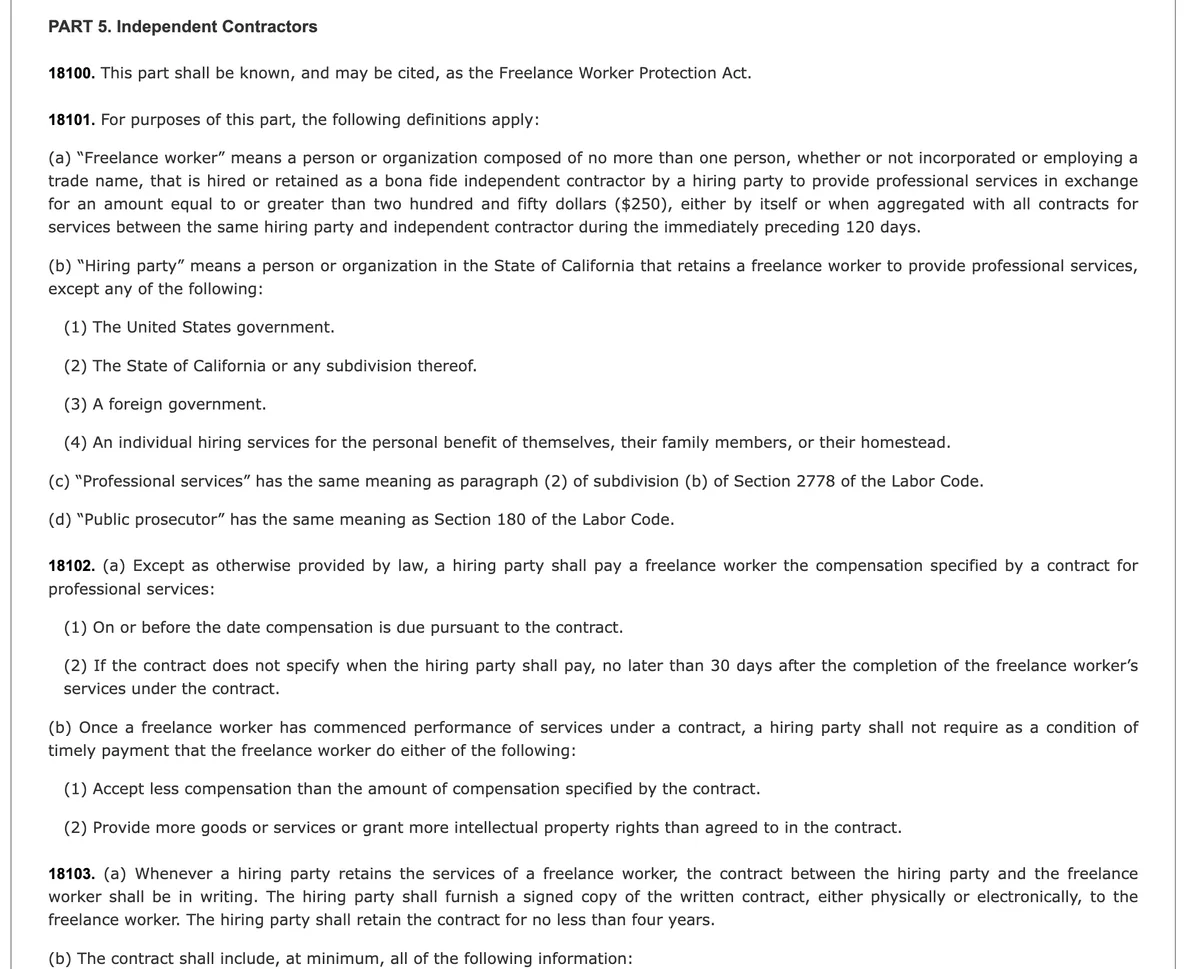
The obligations are concrete. The hiring party has to put the contract in writing, furnish a signed copy to the freelancer, keep it for at least four years, and include the parties' names and addresses, an itemized list of services with their value and the rate and method of pay, the date payment is due or how it will be determined, and any deadline for submitting an invoice. Payment is due on the contract date, or within 30 days of completion if the contract is silent. A worker who asked for a written contract and was refused is awarded an extra $1,000, and late payment can cost up to twice the unpaid amount.
Section 18102(b)(2) is the clause that ties this section to the rest of the article: once work has started, a hiring party cannot require, as a condition of paying on time, that the freelancer grant more intellectual property rights than the contract agreed. Ownership has to be negotiated up front, not extracted at invoice time.
Other places have their own floors, all lower than most project budgets.
New York's Freelance Isn't Free Act added Article 44-A to the General Business Law on 28 August 2024, covering freelance workers hired for $800 or more alone or across the preceding 120 days, with payment due within 30 days when the contract does not say. The Illinois Freelance Worker Protection Act took effect on 1 July 2024 at $500 across 120 days, with the same 30-day default, as summarized by Jackson Lewis. The city of Los Angeles has run its own ordinance since 1 July 2023 at $600, and its Office of Wage Standards now says it will only take complaints on contracts that state law does not already cover.
One limit matters for anyone about to panic. California and New York both define a freelance worker as a person, or an organization of no more than one person. Hiring a twelve-person studio does not trigger these laws. Hiring the designer who works alone does, and that is a very common way to buy a website.
Eight questions to ask before you sign
Print these. Any studio worth hiring answers all eight without checking with anyone, and the answers tell you more about how a company operates than its portfolio does.
- Does the contract assign the copyright to me, in present tense, and when does that happen? Look for "hereby assigns" and a clear trigger such as final payment. A promise to assign later is not the same thing.
- What exactly is assigned, and what is only licensed? Expect internal frameworks and libraries to stay theirs. Make sure the license to keep using them is perpetual and survives the relationship.
- Do I get source files and the repository, including history? Layered design files and the code as it is actually built, not exports.
- Whose name goes in the domain registrant field? The answer should be yours, from day one.
- Which accounts will be in my name and billed to me directly? Hosting, analytics, Search Console, business profile. Ask for the list before the project starts.
- Which fonts, images, plugins and themes are licensed, to whom, and what do they cost each year? Ask for a written inventory at handover.
- What happens on the day we part ways? A wind-down clause with a fixed handover window and a defined list of what gets transferred beats goodwill.
- Who can I call in six months, and what does that cost? Ownership is worthless if nobody can use it. Prices for ongoing help should be written down before you need them.
What a complete handover contains
A handover is a delivery, not an email saying thanks. When we close out a build, the client receives a single document listing the domain registrar and account, the hosting account and where it is billed, admin credentials for the CMS at owner level, the repository with its history, the design source files, an inventory of every third-party license with renewal dates and costs, the analytics and Search Console properties under their own Google account, and the signed assignment. It takes an hour to assemble if the project was set up correctly and two miserable days if it was not.
Ask for that list in writing at the proposal stage. A studio that hesitates is telling you something useful about how the last engagement ended.
What we do, and when we are the wrong choice
Our position is simple: you paid for it, so you take it with you. Our agreements assign the copyright in the deliverables on final payment, our clients hold their own domains and hosting from day one, and the handover document above ships with every project. We publish what that costs on our pricing page rather than making you ask, at $1,499 for a focused one-time build and $2,499 a month for continuing design and development work.
We are the wrong choice in three situations. If you want a site you will never touch again and never move, a template on a builder platform will do the job for less, and our comparison of builders against hiring a designer lays out that tradeoff honestly. If you need a lawyer to draft or review a bespoke agreement, hire the lawyer, not us. And if the person you actually need is a full-time employee sitting in your standups, our breakdown of in-house against agency costs will save you a discovery call. Businesses in local service industries often get more from a small, well-owned site than from a large one they cannot edit.
A 20-minute audit of the site you already have
You do not need a contract review to find out where you stand. Six checks, done in one sitting, will tell you which assets you actually control. Do them in this order, because the early ones are the expensive ones.
- Look up your own domain. Use ICANN's public lookup service. Registrant details are usually redacted, so what you are really testing is the next step.
- Log in to the registrar yourself. Not a shared screen, not a screenshot from your agency. If you cannot get in with your own credentials, you do not control your domain today.
- Log in to the hosting or platform account and find a billing receipt with your business on it. No receipt usually means the account is somebody else's.
- Open your analytics property and check your own access level. Administrator or nothing. The same goes for Search Console and your business profile, where you are looking for owner rather than manager.
- Ask your developer for read access to the repository. The speed of the reply is data.
- Search your email for the contract and read one sentence. The one containing the words assigns, assignment or ownership. If it does not exist, or it only says work made for hire, you have found the gap.
Failing a check is not a crisis and rarely means bad faith. Most of it is drift: an agency registered the domain in 2019 to get a project moving, and nobody revisited it. The fix is an email asking for the assignment to be signed and the accounts to be transferred, sent while the relationship is still good. That email is much harder to write after the relationship is not.
Frequently asked questions
Not automatically. Under 17 U.S.C. 201(a) the copyright belongs first to whoever created the work, and 17 U.S.C. 204(a) says it transfers only through a written instrument signed by that owner. Payment on its own creates, at most, an implied license to use what you bought, with terms nobody wrote down. If your agreement contains no assignment clause, the practical answer is that your designer still owns the design and the code.
 Web Design
Aug 10, 2026 · 13 min
Nonprofit Donation Pages in 2026: What the Data Says to Fix First
Mobile brings most of the traffic to nonprofit websites and about a quarter of the money. Here is what 180 nonprofits reported this year, what it costs to take a gift, and the order worth fixing things in.
 Web Design
Aug 7, 2026 · 12 min
Website Builder vs Hiring a Designer: An Honest 2026 Comparison
Published plan prices, real Core Web Vitals data from millions of live sites, and what each platform's own documentation says you can take with you if you leave.
 Web Design
Aug 6, 2026 · 13 min
In-House vs Agency Web Design: What Each One Actually Costs in 2026
Most in-house versus agency comparisons run on invented fully loaded cost figures. Here is the same comparison built only on wages the government publishes and prices companies publish about themselves.