
How Much Should a Therapy Practice Website Cost in 2026?

Aug 17, 2026 · 14 min read
Search this question and you get a range. One thousand to seven thousand. Eight hundred to twenty five hundred. Five thousand and up for anything custom. Not one of the pages offering those numbers says where they came from, because they came from nowhere.
Here is the same question answered only with prices that companies print on their own websites, and rules quoted from the agencies that wrote them. Everything below was read on 17 August 2026 and linked where it appears. We sell websites, including to practices in this field, so read this as a page written by one of the options on it. Near the end there is a section on the practices we are a bad fit for. There are also three rules that apply to a therapy website and to very few other kinds of small business site, and the cost guides we read while writing this leave all three out.
The 30-second answer
A therapy practice website costs between about $830 and $4,200 in its first twelve months if you buy it from a company that publishes its prices, and the entire spread is subscription pricing rather than build cost. The floor is a hosted plan at $69 a month with no required setup fee. The ceiling is a plan at $349 a month that bundles monthly content, secure forms and a directory membership. A one-time build you own outright, ours at a flat $1,499, sits in the lower half of that range and then stops charging you. What almost nobody tells you before you buy is that the cheapest line in a private practice's marketing is not the website at all. It is a $29.95 directory listing, and the job left for the website is different, and smaller, than any of these plans imply.
What the published market actually charges
Two companies build websites specifically for therapists and print full price lists in public, which makes them the honest basis for a comparison. A third company sells the software most practices already run on, and its prices matter to this decision for reasons that become clear further down.
| Published plan | Monthly | One-time | First 12 months | What the price includes, in the vendor's own words |
|---|---|---|---|---|
| TherapySites Core | $69 | None required | $828 | Hosting, domain management, SSL, mobile responsive, online appointment scheduling, unlimited support |
| Brighter Vision Start, annual | $78 | $100 setup | $1,036 | Site built by a design team, hosting, security, content library, two email addresses |
| Brighter Vision Start, monthly | $99 | $100 setup | $1,288 | Same plan, billed month to month rather than a year up front |
| TherapySites Premium | $158 | $199 design, optional | $1,896 | Core features plus what the page calls SEO 2.0 |
| Brighter Vision Grow | $179 | $100 setup | $2,248 | Start features plus four more email addresses and a social posting tool |
| Brighter Vision Flourish | $349 | No setup fee | $4,188 | One optimized content page a month, HIPAA compliant forms and five secure email addresses by Hushmail, analytics, a GoodTherapy Pro membership |
| TherapySites Elite Plus | $336 | $199 design, optional | $4,032 | Premium features plus social media management and reputation management |
TherapySites publishes six tiers: Core at $69 a month, Advantage at $99, Premium at $158, Premium Plus at $207, Elite at $266 and Elite Plus at $336. The Core list is the useful one to read, because it tells you what the base product is: domain name management, hosting, a mobile responsive and SSL secured site, online appointment scheduling, unlimited email accounts and unlimited live support. Everything above Core is marketing services stacked on the same website. Optional add-ons are priced separately, including website design with concierge onboarding at $199 one time, secure emails and forms from $15 a month, reputation management from $40 a month, Google Ads from $600 a month plus a $99 setup fee, and Facebook Ads from $158 a month plus the same setup fee.
Brighter Vision publishes three named plans plus a custom tier. Billed monthly they are Start at $99, Grow at $179 and Flourish at $349, with a $100 setup fee on Start and Grow and none on Flourish. Billed annually the same plans work out at $78, $143 and $299 a month, with the setup fee still applying to the two cheaper ones, so a year of Flourish costs $3,588 up front against $4,188 paid monthly. Start buys a site built by a design team, hosting, security, a library of pre-written content and two email addresses. Flourish adds one optimized content page a month, HIPAA compliant forms and five secure email addresses through Hushmail, an analytics dashboard and a GoodTherapy Pro membership.
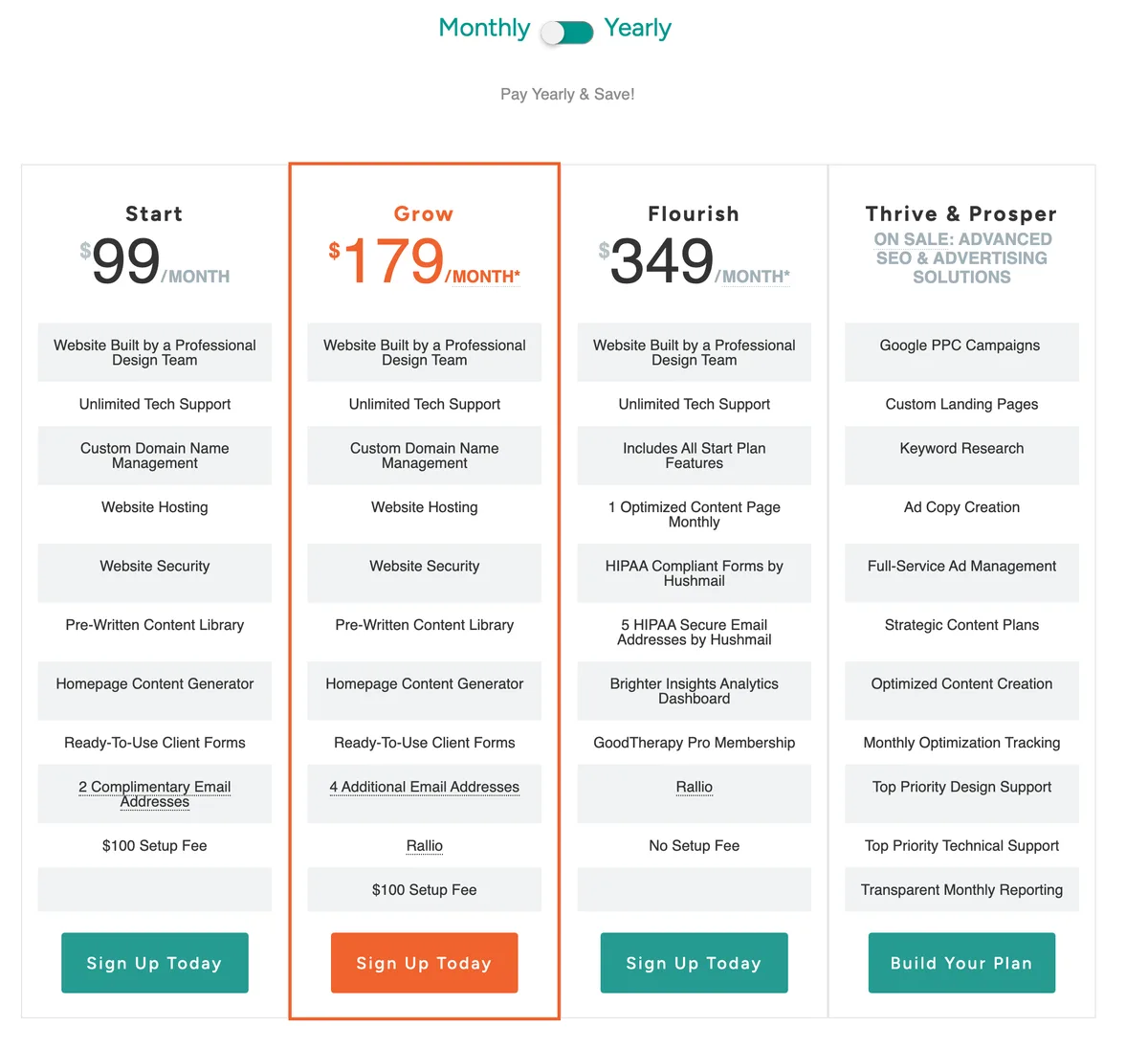
Notice two things before you pick a row. The gap between cheapest and dearest is about five times, and every plan on the chart produces a site a prospective client would call perfectly good. And the number that decides your real annual spend is not on the chart at all, because none of these totals include the channel that actually brings people to you.
The $29.95 line that changes the arithmetic
The cheapest line in this whole comparison is a directory profile, and in our view it is also the one doing the most work. Psychology Today states its price in one sentence on its own signup page: members pay a fixed monthly fee of $29.95, with no contracts and the option to cancel at any time. That membership also includes a telehealth video platform the company describes as free and HIPAA compliant.
The second half of that claim is a judgment rather than a statistic. Nobody publishes a reliable national breakdown of how therapy clients find their clinician, so anyone quoting you a percentage is guessing, and we are not going to add another guess to the pile. What is verifiable is the price, and the price is the part that should worry you.
Set that beside the plans above and the picture inverts. The listing that gets you found costs less than half the cheapest website plan and under a tenth of the dearest one.
The black bars are the two purchases a practice usually makes before it thinks about a website: the directory profile, and practice management software. SimplePractice publishes three plans at $49, $79 and $99 a month, currently with half off the first three months. Its own feature lists for those plans name paperless intake documents, online appointment requests, appointment reminders, electronic claim filing and something it calls a Client Portal website and mobile app. The booking and paperwork half of what people picture a practice website doing is therefore already bought before the website conversation starts.
So the honest framing of the website decision is not what should a therapist website cost. It is what should a therapist website do, given that something cheaper already handles being found and something else already handles booking. That question has a good answer, and it changes what you should be willing to pay.
What the site is actually for
Three jobs, and being found is not one of them.
The first is the second look. Somebody reads your directory profile, then types your name into Google before writing to you, because choosing a therapist is a high-trust decision made by an anxious person. Your site is what they find on that second look, and it is the only version of you they can read without a matching algorithm sitting in between. If it loads slowly on a phone, says less than the profile did, or looks like the template of every other practice in your city, it has cost you the referral rather than earned it.
The second is the referrals you already have. A physician, a school counselor, a former client and a colleague who is full all pass your name along, and none of those people arrive through a directory search. They arrive by typing your practice name. Everything that makes a first session easier to say yes to belongs on that page: your fee, your availability, what the first appointment is like, where to park, whether you use insurance and how.
The third is ownership. A directory profile is rented and the terms can change. A profile on an insurance platform belongs to the platform. Your website and your domain are the only pieces of your practice's presence that no company can reprice or switch off, which is worth something the day a directory raises its rate or your specialty gets crowded. We wrote the long version of that argument in who owns your website.
Judge every price on the chart against those three jobs, and most of the top of the range stops making sense for a solo practice. What the expensive plans really sell is content marketing and social posting, which is a different purchase from a website and deserves to be evaluated as one.
The one page a federal rule puts on your site
If you see any client who is uninsured or paying out of pocket, and most private practices see at least some, a federal regulation requires a specific notice to be on your website and to be findable by a search engine. It is the most concrete website requirement in this article, and not one of the cost guides we read while researching this piece mentions it.
The Good Faith Estimate rules under the No Surprises Act, at 45 CFR 149.610, require a provider to inform every uninsured or self-pay individual that a good faith estimate of expected charges is available. Paragraph (b)(1)(iii)(A) says how: the information must be written in a clear and understandable manner, prominently displayed and easily searchable from a public search engine on the provider's website, in the office, and on-site where scheduling or questions about cost occur. Paragraph (B) adds that it must also be provided orally when someone schedules or asks about cost, and paragraph (C) that it must be available in accessible formats and in the languages your clients speak.
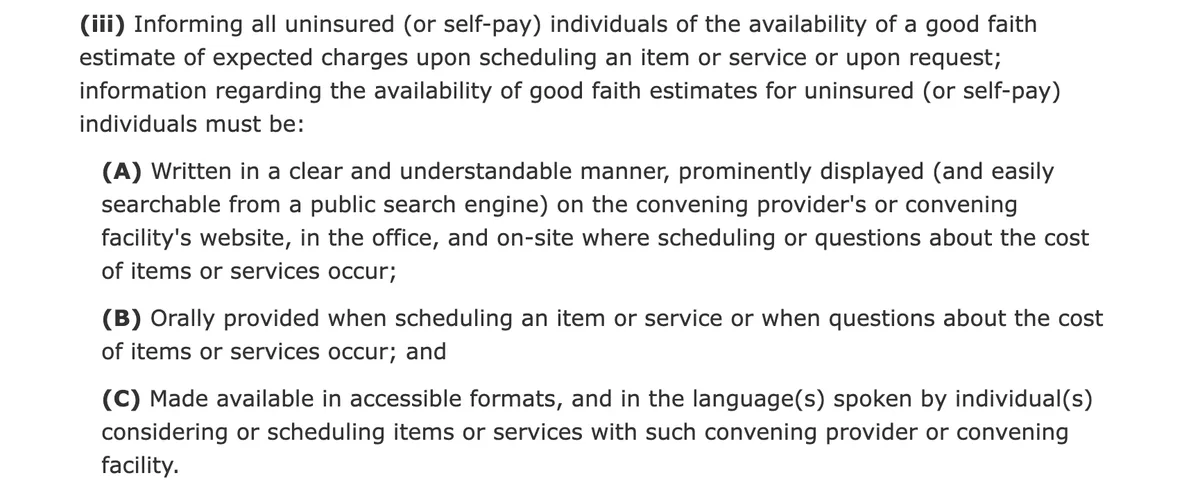
Read the phrase easily searchable from a public search engine again, because it is doing real work. A notice buried in a PDF, hidden behind a form, or dropped into a paragraph on a page that carries a noindex tag does not satisfy it. This is a page that has to exist, be crawlable, and be written plainly. The rule also treats any discussion or inquiry about potential cost as a request for an estimate, so the page saves you administrative time as well as satisfying a regulator.
Two practical consequences for the build. You need a real page, not a footer line, and it should be linked from your main navigation or your fees page rather than orphaned. And whoever builds the site has to leave it indexable, which sounds obvious until you meet a staging site that shipped with search engines blocked.
What your fees page is allowed to say
Fee language on a therapy website is regulated advertising, and the wording most practices reach for is the wording that is specifically ruled out. California's healing arts advertising statute is the clearest example, and it covers everyone licensed under that division of the state's code, therapists and counselors included.
Business and Professions Code 651 makes it unlawful for a licensee to disseminate any public communication containing a false, fraudulent, misleading or deceptive statement likely to induce the rendering of professional services. The definition of public communication in the statute names the Internet and a directory of healing arts practitioners explicitly, so your website and your directory profile are both covered. Subdivision (c) is the one that catches everyday copy: any price advertisement shall be exact, and the statute names the phrases it will not accept, including "as low as", "and up" and "lowest prices".
Put that next to the federal estimate rule and the two point the same way. Publish the actual number. Sixty minutes, this many dollars, sliding scale places available or not. A single exact figure satisfies the state rule, gives the federal notice something to point at, and answers the question that stops most people from writing to you in the first place.
The stock photo rule almost nobody knows
Open a dozen therapy websites and most will show a purchased photograph of somebody who reads as a client. In California that carries a labeling requirement. The same statute, at subdivision (b)(3)(B), says that using a photograph or image of a model without clearly stating in a prominent location in easily readable type that the image is of a model is a violation. A model, for that purpose, is anyone other than an actual patient of the licensee advertising the service.
The rule was written with cosmetic before-and-after advertising in mind, and it sits in a statute that covers every healing arts licensee. Whether an enforcement action would ever follow from a calm stock photograph on a counseling page is a fair question to ask your own board. The design conclusion holds regardless, and it is the one we would give anyway: photographs of real rooms, real light and the actual person doing the work convert better than a stranger looking thoughtful on a sofa. A client is choosing a human being. Show them the human being.
Testimonials, and the box you cannot tick
Social proof is the standard tool for a small service website, and it is largely unavailable to you. A review from a psychotherapy client discloses that the person was in psychotherapy, so asking for one raises a confidentiality problem before it raises an advertising one, and the exact limits sit in your own board's rules and your association's ethics code rather than in anything a web designer can tell you. The same California statute reaches it from the advertising side: a statement or claim is deceptive if it is likely to mislead or deceive because of a failure to disclose material facts, which is exactly what a curated wall of the happiest outcomes does.
The federal layer applies too. Testimonials and reviews on a business website sit under the Federal Trade Commission's 2024 rule and its endorsement guides, which we covered in detail in what you can and cannot publish. The point for a practice is that the usual workaround, a page of five-star quotes with first names, is the wrong tool here.
What replaces it is more work and better material. Write about how you actually practice, including the modalities you use and the ones you do not. Say who you are a poor fit for. Publish a genuine answer to what happens in the first session. Colleagues, physicians and past clients making referrals are reading for competence and fit, not for stars.
Read the add-on list to learn what the base plan is not
Both website vendors price HIPAA features as extras, and that pricing is the most useful disclosure on either page. Brighter Vision sells HIPAA compliant email at $14.99, $19.99 and $24.99 a month, or $165, $220 and $275 a year, and its HIPAA compliant forms arrive with the $349 Flourish plan rather than the cheaper ones. TherapySites prices secure emails and forms from $15 a month on top of any plan.
Which tells you the thing to check before you sign anything: an ordinary contact form on an ordinary website is not a secure channel, and a prospective client will absolutely type clinical detail into it. Either the form goes to a compliant vendor, or the form asks for a name and a phone number and nothing else, with a line saying not to include health information. Both are defensible. A standard form with a message box and no agreement in place is not.
Note also that no website is certified compliant. TherapySites lists HIPAA compliant and ADA friendly as Core features, and both phrases describe an intention rather than a certificate that exists. Nobody certifies a website against either standard, a point we made at length about accessibility and about HIPAA. Ask instead for the specifics: who signs a business associate agreement, where form submissions are stored, and whether the site has ever been tested with a keyboard and a screen reader.
Where you are allowed to say you practice
A service area page is standard practice for a local business site, and for a licensed clinician it is a compliance question rather than a marketing one. This is also the fastest moving fact in this article.
The Counseling Compact is switching on one state at a time. Its own status notice, updated 30 July 2026 when Arkansas joined, lists it as live in Arkansas, Arizona, Georgia, Indiana, Louisiana, Minnesota and Ohio. A counselor licensed in and residing in one of those states can apply for the privilege to practice in the others. The same page says 31 additional states and the District of Columbia are working through the steps needed to issue and recognize privileges.
So the copy on your site has a shelf life. If you are licensed in a live compact state, your reach genuinely changed this summer and your website should say so. If you are not, writing that you serve clients across several states is a claim your board may read differently than your marketing did. Date that page, put the states in a list rather than a sentence, and put a reminder in your calendar to re-check it while this is still moving.
What this costs next to what you earn
The prices in this article are small numbers to an agency and large numbers to a solo clinician, so it is worth putting them beside the income of the people paying them. Federal wage data settles the comparison. The May 2025 occupational survey counts 491,930 substance abuse, behavioral disorder and mental health counselors earning a median of $59,350 a year and a mean of $64,440. Alongside them are 132,810 mental health and substance abuse social workers at a $60,280 median, 66,740 marriage and family therapists at $66,940 with a mean of $76,960, and 75,990 clinical and counseling psychologists at $100,580 with a mean of $112,750.
Against a $59,350 median for a mental health counselor, the $69 a month plan is roughly one and a half percent of a year's wage and the $349 plan is about seven percent. That is the real decision. Seven percent of gross earnings, every year, indefinitely, for a website plus content and social posting that a practice with a full caseload may not need at all.
The same numbers explain why the subscription model dominates this niche. A one-time build is a difficult purchase on a counselor's income, and $69 a month is an easy yes. That is a legitimate service and for many practices it is the right call. It is worth knowing that you are choosing to pay indefinitely for something that could be bought once.
What we would spend, in order
For a solo or small group practice, the sequence matters more than the vendor.
Start with the directory profile, because at $29.95 it is the cheapest client acquisition in this article and, in our experience, it outranks a brand new practice website for the searches that matter. Write it properly. Specific presenting problems, a real photograph, the fee, and availability that is actually current.
Then buy or build a site you own, once, with a small and honest set of pages: who you are, what you treat, what it costs, the good faith estimate notice, how to start, and where you are licensed. Six to eight pages that answer real questions beat a twenty page template every time. At published rates that is somewhere between about $830 for a year of the cheapest hosted plan and a few thousand dollars for a build.
Only then consider content. The $349 tier buys you one optimized page a month. Written well by somebody who understands clinical nuance, that can compound into real search traffic over a year or two. Written as filler, it is a subscription to nothing. Ask to read three articles the vendor produced for other clients before you agree to it, and judge them the way you would judge a colleague's writing.
Ads come last, if at all. TherapySites prices Google Ads management from $600 a month plus setup, before a dollar of ad spend. For a practice with a waiting list that is money burned, and for one with empty slots it is worth testing only after the profile and the site are doing their jobs.
Our numbers, and the practices we are wrong for
Our own two prices sit on the pricing page so nobody has to sit through a call to hear a figure: $1,499 flat for a build you own, and $2,499 a month when there is continuing work to do. Most focused builds take about two weeks from kickoff to launch. Email us and you will hear back within 48 hours. There is more on how we approach this field on our mental health page. Outside private practice, the outcome we can point to is a treatment center rebuild: Cornerstone Healing Center ended up with 20% more website conversions.
Now the honest part. A solo practice with a full caseload and a working directory profile does not need us, and probably does not need a new website at all. If $69 a month is the shape of spending that fits your cash flow, a hosted therapist plan is a reasonable purchase and we are not going to pretend otherwise. And if what you want is somebody writing a clinical blog every month and running your social accounts, hire a marketing service built for this field, because that is their product and it is not ours.
The work we are good at begins where the website itself is the bottleneck: a group practice whose clinicians cannot be found individually, a niche practice that needs the site to do the explaining the directory cannot, a rebuild where the previous vendor holds the domain, or a practice adding services where the site has to grow rather than be replaced again.
The arithmetic that settles it, using your own numbers
Every number in this article becomes decidable when you put it next to your session fee, which is a figure only you have. Do this on paper in five minutes.
Write down your standard fee for a fifty minute session. Multiply it by the average number of sessions a client completes with you, which you can get from your own records, and you have the value of one new client. Now take the annual cost of each option in the table, and divide.
Say a client is worth roughly a thousand dollars over their course of work. The $828 plan needs to bring you one client a year to have paid for itself. The $4,188 plan needs four and change, every year, on top of what the directory was already sending you. A $1,499 build needs one and a half in the first year and nothing at all in the second.
Then ask the question that number cannot answer on its own: where did your last ten clients actually come from? If the answer is the directory and word of mouth, spend accordingly and keep the website small, sharp and owned. If the answer is that people found you by searching and read three of your pages before writing, the case for the bigger plan just got made with evidence rather than a sales call.
Frequently asked questions
Between about $830 and $4,200 in the first twelve months on plans vendors publish openly. The floor is TherapySites Core at $69 a month with no required setup fee. Brighter Vision runs $99, $179 and $349 a month billed monthly, or $78, $143 and $299 billed annually, with a $100 setup fee on the two cheaper plans. A one-time build you own outright is a different purchase: ours is a flat $1,499 and then only hosting. Almost none of the price difference is design work. It is bundled marketing services.
 Healthcare
Aug 3, 2026 · 14 min
HIPAA Compliant Website: What Your Practice Actually Has to Do in 2026
There is no HIPAA certificate for a website. There are four narrow places where the rules actually bite, a tracking-script problem that has cost health companies millions, and an accessibility deadline that quietly moved in May 2026.
 Healthcare
Jun 10, 2026 · 7 min
Healthcare Website Design: 10 Principles That Build Trust and Bookings
In healthcare, trust is the conversion. These ten design principles help clinics and practices turn anxious visitors into booked patients.
 Development
Aug 15, 2026 · 14 min
How Much Should an HVAC Company Website Cost in 2026?
Published plans for HVAC websites run from about $3,000 to $28,000 in the first year. Here is what each one buys, why the site is the cheapest thing most agencies sell you, and the Google change hitting contractors this month.