
Most owners ask what Google Ads costs and get one number back: a click price, or an agency retainer, or a monthly budget someone else spends. For an addiction treatment center the bill has more lines than that, and one of them decides whether you are allowed to advertise at all.
This guide adds up every line for a US treatment center in 2026: the certification you need before your first ad, the fee someone charges to run the account, the money Google keeps, and what the benchmark data says each inquiry costs. It also covers the rules that take the cheapest tactics off the table for rehabs, and who should not run Google Ads yet.
How we researched this. On 26 November 2026 we read Google's Addiction services policy and its Healthcare and medicines country rules, LegitScript's Addiction Treatment Certification FAQ and pricing table, Meta's drug and alcohol addiction treatment ad policy, Google's rules on targeting sensitive interest categories, and the HHS Office for Civil Rights bulletin on tracking technologies. We took click and lead costs from LocaliQ's healthcare search benchmarks, the newest published set we could find with an addiction recovery line. Then we read the paid search pages of 25 agencies that sell Google Ads to treatment centers (the 21 named in a 2026 published roundup of rehab Google Ads agencies, plus SEO Brand, Sagapixel, Ignite Digital and WebFX) and wrote down every management fee and every click-cost claim they print.
The 30-second answer: what Google Ads costs a US treatment center in 2026
Budget three things. First, LegitScript certification, which Google requires before a US addiction treatment provider can advertise: $1,595 per facility to apply and $3,095 per facility a year once approved, so $4,690 for one facility in year one. Second, management: of the 25 agencies we checked, the four that print a Google Ads fee start at $600, $1,250, $1,500 and $3,000 a month. Third, ad spend, paid to Google: agencies recommend at least $5,000 a month, and LocaliQ's median addiction recovery campaign paid $120.30 per lead. A single-facility center should plan on roughly $6,250 to $8,000 a month, all in, plus certification.
What are the four costs of running Google Ads for a rehab?
There are four, and most quotes show you one or two of them.
- Permission. LegitScript certification for your facilities, then Google's own approval to advertise healthcare in each country you target. Without both, ads for addiction treatment do not run.
- Management. The fee to an agency or the salary of someone in house who builds the campaigns, writes the ads, sets bids, watches the search terms and reports. Usually monthly.
- Media. What Google charges for the clicks. It is billed by Google to your card, separately from the management fee, at every agency we read that said where spend goes.
- The page and the tracking. The landing page the ad sends people to and the call and form tracking that tells you which searches turned into admissions. Some agencies bundle this; most bill it as a project or leave it to you.
The fourth line is the one owners skip, and it is the one that decides whether the third line is money or waste. A paid click on a slow, vague admissions page still costs the full click price.
Who is allowed to advertise addiction treatment on Google?
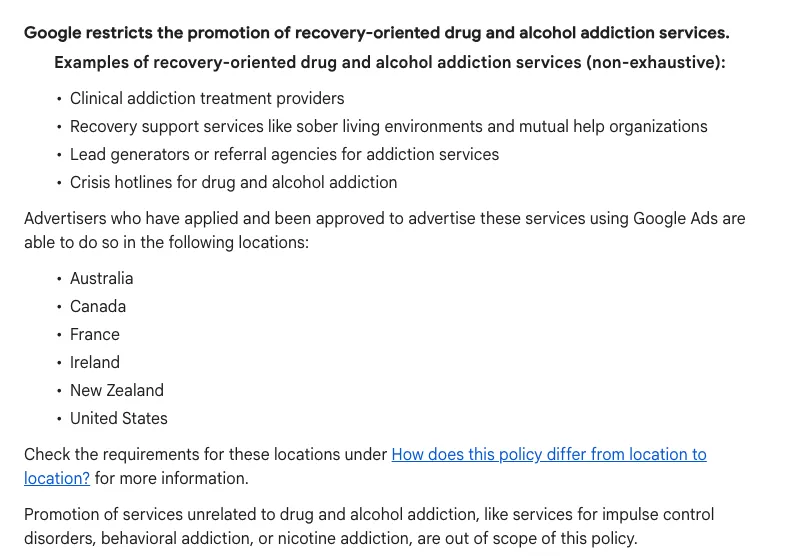
Only certified providers in six countries. Google's Addiction services policy, read on 26 November 2026, restricts ads for recovery-oriented drug and alcohol addiction services and lists four kinds of advertiser it covers: clinical treatment providers, recovery support services such as sober living and mutual help groups, lead generators or referral agencies, and crisis hotlines. Approved advertisers can run these ads in Australia, Canada, France, Ireland, New Zealand and the United States.
 Open full size
For the United States, Google's Healthcare and medicines policy spells out the gate. To advertise recovery-oriented drug and alcohol addiction services you must be certified as an addiction services provider by LegitScript, and advertisers must also be certified with Google. The same page says that services not eligible for LegitScript certification are not allowed to advertise for drug and alcohol addiction services on Google at all.
That second sentence is where some business models stop. LegitScript's certification FAQ lists who is generally not eligible, and the list includes:
- sober living homes, sober retreats and other non-clinical recovery residences;
- peer support programs, peer recovery coaching, sober coaching and sober transportation;
- lead generation websites and referral services that send patients to providers for a fee;
- assessment-only services that evaluate but do not treat;
- providers treating outside the United States or Canada.
So a sober living home cannot buy its way onto the page for "sober living near me" through Google's addiction services route, however good its website is. Its marketing has to come from organic search, Google Business Profile, referral relationships and direct outreach. We covered those routes in rehab marketing without buying leads.
Clinical providers have a wide lane. LegitScript lists outpatient, inpatient and residential, telehealth, licensed in-home and concierge clinical care, and co-occurring or dual diagnosis programs as eligible, along with credentialed in-person interventionists, mutual support groups and crisis hotlines that do not steer callers to specific facilities.
Two practical notes from the policy pages. Google says a violation of this policy will not suspend an account without warning: it issues a warning at least 7 days before suspending. And a corrected ad is re-reviewed automatically, which Google says typically takes 24 to 48 hours. Neither is a reason to launch first and fix later, but both mean one disapproval is not the end of an account.
How much does LegitScript certification cost in 2026?
$4,690 for one facility in its first year, at standard pricing. LegitScript's FAQ, read on 26 November 2026, prices addiction treatment certification per facility: organizations with 1 to 9 facilities pay a $1,595 application fee and a $3,095 annual certification fee for each one. The annual fee is due only if the application is approved. The application fee is not refunded.
| Pricing tier | Application fee | Annual fee | Who qualifies |
|---|---|---|---|
| Standard | $1,595 per facility | $3,095 per facility | 1 to 9 facilities |
| Individual Practitioner | $535 | $1,070 | Three or fewer client-facing practitioners, one location, one website, no affiliation with a larger treatment organization |
| Enterprise | Not published | Not published | 10 or more facilities, on a separate pricing model |
Standard
- Application fee
- $1,595 per facility
- Annual fee
- $3,095 per facility
- Who qualifies
- 1 to 9 facilities
Individual Practitioner
- Application fee
- $535
- Annual fee
- $1,070
- Who qualifies
- Three or fewer client-facing practitioners, one location, one website, no affiliation with a larger treatment organization
Enterprise
- Application fee
- Not published
- Annual fee
- Not published
- Who qualifies
- 10 or more facilities, on a separate pricing model
LegitScript decides the Individual Practitioner tier during enrollment; you cannot select it. Its FAQ is blunt that part-time practitioners and locations that open on alternating days do not count as exceptions.
First-year LegitScript cost, application plus annual fee
- Individual Practitioner$1,605
- One facility, standard$4,690
- Three facilities, standard$14,070
- Nine facilities, standard$42,210
Three details change the arithmetic for groups. A facility added within six months of your renewal date gets its first annual fee cut by 50 percent, according to the same FAQ. Facilities under common ownership go on one application and one payment method. And Google's own policy page notes that LegitScript fee waivers may be available in certain circumstances, so a small nonprofit should ask before paying.
What certification does not buy is just as important. LegitScript's FAQ says its certification may be required for certain advertising programs "but it does not guarantee advertising approval." Google still runs its own review, and Google still reviews every ad and landing page. Our walk-through of what LegitScript reviews on your website covers the pages that most often hold an application up, and our free LegitScript readiness check scores your own site against the same list.
Do Meta and Microsoft ask for the same thing?
Meta does, with its own permission step on top. Meta's ad standard for drug and alcohol addiction treatment, read on 26 November 2026, requires advertisers targeting people in the United States to be certified with LegitScript and to apply to Meta for written permission. It covers in-person treatment, addiction hotlines, mutual support groups and online treatment such as recovery apps.
LegitScript's FAQ lists Google, Meta and Microsoft Bing as the major platforms its certification opens, each subject to its own advertising policies. In practice one LegitScript certificate is the entry ticket for all three, and each platform then has its own application or permission step.
What does a click and a lead cost for addiction treatment?
On the largest public benchmark, less than you have been told per click and more than you would like per lead. LocaliQ's healthcare search advertising benchmarks, last updated 13 January 2026, studied 3,542 US search campaigns that ran between 1 October 2024 and 30 September 2025, with at least 43 campaigns in each of 16 specialties. Its figures are medians.
- Addiction recovery campaigns had a median cost per click of $3.46 in LocaliQ's 2024 to 2025 data, among the three lowest of the 16 specialties.
- Addiction recovery had a median cost per lead of $120.30, up 77 percent on the year before, according to LocaliQ.
- Addiction recovery had a median conversion rate of 0.50 percent, the lowest of all 16 specialties, and down 87 percent year over year in LocaliQ's data.
- Addiction recovery ads drew a median click-through rate of 4.57 percent, against 6.07 percent for healthcare overall, LocaliQ reported.
- Mental health was the most expensive specialty per lead in LocaliQ's set, at a median $141.17, with cost per lead up 146 percent year over year.
Median search cost per lead, US healthcare, 2024 to 2025
- Mental health$141.17
- Addiction recovery$120.30
- Plastic and cosmetic surgery$102.51
- General dentistry$84.77
- Healthcare, all 16 specialties$66.02
- Dermatology$18.54
Two cautions before you put these numbers in a spreadsheet. Each metric is a separate median across campaigns, so you cannot multiply the median click price by the median conversion rate and get the median lead cost; the campaigns at the middle of one list are not the ones at the middle of another. And a benchmark built from a large advertising vendor's book of accounts leans toward smaller, local campaigns. A center bidding on "drug rehab" in Los Angeles is not the median account.
The honest reading is directional. Treatment center clicks are not unusually expensive on average, but very few of them turn into an inquiry, and that gap got wider in the year LocaliQ measured. The cost problem in rehab advertising is mostly a conversion problem.
Why do agencies quote $40 to $200 a click?
Because they are describing a different slice of searches, and nobody can audit their number. Two of the agency pages we read print click-cost claims for rehab, and both sit far above the benchmark.
- Webserv's paid search page says most addiction treatment PPC programs spend $25,000 to $80,000 a month, with clicks averaging $40 to $200 depending on geography and level of care.
- Behavioral Health Partners' PPC page cites a $185 reported cost per click for keywords like "alcohol rehab near me" in 2024, and says industry analyses put the lowest viable budget for rehab Google Ads at $10,000 a month.
Cost per click: the benchmark against what agencies print
- LocaliQ median, addiction$3.46
- LocaliQ median, mental health$4.22
- LocaliQ median, healthcare$5.64
- Webserv, low end of range$40
- BHP, "alcohol rehab near me"$185
- Webserv, high end of range$200
The agencies' high end is 58 times the LocaliQ median. Both can be true at once. A median across every addiction campaign includes cheap clicks on a center's own name, outpatient searches in small towns and informational phrases. A residential program bidding on "rehab near me" in a dense metro against national operators is buying the most contested clicks in the category, and those are the ones agencies with big-budget clients quote.
What follows for your budget: ask any agency which of these two worlds your account will live in, and to show you bid estimates for your own market and your own keywords before you agree to a spend level. A quote built on a national average for someone else's city is a guess.
What do agencies charge to manage rehab Google Ads?
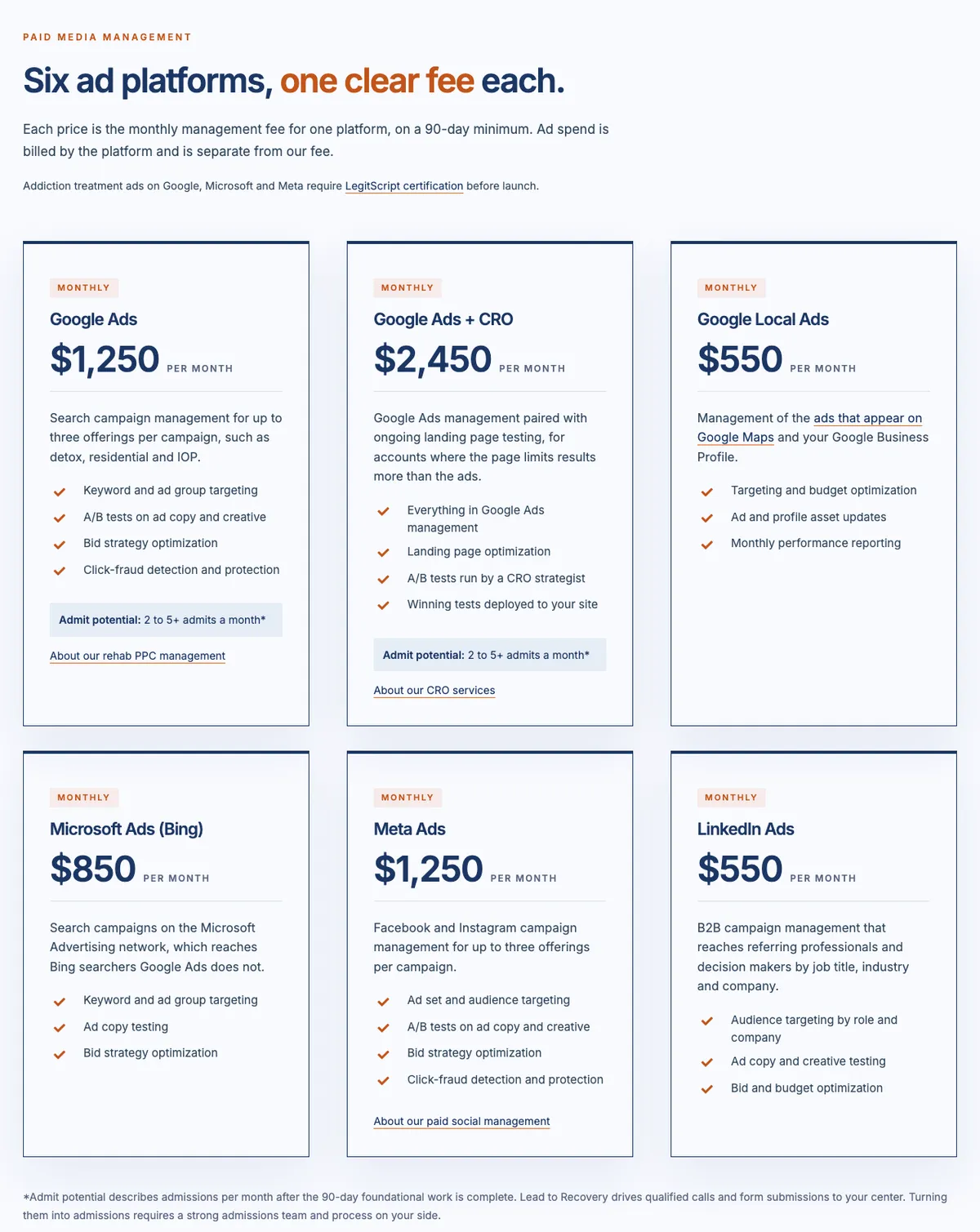
Of the 25 agencies we checked on 26 November 2026, four print a Google Ads management fee. Three sites would not fully load for us, so that is 4 of the 22 we could read in full. The rest ask you to book a call.
| Agency | Published management fee | Terms they print |
|---|---|---|
| Enlightened Media | From $600 a month | No setup fee; 3-month start, then month to month; ad spend paid directly to the platforms; Meta or Microsoft Ads add $300 a month each |
| Lead to Recovery | $1,250 a month for Google Ads; $2,450 with landing page testing | Per platform, 90-day minimum, up to three offerings per campaign; ad spend billed by the platform |
| The Influence Agency | From $1,500 a month | Tiered fees of 15% of spend over $10,000, 11% between $50,000 and $75,000, and 10% at $75,000 and above |
| Direct Online Marketing | From $3,000 a month, flat | Never a percentage of spend; recommends at least $5,000 a month in Google Ads spend |
Enlightened Media
- Published management fee
- From $600 a month
- Terms they print
- No setup fee; 3-month start, then month to month; ad spend paid directly to the platforms; Meta or Microsoft Ads add $300 a month each
Lead to Recovery
- Published management fee
- $1,250 a month for Google Ads; $2,450 with landing page testing
- Terms they print
- Per platform, 90-day minimum, up to three offerings per campaign; ad spend billed by the platform
The Influence Agency
- Published management fee
- From $1,500 a month
- Terms they print
- Tiered fees of 15% of spend over $10,000, 11% between $50,000 and $75,000, and 10% at $75,000 and above
Direct Online Marketing
- Published management fee
- From $3,000 a month, flat
- Terms they print
- Never a percentage of spend; recommends at least $5,000 a month in Google Ads spend
WebFX publishes a market guide rather than its own price, saying professional PPC management usually runs 10 to 20 percent of ad spend or $1,000 to $3,000 a month. We left it out of the count.
 Open full size
One finding from doing this twice. When we read the same agency's pricing page for our guide to choosing a treatment center marketing agency on 30 September 2026, its PPC management started at $1,000 a month. Eight weeks later the Google Ads line reads $1,250. Published prices in this niche move, and quotes older than a quarter are worth rechecking.
The fee structures also hint at how each shop thinks. A percentage of spend rewards the agency for spending more of your money. A flat fee rewards it for keeping you. Neither is wrong, but on a percentage model, ask what happens to the fee when the right answer is to cut spend.
What do the targeting and tracking rules take off the table?
The cheapest tactics in most industries, retargeting lists and pixel-fed audiences, are restricted or risky for a rehab.
Google's personalized advertising policy, read on 26 November 2026, lists Health and Restricted drug terms among its sensitive interest categories, and says advertisers promoting products and services in those categories cannot use advertiser-curated audiences. In plain terms: you should not plan a funnel that follows last week's website visitors around the internet with a "still thinking about treatment?" ad.
Tracking carries its own risk. The HHS Office for Civil Rights bulletin on online tracking technologies says regulated entities may not use tracking in a way that discloses protected health information to vendors, and that disclosing it to tracking vendors for marketing without HIPAA-compliant authorization would be impermissible. On 20 June 2024 a federal court in Texas vacated one part of that guidance, the part about connecting an IP address with a visit to an unauthenticated public page about a health condition, and HHS says it is evaluating next steps. The rest of the bulletin stands. This is not legal advice: if you are a HIPAA covered entity, have counsel look at what your ad tags and forms send before launch.
The practical setup most centers land on is conversion tracking that records that a call or a form happened, without sending what the person typed, plus call tracking that measures calls by campaign. That still lets the account learn which searches produce admissions. It also tends to be what an honest agency builds first, before spending a dollar on media.
How should a single-facility center budget its first year?
Add the four lines, using your own numbers where you have them. The table below uses only figures printed by the sources in this article, so treat it as a starting frame, not a forecast.
| Line | Lean example | Fuller example |
|---|---|---|
| LegitScript, one facility, year one | $4,690 | $4,690 |
| Management, 12 months | $15,000 (at $1,250 a month) | $36,000 (at $3,000 a month) |
| Ad spend, 12 months | $60,000 (at $5,000 a month) | $120,000 (at $10,000 a month) |
| Year-one total before the landing page | $79,690 | $160,690 |
LegitScript, one facility, year one
- Lean example
- $4,690
- Fuller example
- $4,690
Management, 12 months
- Lean example
- $15,000 (at $1,250 a month)
- Fuller example
- $36,000 (at $3,000 a month)
Ad spend, 12 months
- Lean example
- $60,000 (at $5,000 a month)
- Fuller example
- $120,000 (at $10,000 a month)
Year-one total before the landing page
- Lean example
- $79,690
- Fuller example
- $160,690
Then test the spend line against your admissions math. At LocaliQ's median addiction recovery cost per lead of $120.30, $5,000 a month buys about 41 leads. What matters is how many of those become admissions, and only your intake records can say that. Divide the monthly cost (management plus spend) by your expected admissions to get a cost per admission, and compare it with what an admission is worth to you after insurance or self-pay. Behavioral Health Partners' PPC page, for reference, says out-of-network facilities report paying $7,500 or more per admission from paid channels, and in-network providers can get to $6,000 or under. That is one agency's figure, not a benchmark, but it is the right unit to argue in.
If the arithmetic only works when your lead-to-admission rate doubles, fix the intake process and the landing page first. Our guide to the insurance verification page covers the page that most often decides whether a paid click becomes a call.
When is Google Ads the wrong first dollar?
More often than agencies say. Hold off if any of these describe you.
- You are not eligible. Sober living, peer coaching and lead generation cannot get LegitScript addiction treatment certification, so Google's addiction services route is closed to them.
- Your certification is not in hand. Building campaigns before approval is fine; budgeting revenue from them is not. LegitScript reviews your licensure, your services and your websites, and approval takes as long as your paperwork does.
- Nobody answers the phone at night. Paid clicks keep coming at 2 a.m. An unanswered call is the most expensive line in the account.
- The page cannot convert. If the landing page loads slowly on a phone, hides the phone number or never says which insurance you take, the median 0.50 percent conversion rate is a ceiling you will not reach.
- The budget cannot fund a real test. Agencies in our set recommend at least $5,000 a month in spend, and one cites industry analyses that put the floor at $10,000. Below that, organic search and your Google Business Profile usually return more per dollar, and they keep working when you stop paying.
Where KhanWork fits
KhanWork, the marketing team for healthcare practices and treatment centers, runs Google and Meta ads on one plan: Scale Partner, at $5,000 a month with no minimum term, pause or cancel anytime. That covers campaign setup, budgets and weekly optimization, a landing page built for every campaign and tested every week, and a weekly strategy call. Ad spend is not included in any plan; you pay Google and Meta directly, from accounts you own. The details are on our Google and Meta ads page.
Be clear about the comparison. Scale costs more than every Google Ads management fee in the table above, because it is a whole marketing team (pages, tests, SEO and content alongside the ads), not a PPC desk. If all you need is someone to run spend against a page that already converts, a PPC specialist is the cheaper and better hire.
Two cheaper starting points exist. Growth Partner, at $2,500 a month, does not manage ads, but it builds the pages, SEO and monthly tests that make ads worth buying later, and Growth and Scale both carry our one written guarantee: if the landing page does not beat your baseline inquiry rate within 90 days, we keep working on it at no charge until it does (for clients who stay through the 90 days from launch; a pause pauses the window). And a one-time Foundation landing page, $1,000, goes live in 14 business days from the day your content and assets land, with every page checked against what Google, Meta and LegitScript review and call and form tracking installed with a recorded baseline. Certification itself stays between you and LegitScript.
We have shipped more than 200 projects and worked with five treatment centers; after our redesign, Cornerstone Healing Center saw 20 percent more website conversions. You can see more on our addiction treatment page. Before any of that, our free review is a quick way to see where you stand: we look at the page your patients actually land on, usually the homepage or whatever your ads point at, and name the first thing we would change before you pay for another click.
Five numbers to bring to any Google Ads call
Whoever you talk to, walk in with these written down. A good agency will ask for them; a weak one will quote without them.
- Facilities and certification status. How many locations, and whether each is LegitScript certified, applied, or not started. This sets your year-one permission cost before anything else.
- Admissions per month and where they come from today. Even a rough split between referrals, organic search and phone calls tells you what ads must add.
- Lead-to-admission rate. Out of every ten calls or forms, how many admit. If you do not know, find out before you buy clicks.
- Value of an admission. After insurance or self-pay, what one admission is worth. This is the ceiling on what a lead can cost.
- Monthly ceiling, all in. Management plus spend, the number you can hold for at least 90 days. Ads need weeks of data to learn; a budget that runs out in month two buys nothing.
With those five on the table, the conversation is about your market and your intake, not about someone else's average.