
How Much Should a Real Estate Website Cost in 2026?

Aug 12, 2026 · 14 min read
Ask what a real estate website costs and you will get a range with no arithmetic behind it. The people publishing those ranges are almost always selling one of the things inside them, and the line that gets treated as the scary one, the fee your multiple listing service charges to hand over its listings, turns out to be the smallest number on the invoice. For most agents it is not a number at all.
So this is built the other way around. Every figure below is a price a named company prints on its own page, or a count taken from a directory anyone can open. We sell websites, which makes us an interested party, and the section near the end says plainly who should buy from someone else. All prices were read on 12 August 2026 and are linked where they appear.
The 30-second answer
A working real estate website in 2026 costs between roughly $700 and $9,200 in its first twelve months of software, and where you land inside that has almost nothing to do with design. The listings feed itself is cheap: roughly two thirds of United States multiple listing services charge nothing to send data to your site, and the highest fee published in the directory we read is $30 a month. What moves the total is the platform subscription, which runs from $59 to $724.95 a month at published rates, plus a one-time setup fee of $0 or $500 depending on how you pay, plus advertising packages that cost more than everything else combined. Design and build sit on top of that as a separate purchase.
Four separate purchases hiding behind one question
The confusion in this market comes from bundling. Four different things get sold as "a real estate website", and their prices have nothing to do with each other.
- The listing data. Permission from your MLS to publish its listings, delivered as an IDX feed. Priced by the MLS, usually per website per month.
- The software that displays it. A plugin bolted onto a site you already have, or a hosted platform that is the site. This is the recurring bill people remember.
- The site itself. Design, copy, structure, speed, the pages that are not search results. Sold as a project, a template, or thrown in free with the subscription.
- Traffic. Advertising packages, lead guarantees, ad management fees. Not a website expense at all, but it usually arrives on the same invoice.
Price them separately and the decision gets easy. Price them as one number and you will overpay for the two that are cheap in order to get the two that are not.
The MLS data fee is the smallest line, not the biggest
Start with the number everybody gets wrong, because getting it right removes most of the fear from this decision. Cost guides quote a single blended "IDX service fee" and let you assume the multiple listing service is behind it. Luxury Presence, which sells real estate websites and says so, puts that recurring fee at between $50 and $200 per month in 2026, with a one-time IDX setup running from $200 to more than $2,000. Its overall verdict is that an IDX website in 2026 typically costs from $250 to $1,500 or more per month.
That blend hides three separately priced things, and the one people fear most is the cheapest of them. The MLS's own share is published. One IDX vendor, Showcase IDX, runs an open coverage directory with a page for every MLS it connects to, and each page prints the subscriber's share of that MLS's data fee. Reading all 343 active United States entries gives a clean picture.
Two hundred and twenty-four of the 343 charge nothing at all. Seventy charge $5 a month, thirty-seven charge $10, and only twelve charge more than that. The single highest figure in the set is the $30 a month that Northwest MLS in Washington charges, and it bills per team rather than per website. The median MLS in this directory charges zero.
Size does not predict the fee either, which is worth knowing before anyone tells you a large market is expensive. Bright MLS, listed with 98,910 agents across the Mid-Atlantic, charges nothing. Stellar MLS in Florida, listed with 64,893, charges nothing. California Regional MLS, the largest in the set at 120,142 agents, charges $10.

Two caveats keep this honest. This is one vendor's directory, and the fee it lists is what that vendor passes through to you, so a different provider may present the same MLS differently. Showcase's own pricing page puts the range at $0 to $33 a month and says that although rates vary slightly, 99% of IDX companies charge these fees. And some MLSs charge the agent directly for feed access, separately from anything a vendor collects, which is a question for your board rather than your web developer.
The practical instruction is short. Look up your own MLS before you budget anything. If you were working from a $50 to $200 a month figure, the MLS's part of it is very likely zero, and over three years that gap is larger than the cost of a decent website.
What the platforms charge to run the site
Here is where the money actually goes. The software that turns a data feed into a searchable website is sold by subscription, and the published range is wide enough that the same job can cost twelve times more depending on what else is bundled in.
At the bottom, Placester sells a hosted site from $59 a month for Agent Essential, $79 for Agent Plus and $129 for Agent Premier, with 20% off for annual billing, no contracts and a fourteen day trial. Extra IDX feeds are $25 a month each.
In the middle sits the plugin approach. Showcase IDX charges $94.95 a month for Essentials and $124.95 for Premium, with no setup fee, or $949.50 and $1,249.50 paid yearly, which is two months free. It is a WordPress plugin, so it assumes you have a site already. That assumption is the entire cost difference between this row and the next one.
At the top are the all-in-one platforms. Real Geeks charges $399 a month plus a one-time $500 setup fee, includes two users, and adds $10 per MLS board per month for feeds. Sierra Interactive publishes two columns: on an annual subscription its packages start at $299.95, $399.95 and $599.95 a month, and month to month the same three are $359.95, $474.95 and $724.95. One MLS feed is included and additional feeds are $25 per site each month.
Compare what you get, not the number. The $59 plan and the $724.95 plan both put listings on a website. The gap is a customer relationship manager, lead routing, automated messaging, seats for a team and an onboarding program. If you have a team of five and no CRM, the top of that chart is defensible. If you are one agent with a phone and a spreadsheet, $724.95 a month is $8,699.40 a year for features you first heard named during a demo.
Setup fees, contract terms and the price of leaving
The monthly figure is not the whole subscription. Three other numbers sit around it, and only one of them appears in most comparisons.
Setup fees depend on how you pay rather than what you get. Sierra charges $0 to set up an annual subscription and $500 to set up the same thing month to month. Real Geeks charges $500 once, on top of the $399. Showcase IDX and Placester both charge nothing, and Showcase says so in as many words: there are no setup fees or long term contracts.
Commitment length is the second. Real Geeks offers six month, twelve month and annual terms, and its lead guarantee is written against the full length of the term rather than any single month. Showcase IDX sells a monthly plan you can leave with thirty days notice, or a yearly plan at two months off, and if you leave the yearly plan early you get a prorated refund minus a $200 early cancellation fee. Placester says it has no contracts and includes a fourteen day trial.
The third number is the one nobody looks for. Real Geeks states that if it bought your domain for you, moving that domain to a website it does not host costs $50. Fifty dollars is nothing. Discovering the clause during a migration, when your listings are down and your email is routing through somewhere you no longer control, is not nothing. We wrote a whole piece on who owns your website because that clause has a hundred cousins.
Most of a big real estate bill is advertising
The subscriptions above are the small half of a big real estate bill. The large half is advertising, sold beside the software and priced per month so that it reads like part of the same product.
Real Geeks sells three lead packages: a social package running Facebook and Instagram listing ads at $299 a month, a search package running Google and Bing property search ads at $599, and a seller package running Google valuation ads at $599. Sierra takes a different shape, offering managed Google Ads to customers with a minimum ad spend of $500 a month and charging a 10% monthly management fee on top.
What makes Real Geeks unusually worth studying is that it publishes the guarantee behind those prices, which means you can do arithmetic instead of guessing.
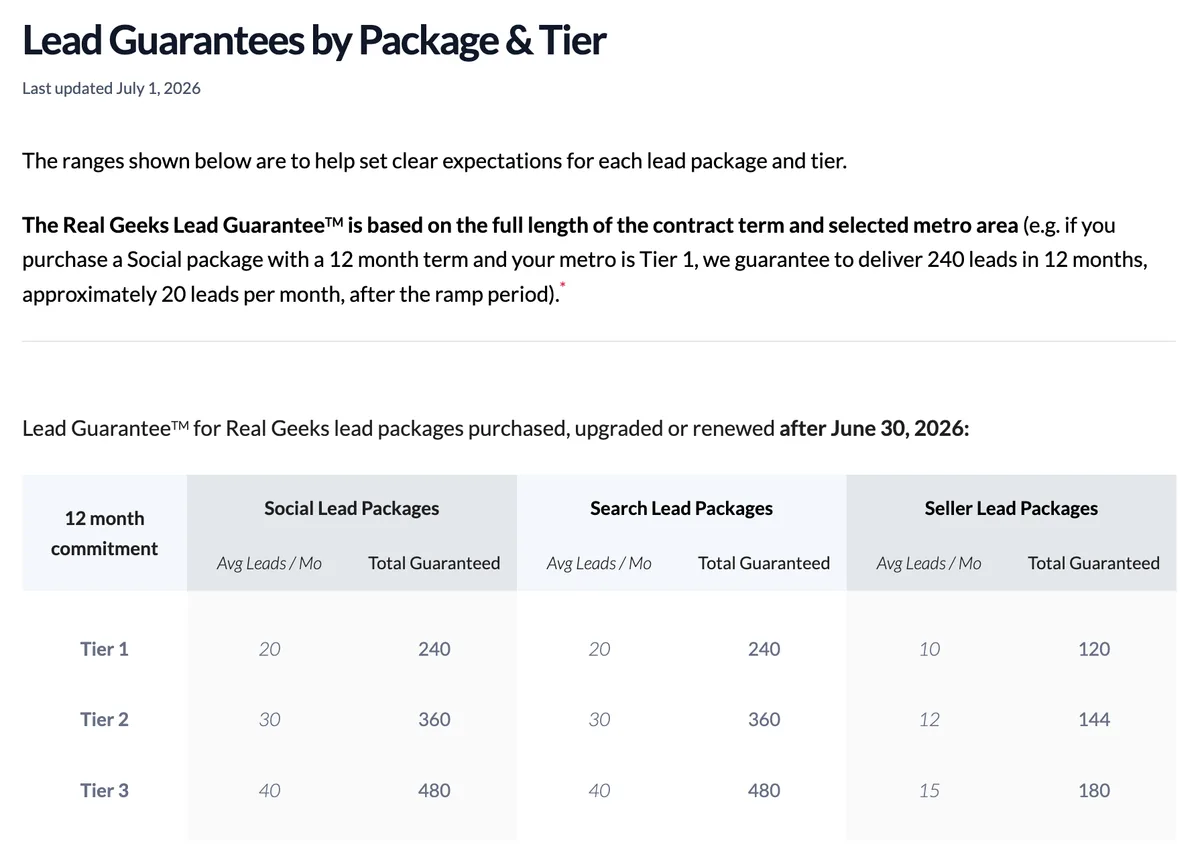
Divide one by the other and the advertising line becomes legible. The social package at $299 a month guarantees twenty leads a month in a Tier 1 metro, which is $14.95 per guaranteed lead, and forty in a Tier 3 metro, which is $7.48. The search package at $599 guarantees the same counts, so $29.95 and $14.98. The seller package, also $599, guarantees ten a month in Tier 1 and fifteen in Tier 3, which works out at $59.90 and $39.93.
None of those numbers are bad. Seller leads are worth more than buyer leads and cost more to buy, and a company willing to put a floor under the count in writing is being more transparent than most of this market. The point is the comparison they make possible. If you would not pay $59.90 for a seller contact from any other source, the package is not cheaper because a website came with it. And if you would happily pay it, then what you are buying is advertising, and the website is the delivery mechanism, not the purchase.
One thing the pages do not settle: whether the media spend sits inside the package price or beside it. Sierra states its ad spend minimum separately and prices management on top, which is unambiguous. Ask any vendor to put the answer in writing before you sign, because the difference between the two readings is several thousand dollars a year.
The clause that charges you for editing your own site
Read the footnote under any lead guarantee before you sign the front of it. The Real Geeks guarantee, in the company's own words, is invalidated if the site owner makes changes to the code or content on the templated website it provides, and it names the home search pages, the home valuation pages and the lead forms specifically. It is also invalidated if you change your target market more than thirty days after launch.
There is nothing sinister in that. A company promising a lead count cannot promise it on a funnel somebody else has been editing. But look at what you have actually bought. You are renting a site you may not touch, in a market you may not change, for the length of a term, and if the leads fall short the remedy is a one month credit on a twelve month term or a half month credit on a six month one. That is a media buy with a website attached, and it should be evaluated as a media buy.
The alternative is not exotic. Own the site, run the ads separately, and keep the freedom to rewrite the page that is not converting on the afternoon you notice it is not converting.
What the build itself should cost
Nothing above pays for design. Platform templates are included with the subscription, which is exactly why they look like each other, and an agent site that reads like every other agent site in the county is not competing on anything except the ad budget behind it.
A build is a fixed-scope project: a home page that says who you serve, area or neighborhood pages that can rank, a valuation or inquiry path that works on a phone, the search experience wired into whichever feed you chose, and the technical work underneath. On a plugin route it is a real project. On a hosted platform it is mostly configuration, because the platform will not let you do much else, and paying an agency four figures to configure a template is a poor trade.
Our own number is public and flat: $1,499 for a one-time build, or $2,499 a month when a business wants design and development running continuously rather than once. Those live on our pricing page so nobody has to sit through a call to hear them. Whoever you hire, get the build quoted as a separate line from the software, because otherwise you cannot tell which of the two you are unhappy with a year later.
The same twelve months, priced four ways
Four routes, one year, using only the published figures above. Advertising is excluded from every row on purpose, because it is a separate decision and it would swamp the comparison. The build is excluded too, for the same reason.
| Route | To start | Each month | Twelve months of software | What you end up holding |
|---|---|---|---|---|
| Your own site plus an IDX plugin | $0 setup, plus the build | $94.95 plus your MLS's fee, often $0 | $1,139.40 | A site you own, with listings inside it |
| Placester Agent Essential | $0, fourteen day trial | $59, plus $25 per extra IDX | $708, or $566 paid annually | A hosted template you rent |
| Real Geeks Platform | $500 one time | $399, plus $10 per MLS board | $5,288 | Platform, CRM and templated site, two users |
| Sierra Growth, annual subscription | $0 on annual, $500 month to month | $599.95, one MLS feed included | $7,199.40 | Platform, CRM, five users, 90 day onboarding |
The arithmetic is deliberately visible: $94.95 times twelve is $1,139.40, $399 times twelve plus the $500 setup is $5,288, and $599.95 times twelve is $7,199.40. Take the last row month to month instead of annually and it becomes $724.95 times twelve plus a $500 setup, or $9,199.40, which is the top of the range in the answer at the start. The distance between that and the $708 row is $8,491.40 a year.
Notice what the fourth column does not measure. The cheapest row assumes you already have, or will pay for, a website. The two most expensive rows include one. That is the honest tension in this table, and the next section prices the missing piece.
What the site has to earn before any of it makes sense
Now put those totals next to what the average buyer of them earns. The National Association of REALTORS, in its 2025 Member Profile released on 6 August 2025, reported a median gross income of $58,100 for 2024, up from $55,800 the year before. The typical member had twelve years of experience, closed ten transactions and did $2.5 million in sales volume. Eighty-seven percent are independent contractors, which means the technology bill is theirs, not their brokerage's.
The association's REALTOR Technology Survey, published 18 September 2025, found that 34% of respondents spent an average of $50 to $250 a month on technology for their individual business over the previous twelve months. That is a third of the profession, and the figure covers the whole technology budget, not the website line. A $724.95 platform sits about three times above the top of it before a dollar of advertising.
The same survey is worth reading for what it says about where business comes from. Social media was the top lead-generating technology at 39%, followed by customer relationship management at 23% and the local MLS at 17%. If your website is meant to be your lead engine, that survey is a reason to check the assumption rather than fund it.
The website you may already be paying for
Before buying anything, find out what your brokerage already provides. In the same technology survey, 38% of members agreed and a further 29% strongly agreed that their brokerage gives them all the technology tools they need to do their jobs. Two thirds is not a rounding error, and brokerage-provided sites usually arrive with the MLS relationship already handled.
The catch is the one this whole article circles. A brokerage site is the brokerage's, and it goes away when you do, along with the content, the rankings and often the leads. That trade may be worth making for a new agent with no book of business and no budget. It is a bad trade for someone twelve years in with a farm area they have spent a decade building.
Ask three things: does the brokerage site let you publish your own pages, does the domain belong to you, and can you take the content with you. If the answers are no, no and no, then what you have is a profile, not a website, and the honest way to think about a paid site is as the thing that survives a move.
The two lines that decide whether it is actually yours
Everything above changes value depending on where two things sit. The first is the domain. It should be registered in your name, in an account you can log into today, before anyone builds anything. The second is the content and the pages you write. A hosted platform holds both by default unless you have arranged otherwise, and platforms are bought and sold and repriced.
This is not a reason to avoid platforms. It is a reason to know which route you picked. A plugin on your own site means you keep the site if the plugin disappears. A hosted platform means the site is the subscription, and cancelling ends both. Neither is wrong. Choosing one without noticing is.
Buyers, meanwhile, are not choosing you off a search box. NAR's 2025 Profile of Home Buyers and Sellers found that 88% of buyers purchased through an agent or broker, and that agents were the most trusted and most used information source, ahead of online listings. Ninety-one percent of sellers used an agent, matching the record, and only 5% of homes sold without one. The website's job is to be found, to be credible on a phone, and to make contact easy. It is not the transaction.
What we do, and who should not hire us
We build the site and leave the feed to whichever vendor your MLS approves. That is the split we recommend to most agents: a fast, owned site with pages that can rank, a search experience running on a plugin costing under $100 a month, and no long term contract on the design. The one measured result we can point to is a 20% rise in website conversions at Cornerstone Healing Center following its redesign, and that came out of structure and speed rather than a bigger advertising budget.
Three situations point elsewhere. If you want a customer relationship manager, a dialer, drip campaigns and a website in one login with one bill, buy a platform, because stitching those together yourself is worse value than the subscription. If you are brand new, have no listings and no budget, use whatever your brokerage gives you for a year and spend the money on getting in front of people instead. And if what you actually want is leads next month, that is an advertising decision, and our comparison of in-house against agency costs will not help you with it.
Agents and teams who want the longer version of how we work with this market can read the real estate page. We answer partnership requests within 48 hours, and a focused build is usually live about two weeks after we start.
Choose your route in three questions
Three questions settle this faster than any comparison table, because each answer removes an entire branch. Answer them in order.
- Do you need a customer relationship manager you will actually use? Not one you intend to use. One you already use, or one you are replacing because the current one is failing. If yes, you are buying a platform, and the website is included in that decision rather than driving it. If no, you have just eliminated the $299 to $724.95 tier and saved yourself several thousand dollars a year.
- Will you publish anything other than listings? Neighborhood guides, market notes, seller resources, the pages that earn search traffic over years. If yes, you need a site you can edit and own, which means a plugin route, and the guarantee clauses attached to templated platform sites are a direct conflict with that plan. If no, a hosted template at $59 to $129 a month is honestly enough, and you should not let anyone talk you past it.
- Is your advertising budget already working? If you are running ads that produce business today, adding a platform will not improve them, and the money is better spent widening what works. If you have no advertising at all, be clear that a website does not create demand on its own, and decide whether you are buying a place to send people or a machine for finding them. They are different purchases with different prices.
Whatever the three answers point at, look up your own MLS's data fee before you budget for it. Yours is probably zero, and now you know what to do with the difference.
Frequently asked questions
Between roughly $700 and $9,000 for the first twelve months of software, depending entirely on which route you pick. A hosted template from Placester is $59 a month, an IDX plugin such as Showcase IDX Essentials is $94.95 a month on top of a site you already have, and all-in-one platforms run from $299.95 to $724.95 a month at published rates. Add a one-time setup fee of $0 or $500, plus the cost of designing and building the site itself, which is a separate purchase from all of them.
 Development
Aug 8, 2026 · 13 min
Website Maintenance Cost in 2026: The Four Bills Behind One Number
Care plans, managed hosting and a vague promise to keep an eye on things all get quoted as one monthly figure. Here is what sits inside it, at prices companies publish about themselves.
 Development
Aug 4, 2026 · 14 min
ADA Website Compliance in 2026: What Actually Protects You From a Lawsuit
No agency certifies a website as ADA compliant, and there is still no federal standard for private businesses. Here is what the law really requires, what the 3,117 lawsuits filed last year were about, and why the FTC fined an overlay vendor $1 million.
 Development
Jul 2, 2026 · 15 min
WordPress vs Next.js in 2026: Which Is Right for Your Business Website?
A detailed, no-hype comparison of WordPress and Next.js for business websites: performance, SEO, AI search, cost, security and exactly when to choose each.