
How Much Should an HVAC Company Website Cost in 2026?

Aug 15, 2026 · 14 min read
Nearly every published guide to this question answers it with a range somebody made up. Three thousand to fifteen thousand. Five to twelve. Twenty-five hundred and up. None of them show where the number came from, because there is nothing behind it.
So here is the version built only from prices the companies charging them publish on their own websites, and rules quoted from the source that wrote them. Everything below was read on 15 August 2026 and linked where it appears. Websites are what we sell, home service companies included, so treat this as a page written by one of the options on it. There is a section near the end naming the situations where a different company is the better buy. There is also a change happening to Google Local Services Ads this month that almost every article on this topic still describes wrongly, and it matters more to your phone ringing than any design decision you will make.
The 30-second answer
An HVAC company website costs between roughly $3,000 and $28,000 in its first twelve months on a plan somebody publishes openly, and the spread has almost nothing to do with the website. At the bottom is a flat monthly program with the site included and no build fee. In the middle is a subscription with a one-time build charge of about $2,000 to $4,500. At the top is a custom build billed over twelve months by an agency that also sells you the marketing around it. A one-time custom build you own outright, ours included, sits below the bottom of that range and carries no monthly agency fee, only hosting. What decides your real cost is not the page count. It is whether you are also renting the channel that brings the calls, and whether the site is yours when you stop paying.
What the published market actually charges
Three companies serving this market put real numbers on a public page, which makes them the only honest basis for comparison. They are selling different things, so the table says what each price includes.
| Published plan | Monthly | Build fee | First 12 months | What the vendor says about ownership and terms |
|---|---|---|---|---|
| Footbridge Media HVAC program | $249 | None | $2,988 | No contracts, no build fees, 90 day money back guarantee |
| Websites for HVAC, Starter | $399 | $1,995 | $6,783 | You own the content and domain, exclusive territory lock |
| Websites for HVAC, Growth | $639 | $2,749 | $10,417 | Same ownership language, adds city pages and review automation |
| Hook Agency, standard website | $1,000 | Included | $12,000 | Site total split across twelve months, you own it 100% |
| Websites for HVAC, Dominate | $1,039 | $3,499 | $15,967 | Up to ten city and service pages |
| Hook Agency, custom website | $2,000 | Included | $24,000 | Complex sites quoted up to $50,000 |
| Websites for HVAC, Enterprise | $1,999 | $4,499 | $28,487 | Multi location, three to ten sites |
Footbridge Media sells a flat $249 a month program to HVAC contractors, with $0 setup fees, no contracts and a 90 day money back guarantee, and the price includes a custom website with unlimited pages alongside SEO, Google Business Profile management, review automation and a contractor CRM. The company says it has served more than 2,000 contractors over more than 20 years in business.
Websites for HVAC runs the subscription model: four tiers at $399, $639, $1,039 and $1,999 a month on an annual term, each with a one-time build and territory lock fee of $1,995, $2,749, $3,499 or $4,499. Month to month costs $100 to $500 more per month and $300 to $500 more on the build fee. The plans are sized by pages and cities rather than by features, from five pages and one city up to fifty pages and ten cities, and the page states that you own the content and domain.
Hook Agency, which works with contractors, publishes a standard templated website at $1,000 a month described on the page as $12,000 total split into twelve months, and a fully custom site at $2,000 a month, $24,000 total, with a note that more complex sites run up to $50,000. Its pricing FAQ answers the ownership question directly: you own your website 100%, and it adds that many companies do not operate that way.
Two things are worth noticing before you use that chart to pick a tier. First, the gap between the cheapest and the most expensive published plan is roughly nine and a half times, and every one of them delivers a website that a homeowner would call good enough. Second, none of these numbers include the money that actually buys phone calls.
At most agencies, the website is the cheapest thing they sell you
The website is not where a contractor's marketing budget goes, and one agency's own price list proves it better than any survey could. Hook Agency publishes six prices on the same page, and the two website lines are the lowest two on it.
Read the two aqua bars first. A templated site costs $1,000 a month for a year and then stops. Local SEO costs $2,800 a month and does not stop. Answer engine optimization, the newer service aimed at getting your company named inside AI answers, is listed at $4,000 a month, or $2,000 when added to an SEO package. Paid search management starts at $2,000 a month before a cent of ad spend, and the page notes the management fee rises as spend rises.
Twelve months of the custom site plus twelve months of local SEO is $57,600 at published rates, and only $24,000 of that is the website. This is the single most useful thing to understand before you ask anyone for a quote. You are not choosing a website price. You are choosing how much of your lead generation to outsource, and the site is the small line at the bottom of that decision.
The channel a lot of contractors lean on is changing this month
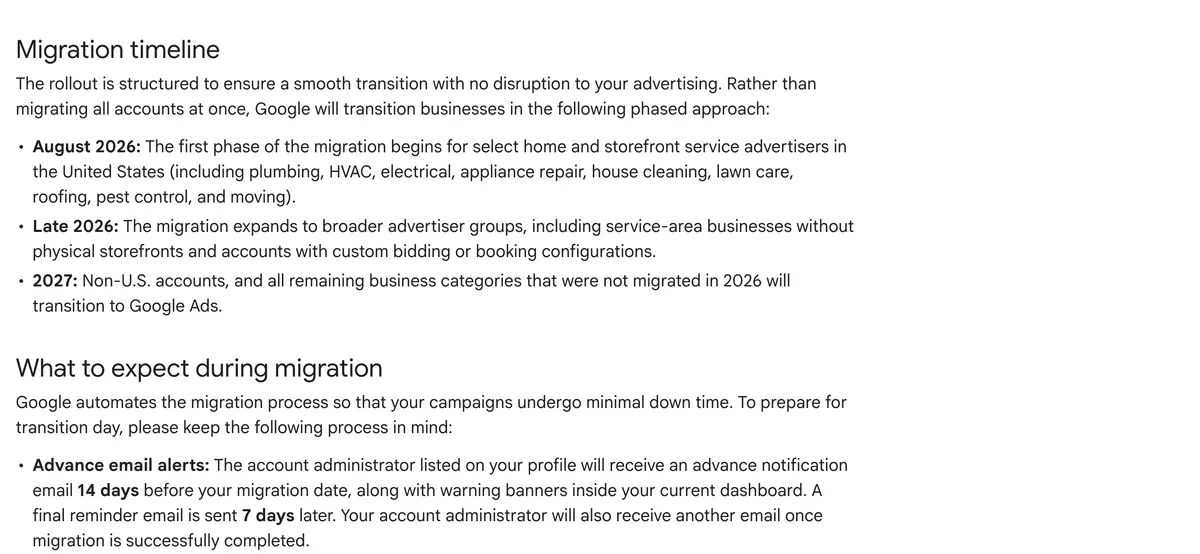
Google Local Services Ads, the pay per lead unit that sits above the normal search results with the badge next to it, is being folded into Google Ads right now, and home services is the first group to move. Google's own migration notice says the first phase began in August 2026 for select home and storefront service advertisers in the United States, and it names the categories: plumbing, HVAC, electrical, appliance repair, house cleaning, lawn care, roofing, pest control and moving. Broader groups follow in late 2026, and non US accounts plus everything remaining move in 2027.
The pay per lead model survives the move. You still pay for valid leads rather than clicks, the ads still appear only on Google Search and Google Maps, and the campaign stays keywordless, targeted by the services and areas you choose. Verification carries over, and Google says insurance and license reverification are not required.
Four changes are worth putting in your calendar rather than discovering later. Manual bidding and industry level target CPA are being deprecated, so whatever bid strategy you tuned by hand gets replaced. Better Business Bureau callouts are gone, and Google's instruction is to pick at least six other structured callouts instead. Your old Local Services dashboard closes on migration day and previous performance reports do not carry over, so anything you want to keep has to be downloaded first. And the account administrator gets an email 14 days before migration with a reminder seven days later, which is the entire warning you get.
Google also tells you to expect a wobble: while many ads start running right away, allow up to two weeks for the migration to complete and for campaign performance to ramp back to stable levels. If your booked jobs dip in the two weeks after your migration date, that is the reason, and it is not a reason to fire your web designer.
The badge changed too, and the guarantee behind it is gone
The Google Guarantee money back promise is being discontinued, which is news to almost every marketing page still selling it as a reason to advertise. Google's help page on the new badge says the company is simplifying advertiser badging into a single Google Verified badge, and then says plainly that it will be discontinuing the Money Back Guarantee associated with the Google Guarantee badge. The page limits reimbursement to services booked through Local Services Ads before 7 December 2025, with requests due within 30 days of the initial service completion date, which leaves almost nothing open by now.
What remains is the screening, and the screening is the part that was always worth something. Google describes it as an extensive verification process that varies by category and location and may include background, business registration, insurance and license checks, plus minimum review requirements. Existing advertisers keep their badge automatically. New ones earn it by passing those checks.
There is a ranking consequence for anyone starting out. Google offers pre badge ads that let you take leads while you finish onboarding, but says your listing will appear below providers who have completed all onboarding requirements. So the order of work for a new contractor is not website, then ads. It is licenses and insurance documents and first reviews, then ads, then the website that catches everything else.
The two free things that decide whether the phone rings
They are your Google Business Profile and your reviews, and the reason to start there is that neither one is for sale. Google's guidance on local ranking states it flatly: there is no way to request or pay for a better local ranking on Google. Local results are mainly based on relevance, distance and prominence, where prominence is partly built from how many websites link to your business and how many reviews you have.
Read those three words as a budget. Distance you cannot change. Relevance is a complete, accurate Business Profile with the right category and hours, which is an afternoon of work and no money. Prominence is reviews and links, which is a habit rather than a purchase. A website contributes to the third one and to nothing else on that list.
The service area rules matter here too, because HVAC companies are usually service area businesses rather than storefronts. Google's representation guidelines allow one profile for the central office with a designated service area, say that a rented mailing address you do not operate from is not eligible, and put a limit on reach: the boundaries of a profile's service area should not extend farther than about two hours of driving time from where the business is based. If a vendor is selling you visibility three states wide, that is not how the map works.
About those forty city pages
City landing pages are one of the most commonly sold upsells in HVAC web design, and the pattern most vendors ship is the one Google's spam policies describe by name. The policy on doorway abuse lists, as an example, having multiple domain names or pages targeted at specific regions or cities that funnel users to one page, alongside creating substantially similar pages that are closer to search results than a clearly defined, browseable hierarchy.
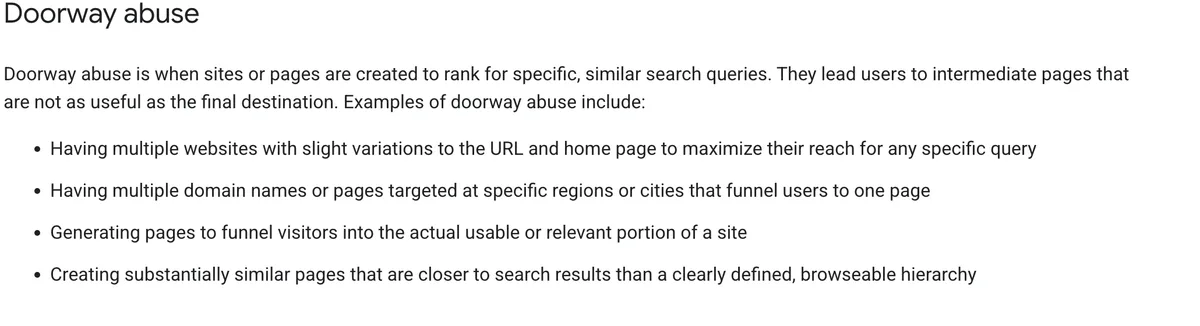
That is not a ban on writing about the towns you serve. It is a description of what happens when twenty pages differ only by the place name in the headline. The distinction a homeowner can see is the same one the policy draws. A page about the neighborhood with your actual response time to it, the systems common in its housing stock, a job you did on that street and the permit office you deal with is a real page. A page produced by find and replace is a template with a zip code in it.
This is worth checking before you buy a plan sized by city count, because that is exactly how several published plans are priced. Ask for three live examples of city pages the vendor has produced for another client, read them side by side, and count the sentences that differ. If the answer is one, you are buying pages that will not earn their keep, whatever the invoice calls them.
What you own when you stop paying
On a subscription site, the honest question is not the monthly fee, it is what survives cancellation. Two of the vendors above answer it in writing, which is worth more than a reassuring sentence on a sales call. Hook Agency's FAQ says you own your website 100% and observes that many companies do not work that way. Websites for HVAC states on each plan that you own the content and domain.
Notice what those sentences do and do not cover. Owning the content and the domain is not the same as owning the build, and none of these pages promise you the theme, the page templates or an export you can host elsewhere. Nor is exclusivity free of consequences: Websites for HVAC sells a territory lock, so the value you are buying is partly that the vendor will not sell the same thing to the shop across town, which also means your bargaining position at renewal is weaker than it looks.
Three questions settle it. Ask who the domain is registered to today. Ask what specifically you receive as files if you cancel, and whether that includes the design or only the text and images. Ask whether your Google Business Profile, your Google Ads account and your call tracking numbers are owned by your company or by the agency, because those are the assets that carry your history. We wrote a longer version of this argument in our piece on who owns your website, and the short version is that the contract decides, not the invoice.
The line item that is never in the quote
In most states your website is advertising in the legal sense, and your license number belongs on it. California's rule is the plainest example. Business and Professions Code 7030.5 requires every licensed contractor to include the license number in all construction contracts, in subcontracts and calls for bid, and in all forms of advertising as prescribed by the registrar of contractors. A website is a form of advertising, and so are the Facebook page, the truck wrap and the pay per click ad.
Requirements differ by state and by trade, and some states add rules about which license classification you may name and how a company name may be presented. This is a ten minute check with your own licensing board that no web designer will do for you, and it costs nothing until an inspector or a competitor notices. Put the number in the footer of every page and in the same place on every profile you control, and the whole issue disappears.
While you are there, two other pieces of text pay for themselves on an HVAC site: the service area written as the towns you actually serve, and your after hours policy stated in words rather than implied. Emergency work pays well, and a homeowner who cannot tell whether you pick up at nine at night will call the company whose site says so.
What the same money buys in labor
Set the website prices next to a payroll line and they stop being abstract. The Bureau of Labor Statistics occupational survey for May 2025 counts 409,670 heating, air conditioning and refrigeration mechanics and installers in the United States, with a median annual wage of $61,010 and a mean of $64,780.
A $12,000 website is about ten weeks of a median technician's wage before employer costs. A $2,988 flat program is about two and a half weeks. The $57,600 custom site plus SEO package is closer to a full year of one technician, and unlike the technician it does not carry a truck to a job. That comparison does not decide anything on its own, because a website works while you sleep and a technician does not. It does put the decision in a currency you already price in your head every time you consider adding a van.
What we would actually spend
For a single location shop doing residential service and replacement, the order is not the one most vendors sell. First, spend nothing and fix the Business Profile: correct category, correct hours including the ones you really answer the phone, a service area that matches your driving reality, photos of your own trucks and crew, and a standing habit of asking every completed job for a review. That is the highest return work available to you and it has no invoice.
Second, buy a site you own, once. Ten to fifteen genuinely useful pages beat forty templated ones: what you fix, what it costs, how fast you come, who you are, the towns you cover written like a human wrote them, and a phone number that is impossible to lose on a phone screen. That is a one time build, not a subscription, and at published rates it is between about $1,500 and $12,000 depending on who does it.
Third, buy leads deliberately and count them. Local Services Ads charges per valid lead, and Google says lead prices vary by location, job type, lead type and bidding mode, so nobody can quote you a national number honestly. What you can do is set the weekly budget low, run it for a season, and divide what you spent by the jobs you booked. That one division tells you more than any proposal you will be sent.
Fourth, only after those three, consider a retainer. A $2,800 a month SEO engagement is a reasonable purchase for a company with several vans and a growth target, and a poor one for a shop that has not yet claimed its own profile. The order matters more than the vendor.
Our two prices, and the shops we are wrong for
Two numbers, both public. Flat $1,499 buys a one-time build, and $2,499 a month covers work that carries on after launch, and the pricing page lists them so nobody has to sit through a call to hear a figure. Focused builds are usually live about two weeks after kickoff, and we answer partnership emails inside 48 hours. Home service companies can see how we approach this market on our local services page. One result we can point to outside this trade: a treatment center we rebuilt the site for, Cornerstone Healing Center, ended up with 20% more website conversions.
Here is where a different company beats us. If your problem is that nobody in your market knows your name, a website will not fix it and a full marketing program from a contractor specialist probably will, so buy the program and skip the design conversation. If you want one company answering for the site, the ads, the reviews and the CRM on one invoice, hire a home services agency, not us, because that bundle is their product and it is not ours. And if you are shopping purely on monthly price, the $249 program undercuts anything we would build and it is a genuinely reasonable purchase.
Hire us when the site itself is the constraint: when it is slow on a phone in a driveway, when it does not say what you charge or how fast you come, when it was built by a vendor who still holds the keys, or when you want to own the thing outright and stop renting it. Those are the jobs we are good at, and they are a small fraction of the marketing budget this article has been describing.
Your fourteen day window, and what to do inside it
This is the only deadline in this article with a date attached to it, and it applies to every contractor running Local Services Ads. When the migration email arrives, you have 14 days before your account moves and your old dashboard closes for good.
Inside that window, do five things in an hour. Download every performance report you want to keep, because Google says previous reports do not carry over. Write down your current cost per lead and cost per booked job from that data, so you have a before number that nobody can argue with later. Check which bid strategy you are on, since manual bidding and industry level target CPA are being retired and something automatic will replace them. Pick your six structured callouts to fill the space the Better Business Bureau callout used to occupy. Confirm the phone number your leads route to, because in the new setup you can edit it yourself in real time and that is the one field a wrong entry will cost you money on immediately.
Then leave it alone for two weeks. Google says performance takes up to that long to stabilize, and the temptation to change three things at once during a migration is how contractors end up believing their website broke. It did not. The channel moved, and the only thing you needed was the fourteen days of notice you just used properly.
Frequently asked questions
Between roughly $3,000 and $28,000 for the first twelve months on plans vendors publish openly. The floor is a flat monthly program at $249 with the site included and no build fee. Subscription plans aimed at HVAC contractors run $399 to $1,999 a month on an annual term plus a one-time build fee of $1,995 to $4,499. An agency custom build is published at $12,000 to $24,000 spread over a year, with complex sites quoted up to $50,000. A one-time build you own outright can sit well below all of those: ours is a flat $1,499.
 Development
Aug 12, 2026 · 14 min
How Much Should a Real Estate Website Cost in 2026?
Every published answer is a range with no arithmetic behind it. Here is the real invoice, built only from prices named companies publish themselves, including the MLS data fee that two thirds of listing services do not charge at all.
 Development
Aug 8, 2026 · 13 min
Website Maintenance Cost in 2026: The Four Bills Behind One Number
Care plans, managed hosting and a vague promise to keep an eye on things all get quoted as one monthly figure. Here is what sits inside it, at prices companies publish about themselves.
 Development
Aug 4, 2026 · 14 min
ADA Website Compliance in 2026: What Actually Protects You From a Lawsuit
No agency certifies a website as ADA compliant, and there is still no federal standard for private businesses. Here is what the law really requires, what the 3,117 lawsuits filed last year were about, and why the FTC fined an overlay vendor $1 million.