
Drug and Alcohol Rehab Website Design: Build It Around What Families Search

Sep 28, 2026 · 17 min read
Nobody types "addiction treatment center" into a phone at eleven at night. They type "alcohol rehab near me" or "drug rehab" plus the name of their city, often on behalf of someone else, and often after an argument. A rehab website is designed for that person or it is designed for nobody.
This article is about designing a drug and alcohol rehab website around the words people actually search with and the questions each search carries. On 28 September 2026 we ran both searches, "alcohol rehab" and "drug rehab", in 12 large US metros, then read the titles, headings and substance pages of every provider that came back. We also read what the National Institute on Alcohol Abuse and Alcoholism tells families to ask a program before they call. The two sources together make a design brief. Because we sell this kind of work, discount the section about us as you see fit. The counts do not change with the agency you pick.
In one paragraph: what the design has to do
A drug and alcohol rehab website has to do three things a generic "addiction treatment" site does not. It has to say "drug", "alcohol" and "rehab" in the places search engines and tired readers look first, because that is how the ranking sites speak: 49 of the 73 pages we read put "drug" in the title or main heading, and only 22 said "addiction treatment". It has to answer two different readers on two different pages, because a family worried about alcohol needs to hear that stopping suddenly can cause seizures, and a family worried about opioids needs to hear about medication and naloxone. And it has to answer, before the phone call, the ten questions NIAAA tells families to ask. The ranking pages handle insurance well and medication badly: 6 of 34 alcohol pages named an approved medication.
How we checked
We ran a US web search for "alcohol rehab" and for "drug rehab" followed by each of 12 cities, listed from west to east: Seattle, San Diego, Phoenix, Denver, Austin, Houston, Minneapolis, Chicago, Nashville, Atlanta, Philadelphia and Boston. That is 24 result pages. From each we removed directories and listing sites, government pages, hospital systems and hospitals, a national charity's local program pages, encyclopedia and news entries, and our own client. What was left was 59 provider results for the alcohol searches and 63 for the drug searches, 88 different URLs in all.
We fetched each URL as an ordinary browser would. Fifteen refused automated requests or did not answer, which left 73 pages to read. For each we saved the title tag, the first main heading and the page text. Then we looked for a page about alcohol and a page about opioids linked from each provider's homepage or ranking page, kept only real treatment or condition pages (no quizzes, blog posts or event listings), and read those: 34 alcohol pages and 33 opioid pages across 67 providers. Every count built on pattern matching was checked by reading the matched sentence, and several first-pass hits, such as "methadone" appearing in a list of abused drugs, were thrown out.
The limits matter. A web search tool is a proxy for Google, not a copy of it. A homepage link is not a full site crawl, so a provider we scored as having no alcohol page may have one buried deeper. Read the numbers as a picture of the pages families actually land on, not an audit of any one center.
Families type rehab, and the ranking pages say it back
The pages that rank for these searches use the searcher's words, in the two places a reader and a search engine see first. Forty-nine of the 73 pages put "drug" in the title tag or main heading, 47 put "alcohol" there, and 46 said "rehab" or "rehabilitation". "Addiction treatment", the phrase most agencies and most clinical writing reach for, appeared in 22. "Substance use" or "substance abuse" appeared in 6.
One detail in that chart shapes the whole design. Not one of the 73 pages named alcohol in its title or heading without also naming drugs. "Drug and alcohol rehab" is the standard label because it answers both searches with one line of text, and it is the label a family expects to see when they land.
Google says the same thing in plainer terms. Its SEO starter guide tells site owners to think about the words a user might search for, and gives the example of one person searching "charcuterie" while another searches "cheese board".
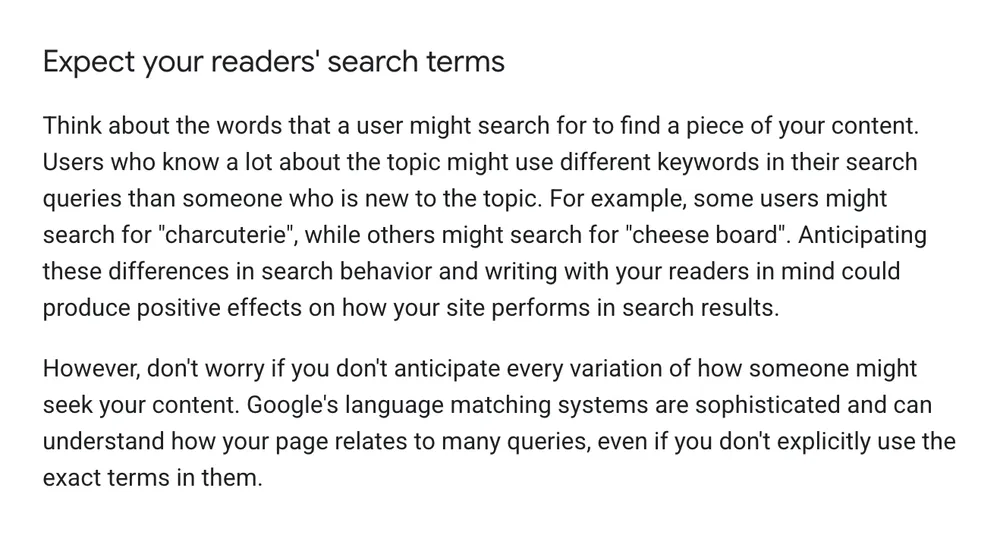
Read the second paragraph too, because it keeps this honest. Google's language matching connects pages to searches they do not quote word for word, and our census shows it: 16 of the 48 readable pages returned for "alcohol rehab" did not say "alcohol" in either the title or the main heading, and ranked anyway. Several belong to long-established programs such as Rosecrance and Olalla, whose names carry weight of their own. Wording is not a trick that lifts a weak site. It is the cheapest way to tell a searcher and a search engine, at a glance, that they are in the right place.
The heading that says nothing
The most common miss was a main heading that carries only a brand or a mood. Fifteen of the 73 pages had a first heading with no service word in it at all, such as a program name, a welcome line or a slogan, and two more had no main heading. A heading like "Together we rise" may be good copy, but a family skimming five tabs needs "Drug and alcohol rehab in Austin" to know which tab to keep. Put the plain description in the heading and let the brand line sit under it.
One homepage usually answers both searches
The two searches mostly lead to the same pages. Of the 59 provider results for "alcohol rehab", 34 were the exact URLs that also came back for "drug rehab" in the same city. Forty-one of the 59 alcohol results were homepages, and 44 of the 63 drug results were. Only one alcohol result was a page about alcohol alone, and that site blocked our reader.
So the homepage is the page doing the work for both searches, and it has to serve both readers in its first screen. That argues against two separate sites, and against a homepage that leans so hard on opioids, or on alcohol, that the other reader thinks they are in the wrong place. The substance pages come second. They are where a family goes after the homepage has convinced them to keep reading, and where search engines send the more specific searches, such as "alcohol detox" or "fentanyl rehab".
In practice, that means a homepage built like this:
- A heading that names both. "Drug and alcohol rehab in Phoenix", or the same idea in your own voice, above everything else.
- Two clear doors below it. One for alcohol and one for drugs, opioids in particular, each leading to its own page. Let the family choose its own door rather than making it read a menu of programs first.
- Levels of care named in plain words. Detox, residential, outpatient. Our census of the development layer of rehab sites found separate pages for each level on most ranking sites.
- The phone number and the insurance check, in that order. Our anatomy of an admissions page covers how those two elements should work.
The alcohol page: a different reader and a different risk
The alcohol page serves the larger and less treated group. According to NIAAA's summary of the 2024 National Survey on Drug Use and Health, 28.0 million people aged 12 and older had alcohol use disorder in the past year. Only 2.1 million of them, 7.6%, received any alcohol use treatment. Only 697,000, or 2.5%, received medication for it.
That gap has a design consequence. Most people reading an alcohol rehab page have never been in treatment, and many are not sure it applies to them. NIAAA notes that people with alcohol use disorder are more likely to see a primary care provider about an alcohol-related medical problem than about the drinking itself. The page has to meet a reader who is still deciding whether this is a rehab problem at all.
Two facts belong on every alcohol page, and the census shows how often they are missing.
The first is safety. NIAAA's guide to finding treatment warns that when someone who has been drinking heavily for a long time stops suddenly, withdrawal can be painful and potentially life-threatening, with symptoms that include seizures. That is the single most useful thing an alcohol page can tell a family, because it explains why medical detox exists and why "just stop at home" can be dangerous. Of the 34 alcohol pages we read, 19 named seizures or delirium tremens. Fifteen did not.
The second is medication. The same NIAAA guide says three medications are approved in the United States for alcohol use disorder: naltrexone, acamprosate and disulfiram. It also answers the objection families raise, saying all of the approved medications are nonaddictive. Six of the 34 alcohol pages named any of them. If your program prescribes them, say so by name. If it does not, say how you refer patients who need them. Either answer beats silence on the question NIAAA tells families to ask.
The drug page: opioids, medication and the overdose question
The drug page, and in most markets that means an opioid page first, serves a reader whose fear is death rather than decline. Provisional CDC figures released on 13 May 2026 put US drug overdose deaths at an estimated 69,973 in 2025, down almost 14% from 81,313 in 2024. Deaths involving opioids fell from an estimated 55,296 to 44,564. The trend is good news. It is not evenly shared: the same CDC release names Arizona and Colorado among the states where deaths rose 10% or more, and our census includes Phoenix and Denver.
The opioid page has its own two facts to carry.
The first is treatment medication. The FDA's page on medications for opioid use disorder lists three approved medications, buprenorphine, methadone and naltrexone, and says all three have been shown to be safe and effective. Families searching for opioid rehab often want to know early whether a program uses them, allows them or insists on stopping them. Seventeen of the 33 opioid pages we read described one of these medications as part of treatment. Several others mentioned methadone only in a list of drugs people misuse, which answers nothing.
The second is naloxone. On 29 March 2023 the FDA approved Narcan nasal spray for sale without a prescription, describing naloxone as a medication that rapidly reverses the effects of opioid overdose. A family member reading an opioid page at night may be living with someone who could overdose before admission happens. Four of the 33 opioid pages explained that naloxone reverses an overdose. A short, calm block saying what naloxone is, that it can be bought without a prescription, and to call 911 in an emergency is the most useful paragraph many of these pages are missing. Across all 67 substance pages, only 5, from 3 providers, mentioned 911 or 988 at all.
Other substances
Alcohol and opioids lead the searches, but they are not the whole list. From the pages we read, 24 of the 67 providers linked to a page about cocaine, and 21 each to pages about methamphetamine and benzodiazepines. The same rule applies to each: say what makes withdrawal or treatment for that substance different, and link back to the level of care that handles it. A substance page that swaps the drug's name into a shared template tells a family nothing.
Design the page around the ten questions families are told to ask
NIAAA runs a tool for families called the Alcohol Treatment Navigator. Its second step is a list of ten questions to ask any provider, and just before that list it tells readers to learn what they can from a provider's website first. That turns the list into a design brief. Every question a page answers in advance is one fewer reason for a family to cross you off.
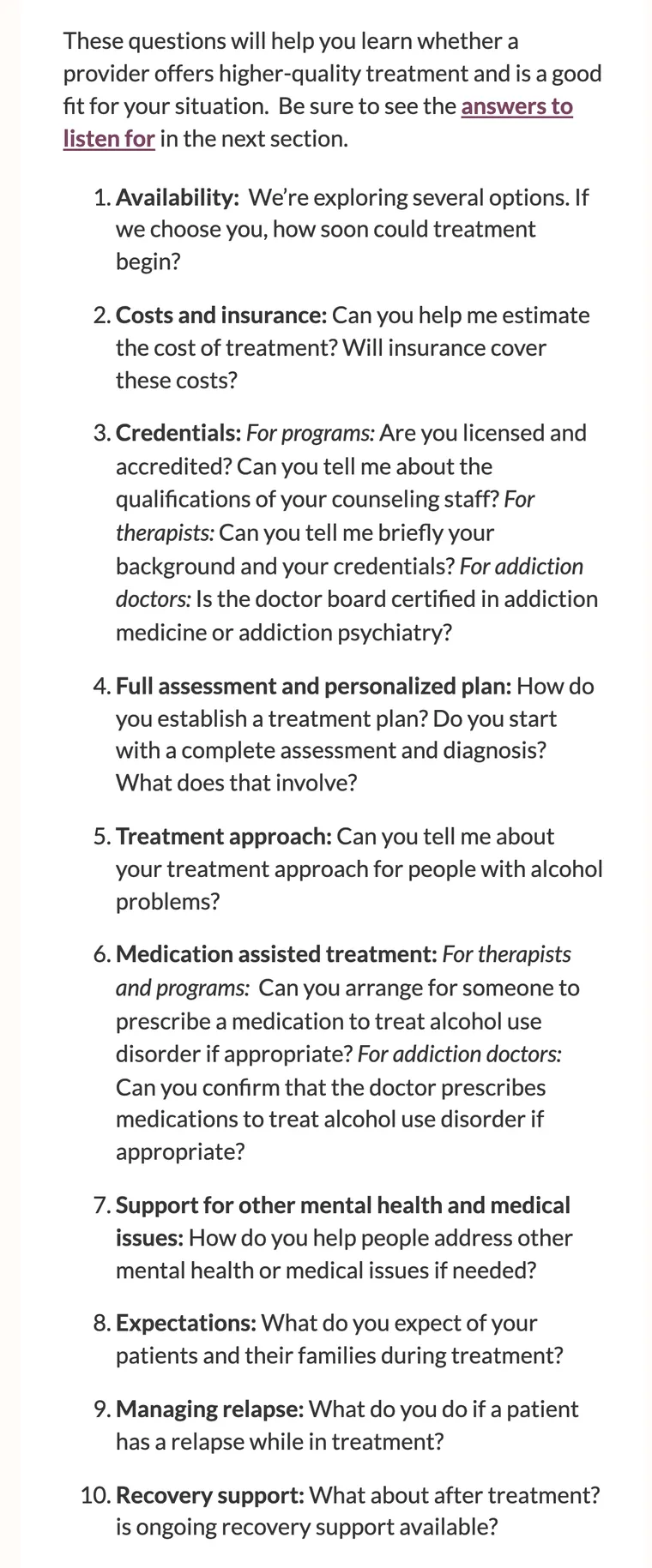
The questions are written about alcohol, but a family comparing drug programs asks the same things. Here is how each one becomes something on the page, with the census count where we could measure it cleanly. Where we could not, the table says so rather than guessing.
| Navigator question | What the page should show | 34 alcohol pages, 28 September 2026 |
|---|---|---|
| 1. How soon could treatment begin? | A plain statement of how fast admission usually happens, and whether same-day is possible | 2 mentioned same-day admission |
| 2. Cost, and will insurance cover it? | Insurers you are in network with, a verification form, and a price or range for people paying themselves | 21 mentioned insurance; none stated a price |
| 3. Licensed and accredited? Staff credentials? | License and accreditation named with numbers or links, and the clinical team with credentials | Not measured: a keyword count was too noisy to publish |
| 4. Full assessment and a personal plan? | What the first assessment involves, who does it, and how long it takes | Not measured |
| 5. Treatment approach? | The therapies you use, named and explained in a sentence each | Not measured |
| 6. Medication for alcohol use disorder? | Whether you prescribe naltrexone, acamprosate or disulfiram, or how you refer | 6 named an approved medication |
| 7. Other mental health and medical issues? | How co-occurring conditions are treated, and by whom | Not measured |
| 8. What is expected of patients and families? | Schedule, rules, family sessions and visiting, written down | Not measured |
| 9. What happens after a relapse in treatment? | Your actual policy, stated without shame | Not measured |
| 10. Support after treatment? | Aftercare, alumni and step-down options, with how long they last | Not measured |
Two rows stand out. Nobody published a price, which is common across healthcare, but the Navigator asks for an estimate in its second question, and a range for people paying out of pocket is honest and rare enough to be noticed. And the medication row is where the gap between what families are told to ask and what pages say is widest.
What goes on the first screen
The first screen of the homepage and of each substance page decides whether the family stays. Put these there, in roughly this order, and test them on a phone rather than a desktop monitor:
- The plain heading. Drug and alcohol rehab, or alcohol rehab, plus the city. Brand lines go underneath.
- One sentence on safety for that page. On an alcohol page: stopping heavy drinking suddenly can cause seizures, so talk to us or a doctor first. On an opioid page: what naloxone does and where to get it.
- A tap-to-call number that a person answers. Say when it is staffed. If it is answered around the clock, say that; if it is not, say what happens after hours.
- The insurance check. One button, leading to a short form. Our piece on rehab websites built to convert shows how several ranking sites place it.
- A crisis line. A single sentence pointing to 911 for an emergency and 988 for a mental health crisis. It costs nothing and it tells a scared reader you have thought about them.
What should not be on the first screen: a slideshow, a pop-up asking for an email address, or a chat widget that covers the phone number. Each one pushes the answer a family came for further down the page.
Three wording traps to avoid
Keyword stuffing. Google's guidance on title links asks for descriptive, concise titles and warns against repeating the same words, which can make a result look spammy. "Drug and Alcohol Rehab in Denver | Center Name" is enough. "Drug Rehab Denver, Alcohol Rehab Denver, Denver Rehab" is not better.
Cloning city pages. Once the wording lesson lands, the temptation is to produce a "drug rehab" and "alcohol rehab" page for every nearby town. Pages that differ only by a place name help nobody. One strong page per location you actually operate in is the version that holds up.
Clinical language in the wrong place. "Alcohol use disorder" is the accurate term and belongs in the body text, where it also tells an informed reader you know the field. It is not what a frightened spouse types. Use the family's words where they land and the clinical words where they read.
Where we come in, and when you do not need us
Everything above can be done by any competent team, and plenty of agencies take on rehab sites. Here is what working with us looks like. Our three plans are monthly, with published prices on the pricing page, no minimum term, and the option to pause or cancel. Foundation is $1,000 a month: a brand refresh and one high-converting landing page, which goes live within 14 business days of receiving your copy, photos and logins, followed by a new page every month. Growth is $2,500 a month and covers the full website, with unlimited requests handled one at a time. Scale is $5,000 a month and runs two requests in parallel, which suits groups with several locations. You own everything we make, and your hosting stays in your name.
Our team has shipped more than 200 projects, and treatment centers account for 5 of them. One of those, Cornerstone Healing Center, measured a 20% rise in website conversions following our redesign. Treat that as one client's outcome, not a forecast for your site. Our design service and our addiction recovery page say more about how we work.
You probably do not need us if your site already names drugs, alcohol and rehab plainly, has real substance pages, and answers most of the Navigator's questions. In that case the gains are in ads, reviews or admissions follow-up, not design. You also do not need a monthly plan if you only want a one-off fix to a heading or two. Make those edits yourself this week.
The two-tab test
Here is a test you can run tonight without anyone's help. Open your alcohol page in one tab and your opioid or drug page in the other, on your phone. Take the ten Navigator questions and, for each tab, mark which ones the page answers without you calling anyone. Then check the three safety points: seizures on the alcohol page, medication on both, naloxone on the opioid page.
If either tab scores below five, or is missing a safety point, that page is the first thing to fix, before any redesign of the homepage. If you do not have two tabs to open because you have no substance pages yet, that is your answer too. For an outside read of the page most visitors reach first, try our free funnel review, which covers that one page and names what we would change first.
Frequently asked questions
It should name drugs, alcohol and rehab plainly in the page title and main heading, give alcohol and opioids their own pages, and answer the questions families ask before they call. On the alcohol page that means withdrawal safety and the three approved medications. On the opioid page it means treatment medications and what naloxone does. Every page also needs a phone number a person answers and a short insurance check.
Use drug and alcohol rehab in the title and main heading, and clinical terms in the body. Of the 73 ranking provider pages we read on 28 September 2026, 49 put drug in the title or main heading and 46 said rehab, while only 22 said addiction treatment. Google's language matching can connect other wording to these searches, but plain words tell a tired reader they are in the right place.
Yes, as a second layer under a homepage that names both. In our census, 34 of 59 provider results for alcohol rehab were the same URLs that ranked for drug rehab, so the homepage does most of the work for both searches. Separate substance pages then answer the questions that differ, such as alcohol withdrawal seizures and opioid treatment medication.
It should say that stopping heavy drinking suddenly can cause dangerous withdrawal, including seizures, and whether your program prescribes naltrexone, acamprosate or disulfiram. NIAAA names those three as the approved medications for alcohol use disorder. In our census 19 of 34 alcohol pages mentioned seizures or delirium tremens, and only 6 named an approved medication.
It should say whether your program uses buprenorphine, methadone or naltrexone, the three medications the FDA lists for opioid use disorder, and explain what naloxone does. Seventeen of 33 opioid pages we read described one of those medications as treatment. Four explained that naloxone reverses an overdose, even though it has been sold without a prescription since the FDA's 2023 approval.
Many use the same questions, and NIAAA publishes a list of ten in its Alcohol Treatment Navigator. They cover how soon treatment can start, cost and insurance, credentials, assessment, treatment approach, medication, other health issues, expectations, relapse and aftercare. The Navigator tells families to learn what they can from a provider's website before calling, so each answered question on the page helps.
It depends mostly on how many program, substance and location pages you need and who writes them. Our article on treatment center website costs covers the typical ranges. KhanWork publishes its own monthly plans on its pricing page, from $1,000 a month for a brand refresh and one landing page to $5,000 a month for multi-location groups.
 Recovery
Sep 27, 2026 · 17 min
Addiction Treatment Website Development: What Actually Gets Built
We read the code, headers and sitemaps of 45 ranking rehab websites to show what a treatment center build contains, layer by layer, and what to put in writing before you hire a developer.
 Recovery
Sep 26, 2026 · 16 min
The Best Website Builder for a Treatment Center (and When to Skip One)
Only one of the big four builders will now sign a HIPAA agreement covering its forms. We checked their own terms, and read the code behind 46 ranking rehab sites, to show when a builder fits a treatment center and when it does not.
 Recovery
Sep 25, 2026 · 17 min
The Admissions Page: Anatomy of a Treatment Center Page That Gets Calls
We measured 44 admissions pages at ranking rehab providers on a phone. Most make the call easy and leave the questions a family asks before calling unanswered. Here is the page, part by part.