
How Much Should a Veterinary Website Cost in 2026?

Aug 24, 2026 · 15 min read
Ask the internet what a veterinary website costs and you will get confident numbers. Ask where those numbers come from and the confidence evaporates. While researching this article we found a 2026 buying guide pricing a practice management platform at $119 a month. The company behind that platform has since been acquired, its customers have been migrated to the buyer's product, and its old domain now serves an Indonesian online gambling page. The price is still being quoted. The product it describes no longer exists.
That is the state of pricing information in the veterinary industry, and it is why this article works differently. Every price in it was read on the seller's own page on 24 August 2026, every industry statistic comes from the association or firm that collected it, and where a number is our arithmetic the text says so. We sell websites, so this page is written by one of the vendors you might be evaluating, and you should weigh it accordingly.
The 30-second answer
For a single-location veterinary clinic, every published website price is a subscription, and the only build fee anyone prints is in the low thousands: the one vet-specific agency that publishes its fee charges $1,999 to build and $129 a month to run, and subscription website vendors run $99 to $299 a month. Ours is a monthly partnership at $1,000, $2,500 or $5,000 a month with pause or cancel anytime, which is a different purchase rather than a different price for the same one. The bigger recurring bill is the practice management software underneath, where the vendors that publish prices start between $123 and $260.50 a month and most price per veterinarian, so the bill grows as you hire doctors. Several of the biggest names publish no price at all. Judge every quote against the industry's own numbers: the average veterinary visit ran $147 in 2024 by the AVMA's count, patients average 2.39 visits a year, and industry data shows visit volume falling while prices rise, which makes the case for a site that wins new clients and recalls lapsed ones stronger than it has ever been.
The prices page one quotes are not on the vendors' pages
Before any budgeting, you should know how unreliable the published guidance is, because we measured it. We took the pricing claims in two guides ranking for veterinary software costs and checked each claim against the vendor's own website on the same day, 24 August 2026.
One guide, published by the software vendor VetSyCare in January 2026, carries a table titled 2026 Veterinary Software Pricing Comparison with the introduction, in its own words, "Here's what major platforms actually charge." It prices Digitail at $199 a month and Shepherd at $299 a month. Neither company publishes a price anywhere on its site. Digitail's pricing page lists four plans and ends every one of them in a demo request. Shepherd's site has no pricing page at all. The same table prices ezyVet at $250 and up; ezyVet's own page says $260.50. Another guide, at co.vet, says DaySmart Vet starts at $116 a month; DaySmart's page says $123.
| Vendor | What 2026 guides claim | What the vendor's own page says, 24 Aug 2026 |
|---|---|---|
| Digitail | $199 a month | No price published. Every plan ends in a demo request |
| Shepherd | $299 a month | No price published. No pricing page exists |
| ezyVet | $245 to $250 and up | "As little as $260.50 per month" |
| DaySmart Vet | From $116 a month | "Plans starting at $123/month" |
| Hippo Manager | $119 a month | Product acquired and retired in 2025. The domain now serves a gambling site |
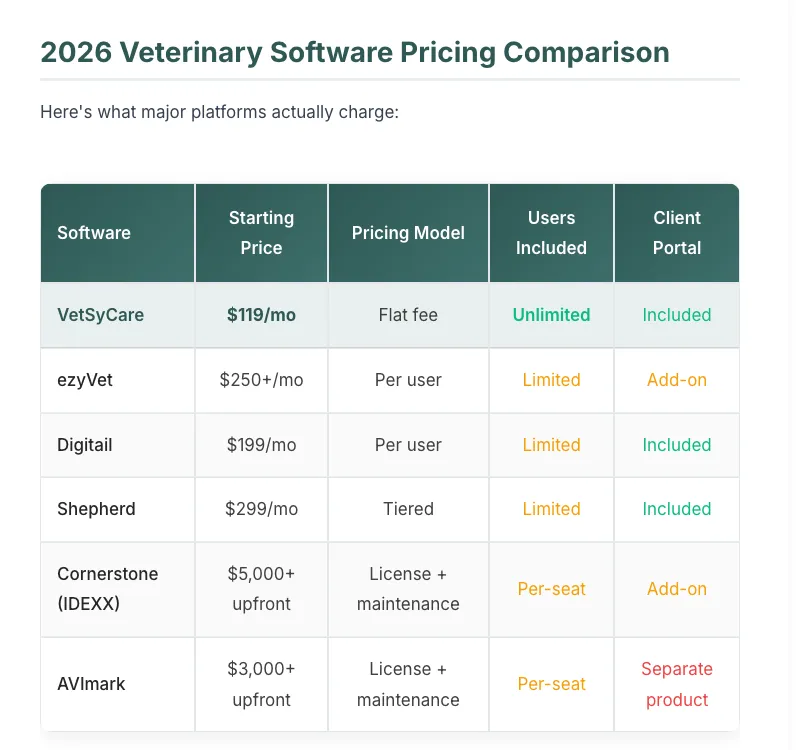
We also ran the test a buyer in 2026 actually runs: we asked an AI-powered search tool what veterinary software costs. Its answer priced Shepherd at $299 a month, quoted a per-veterinarian rate for a platform that publishes no rates, and offered $119 a month for Hippo Manager, the product that no longer exists. AI answers are trained on the guides, the guides copy each other, and nobody in the chain reopens the vendor's page. The habit that protects you costs nothing: no price is real until you have seen it on the seller's own site, dated today.
The $119 product that does not exist
The Hippo Manager story deserves its own section because it shows how long a dead price can outlive its product. Hippo Manager was a budget practice management system that small clinics genuinely used. It was acquired by Shepherd Veterinary Software, and Shepherd's own migration page states the outcome plainly: "Veterinary practices previously using Hippo Manager have now migrated to Shepherd." There is no Hippo Manager to buy.
What happened next is the instructive part. The company's domain, hippomanager.com, was not kept. When we loaded it on 24 August 2026, both the bare domain and the www version returned a page in Indonesian advertising an online slot gambling operation. Meanwhile, buying guides published in 2026 still list Hippo Manager beside its old $119 price as a live option, and AI search tools repeat it. A practice owner who trusts the guide is now one click from a casino page, and a practice owner who trusts the AI answer is budgeting around a product that cannot be purchased.
This matters beyond one vendor. Veterinary software and veterinary website companies get acquired constantly: WhiskerCloud, the best-known vet website agency of the late 2010s, sold to PetDesk in January 2022 in what the acquisition trade publication They Got Acquired reported as a low eight-figure deal covering roughly 2,000 veterinarian clients. When your website vendor is acquired, your site, your content and sometimes your domain are part of the inventory being sold. The section at the end of this article gives you a ten-minute test for that risk before you sign anything.
What the software vendors actually publish
Now the real numbers, starting with the recurring bill, because for most clinics the practice management system costs more per year than the website. Among the major cloud platforms, exactly three publish a price a buyer can read without a sales call.
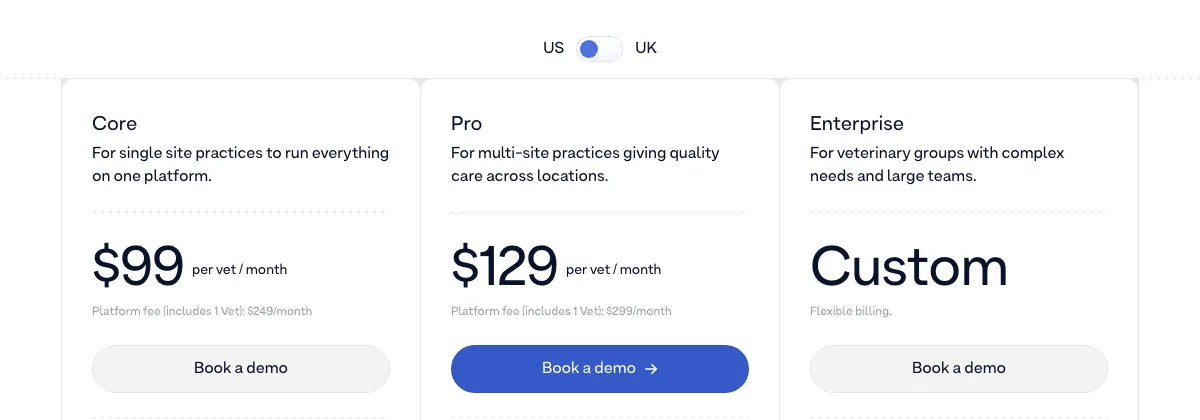
Provet Cloud is the most transparent of the group. Its Core plan is $99 per veterinarian per month plus a $249 monthly platform fee that includes the first vet, so a one-doctor clinic pays $249 a month and a two-doctor clinic pays $348. The Pro plan for multi-site groups runs $129 per vet plus a $299 platform fee. Its AI scribe is a further $40 per vet per month, and its payments product takes a share of revenue rather than a subscription. ezyVet publishes a single line: every feature included, "as little as $260.50 per month," with implementation priced separately. DaySmart Vet publishes "plans starting at $123/month" and scales by practice size from there.
The unit matters more than the number. Veterinary software prices by the doctor, not by the location. A three-vet practice on Provet Cloud Core is $447 a month before the AI scribe, which at $40 per vet adds another $120, taking the stack to $567. That is the figure to compare against any website quote: the site is usually the smaller line, and unlike the software it does not grow a seat charge every time you hire an associate.
The other half of the market has decided not to tell you. Digitail, Shepherd and Vetspire all route every plan through a demo call, and IDEXX's Cornerstone and Covetrus products have never published list prices. That is their right, but it has a consequence for you: every number you have read about those platforms came from somewhere other than the company, which is exactly how a dead product keeps a live price.
Who sells the veterinary website itself
Unlike the med spa market, where the booking platforms sell no websites, the veterinary market has an ecosystem of companies that sell the website as a subscription, usually bundled with marketing. Their published prices are the most useful benchmark you will find, because they define the floor.
iMatrix, which builds websites and marketing for veterinary, chiropractic and eye care practices, publishes a six-tier grid and prices the first three: Core at $99 a month, Trust at $199 and Build at $299, with the top marketing tiers behind a consultation. Even the $99 Core tier includes a professional website with unlimited edits, an online booking widget, lead capture forms and business listings management, which tells you how commoditized the base veterinary website has become.
Digital Empathy, a veterinary design agency, is the rare vendor that publishes both of its numbers and its competitors' typical ranges in the same place: its own development fee is $1,999 with a $129 monthly service fee, and it puts template website companies at $50 to $100 a month and professional design agencies at $200 to $400 a month with development fees "in the thousands." Those ranges match everything else we verified, so we consider them honest, and we say that as a competitor.
Do the twelve-month arithmetic before choosing a lane. iMatrix Core at $99 a month is $1,188 a year, every year, for a site you rent. Digital Empathy's model costs $3,547 in year one and $1,548 a year after. Our own plans are monthly, from $1,000 a month, so $12,000 across the same twelve months at the lowest tier, with pause or cancel anytime and everything we deliver yours to keep, files, pages and brand assets; we have written before about what ownership actually means when a vendor holds your domain and files. None of these is automatically right. A subscription with unlimited edits genuinely fits a practice with no one to manage a site. A build fits a practice that wants the asset on its own books and its costs to stop.
What a patient is worth, by the industry's own count
Website quotes only make sense against what a client is worth, and veterinary medicine is unusually well measured. The AVMA's 2024 Pet Ownership and Demographic Sourcebook, presented at its Veterinary Economic and Business Forum in October 2024, counted 89.7 million pet dogs in the United States, the highest figure it has ever recorded, with 45.5% of households owning a dog and 32.1% owning a cat.
The money numbers are the ones to pin above your desk. The average veterinary visit cost $147 in 2024 across all pets seen, down from $190 in 2023. A dog visit averaged $214 in 2024 against $265 in 2023, and a cat visit $138 against $163. Dog-owning households spent an average of $580 a year on veterinary care, cat-owning households $433. And the visits are overwhelmingly the kind a website wins: about 80% of dog and cat visits are routine checkups or preventive care, the appointment a new resident books after searching for a clinic nearby.
Two more industry findings sharpen the picture. VetSource data presented at the AVMA's 2023 forum shows the average patient visits 2.39 times a year, so at 2024 visit prices one dog on the books is worth roughly $511 a year in visit revenue alone, our arithmetic from the two published figures. And iVET360's 2026 Veterinary Industry Benchmark Report, published in April 2026, found that 2025 industry revenue grew 2.6% while transaction volume fell 4.7% and the average transaction charge rose 7.5%, with new client acquisition running below historical norms. Growth is coming from charging more per visit, not from seeing more patients. A practice that wants volume growth has exactly two levers a website touches: winning new clients, and recalling the lapsed ones the AVMA's 2023 forum flagged as a rising share of every practice's file.
The gap between having a vet and visiting one
Buried in the AVMA's 2024 numbers is the most commercially useful statistic in this article. Among dog owners, 86.8% say they have a regular veterinarian, but only 74.2% visited one in the past year. For cat owners the gap is wider: 77.1% claim a regular vet, 57.3% actually went. Roughly one dog owner in eight and one cat owner in five thinks of themselves as your client and did not show up last year.
That gap is not a marketing abstraction, it is deferred revenue sitting in your practice management system. The AVMA's economists have tracked the same pattern from the other side: practice revenue rose 5.7% between August 2021 and August 2023 while visits fell 2.7%, and the share of owners telling Cleveland Research they planned to visit the vet less to save money nearly doubled from 10% to 19% between mid 2022 and mid 2023. Price-sensitive owners defer, deferral becomes lapse, and a lapsed patient is the cheapest appointment your website can win back, because the owner already trusts you. This is why the reminder and booking layer of the site matters more in veterinary medicine than in almost any other local business, and why we treat online booking as a first-class requirement rather than an add-on when we build for clinics; the same logic drives the local service businesses we work with, where the website's job is measured in booked appointments, not visits.
What a custom build should cost, and what ours costs
Against those benchmarks, here is the honest range for the build itself. A template subscription runs $50 to $100 a month with no build fee and you own nothing at the end. A vet-specific subscription with marketing folded in runs $99 to $299 a month at published rates. A professional agency build runs a development fee in the low thousands, $1,999 at the one agency that publishes it, plus $129 to $400 a month in service fees. Ours is monthly: $1,000, $2,500 or $5,000 a month for practices that want design and development on tap rather than a single launch, with pause or cancel anytime. A focused build usually goes live 14 business days after kickoff, a typical figure rather than a promise, and we answer partnership inquiries within 48 hours.
Two outcomes we can point to, both from adjacent industries where the same trust problem applies: a treatment center rebuild that produced 20% more website conversions for Cornerstone Healing Center, and Eden Digital, a brand we built that grew revenue tenfold. We have not built for a veterinary clinic yet, and we would rather tell you that than imply otherwise; the mechanics of a clinic site, service pages, booking paths and local search, are the same ones we ship every week, but if vet-specific pedigree matters to you, iMatrix and Digital Empathy have it and we do not.
The pricing conversation is simpler than vendors make it. As with med spas, the recurring software bill dwarfs the website over time, so the website decision is really a decision about what each monthly line buys you. A $299 a month subscription is $3,588 a year forever. Our Foundation Partner is $1,000 a month and buys a brand refresh, the landing page built and live, then a new page every month, and everything we deliver is yours to keep: files, pages, brand assets. Run both lines out five years with your own quote in hand and ask what each one leaves you holding.
Where the money should go, in order
If you are budgeting a clinic site from zero, spend in this order. The reasoning is the AVMA arithmetic above rather than preference.
- Service pages that match how owners search. One page per service you want more of: wellness exams, dental, spay and neuter, urgent care, exotics if you see them. Roughly 80% of visits are routine care, so the wellness and vaccination pages are the revenue pages, not the surgery page you are proudest of.
- The booking path. Whatever your practice management system is, its booking widget must sit on your domain, two taps from any service page on a phone. If a vendor cannot embed it, that constraint belongs in your brief before anyone quotes.
- The lapsed-client path. A visible existing-clients entry: request records, refill a prescription, book a recheck. One owner in five who considers you their vet did not visit last year; make returning frictionless.
- Local search plumbing. Accurate structured data, service-area pages if you draw from several towns, and a Google Business Profile that matches the site. For a clinic, ranking in the map pack is worth more than any blog.
- Real photography. Your building, your exam rooms, your team with animals. Stock photos of a model in a lab coat read as a franchise, and trust is the product.
- Everything else. Team bios, a blog, a careers page. Useful, rarely urgent, and the padding a page-count quote hides in.
Who should not hire us
A brand new single-doctor practice with no photography, no service list and an opening date six weeks out will get more from a $99 a month vet-specific subscription than from any custom build, ours included, because the bottleneck is content, not code. A practice whose real problem is phones going unanswered needs staffing or a phone tree before it needs a website. And if what you want is someone to run your Google and Meta ads every month, hire a veterinary marketing agency; iMatrix's upper tiers exist for exactly that, and it is not our product.
The practices that get their money's worth from us look different: a real service list that ranks for nothing, a subscription template the team cannot edit, a rebuild where the current vendor holds the domain, or a multi-location group whose clinics cannot be found separately. If that is you, the numbers are public and the first conversation costs nothing.
The ten-minute vendor-mortality test
Every price in this article could change tomorrow, and as Hippo Manager shows, so can the existence of the company charging it. Before you sign with any website or software vendor, run these four checks. They take ten minutes and they would have protected every practice caught in the stories above.
- Look up who owns your domain, right now. Run a WHOIS lookup on your own domain. If the registrant is your current website vendor rather than your practice, fixing that is the first line of any new contract. When a vendor dies or sells, domains they hold go with them, and hippomanager.com now points somewhere no client should land.
- Ask what happens on acquisition, in writing. One sentence in the contract: if the vendor is acquired or discontinues the product, you receive a full export of the site files, content and data, and the domain transfers to you within 30 days. A vendor who resists this sentence is telling you something.
- Get the price in writing, dated. Not a screenshot of a guide, not an AI answer: an email from the vendor with the number and the date. Two of the five prices we checked this week were wrong and one was for a product that no longer exists. Vendors honor their own dated emails; they do not honor co.vet.
- Test the export before you need it. Ask for a sample export of your site content or your patient data during the sales process. If they cannot produce one for a prospect, they will not produce one during a shutdown.
Do those four things and the worst outcome of any vendor's death is an inconvenient month. Skip them and you are betting your practice's front door on a company you found through a guide that quotes dead prices. In the time it took to research this article, one vendor's domain became a casino and two published prices turned out to be fiction. Your website should be built to survive its builders. Ours are, and so should everyone's.
Frequently asked questions
A custom build runs in the low thousands one time, and a subscription site runs about $99 to $299 a month at published rates. The one veterinary agency that publishes its fee charges $1,999 to build plus $129 a month, iMatrix prices its website tiers at $99, $199 and $299 a month, and our package is monthly, $1,000, $2,500 or $5,000 a month, with pause or cancel anytime. Template builders sit at $50 to $100 a month. The larger recurring cost for most clinics is the practice management software, not the site.
Among major cloud platforms, only three publish prices as of August 2026: DaySmart Vet starts at $123 a month, Provet Cloud's Core plan works out to $249 a month for a one-vet clinic ($99 per vet plus a $249 platform fee that includes the first vet), and ezyVet starts at $260.50 a month. Digitail, Shepherd and Vetspire publish no prices and quote through demo calls, so treat any specific number you read about them as unverified.
No. Hippo Manager was acquired by Shepherd Veterinary Software, and Shepherd's own site states that practices previously using Hippo Manager have now migrated to Shepherd. Despite that, 2026 buying guides and AI search answers still quote Hippo Manager at $119 a month as if it were a live option, and its old domain now serves an unrelated gambling site. It is a useful reminder to verify every price on the vendor's own page before budgeting around it.
Because the doctor is the revenue unit: each additional DVM brings appointments, records and billing volume, so vendors scale the license with headcount. Provet Cloud charges $99 per vet per month on top of its platform fee, and ezyVet prices per user. The practical consequence is that a three-vet practice can pay $447 a month before add-ons for software, while the website usually costs less and does not grow a seat charge when you hire.
Usually not. Practice management platforms sell scheduling, records and billing, and their booking widgets are designed to embed into a website you supply. Some client-communication vendors do sell websites, most notably PetDesk, which acquired the vet website agency WhiskerCloud in 2022, but its website product is priced by consultation. Whoever builds the site, insist that your booking widget lives on your own domain rather than on the vendor's.
By the AVMA's 2024 sourcebook, the average veterinary visit cost $147 across all pets, a dog visit averaged $214, and dog-owning households spent about $580 a year on veterinary care. VetSource data puts the average patient at 2.39 visits a year. Combining the dog figures, one dog on your books is worth roughly $511 a year in visit revenue, which is our arithmetic from those published numbers, so a website that adds even a few patients a month pays for its build quickly.
Use a template or a $99 a month vet subscription if you are opening soon, have no photography or service content yet, and need something live while the business finds its feet. Hire an agency when you have a real service list that is not ranking, when you have outgrown a template you cannot edit, or when a vendor controls your domain. The deciding question is whether the site's job is to exist or to win appointments.
Four things, and they take about ten minutes in total. Run a WHOIS lookup to confirm your practice, not the vendor, owns your domain; get an acquisition clause in writing that guarantees a full export and domain transfer if the vendor is bought or shut down; get the price in a dated email from the vendor rather than trusting a guide or an AI answer; and ask for a sample export during the sales process. Vendor acquisitions are routine in this market, and those checks are what protect your site when one happens.
 Web Design
Sep 6, 2026 · 17 min
SaaS Website Cost in 2026: What 1,953 Agencies Say They Charge
Every published range for this question is written by an agency describing its own invoices. So we read all 196 pages of Webflow's Certified Partner directory and counted what 1,953 of them actually put on the card.
 Web Design
Sep 5, 2026 · 17 min
Template or Custom Website in 2026: What a Template Actually Buys
We read the license and the support policy behind the biggest template marketplace, then counted every theme in the WordPress.org directory and the Shopify Theme Store. The sticker price is the smallest number in the decision.
 Web Design
Sep 3, 2026 · 19 min
How Much Should a Hotel Website Cost in 2026?
Published platform prices run from $9 to $197 a month and a managed hotel website starts at $14,400 a year. Then a federal rule decides which number on your page has to be the biggest.