
How Much Should a Hotel Website Cost in 2026?

Sep 3, 2026 · 19 min read
Every published answer to this question is a range, and the ranges do not agree with each other. So we did it the other way round: only prices a vendor prints on its own page, only rules we read in the text, and one count we ran ourselves across 78 independent hotels. What came back changed the brief. The most consequential design decision on a hotel website in 2026 is which number is the biggest, and since May 2025 a federal rule has been deciding that for you.
The 30-second answer
Ten platforms publish a monthly price and they run from $9 to $197, a spread of more than twenty to one for what is nominally the same job. Above that sits a managed lane where Leonardo's hotel website packages start at $1.2k, $1.5k and $1.8k a month billed annually with the build included, so $14,400 to $21,600 in year one. The expensive part is neither. It is the channel: Airbnb's single fee structure, mandatory for hotel listings, takes 15.5% from most hosts, and Booking.com will not publish its rate at all. And the cost nobody quotes for is the price display itself. Since 12 May 2025 the FTC's Rule on Unfair or Deceptive Fees has covered short-term lodging, and it does not merely tell you what to write. It tells you what has to be most prominent.
What the platforms actually print
Ten vendors publish a number. Guesty is the cheapest at $9 a month plus 1% per reservation, though its Lite plan caps out at three listings and everything above it is a quote. HotelRunner lists three Essential plans, Manage, Sell and Complete, at 0.75%, 1.25% and 1% a month, each with a minimum fee of $19.95, $29.95 and $39.95 USD. eviivo starts at $50 a month for a single property and $125 for a multi-property setup. BookingCenter does something no other vendor here does and prices its booking engine at $50 a month or 3% commission, your choice, with its payment gateway priced separately at $300 one time plus $25 a month. RezStream says plans start at $95 a month and scale with unit count and distribution level. WebRezPro charges $10 per unit per month against a $100 monthly minimum. SiteMinder is from $135 a month and SiteMinder Plus from $179, both marked with a plus sign and a note that transactional fees may apply in available markets. Little Hotelier Pro is from $179. innRoad answers in its own FAQ rather than on a plan card, saying its core property management software typically falls around $150 a month. And RoomRaccoon prints a full four-plan table: Entry, Essentials, Premium and Pro at $236, $300, $441 and $620 a month, or $197, $250, $367 and $517 on annual billing, at the room count the page loads with.
One detail on that RoomRaccoon table, since we checked the arithmetic. The billing toggle carries a badge reading Save 20%, and each pair of figures on the same screen is about 16.6% apart. Entry at $236 against $197 is a saving of $39, not the $47 that 20% would give. The annual price is still the better deal. It is just not the deal the badge promises.
That BookingCenter choice is worth a moment, because it puts the whole subscription-versus-commission argument on one line and lets you do the sum yourself. Fifty dollars is 3% of $1,667. Below that much booking-engine revenue in a month the commission is cheaper, above it the subscription is, and the crossover does not move.
Two of those need reading carefully. HotelRunner prices its plans as percentages and never says on the page what the percentage is charged against, so the minimum fee is the only fixed number available to you. And the middle plan, Sell, carries the highest rate of the three at 1.25%, above Complete at 1%, which is worth a question before you sign.
The minimum table that charges almost nobody
WebRezPro is the cleanest price in the category and it repays a second look. The headline is $10 per unit per month with a $100 minimum, and then the page lists seven unit bands each with its own monthly minimum: $100, $150, $250, $500, $750, $1,000 and $1,500.
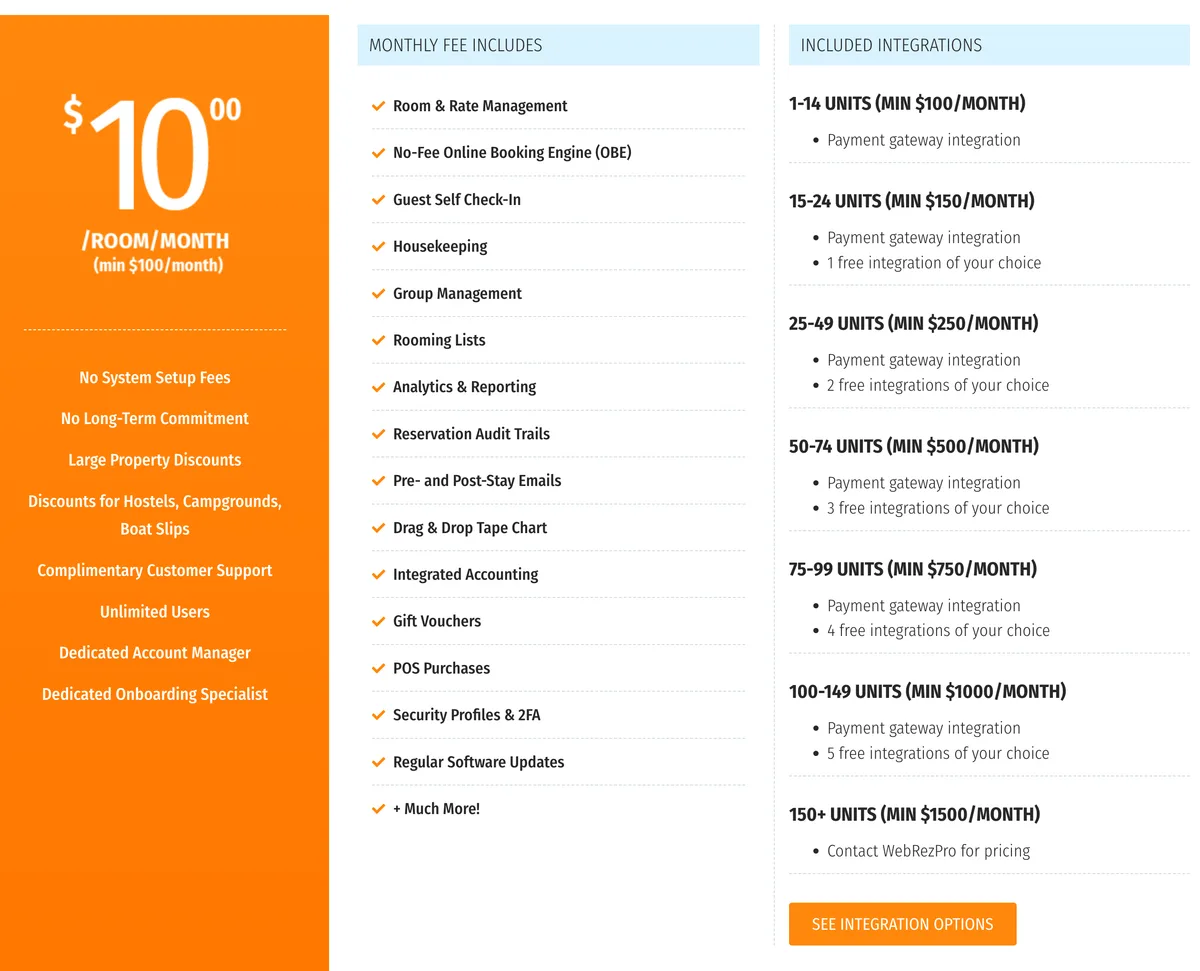
Take each minimum, divide by the $10 rate, and six of the seven land exactly on the first unit in their own band. Fifteen units at $10 is $150. Twenty-five is $250. Fifty is $500. A minimum that equals the arithmetic can never take money off anybody, so six of those seven numbers are decoration. Only the first band does any work, and it works on properties below ten rooms: a nine-room inn pays $100 rather than $90. That is a $120 difference over a year, and it is the entire practical content of a table that looks like a pricing structure.
We spell that out because a table that looks tiered is not always a tiered bill, and this one is not. It is a flat rate with a floor under it, printed seven times.
The firms that will not print a number
Now the other half. Cloudbeds runs a pricing page with four plans and the words Request a quote under every one. Mews runs a page whose own title promises three tiers of hotel management pricing, and every button on it says Get Pricing. We rendered both in a real browser rather than reading the raw HTML, so this is not an artifact of how we read the page. Between the two of them, not one figure.
The agency lane is thinner still. We requested the sites of fourteen hospitality web and marketing firms. Eight returned a readable homepage, and two of those eight link to a page named for pricing or packages. One of the two does publish. Leonardo's hotel website packages, sold under the Vizlly name, are Basic+ from $1.2k a month, Standard+ from $1.5k and Premium+ from $1.8k, all billed annually, and all three include the initial build of the site and the content writing. Annualized, that is $14,400, $18,000 and $21,600 in the first year, and the site is bundled into the retainer rather than sold separately.
The other one does not. Acorn Marketing publishes a detailed page describing four named packages, Standard, Deluxe, Custom and Premium, each with an established base number of web pages inside a bid estimate, and no bid. Six of the eight have no pricing page to link to at all.
That is the real shape of this market. One published agency price, from $14,400 a year, against a software layer that starts at $108 a year. Any guide quoting a tidy range in between is averaging numbers that do not exist.
The rule that decides which number is biggest
On 12 May 2025 the FTC's Rule on Unfair or Deceptive Fees took effect. It is short, it is at 16 CFR Part 464, and it covers exactly two industries. One is live-event tickets. The other, in the definition at 464.1, is short-term lodging, named as temporary sleeping accommodations at a hotel, motel, inn, short-term rental, vacation rental or other place of lodging. If you rent rooms by the night, you are inside one of only two industries this rule reaches, and it is a rule about how your prices are laid out.
Section 464.2 does the work. Displaying any price without clearly and conspicuously disclosing the total price is an unfair and deceptive practice. The total price must be shown more prominently than any other pricing information. And where the final amount of payment appears, it must be at least as prominent as the total price. Read that as a designer and it is a type hierarchy, written into federal regulation: the total is the largest number on the screen, and only the final amount of payment is allowed to match it.
What counts inside the total price
The definition of total price in 464.1 is the maximum of everything a guest must pay, including any mandatory ancillary good or service, with three exclusions and only three: government charges, shipping charges, and charges for optional extras the guest chooses to add. Everything else is in.
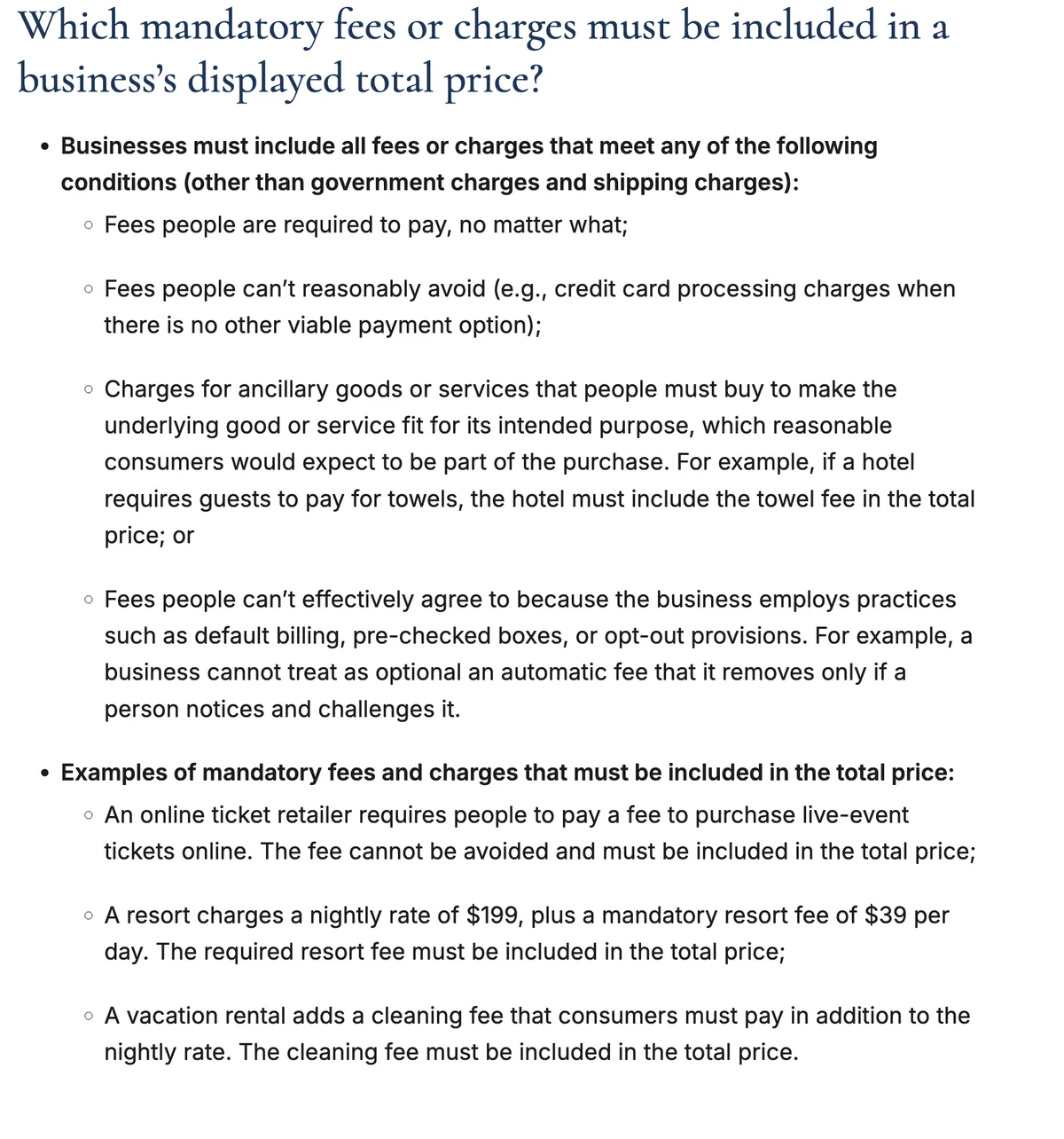
The agency's own examples are unusually direct for a hotel. A $199 nightly rate with a mandatory $39 resort fee is a $238 total price. A cleaning fee a guest must pay is in. A towel fee, if you charge one, is in. And a resort fee that is charged automatically but waived when a guest notices and complains is still mandatory, because a fee you can only escape by objecting is not optional. That last example removes the argument that a fee applied by default is an optional one.
Itemizing is still allowed. The rule does not ban resort fees, destination fees or any other fee, and it does not cap them. It bans hiding them. You can print a room rate, a resort fee and a total, so long as the total is the most prominent of the three and everything you say about each fee is true.
Unavoidable is a layout word
The definition of clear and conspicuous in 464.1 runs to eight numbered requirements, and four of them are instructions to whoever builds the page. A visual disclosure must stand out by size, contrast, location and how long it stays on screen. In an interactive electronic medium, the rule says, "the disclosure must be unavoidable". It must not be contradicted or watered down by anything else in the same communication. And where the offer targets a specific audience, ordinary consumers means members of that group.
Unavoidable rules out a set of patterns that are still normal on hotel sites: the fee behind a tooltip, the fee in a collapsed accordion, the fee in an asterisk footnote below the fold, the fee that appears only after a date is chosen. Contradiction rules out the pattern where the hero says $199 and the checkout says $238. Neither of those is a copywriting problem. Both are build decisions, and both are cheaper to get right in the wireframe than in a redesign.
California asks for a different number
Here is the part most guides miss. The federal rule lets you leave government charges out of the total price, as long as you disclose them and the final amount before you ask for payment. California does not.
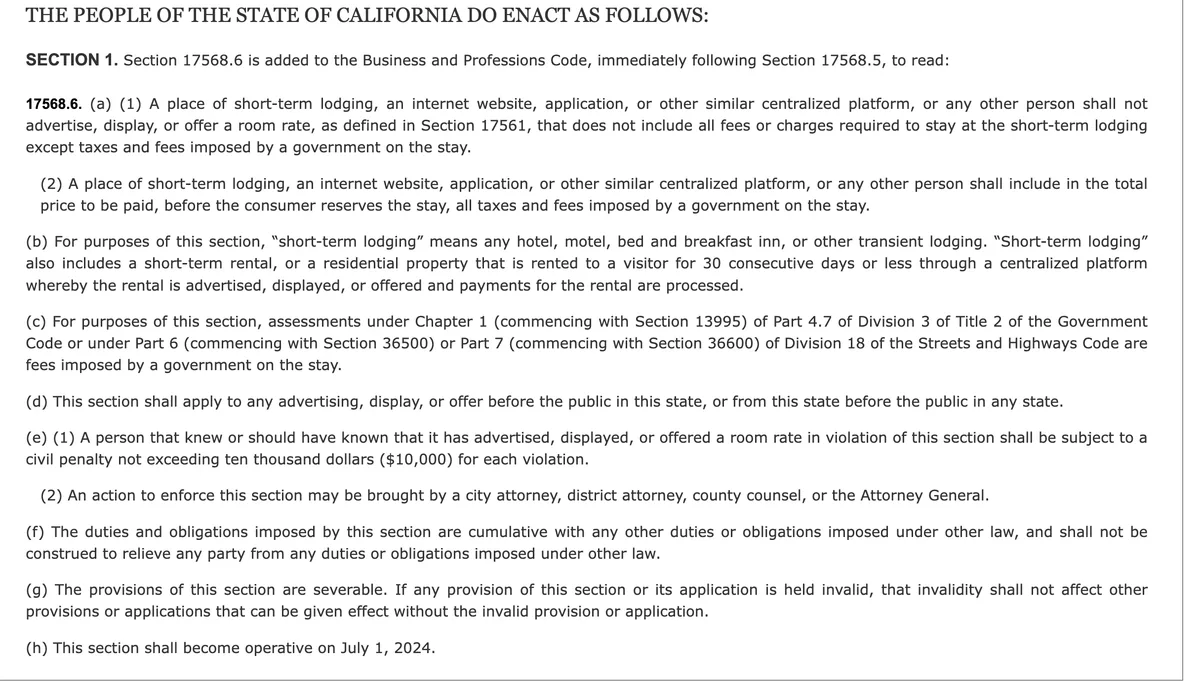
Assembly Bill 537 added Section 17568.6 to the Business and Professions Code, operative 1 July 2024. Subsection (a)(1) bars advertising, displaying or offering a room rate that leaves out any fee required to stay, other than government taxes and fees. Subsection (a)(2) then requires all of those taxes and government fees to be inside the total price to be paid before the consumer reserves the stay. Subsection (c) is explicit that tourism assessments and business improvement district charges count as government fees for this purpose.
So the federal total price and the Californian total price are two different figures, and the state's is larger. The FTC anticipated this: Section 464.4 says the rule does not supersede state law except where the two directly conflict, and a state law that protects consumers more is not treated as inconsistent. In practice you build the stricter number, once, and both rules are satisfied.
Two more things in 17568.6 deserve a line each. Subsection (e) sets a civil penalty of up to $10,000 for each violation, enforceable by a city attorney, a district attorney, county counsel or the Attorney General. And subsection (d) applies the section to any advertising before the public in California, or from California before the public in any state. Your hotel does not have to be in California. Your booking page only has to be visible there.
Naming a fee is now a legal act
Section 464.3 makes it a violation to misrepresent the nature, purpose, amount or refundability of any fee, or the good or service it pays for. The FTC's guidance sharpens this into two rules a copywriter can hold. First, an environmental fee that is not spent on environmental work is a misrepresentation. Second, vague labels are a problem in themselves: the guidance tells businesses to describe what fees are for and to avoid phrases like convenience fee, service fee and processing fee.
That is a strange and useful thing to find in a regulation, because it is ordinary good writing. If you cannot finish the sentence "this $39 pays for...", you have a legal problem and a conversion problem at the same time, and they have the same fix.
78 hotels, and where the price actually lives
We wanted to know how independent hotels currently solve this, so we counted. The frame is the member directory of Palm Springs Preferred Small Hotels, an association of independently owned small properties, which listed 78 hotels on 3 September 2026. For 73 of them the directory gave us both the hotel's own website and its booking link. We then requested each hotel's homepage and read the HTML the server returned.
Sixty-three of the 73 booking links leave the hotel's own domain. Ten stay on it, and some of those are almost certainly an embedded engine wearing the hotel's address. Of the 63, one link was malformed and 62 resolved to 21 distinct platforms: ResNexus 13, SynXis 7, Cloudbeds 6, ThinkReservations 6, WebRezPro 4, then ASI, InnQuest, AvantStay and Direct-Book on 3 each, TravelClick and Airbnb on 2 each, and ten platforms appearing exactly once. Two of these hotels send the guest straight to Airbnb, which for a hotel listing means the 15.5% side of the fee table.
Then the homepages. Of 63 distinct pages we could read, one shows a nightly rate. Six show any dollar figure at all. Five name a mandatory fee, two of them a resort fee and three a cleaning fee. Six make a book direct or best rate claim.
The honest caveats first. We read only the HTML the server returned, so anything drawn in later by JavaScript is invisible to this count and every figure is a floor. It is one market and one association. And nothing here is a finding about anybody's compliance, which is why no hotel is named: where a price sits is a different question from whether it is disclosed correctly at the point it appears.
With that said, the pattern is hard to miss. The number the federal rule says must be the most prominent thing in your offer is, for almost every independent hotel in this sample, not on the hotel's website at all. It is on a booking engine at a different address, built by a company the hotel does not control, whose defaults the hotel did not write. Six of these hotels promise a best rate on a page that does not contain a nightly rate.
Twenty-one engines is the real build constraint
That spread of platforms is the single most useful thing we learned, and it should change how a hotel website is scoped. A hotel site is not one product. It is a marketing site plus a handover, and the handover is where the money, the compliance surface and the guest's patience all live.
Three practical consequences. The engine's price display is now part of your legal exposure, so whether you can control the type hierarchy on the rates screen belongs in vendor selection rather than in a later change request. The handover is a domain change the guest can see, which affects trust and analytics, so decide early whether the engine renders on your domain, in an iframe or on its own address, and make the visual transition deliberate. And your total price has to be consistent across the marketing page, the engine and any feed you send out, because the moment those disagree you have both a rule problem and a ranking problem, which we come to below.
What one $238 booking costs, by channel
Use the FTC's own worked example as the unit: a $199 room plus a $39 mandatory resort fee, a $238 total price. Now watch what each channel takes from it.
Airbnb publishes both of its fee structures. Under the split fee, most hosts pay 3% and the guest pays a service fee of 14.1% to 16.5% of the booking subtotal. Under the single fee, the whole thing comes out of the host payout: most hosts pay 15.5%, the rest typically 14% to 16%. The detail that matters here is that the single fee structure is mandatory for traditional hospitality listings, which the help page names as hotels and serviced apartments. A hotel on Airbnb is on the 15.5% side of that chart, not the 3% side, and the fees are charged on the subtotal including host fees, so the resort fee is inside the base.
Against that, WebRezPro states plainly that it charges no commission or transaction fee on reservations generated through its own website booking engine, eviivo says it takes no revenue share and no percentage per booking, only a flat 50 cents on a confirmed booking, and RoomRaccoon describes itself as commission-free. BookingCenter charges 3% if you take its commission option instead of the $50, HotelRunner charges between 0.75% and 1.25%, and Guesty's Lite plan adds 1% per reservation on top of its $9. Which is worth knowing: your own booking engine can also be on commission, and several are.
The arithmetic on that one $238 booking: Airbnb's single fee takes $36.89 of it, the split-fee host share and BookingCenter's 3% each take $7.14, HotelRunner's Sell rate takes $2.98, eviivo takes 50 cents, and WebRezPro's own engine and a Google free booking link take $0.00 each.
One booking is not an argument. Twenty a month is. At 15.5% that is $738 a month, which is more than four times Little Hotelier's published price and more than seven times WebRezPro's minimum.
The rate nobody publishes
Booking.com is the one channel here we could not chart, because it does not publish a percentage. Its own partner help page says the exact figure depends on your country, your property type and the accommodation agreement you signed, and points you at registration to find out. That is not a criticism so much as a fact you should plan around: you cannot model this channel from public information.
What the page does publish is the mechanics, and they are more interesting than the rate. Commission is charged on the total booking amount, which explicitly includes the additional fees you charge, such as cleaning fees and service fees, and charges for no-shows and cancellations. It is charged on non-refundable bookings whether or not the guest stayed. It is not charged on local taxes such as city tax, but in most countries it is charged on VAT or GST. Changes have to be marked in the extranet within 48 hours of check-out or full commission is charged on the original booking. And marketing programs such as Preferred Partner and Visibility Booster raise the total percentage above the one in your contract.
Two of those are direct consequences of the rule we started with. If your resort fee has to be inside the total price, and commission is charged on the total booking amount, then folding a fee into the rate does not reduce what you pay. And the 48-hour marking window is an operational obligation with a price attached, which belongs in a staff checklist rather than in a contract nobody reopens.
The free channel that grades your price accuracy
There is one distribution channel that costs nothing and rewards exactly the work the FTC rule already forces you to do. Google's hotel free booking links put your own booking site into the hotel results at no cost for clicks, and Google's own documentation says bids have no effect on their ranking.
What does affect ranking, according to the same page, is a short list: consumer preference, the value offered to the user, the landing page experience, and the historical accuracy of the prices you have provided to Google. That last one is the sentence to pin above the desk. A hotel whose feed says one number and whose landing page says another is not only exposed under 464.2, it is quietly losing free placement for the same defect. Getting the total price right is the rare compliance job with a distribution payoff attached.
What this means for the build
Put the pieces together and a hotel website in 2026 has a spec that no template ships with. Here is the short version, and it is mostly about numbers rather than pictures.
The total price is the largest number in every price display, on every breakpoint. Mandatory fees are inside it, itemized underneath it if you like, never above it. Government taxes are inside it too if your booking page can be seen in California, which for a public website is the safe assumption. The final amount of payment appears before the pay button and is at least as prominent as the total. Every fee has a name that finishes the sentence "this pays for", and no fee is called a service fee. Nothing about the price is behind a tooltip, an accordion or a footnote. The feed you send to Google and the number on your landing page are generated from the same source, so they cannot drift. And the booking engine, wherever it lives, obeys all of the above, which means you check it before you buy it.
Building it that way costs nothing extra. Retrofitting it costs a redesign, which is the whole argument for settling the price display in the wireframe.
The platform comparison, in one table
The decision most small hotels are actually making is which platform sits under the site. This is what each one publishes, read on 3 September 2026.
| Platform | Lowest published monthly price | What it takes from a direct booking | What it does not publish |
|---|---|---|---|
| WebRezPro | $100 minimum, $10 per unit | Nothing on its own booking engine | Nothing material |
| eviivo | $50 single, $125 multi-property | $0.50 flat per confirmed booking | How inventory moves the price |
| HotelRunner | $19.95 minimum | 0.75% to 1.25% | What the percentage is charged on |
| BookingCenter | $50, or 3% instead | 3% if you pick commission | Nothing material |
| RezStream | $95 | Not stated | The unit bands |
| SiteMinder | $135, Plus $179 | Transactional fees may apply | What those fees are |
| innRoad | About $150, from its FAQ | Not stated | The plan table |
| Little Hotelier | $179 Pro | Not stated | How room count moves the price |
| RoomRaccoon | $197 annual, $236 monthly | Commission-free, per its own page | How the room count moves it |
| Guesty | $9 Lite, 1 to 3 listings | 1% per reservation | Every tier above Lite |
| Leonardo, managed website | $1,200 to $1,800, billed annually | Nothing stated | What sits above the "from" |
| Cloudbeds, Mews | Not published | Not published | The price |
Read the last column first. On this evidence the useful question at a demo is not what does it cost, which you can usually find, but what does it take, which you often cannot.
Weighed against a payroll
Some scale, so the numbers stop floating. In the fourth quarter of 2025, private-sector hotels and motels in the United States, NAICS 721110, ran 61,951 establishments employing 1,525,381 people at an average weekly wage of $884, according to the Bureau of Labor Statistics Quarterly Census of Employment and Wages. That is about 24.6 employees per establishment and an average annual wage of $45,968.
A year of Little Hotelier at $179 a month is $2,148, or 4.7% of one average hotel wage. A year of WebRezPro at a 20-room property is $2,400, or 5.2%. Twenty Airbnb bookings a month at the $238 example and the 15.5% single fee is $8,854 a year, which is 19.3% of that wage, and it buys no software at all. A year of Leonardo's Basic+ package at $1.2k a month is $14,400, or 31.3%, and that one does include the website.
Our own numbers, and the case for a template
Ours is published as well: $1,000 a month for Foundation Partner, $2,500 for Growth Partner and $5,000 for Scale Partner, billed monthly with no minimum, and you can pause or cancel at any point. Fourteen business days from the day content and assets land is typical for a focused build to go live, and we answer partnership requests inside 48 hours. The full picture is on our pricing page.
Here is the advice that loses us work. If you run a six-room inn on one of the platforms above, and its templates let you control the price display, buy the template. The compliance surface here is small enough that a good vendor default covers it, and the money is better spent on photography and on the feed you send to Google. Come to us when the marketing site and the booking engine have to feel like one product, when you have more than one property, or when the price display on your current engine cannot be changed and nobody at the vendor will say when it will be.
The prominence walk
Here is the exercise we would run before spending anything, and it takes about fifteen minutes on a phone. Book a room at your own hotel, stop at the pay button, and at every step write down the biggest number on the screen and what the guest will actually be charged. Do not measure the code. Measure what your eye lands on.
| Step | Biggest number on screen | Is it the total price | Gap to the final amount |
|---|---|---|---|
| Homepage or rates page | |||
| Room list, after dates | |||
| Room detail | |||
| Cart or summary | |||
| Guest details | |||
| The pay button |
Column four is the whole exercise. Find the first row where the gap reaches zero. If that row is the pay button, every guest before it was looking at a number that was never the price, and that is the pattern the rule was written to stop. If the gap never closes at all, the fee is being disclosed somewhere you did not see, which is the definition of avoidable.
Column three catches the subtler failure. A row can have a zero gap and still fail, because the biggest number on screen is the room rate while the correct total sits in smaller type beside it. That is the specific thing 464.2(b) forbids, and it is the most common defect we see, because it is what a lot of booking templates do by default.
One thing to do this week
Open your booking engine's rate display settings and find out whether you can change which number is largest. Not whether you can add a disclaimer, whether you can change the hierarchy. If you can, do it, and the whole of this article costs you an afternoon. If you cannot, ask the vendor in writing when you will be able to, and keep the answer. That question, asked before the contract rather than after, is worth more than any redesign, and it is free.
If you would rather someone else did the walk with you, we do that. It is also fine to do it yourself, which is why the table is above rather than behind a form. Related reading: what happens when a platform sits between you and your customer, in delivery app fees versus ordering direct, and how the FTC treats another part of your page in website testimonials and the FTC.
Frequently asked questions
There are two published lanes and a wide gap between them. The software lane, a property management system with a booking engine attached, runs from $9 a month at Guesty's smallest plan to $197 at RoomRaccoon's annual Entry price, with WebRezPro at $100, SiteMinder at $135 and Little Hotelier at $179. The managed lane, where an agency builds and then runs the site, starts at $1.2k a month billed annually from Leonardo, which is $14,400 in year one with the build included. Most custom builds from a studio are quoted rather than listed. We publish ours: from $1,000 a month, billed monthly, pause or cancel anytime. Add your own numbers rather than trusting a range: a $100 platform year, the website lane you choose, and the commission you pay on the channels you keep.
Yes, since 12 May 2025. The FTC's Rule on Unfair or Deceptive Fees, 16 CFR Part 464, covers short-term lodging and makes it an unfair and deceptive practice to display any price without clearly and conspicuously disclosing the total price. Mandatory fees are inside that total, and the agency's own example is a $199 room with a $39 resort fee making a $238 total. You may still charge the fee and still itemize it. What you may not do is show the room rate more prominently than the total.
Yes. The definition of covered short-term lodging in 16 CFR 464.1 names hotels, motels, inns, short-term rentals, vacation rentals and other places of lodging, with no size threshold and no minimum number of rooms. The rule also does not set a length of stay that counts as short-term, saying instead that it depends on the facts. If you rent rooms by the night and you display a price, you are inside it.
Guesty's Lite plan at $9 a month is the lowest published figure we found, but it is capped at three listings and adds 1% per reservation, so a hotel is not really its customer. Among platforms built for properties, HotelRunner's minimum fee of $19.95 a month is the lowest, then eviivo and BookingCenter at $50. Look past the headline at what the engine takes from a direct booking: WebRezPro and RoomRaccoon say they charge no commission on their own engines, while BookingCenter charges 3% and HotelRunner charges 0.75% to 1.25%.
Booking.com does not publish the number. Its partner help page says the percentage depends on your country, your property type and the accommodation agreement you signed, and directs you to registration to find out. What it does publish is the base: commission is charged on the total booking amount including the additional fees you charge, such as cleaning and service fees, and on no-show and cancellation charges. It is charged on non-refundable bookings whether or not the guest stayed, and marketing programs such as Preferred Partner raise the total above your contract rate.
Price it with the 15.5% figure, not the 3% one, and then decide. Airbnb's single fee structure is mandatory for traditional hospitality listings, which its help page names as hotels and serviced apartments, and most hosts on that structure pay 15.5% out of the payout. The 3% figure people quote belongs to the split-fee structure that hotels cannot use. On the FTC's $238 example that is $36.89 a booking, or $738 a month across twenty bookings, against platform prices in the low hundreds.
Ideally yes, and if it cannot, make the handover deliberate. In our count of 73 independent hotels, 63 booking links left the hotel's own domain for one of 21 different platforms. That is normal and not by itself a problem, but it means the screen where the guest sees the price is built by somebody else. Before you buy, ask whether you can control which number is largest on the rates screen, because that is the requirement in 16 CFR 464.2(b) and most templates get it wrong by default.
Through a connectivity partner in most cases, and it costs nothing. Google's Hotel Center documentation says there is no cost for clicks on free booking links and that bids have no impact on their ranking. If you already use a reservation system, your provider may have connected you already, so ask them first. Ranking depends on consumer preference, the value offered, the landing page experience and the historical accuracy of the prices you send Google, which is a good reason to make the feed and the page read from the same source.
 Web Design
Sep 6, 2026 · 17 min
SaaS Website Cost in 2026: What 1,953 Agencies Say They Charge
Every published range for this question is written by an agency describing its own invoices. So we read all 196 pages of Webflow's Certified Partner directory and counted what 1,953 of them actually put on the card.
 Web Design
Sep 5, 2026 · 17 min
Template or Custom Website in 2026: What a Template Actually Buys
We read the license and the support policy behind the biggest template marketplace, then counted every theme in the WordPress.org directory and the Shopify Theme Store. The sticker price is the smallest number in the decision.
 Web Design
Sep 1, 2026 · 18 min
How Much Should a Property Management Website Cost in 2026?
Buildium gives you one free, DoorLoop bundles one with hosting, and Yardi charges the same dollar a unit whether your floor is $100 or $400. The website is rarely the number that matters. Your door count is.