
SaaS Website Cost in 2026: What 1,953 Agencies Say They Charge

Sep 6, 2026 · 17 min read
Ask what a SaaS website costs and you will be handed a range. The two pages that came top when we searched for this question say $10,000 to $35,000, then $30,000 to $100,000 and up, then $8,000 to $40,000 for a freelancer and $40,000 to $150,000 and up for a boutique agency. Neither names a survey or a dataset. Between them they cite exactly one outside source, and it is another agency's blog post. These are agencies describing their own invoices, which is not the same thing as a market.
So we went and counted one. Webflow keeps a public directory of its Certified Partners, and every partner in it publishes a starting price on their card. On 6 September 2026 we read all 196 pages of that directory. It holds 1,954 agencies and freelancers, 1,953 of whom state a floor. Everything below rests on those 1,953 numbers, on prices the platforms publish themselves, and on federal wage data. Worth saying before you read the rest, since it shapes everything: building websites is what we do for a living, and most of the routes below send you somewhere other than us.
The 30-second answer
Most SaaS marketing sites cost far less than the published ranges suggest. Across 1,953 certified Webflow partners worldwide, the median starting price is $5,000, three quarters of them start between $1,000 and $9,999, and only three agencies in the entire directory set their floor at $100,000 or above. Your software bill on top of that runs about $25 to $30 a month on Webflow or Framer, or $450 a month if the decision goes to HubSpot. The honest way to size the number is not to ask what a website costs, it is to work out your annual marketing budget and decide what share of it the site deserves. Our own prices are monthly and published: $1,000, $2,500 or $5,000 a month.
What 1,953 agencies say they charge
Here is the shape of the market, and it is not the shape the articles describe. Of the 1,953 certified partners who publish a starting price, 845 start somewhere between $1,000 and $4,999, and another 620 start between $5,000 and $9,999. That is 1,465 agencies, three quarters of the directory, whose floor is under five figures. Below them, 58 partners will start a project for under $1,000. Above them the numbers fall away fast: 302 start between $10,000 and $19,999, 96 between $20,000 and $49,999, 29 between $50,000 and $99,999, and 3 at $100,000 or more. The highest floor in the world, as published, is $200,000.
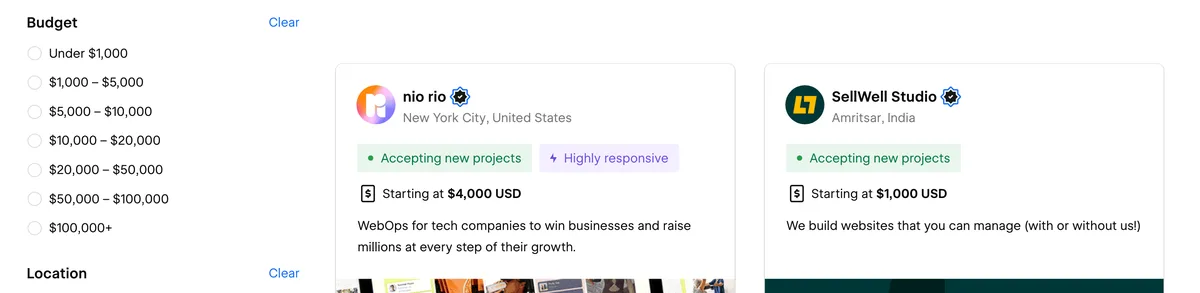
The single most common answer is $5,000, chosen by 413 partners, more than one in five of the whole directory. After that come $10,000 on 216 cards, $3,000 on 184, $2,000 on 118, $2,500 on 99 and $1,000 on 97. Those six round numbers alone account for 1,127 of the 1,953 partners, which tells you something useful before you get a single quote: these are not calculated figures. They are the number the agency decided was worth answering the phone for.
Read as a ladder rather than as bands, the same data says the cheapest tenth of partners start at $1,500 or below, the lower quarter at $2,500, the middle at $5,000, the upper quarter at $8,000, the top tenth at $15,000, the top five percent at $20,000 and the top one percent at $50,000. The mean is $6,950, comfortably above the $5,000 middle, which is what happens when a handful of very high floors sit on top of a large pile of low ones.
Geography moves the number less than you would expect and the tail more. The 452 United States partners with a published floor have a median of $5,250, barely above the worldwide figure, but a mean of $11,296, because that is where most of the very expensive firms are. Fifty-eight percent of them start under $10,000. Across 929 partners in 29 European countries the median is $5,000 and 82 percent start under $10,000. The 157 partners across South and Southeast Asia have a median of $2,000 and 94 percent start under $10,000.
| Region | Partners listed | Middle floor | Average floor | Share starting under $10,000 |
|---|---|---|---|---|
| Worldwide | 1,953 | $5,000 | $6,950 | 78% |
| United States | 452 | $5,250 | $11,296 | 58% |
| Europe, 29 countries | 929 | $5,000 | $5,860 | 82% |
| South and Southeast Asia | 157 | $2,000 | $3,656 | 94% |
Two entries in the census are almost certainly mistakes: one partner publishes a floor of $15 and another $20, which are hourly rates typed into a project field. Both are left in because removing them changes nothing, and because pretending a dataset is cleaner than it is would be its own kind of dishonesty.
A starting price is a floor, not a price
None of the above tells you what your project will cost, and it would be a bad article that let you believe otherwise. A partner whose card says $5,000 may do most of its work at $40,000. The floor is a filter the agency puts up so it stops fielding calls it does not want, and it is set by who they want to talk to rather than by what a website takes to build.
What the census does tell you is genuinely useful, and it is three things. It tells you the real distribution of who is available at each budget, which no agency page will. It tells you that the $40,000 to $150,000 framing describes the top few percent of a market rather than its middle. And it tells you, if your budget is $6,000, that close to 1,400 certified partners worldwide have a floor at or below it, which is a completely different feeling from reading that boutique agencies start at $40,000 and concluding you cannot afford a website.
The reverse is also worth saying. If your floor requirement is that the agency has shipped several sites for companies at your stage, the pool shrinks fast, and the price you end up paying will be set by that requirement rather than by any published band. Paying $25,000 to a firm that has shipped this exact kind of site many times over can easily be the cheaper decision than paying $5,000 twice.
Where the published ranges come from
Set the census next to the ranges circulating online and the gap is stark. One of those top-ranked pages puts corporate sites at $10,000 to $35,000 and larger builds at $30,000 to $100,000 and up, with no source given for either. Another puts a freelancer at roughly $8,000 to $40,000, a boutique agency at $40,000 to $150,000 and up, and a specialist Webflow partner, which is what that page's publisher is, at $60,000 to $250,000 and up. Its stated basis is its own perspective and its own project data from 2024 to 2026, plus one citation, which points at another agency's blog post.
We are not accusing anyone of making numbers up. Those firms genuinely charge what they say. The problem is a sampling one: every published range for this question is written by a company at the expensive end of the market describing itself, because those are the companies with the budget to publish. Nobody at the median has a content team. The result is a public record that describes the top decile and reads like an average, and a founder who concludes a website starts at $40,000 when three quarters of the certified market starts under $10,000.
The fix is not to trust our numbers instead. It is to notice that Webflow's directory is one of the very few places where a large number of agencies state a price without being asked to write an article about it, and to weigh it accordingly.
The software bill, which is the small one
Whatever you pay a person, the site also runs on something, and this is the part founders overestimate. Read on 6 September 2026, a Webflow site plan that gives you a custom domain and 300 static pages is $15 a month billed yearly, and the Premium plan that adds the CMS and site search is $25. Framer is $10 a month for Basic and $30 for Pro on yearly billing, with additional editors at $20 each and content editors at $10. Vercel's Pro plan is $20 a month and includes $20 of usage credit, ten million edge requests and a terabyte of transfer. Sanity's Growth tier is $15 per seat per month.
Then there is HubSpot, and it is a different animal. Content Hub Professional starts at $450 a month on an annual commitment, or $500 paying monthly, and includes three core seats with additional ones from $45. Enterprise starts at $1,500 a month with five seats and additional ones from $75. That is $5,400 or $18,000 a year before anyone has designed anything.
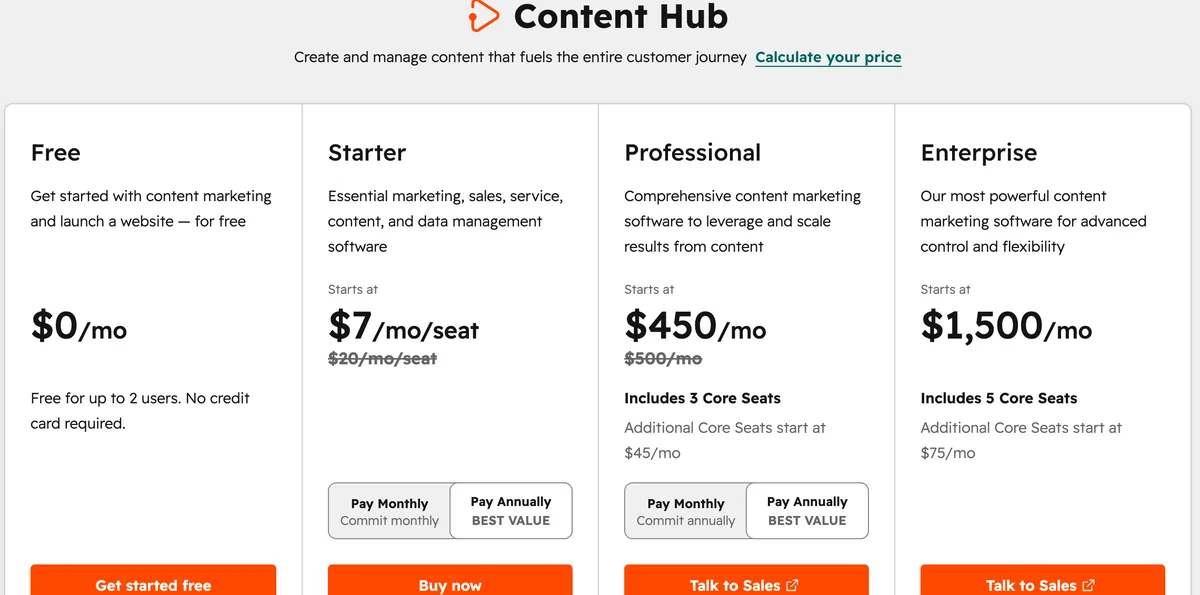
We are not arguing against HubSpot. If the CRM, the email, the forms and the site all live in one place and the marketing team can ship a landing page without filing a ticket, $5,400 a year buys something real, and Professional includes A/B and adaptive testing that the cheaper platforms charge extra for or do not have. Framer, for comparison, sells A/B testing as an add-on at $50 per 500,000 events.
The point is arithmetic. On a Webflow or Framer stack the software costs about $300 to $360 a year, which is a rounding error against any build price in the census. On HubSpot Professional the software costs $5,400 a year, which is more than the entire published starting price of 1,318 of the 1,953 certified partners. If your budget is tight, the CMS decision is a far bigger lever than the agency decision, and almost nobody treats it that way.
One trap to watch on the usage-priced platforms. Framer Pro includes 150 pages and then charges $20 per additional hundred to a maximum of 700, ten CMS collections and then $40 per additional ten, and 100 GB of bandwidth and then $40 per additional hundred. Sanity Growth includes 25,000 documents and then charges $299 per additional 50,000, with extra datasets at $999. None of that matters for a twenty-page marketing site. All of it matters if the plan is a programmatic SEO build with thousands of generated pages, and that is a conversation to have before you choose, not after.
The people bill, which is the big one
The genuine alternative to hiring anyone is hiring someone, and this is where the real money is. Federal wage data puts the May 2025 median at $104,000 for web and digital interface designers and $92,650 for web developers. There were 132,700 of the former and 87,400 of the latter employed in 2025, and the two occupations together are projected to grow 5 percent between 2025 and 2035.
A salary is not what an employee costs. The Bureau of Labor Statistics tracks this separately, and its March 2026 compensation release puts total pay for private industry workers at $46.60 an hour, of which wages and salaries are $32.60, or 69.9 percent. Benefits are the other 30.1 percent. Run the median designer's wage through that ratio and one full-time digital designer costs roughly $148,800 a year in employer compensation. A web developer costs roughly $132,500. Hire one of each and you are at about $281,300 before a desk, a laptop, or a single line of design work.
Put that next to another number from the same year. SaaS Capital's 2026 benchmarking survey, its fifteenth annual, completed in March 2026 with more than 1,000 SaaS companies responding, puts median revenue per employee at $141,125. So the fully loaded cost of one median digital designer is slightly more than the revenue a median SaaS employee generates. That is not an argument against ever hiring a designer. It is an argument for being extremely clear about what they will do all year, because at that ratio the role has to carry the product, the brand and the site, not just the website.
The reason so many SaaS companies end up with an agency or a contractor is not that agencies are cheap. It is that a marketing site is lumpy work. There is a great deal of it for six weeks and very little for the eight months after, and salaried people do not resize.
The number that actually sizes the decision
Here is the reframe, and it is the most useful thing in this article. Stop asking what a website costs and work out what your marketing budget is, because that is the pot the site comes out of and the ratio is what tells you whether a quote is sane.
The same SaaS Capital survey puts median spending on marketing at 8 percent of annual recurring revenue, with sales at 15 percent, research and development at 22 percent and general and administrative at 15 percent. How you are funded moves it a lot: equity-backed companies spend about twice what bootstrapped companies spend on marketing, and 70 percent more on sales. In the $3M to $5M ARR band the marketing figure is the same 8 percent, with sales at 12 and R and D at 24.
So take a bootstrapped company at $2M ARR. Eight percent is $160,000 a year for all of marketing: content, ads, events, tools, contractors and the website. Against that pot, the $5,000 median agency floor is 3.1 percent of a year's marketing. A $60,000 flagship rebuild is 37.5 percent of everything you will spend on marketing that year, and it might still be the right call, but now you can see what it is competing with rather than just whether it feels expensive.
What makes a SaaS site different from a brochure site
A restaurant's website has to tell you where the restaurant is. A SaaS marketing site has to do a harder job, and the difference is where the money should go.
The first difference is that the site is not the product, and the two get confused constantly. Nothing in this article covers building the application. Product design, the app UI, the onboarding flow and the in-product experience are a separate discipline on a separate budget, and an agency quoting $5,000 is quoting for the marketing site.
Next comes the pricing page, usually the highest-intent page on a SaaS site and usually the worst one. It is the page where a prospect decides whether you are for companies like theirs, and it has to survive being read by someone who is comparing you against two competitors in adjacent tabs. Every platform we priced above publishes its own pricing page, and reading five of them in an afternoon is a better education in this than any article, including this one.
Third, the buyer is rarely one person. A SaaS purchase gets checked by someone technical, someone financial and someone who will have to use it, and each of them looks for something different. That is why SaaS sites grow documentation, security pages, integration listings and case studies. It is also why page count creeps, which is the single most common reason a quote comes back higher than expected.
Fourth, content volume is the strategy. If the plan is to publish, the CMS and the templates matter more than the homepage, and a build that produces a beautiful homepage with no working article template has solved the wrong problem.
Speed is a cost that arrives late
Nobody puts performance on a quote, and it shows up in the numbers a year later. The thresholds are public and Google states them plainly: Largest Contentful Paint should happen within 2.5 seconds of the page starting to load, Interaction to Next Paint should be 200 milliseconds or less, and Cumulative Layout Shift should stay at 0.1 or below, all measured at the 75th percentile of real page loads and split between mobile and desktop. Interaction to Next Paint became a stable Core Web Vital in 2024, replacing First Input Delay.
Those are free to test against and they are the closest thing to an objective quality bar in this whole conversation. Take the three numbers to every vendor call and ask what the sites they built actually score. Firms with the answer ready have thought about the part of the job that never shows up in a mockup. Firms that treat it as an afterthought are telling you where it will land in the build.
One company, four ways
Same company throughout: bootstrapped, $2M ARR, marketing budget $160,000 a year on the 8 percent median. Every figure here comes from somewhere earlier in the article.
| Route | First-year outlay | Software in there | Share of the marketing pot |
|---|---|---|---|
| Build it yourself on Framer Pro | $360 | $30 a month, yearly billing | 0.2% |
| A median certified partner, same plan | $5,300 | $25 a month, yearly billing | 3.3% |
| Twelve months of Foundation Partner with us, same plan | $12,000 | $25 a month, yearly billing | 7.5% |
| Hire one median digital designer | $148,800 | Not included | 93% |
The first row costs you nothing but your own weeks, and for a pre-revenue idea that is the right answer. The last row is in the table to be looked at rather than chosen: one salaried designer consumes almost the entire marketing budget of a $2M ARR company, which is why that hire usually only makes sense once the person has a job much larger than the website.
The two rows in the middle are the ones most companies are actually choosing between, and they are not the same purchase. The median partner's figure is a starting price for a project. Ours is twelve months of continuing design and development at $1,000 a month, which you can pause or cancel at any point. Decide it on whether you want the work to carry on after launch, and on whether the person you would be working with has built this before for a company like yours.
Spending order when the budget is fixed
If the budget is fixed and the wish list is not, spend in this order. Positioning first, meaning the sentence at the top of the homepage that says who this is for and what changes. It costs nothing but argument and it decides whether everything below it works.
Then the pricing page, for the reasons above. Third, one case study with a real number in it, because a specific outcome from a company your prospect recognizes outperforms any amount of design polish. Fourth, the article template, if publishing is part of the plan. Fifth, everything else.
What we would cut, in order, if the money runs out: custom illustration, scroll animation, a video background, and a second round of homepage concepts. None of those has ever been the reason a deal closed, and the first three are the reason Largest Contentful Paint misses 2.5 seconds.
When you should not hire anybody
Three cases, and we will talk you out of it in all three. Until you have found out whether people want the thing, build the site yourself on Framer or Webflow for $360 a year, spend the weeks on customer conversations, and replace it when you know what it should say. A site built before product-market fit is a site built on guesses, and paying someone to render your guesses beautifully does not improve them.
If somebody on the team genuinely enjoys this and will keep enjoying it, an in-house capability is worth more over three years than a better launch. The sites that stay good are the ones with somebody who touches them weekly, and no agency relationship reproduces that.
And if the actual problem is that nobody knows you exist, a rebuilt site will not fix it. A site converts the traffic it gets. If the traffic is fifty visits a month, the constraint is distribution, and $5,000 spent on the website is $5,000 not spent on the thing that would have moved the number. We have written about the opposite situation, where the traffic is there and the site is the problem, and the test between them takes about ten minutes with your analytics open.
Where we fit in the census
We sell three monthly plans: Foundation Partner at $1,000 a month, Growth Partner at $2,500 and Scale Partner at $5,000. Every one is billed monthly with no minimum, and you can pause or cancel at any point. On the 200-plus projects behind us, a focused build has usually gone live 14 business days from the day content and assets land. That is what has happened rather than something we put in a contract. Partnership inquiries get a reply within 48 hours.
What we can point at: the site we rebuilt for Cornerstone Healing Center produced 20 percent more website conversions, and the site we built for Eden Digital sat under a tenfold increase in revenue. Neither came from a nicer homepage. Both came from changing what the pages said and in what order. Our pricing page sets out all three plans.
If the first row of that table describes your situation, go and build it yourself. Saying so costs us nothing we want, because a project whose honest deliverable is a weekend in Framer is not a project we should be invoicing for.
The one number to bring to the call
Before you speak to anyone, work out one figure and write it at the top of the page: your annual marketing budget. If you do not have one, use 8 percent of your ARR, which is where the median private B2B SaaS company lands. Then judge every quote as a percentage of that number rather than as a number on its own.
It changes the conversation completely. A $12,000 quote is meaningless in the abstract. At $500,000 ARR it is 30 percent of your entire marketing year and almost certainly wrong. At $5M ARR it is 3 percent and probably underspending for what a site at that stage has to carry. Same quote, opposite verdicts, and the only thing that moved was the denominator.
Then ask each vendor three things, and none of them is about price. What did the last three sites you built score on Largest Contentful Paint. What breaks on the pricing page when a plan gets renamed. And who is responsible for the words. The answers will separate the quotes faster than any amount of comparing bottom lines, and if you want the longer checklist we keep one in how to choose an agency and a companion piece on what you actually own when it is finished.
Frequently asked questions
The median certified Webflow partner publishes a starting price of $5,000, and three quarters of the 1,953 partners worldwide start between $1,000 and $9,999. Only 32 start at $50,000 or more, and just 3 set their floor at $100,000 or above. Those are floors rather than typical project prices, so a firm whose card says $5,000 may do most of its work well above that, but the distribution is a far better guide than the $40,000 to $150,000 ranges that agencies publish about themselves. We publish ours: $1,000, $2,500 or $5,000 a month.
Because almost all of them are written by agencies at the expensive end of the market describing their own invoices. The two pages that came top when we searched name no survey or dataset for their figures, and one of them cites a second agency's blog post. Firms at the median of the market do not have content teams, so they never publish, and the public record ends up describing the top few percent while reading like an average.
Work out your annual marketing budget first, then judge the quote as a share of it. SaaS Capital's 2026 survey of more than 1,000 companies puts median marketing spend at 8 percent of annual recurring revenue. At $2M ARR that is $160,000 a year for all of marketing, so a $5,000 site is about 3 percent of it and a $60,000 rebuild is 37.5 percent. The same quote can be obviously wrong at one revenue level and obviously right at another.
They are close enough that price should not decide it. Read on 6 September 2026, Webflow's Basic site plan is $15 a month billed yearly and Premium, which adds the CMS, is $25. Framer is $10 for Basic and $30 for Pro on yearly billing, with extra editors at $20 each. The bigger cost difference is usage: Framer Pro includes 150 pages and then charges $20 per additional hundred, which matters only if you plan to generate a lot of pages.
It depends on whether you need the rest of HubSpot. Content Hub Professional starts at $450 a month on an annual commitment, or $500 paying monthly, and Enterprise starts at $1,500. That is $5,400 or $18,000 a year, more than the entire published starting price of 1,318 of the 1,953 certified Webflow partners. If the CRM, email, forms and site all live in one place and your marketing team ships pages without engineering, that is real value. If you only need a website, it is the most expensive way to have one.
Run the loaded number before you decide. The BLS median wage for web and digital interface designers was $104,000 in May 2025, and its March 2026 compensation survey puts wages at 69.9 percent of what a private-sector employee costs an employer, which puts one designer around $148,800 a year. For a bootstrapped company at $2M ARR that is roughly 93 percent of the whole marketing budget. The hire makes sense when the person owns the product, the brand and the site, not when they only own the website.
On our side a focused marketing site usually goes live 14 business days from the day content and assets land, drawn from more than 200 shipped projects rather than promised in a contract. Longer timelines usually come from page count and content rather than from design. If the site needs documentation, security pages, integration listings and several case studies, the writing is the critical path and no design process will compress it.
Ask three things that have nothing to do with price. First, what the last three sites they shipped scored on Largest Contentful Paint, which Google says should land within 2.5 seconds at the 75th percentile. Second, what breaks on a pricing page when a plan gets renamed. Third, who is responsible for the copy. Those answers separate quotes faster than comparing bottom lines, because they reveal whether the firm owns performance, structure and content or only the visual layer.
 Web Design
Sep 5, 2026 · 17 min
Template or Custom Website in 2026: What a Template Actually Buys
We read the license and the support policy behind the biggest template marketplace, then counted every theme in the WordPress.org directory and the Shopify Theme Store. The sticker price is the smallest number in the decision.
 Web Design
Sep 3, 2026 · 19 min
How Much Should a Hotel Website Cost in 2026?
Published platform prices run from $9 to $197 a month and a managed hotel website starts at $14,400 a year. Then a federal rule decides which number on your page has to be the biggest.
 Web Design
Sep 1, 2026 · 18 min
How Much Should a Property Management Website Cost in 2026?
Buildium gives you one free, DoorLoop bundles one with hosting, and Yardi charges the same dollar a unit whether your floor is $100 or $400. The website is rarely the number that matters. Your door count is.