
How Much Should a Property Management Website Cost in 2026?

Sep 1, 2026 · 18 min read
Buildium will give your property management company a website for nothing. It says so on its own feature page, in a sentence that leaves no wiggle room: a free website for property managers, hosted by Buildium. DoorLoop includes one with hosting and your own domain. At Rentec Direct the marketing tools are in the plan. The question in the title has a strange answer for a lot of firms, which is that the website is already in something you are paying for.
Which leaves the real question. A good deal of property management software is not priced as a subscription at all. It is priced per door, with a monthly floor underneath it, and for a firm of ordinary size the floor is what gets billed, not the rate. At Propertyware the published rate is $1.00 a unit and the published minimum is $250 a month, so a 50 door manager pays five times the rate on the page. Everything below comes from prices these companies print on their own sites, read on 1 September 2026, plus the arithmetic those prices force once you divide by your door count. We build websites for real estate and property firms, so our own number is in here with everyone else's.
The 30-second answer
For a lot of property management companies, close to nothing, because the website comes inside the software. At Buildium the hosted website is free and the plans it sits inside start at $62 a month. DoorLoop bundles a website with hosting from $69 a month on annual billing. A flat $25 a month covers ten or fewer properties at Rentec Direct. If you want a standalone marketing site built and run for you instead, PMW publishes $1,795 or $3,895 to set up plus hosting from $195 a month, and Fourandhalf publishes $600 to $2,399 of setup against $349 to $1,199 a month. So the honest range is $0 to about $24,000 in year one, and which end you land on depends less on the website than on whether you are also buying owner lead generation.
The published answers run from $5 to $100,000
Search this question and you get numbers that do not overlap. On 1 September 2026 we opened the pages ranking for it and wrote down what each one says.
PropertyManagerWebsites says property management sites "generally range from $2,000 to $20,000" and that enterprise builds "can even exceed $100,000". inMotion Real Estate Media splits it into a simple informational site at $5,000 to $8,000, a mid-size site with custom property search at $9,000 to $15,000, and a large database-driven build at $31,000 to $100,000. DoorLoop's guide, dated 2 June 2026, says setting one up from a template "can range from $5 to $100 for a basic DIY option, not including hosting or domain fees". Resident360's property management web design page publishes no figure at all and asks you to request pricing.
Those answers span four orders of magnitude, and every one of them is defensible, because they are describing different products. What none of them puts in front of you is an option a good share of their readers already own. A firm running Buildium, DoorLoop or Rentec Direct has a hosted, syndicated, lead-capturing website sitting inside the subscription it pays for the accounting.
Credit where it is due on one point. The PropertyManagerWebsites guide quotes that $2,000 to $20,000 range and then names its own prices in the same article, $1,795 and $3,895 to set up with hosting from $195 a month. That is more transparent than most cost guides manage. It also means the range the article opens with starts above the price the same article closes with.
The website is already in the software
Three of the major platforms put a website in the plan and say so in plain language on their own pages.
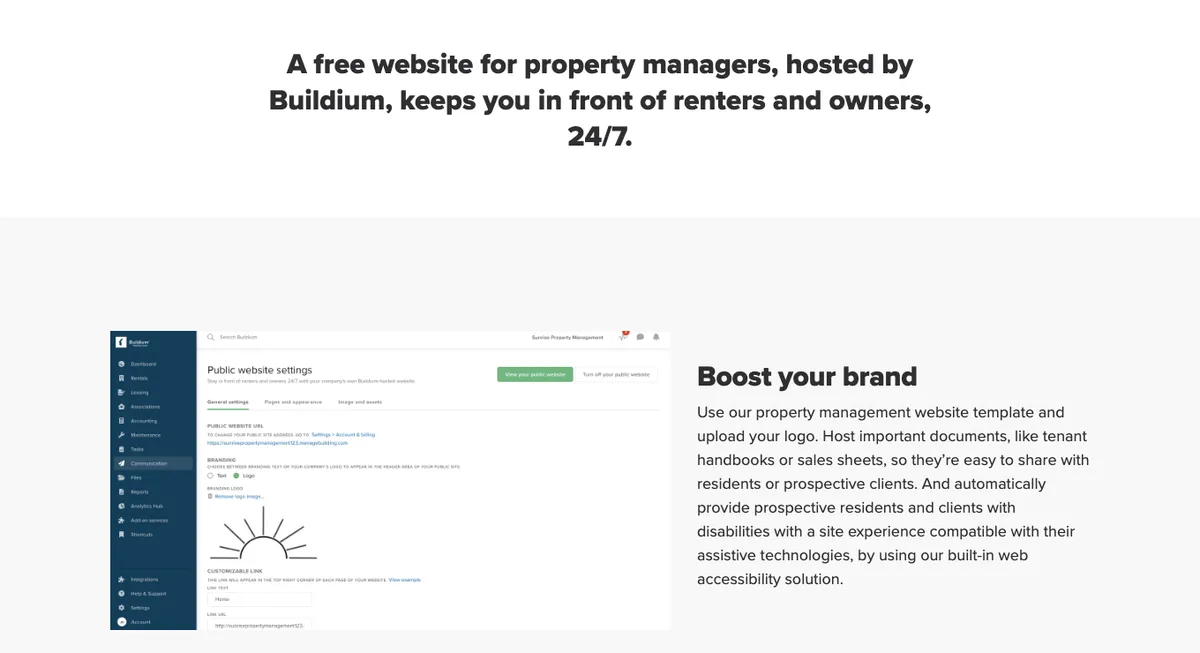
Buildium hosts the site, lets you upload a logo and publish documents such as tenant handbooks, and states that it provides a site experience compatible with assistive technologies through a built-in accessibility solution. DoorLoop gives you the domain choice and the hosting, publishes vacancies to the site, and takes applications and rent payments through it. Marketing tools appear in Rentec Direct's Pro and PM editions. At Yardi Breeze it is different: customizable property websites are a Premier feature, delivered through RentCafe, and RentCafe Property Websites is listed as a Premier add-on with no published price. That distinction matters and we will come back to it, because Premier carries a much higher floor.
None of this makes the bundled site the right answer for every firm. A template that every other manager in your city is also running will not win a competitive market on design, and the ones we have looked at are built to convert renters rather than to persuade an owner with forty doors to move their portfolio. But if the question is what a property management website costs, the truthful first answer is that a serviceable one is already paid for, and the second question, the one that decides your bill, is what the software around it costs.
What the software actually costs a month
Eleven published entry prices, from zero to $400 a month, all read on the same day.
At the bottom, Innago charges nothing at all and Hemlane publishes a Starter tier as free forever with no card required. RentRedi is one plan with every feature in it, $29.95 a month paid monthly, $20 on six months, or $12 on annual billing, for unlimited properties and unlimited tenants. TenantCloud runs $18, $35 and $60 a month, or $15, $29.17 and $50 on annual terms, with a Business tier from $100. Rentec Direct charges a flat $25 for up to ten properties and starts its Pro and PM editions at $50, with free setup and onboarding.
Then the shape changes. Buildium prints Essential from $62, Growth from $192 and Premium from $400 a month, and the words "starting at" are load-bearing: those are floors, not prices. DoorLoop caps its Starter plan at ten units, prints $99 a month or $69 billed yearly, and lists Pro at $189 or $149 and Premium at $239 or $209, with a note above each card reading "Only $3/unit" and an instruction to book a demo above 300 units. At Yardi Breeze and at Propertyware the subscription idea is abandoned entirely.
The floor is the price, not the rate
Propertyware publishes the clearest per-door pricing in this market, and reading it carefully is the single most useful thing in this article.
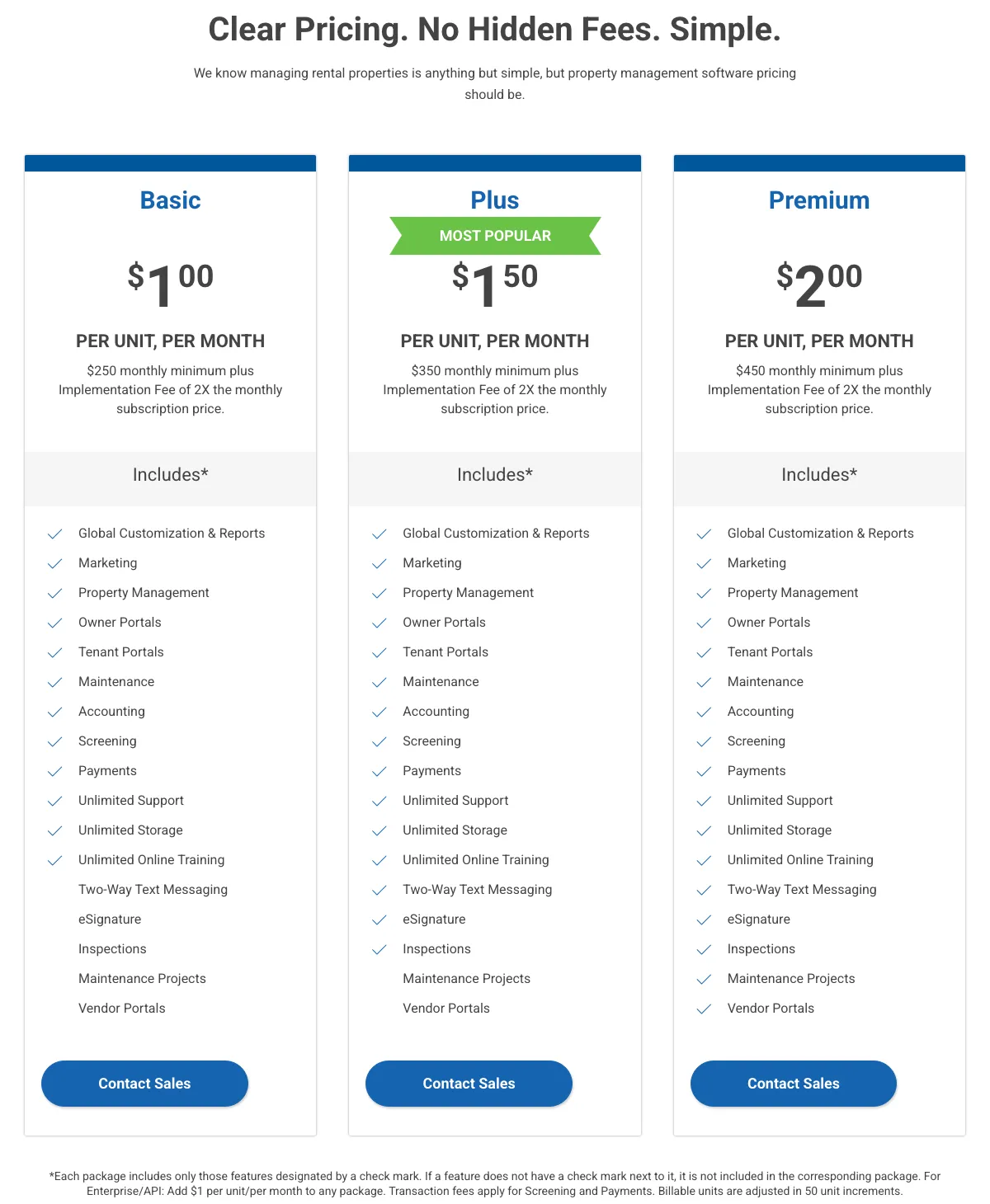
Propertyware charges $1.00, $1.50 and $2.00 a unit a month across Basic, Plus and Premium, with monthly minimums of $250, $350 and $450, an implementation fee of twice the monthly subscription, an extra $1 a unit for Enterprise and API access, and billable units adjusted in 50 unit increments. Over at Yardi, Breeze is $1 a unit a month for residential portfolios with a $100 monthly minimum on an annual agreement and no onboarding, training or support fees, while Breeze Premier charges the same $1 a unit against a $400 minimum. Commercial portfolios are $2 a unit with a $200 minimum, affordable housing is Premier only at $3 a unit with a $400 minimum.
Put those two vendors side by side and something odd falls out. Yardi Breeze and Yardi Breeze Premier charge exactly the same published rate per residential unit. The only difference between the two published prices is the floor, $100 against $400. So a 50 door manager who needs the RentCafe website, which only exists on Premier, pays four times as much for the identical per unit rate as the manager next door who does not.
Divide by your doors and the floor becomes visible
A monthly price tells you almost nothing in this industry until you divide it by the number of doors it covers. Do that at 50 doors and the distance between the advertised rate and the real one stops being abstract: plans whose published rate is $1.00 to $2.00 a unit turn out to cost $5.00 to $9.00 a door.
Every bar there is software doing broadly the same job for the same portfolio. At 50 doors, Propertyware Premium is $9.00 a door a month and RentRedi is $0.24, a spread of nearly 38 to one on published prices, with Yardi Breeze at $2.00 and Hemlane Basic at $2.56 in between. Yardi Breeze Premier lands at $8.00 a door not because its rate is high, its rate is a dollar, but because the $400 floor is spread across too few units.
Now run the same portfolio forward. On Propertyware Basic, 50 doors costs $250 and so does 150 doors and so does 249 doors, because the minimum has not been cleared. Per door that is $5.00, then $1.67, then $1.00. On Yardi Breeze the floor clears at 100 doors and the price becomes genuinely linear after that. The vendor that is expensive for you today may be the cheap one in three years, and the flat-rate plan that looks unbeatable at 50 doors, like RentRedi at $12 a month for unlimited units, does not get any dearer at 500 either.
The door count where the published rate becomes your price
Divide the minimum by the rate and you get the exact portfolio size at which each vendor starts charging what its page advertises. Below that number, the advertised rate is decoration.
| Plan | Published rate | Monthly minimum | Doors before the rate applies | Per door at 50 doors |
|---|---|---|---|---|
| Yardi Breeze, residential | $1.00 a unit | $100 | 100 | $2.00 |
| Propertyware Premium | $2.00 a unit | $450 | 225 | $9.00 |
| Propertyware Plus | $1.50 a unit | $350 | 233 | $7.00 |
| Propertyware Basic | $1.00 a unit | $250 | 250 | $5.00 |
| Yardi Breeze Premier | $1.00 a unit | $400 | 400 | $8.00 |
Those thresholds sit a long way up. A firm has to be managing 400 doors before Breeze Premier charges the dollar a unit it advertises, and 250 before Propertyware Basic does. Any company below its own vendor's threshold is buying a minimum rather than a rate, and will keep buying it until the portfolio grows into the number.
None of this is hidden. All five of those numbers are printed on the vendors' own pricing pages, in the same size type as everything else. They are simply not presented on those pages in the one form that would let you compare them, which is dollars per door at the portfolio you actually manage.
What your next door costs
Here is the part almost nobody prices before signing, and it is where the floor stops being a nuisance and starts being an asset.
Below a minimum, the marginal cost of your next door is zero. A firm on Propertyware Basic at 100 doors can take on 149 more without its software bill moving by a cent, because the $250 floor absorbs all of them. The same firm on a per unit plan with no floor pays for every one. On RentRedi's single plan the marginal door is free at any size, because the plan is flat and the units are unlimited. On DoorLoop's Starter tier the marginal cost of door eleven is a plan change, since Starter is capped at ten units.
This inverts how the decision usually gets made. Managers shop on the monthly number and then discover the growth cost afterwards. The better order is to price the door you are about to win, because a company adding 60 doors a year will pay for those doors many more times than it will pay any setup fee. Propertyware makes this concrete in a way the others do not: its implementation fee is defined as twice the monthly subscription, so it is not a fixed cost at all. At the Basic minimum it is $500. At 500 doors on Plus, where the monthly bill is $750, the same fee is $1,500.
The companies that will not print a number
Three of the better known names in this category publish no price whatsoever, and one of them publishes something more interesting in its place.
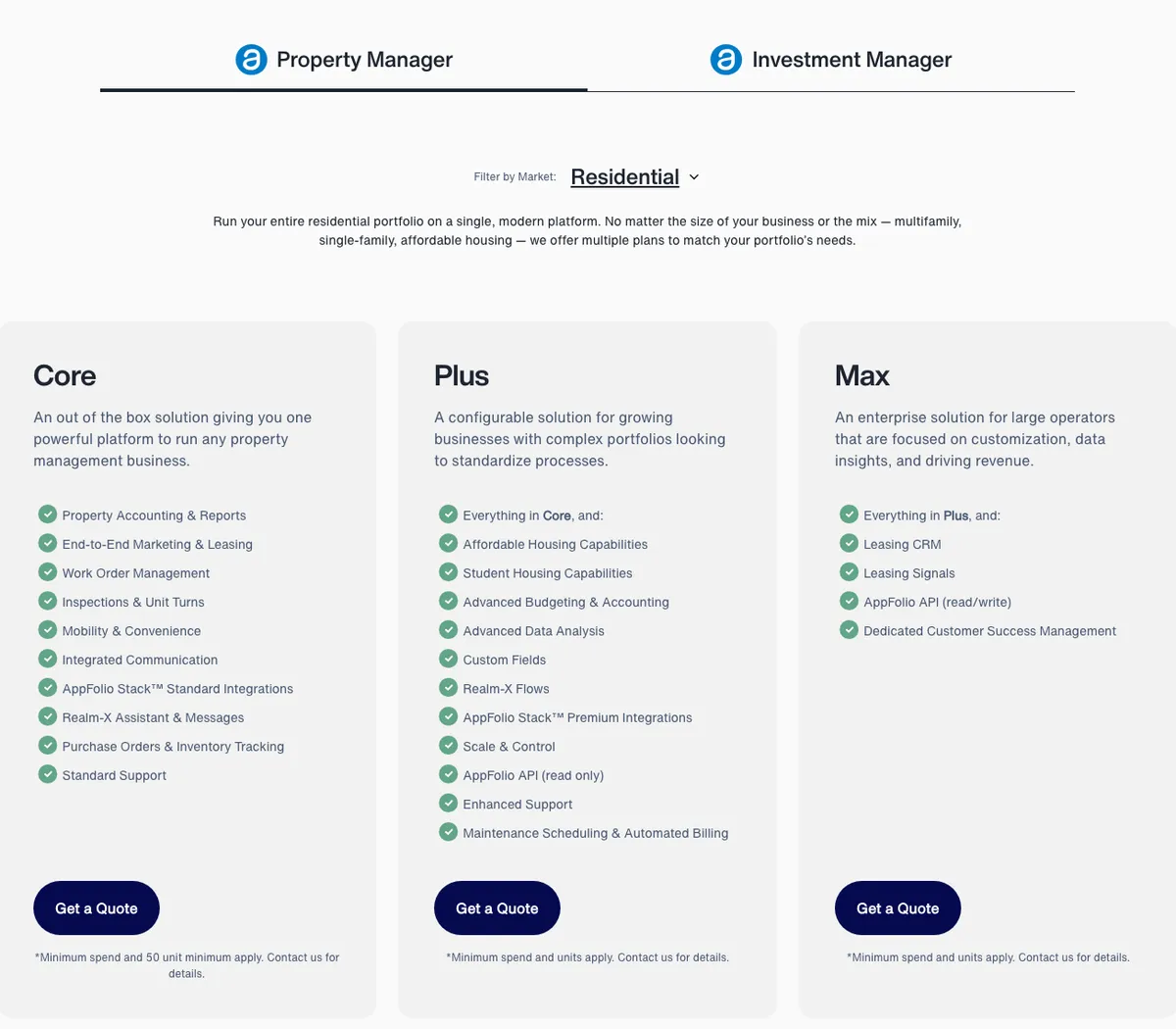
AppFolio shows Core, Plus and Max with no figure against any of them, only a Get a Quote button. What it does publish is the qualification: a minimum spend and a 50 unit minimum on Core, and a minimum spend and units on the other two. Read that as a straight answer to a different question. AppFolio will not tell you the price, but it will tell you that a 30 door manager is not the customer.
Rentvine says "as low as $1.50 per unit" and then asks you to request pricing. It also runs one of the more detailed cost guides in this market, which prints per unit ranges of $1 to $5, minimums of $100 to $300 for small portfolios, and a table of expected monthly cost by portfolio size. A company willing to publish a cost table for the whole category and not its own price is doing something worth noticing, though calling it hypocrisy would be too strong: quoted pricing is a legitimate model when the product is genuinely configured per customer.
Resident360 does the same on the agency side, publishing awards and process and no numbers. The practical consequence for you is identical in all three cases. You cannot compare an unpublished price to a published one, so any shortlist that mixes the two is really a shortlist of one known quantity and several unknowns, and the unknowns need a written quote before they belong on the same page.
The other lane, and what it is really selling
Alongside the software sits a group of agencies that build property management websites and then market them, and their prices are an order of magnitude above everything so far.
PropertyManagerWebsites, which trades as PMW, sells a Smartsite from $1,795 to set up and a Custom build from $3,895, with hosting from $195 a month on either, and says a Smartsite typically launches within seven to ten business days of content approval. Its bundled marketing packages run $145, $795 and $1,995 a month. It also notes that a Smartsite is included with Rentvine, which is a neat illustration of how tangled these two lanes are.
Fourandhalf publishes three tiers with both halves of the price visible: Launch at $600 setup and $349 a month, Grow at $1,799 and $699, Scale at $2,399 and $1,199, with a la carte services from $199 a month. Only the Grow tier and up include a website; Launch is content and reputation work. Geekly Media publishes a property management operating system from $1,500 a month, digital marketing strategy from $4,000 a month, and HubSpot onboarding from $4,500 a project.
What you are buying at those numbers is not HTML. It is owner lead generation, which is the harder half of marketing in this industry, because a renter can find your vacancy on Zillow but an owner with a portfolio has to find you. BuiltRight Digital, in a guide dated 15 June 2026, prices that work at $1,500 to $6,000 a month and publishes a table running from $800 a month for single city local SEO to $10,000 or more for national campaigns, with a website redesign for SEO at $3,500 to $12,000 as a project. Those figures line up with the agency prices above rather than contradicting them.
A year in each lane
Setup fees make monthly comparisons misleading, so here is the first twelve months with everything in it.
The dark bar is the honest comparator. Twelve months of Buildium's most expensive published tier, which carries a free hosted property management website, comes to $4,800. That sits above PMW's Smartsite at $4,135 and Fourandhalf's Launch tier at $4,788, and below PMW's Custom build at $6,235. Go up the chart from there and the extra money is buying marketing labor, not a better website. PMW's Elite bundle at $1,995 a month is $23,940 a year, five times Buildium Premium, and Geekly Media's operating system at $1,500 a month is $18,000.
Two honest caveats on that chart. First, the Buildium figure is a floor, so a large portfolio will pay more than $4,800 and the comparison narrows. Second, the agency packages include work the software does not do at all: content, reviews, ad management, and someone whose job is to answer for the result. Comparing them like for like on the website alone would be unfair to both.
When the retainer earns its place
The way to settle this is not to argue about value. It is to work out how many doors the retainer has to win, using numbers you already have.
Your management fee per door per month is a number you know exactly. Multiply it by twelve, then divide the annual cost of the package into it, and you have the count of new doors that has to arrive before the marketing is free. RentRedi publishes an assumption for this on its own pricing page, using a 9% management fee on a $1,500 average rent to arrive at $135 per unit per month for a property manager. It is their assumption rather than a measurement, and your own fee schedule beats it, but as an illustration: at $135 a door a month, Fourandhalf Grow at $10,187 in year one needs about 6.3 doors held for a full year to break even, and PMW Elite at $23,940 needs about 14.8.
Whether those are easy or impossible depends entirely on your average portfolio size per owner. A firm whose typical new client brings one single family home needs to close six or fifteen separate owners. A firm that signs small multifamily buildings might clear it with two phone calls. Run the number before the sales call rather than during it, because the answer determines which lane you should even be shopping in.
What the listing pages are not allowed to say
A property management website is not a brochure. Its vacancy pages are housing advertisements, and federal law regulates their contents in terms that read like a build specification.
24 CFR 100.75, the Fair Housing Act regulation on discriminatory advertisements, makes it unlawful to publish any notice, statement or advertisement about the rental of a dwelling indicating a preference, limitation or discrimination based on race, color, religion, sex, handicap, familial status or national origin. Subsection (b) extends that to applications, flyers, brochures, signs and banners, which is to say to every template on your site and not only the listing copy. Subsection (c)(1) is the one that catches website teams by surprise: it names "words, phrases, photographs, illustrations, symbols or forms" that convey availability to a particular group. Your stock photography and your amenity icons are covered by the same rule as your headline.
Subsection (c)(3) reaches further still, to selecting media or locations for advertising that deny particular segments of the market information about housing. Anyone running paid distribution for those listings should read that line before choosing an audience. The regulation itself points to 24 CFR part 109 for guidance on advertising in a non-discriminatory manner.
The practical version for a build: the listing template should have no free text field that lets a leasing agent type a preference into a public page without review, the photo library needs an owner, and "perfect for" is a phrase worth removing from the component library entirely.
What the rejection email has to contain
If your site takes applications and runs screening, as every platform whose feature list we read here does, then your software is sending adverse action notices whether or not anyone has read what one must say.
15 U.S.C. 1681m(a) sets four duties on anyone taking adverse action based in whole or in part on a consumer report, and it expressly allows the notice to be electronic, which means the email your site sends is the compliance artifact. The applicant must get notice of the adverse action; written or electronic disclosure of the numerical credit score used; the name, address and telephone number of the consumer reporting agency that supplied the report, together with a statement that the agency did not make the decision and cannot explain it; and notice of their right to a free copy of the report within 60 days and to dispute its accuracy.
Screening prices tell you how often this template fires. Buildium charges $17 a screening, $20 on its enhanced product, or $35 when the applicant pays. Rentec Direct charges $10 to $18 for Pro and PM subscribers and $14.95 to $29.45 on Starter. RentRedi passes it to the tenant at $39.99, or $49.99 with income verification. A firm turning down even a handful of applicants a month is sending this notice regularly, so it is worth reading the version your platform sends against those four items once, rather than assuming.
What these numbers weigh against a payroll
Software and marketing budgets only mean something next to the cost of a person. For the fourth quarter of 2025, the Bureau of Labor Statistics county employment series counts 80,710 residential property management establishments in the United States, employing 550,304 people, at an average weekly wage of $1,376. That is about 6.8 employees per firm and roughly $71,552 a year for one full-time role.
Measured against that wage, twelve months of Buildium's top tier is 6.7% of one salary and twelve months of Propertyware's Basic minimum, $3,000, is 4.2%. A year of Fourandhalf's Scale package is 23.5% and PMW's Elite bundle is 33.5%, so the largest marketing packages in this article cost a third of a person. Nonresidential property managers, a separate series, are a smaller and better paid group: 23,802 establishments, 174,432 employees, $2,092 a week.
That framing cuts both ways and we should say so. A third of a salary is a serious commitment for a firm with seven people, and it is also considerably less than hiring a marketer who would then need software, tools and management. The comparison is a check on scale, not an argument.
What we charge, and when the software wins
Our own numbers, for completeness. We sell one thing, a monthly partnership, and the prices are on the page rather than behind a call: $1,000, $2,500 or $5,000 a month, billed monthly in advance, no minimum, pause or cancel anytime. Everything we deliver is yours to keep, files, pages and brand assets, so leaving does not cost you the site. On a focused build, 14 business days from the day content and assets land to launch is what we typically see across more than 200 shipped projects, offered as a pattern rather than a promise, and partnership inquiries get an answer inside 48 hours. The pricing page sets out what sits in each tier.
We do not sell property management software, take a share of anyone's screening fees, or receive anything from the companies named above. That matters more here than in most industries, because the platforms in this article are also the ones giving away the free website, and an agency paid by a platform has a reason to tell you the free one is not good enough.
Several kinds of firm should not hire us. A landlord with a handful of units should take Innago or Hemlane's free tier and spend nothing on a site. A manager under 200 doors who is happy with a template should use whatever their software already includes and put the money into the thing that actually generates owner leads. A company that wants the website, the accounting, the portals and the screening on one invoice from one vendor should buy a platform, because that integration is real and we do not build property management software. Where a custom site earns its cost is a firm competing for owner portfolios in a market where the other managers all run the same template, which is more markets than you would think.
Work out what your next door costs
Every worksheet in this genre prices the decision you are making today. This one prices the door you have not won yet, because that is the number that decides which vendor is cheap for you in three years.
Take your shortlist and fill in six lines for each vendor.
| Line | What to write down | Vendor A | Vendor B |
|---|---|---|---|
| 1 | Doors you manage today | ||
| 2 | This month's bill at that door count | ||
| 3 | Line 2 divided by line 1, the cost per door | ||
| 4 | The bill after adding ten more doors | ||
| 5 | Line 4 minus line 2, the cost of ten doors | ||
| 6 | The bill at the portfolio you want in three years |
Line 5 is the answer. If it is zero you are under a minimum, which means growth is free until you clear it and you should find out exactly where that point is. If it is the published rate times ten, you are above the floor and every door you win from now on carries a cost you can plan around. If line 5 is a whole plan upgrade, your cheap tier has a cap in it.
Three rules keep it honest. Put the implementation or setup fee in as a separate line and check whether it is fixed or, as at Propertyware, a multiple of the monthly bill you have just calculated. Use the billing term you will actually sign, since several of these prices are annual-agreement prices and Yardi Breeze states that condition on its own page. And do line 6 on the portfolio you expect rather than the one you hope for, because a floor that looks generous at 400 doors is simply an overpayment at 90.
If you only do one thing this week
Open your current invoice and divide it by your door count. It is the figure that makes two otherwise incomparable vendors comparable, and it is not printed on anybody's pricing page. Once you have it you will know within a minute whether you are paying a rate or a floor, and everything else in this article follows from that one division.
After that, in order: check whether the website you are paying an agency for is one your software already includes; get any quoted, unpublished price in writing with the unit minimum stated; read one adverse action email your system has actually sent against the four items the statute lists; and take a pass through your listing template for preference language and stock photography. On the question of who should hold the domain and the accounts at the end of all this, we wrote separately about who owns your website, and the recurring side of the bill is covered in our piece on website maintenance costs. For agents and brokerages rather than managers, the sister article is what a real estate website costs.
The website was never the expensive part of this decision. The expensive part is a floor you may be sitting well below, attached to a rate you will not reach for years, on a contract few people re-read once the doors start arriving.
Frequently asked questions
For most firms, nothing extra, because the website is included in property management software they already pay for. Buildium publishes a free hosted property management website on plans from $62 a month, DoorLoop includes a website and hosting from $69 a month on annual billing, and Rentec Direct starts at $25 a month flat for ten or fewer properties. A standalone site built and run by a specialist agency is a different purchase: PMW publishes $1,795 or $3,895 to set up plus hosting from $195 a month, and Fourandhalf publishes setup fees of $600 to $2,399 against $349 to $1,199 a month. All figures read on 1 September 2026.
At several of the major platforms, yes, and they say so on their own pages. Buildium describes a free website for property managers that it hosts. At DoorLoop the domain choice and the hosting come with the plan, and vacancies, applications and rent payments all run through the site. Rentec Direct puts marketing tools in its Pro and PM editions. Yardi Breeze is the exception worth knowing about: customizable property websites are delivered through RentCafe as a Breeze Premier add-on, and Premier carries a $400 monthly minimum against Breeze's $100.
Almost always per unit with a monthly minimum underneath, which means your door count sets your bill. Propertyware publishes $1.00, $1.50 and $2.00 a unit a month with minimums of $250, $350 and $450, plus an implementation fee of twice the monthly subscription. Yardi Breeze publishes $1 a unit for residential portfolios with a $100 minimum, and $400 on Breeze Premier. Below the minimum you pay the floor, not the rate, so a 50 door manager on Propertyware Basic pays $5.00 a door against the $1.00 printed on the page.
It is the smallest amount the vendor will bill you regardless of how few units you manage, and it decides the price for most small and mid-sized firms. Divide the minimum by the per unit rate and you get the portfolio size at which the advertised rate finally becomes what you pay: 100 doors at Yardi Breeze, 225 at Propertyware Premium, 233 at Propertyware Plus, 250 at Propertyware Basic and 400 at Yardi Breeze Premier. The useful consequence is that below that point your next door is free, because the floor already covers it.
It sells on quoted pricing, and its pricing page shows Core, Plus and Max with a Get a Quote button and no figures. The page does carry a qualification instead of a price: a minimum spend and a 50 unit minimum on Core, and a minimum spend and units on the other two tiers. Rentvine and Resident360 also ask you to request pricing. Quoting is a legitimate model, but you cannot compare an unpublished price to a published one, so ask for the number and the unit minimum in writing before putting them on the same shortlist.
It depends on how many doors it has to win, and that is a calculation you can do before the sales call. Take your management fee per door per month, multiply by twelve, and divide the package's annual cost by it. Fourandhalf's Grow tier comes to $10,187 in year one and its Scale tier to $16,787; PMW's Elite bundle is $23,940 a year. What those agencies sell is owner lead generation rather than a better website, which is a real product, but it is only worth buying if your average portfolio per owner makes the door count reachable.
Two things gate the build. Vacancy listings are housing advertisements under 24 CFR 100.75, which prohibits any statement indicating a preference or limitation based on race, color, religion, sex, handicap, familial status or national origin, and explicitly covers photographs, illustrations and symbols as well as words. Separately, if your site takes applications and runs screening, 15 U.S.C. 1681m(a) sets four things your adverse action notice must carry, and it allows that notice to be electronic, so the rejection email your platform sends is the compliance record.
Start there and prove it is the constraint before replacing it. The bundled sites host, publish vacancies, take applications and collect rent, which covers what a renter needs. Where they run out is persuading an owner with a portfolio to switch managers, because that visitor is comparing you against other firms who are usually running the same template from the same vendor. If your owner enquiry volume is the problem, the fix is a differentiated site plus the marketing behind it. If it is not, the free one is doing its job.
 Web Design
Sep 6, 2026 · 17 min
SaaS Website Cost in 2026: What 1,953 Agencies Say They Charge
Every published range for this question is written by an agency describing its own invoices. So we read all 196 pages of Webflow's Certified Partner directory and counted what 1,953 of them actually put on the card.
 Web Design
Sep 5, 2026 · 17 min
Template or Custom Website in 2026: What a Template Actually Buys
We read the license and the support policy behind the biggest template marketplace, then counted every theme in the WordPress.org directory and the Shopify Theme Store. The sticker price is the smallest number in the decision.
 Web Design
Sep 3, 2026 · 19 min
How Much Should a Hotel Website Cost in 2026?
Published platform prices run from $9 to $197 a month and a managed hotel website starts at $14,400 a year. Then a federal rule decides which number on your page has to be the biggest.