
Template or Custom Website in 2026: What a Template Actually Buys

Sep 5, 2026 · 17 min read
A template costs $79 and a custom website costs a few thousand, so the decision looks like it makes itself. It does not, because those two numbers are not measuring the same object. One is the price of a file, plus permission to use it once. The other is the price of a finished website with somebody's name attached to it. Everything difficult about this choice lives in the gap between them.
So instead of arguing, we read the paperwork and counted things. The license and the support policy that govern ThemeForest, whose own footer counts 78,925,597 items sold, are both published, and almost nobody writing about this quotes either one. We also counted every theme in the WordPress.org directory and every theme in the Shopify Theme Store, on 5 September 2026. We sell custom websites, which means one of the answers below pays us and the other does not. The numbers include the ones that argue against hiring us, because that is the only version of this article worth your time.
The 30-second answer
Buy a template when you could describe the entire site on one page, and pay for custom when the site has to do something particular. The sticker prices are real: Webflow templates cluster at $79, the median paid Shopify theme is $320, and a WordPress theme or page builder license runs $59 to $99 for a first year. None of those prices covers installation, customization, hosting, or support past six months on ThemeForest. Our own plans are monthly, from $1,000 a month. That difference is the cost of turning a file into a working website, and somebody pays it either way, in money or in evenings.
Four template markets, and what they charge
Template pricing is not one market, it is four, and they do not price the same way. Two sell you a file once. One sells you a yearly license. One gives the file away and sells the software around it. Knowing which one you are standing in front of settles half the confusion.
Webflow sells one-time templates. The marketplace calls itself a home for 7000+ free and premium templates, and its first page of listings carried 66 priced tiles on the day we looked: eight at $39, fourteen at $59, twenty-six at $79, fourteen at $99 and four at $129. The middle of that page is $79, which is where the number in most template articles comes from.
Shopify also sells one-time themes, and charges several times more. Its store listed 1,257 themes, and its own price filter split them into 24 free and 1,233 paid. We read all 53 pages of listings and captured a price for 1,231 of the paid ones. The cheapest is $100 and the most expensive is $500. The median is $320 and the mean is $288, which makes a paid Shopify theme roughly four times a Webflow template and more than three times a year of any WordPress license below. The distribution is lopsided toward the middle: 258 themes are priced under $200, 272 sit between $200 and $299, 550 sit between $300 and $399, 131 sit between $400 and $499, and 20 are at $500.
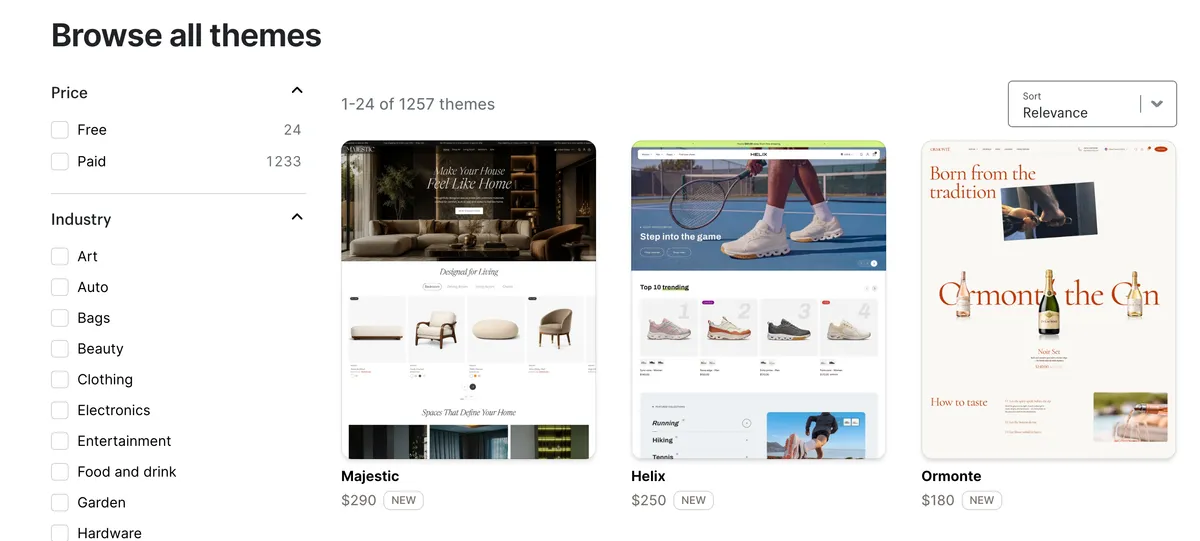
Shopify also does something worth knowing before you buy anywhere: its theme pages invite you to customize a paid theme first and only pay when you publish. You can find out whether your content fits before any money changes hands, which is precisely the question a template buyer cannot usually answer in advance.
WordPress splits in two. There are 15,181 free themes in the official directory, which we get to below, and there is a paid lane that mostly sells annual licenses rather than files. Read on 5 September 2026: GeneratePress Premium is $59 a year, Bricks Starter is $79 a year for one site, Divi is $89 billed yearly for unlimited sites, Beaver Builder Starter is $89 a year, Kadence Essentials is $99 a year and Astra Pro plus AI is $99 for a first year. A few of them also sell a one-time option. Divi is $249 for life, and Bricks Ultimate is $599.
ThemeForest is the fourth market and it is missing from this article, which we should say plainly rather than quietly. Its item pages would not open for us, so there are no ThemeForest prices here and we are not going to characterize them from memory. Its two governing documents are public, and they turn out to be more useful than any price on the site.
One caution while you are comparing, because vendor comparison tables age badly. Divi's pricing page carries a table pricing six competitors against itself, and it lists Beaver Builder at $199 a year for unlimited sites. Beaver Builder's own pricing page, read the same day, sells Starter at $89, Plus at $179 for three sites, Professional at $299 and Unlimited at $546. No tier on that page is $199. Every price in this article comes from the vendor selling the thing, and that is why.
What the license actually says you bought
You bought permission to build one website. That is the operative clause of the ThemeForest Regular License, last revised on 11 March 2025, and it is the single most useful paragraph in this whole topic. The license lets you use the item to create one end product, for yourself or for one client. For a template, it defines that end product as the item after you have customized it and put your content in.
Read the rest and the shape of the deal appears. You can hand that one finished website to your client for any fee you like, and the license goes with it, which is what makes a marketplace theme usable in commercial work at all. You cannot sell the end product to anyone beyond that single client. You cannot pass the item itself along, on its own or bundled, even free, even modified. You cannot pull one component out and use it somewhere else, and the license spells that out with an example about deleting unwanted icons from a theme.
Two clauses matter more than the restrictions. The first: the author of the item keeps ownership of it, and the license is an agreement between that author and you. Envato states that neither it nor any group company is a party. The second: WordPress and other open source platforms get what the license calls split licensing, where an open source license covers part of the item and the marketplace license covers the rest, and which part is which is recorded in the download files. If you have ever been told that a marketplace theme is fully yours, or that it is fully GPL, both statements are simplifications of a document you can read in about six minutes.
The free directory is a different arrangement and, on this narrow point, a plainer one. WordPress.org's theme review requirements state that themes must be compatible with the GNU General Public License, with GPLv2 or later strongly recommended. There is no single application clause, no per client limit, and nothing to transfer. That is the one dimension on which the free option is unambiguously less complicated than the paid one, and it rarely appears on the lists of reasons to pay.
Six months, and the four things support never covers
Support on a ThemeForest theme runs for six months from the date you buy it, and you can extend it to a maximum of twelve months only at the moment of purchase. That is the Envato Item Support Policy, version 1.0, in effect since 1 September 2015. During those six months the author is expected to answer questions about the item, help with bugs, and answer questions about third party assets bundled inside it, such as a slider or a contact form.
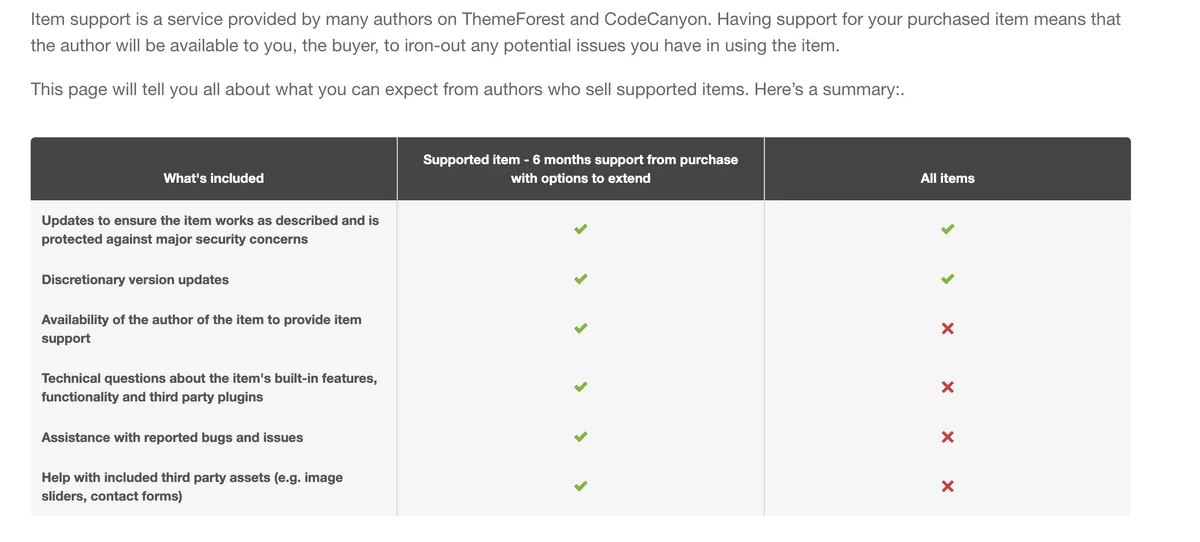
Now the exclusions, which are the part nobody quotes. Item support does not cover customization, and the policy suggests contacting the author about paid work instead. It does not cover installation, because getting the item onto your server depends on circumstances the author cannot see. It does not cover your hosting or your server environment. And if the theme bundles somebody else's plugin, that plugin's author is not required to help you at all; your questions about it go back to the theme author, who did not write it.
The most telling line in the document is the example Envato picks for a typical support question. It offers, as its illustration of a general query the author is expected to answer, the buyer asking how to get their homepage to look like the one in the preview. That question is in the policy because everybody asks it. It is the exact distance between what a template shows you and what a template gives you, and the marketplace has written it into the documentation.
What continues past six months is narrower than it sounds: updates to keep the item working as described and to fix major security problems, plus whatever other updates the author decides to publish. Those discretionary updates are real and many authors are diligent about them. They are also, in the policy's own wording, at the author's discretion.
What stops the day you stop paying
Your website keeps running and your updates stop. That is the answer at every annual license vendor we read, and Bricks writes it out more clearly than the rest. Cancel, and your license stays live until the end of the billing period you already paid for. After that, in the company's own words, "you will no longer have access to updates, support, or our community templates", while your sites carry on exactly as they were. The site is yours. The maintenance is a subscription.
The second thing to check is which price you are looking at. Astra's pricing page, read on 5 September 2026, offers Astra Pro plus AI at $99 a year against a struck through $149, and prints Renews at $149 a year directly under the price. The two tiers above it do the same: $199 renewing at $299, and $279 renewing at $429. Nothing is hidden, and it is on the card in gray type. But a three year comparison built from the number in the large font is wrong by $100 on the entry plan before you have started.
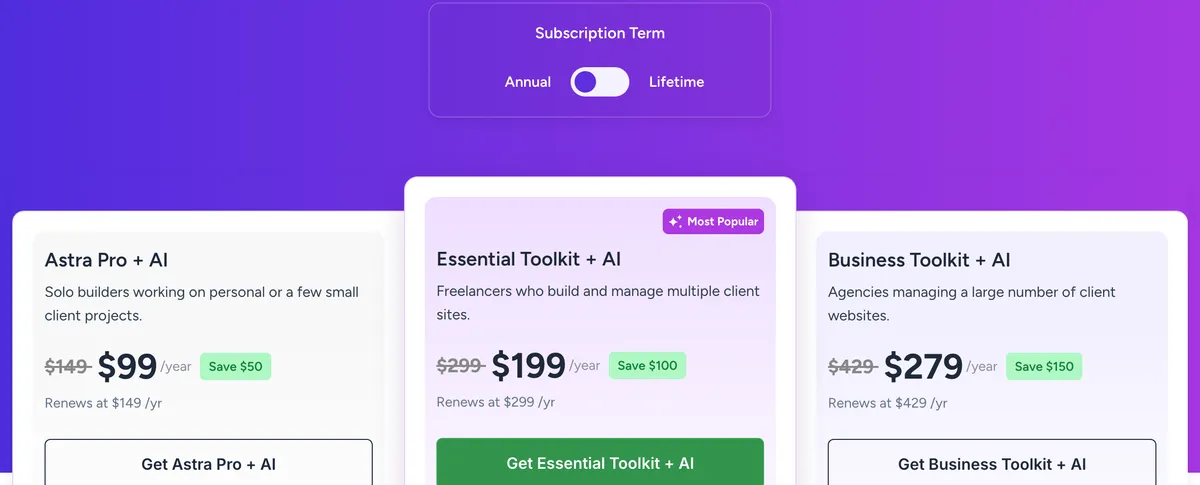
Do the arithmetic across three years and the annual lane stops looking cheap next to the one-time lane. Astra Pro plus AI is $99 then $149 then $149, so $397. Kadence Essentials is $297 and Beaver Builder Starter is $267. Divi is $267 if you pay yearly, or $249 once and never again. Bricks Starter is $237 across three years, and its own FAQ says a lifetime license is truly lifetime, with future updates and support included. None of these are large sums. They are simply not the sums printed on the page you were reading.
Fifteen thousand free themes, and the eighty-three
The free option is enormous and almost all of it is inert. On 5 September 2026 we queried the WordPress.org theme directory through its public API, 152 pages of 100 records, and got 15,181 themes with no duplicate slugs. That is the real size of the thing people mean when they say you can just use a free theme.
Adoption inside it is concentrated to a degree that is hard to picture. Three themes report a million or more active installs: Twenty Twenty-Five, Hello Elementor and Astra. Nineteen report 100,000 or more. Eighty-three report 10,000 or more. At the other end, 8,796 themes, well over half the directory, report fewer than 100 active installs each. Of the installs the directory reports, the ten most-installed themes account for about half, and the top hundred for about three quarters.
The feedback signal is thinner still. 10,038 of the 15,181 themes have no ratings at all, and 13,913 of them have fewer than five. If you pick a theme by browsing rather than by reputation, the overwhelmingly likely outcome is that you have chosen something nobody has publicly said anything about. That is not the same as choosing something bad. It does mean the star rating you were about to rely on mostly does not exist.
The directory also flags 2,491 themes as commercial, which is roughly one in six. Those are the free themes with a paid upgrade behind them, and they are the honest middle of the WordPress market rather than a trick. Astra, Kadence, GeneratePress, Blocksy and Hello Elementor all work this way. The free theme is real and usable, and the features you eventually want are on the pricing page.
Four hundred and thirty-eight days, or twenty-nine
Whether free themes are maintained depends entirely on which half of the directory you are standing in. The median theme in the directory was last updated 438 days ago. The median theme among the 83 with 10,000 or more installs was last updated 29 days ago. Same directory, same day, a fifteen-fold difference.
Across the whole directory, 7,894 themes have not been updated in a year and 6,531 have not been updated in two. Push the line out and it barely moves: 5,618 have gone three years, 4,360 have gone five, and 3,492 have gone seven. The oldest last-updated date on record in the directory is 18 July 2008, which is a theme still sitting there, downloadable, older than the iPad.
Almost all of that decay is in the tail. Of the 8,796 themes with fewer than 100 installs, 5,193 have not been touched in a year and 3,195 have not been touched in five. Of the 83 popular themes, 14 are more than a year old and 6 are more than two, so the head is not spotless either, but it is a different world. The practical rule falls out of the data: in the free directory, installs are the maintenance signal, and they are the only one on offer. A theme on 200,000 sites has somebody with a commercial reason to keep it working. A theme on 40 sites has a person who may have moved on years ago.
The person on the other end of the file
A template is a dependency on an individual, and the paperwork says so out loud. The Envato license is between you and the item's author, with the marketplace explicitly not a party to it. Support, when you have it, is that author's availability rather than a company's. Both statements are unremarkable until the day you need something.
The free directory shows the same structure in its numbers. Those 15,181 themes come from 3,094 distinct authors, and 1,891 of them have exactly one theme in the directory. The median author has one theme. At the other end, Automattic has 263 and a handful of theme shops carry between 150 and 220 each. So the directory is a small number of workshops and a very large number of people who published something once.
None of this is an argument against buying from an individual. Several of the best WordPress products in existence come from very small teams, and GeneratePress, on 500,000 sites, is published in the directory under a single author name. It is an argument for looking, for ten seconds, at who made the thing and what else they have made, before you build a business on it. That question has an answer on every listing page in every one of these markets, and it is the question the price tag distracts you from.
The demo is a photograph of somebody else's business
The distance between a demo and your website is content, and content is the expensive part. Every template you have shortlisted is showing you a fictional company with about the right amount of text in every box, a set of photographs that plainly came from one session, and a services list of exactly the length the grid wants. Your business has four services and one of them needs three paragraphs, plus two photos you like and one you hate.
This is why the marketplaces sell demo import as a feature and why Envato's support policy names the preview question as its worked example. The gap it describes is not a defect. A template is a layout for a plausible business, and the work of making it your business is the same work whoever does it. When you buy a template you have not skipped that work, you have bought the visual design and taken on the rest yourself.
The useful test before you buy is to open the demo and read it as though the words were yours. Count the services in the grid against your services. Find where your longest sentence goes. Look for the page you actually need, the one with the form or the price table or the fourteen locations, and check that a page like it exists in the demo. If it does not, you are not buying a design for your website, you are buying a design for a different website and a project to convert it.
What the extra money buys, honestly
Custom buys decisions rather than pixels, and that is a less exciting sentence than the ones agencies usually write. On a template project the structure is decided before anyone has heard of your business: this many services, this shape of case study, this navigation, this checkout. On a custom project those are questions somebody asks you, and the answers become the site. Most of the value is in the questions.
You are also buying accountability, which sounds like marketing until something breaks at 9pm before a campaign. With a template the support chain is a theme author with a six month clock, a plugin author who owes you nothing, and a host who will point at both. With an agency there is one phone number, and the person answering it cannot blame the theme, because they chose it.
And you are buying a shorter dependency list. A template site usually arrives as a theme, often a page builder, and a run of plugins, each with its own version, license and author. That stack is normal, it works, and every item on it is a thing that can lapse. A build with fewer moving parts is not automatically better, but it is easier to keep alive, and the difference compounds over the years nobody plans for.
The route most people actually take
A great many sites in the real world are neither, and pretending otherwise is the main dishonesty in this genre. The common path is a well-maintained commercial theme or a page builder underneath, then a designer or a developer paid to make it stop looking like the demo. That is a hybrid, it is what a lot of small business sites are, and it is often the correct answer.
What it changes is where the money goes. Under this route, the license is the small line and the hours are the big one, exactly as with custom. What you save is the design and front end build. What you keep is the ongoing license, the plugin stack, and the constraint that the thing under your site was designed for everybody. If you are being quoted for this route, the useful question is not which theme, it is how many hours, and what happens to those hours when the theme updates.
Our honest position, given that we sell the other thing, is that the hybrid is a good deal for a brochure site with a real budget ceiling, and a bad deal for anything where the site has a job to do that a theme has not anticipated. Booking, member areas, calculators, multi-step forms, anything with a database behind it: those are where the hours needed to bend a template past its assumptions overtake the hours to build the thing.
Three years, in one table
Here is every published number in this article in the same units, which is the comparison the marketing on all sides avoids. Platform fees are deliberately excluded, since Shopify and Webflow templates only run on paid plans and WordPress needs hosting; we covered those bills in what website maintenance actually costs. Everything below is the template or license line alone.
| Route | Year one | Three years | What the money covers |
|---|---|---|---|
| Free WordPress.org theme | $0 | $0 | The files, under the GPL. No support promise of any kind |
| GeneratePress Premium | $59 | $177 | Updates and support while the license runs |
| Bricks Starter, one site | $79 | $237 | Updates, features and support during the term |
| Divi, billed yearly | $89 | $267 | Theme and builder, unlimited sites |
| Divi, one time | $249 | $249 | The same, with no renewal |
| Astra Pro + AI | $99 | $397 | Year one is $99, then $149 a year |
| Webflow template, median | $79 | $79 | One template, one time |
| Shopify theme, median | $320 | $320 | One theme, one time, publish when ready |
| KhanWork Foundation Partner | $12,000 | $36,000 | A converting landing page built and launched for you, then a new page every month. Pause or cancel anytime |
Read across the rows and the argument that templates are cheap survives comfortably. Every template route costs a fraction of what we charge, and no amount of writing changes that. What the table also shows is that the spread inside the template column is wider than most people expect, that $0 and $397 and $320 are all called using a template, and that the one-time and annual lanes cross at different points, which for Divi is the third year.
When a template is clearly the right answer
Four situations, and we will talk you out of hiring us in every one of them. The first is a site whose whole job is to exist: a name, what you do, some proof, a phone number. If you can write the sitemap on a napkin, a good commercial theme and a weekend will get you something better than most of what ranks in your town.
The second is an idea that has not been tested yet. Spending four figures on a custom build to find out whether anyone wants the thing is the wrong order of operations, and a $79 template that you replace in a year has done its job perfectly.
The third is a Shopify store in a normal category. Those themes are expensive by template standards and they are the most complete products in this article, they are built against a platform that will not change under them without notice, and you can customize one before paying. Our ecommerce work starts from custom, and we still tell people with fifteen products and a standard checkout to buy a theme.
The fourth is the case where somebody in the business genuinely enjoys this. If you have a person who will happily spend a Sunday in a page builder, a template turns into an internal capability rather than a purchase, and that is worth more over five years than the design difference.
When a template quietly stops being the cheap one
The crossover is never about design and it is always about a specific thing the site has to do. The usual pattern: the template does most of the job, so somebody buys a plugin for the part it will not do, then another plugin, then somebody is paid a few hundred dollars to make two of them agree. Nobody notices the total because it arrives in fragments, and every fragment was defensible.
Watch for these four. A workflow the template has never met, meaning bookings, intake forms with logic, quotes, or anything where a visitor tells you something and the business has to act on it. A content shape the grid refuses, most often a services list that is far longer or far shorter than the demo's. A second audience, where the same site now has to speak to customers and to referrers, or to patients and to families. And ownership questions, where you need the site somewhere else, on your own hosting, with the files in your hands. That last one has its own article: what to check before you sign anything.
There is a cheap early warning for all four. If your list of things you want changed on the demo runs past a page, the template is not the thing you are buying any more, the hours are, and hours priced by the change request are the most expensive hours in this business.
Where we sit
We charge a monthly subscription: $1,000, $2,500 or $5,000 a month depending on how much of the site you want built and how fast, with no minimum and no contract, so you can pause or cancel at any point. A focused build is typically live in 14 business days, which is a pattern across more than 200 projects rather than a promise. Set that against a $79 template and the honest framing is not that we are better value. It is that the two prices answer different questions, and ours includes the part the template leaves for you.
Where custom has earned its money for our clients, it has been about capability rather than looks. The site we rebuilt for Cornerstone Healing Center lifted website conversions by 20 percent, and that came from restructuring how programs were explained rather than from a nicer hero. The site we built for Eden Digital sat under a tenfold increase in revenue. Neither outcome was available from swapping a theme, and neither was about the theme that came before.
And if what you need is the brochure site described three sections ago, buy the template. We would rather write that sentence than take money for a project where the honest deliverable is a weekend and $79.
The four dates
Before you pay for any template, write down four dates. Each one is on a page you are already looking at, all four take about a minute in total, and between them they decide what you own and for how long. Most template regret we have seen traces back to one of them going unread.
| The date | Where it is | What it decides |
|---|---|---|
| Purchase date | Your receipt | Everything below counts from here |
| Support ends | Purchase date plus six months on ThemeForest, or the term on a license page | The last day a human is obliged to answer you |
| Renewal, and at what price | The small gray line under the big price | Your year two cost, which is often not your year one cost |
| The item's last update | The listing page, or the theme directory entry | Whether anyone is still looking after this |
The fourth is the one to weigh most heavily, because it is the only one that tells you about the future rather than the paperwork. A theme updated last month is a theme with somebody behind it. A theme updated in 2019 is a file. Both may work perfectly today and only one of them will still be working after the next WordPress release, and the directory data above says just over half the free catalog has gone at least a year without an update.
Then decide with the actual numbers in front of you: the three year total, not the sticker; the support end date, not the word support; and your own list of changes to the demo, which is the real quote. If that list is short, buy the template and get on with your business. If it runs to a page, get quotes, including ours, and read them next to the builder versus designer comparison and what to check before hiring anyone.
Frequently asked questions
Yes on the day you buy, and the gap is large enough that the question is really about what happens afterwards. A Webflow template sits around $79, the median paid Shopify theme is $320, and a WordPress theme or builder license runs $59 to $99 for a first year, against $1,000 a month for our entry plan. What the template price excludes is the work: Envato's item support policy says plainly that support does not cover installation or customization, and neither does a Webflow or Shopify purchase. So the honest comparison is the template price plus your hours, or somebody else's hours billed to you, against a monthly plan with those hours included.
Between nothing and about $500, depending on which market you are in. The WordPress.org directory holds 15,181 free themes. Webflow's first page of templates ran $39 to $129, and $79 was the most common price, when we read it on 5 September 2026. The Shopify Theme Store listed 1,257 themes, 24 free and 1,233 paid, and the 1,231 paid prices we captured ran from $100 to $500 with a median of $320. Commercial WordPress themes and page builders mostly sell annual licenses instead: $59 for GeneratePress Premium, $79 for Bricks Starter, $89 for Divi, $99 for Kadence Essentials.
Not on a ThemeForest Regular License, which is the one most marketplace buyers hold. It licenses you to create one end product for yourself or for one client, and it defines the end product for a template as the item with your content in it. You can hand that finished website to the client for any fee and the license transfers with it. Building a second client's site means a second license. The free WordPress.org directory works differently, since its themes must be GPL compatible and carry no per client limit.
You own the website, not the template. The ThemeForest Regular License states that the item's author retains ownership and that the license is an agreement between that author and you, with the marketplace not a party to it. You can modify the item, combine it with other work and hand the finished site to a client. You cannot redistribute the item itself, or extract a component and use it elsewhere. For WordPress items, part of the download is usually covered by an open source license and part by the marketplace license, which is recorded in the files.
Your website keeps working and your updates stop. Bricks puts it most plainly: once you cancel, the license runs to the end of the paid period, after which you lose access to updates, support and the vendor's template library, while your existing sites carry on unchanged. That is the deal at every annual vendor we read. It matters because a theme or builder that stops receiving updates gradually drifts away from current WordPress and PHP versions, and security fixes are the first thing you stop receiving.
The popular ones are, and the rest are a lottery you can win by looking at two numbers. Across the 15,181 themes in the directory on 5 September 2026, the median theme was last updated 438 days ago, 7,894 have gone a year without an update and 3,492 have gone seven. Among the 83 themes with 10,000 or more active installs, the median was updated 29 days ago. Install count is the maintenance signal in the free directory, and the ratings are not a substitute: 10,038 themes have no ratings at all.
Six months on ThemeForest, extendable to twelve only if you pay for the extension at the moment of purchase. Envato's item support policy sets that out, and lists what is excluded: customization, installation, and anything to do with your hosting or server. If the theme bundles somebody else's plugin, that plugin's author has no obligation to help you, and your questions go back to the theme author. After the support period you still get updates that keep the item working as described and fix major security issues, plus whatever else the author chooses to release.
When the site has to do something a template has not anticipated. Bookings, intake forms with logic, member areas, calculators, anything where a visitor tells you something and your business has to act on it. The second trigger is a content shape the demo does not have, most often a services list far longer or shorter than the grid was built for. The practical test is to list every change you want to the demo before you buy. If that list runs past a page, you are buying hours rather than a template, and hours bought as change requests are the most expensive kind.
 Web Design
Sep 6, 2026 · 17 min
SaaS Website Cost in 2026: What 1,953 Agencies Say They Charge
Every published range for this question is written by an agency describing its own invoices. So we read all 196 pages of Webflow's Certified Partner directory and counted what 1,953 of them actually put on the card.
 Web Design
Sep 3, 2026 · 19 min
How Much Should a Hotel Website Cost in 2026?
Published platform prices run from $9 to $197 a month and a managed hotel website starts at $14,400 a year. Then a federal rule decides which number on your page has to be the biggest.
 Web Design
Sep 1, 2026 · 18 min
How Much Should a Property Management Website Cost in 2026?
Buildium gives you one free, DoorLoop bundles one with hosting, and Yardi charges the same dollar a unit whether your floor is $100 or $400. The website is rarely the number that matters. Your door count is.