
A therapist who sees every client by video has quietly changed what a website is for. There is no waiting room to photograph, no parking note, no map pin. The site has to do the jobs an office used to do on its own: prove you are real, show which states you can legally serve, and get a stranger from a search result to a booked first session without a single handshake.
So the stock answer to what a therapist website should cost is slightly off for this kind of practice.
How we researched this. On 9 November 2026 we priced it three ways. We read the published plans of the website services built for therapists. We checked the rules that decide what a video-only practice can and cannot do online, from Google's own listing policy to Medicare's telehealth dates. And we read 215 private practice websites that talk about telehealth, then sorted out the 36 that say, in their own words, that every session happens online. On 25 November 2026, before publishing, we checked the Medicare, prescribing and accessibility dates again against the CMS telehealth FAQ and the Federal Register.
The 30-second answer: telehealth therapy website cost in 2026
Budget roughly $1,800 to $3,700 across three years for a working site on an entry-level therapist website plan, and $7,600 to $12,600 if you take the top tier of the same services. A custom build runs $2,900 to $8,700 through a freelancer or $7,250 to $20,300 through an agency, by one 2026 estimate. The money should buy things an office practice gets for free: a clear list of the states you serve, an online booking path, a self-pay price, and a plan for being found without a Google Business Profile, because Google does not list a business that has no location clients can visit.
What changes when there is no office
The short version: a video-only practice loses the free local listing most therapists rely on, so the website has to carry the trust and the search traffic on its own.
Start with demand, because it is not small. The National Center for Health Statistics reported in its June 2026 data brief that 14.0 percent of US adults received counseling or therapy from a mental health professional in 2024. The share was 20.2 percent among adults aged 18 to 29 and 18.7 percent among those aged 30 to 44, then fell to 11.7 percent at 45 to 64 and 5.0 percent at 75 and over. Women were more likely than men to have had therapy, 16.9 percent against 10.9 percent. The people most likely to be in therapy are also the people most comfortable booking it from a phone.
Video is now an ordinary way to deliver that care, not a pandemic workaround. In an April 2024 analysis of claims for every Medicare fee-for-service beneficiary, MedPAC found that 50 percent of common psychotherapy services in 2022 were delivered by telehealth, against 6 percent of common office visits for medical care. MedPAC labelled the figures preliminary. Therapy is the part of medicine that moved online and stayed there.
That leaves the website with three new duties. One: the map pin is gone, so local search works differently (more on that below). Two: the site is the first place a client looks to see whether you are licensed where they live, so the states have to be written down. Three: nobody walks past your door, so every new client arrives through a screen, which puts the whole intake on the site: price, insurance, booking and what happens in the first session.
Who prints a price
Three therapist-specific website services print fees anyone can compare, and one directory sells a listing that many solo clinicians treat as a website substitute.
| Option | Printed price | What matters for a video-only practice |
|---|---|---|
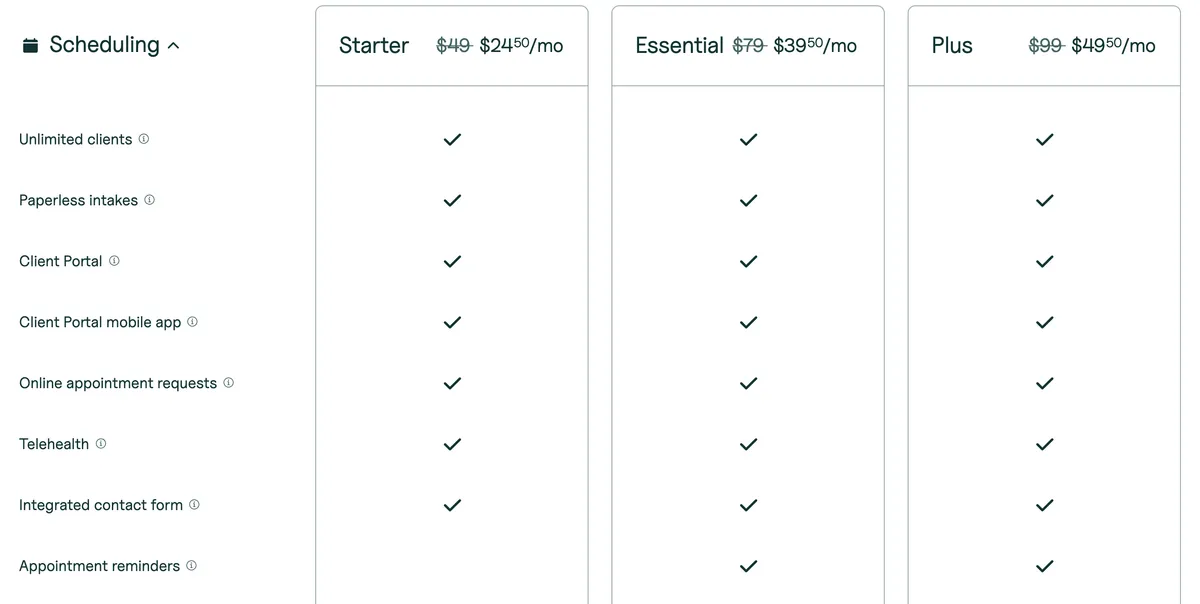
| SimplePractice | Starter $49, Essential $79, Plus $99 a month (half price for the first 3 months) | Telehealth, online appointment requests and a professional website are ticked on all three plans; appointment reminders start on Essential |
| TherapySites | $199 one-time design fee, then $69 to $336 a month across six tiers | HIPAA-compliant email and forms are an add-on from $15 a month; paid search management starts at $600 monthly |
| Brighter Vision | Start $99, Grow $179, Flourish $349 a month; $78, $143 or $299 billed yearly; $100 setup on Start and Grow | HIPAA-compliant forms through Hushmail are built into Flourish only; otherwise an add-on from $14.99 a month |
| Psychology Today | $29.95 a month, no contract | A directory profile, not a website; membership includes its free HIPAA-compliant video platform, Sessions |
SimplePractice
- Printed price
- Starter $49, Essential $79, Plus $99 a month (half price for the first 3 months)
- What matters for a video-only practice
- Telehealth, online appointment requests and a professional website are ticked on all three plans; appointment reminders start on Essential
TherapySites
- Printed price
- $199 one-time design fee, then $69 to $336 a month across six tiers
- What matters for a video-only practice
- HIPAA-compliant email and forms are an add-on from $15 a month; paid search management starts at $600 monthly
Brighter Vision
- Printed price
- Start $99, Grow $179, Flourish $349 a month; $78, $143 or $299 billed yearly; $100 setup on Start and Grow
- What matters for a video-only practice
- HIPAA-compliant forms through Hushmail are built into Flourish only; otherwise an add-on from $14.99 a month
Psychology Today
- Printed price
- $29.95 a month, no contract
- What matters for a video-only practice
- A directory profile, not a website; membership includes its free HIPAA-compliant video platform, Sessions
The cheapest real website in the set is not a website company at all. SimplePractice's plan comparison ticks telehealth, online appointment requests and a professional website on its $49 Starter plan, the same as on Essential and Plus. For a solo clinician who already keeps records there, that is one bill for the video room, the scheduler and a basic site. The group plan starts at $99 for the first clinician and adds $74 a month for each additional one.
 Open full size
After a $199 design fee, TherapySites bills monthly across six tiers: Core is $69, the middle four sit between $99 and $266 (Premium Plus, at $207, is where it adds what it calls AI search optimization), and Elite Plus tops out at $336. Brighter Vision runs three tiers at $99, $179 and $349 a month, cheaper when paid yearly; Start and Grow also carry a one-off $100 setup charge. Only its top tier, Flourish, includes HIPAA-compliant forms and secure email. Psychology Today charges a flat $29.95 a month for a directory profile with no contract.
Three years of a therapist website plan, at printed prices
- SimplePractice Starter$1,764
- TherapySites Core$2,683
- Brighter Vision Start, yearly$2,908
- Brighter Vision Start, monthly$3,664
- TherapySites Premium Plus$7,651
- Brighter Vision Flourish, yearly$10,764
- TherapySites Elite Plus$12,295
- Brighter Vision Flourish, monthly$12,564
Read the chart for what it leaves out. The website plans do not include your video platform or your records system, so a practice on Brighter Vision or TherapySites still pays for those somewhere else. SimplePractice is the opposite: the website is a by-product of a records system, and its design range is narrower. The top bars buy content, search work and, in Brighter Vision's case, the HIPAA-safe forms a practice taking intake online should have anyway.
What a custom build costs
For a practice that wants its own design rather than a plan, estimates are the only public numbers, and they are wide.
ProjectCostEstimator's therapist page, updated in July 2026 and based on what it calls 600-plus project quotes, puts a therapist website at $2,900 to $8,700 through a freelancer and $7,250 to $20,300 through an agency. It says a private practice site with online inquiry, specialty pages, telehealth and a fees and insurance section lands around a $5,800 median, and it gives 3 to 8 weeks as a typical timeline. The same page also states a median freelancer build of $4,000, so treat its numbers as a band, not a quote.
Our reading: a solo telehealth clinician rarely needs custom design to start. A plan, a well-written services page and an honest fees page will outperform a beautiful site that hides the price. Custom work starts to pay when the practice is a group serving several states, when it competes for a specialty across a whole state rather than one town, or when it needs pages per clinician, per state and per service that a template cannot hold without turning into a maze.
What 215 practice websites show
The short version: online-only practices are better than office practices at publishing a price and a booking link, and much worse at proving where they are.
We asked a research agent to find independent therapy practices that lead with telehealth across 35 states, with directories and national platforms blocked from the results, and it returned 241 domains. Our script loaded 220 of them and read each homepage with up to seven linked pages about fees, insurance, telehealth, services and contact. 215 talk about telehealth. We then read the wording of every site our script flagged and kept 36 that say plainly that all sessions happen online: phrases like "100% virtual", "telehealth only" or "we do not offer in-person therapy". The other 179 are office practices, many of which offer video too. The sample is search-weighted, because it came from search results, and it is not a random draw of all US practices.
The gap that matters is the second row. 78 percent of office practices show a street address somewhere on the pages we read; 31 percent of online-only practices do, and some of those are a home base or a billing address rather than a place to visit. Fewer online-only homepages offer a number you can tap to call: 21 of 36, compared with 139 of 179. That is a choice many solo clinicians make on purpose, and a reasonable one, but it means the website has to replace both the map pin and the phone call.
Where they do better is money and booking. 22 of the 36 link to an online scheduler, 16 use the words "Good Faith Estimate", and 18 print the 988 crisis line, a crisis text line or 911 guidance, which matters more when the clinician cannot see the room the client is in. Only 2 mention PSYPACT, and not one site in the full 215 mentions the Counseling Compact by name.
The builders are the usual ones. 103 of the 215 run on WordPress, 49 on Squarespace and 15 on Wix. Among the online-only 36 it is 17, 8 and 4. Nothing about telehealth requires a special platform; what it requires is different content.
The Google Maps problem
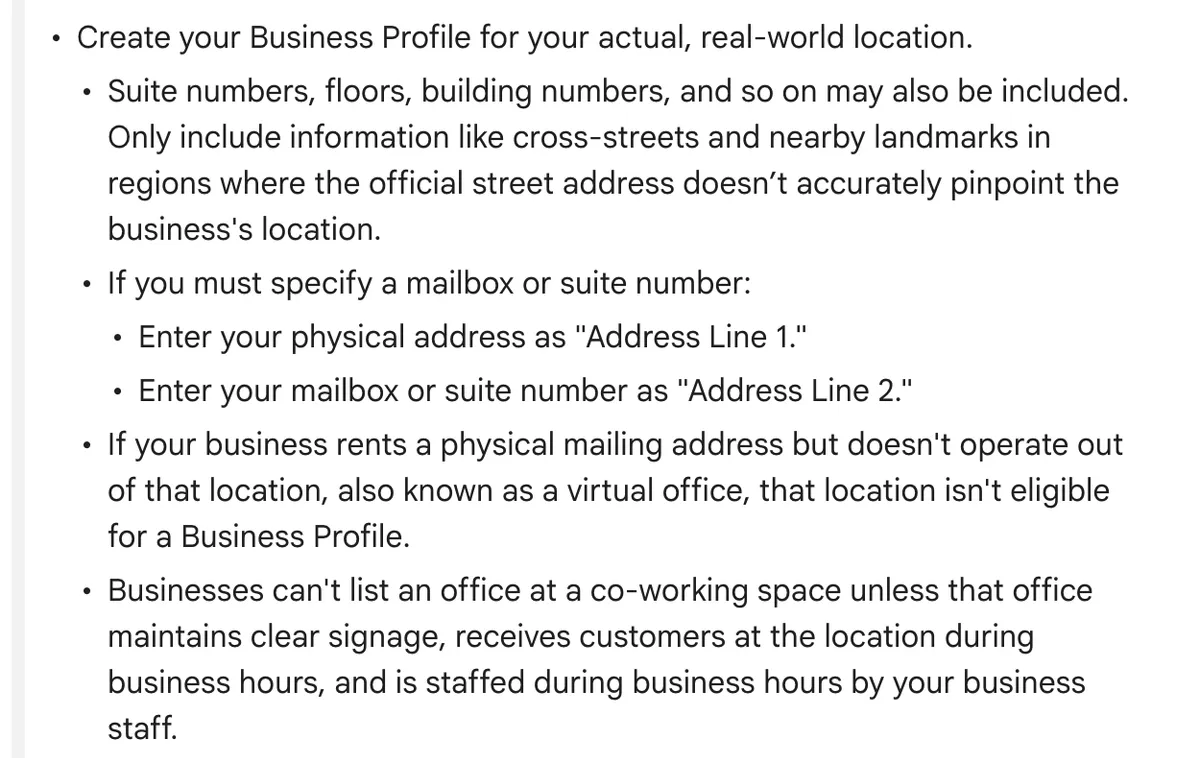
A practice that sees no one in person cannot have a Google Business Profile, and a rented address does not fix that.
Google's guidelines for representing your business open with the condition: you can create a profile if your business has a physical location customers can visit, or travels to customers where they are. A video-only therapist does neither. The same page closes the obvious workaround in plain terms.
 Open full size
This is where most of the budget for a telehealth practice should go, because it changes how new clients find you. An office practice gets the map pack, reviews and directions for free. A video-only practice has three routes left: organic search, directories such as Psychology Today, and the AI assistants that now answer "online therapist licensed in Ohio who takes Aetna" directly. All three reward the same thing: pages that state, in text, who you see, where they must live, what it costs and how to start.
If you keep a real office one day a week, the picture changes. A practitioner who genuinely sees clients at a location can be listed there, and the website should say which days are in person. If you sublet a room for that purpose, it has to meet Google's signage and staffing test. Do not invent an office to get a pin: a suspended profile costs more than one you never had.
For the AI side of this, we wrote about how assistants choose which therapist to name in when a family asks ChatGPT for a therapist, and our AI search visibility service covers the work in detail. For a practice with no map pin, that channel is worth more than it is to an office practice.
Licensure is a website problem
A video-only practice serves only the states its clinicians are licensed in, so the website's first job is to say which ones.
In our sample, 26 of the 36 online-only practices name at least one state in a sentence about who they serve or where they are licensed, and 13 name two or more. That leaves 10 that make a stranger guess. A client in Kansas who books with a Missouri-only counselor wastes a consultation slot for both of them.
The compacts make this more complicated, not less. The Counseling Compact went live in Missouri on 19 October 2026 and now operates in eleven states: Arizona, Arkansas, Georgia, Indiana, Louisiana, Minnesota, Missouri, Ohio, Oklahoma, Tennessee and Wyoming. A counselor licensed in and living in one of them can apply for a privilege to practice in the other ten. The Social Work Licensure Compact says it has been enacted in at least seven states and reached activation, but multistate licenses are not being issued yet, and implementation will take 12 to 24 months. Psychologists have PSYPACT, which reports that Alaska passed its legislation on 25 June 2026 and Iowa on 1 July 2026.
So a page that says "licensed in Ohio" may be true and still undersell a counselor who now holds privileges in ten more states. Build the states list as a short, structured block your team can edit: one line per clinician, the states, and whether each is a full license or a compact privilege. Then link each clinician's profile to the same block, so a change happens once.
Price, insurance and the Good Faith Estimate
The online-only practices in our sample are unusually open about price, and that is worth copying.
We read the fees page of every online-only practice by hand. 20 of the 36 print their own self-pay price. Nineteen of them give a single figure for an individual session; one gives a $100 to $200 range that depends on the clinician. Across those 19, the median is $165, the lowest $110 and the highest $265.
Own self-pay price for one individual session, 19 online-only practices
- Under $1253 practices
- $125 to $1493 practices
- $150 to $1744 practices
- $175 to $1994 practices
- $200 to $2242 practices
- $225 and over3 practices
Insurance is the other half. 23 of the 36 name at least one insurer and 23 mention out-of-network benefits or superbills. A video-only practice has one advantage here that office practices lack: it can serve the whole state, so the insurers worth naming are the large statewide plans, and the page can say so in one line.
Self-pay clients bring a federal rule with them. Under 45 CFR 149.610, the website has to tell uninsured and self-pay visitors that written cost estimates exist, in wording that is "prominently displayed (and easily searchable from a public search engine)". 16 of our 36 use the phrase anywhere we looked. It costs one paragraph on the fees page.
The intake form deserves the same care as the price. A booking request from a telehealth client usually includes a reason for seeking care, which is health information, so pick a form tool whose maker, along with whoever hosts the inbox it fills, will sign a business associate agreement covering those client messages. That is the single strongest argument for paying for a top tier, or a records system with built-in requests, instead of a contact form on a general website builder. We set out what HIPAA does and does not require of a practice website in our HIPAA website guide.
The dates that can change your site
Three federal dates decide what a telehealth practice's website can promise, and all three arrive within the next fourteen months.
Medicare and the in-person visit. CMS's telehealth FAQ, updated 8 October 2026, says the in-person requirement for mental health telehealth applies only after 31 December 2027. From then, the statute requires an in-person, non-telehealth visit within 6 months before the first mental health telehealth service, and one within 12 months of each later telehealth service, with limited exceptions. Patients who began home mental health telehealth before 1 January 2028 are treated as established and need the yearly visit only. A video-only practice that bills Medicare should plan now for how it will offer that visit, and its website should say so before a new Medicare client books in late 2027.
Prescribing by video. Psychiatric prescribers are working under the fourth temporary extension of the pandemic-era rules that let controlled medications be prescribed by video, and it ends on 31 December 2026. Write the medication page so it survives either outcome: describe how evaluations work today and say you will update clients if the federal rules change.
Accessibility for practices that take HHS money. Practices that receive HHS financial assistance fall under its Section 504 rule on web accessibility. The current deadlines come from an interim final rule issued in May 2026, which added a year to each: a practice employing 15 people or more must comply by 11 May 2027, while a smaller one gets until 10 May 2028. If your group bills Medicaid, have the new site meet WCAG 2.1 AA from day one; fixing it afterwards costs more.
Questions to ask any web designer
Put these to anyone quoting you, including us. Beside each one, our census figure for the 36 online-only sites.
| Ask | A good answer | What the 36 online-only sites show |
|---|---|---|
| Where will the states we serve appear, and who edits that list? | A structured block per clinician, on every relevant page, editable by your team | At least one state named in 26; two or more in 13 |
| How will we be found without a Google Business Profile? | A plan for organic pages, directories and AI answers, not a promise of a map pin | Street address on 11 sites |
| Can a client book a first session without calling? | A scheduler or request form linked from every page, covered by a business associate agreement | Scheduler link on 22 |
| Will the self-pay price be on the site? | Yes, with a Good Faith Estimate paragraph next to it | Own price on 20; Good Faith Estimate wording on 16 |
| What does a client see about crisis care? | A plain line that sessions are not for emergencies, with 988 and 911 | Crisis guidance on 18 |
| Which tracking will run on the booking and contact pages? | A named list, with no advertising pixel where people type health details | Meta pixel on 4 homepages |
| Who holds the domain and files if we stop working together? | The domain is ours, and so are the content and design, in writing | Not visible from outside |
| How are edits priced once the site is live? | A printed monthly fee or rate | All three plan sellers print one |
Where will the states we serve appear, and who edits that list?
- A good answer
- A structured block per clinician, on every relevant page, editable by your team
- What the 36 online-only sites show
- At least one state named in 26; two or more in 13
How will we be found without a Google Business Profile?
- A good answer
- A plan for organic pages, directories and AI answers, not a promise of a map pin
- What the 36 online-only sites show
- Street address on 11 sites
Can a client book a first session without calling?
- A good answer
- A scheduler or request form linked from every page, covered by a business associate agreement
- What the 36 online-only sites show
- Scheduler link on 22
Will the self-pay price be on the site?
- A good answer
- Yes, with a Good Faith Estimate paragraph next to it
- What the 36 online-only sites show
- Own price on 20; Good Faith Estimate wording on 16
What does a client see about crisis care?
- A good answer
- A plain line that sessions are not for emergencies, with 988 and 911
- What the 36 online-only sites show
- Crisis guidance on 18
Which tracking will run on the booking and contact pages?
- A good answer
- A named list, with no advertising pixel where people type health details
- What the 36 online-only sites show
- Meta pixel on 4 homepages
Who holds the domain and files if we stop working together?
- A good answer
- The domain is ours, and so are the content and design, in writing
- What the 36 online-only sites show
- Not visible from outside
How are edits priced once the site is live?
- A good answer
- A printed monthly fee or rate
- What the 36 online-only sites show
- All three plan sellers print one
Where KhanWork fits
Plenty of solo telehealth clinicians should not hire an agency at all, and that includes KhanWork, the marketing team for healthcare practices. With a full caseload in one state, a SimplePractice site or a Brighter Vision plan plus an honest fees page is enough; put the difference into your Psychology Today profile and the pages you write yourself.
We are useful to the next size up: a group practice licensed across several states, a practice adding medication management or an intensive outpatient track online, or a team that has outgrown its template and needs pages per clinician, state and specialty that still read clearly on a phone. Our team has delivered over 200 projects, and five of our clients are treatment centers. At Cornerstone Healing Center, one of those five, conversions from the website rose 20 percent once our redesign launched.
Nothing about our pricing is hidden; every figure is public. Foundation Partner is paid once: $1,000 buys a brand refresh with one high-converting landing page, live 14 business days after your content and assets reach us, and $2,500 buys the refresh with the full website, live in 21. Growth Partner, at $2,500 a month, builds the full website in month one and then works as your marketing team every month, with SEO and AI search, social posts and monthly tests to lift bookings. Scale Partner, at $5,000 a month, is for multi-location groups and adds Google and Meta ads. Either monthly plan can be paused or cancelled anytime. Hosting stays in your name and on your bill, and you own the domain, the code and every word.
Our mental health practice work shows the kind of site we build, and our earlier guide to therapy practice website cost covers office-based practices. Prefer to see our thinking before any invoice? The free review of the page your clients land on costs nothing: send us the address of the page new clients reach first (for a therapy practice it is nearly always the homepage) and we reply with the first thing we would change.
The two-hundred-miles test
Ask a friend who lives in a different part of your state, a long drive from you, to look for a therapist like you tonight, on their phone. They have never heard your name. Give them five minutes and these six questions.
- State. Can they tell, without scrolling past the first screen of your homepage, that you can see someone where they live?
- How. Do they know what a session looks like: video, phone, which platform, how long?
- Price. Can they find what a session costs if they pay themselves, and which insurers you take?
- Start. Can they request a first session without phoning you?
- Safety. Do they see what to do in a crisis, since you will not be in the room?
- Proof. Is there a real name, a license number or credential, and a face, so they believe a person is behind the page?
Score one point per clear yes. Five or six means the site already works, so put money into getting found, not into a new design. Three or fewer, and the site is costing you clients you will never hear about, and the ranges in this article are a fair starting budget. Most of the online-only practices we read would drop a point on question one.