
A rehab that gets paid by insurance companies is buying a different website from one that gets paid by families writing checks. The private-pay site sells a setting. The insurance-based site has to answer one question before anything else: will my plan cover this? Every part of the build that answers it, the verification form, the list of plans, the privacy work behind the form, the advertising certification, has a price, and most quotes leave those parts out.
This guide prices a website for an in-network or insurance-reliant addiction treatment center in the US in 2026: what the sellers who publish prices charge, what the insurance layer adds on top, and what 543 real insurance-based treatment center websites show about where the money is usually missing.
How we researched this. On 28 November 2026 we pulled every substance use treatment listing within 25 miles of 28 large US metros from FindTreatment.gov, the federal treatment locator run by SAMHSA: 3,101 unique facilities. We kept the 957 private for-profit centers that list private health insurance as a payment they accept and offer residential, hospital inpatient or intensive outpatient care. Those listings pointed to 644 websites, and 543 of them, in 23 states, loaded for us. On each we read the homepage and up to ten pages it links to about insurance, admissions, cost or payment, and recorded what a family would find there. We also read the published price pages of five treatment center web sellers, LegitScript's certification fees, Jotform's HIPAA plan page, the HHS bulletin on tracking technologies, the federal Good Faith Estimate rule and the federal anti-kickback law for treatment facilities. Prices and rules below are quoted exactly as each source showed them that day, and the census numbers are our own count.
The 30-second answer: what an insurance-based rehab website costs in 2026
A website for an insurance-based addiction treatment center in the US costs $3,500 to $25,000 to build at the prices sellers publish in 2026, with one estimator putting a typical build with an insurance verification form at a $10,850 median. The insurance layer costs extra: LegitScript certification is $4,690 per facility in year one, a HIPAA-eligible form plan starts at $99 a month billed yearly, and one seller says each integration (CRM, call tracking, verification workflow, compliant analytics) adds $3,000 to $10,000. Plan on roughly $6,000 a year of running costs before the site itself.
What makes an insurance-based site its own job?
It has to sell coverage before it sells care. A family searching at night for a detox bed usually holds an insurance card and one worry: whether that card works here. A private-pay center can answer cost on a phone call. An insurance-based center loses that caller to the next listing if the page does not show, in the first screen or two, that it works with their plan and will check their benefits quickly.
That shifts where the budget goes. Photography and copy still matter, but four parts of an insurance-based build do the heavy lifting, and each one carries a cost that a brochure-site quote will not show:
- A benefits check that a stranger will finish. A form that asks for the plan, member ID and date of birth, sends it somewhere secure, and reaches an admissions person fast.
- An honest list of plans. The insurers you are in network with, the ones you take out of network, and whether you take Medicaid or TRICARE, in words a search engine and a parent can both read.
- Privacy plumbing. A form tool that will sign a business associate agreement, and analytics that do not hand a member ID to an ad platform.
- Permission to advertise. Insurance-based centers lean on paid search, and paid search for addiction treatment needs certification first.
None of these are exotic. They are the parts a cheaper quote skips and a later invoice adds back.
What do treatment center web sellers charge?
Five sellers that build for treatment centers print prices you can compare, and their one-time builds run from $3,500 to $25,000. None of them sells an insurance-based package by name, so the useful question is what each price includes of the insurance layer.
| Seller | What the price covers | Printed price | Upkeep or monthly |
|---|---|---|---|
| DrugRehab.Agency | A professionally developed rehab site with conversion work included | $3,500 to $6,000 | Not printed |
| Lead to Recovery | Design and development billed by the hour; landing pages priced per page | $200 an hour; landing page $750 (Avada) or $900 (other builders) | Monthly programs from $550, 90-day minimum; local SEO $850 a month per location |
| Webserv | Core: up to 10 pages, 1 location. Growth: up to 20 pages, 3 locations, analytics and CRM integration. Enterprise: 40+ pages, 5+ locations | $8,000, $15,000 or $25,000 one-time | Optional maintenance $250, $450 or $750 to $950 a month |
| Treatment Center Agency | Care plans that manage the site, plus priced add-ons | Landing pages from $1,200 a page | Growth Care from $6,800 a month |
| ProjectCostEstimator (an estimate, not a seller) | A rehab site with 24/7 admissions inquiry, levels-of-care pages, an insurance verification form and staff bios | $5,800 to $15,950 freelancer; $13,750 to $37,700 agency; $10,850 median | Admissions and verification tools plus reputation management add $150 to $350 a month |
DrugRehab.Agency
- What the price covers
- A professionally developed rehab site with conversion work included
- Printed price
- $3,500 to $6,000
- Upkeep or monthly
- Not printed
Lead to Recovery
- What the price covers
- Design and development billed by the hour; landing pages priced per page
- Printed price
- $200 an hour; landing page $750 (Avada) or $900 (other builders)
- Upkeep or monthly
- Monthly programs from $550, 90-day minimum; local SEO $850 a month per location
Webserv
- What the price covers
- Core: up to 10 pages, 1 location. Growth: up to 20 pages, 3 locations, analytics and CRM integration. Enterprise: 40+ pages, 5+ locations
- Printed price
- $8,000, $15,000 or $25,000 one-time
- Upkeep or monthly
- Optional maintenance $250, $450 or $750 to $950 a month
Treatment Center Agency
- What the price covers
- Care plans that manage the site, plus priced add-ons
- Printed price
- Landing pages from $1,200 a page
- Upkeep or monthly
- Growth Care from $6,800 a month
ProjectCostEstimator (an estimate, not a seller)
- What the price covers
- A rehab site with 24/7 admissions inquiry, levels-of-care pages, an insurance verification form and staff bios
- Printed price
- $5,800 to $15,950 freelancer; $13,750 to $37,700 agency; $10,850 median
- Upkeep or monthly
- Admissions and verification tools plus reputation management add $150 to $350 a month
Two of these changed recently enough to matter. Lead to Recovery's pricing page, which its own footer says was updated on 10 November 2026, no longer names a figure for a whole website: design and development are billed at $200 an hour, and you buy the hours a project needs. Webserv is the only seller that prints both the build and the upkeep, and the only one whose middle tier names CRM integration, which is where a benefits check usually lands.
Published one-time prices for a treatment center website
- DrugRehab.Agency, low end$3,500
- DrugRehab.Agency, high end$6,000
- Webserv Core$8,000
- Estimator median, with verification form$10,850
- Webserv Growth, with CRM$15,000
- Webserv Enterprise$25,000
- Estimator, agency top of range$37,700
Read the high end with care. Webserv's own FAQ says most addiction treatment builds run $25,000 to $80,000 and that multi-location, multi-program centers regularly land at $50,000 to $120,000 with CRM and call tracking. That is a seller describing its own market, not an audit, but it tells you where the published $8,000 Core tier stops: at one location and basic calls to action.
What does the insurance layer add, line by line?
The insurance layer adds roughly $6,000 a year in fees a center pays whoever builds the site, plus one-time integration work that ranges from a few hundred dollars to $10,000 an item. Here is each line with the price its seller prints.
| Line item | Printed price | One-time or recurring | Source, read 28 November 2026 |
|---|---|---|---|
| LegitScript addiction treatment certification, one facility | $1,595 application plus $3,095 a year | $4,690 in year one, then $3,095 a year | LegitScript certification FAQ |
| HIPAA-eligible online forms (Jotform Gold) | $99 a month billed yearly, or $129 month to month | $1,188 to $1,548 a year | Jotform HIPAA pricing page |
| A compliant admissions and verification form set, built in | $500 to $1,500 | One-time | ProjectCostEstimator rehab center page |
| Admissions and verification tools plus reputation management | $150 to $350 a month | $1,800 to $4,200 a year | ProjectCostEstimator rehab center page |
| CRM integration, call tracking, verification workflow or HIPAA-compliant analytics | $3,000 to $10,000 each | One-time, per integration | Webserv web design FAQ |
| Call tracking setup or analysis | From $1,500 | One-time | Treatment Center Agency pricing |
| HIPAA website, ads and marketing compliance audit | From $2,800 | One-time | Treatment Center Agency pricing |
LegitScript addiction treatment certification, one facility
- Printed price
- $1,595 application plus $3,095 a year
- One-time or recurring
- $4,690 in year one, then $3,095 a year
- Source, read 28 November 2026
- LegitScript certification FAQ
HIPAA-eligible online forms (Jotform Gold)
- Printed price
- $99 a month billed yearly, or $129 month to month
- One-time or recurring
- $1,188 to $1,548 a year
- Source, read 28 November 2026
- Jotform HIPAA pricing page
A compliant admissions and verification form set, built in
- Printed price
- $500 to $1,500
- One-time or recurring
- One-time
- Source, read 28 November 2026
- ProjectCostEstimator rehab center page
Admissions and verification tools plus reputation management
- Printed price
- $150 to $350 a month
- One-time or recurring
- $1,800 to $4,200 a year
- Source, read 28 November 2026
- ProjectCostEstimator rehab center page
CRM integration, call tracking, verification workflow or HIPAA-compliant analytics
- Printed price
- $3,000 to $10,000 each
- One-time or recurring
- One-time, per integration
- Source, read 28 November 2026
- Webserv web design FAQ
Call tracking setup or analysis
- Printed price
- From $1,500
- One-time or recurring
- One-time
- Source, read 28 November 2026
- Treatment Center Agency pricing
HIPAA website, ads and marketing compliance audit
- Printed price
- From $2,800
- One-time or recurring
- One-time
- Source, read 28 November 2026
- Treatment Center Agency pricing
Add only the two lines nearly every insurance-based center needs, LegitScript for one facility and a yearly HIPAA-eligible form plan, and year one comes to $5,878 before a single page is designed. The rest depends on how much you automate. A center whose admissions team calls every lead back by hand can live with a well-built form and good call tracking. A center running several programs through an EHR or CRM will pay for the integration, and Webserv's $3,000 to $10,000 per integration is the only printed figure we found for that work.
 Open full size
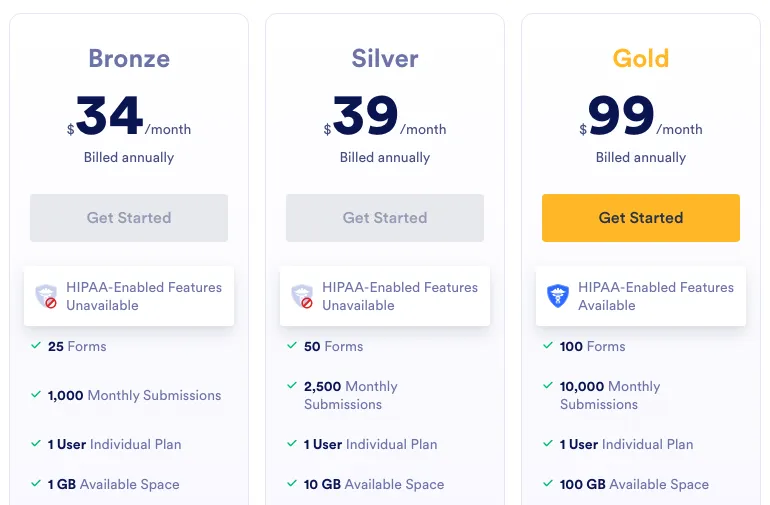
The form plan is the line most often missed. Jotform states that its HIPAA compliance features are available only on its Gold and Enterprise plans; the cheaper Bronze and Silver plans, at $34 and $39 a month billed yearly, do not include them. A verification form built on a free or entry plan of any form tool can look identical to a compliant one. The difference is the agreement behind it and where the submission is stored.
 Open full size
What do 543 insurance-based treatment center websites show?
They show centers that are good at the phone number and weak at the insurance answer. Of the 543 websites we read, 87 percent put a tap-to-call phone link on the homepage and 80 percent mention insurance. Far fewer finish the job.
What 543 insurance-based treatment center sites show
- Tap-to-call link on homepage87%
- Mentions insurance80%
- Names or shows an insurer62%
- Offers a way to verify insurance62%
- Says "most major insurance"51%
- Mentions LegitScript41%
- Uses the word HIPAA20%
- Meta Pixel in page source8%
- Good Faith Estimate notice2%
Four numbers in that chart deserve a sentence each.
Only 62 percent name or show a single insurer. 338 of the 543 sites name at least one insurance company in text or show an insurer's logo on the pages we read. 107 sites talk about insurance and never say whose. Half of all sites (274) use a phrase like "most major insurance", which a parent cannot check against the card in their hand.
Six in ten offer a way to verify. 334 sites have a verify-your-insurance path. Of those, 243 never use the word HIPAA anywhere we read, which does not prove the form is unsafe, but it does mean the page never tells a nervous family where their member ID is going.
Eight percent load a Meta Pixel where we can see it. 46 sites carry Meta's tracking code in their page source, 34 of them sites with a verification path. Tags loaded through Google Tag Manager are invisible to a source read, so the real number is higher.
Nine sites out of 543 mention a Good Faith Estimate. That is 1.7 percent, against listings in which 537 of the 543 centers say they accept cash or self-payment. We come back to why that matters below.
Do these sites say which plans they take?
Often not, and the gap is widest for public plans. Every center in our sample told the federal locator which payments it accepts. We compared that listing with the words on the center's own homepage and insurance pages.
Told the federal locator, then said it on their own site
- Medicaid, on the listing340
- Medicaid, on their own site158
- TRICARE, on the listing260
- TRICARE, on their own site93
182 of the 340 centers that list Medicaid with the federal locator do not say Medicaid on the pages a family reads first. For TRICARE it is 167 of 260. Some of those centers will name the plan deeper in the site, on a page we did not open, and a few may have stopped taking it since they updated the listing. But the pages we read are the pages that decide the call. A military family that has to dig for the word TRICARE has already been told something about how welcome they are.
This is the cheapest fix in the article. Naming the plans you take, and the ones you do not, is a copy job, not an integration. It is also a search job: a page that says "we accept Aetna, Cigna and TRICARE" can be found by someone who types those words, and a page that says "most major insurance" cannot.
The opposite mistake is just as easy. 54 of the sites link from the homepage to a separate page for each insurance company. Those pages can help, if each one says something specific about that plan at that center. A stack of near-identical "Does Aetna cover rehab?" pages with the insurer's name swapped in is the kind of thin, repeated content that search engines are built to discount, and it can put an insurer's trademarked logo on a page the insurer never approved. Insurers set their own rules on that; ask them before you use the logo.
What does privacy law change about the verification form?
It changes where the form sends its data and which tracking codes may sit on the page. This is not legal advice, and a center should run its setup past a healthcare lawyer, but the rules that shape the build are public.
The HHS Office for Civil Rights, in its bulletin on online tracking technologies, says tracking tools on an unauthenticated page that lets people book appointments or use a symptom checker can collect protected health information in some cases, for example when a person types the reason they are seeking care. A verification form that asks for a plan, a member ID and what the call is about sits squarely in that example. Part of the same bulletin was vacated by a federal court in Texas on 20 June 2024 in American Hospital Association v. Becerra: the part that said HIPAA is triggered when a tool merely connects a visitor's IP address with a visit to a public page about a health condition. The HHS page we read on 28 November 2026 still carries that notice and says the department is evaluating its next steps. The part about forms where people type their own information was not vacated.
Substance use treatment adds a second rule set. The federal confidentiality rule for substance use disorder records, 42 CFR Part 2, was rewritten in a final rule announced on 8 February 2024, and the HHS fact sheet (read 28 November 2026) says anyone subject to it had to comply by 16 February 2026. If your center is a Part 2 program, the data behind your verification form and your intake calls is the kind that rule protects.
For the website budget, that means three things. The form tool needs a plan whose vendor will sign a business associate agreement, which is why the Jotform line in the table above is Gold, not Silver. Submissions should go to admissions, not into an email inbox that forwards to five people. And ad platform tags should stay off the verification page and its thank-you page, with conversions counted some other way, which is real work and the reason sellers price "HIPAA-compliant analytics" as its own item. Our earlier piece on why insurance verification pages lose admissions walks through the form itself, field by field.
Does an insurance-based rehab need a Good Faith Estimate notice?
Almost certainly, if it ever sees a self-pay patient, and nearly all of them do. Under the No Surprises Act, a provider generally has to give an uninsured or self-pay patient a good faith estimate of expected charges when the patient asks or schedules care at least 3 business days ahead, according to CMS's guide for patients. The federal rule behind it, 45 CFR 149.610, also requires the provider to tell self-pay patients that the estimate exists, and says that information must be "prominently displayed (and easily searchable from a public search engine)" on the provider's or facility's website.
Insurance-based centers tend to think this rule belongs to the private-pay end of the market. Their own listings say otherwise. 945 of the 957 centers in our sample list cash or self-payment as a payment they accept, and families who are out of network, between jobs or on a plan that denies the stay all end up there. Yet only 9 of the 543 sites we read mention a Good Faith Estimate anywhere we looked. Adding a short notice and a page that explains how to ask for an estimate costs an afternoon of writing. It also gives a worried family a straight answer to the question they were afraid to ask on the phone.
What does it cost to be allowed to advertise?
$4,690 per facility in year one, before any ad spend, because insurance-based centers usually buy clicks. Google restricts ads for recovery-oriented drug and alcohol addiction services, including clinical treatment providers and referral agencies, to advertisers who have applied and been approved, in six countries including the United States, according to its addiction services policy, read on 28 November 2026. LegitScript's addiction treatment certification is what makes a center eligible to advertise on Google, Meta and Microsoft Bing, subject to each platform's policies, and its standard fee is $1,595 per facility to apply plus $3,095 per facility a year.
Only 220 of the 543 sites we read mention LegitScript at all. Some certified centers simply do not show the seal, so that number undercounts certification. But a center that plans to run Google Ads and is not yet certified should put certification on the website timeline rather than after launch, because no ad runs until it is approved. Our LegitScript readiness check lists what reviewers look for, and our guide to what Google Ads costs a treatment center covers the click and management costs that follow.
Can you pay a marketer or web firm per admission?
Be very careful before you do, and ask a healthcare lawyer first. The Eliminating Kickbacks in Recovery Act, 18 U.S.C. 220, makes it a federal crime to knowingly and willfully pay or receive remuneration for referring a patient to a recovery home, clinical treatment facility or laboratory, for services covered by a health care benefit program. It borrows its definition of a health care benefit program from 18 U.S.C. 24(b): any public or private plan, so commercial insurance is covered, not only Medicaid. The penalty is a fine of up to $200,000, up to 10 years in prison, or both, for each occurrence.
That matters for website pricing because some marketing offers to treatment centers are priced per call, per lead or per admission. A flat fee for building a website and running marketing is the ordinary way to buy this work. A fee that rises with each admitted, insured patient is the shape the law was written against, and the statute's exceptions are narrow. Price structure is part of the cost, and this is the one place where the cheaper-looking structure can be the most expensive.
How should a single-facility center budget year one?
Split it into the build, the insurance layer and the running costs, and get each one priced in writing. For one facility that already has a license, accreditation work under way and an admissions team, a realistic first year looks like this:
- The build. $3,500 to $15,000 at the published prices above for a site with real program pages, a plans-accepted page and a verification form. Spend more only if the extra buys an integration you will use every day.
- The insurance layer. $5,878 a year at minimum for LegitScript and a HIPAA-eligible form plan, plus one-time integration work if your admissions process needs it.
- Upkeep. Webserv prints $250 to $950 a month for maintenance. Over three years, $250 a month is $9,000, which is more than its Core build.
- Traffic. Ad spend and management are separate from all of the above and usually the largest line. They are the subject of a different guide.
Where the money is tight, spend it in this order: plans named honestly, a verification form on a compliant tool that reaches a person within minutes, the Good Faith Estimate notice, and then the integrations. A beautiful site with a vague insurance page loses to a plain site with a clear one.
Where KhanWork fits
KhanWork, the marketing team for healthcare practices, prints its prices on one page. If the website itself is what loses the caller, Foundation is a single payment with two sizes. The landing page option is $1,000: a refreshed brand plus one page built to turn insured visitors into calls, live in 14 business days once we have your content and assets. The full website option is $2,500, every page, live in 21 business days. Either way the build ships with call and form tracking, a baseline recorded before launch, and a compliance check ahead of your ad application. LegitScript's own fees and hosting are not part of any of our plans.
Centers that want a team on the site every month usually pick Growth Partner at $2,500 a month. Month one delivers the full website; after that come search and AI answer work, three social posts each week, a monthly test aimed at more admissions calls, and a 48-hour turnaround on most requests. Scale Partner costs $5,000 a month, runs your Google and Meta ads with a tested page per campaign, and is built for groups with more than one location. You can pause or stop either plan whenever you like. Our single written promise sits on these two plans: should the landing page fail to beat your recorded inquiry rate inside 90 days of launch, our team keeps improving it without charge until it does, provided you stay on the plan through those 90 days. We do not charge per admission, per lead or per call, on any plan.
We are not the right buy for everyone. If your admissions run through an EHR and you need the verification form to write straight into it across five programs, pay a firm that prices that integration in writing, like the $3,000 to $10,000 line above. If your site already names your plans, verifies quickly and passed LegitScript, you need traffic, not a rebuild. More on our work with treatment centers is on our addiction and recovery page, where our redesign for Cornerstone Healing Center brought a 20 percent lift in website conversions, and our website development page shows how we build. If you are not ready for any plan, send us the page your callers land on first, usually the homepage or the page your ads point to, and our free review names the first fix we would make to it.
The member-card test
Before you pay anyone, run this on your own site. Hand a phone to someone who has never seen it, give them a real insurance card (theirs is fine), and start a timer. A site that is ready for insurance-based admissions passes all seven:
| Check | Passes when | Sites in our sample that pass, of 543 |
|---|---|---|
| 1. Call | They can tap to call from the first screen | 472 have a tap-to-call link on the homepage |
| 2. Coverage | They can find the word insurance without searching | 435 mention insurance |
| 3. Their plan | They find their insurer named, or clearly not named | 338 name or show at least one insurer |
| 4. Public plans | A Medicaid or TRICARE holder can tell within a minute whether you take it | 158 of 340 Medicaid-listed centers say Medicaid |
| 5. Verify | They can start a benefits check in under two minutes | 334 offer a way to verify |
| 6. Privacy | The form says where their member ID goes | 108 use the word HIPAA anywhere we read |
| 7. Self-pay | If the plan says no, they can find how to ask for a Good Faith Estimate | 9 mention a Good Faith Estimate |
1. Call
- Passes when
- They can tap to call from the first screen
- Sites in our sample that pass, of 543
- 472 have a tap-to-call link on the homepage
2. Coverage
- Passes when
- They can find the word insurance without searching
- Sites in our sample that pass, of 543
- 435 mention insurance
3. Their plan
- Passes when
- They find their insurer named, or clearly not named
- Sites in our sample that pass, of 543
- 338 name or show at least one insurer
4. Public plans
- Passes when
- A Medicaid or TRICARE holder can tell within a minute whether you take it
- Sites in our sample that pass, of 543
- 158 of 340 Medicaid-listed centers say Medicaid
5. Verify
- Passes when
- They can start a benefits check in under two minutes
- Sites in our sample that pass, of 543
- 334 offer a way to verify
6. Privacy
- Passes when
- The form says where their member ID goes
- Sites in our sample that pass, of 543
- 108 use the word HIPAA anywhere we read
7. Self-pay
- Passes when
- If the plan says no, they can find how to ask for a Good Faith Estimate
- Sites in our sample that pass, of 543
- 9 mention a Good Faith Estimate
Score your site, then score the quote in front of you against the same seven lines. If a proposal does not say how it handles lines 3 through 7, it is pricing a brochure, not an insurance-based admissions site, and the gap will turn up later as an invoice or a lost call.