
How Much Should a Gym Website Cost in 2026?

Aug 18, 2026 · 15 min read
Search this question and the first page hands you ranges. Five hundred to fifteen hundred for something simple. Fifteen hundred to thirty five hundred for something bigger. Three and a half thousand and up for anything custom. Not one of those pages says where its numbers came from, and the reason is that they came from nowhere.
What follows is the same question answered only with prices that companies print on their own websites, and with rules quoted from the agencies and statutes that wrote them. Everything below was read on 18 August 2026 and linked where it appears. We sell websites, so read this as a page written by one of the options on it. The gyms we are the wrong choice for get their own heading further down, and it is not a short list. There is also a legal half to this question that the cost guides skip completely, and for a gym it is the half that decides what your join page has to look like.
The 30-second answer
A gym website costs between about $900 and $5,988 in its first twelve months if you buy from a company that publishes prices, and very little of that is design work. Most of it is subscription pricing for gym management software that happens to include a website. The floor is $75 a month from a vendor that hands every account a website at no extra charge. The ceiling is $499 a month for a plan where the website is one line among booking, billing, a branded app and a CRM. Two things move this decision more than any price. Several platforms a gym already pays for include a website, so the real question is whether the included one is costing you signups. And if you sell memberships online, your join and cancel flow is regulated.
What the published market actually charges
Six companies selling software or websites to gyms print their prices in public, which makes them the only honest basis for a comparison. Their plans are not equivalent, and the table says so: some include a website, some sell one as an upgrade, and two do not offer one at all.
| Plan, as published | Per month | Paid once | First 12 months | What the money covers, in each vendor's own terms |
|---|---|---|---|---|
| Gymdesk Micro Gym | $75 | None | $900 | Up to 50 active members, unlimited staff accounts, responsive gym website, all features included |
| GymMaster Foundation | $89 | None | $1,068 | Per month per site, up to 100 current members, with website integration and online timetables rather than a website |
| My PT Website Starter | $75 | $499 setup | $1,399 | Done-for-you website including copy and pricing, bookings for up to 2 staff, email marketing software, hosting, domain and SSL |
| Zipper Starter | $139 | None | $1,668 | Under 100 members, basic branded website, branded booking app, CRM, 1% platform fee on payments |
| PushPress Pro | $159 | None | $1,908 | Advanced reporting, automations, lower processing fees. No website at this tier |
| TeamUp | $189 | None | $2,268 | 101 to 200 customers, with booking, memberships, payments, reporting and messaging. No website |
| Zipper Studio | $299 | None | $3,588 | Up to 300 members, custom-branded website, 0% platform fee on payments, 10 staff accounts |
| PushPress Grow | $329 | None | $3,948 | Full CRM with automated workflows, email and SMS, and websites |
| Zipper Growth | $499 | None | $5,988 | Unlimited active members, custom-branded website, unlimited staff accounts, API access |
Gymdesk prices by member count and nothing else: $75 a month up to 50 active members, $100 for 51 to 100, $150 for 101 to 200, $200 for 201 to 400, and a custom quote above that. Every tier lists the same three lines, unlimited staff accounts, a responsive gym website and all features included, and the page adds that visitors, frozen members, canceled clients and prospects do not count toward the total. Plans are month to month with a 30-day trial and no card required to start.
GymMaster also prices by member count, but per site: Foundation at $89 a month for up to 100 current members, Advanced at $129 for up to 400, Professional at $209 for up to 1,300, and a quote above that, with 10% off for paying yearly and a 60-day money-back guarantee. Its feature list includes website integration, online timetables and contact forms in every tier, plus a customizable member portal. That is not the same thing as a website, and the distinction matters more than the price.
PushPress publishes three plans on its pricing cards, Free at $0, Pro at $159 and Max at $229, and then a fuller ladder in its own pricing FAQ further down the same page: Train from $79 a month for workout tracking up to 20 clients, Grow at $329 a month described as a full CRM with automated workflows, email and SMS, and websites, a branded app add-on at $81 to $97 a month, and a Full Stack bundle at around $559 a month. Read that ladder twice. The website does not appear until $329.
Zipper is the clearest of the six about what changes as you climb: Starter at $139 a month gets a basic branded website and pays a 1% platform fee on payments, Studio at $299 gets a custom-branded website and no platform fee, and Growth at $499 adds unlimited members and API access. Extra locations are $129 a month each, there are no setup fees, and the page states plainly that you also pay Stripe's standard 2.9% plus 30 cents.
Two more are worth naming. TeamUp prices by customer count, showing $189 a month for 101 to 200 customers, with a custom branded app at $99 a month, and lists no website in what is included. Wodify has three tiers, Essentials, Accelerate and Ultimate, and puts a Custom Website only in Ultimate, but it does not print a price against any of them. What it prints instead is a promotion: starting at $199, struck through, $99 a month per location, with $100 a month off for life if you book a demo by 31 August. A price you can only get by booking a call, expiring on a date, is not a published price, and we have left it out of the chart for that reason.
Which platforms hand you a website, and which do not
Ask six vendors whether a website is included and you get four different answers, and the one your vendor gives is the single biggest factor in what a gym website should cost you. Gymdesk includes one on every plan, including the cheapest. Zipper includes a basic one at $139 and a custom-branded one from $299. PushPress puts websites in Grow at $329. Wodify puts a Custom Website in its top tier only. GymMaster and TeamUp do not sell you a website at all, and expect you to bring your own and wire their booking into it.
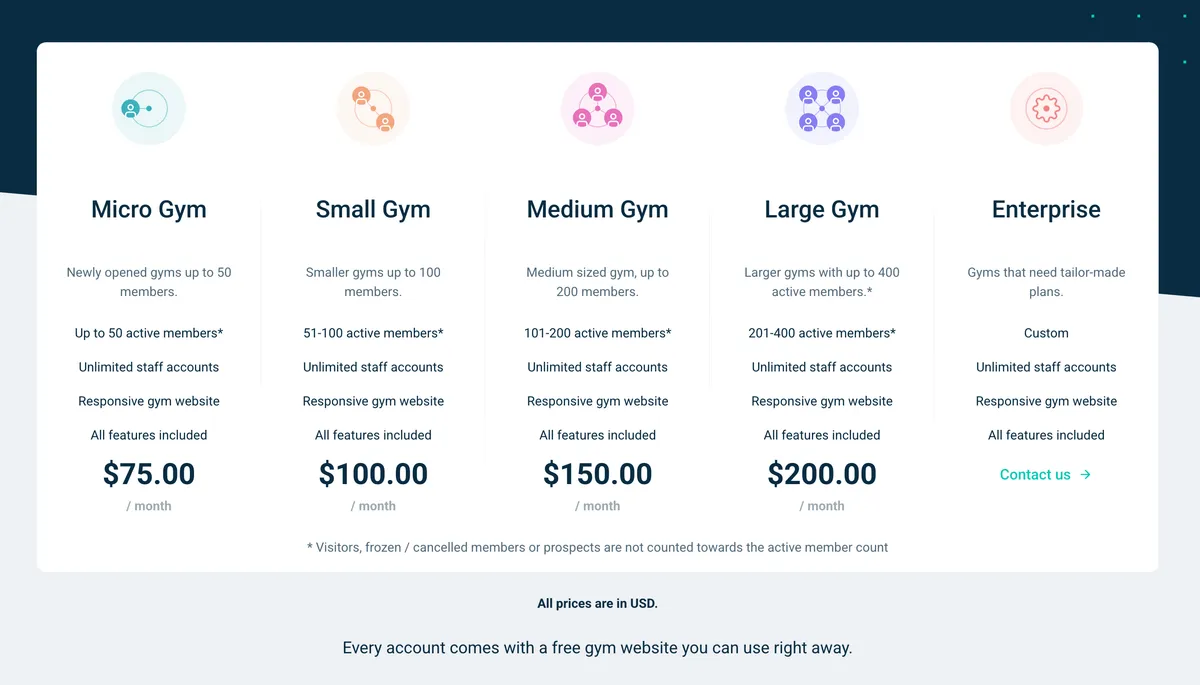
That line under the pricing cards is the sentence that should reframe this whole purchase for most gym owners. If your software already gives you a site at no extra cost, the honest question is not what a website should cost. It is what the included one cannot do, and whether that gap is worth paying to close.
Here is our answer to that, and it is a judgment rather than a sourced fact, so weigh it accordingly. A platform website is usually fine at three things: showing an accurate timetable, taking a booking, and existing. It is usually weak at three others: saying what makes your gym different from the one four minutes away, ranking for anything other than your own name, and handling an intro offer as something other than a generic sign-up button. If your problem is the first list, do not buy a website. If it is the second list, the included site is now the constraint.
One structural warning that applies to every bundled option, and we have written about it at length elsewhere: when the software company builds and hosts your site, leaving the software means leaving the site. Ask before you sign, not at renewal.
The price that is not on the pricing page
The cheapest plan in this market is not the cheapest way to run a gym, because payment processing is priced by plan, and past a certain volume the gap between the rates is bigger than the gap between the subscriptions. PushPress publishes its rates next to each tier: 4.99% plus 30 cents per card transaction on the free plan, 2.89% plus 30 cents on Pro at $159 a month, and 2.75% plus 30 cents on Max at $229. Bank transfers follow the same shape, 2.89% on the free plan against 0.79% on both paid plans.
The arithmetic is ours, done on their published numbers. Moving from the free plan to Pro costs $159 a month and saves 2.10 percentage points on every card payment you take. Those cancel out at $7,571 of monthly card volume. Below that the free plan is genuinely cheaper. Above it, the free plan is the more expensive product and the difference grows with every member you add. A gym with 150 members averaging $100 a month is at $15,000 of volume, which is roughly twice the break-even, so the free plan there hands over about $315 a month in extra card fees, a net penalty of roughly $156 once you allow for the subscription it avoids.
Zipper's version of the same trade is smaller and easier to read: 1% platform fee on Starter, nothing on Studio and Growth. The $160 a month between the two plans is repaid at $16,000 of monthly card volume. Whichever vendor you are looking at, find the processing rates before you compare the subscription prices, because on this shopping list the headline number is the smaller one.
What you actually pay once
Almost nothing in this market is a one-time cost, and the few things that are tell you something useful about where a gym's money really goes. GymMaster publishes its hardware prices openly, which is rare and to its credit.
The full list is longer than the chart. A door access controller is $550 and a door reader $300, a reception reader is $130, and a branded Bluetooth reader carries a $700 setup fee. Alongside those, GymMaster prices key fobs from $1.30 each plus $170 per 500, the tailgating camera system at $400 plus a $40 monthly module fee, and a branded member app at $150 a month on top of the $450 setup. My PT Website is the only vendor here charging a website setup fee at all, currently $499 against a struck-out $999, and it is charged once on every one of their three plans.
Put those next to each other and the point arrives on its own. The hardware on your door costs more than the setup fee on a done-for-you website, and the reader on your reception desk is the only item on the list that comes in under it. If your instinct has been that the website is the big capital item in opening or refreshing a gym, the published prices disagree.
The cancellation rule everyone still quotes was thrown out
If you have read anything about gym websites and memberships in the last two years, you have read that a federal click-to-cancel rule requires you to let members cancel online as easily as they signed up. That rule is not in force, and a good deal of what is still being written about it has not caught up.
The sequence is short and each step is on the record. In November 2024 the Federal Trade Commission published a final rule amending its Negative Option Rule, at 89 FR 90476, which among other things required sellers to obtain unambiguously affirmative consent and to provide simple cancellation mechanisms that immediately halt recurring charges. Industry groups petitioned four circuits, the petitions were consolidated in the Eighth Circuit, and in Custom Communications, Inc. v. FTC, 142 F.4th 1060, that court found the Commission's failure to issue a preliminary regulatory analysis procedurally insufficient and vacated the 2024 rule outright.
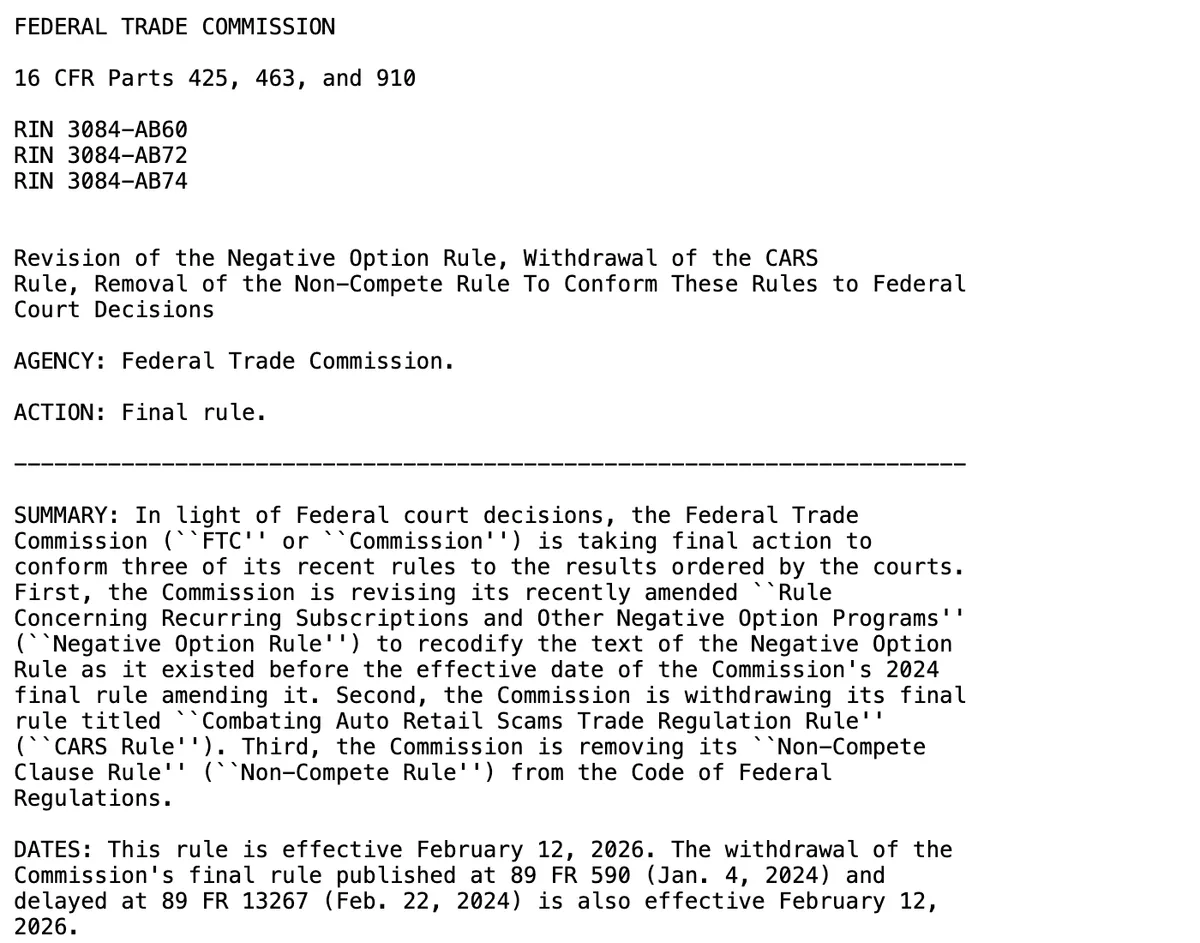
The Commission then made it official. On 12 February 2026 it published a final rule, effective the same day, recodifying the text of the Negative Option Rule as it existed before the 2024 amendments and changing the name of the rule back to Use of Prenotification Negative Option Plans. On 13 March 2026 it opened a fresh rulemaking on the same subject and took comments until 13 April. Its own regulatory agenda, published on 14 August 2026, still lists the removal of the vacated 2024 amendments from 16 CFR 425 as live work.
Two things this does not mean. It does not mean deceptive sign-up flows are now legal, because Section 5 of the FTC Act was never the thing that got vacated. And it does not mean nobody is regulating your join page, because state law moved into the space, and in one state it is more specific about your website than the federal rule ever was.
What binds you if you sell memberships online
California's Automatic Renewal Law is now the practical spec for any recurring membership sold on a website, and it is written in enough detail to be read as a build requirement. The controlling section is Business and Professions Code 17602, as amended by AB 2863, which applies to contracts entered into, amended or extended on or after 1 July 2025.
The rule that changes your build is subdivision (d). A business that lets a consumer accept an automatic renewal offer online must let them terminate it exclusively online, at will, without further steps that obstruct or delay immediate termination, and the method has to be either a prominently located direct link or button, which may sit inside a customer account or profile or in device settings, or an immediately accessible termination email that the business formats and provides and the consumer can send without adding anything. You may require the member to log in first. If they will not or cannot, you have to let them cancel by one of the offline methods instead.
Subdivision (e) then anticipates the retention flow every gym runs, and permits it on one condition. You may show a discount, a retention benefit or an explanation of what canceling means, but only while simultaneously displaying a prominently located and continuously visible link or button labeled click to cancel, or words to that effect. The phrase the federal rule became famous for is written into California's statute, and this half is still in force.
The rest of the section reads like a specification document, and every line lands somewhere in a build:
- Cancellation must be available in the same medium the member used to sign up, or the one they normally use with you.
- You must keep verification of the member's affirmative consent for at least three years, or one year after the contract ends, whichever is longer. That is a data retention decision, and it belongs in whatever your join form writes to.
- Before you confirm billing information you must clearly disclose that the membership renews until the member cancels, the length and terms of the renewal, the amount or range of charges and how often they will happen, at least one way to cancel, and your contact details. If that notice goes out electronically it has to carry a link to the cancellation process.
- If you change the fee, including a change the member previously agreed to, you must give clear notice of it and of how to cancel, no less than 7 and no more than 30 days before it takes effect.
- Annual memberships need an annual reminder, in the same medium, naming the service, the frequency and amount of charges, and how to cancel.
One honest limit on all of this. Other states run their own versions of these rules and several are stricter in places, but the primary sources for the two we most wanted to quote here were unreachable from our network on the day we wrote this, and we do not publish law we have not read. Treat the California text as the shape of what a careful build looks like, and get your own state checked by somebody qualified before you rely on it.
Three older rules that shape the join form itself
Underneath the renewal rules sits a much older body of law aimed squarely at gyms, and it constrains the form on your website in ways most designers have never heard of. In California these are the health studio services provisions of the Civil Code, and they were written for paper contracts but drafted broadly enough to cover the electronic ones.
Section 1812.82 requires every contract for health studio services to be in writing, and requires a copy to be physically given or emailed to the customer at the time they sign. Your online join flow needs to send that copy, and it needs to send it then, not in a welcome sequence three days later.
Section 1812.84 is the one that reads like a design brief. A health studio contract cannot run longer than three years, and payments cannot be required beyond its term. The contract must carry a statement of the initial or minimum length of the term, printed in at least 14-point type or presented in an equally legible electronic format, and that statement must be placed above the space reserved for the buyer's signature. There is a typographic minimum, and a required position on the page, sitting in a consumer statute. Cancellation, where the title allows it, may be done in person, by email from an address on file with the studio, or by first-class mail.
Section 1812.86 caps the total a health studio contract can require at $4,400, inclusive of initiation or initial membership fees and exclusive of interest and finance charges. If you sell a multi-year package with a joining fee on top, that ceiling is worth doing the arithmetic against before the pricing page goes live.
None of this is exotic or new. It is simply missing from the gym website cost guides we read while writing this, which treat the join page as a design problem and leave out the part where its type size and its layout are legislated.
What is left for the website to do
Once the software is handling booking, billing, waivers and check-in, and once the join flow is doing what the law asks, the honest job list for a gym website is short. That is not a criticism of websites. It is what makes a good one cheap to specify.
The site has to make the trial or intro offer obvious and one tap away, on a phone, at nine at night. It has to show a timetable that is actually current, which in practice means pulling from the same system your coaches update rather than a page somebody edits by hand. It has to state prices, because the single most common reason a gym inquiry never happens is that the visitor could not find out what it costs. It has to say where you are and where to park. It has to introduce the coaches, because for most independent gyms the coach is the product. And it has to say what kind of gym this is, clearly enough that the wrong person self-selects out and the right one recognizes themselves.
Scale is worth a moment here, because it explains why the differentiation matters more than the craft. Bureau of Labor Statistics Quarterly Census of Employment and Wages data for the first quarter of 2025 counts 45,564 private establishments in the fitness and recreational sports centers industry, the code that covers gyms, in the United States, employing 648,903 people at an average weekly wage of $435. The Occupational Employment and Wage Statistics for May 2025 put 322,930 exercise trainers and group fitness instructors in the country, with a median wage of $47,160 and a mean of $52,420. You are not competing with all 45,564. You are competing with the three or four within a few miles, and the visitor deciding between you is not comparing your typography.
One more thing belongs on that list. The reviews and transformation photos a gym leans on are, in our experience, the part of the site carrying the most legal exposure, and the rules there are federal, current and unrelated to anything above. We have written a separate piece on what you can and cannot publish.
Where the money goes first
The order you work through these matters more than which vendor you end up with.
Start by finding out what you are already paying for. Log into your platform and check whether a website is included, whether it is the basic or the custom version, and what it would cost to move up a tier. On the numbers above that answer ranges from free to $329 a month, which is a wide enough spread to be worth ten minutes.
Then fix the join flow, whichever site you are on. Same-medium cancellation, an honest pre-billing disclosure, a contract copy sent at signing, the term stated above the signature. These are small pieces of work, they are cheap to do while you are already in the code, and they are expensive to retrofit after a complaint.
Then, and only if the included site is holding back signups rather than merely looking dated, buy or build one you own, with a small honest set of pages: who this gym is for, the timetable, the prices, the intro offer, the coaches, and how to get here. A short site that answers the questions a stranger actually has will out-earn a twenty page template, every time.
Content and ads come last, if at all. A gym is a local business with a physical door and word of mouth is still the strongest channel most of them have. Before you buy a monthly content plan, ask the vendor for three pieces they wrote for other gyms and read them the way you would read a coach's programming.
Our offer, and the gyms we are wrong for
We work on monthly plans, all three priced on our pricing page: Foundation Partner at $1,000 a month, Growth Partner at $2,500, Scale Partner at $5,000. Billed monthly, no minimum, pause or cancel anytime, and everything we build is yours to keep. Two weeks from kickoff to live is what a focused build usually runs to, and what decides that timeline is mostly content and approvals rather than build speed. Requests get an answer inside 48 hours. Our fitness and wellness page sets out how we work in this field. The nearest outcome we can point to is a treatment center rebuild, where Cornerstone Healing Center ended up with 20% more website conversions.
We are more use to you if we are specific about who should close this tab. A gym with a full class schedule, a waiting list and a working Gymdesk site does not need us, and we would rather say so than sell you a rebuild you will not feel. If $75 or $89 a month is the shape of spending your cash flow can absorb, the included website is a reasonable purchase and we are not going to pretend it is a scandal. Want somebody posting to Instagram three times a week and filing a monthly blog? Hire a fitness marketing service. That is their product, and it is not ours.
The work we are good at starts where the website itself is the bottleneck: a gym whose classes fill but whose personal training never sells, a multi-location operator whose platform site cannot express three different timetables, a rebrand where the old vendor holds the domain, or a gym competing against a chain that outspends it and needs the site to do the arguing.
The join flow test, run it on your own site tonight
Every number in this article is decidable once you have watched your own join page behave. Do this on a phone, not a laptop, with your reading glasses off, and time it.
One. From your home page, how many taps to a trial or intro offer? More than two and the offer is decorative.
Two. Can you find the price of a standard membership without submitting a form? If not, you are asking a stranger to phone you before they know if they can afford you.
Three. Is the timetable on screen the one your coaches are teaching this week? Check one class against your software.
Four. Sign yourself up for the cheapest plan you sell. Does the page tell you, before you enter card details, that it renews until you cancel, how much and how often it will charge, and how to stop it?
Five. Now cancel that membership, using only the website. If you cannot, or the path pushes you to phone somebody, you have found the most expensive defect on your site, and it is a legal one in California and a trust one everywhere.
Six. Look at the confirmation email. Is your contract attached or linked, and is the length of the term stated where a member would see it before agreeing?
Six answers, twenty minutes, and no vendor involved. If all six pass, your website is doing its job and your money belongs somewhere else this quarter. If two or more fail, you now know exactly what you are buying, which is the only position worth being in before anybody quotes you a price.
Frequently asked questions
Between about $900 and $5,988 for the first twelve months if you buy from a company that publishes prices. Almost all of that is subscription pricing for gym management software that includes a website, not design work. The cheapest published option is Gymdesk at $75 a month, which includes a website on every tier. The most expensive published plan carrying a custom-branded website is Zipper Growth at $499 a month. Our own plans are monthly and published: $1,000, $2,500 or $5,000 a month, pause or cancel anytime.
For many gyms, yes. A platform website usually handles the timetable, the booking and the basic pages well, and Gymdesk states that every account comes with a free gym website you can use right away. It is usually weaker at explaining what makes your gym different, at ranking for anything beyond your own name, and at presenting an intro offer as more than a generic sign-up button. If those are your problems, the included site has become the constraint. If they are not, keep it.
In California, yes, if they signed up online. Business and Professions Code 17602(d) requires a business that lets a consumer accept an automatic renewal offer online to let them terminate it exclusively online, at will, through a prominently located direct link or button or a pre-formatted termination email. You may require them to log in first. Other states have their own versions of this rule, so check yours rather than assuming California is the ceiling.
No. The Eighth Circuit vacated the FTC's 2024 amendments to the Negative Option Rule in Custom Communications, Inc. v. FTC, 142 F.4th 1060, and on 12 February 2026 the Commission published a final rule recodifying the older text and restoring the rule's previous name. A fresh rulemaking opened on 13 March 2026. Section 5 of the FTC Act still prohibits deceptive sign-up and cancellation practices, and state automatic renewal laws still apply, so nothing about this makes a hard-to-cancel membership safe.
About two weeks from kickoff to launch is typical for a focused build, and that is what we plan for. Platform websites are faster because the pages already exist, and Gymdesk states you can start taking signups the same day if you are starting from scratch. What actually sets the timeline is content: photographs of your own gym, an accurate timetable, and prices you have decided on.
Compare the twelve-month totals, then the second year. A monthly plan at $299 costs $3,588 a year and keeps costing it. A one-time build costs once and then only carries hosting. Monthly makes sense when the plan is bundling software you need anyway, since you would be paying for booking and billing regardless. Buying outright makes sense when you already have the software and are paying only for the website, and when you want to keep the site if you switch platforms.
Usually not you, in any practical sense. When the platform builds and hosts the site, leaving the platform means leaving the site behind, even where you own the domain and the copy. Ask three questions before signing: do I own the domain, can I export the content, and does anything I have paid to have written or photographed come with me. Get the answers in the contract rather than from a sales call.
Yes, because they serve different people. The app serves members who have already joined, and vendors price it accordingly: TeamUp lists a custom branded app at $99 a month, PushPress at $81 to $97, GymMaster at $150 a month plus a $450 setup fee. The website serves the person who has not joined yet and will never download an app to find out what a drop-in costs. If budget forces a choice, the website is the one that does acquisition.
 Web Design
Sep 6, 2026 · 17 min
SaaS Website Cost in 2026: What 1,953 Agencies Say They Charge
Every published range for this question is written by an agency describing its own invoices. So we read all 196 pages of Webflow's Certified Partner directory and counted what 1,953 of them actually put on the card.
 Web Design
Sep 5, 2026 · 17 min
Template or Custom Website in 2026: What a Template Actually Buys
We read the license and the support policy behind the biggest template marketplace, then counted every theme in the WordPress.org directory and the Shopify Theme Store. The sticker price is the smallest number in the decision.
 Web Design
Sep 3, 2026 · 19 min
How Much Should a Hotel Website Cost in 2026?
Published platform prices run from $9 to $197 a month and a managed hotel website starts at $14,400 a year. Then a federal rule decides which number on your page has to be the biggest.