
How Long Does It Take to Build a Website in 2026? What the Clocks Actually Say

Aug 21, 2026 · 15 min read
Somebody is about to quote you a number of weeks. Before they do, it helps to know that the number has two halves, and only one of them belongs to the person saying it.
Search the question and page one hands you confident ranges that do not agree with each other. Elementor's guide puts a small business site at one to two weeks if you do it yourself and four to eight weeks with a professional. WPX gives four different bands in a single article. Hostinger's tutorial breaks a WordPress business site into five phases totaling five to fourteen weeks, and an enterprise build at thirteen to twenty two. None of them cites a measurement. They are estimates, written by companies that sell hosting and page builders, presented in the tone of facts.
A better set of numbers is sitting in public, unquoted by any of them. The companies that sell finished websites publish the launch time they are willing to be held to, on the same page as their prices. Underneath those promises sit a handful of external clocks with published or measurable durations that nobody on the project can shorten. Put the two together and you get a timeline you can actually plan a launch date around. Nothing below is estimated: each figure was either quoted from the page of the company that published it or measured on this machine, on 21 August 2026. One disclosure before you start. KhanWork sells the work being timed here, so treat the section near the end about our own process as the least neutral part of the article.
The 30-second answer
Most small business websites take two to eight weeks of calendar time, and the companies selling them say so on their own pricing pages. Placester advertises a template site live in minutes. Brighter Vision and Websites for HVAC both publish two to three weeks. FMG Suite publishes four to six and names approvals as the reason. The spread has almost nothing to do with how fast anyone builds. It tracks how much of the site is written before work starts and how many people have to approve it. Under all of that sit external clocks, from a 48 hour DNS cache to a 60 day domain lock, that no agency can speed up.
Why no two published answers agree
They disagree because none of them is measuring anything. Each range is an estimate written for an audience, and once you line them up the seams show.
WPX is the clearest example, because the contradiction is internal. Its 2026 article says a professional developer can build a basic informational site in four to eight weeks. A few paragraphs later it puts a standard agency project for a small business at six to ten weeks. Under its heading for business websites, a small or medium business on WordPress is typically four to six. At the end, a moderately experienced developer using WordPress is given four to twelve. Four bands, one article, for a project most readers would describe the same way. Different delivery routes explain some of that, but not the last two, which describe the same route and differ by a factor of two.
Hostinger's tutorial is more careful, and it is the only one that shows its work by publishing phase lengths. That is also how you find the arithmetic. It puts a custom coded single page site at eight to twenty one days, then lists the phases: planning one to three days, design and prototyping two to seven, development three to ten, testing one to three, deployment one. The low ends add to eight, which matches. The high ends add to twenty four, not twenty one. It is a small thing, and it is exactly the kind of small thing that tells you the total was chosen and the phases were written to fit around it.
Elementor's table is internally consistent and worth quoting for the shape rather than the numbers. A simple brochure site of one to five pages: one to three days do it yourself, one to two weeks professional. A small business site of five to fifteen pages: one to two weeks, then four to eight. A custom web application: six to twelve months or more. All three guides agree on one thing about small sites: hiring somebody makes the project take longer, not shorter. That is worth sitting with for a second before anyone explains it away.
What the sellers put in writing
The numbers worth trusting are the ones a company has to live with. A website vendor that publishes a launch time on its pricing page has customers who will hold it to that, which makes those figures a different class of evidence from an estimate in a blog post. Six of them are plotted below, read from the vendors' own pages on the day this was written.
Placester, which sells real estate agent sites, tells buyers on its pricing page that they can "Launch your modern, IDX-ready website in minutes with AI". Brighter Vision, which sells to therapists, answers the question in its own FAQ: the whole process can be as short as two to three weeks, and longer if the client spends more time in the design phase. Websites for HVAC publishes a week by week schedule: day one you sign up and your territory is locked, weeks one to three they build, week three the site goes live, and management billing starts at launch rather than at signing. FMG Suite, selling to financial advisors, offers turnkey designs and pre-written copy and still puts launch at four to six weeks, which its page attributes to approvals and to how much the client wants personalized.
Read that list again and notice that they are not describing the same product. The minutes version is a template filled in automatically. The two to three week versions are template families with your content dropped into them. The four to six week version has a compliance step in the middle. The honest summary is that the timeline is a description of how much judgment is being applied, not of how fast anyone works.
The sentence that explains the whole spread
One vendor states the mechanism out loud, and once you have read it the rest of the market becomes legible. My Personal Trainer Website answers the question in two sentences: the framework can be ready within 24 hours, and adding content, images and integrations usually takes two to four weeks.
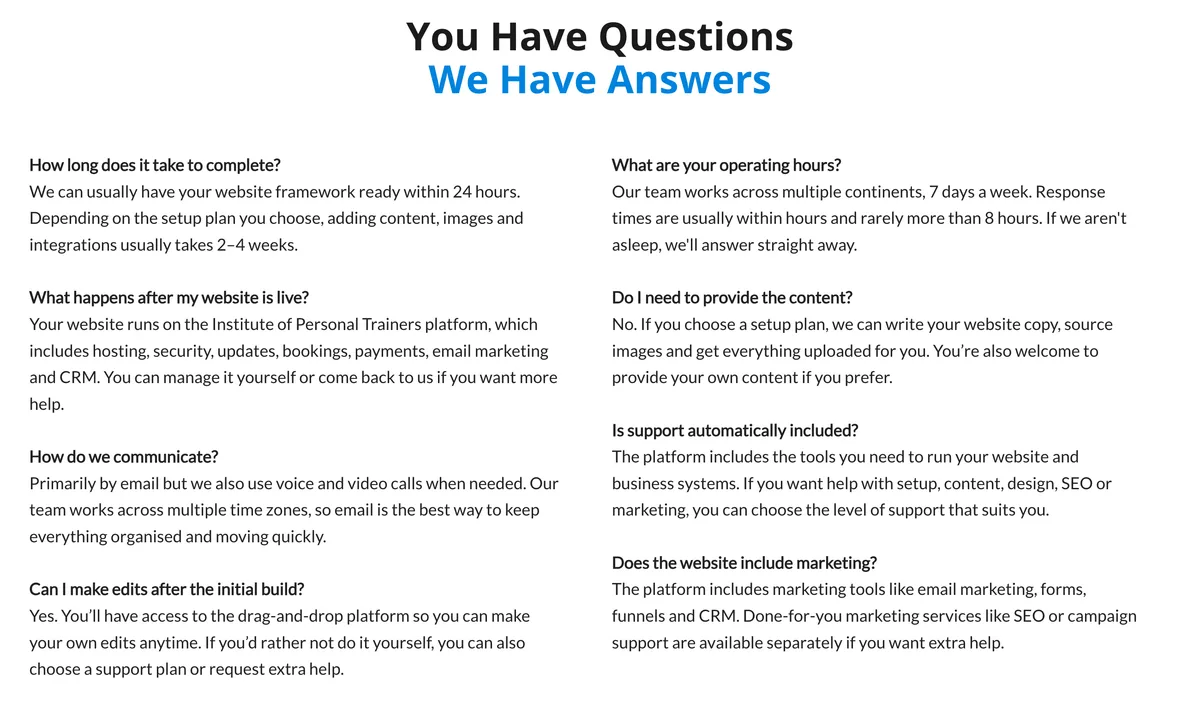
One day against fourteen to twenty eight of them. The software part of a website, the part people picture when they imagine somebody building it, is a day. Everything after that is deciding what the site says, finding the photographs, agreeing the wording of the service descriptions and connecting the booking or payment tools to accounts that somebody has to create. That is where the weeks live, and it is why two agencies quoting the same project can honestly say two weeks and eight weeks. They are describing different amounts of unfinished thinking.
The same page makes the point again from the other direction. Asked whether the client has to supply the content, the answer is no, because on a setup plan they will write the copy and source the images themselves. That is the fastest lever anyone has ever found for a website project, and the reason it works is that it removes the client from the critical path rather than making anyone type faster.
Building is a minority of the calendar
Even in the estimates published by companies that sell development, writing code is not where most of the time goes. Hostinger's enterprise WordPress breakdown is the useful one, because it publishes each phase rather than a single total.
Writing code accounts for 4 of the 13 weeks at the fast end of that range and 6 of the 22 at the slow end. Call it a third of the project at best. The rest is planning, design and setup at the front, testing and deployment at the back. For a small business site the proportion is usually worse, because the build shrinks while the deciding does not: a five page site still needs five pages of decisions, and those take about as long to make as fifteen pages of decisions did.
This matters when you are comparing quotes. Where one agency says six weeks and another says three, ask each of them what happens in week one. A discovery call, a content questionnaire and a wireframe round means you are buying the deciding. A staging link on Thursday means you are buying the template. Both are legitimate purchases. They are not the same purchase, and the week difference is the tell.
The part of the clock that belongs to you
Vendors are unusually specific about this when they are trying to reassure you, and the numbers give the game away. Brighter Vision tells prospective clients that most of them invest about 60 to 90 minutes of their own time in the process. That is the total, for a site the same page says takes two to three weeks.
Ninety minutes of work spread across three weeks is not a workload. It is a queue. The client's ninety minutes arrive in six or seven fragments, each one blocking everything behind it, each one waiting on somebody to open an email. Which is why the same FAQ warns that more time spent in the design phase stretches the project, and why FMG Suite hangs its four to six weeks on approvals, and why the Websites for HVAC schedule gives the client exactly one job during the three build weeks, which is to review and approve.
The practical version: if you can put one person in charge who is allowed to approve things without a meeting, you will beat the published range. If approval requires three partners and a board, you will not, and no agency selection will change that.
The clocks nobody on the project controls
Some of the elapsed time in a website launch is not work at all. It is waiting for systems that run on their own schedules, and those schedules are published or measurable. Individually they are short. What makes them expensive is that most get started on the day somebody remembers them, which is usually launch week.
Two of those bars were measured rather than quoted, and between them they cover everything people mean when they say a launch is waiting on DNS. The rest come from the documentation of the organizations that run them. Taken together they set a floor: no matter how fast the site is built, a business that also needs a verified Google listing and a domain moved to a new registrar is looking at weeks of external process running alongside the project.
What DNS propagation actually measures
DNS propagation measures a cache timer that somebody chose in advance, and you can look up the number instead of guessing at it. The folklore says 24 to 48 hours. The folklore is describing one specific case and applying it to all of them.
Every domain publishes a time to live on each record, in seconds, and that value is the longest a resolver anywhere is allowed to keep serving the old answer. We queried a handful of well known domains at their own authoritative nameservers on 21 August 2026, and separately queried the .com registry servers for the delegation records that point at those nameservers.
| What was queried | Record | TTL returned on 21 August 2026 | Longest a change can stay cached |
|---|---|---|---|
| khanwork.com at its own nameservers | A | 60 seconds | 1 minute |
| shopify.com at its own nameservers | A | 60 seconds | 1 minute |
| webflow.com at its own nameservers | A | 60 seconds | 1 minute |
| github.com at its own nameservers | A | 60 seconds | 1 minute |
| squarespace.com at its own nameservers | A | 300 seconds | 5 minutes |
| wordpress.org at its own nameservers | A | 600 seconds | 10 minutes |
| wix.com at its own nameservers | A | 3,600 seconds | 1 hour |
| The .com registry, for the nameserver records of all of the above | NS | 172,800 seconds | 48 hours |
That last row is the whole story. Changing where a site is hosted, by pointing an A record somewhere new, is a one minute to one hour operation on every domain we sampled. Changing which nameservers are in charge of the domain is a 48 hour operation, because the .com registry stamps every delegation with a two day cache time and there is nothing you or your host can do about it. The 48 hours in the folklore is real. It belongs to one specific action, and most launches do not need to take it.
The certificate worries people more than it deserves to. The live certificate on this site, read straight off the connection on the day of writing, was issued by Let's Encrypt on 5 July 2026 and expires on 3 October 2026, a 90 day window renewed automatically. Issuing one takes minutes and no human attention. There is one way to turn it into a real delay: Let's Encrypt caps issuance at 50 certificates per registered domain every 7 days, so a launch that repeatedly fails validation and retries can lock itself out of new certificates for a week.
Launch day is not the day Google agrees
The site goes live in an afternoon. Google catches up on its own schedule, and Google says so plainly rather than leaving it to be discovered.
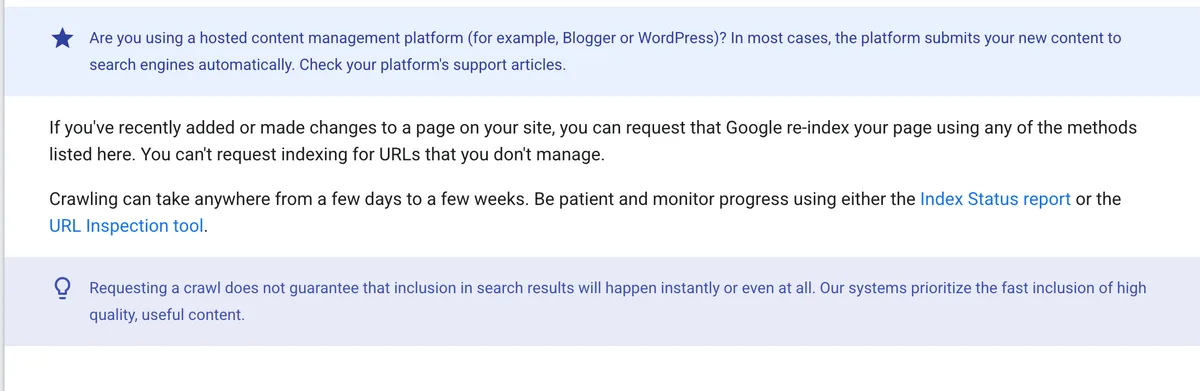
"Crawling can take anywhere from a few days to a few weeks," the page says, and a note directly under it adds that asking for a crawl guarantees neither speed nor inclusion at all. There is no queue to pay for and no button that helps.
Speed reporting runs on a longer clock still. The Chrome UX Report, which is the field data behind Core Web Vitals and behind the "real world" half of most speed tools, describes itself as "a 28-day rolling average of aggregated metrics". Its API documentation adds the detail that catches people out after a rebuild: the reported collection period always reads as 28 days even when the page has existed for fewer than 28, so a site that got dramatically faster last Tuesday will keep reporting a blend of the old site and the new one for four more weeks, and anyone judging the rebuild on those numbers in week two is reading mostly the site you replaced.
If the project is a rebuild of an existing site rather than a first one, the ranking mechanics deserve their own attention and we wrote them up separately in the guide to redesigning without losing your Google rankings. The timeline point stands either way: the last third of a website project happens after the launch party.
Queues you cannot jump
Several of the things a new business needs alongside a website are queues run by third parties, and each one has a published waiting time. They are worth listing because they are the ones that turn a two week build into a two month launch.
The Google Business Profile. For a local business this is often more valuable than the website itself, and it is the slowest item on the list. Google's help page says most postcard verification codes arrive within 14 days, and that once the code is entered the review itself can take up to five business days. It also warns that editing your business name, address or category while the postcard is in transit invalidates the code, which means an impatient rebrand mid-project restarts the clock.
The domain. Under the ICANN Transfer Policy a registrar is entitled to refuse to release a domain during three separate 60 day windows: within 60 days of the creation date (section 3.7.5), within 60 days of a previous transfer (3.7.6), and during the 60 day lock that follows a change of registrant (3.9.4). Register a new domain today at the wrong registrar and you may not be able to move it until well after your intended launch. Which registrar it lives at, and in whose name, is a decision that belongs at the start of a project rather than the end, and it is bound up with who actually owns the site when the work is finished.
The regulator, if you have one. Regulated firms have review clocks written into rules. A member firm in its first year of FINRA membership must file retail communications with the Advertising Regulation Department "at least 10 business days prior to first use", which for a website means the copy has to be final two weeks before the site can be published. Other regulated trades have their own advertising rules and their own reviewers, so the question to settle early is who has to see the copy before the public does.
Anything with a payout. Payment processing, appointment tools and anything holding customer data has an onboarding step with identity checks. No single step is long. The steps run one after another, though, and each one needs somebody with the legal authority to sign.
What actually makes a website project late
Projects run late for reasons the vendors themselves name in their FAQs, and none of them is technical. Brighter Vision blames extra time in the design phase. FMG Suite blames approvals and personalization. My Personal Trainer Website's fast path is the one where they write the copy for you. Read three sales pages and the same admission is in all of them.
In our own work the pattern repeats. The projects that overrun do so because the photographs were never taken, because the service descriptions turned out to be a genuine disagreement inside the business rather than a writing task, or because the one person who could approve the homepage was traveling. The build sits finished, waiting on a paragraph.
The second pattern is the queue nobody started. A business that decides in week three that it also wants a Business Profile, a new domain at a different registrar and a payment processor has added a month of external waiting to a project that was on schedule.
What genuinely compresses the calendar
Four things move the date, and they all move it before anyone opens a design tool.
Write the content first, or hand it over entirely. Every vendor quoted in this article agrees on this one, which is rare enough to be worth noticing. A site whose copy exists on day one can be built in the time the tools take.
Cut the page count honestly. Six pages that are finished beat sixteen that are half written. Pages can be added after launch at no penalty, and a smaller launch also means fewer approvals.
Name one approver. Not a committee, not a founder who reviews things on Sundays. One person with authority and a calendar.
Start every external clock in week one. Claim the Business Profile, confirm which registrar holds the domain and in whose name, lower the DNS record time to live to a minute a week before cutover, and get any regulatory filing moving while the design is still in progress. None of these depends on the site being finished, and every one of them is a week you will not spend waiting later.
How we run a build, and who should look elsewhere
Our own typical for a focused build is 14 business days from start to live, and typical is doing real work in that sentence. It holds when the content is ready or when we are writing it, when one person approves, and when the domain and the listings are already where they should be. It does not hold otherwise, and we would rather say that here than discover it with you in week five. Across 200 and more projects, the ones that hit the date were never the ones with the fastest developers on them.
What we sell is a monthly partnership, $1,000, $2,500 or $5,000 a month, published rather than agreed on a call, and everything we deliver is yours to keep. Pause or cancel anytime. The pricing page lays out what each one covers. A request from a new business gets a reply from us inside 48 hours, which is the only date we will promise before we understand the project.
Now the awkward half. If your content genuinely does not exist and you do not want anybody writing it for you, a two week build is not available from us or from anyone, and paying a premium for speed you cannot use is a bad trade. Anyone who needs something live this afternoon to take bookings should buy a template from one of the platforms in the builder comparison and move later. If you are choosing between agencies on timeline alone, the checks in our guide to choosing an agency will serve you better than another quote. And if you run a service business where the Business Profile is doing most of the work, start that verification today and treat the website as the slower half of the project.
Everything with a clock, and when to start it
Keep this one open while you plan. Every row below is a separate clock, with a different owner, a published or measured duration, and a moment at which it should be set running.
| What has to happen | Whose clock it is | How long it runs | Begin it |
|---|---|---|---|
| Content written and approved | Yours | The item that sets the launch date | Before design starts |
| Domain registered or released | Registrar, under ICANN policy | 60 days locked after registration, transfer or a registrant change | Week one, before anything else |
| Google Business Profile verified | Postcard usually inside 14 days, then up to 5 business days of review | Week one | |
| Regulatory or franchise filing | Your regulator | 10 business days before first use for a first-year FINRA member | As soon as the copy is final |
| Payment and booking accounts | The provider | Short, but sequential and needs a signatory | While design is in progress |
| Lower the DNS record time to live | You, whoever hosts your DNS | Takes effect after the old value expires | A week before cutover |
| Point the A record at the new site | The cache timer you set | 1 minute to 1 hour on the domains we measured | Launch day |
| Change nameservers, if you must | The .com registry | 48 hours of cached delegation | Never on launch day |
| Certificate issued | The certificate authority | Minutes, automated, capped at 50 per domain a week | As soon as DNS resolves |
| New pages crawled | A few days to a few weeks | Nothing to start, and nothing to buy | |
| Field speed data reflects the new site | Chrome UX Report | 28 day rolling window | Judge the rebuild after that |
Pick the date, then count backwards
Most website plans are built forwards, which is why they slip: the launch date is whatever is left after everything else has taken as long as it took. Try it the other way. Put a real date on the wall, one that matters to the business, then walk backwards through the clocks above and write in when each one has to have started.
Counting back from launch day, on the evidence in this article: the day before, the certificate should already exist and the record time to live should already be low. One week before, the content is final and any regulatory filing is already sitting with the reviewer. Two weeks before, the build has everything it needs and nothing is waiting on a photograph. Three weeks before, the Business Profile postcard is either in hand or in the mail. Eight weeks before, the domain question is settled, because a domain registered at the wrong registrar today cannot be moved for 60 days.
And then two dates after launch, which almost nobody writes down: two to three weeks out, when the new pages should be crawled and it is fair to ask why any of them are not, and 28 days out, which is the first morning the field speed data describes the site you actually built.
Frequently asked questions
Two to eight weeks of calendar time is the honest band for a small business site, and the companies that sell them publish figures inside it. A Placester template site is advertised as live in minutes, Brighter Vision and Websites for HVAC name two to three weeks, and FMG Suite names four to six. The build is the smaller half of that. Most of the elapsed time goes on writing content, waiting for approvals, and on external processes such as verifying a Google Business Profile or moving a domain that is locked to its registrar.
Plan on four to six weeks, and two is realistic only if the content already exists or somebody else is writing it. The page count matters less than people expect, because a five page site still needs five pages of decisions. What moves the date is whether the copy and the photographs are ready and whether one person can approve them without calling a meeting.
Because they are quoting different amounts of decision making, not different typing speeds. A vendor promising a launch in days is filling a template with content you supply. A vendor promising six weeks is including discovery, wireframes, revision rounds and an approval step. Ask each of them what happens in week one and the difference becomes obvious immediately.
As long as the time to live on the record you changed, and you can look that number up rather than guess it. Querying the authoritative nameservers on 21 August 2026 returned 60 seconds for khanwork.com, shopify.com, webflow.com and github.com, 300 seconds for squarespace.com, 600 for wordpress.org and 3,600 for wix.com. The famous 48 hours belongs to a different action: the .com registry publishes a 172,800 second cache time on the records that say which nameservers run a domain, so changing nameservers really does take two days.
Google's own documentation says crawling can take anywhere from a few days to a few weeks, and that requesting a crawl guarantees neither speed nor inclusion. Submitting a sitemap and using the URL Inspection tool help Google find the pages, but there is no queue to pay for. Budget two to three weeks before it is reasonable to ask why a page is missing.
The build is comparable and the tail is longer. A redesign adds work a first site does not have, chiefly mapping every old URL to a new one and protecting rankings that already exist, which we covered separately. It also takes longer to judge: the field speed data behind Core Web Vitals runs on a 28 day rolling window, so a rebuild reviewed in week two is being scored partly on the site it replaced.
Unwritten content and unavailable approvers, in that order, and the vendors say so themselves in their own FAQs. The second cause is an external queue that nobody started: a Google Business Profile that still needs a postcard, a domain locked to its old registrar for 60 days, or a regulatory filing that has to sit with a reviewer before the site can be published.
Yes, if the content exists on day one, one person can approve it, and the design is a template rather than an original. Placester and My Personal Trainer Website both sell that version, one advertising a launch measured in minutes and the other a framework ready inside 24 hours. What a week does not buy is a site whose structure and copy get worked out during the project, because that thinking is the part that consumes the weeks.
 Web Design
Sep 6, 2026 · 17 min
SaaS Website Cost in 2026: What 1,953 Agencies Say They Charge
Every published range for this question is written by an agency describing its own invoices. So we read all 196 pages of Webflow's Certified Partner directory and counted what 1,953 of them actually put on the card.
 Web Design
Sep 5, 2026 · 17 min
Template or Custom Website in 2026: What a Template Actually Buys
We read the license and the support policy behind the biggest template marketplace, then counted every theme in the WordPress.org directory and the Shopify Theme Store. The sticker price is the smallest number in the decision.
 Web Design
Sep 3, 2026 · 19 min
How Much Should a Hotel Website Cost in 2026?
Published platform prices run from $9 to $197 a month and a managed hotel website starts at $14,400 a year. Then a federal rule decides which number on your page has to be the biggest.