
Staffing Agency Website Cost in 2026: What 46 Agency Sites Actually Run

Sep 7, 2026 · 17 min read
Ask what a staffing agency website costs and the search results answer a different question. Nearly every page that ranks is about what staffing agencies charge their clients, a markup on an hourly bill rate, which is a completely separate subject. The handful of pages that do talk about the website give you a range with no source attached and move on.
So we went and looked. On 7 September 2026 we pulled every staffing agency that came back on the first page of Google for the phrase "staffing agency" in thirteen United States metropolitan areas, threw out the directories and the marketplaces, and were left with 46 real agency websites. Then we fetched each one, followed its own "search jobs" link, and recorded what was actually running. The result changed how we would quote this work.
The 30-second answer
A staffing agency is buying two websites, and they usually come from two vendors on two bills. The marketing site, which is the part a web design agency prices, runs from about $1,500 for a focused build up into five figures for a large custom one. The job board, where candidates search and apply, normally arrives with your applicant tracking system rather than your web designer, and it is priced per recruiter per month, forever. Of the 46 agency sites we measured, 20 run the job board on a separate jobs. subdomain and 22 load a staffing, payroll or staffing-marketing platform directly on the job search page. Before you compare two quotes, establish which half each one covers.
A staffing agency website is two websites
The split is easy to miss because both halves usually wear the same logo. The marketing site sells to employers: what you place, which markets you cover, why a hiring manager should call you instead of the firm down the road. The job board sells to candidates, and it is a database with a search form bolted to the front of it. They have different audiences, different update cycles, and in most cases different owners inside the agency.
They also have very different cost shapes. The marketing site is mostly a one-time build with hosting and maintenance after it. The job board is a subscription, and it is normally bundled into software you were buying anyway. That is why a $4,000 quote and a $25,000 quote can both be honest: they are pricing different objects.
The industry is large enough that this pattern has hardened into a convention. The American Staffing Association counts around 27,000 staffing and recruiting companies in the United States operating close to 54,000 offices, placing about 2.2 million temporary and contract employees in an average week during 2024. Almost all of them need both halves.
What 46 staffing agency websites are actually running
Here is the method, so you can repeat it or argue with it. We searched Google for "staffing agency" plus a city name across Chicago, Houston, Atlanta, Phoenix, Charlotte, Denver, Nashville, Tampa, Columbus, Kansas City, Seattle, Philadelphia and Dallas, and took every result that was an agency's own website rather than a directory. That gave us 55 domains. Fifty served us a homepage, and on 46 of those we could find and fetch the page a job seeker would click. For each one we fetched the homepage, found the link a job seeker would click, fetched that page, rendered it in a headless browser when it needed JavaScript, and then recorded which third-party hosts it loaded and whether a live job board answered at jobs. plus the agency's own domain.
Two numbers stand out. First, 20 of the 46 run a working job board on a jobs. subdomain, which means the thing candidates use is a separate property from the thing employers read. Second, 22 of the 46 load a recognizable staffing platform, payroll platform or staffing marketing vendor on the job search page itself. Those two groups overlap heavily and together they describe most of the sample.
The check has a known blind spot and it matters: we can only see a vendor when the page loads something from that vendor's domain. An agency whose vendor serves every file from the agency's own domain looks, to our script, like a hand-built site. So 22 of 46 is a floor, not a ceiling. The true share of outsourced job boards in this sample is higher than the number we can prove.
The sample has a second bias worth stating plainly. These are the agencies Google puts on page one, so they are the ones with budget and attention on search. A random sample of the 27,000 firms in the country would look worse, not better.
One vendor is behind a quarter of them
The concentration surprised us. Haley Marketing, a marketing company that sells websites and job boards specifically to staffing firms, appears on 11 of the 46 sites. That is roughly one in four of the agencies a buyer finds on the first page of Google, running the same supplier. Nine of those eleven are the jobs. subdomain pattern, which tells you the pattern is a product decision rather than an accident.
Behind it, Avionté appears on 8 sites, Bullhorn or its Herefish product on 5, and TempWorks on 3. ADP, a payroll platform, appears on 3. The rest are single appearances: JobConvo, Zenople, PrismHR and Sense.
If you are about to commission a "custom" staffing website, that concentration is the most useful thing on this page. Nearly half of the sample runs one of about six products. Buying the same product is a reasonable, cheap, low-risk decision. Buying a bespoke build of the same thing is a much more expensive way to arrive in the same place, and the reason to do it has to be something other than the job board.
What the marketing half costs, and what it has to carry
The marketing site is the half a design agency quotes. For a staffing firm it is a short site: a homepage, an employers page, a candidates page, one page per specialty, one per office location, an about page with real faces on it, and a contact form that reaches a person. Ten to twenty pages covers most independents.
Priced honestly, that is a small project. A focused build of that shape is what our monthly plans cover, and 14 business days is the usual run from finished content to launch. Larger firms with a dozen branch pages, multiple brands and a case-study library are a bigger job, and a project quote for one climbs into the tens of thousands with the page count and the amount of writing involved. Our own rates do not move with the page count: they are published monthly, at $1,000, $2,500 or $5,000 a month.
What the marketing half has to carry is trust, because the buyer on the other side is signing a contract that puts strangers inside their building. That means the specialties you actually staff, the markets you actually cover, named people, and proof. An animated hero does none of that work. For a worked example of what a redesign of this kind can move, we rebuilt Cornerstone Healing Center's site and their website conversions rose 20 percent.
One thing to insist on here: the writing is the expensive part and it is the part that is usually skipped. A staffing site with eight specialty pages needs eight pieces of writing that a hiring manager in that specialty finds credible. If a quote does not say who writes them, the quote is incomplete.
The job board usually comes with the software
This is the part buyers get wrong most often. The career portal is a feature of the applicant tracking system, not a page your web designer builds. Bullhorn, whose software we found on five of the 46 sites, lists "Job posting with career portal" as one of five things included in its cheapest published tier at $99 per user per month.
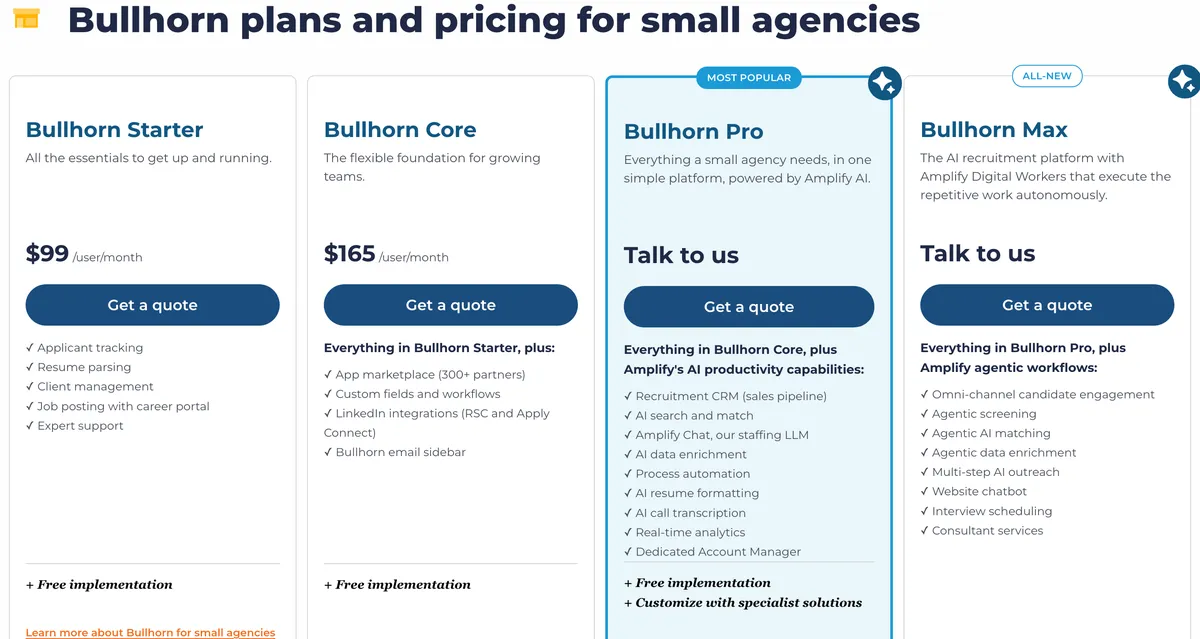
That is worth sitting with. If you are already paying for an ATS, you have already bought a job board. Paying a web design agency to build a second one is paying twice for the same object, and the second one will be worse, because it will not be wired to the system where your jobs actually live.
The reason so many agencies run the board on a jobs. subdomain is that this is what the products ship. The vendor hosts the application, the agency points a subdomain at it, and the branding is applied on top. What you end up with is a second website that looks like the first one and is maintained by somebody else.
There is a real trade-off in that arrangement and it is not the one people usually name. The common worry is that the subdomain "gives away your SEO", which is mostly folklore. The genuine risk is simpler: the job board is the half that carries your legal obligations, and it is the half you do not control. When a pay-range law changes, you are waiting on a vendor's release schedule.
The recurring bill is bigger than the build
Every one of these vendors prices per recruiter per month, so the number that matters is not the sticker but the sticker times your headcount times twelve. Here is what a ten-recruiter desk pays a year at published list prices.
Bullhorn Core at ten seats is $19,800 a year, and it recurs every year the firm keeps recruiting. Crelate Business lands at $14,280 and Manatal's Enterprise Plus tier at $6,600. Even the cheapest credible option on the board, Manatal's Enterprise tier at $35 per user per month billed yearly, is $4,200 a year, every year.
A few caveats on those numbers, because per-seat pricing hides things. Crelate's $85 Essentials tier is capped at two users and 20,000 contacts, so it does not exist at ten seats and is not in the chart; its Business tier at $119 is the one that scales. Manatal's cheapest Professional tier caps you at 15 open jobs, which is not a staffing agency. Loxo publishes both of its tiers as a from-price, so $17,880 and $23,880 are floors rather than totals. And several of the biggest names in staffing software, Avionté and TempWorks among them, publish no price at all, which is its own answer.
The practical consequence: if you are choosing where to spend, the website is the cheap decision and the software is the expensive one. Getting the website wrong costs you a rebuild. Getting the software wrong costs you a year of a five-figure subscription and a migration.
The job board is the search asset, and Google has a spec for it
By page count a staffing website is mostly job pages. One agency in our sample served 38 individual job links from a single search page, against a marketing site of maybe a dozen pages. Google runs a dedicated job experience in its search results, and it is fed by JobPosting structured data on the page itself.
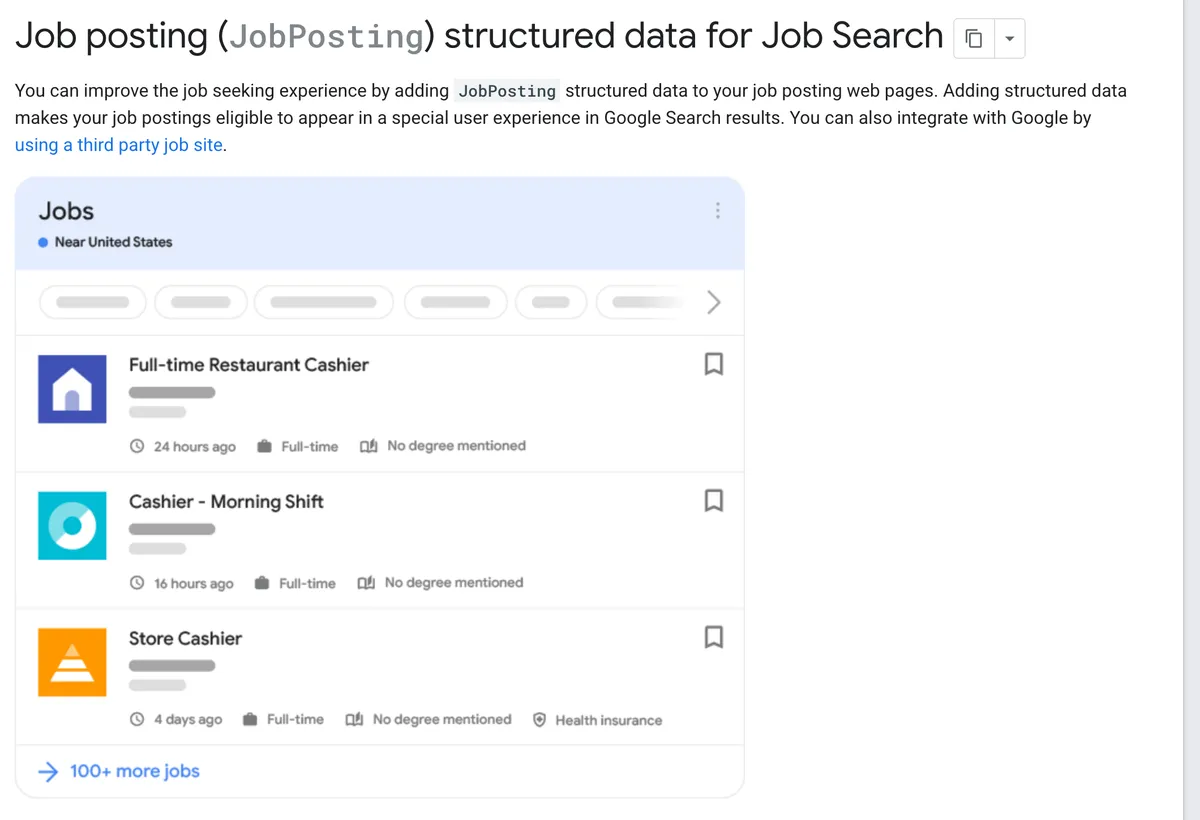
Google's requirements are short and checkable. A posting needs five properties to be eligible: datePosted, description, hiringOrganization, jobLocation and title. There is a baseSalary property, which Google describes as "the actual base salary for the job, as provided by the employer (not an estimate)". Google is specific about placement too: "Put structured data on the most detailed leaf page possible. Don't add structured data to pages intended to present a list of jobs." And closed roles have to be expired, either by setting a past validThrough date, returning a 404 or 410, or stripping the structured data out.
The expiry rule is the easy one to fall foul of on a temp desk, because the same requisition fills and reopens constantly. A board still advertising roles that closed in March is not a neutral problem. It is a signal, to the one search feature your candidates actually use, about how current your listings are.
We checked what the sample does. On 16 of the 46 sites the job search page exposed a repeating link pattern we could follow without typing a search, which is itself the minimum bar for a crawler. Eleven of those led to a genuine individual job page; four led to category listings, and one agency's link pointed at a different firm's site, so we dropped it as a duplicate.
Nine of those 11 carried JobPosting structured data, 8 showed a pay figure a human could read, and 7 carried the machine-readable baseSalary field. Eleven pages is a temperature reading, not a market share, and we would not build a strategy on it alone. But the split inside it is the finding we did not expect. All four of the pages served from a jobs. subdomain carried both the structured data and the salary field. Of the seven served from the main website, five had the structured data and only three had the salary field.
We are a web design agency and that result does not flatter us. It is still what we found. A generalist studio that has never built a job board has no reason to know that validThrough exists, and a vendor whose entire product is job boards has every reason to.
Pay ranges stopped being a policy and became a build requirement
A growing list of states now require a pay range inside the job advertisement itself. For a staffing agency that is not an HR memo, it is a field on a page, a database column, and a rule in whatever system publishes your jobs.
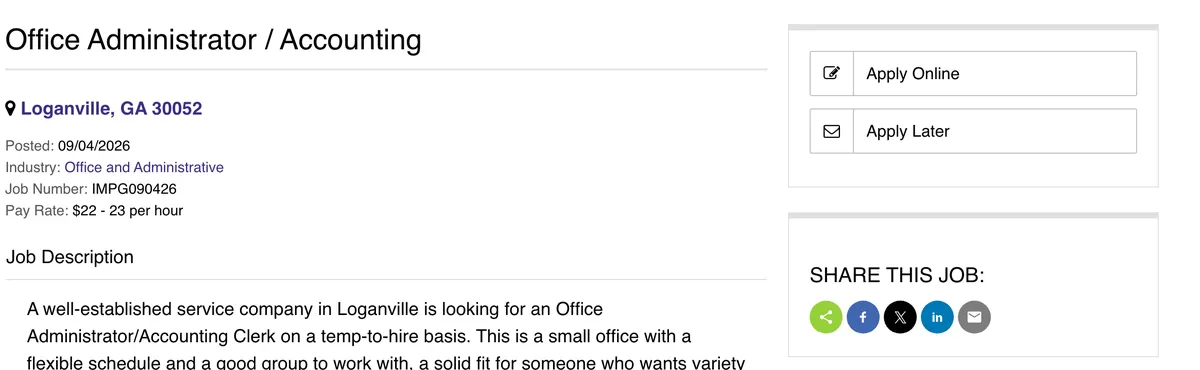
The details differ by state and the thresholds are low. New York State's Labor Law section 194-b covers businesses with four or more employees and requires a job description and a compensation range in the advertisement, plus a clear statement when a role is commission-based. Washington's Equal Pay and Opportunities Act covers employers with fifteen or more employees and asks for the salary range or wage scale plus a general description of all benefits and other compensation. Its 2025 amendment, SB 5408, sets statutory damages of no less than $100 and no more than $5,000 per violation, with administrative civil penalties of up to $1,000, and gives an employer five business days to correct a bad posting after written notice, a window that runs to 27 July 2027. Massachusetts joined most recently, on 29 October 2025, covering any employer with 25 or more employees in the state, and defining a pay range as the annual salary or hourly wage range the employer reasonably and in good faith expects to pay for the role. Its penalties escalate from a warning for a first violation to $500, then $1,000, then up to $25,000, and a grace period through 29 October 2026 lets an employer cure a violation within two business days of notice.
Illinois is the one that should make a staffing agency sit up. Its amendment to the Equal Pay Act took effect on 1 January 2025, applies at 15 employees, and requires the pay scale and a general description of benefits in the posting. It also reaches through to whoever does the posting. As the employment firm Ogletree Deakins reads it, an employer that uses a third party to post a job has to hand that third party the pay scale and benefits, the third party has to include the information or link to it, and the third party carries the liability for a posting that leaves it out unless it can show the employer never supplied it.
Read that as a staffing firm and it is a description of your business. You post other companies' jobs. The default position is that you carry the liability, and your defense is a record showing the client did not give you the numbers. That is a data-capture requirement in your ATS and a display requirement on your job pages, and neither is a thing you can bolt on after launch.
The page New York City makes employment agencies publish
New York City's Local Law 144 governs automated employment decision tools, and it names employment agencies alongside employers. It applies whenever such a tool substantially assists a hiring or promotion decision, which in practice includes a lot of resume screening and ranking features that ship inside modern recruiting software.
The requirement is unusually specific about the web. Under section 20-871, the tool must have been "the subject of a bias audit conducted no more than one year prior to the use of such tool", and "a summary of the results of the most recent bias audit of such tool as well as the distribution date of the tool to which such audit applies has been made publicly available on the website of the employer or employment agency prior to the use of such tool". Candidates also get at least 10 business days' notice before the tool is used, including the qualifications and characteristics it will assess.
So the law requires a specific, public, dated page on your site. Section 20-872 sets civil penalties of not more than $500 for a first violation and each additional violation on the same day, then not less than $500 and not more than $1,500 for each subsequent violation, and each day a tool is used without a compliant audit counts separately. Enforcement by the city's Department of Consumer and Worker Protection began on 5 July 2023.
Two practical notes. If you screen candidates for a New York City role, this reaches you whether or not you are based there. And if the screening feature belongs to your ATS vendor, the audit summary you publish is about their tool, which means you need it from them in writing and refreshed annually.
There is a commercial argument for doing this well rather than minimally. The American Staffing Association's Workforce Monitor reports that 49 percent of employed US job seekers believe AI tools used in recruiting are more biased than their human counterparts. Half your applicant pool starts from suspicion. A plainly written page explaining what you screen with is one of the few things on a staffing website that can actually move that.
Which half is your vendor quoting?
Take any two proposals and put them into this table before you compare the totals. In our experience most of the gap between a cheap quote and an expensive one disappears once you know which rows each vendor is covering.
| The marketing site | The job board | |
|---|---|---|
| Who it is for | Employers deciding whether to call you | Candidates searching and applying |
| Who usually supplies it | A web design agency or a staffing marketing firm | Your ATS vendor, or a staffing marketing firm |
| How it is priced | One-time build, then hosting and maintenance | Per recruiter, per month, indefinitely |
| Where it usually lives | yourfirm.com | A jobs subdomain, on the vendor's platform |
| What carries the legal duty | Little, beyond accessibility and truthful claims | Pay ranges, expired postings, the bias audit page |
| How many pages it has | Ten to twenty, and they change rarely | Dozens to hundreds, and they change daily |
| What breaks if it is wrong | You look smaller than you are | You disappear from Google's job results |
Why the published ranges are worth so little
Take the page that ranks for staffing agency startup costs. It puts the whole cost of opening a firm at $3,000 to $250,000, says most new owners spend $20,000 to $25,000, and credits two lenders for those figures. Its website number is not a website number at all: it bundles a professional website together with laptops and phones into a single $2,000 to $10,000 line, with nothing cited. This is the state of the art on the question, and it is less dishonest than beside the point. Nobody writing these pages sells websites, so the website is a line item in somebody else's budget.
The vendors do not help. Haley Marketing, which is on 11 of our 46 sites, publishes no price for a website or a job board. Avionté and TempWorks have no pricing page at all: both avionte.com/pricing and tempworks.com/pricing simply redirect to the homepage. Bullhorn is the exception, and its published tiers are the ones in the chart above. When a market hides prices, the ranges you read have been reverse-engineered from anecdotes, and the gap between the cheapest and the dearest honest answer is enormous.
Hunting for a better range is the wrong move. Write the specification down first, then ask three vendors to price the same list. We have argued this at length in our guide to choosing a web design agency, and the staffing version of that list is short: how many marketing pages, who writes them, whether the job board is included or assumed, who owns the domain and the DNS, and what happens to your job pages if you leave.
That last one deserves its own thought. If your job pages live on a vendor's platform under your subdomain and you switch vendors, every one of those URLs is at risk. There is a whole separate piece here on who owns your website, and the same questions apply, with the added wrinkle that the asset in question is a database.
Where our own numbers land
We build the marketing half, and we sell it as a monthly subscription: Foundation Partner at $1,000 a month, Growth Partner at $2,500 and Scale Partner at $5,000. There is no minimum and no contract, so you can pause or cancel at any point. The prices and what each plan includes are on our pricing page. Across the US and Europe the count is now past 200 shipped projects, and a partnership request gets an answer inside 48 hours.
The marketing half of a staffing website is a small, well-understood job when the content exists, and we would rather you read our price that way than as a bargain. It gets bigger when it involves twenty branch pages and eight specialty pages that nobody has written yet.
We work with operators of this shape often enough that we keep a page for service businesses covering contractors, carriers and payroll firms. The staffing pattern sits comfortably inside it: a short, trust-heavy marketing site, an operational system doing the real work behind it, and a buyer who is comparing three vendors on a Tuesday afternoon.
The jobs we would send elsewhere
If what you actually need is the job board, hire the people who build job boards. The evidence in this article points that way, and it points away from us. A staffing marketing firm or your ATS vendor will ship a compliant, indexable board faster and cheaper than any generalist studio, including ours, and it will keep pace with the pay-range rules without you filing a ticket.
If you are a single-desk recruiter with fewer than twenty live roles, a template on a mainstream builder plus your ATS portal is a perfectly good answer, and the money is better spent on the software. And if your firm's real problem is that clients do not call back, a new website will not fix that either. Sales problems are not design problems, and we would rather say so before an invoice than after one.
The view-source test, and it takes five minutes
Before you sign anything, run this on your own site, and then on the site of the vendor pitching you. It is the same check we ran on 46 agencies, and it needs nothing but a browser.
One. Open your job search page, then open one individual job from it. If you cannot get to a single job on a URL of its own, stop there. Google cannot either, and neither can a candidate who wants to send the link to a friend.
Two. On that job page, view the page source and search the raw text for the job's title. If the title is not in the source, the listing is being drawn in afterwards by JavaScript, which is a slower and less reliable path into any index.
Three. Search the same source for JobPosting. If it is missing, you are not eligible for Google's job experience, no matter how good the board looks. Then search for baseSalary, and for validThrough. The first tells you whether your pay ranges are machine-readable. The second tells you whether anybody has thought about closing a role.
Four. Look at the domain in the address bar. If it is not your own domain or a subdomain of it, ask your vendor what happens to those pages the day you leave, and get the answer in the contract.
Four checks, one page, no tools. If your current site fails them, you have learned something more useful than any price range on the internet: you now know which half of your website is the one to spend money on.
Frequently asked questions
Budget for two things, not one. The marketing site, meaning the pages that sell to employers, runs from roughly $1,500 for a focused ten to twenty page build up into the tens of thousands for a large multi-brand firm with branch pages and a case-study library. The job board is separate and is normally part of your applicant tracking subscription, priced per recruiter per month. Bullhorn publishes $99 and $165 per user per month, which is $11,880 and $19,800 a year at ten seats. A quote that does not say which of the two it covers cannot be compared with anything.
Usually not, and you should ask directly rather than assume. The career portal is typically a feature of the recruiting software: Bullhorn lists job posting with a career portal inside its cheapest published tier. Of the 46 staffing agency sites we measured on 7 September 2026, 20 ran the job board on a separate jobs subdomain, and 22 loaded a vendor platform on the job search page. If a web design quote does include a job board, ask how it connects to your ATS, because a board that does not sync with the system holding your jobs creates double entry for your recruiters.
Either works, and the subdomain is the industry norm rather than a mistake. In our sample, 20 of 46 agencies ran a live board at jobs plus their own domain, and all four of the individual job pages we opened on such a subdomain carried both JobPosting structured data and a machine-readable salary field, which is better than the hand-built alternatives managed. The real question is not the subdomain, it is control. Ask what happens to those job URLs the day you change vendors, and get the answer written into the contract.
Yes, if you want to appear in Google's job search experience, which is where most candidate traffic now starts. Google requires five properties on each posting: datePosted, description, hiringOrganization, jobLocation and title. Google also says to put the markup on the individual job page rather than on a list of jobs, and to expire closed roles by setting a past validThrough date, returning a 404 or 410, or removing the structured data. Of the 16 job pages we could open directly, 10 carried the markup.
In a growing number of states, yes, and the thresholds are low enough to catch small firms. New York State requires a compensation range and a job description from four employees up. Washington requires a salary range or wage scale plus a general description of all benefits and other compensation at 15 employees, with statutory damages of $100 to $5,000 per violation under its 2025 amendment and a five business day window to fix a bad posting. Illinois applies at 15 employees from 1 January 2025, and Massachusetts at 25 employees in the state from 29 October 2025. Because you post for clients, this is a field in your system as much as a policy.
In Illinois, yes, by default. The state's Equal Pay Act amendment makes the third party that publishes a job posting liable for a missing pay scale and benefits description, unless that third party can show the employer did not provide the information. Reading the amendment, the employment firm Ogletree Deakins describes the employer as having to hand the pay scale and benefits to the third party, which must then include the information or link to it. For a staffing firm that posts other companies' roles, the practical effect is that you need to capture the numbers from the client and keep the record that you asked.
It names employment agencies explicitly, so yes. New York City's Local Law 144 requires that any automated employment decision tool has had a bias audit within the previous year, and that a summary of the results, together with the distribution date of the audited tool, is publicly available on the website of the employer or employment agency before the tool is used. Candidates get at least 10 business days notice. Penalties run to $500 for a first violation and $500 to $1,500 for each subsequent one, with each day counting separately. If the screening feature belongs to your ATS vendor, you need their audit summary in writing every year.
Fourteen business days is typical for a focused marketing site once the content exists, and that last clause is where projects actually slip. A staffing site with eight specialty pages and six branch pages needs fourteen pieces of writing that a hiring manager in each specialty finds credible, and writing them is slower than building them. The job board half is a different timeline entirely, because it depends on your ATS vendor's provisioning rather than on any designer.
 Development
Sep 2, 2026 · 17 min
How Much Should a Mortgage Broker Website Cost in 2026?
Published plans run from $619 to $12,963 in the first year, and the design is not what separates them. On a lending site the rules decide the copy, the layout and how long you keep every version.
 Development
Aug 31, 2026 · 17 min
How Much Should a Church Website Cost in 2026?
The website is the cheap part. Tithely publishes one at $19 a month and Planning Center gives one away. The expensive part is the 2.15% to 3.00% coming off every gift the site collects, which is worth $2,465 a year on a $250,000 offering.
 Development
Aug 27, 2026 · 16 min
How Much Should a Restaurant Website Cost in 2026?
Almost nobody sells restaurants a website any more. They sell a channel with a percentage in it, and one of the biggest platforms charges your guest 5% on the plan advertised as fee free. We read eight vendors' own pricing pages and did the arithmetic.