
How Much Should a Church Website Cost in 2026?

Aug 31, 2026 · 17 min read
Tithely will sell your church a website for $19 a month. That is the whole price, printed on its own pricing page, and twelve months of it comes to $228. Planning Center will not charge you for a website at all. The question in the title turns out to have a much smaller answer than the guides suggest: for a great many congregations, the website is close to free.
The money is somewhere else. It is in the percentage that comes off every gift the site collects, and that percentage runs from 2.15% to 3.00% depending on which company you sign with. On a church receiving $250,000 a year online, the gap between the cheapest and the most expensive published route is $2,465 a year, which is more than ten years of that $19 website. This article is built from the prices and rates these companies print on their own pages, read on 31 August 2026, plus the arithmetic those numbers force. We build websites for churches and nonprofits ourselves, so our own figures are in here alongside everyone else's.
The 30-second answer
A church website costs between nothing and about $190 a month, and the number is smaller than almost every guide claims. Planning Center includes an app and website at no charge. Tithely charges $19 a month, SolaSites $50 plus $500 once, Church Web Works from $58, Ekklesia 360 from $70, ChurchSpring from $71, REACHRIGHT $97, and Nucleus $99. A fully custom build is quoted per project and REACHRIGHT publishes a $2,500 deposit as the entry point. But the subscription is the small number. The giving platform attached to that site takes 2.15% to 3.00% of every card gift plus 30 to 45 cents per transaction, and on $250,000 of online giving that is between $3,763 and $6,228 a year. Choose the rate before you choose the template.
The guides answer in a range, their own pricing pages do not
Every guide currently ranking for this question answers with a range so wide it cannot be wrong, and three of them print an exact price elsewhere on their own sites. On 31 August 2026 we opened five of the pages returned for this query. One of the five, Kingdom Web Services, returned nothing our reader could parse. The other four all lead with a span.
SolaSites, in a post dated 14 April 2026, opens with "$0 to $40,000+" and then calls that range unhelpfully broad itself. REACHRIGHT says "$0 to $20,000+". ChurchCreation also says $0 to $20,000, then usefully splits it into three routes at $0 to $300 a year, $500 to $1,800 a year, and $3,000 to $20,000 up front. It is also the only one of the four to put a number on the giving fee, quoting roughly 2.9% plus 30 cents per card gift and about $3,000 a year on $100,000 of online giving, though it uses one generic rate rather than any vendor's published one. Ekklesia 360's guide takes a different shape and walks through four imagined churches instead.
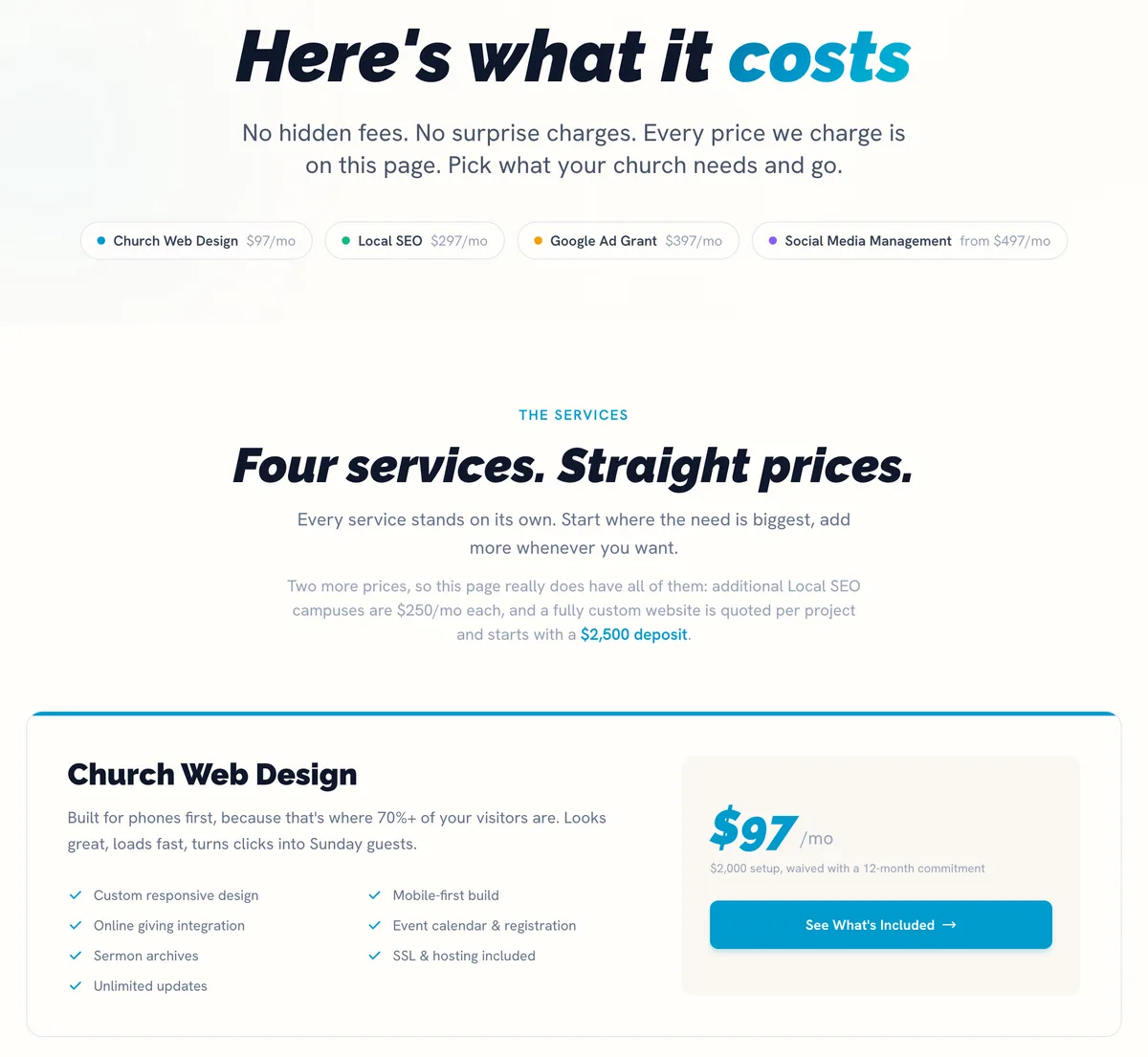
Now open the pricing page on two of those same domains. SolaSites charges $500 once and $50 a month. REACHRIGHT charges $97 a month for church web design, with a $2,000 setup fee waived if you commit to twelve months, and quotes fully custom work from a $2,500 deposit. Ekklesia 360, whose guide is on a marketing subdomain, publishes $70, $95 and $190 a month on its main site. Three companies that answered "somewhere between nothing and twenty or forty thousand dollars" were all printing their real numbers two clicks away.
Nobody is hiding anything here. Those pricing pages are public and one click from the guides. What the pattern actually shows is smaller and more useful than a gotcha: a span running from zero to forty thousand dollars is the question asked again in a longer form, and the company writing it already knew its own answer.
Ten published prices for the same thing
Ten companies print a monthly price for a church website. The whole published range fits between zero and $190, which is a narrower band than any of the guides in the previous section prepares you for.
Read it top to bottom and the shape of the market appears. Planning Center gives away the app and website that its members actually use, called Church Center, and sells a content upgrade for $15 or $32 a month if you want custom pages, themes, sermon notes or media channels. Tithely lists a custom church website at $19 a month standalone, or folds it into an All Access bundle at $119 a month with church management, a mobile app, worship planning and text giving. Servant Keeper never prices a website at all: its core tier is $79.99 a month and its complete tier is $159.99, and a website, an app, a content library and live streaming are the things that appear when you cross between them, so the published marginal price of its website is $80 a month.
At the top, Ekklesia 360 runs $70, $95 and $190 a month with a fourth tier quoted on a call, plus $500 once for onboarding, training and setup on a stock theme. Its feature grid is worth reading closely for a reason we will come back to: online giving and church management software are both marked as an additional cost on every single tier, including the $190 one.
Two of these prices carry conditions that change what they mean. SolaSites is $50 a month but $500 to start, so a congregation that stays two years pays $1,700 rather than $1,200. REACHRIGHT is $97 a month with a $2,000 setup fee that disappears if you sign for twelve months, and twelve months of $97 comes to $1,164. The fee being forgiven is larger than the entire year of subscription it is forgiven for, which tells you the $2,000 was never a measurement of the work.
Why the subscription is the small number
The subscription is not the product these companies are selling, and you can tell because most of them will hand you the website for nothing. Planning Center charges zero for Church Center. Tithely's giving tools are $0 a month with no contract. Subsplash Giving is $0 a month. Vanco has a plan called Grow at $0 a month. Givelify has no monthly fee.
Nobody gives away software for the love of it. What all five of those companies are selling is the payment rail underneath the giving button, and they are paid a percentage of everything that crosses it. That percentage is the real price of a church website, because the website exists in order to collect the offering, and the offering is the only large number in the whole arrangement.
This is worth stating plainly because it inverts the usual advice. In most industries the recurring software fee is the thing to negotiate. Here the recurring fee is often zero and the negotiable number is a rate you may never have looked at, applied to a total you already know down to the dollar.
Every rate a church can be charged for a card gift
Ten published card rates sit between 2.15% and 3.00%, and the gift being processed is identical in every case.
The cheapest published rate belongs to Planning Center Giving, at 2.15% plus 30 cents for credit and debit, and its page says every church pays the same rate with no volume tiers, no contracts, no setup fees and no cancellation charges. The most expensive belongs to easyTithe's entry plan at a flat 3.00%. Between them sit Subsplash, Vanco, Tithely and Givelify, all clustered around 2.9%.
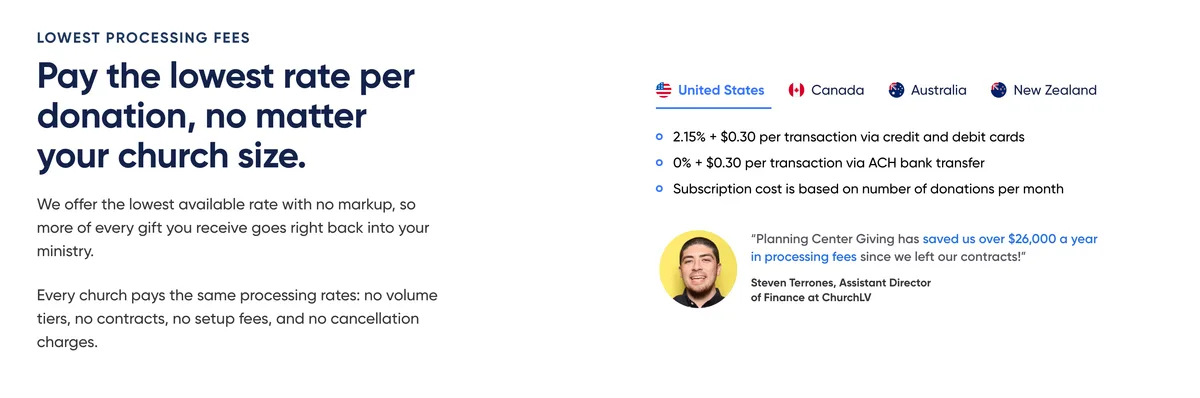
Eighty-five basis points does not sound like an argument. Applied to an offering it is one. A congregation receiving $175,000 a year in card gifts pays $3,763 at 2.15% and $5,250 at 3.00%, a difference of $1,488 for a service that is, at the point of the transaction, indistinguishable.
Two vendors will sell you a lower percentage
Two companies publish something unusual and genuinely useful: a ladder where paying more each month buys a smaller cut of every gift. It is the clearest evidence available that the monthly fee and the rate are two prices for one product.
easyTithe prints three plans. Giving Small Church is $19 a month at 3.00% plus 42 cents per card transaction. Giving Small to Mid-Size Church is $49 a month at 2.6% plus 42 cents. easyTithe Pro, which adds church management and a mobile app, is $75 a month at 2.75% plus 42 cents and is capped at 500 records. Bank transfer is 1.00% plus 42 cents on all three. Note the third rung: the most expensive plan does not carry the best card rate, because you are buying software with it rather than a discount.
Vanco does the same thing with two plans. Grow is $0 a month at 2.90% plus 45 cents for cards and 1.00% plus 45 cents for bank transfer. Thrive is $54 a month at 2.65% plus 39 cents for cards and 0.90% plus 39 cents for bank transfer. The $0 plan carries a footnote worth reading: a $10 monthly fee applies if an organization does not complete its first meeting with a Vanco giving specialist within 15 days and get its giving page live within 30. American Express is 3.99% on both plans, a chargeback costs $25, and a returned bank transfer costs $5. Add-ons are priced separately again: text-to-give $10 a month, giving insights $75 a month, email outreach $19.95 a month.
easyTithe attaches a floor to all of its plans as well. If your processing fees come to less than $10 in a month, you pay $10 anyway, which its page explains is roughly $300 of transactions. At 3% that floor is reached at about $333 of card gifts, so a small congregation on the $19 plan is really on a $29 plan until it crosses it.
Where each ladder actually pays off
Both ladders have an exact crossing point, and both are computable from the vendor's own numbers in about a minute.
On easyTithe the sums are unusually clean, because the 42 cents is identical on both plans and cancels out. The $49 plan costs $30 a month more and saves 0.40% on card gifts. Divide $30 by 0.004 and the answer is $7,500. Below $7,500 a month in card giving the $19 plan is genuinely cheaper. Above it the $19 plan is the more expensive of the two, and the further above it you go the worse the gap gets. In annual terms that is $90,000 of card giving.
Vanco is a little messier because the per-transaction charge moves too. Thrive costs $648 a year and saves 0.25% on cards, 0.10% on bank transfers and 6 cents on every transaction of either kind. Taking the 70% card and 30% bank transfer split that Tithely uses in its own calculator footnote, the percentage savings alone come to 0.205% of everything, so $54 a month is repaid at about $26,300 a month of online giving. Add the 6 cents at an average gift of $150 and the threshold falls to roughly $22,000 a month. Either way, Vanco's paid plan is a large-church product wearing a small-church price.
A discount priced on exclusivity
Subsplash publishes two card rates for the same giving product, and the difference between them is not volume, it is loyalty. The standard rate is 2.99% plus 30 cents. The rate labeled exclusive is 2.3% plus 30 cents, and the banner across the top of the page ties it to going exclusive with Subsplash. Bank transfer is 1% with no per-transaction charge on both, and a program it calls GrowCurve is described as dropping card as low as 1.9% as a church grows.
Sixty-nine basis points is the published price of not going exclusive. On $175,000 of annual card giving that is $1,208 a year, which is what it costs a church to keep a second option open. That is a legitimate thing for a vendor to charge for and a legitimate thing for a church to buy. It is not a legitimate thing to sign without noticing, because the cost of leaving is being collected in advance, in installments, out of the offering.
The rate that is a feature bullet with no number
Servant Keeper sells the same idea and does not tell you the price. Its comparison grid lists integrated giving on both tiers, and against the $79.99 core plan the entry reads Standard Processing Rate while against the $159.99 complete plan it reads Preferred Processing Rate. Neither rate appears anywhere on the page. A church reading that grid can see that $80 a month buys a better rate. It cannot see how much better, which means it cannot work out whether the upgrade pays for itself, which is the only question the grid was built to help with.
Pushpay, one of the largest names in church giving, publishes no price of any kind on its pricing page and asks you to book a demo for answers and pricing options. Subsplash publishes rates but quotes its Subsplash One and Enterprise packages on church size and usage. That is three well-known vendors, on three pricing pages, where the number that decides the decision is absent.
Bank transfer is the line nobody markets
The single largest saving available to a church in this article is not a discount, it is a payment method. Card rates cluster between 2.15% and 3.00%. Bank transfer, the same gift moved by ACH instead of a card, is priced at 0% plus 30 cents at Planning Center, 0.90% plus 39 cents on Vanco's paid plan, and 1% at Tithely, Subsplash, easyTithe and Vanco's free one.
Put a number on that. A church receiving $75,000 a year by bank transfer pays $750 at 1% and nothing at all at 0%, before the flat per-gift charge. Move another $50,000 of card giving over to bank transfer at Planning Center's rates and the saving is $1,075 a year. There is no plan to upgrade to and no contract to sign. Somebody has to put the option in front of givers and explain it, which is a design job on the giving page and a communication job from the front.
Tithely publishes the effect of the same idea in a different form. Its rate page works an example all the way through: a $100 gift by card deposits $96.80, by American Express $96.20, and by bank transfer $98.70. Nearly two dollars in every hundred, decided by which button somebody taps.
One offering, eight routes, one year
Here is what a single year costs a single church, priced eight ways, using nothing but published numbers.
The assumption on the split is not ours. Tithely's own savings calculator footnote describes a typical church as sending 30% of online donations by bank transfer and 70% by card, so that is the mix we used. The subscription column is the plan price times twelve. The processing column is each vendor's published percentage applied to that mix. Nobody's flat per-transaction charge is in there, because it depends on how many separate gifts the $250,000 arrives in, and that is a fact about your congregation rather than about the vendor.
Three things fall out of the chart. The first is the spread: $3,763 at the bottom and $6,228 at the top, a difference of $2,465 a year on identical giving. The second is that the subscription is barely visible. The largest black segment in the chart is Vanco's $648, and it is dwarfed by every processing bar next to it. The third is that Vanco's paid plan, at this volume, costs more in total than Vanco's free plan, which is exactly what the break-even said would happen below $26,300 a month.
None of these are identical products and the chart would be dishonest if it implied they were. Planning Center's row buys the app, the website and a giving platform with no subscription at all, which is remarkable value and also means you are living inside one company's ecosystem. Tithely's row includes a website, and both easyTithe rows include a giving platform with no website attached. What the chart does show is that whatever else you are choosing between, you are choosing a rate, and the rate outweighs everything else on the invoice.
The fee can be moved onto the giver
The large platforms all now offer to ask the giver to cover the processing fee, and enough givers say yes that it changes the arithmetic materially. Tithely calls the feature Cover the Fees and states that churches typically see around 60% of donors cover their giving fees, and that the feature saved churches over $5 million in the last year. Subsplash's calculator uses a more conservative 30% as its average and defaults to $40,000 a month of donations, with a slider running from $5,000 to $150,000.
If 60% of givers cover the fee, a 2.9% headline rate behaves like roughly 1.16% for the church, which would move our $250,000 congregation from $6,053 to about $2,558. That is a large enough effect that it belongs in the decision, and it is also the reason to be careful with vendor savings calculators: a platform quoting you an effective rate has usually applied an adoption assumption you did not make.
There is a judgment underneath the arithmetic that is not ours to make. Adding a checkbox that asks a person to pay $2.90 on top of a $100 gift is a pastoral decision before it is a financial one, and some congregations will decide the friction is not worth it. What we would say is that the choice should be made deliberately rather than inherited from a default, and that whichever way it goes, the giving page should say plainly what the fee is and who is paying it.
What the IRS requires your giving page to send
Two federal rules turn your donation receipt from a nicety into a document with required contents, and both of them are build specifications rather than legal theory. They apply to the automated email your giving platform sends, which means somebody has to check that it actually says the right things.
The first covers any single gift of $250 or more. The IRS states that the written acknowledgment substantiating it must carry the name of the organization, the amount of the cash contribution, a description but not a value of any non-cash contribution, a statement that no goods or services were provided if that is the case, a description and good faith estimate of the value of any that were, and a statement that any goods or services consisted entirely of intangible religious benefits if that was the case. That last clause is written for churches specifically. On the timing, the IRS says the acknowledgment is contemporaneous if the donor obtains it no later than the date they file their return for the year of the gift, and it notes that the acknowledgment and the bank-record communication can be the same document.
The second covers what the IRS calls a quid pro quo contribution, meaning a payment made partly as a gift and partly for goods or services. Above $75 the organization must provide a written disclosure statement, and the threshold is on the whole payment rather than the deductible part. The example the IRS gives is a $100 payment that returns a $40 concert ticket: the deductible portion is $60, which is under $75, and the disclosure is still required because the payment was over it.
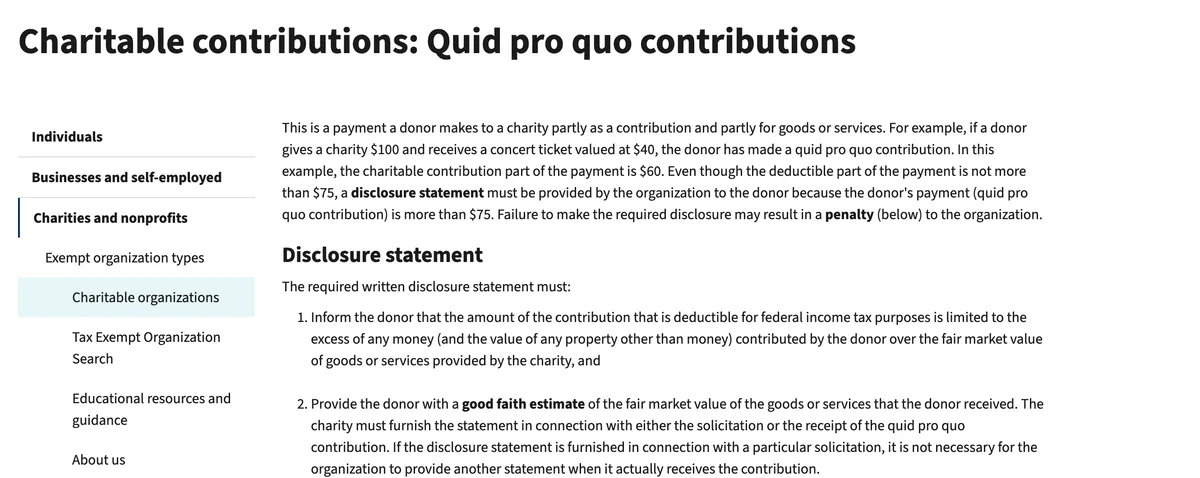
The disclosure must tell the donor that the deductible amount is limited to the excess of what they paid over the fair market value of what they received, and give a good faith estimate of that value. It can be sent with the solicitation or with the receipt. There are exceptions, and one of them matters here: no disclosure is required where the only thing provided is an intangible religious benefit, which the IRS defines as something generally not sold commercially outside the donative context. Admission to a religious ceremony that has no admission charge is the example given. Tuition, travel services and consumer goods are explicitly not intangible religious benefits.
The penalty is small but real, and it scales with the mailing rather than the gift. The IRS imposes $10 per contribution for failing to make a required quid pro quo disclosure, capped at $5,000 per fundraising event or mailing, with an out for reasonable cause. A church running a banquet, a concert or an auction through its website is squarely inside this, and the fix is a receipt template that can carry a fair market value line rather than a blanket thank-you.
What that gap buys in staff time
A $2,465 annual difference is abstract until you set it against a wage. The Bureau of Labor Statistics county employment series for the fourth quarter of 2025 covers 26,371 religious organizations that report to the unemployment insurance system, employing 206,753 people, at an average weekly wage of $797. That is about $41,444 a year for a full-time role.
Measured that way, the $2,465 spread between the cheapest and most expensive published route is a little over three weeks of one staff wage. Ekklesia 360's $190 a month, the top of the website range in this article, comes to $2,280 a year, or just under three weeks of the same wage. Both are real money to a congregation that counts it. Only one of the two is the number every guide points at.
It is also worth saying what these figures are not. That series counts organizations that file unemployment insurance reports, so it is a floor on the sector rather than a census of American congregations. We are using it for the wage, which is the part it measures well.
Where church giving actually sits
Religion is the largest single destination for American charitable giving and it is not growing. Giving USA 2026, published by the Lilly Family School of Philanthropy at Indiana University, puts total US charitable giving at $617.20 billion in 2025, up 5.7% in current dollars and 3.0% after inflation. Religion took $151.58 billion of that, just under a quarter of everything given, and more than any other category.
The growth line is the part that matters for this decision. Giving to religion rose 2.4% in current dollars and fell 0.2% once inflation is taken out, while giving to education, human services, health, arts and the environment all reached new inflation-adjusted highs. In a flat sector, a percentage point of processing is not a rounding error. It is one of the few levers a church can pull that does not require anybody to give more.
What we charge, and when a platform beats us
Having spent an article inside other people's rate sheets, here are our numbers. We work as a monthly partnership and we print the prices: $1,000, $2,500 or $5,000 a month, billed monthly in advance, no minimum, pause or cancel anytime. The files, pages and brand assets are yours to keep, so a church that leaves keeps what was built. Fourteen business days from the day content and assets land to launch is the pattern we see on a focused build across 200 plus shipped projects, offered as a typical rather than a guarantee, and anyone asking about partnership hears back within 48 hours. Scope gets agreed on a call, and the pricing page sets out what sits inside each tier.
The giving platform sits outside that price, deliberately, and the reason is worth stating precisely. None of the companies named in this article pays us anything, and we neither sell nor resell a giving product. Online giving wired into a church management database is bought from Planning Center, Tithely, Subsplash, Vanco or easyTithe at the rates printed above, on an invoice with our name nowhere on it. Keeping those two purchases apart is what lets our number stay flat, because a builder who is paid a share of the offering has an interest in which button a giver taps.
Plenty of churches should not hire us, and it is cheaper for everyone if we say which. A congregation whose entire annual technology budget is a few hundred dollars should take Planning Center's free app and website, or Tithely at $19 a month, and spend nothing with us. A church that wants the website, the app, the database, the check-in kiosk and the giving on one invoice from one company should buy a platform, because that integration is genuinely valuable and we do not build church management software. A church in the middle of a capital campaign should fix the giving rate first and come back to the website afterwards. Where we earn our place is a congregation that has outgrown a template, needs the site to do a specific job well, and wants to own what gets built.
Reprice last month
Every worksheet in this genre asks you to forecast. This one asks you to look backwards, because you already have the only data that settles the question and it is more reliable than any projection.
Pull last month's giving report out of whatever you currently use. You need five numbers from it.
| Line | What to pull from last month | Yours |
|---|---|---|
| 1 | Total received online | |
| 2 | Of that, the amount given by card | |
| 3 | Of that, the amount given by bank transfer | |
| 4 | The number of separate gifts | |
| 5 | Total processing fees actually deducted |
Now price that same month at every vendor you are considering, using the published rates in this article. Card amount times the card rate, plus bank transfer amount times the bank transfer rate, plus the gift count times the per-transaction charge, plus one month of the subscription. You will get a real number for a real month rather than an estimate for a hypothetical one.
Four rules keep the exercise honest. Use the rate you would actually get, not the exclusive or preferred one, unless the condition attached to it is written down and you intend to meet it. Put the flat per-gift charge in, because a congregation making many small gifts is affected by 30 cents far more than by 15 basis points. Do not credit yourself with fees covered by givers unless you already have that feature switched on and know your real adoption rate. And run line 5 against your own calculation on your current vendor first: if the two do not match, the rate you think you are paying is not the rate you are paying, and that is the finding.
If you only change one thing this month
Make bank transfer easy and obvious on the giving page. It is the only change on this list that costs nothing, requires no new contract, and can be worth four figures a year on its own. At Planning Center it is 0% plus 30 cents. Almost everywhere else it is 1%, against roughly 2.9% for a card. If your own giving form asks for a card number before it offers a bank option, that default is quietly routing your largest recurring gifts down the most expensive road.
After that, in order: work out your real effective rate using the exercise above; get any preferred or exclusive rate written into the agreement with its conditions stated; check that your receipt email can carry a fair market value line before the next fundraising event; and only then argue about the template. If you are also weighing who should hold the domain and the accounts when all this is set up, we wrote about that in who owns your website, and the mechanics of the donation page itself are covered in our piece on nonprofit donation pages.
The website is not the expensive part. It has not been the expensive part for years. The expensive part is the percentage attached to it, and unlike the template, it is a number you can change this week.
Frequently asked questions
Between nothing and about $190 a month at the companies that publish a price. Planning Center includes a church app and website at no charge, Tithely lists one at $19 a month, SolaSites is $50 a month plus $500 once, Church Web Works starts at $58, Ekklesia 360 at $70, ChurchSpring at $71, REACHRIGHT at $97 with a $2,000 setup fee waived on a twelve month commitment, and Nucleus at $99. Custom work is quoted per project, with REACHRIGHT naming a $2,500 deposit as its entry point. All figures read on 31 August 2026.
No, it is paid for out of your offering rather than out of your budget. Platforms advertising $0 a month, including Tithely, Subsplash, Givelify and Vanco's Grow plan, all charge a percentage of every gift, typically around 2.9% plus 30 to 45 cents on a card. On $250,000 of annual online giving that comes to thousands of dollars a year, which is far more than any of the paid website subscriptions in this article.
The lowest published card rate we found is 2.15% plus 30 cents, at Planning Center Giving, which also states that it charges 0% plus 30 cents for bank transfers. Published card rates in this market run up to 3.00%. Anything at or below about 2.3% is competitive on published terms, and any rate you cannot find printed on a page should be treated as unknown rather than assumed to be good.
It is a real option and it materially changes the arithmetic, but it is a pastoral decision as much as a financial one. Tithely says churches typically see around 60% of donors cover their fees, while Subsplash uses 30% as its average. At 60% adoption a 2.9% headline rate behaves like about 1.16% for the church. Whichever way you decide, say plainly on the giving page what the fee is and who is paying it, and do not credit yourself with savings before the feature is switched on.
For any single gift of $250 or more, yes. The IRS sets out what that written acknowledgment must contain: your name, the amount, a statement about whether goods or services were provided, and, for churches, a statement where those consisted entirely of intangible religious benefits. Separately, any payment over $75 that returns goods or services needs a written disclosure statement with a good faith estimate of their value, and failing to provide one carries a penalty of $10 per contribution up to $5,000 per event or mailing.
Sometimes, but check what the bundle excludes before you assume it. Tithely's All Access plan puts giving, church management, a website, an app and worship planning together at $119 a month against $228 if bought separately. Ekklesia 360 goes the other way and marks online giving and church management as an additional cost on every tier including its $190 one. The bundle price is easy to compare. The rate underneath it is the number that decides the total.
Because most of them answer with a range instead of a price. The guides ranking for this question on 31 August 2026 lead with $0 to $40,000, $0 to $20,000 and $0 to $20,000, spans wide enough to contain any answer. At least three of those companies publish their own exact prices elsewhere on the same domain, so the information exists. A range that starts at zero tells you the writer chose not to commit rather than that the market is genuinely unknowable.
The giving platform, by an order of magnitude, if you are measuring in dollars. Priced across a $250,000 offering, the published routes in this article differ by $2,465 a year, while the entire spread of published website subscriptions is $0 to $2,280 a year. The website still decides whether a visitor becomes a giver at all, so it is not unimportant. It is simply not where the recurring money goes.
 Development
Sep 7, 2026 · 17 min
Staffing Agency Website Cost in 2026: What 46 Agency Sites Actually Run
We measured 46 staffing agency websites and found that a staffing firm is buying two websites, not one. Here is what each half costs, who supplies it, and which one carries your legal obligations.
 Development
Sep 2, 2026 · 17 min
How Much Should a Mortgage Broker Website Cost in 2026?
Published plans run from $619 to $12,963 in the first year, and the design is not what separates them. On a lending site the rules decide the copy, the layout and how long you keep every version.
 Development
Aug 27, 2026 · 16 min
How Much Should a Restaurant Website Cost in 2026?
Almost nobody sells restaurants a website any more. They sell a channel with a percentage in it, and one of the biggest platforms charges your guest 5% on the plan advertised as fee free. We read eight vendors' own pricing pages and did the arithmetic.