
How Much Should a Restaurant Website Cost in 2026?

Aug 27, 2026 · 16 min read
Owner.com sells restaurants a website, an ordering page and a branded app, and it prints two prices on one page: $249 a month plus a 5% restaurant fee per order, or $499 a month with no additional restaurant fees. Underneath, in an answer you have to open, is the number that changes how you read both of them. On both plans, the guest pays a 5% order support fee. So the plan advertised as having no restaurant fees still takes five cents in the dollar out of the transaction. It just takes it from the person eating the food.
That is the shape of this whole market, and it is why the cost guides on page one cannot answer the question they are titled after. They price a project. The companies actually selling restaurant websites price a channel, and almost all of them put a percentage somewhere in the deal. Every figure below came off a seller's own pricing page or a regulator's own text, read on 27 August 2026, and the arithmetic is shown so you can redo it with your numbers. We sell websites too, so read this as a price list published by one of the firms you might be comparing.
The 30-second answer
A restaurant website is rarely sold as a website in 2026, so a flat range cannot price it. The specialist platforms bundle the site into a subscription with a percentage attached: Owner.com is $249 a month plus 5% per order or $499 a month flat, with a 5% guest fee on both, and Flipdish starts at $119 a month billed annually. The point of sale companies give you the site and charge on the card: Square is $0, $49 or $149 a month at 3.3% or 2.9% plus thirty cents online, and SpotOn is $0 or $55 a station with card rates of 2.79% or 2.45%. Toast publishes a $69 point of sale price and no website price at all. We publish a monthly partnership at $1,000, $2,500 or $5,000 a month with no percentage attached. The right question is not what a restaurant website costs. It is what your order volume makes it cost.
Why the published ranges disagree with each other
They disagree because a range is the wrong shape of answer, and reading the pages that rank shows how wide the disagreement is. On 27 August 2026 we opened four of the guides returned for this question, and one of the four refused to serve us a page. Of the three we could read, one gives $500 to $50,000, one gives $0 to $50,000, and the third leads with $2,500 to $9,000 before splitting into tiers of $1,500 to $4,000, $4,000 to $8,000 and $8,000 to $25,000. Two ranges that run from almost nothing to fifty thousand dollars are not answers. They are the question, restated.
Credit where it is due: two of those three do account for a per-order fee, and one works through what a 5% charge costs a restaurant selling $30,000 a month. What none of the three mentions, anywhere, is a fee charged to the guest. That is the number this article was written around, and it is missing from every page currently ranking for the query.
There is a deeper reason none of them can hold. Every one of these ranges treats the price as a fact about the site you are buying. In this market it is far more often a fact about how much you sell. Square's free ordering tier costs a restaurant selling $5,000 a month online $225, and a restaurant selling $25,000 a month $1,125, on orders averaging $25 in both kitchens and identical software in both. No range expresses that, so every range hides it.
The four ways this market actually prices a website
There are four, and once you can name them the quotes stop looking random. The first is a flat subscription with no percentage, which is rare and is what most people think they are buying. The second is a subscription plus a per-order fee charged to the restaurant. The third is a percentage charged to the guest at checkout, which never appears on your invoice at all. The fourth is a card processing rate, where the software is given away and the margin is recovered on every payment, including the ones taken at the table.
Most contracts mix them. Owner.com's cheaper plan runs models two and three at once. Square runs model four with a subscription bolted on. SpotOn runs model four and adds a bundle priced in basis points on top: its Core Bundle is $50 a month plus 20 basis points of gross payment volume, capped at $200, and the product inside it that handles first-party ordering is described on the same page as commission free. Both statements are true. The commission moved rather than disappeared.
The fee your guest pays, on both plans
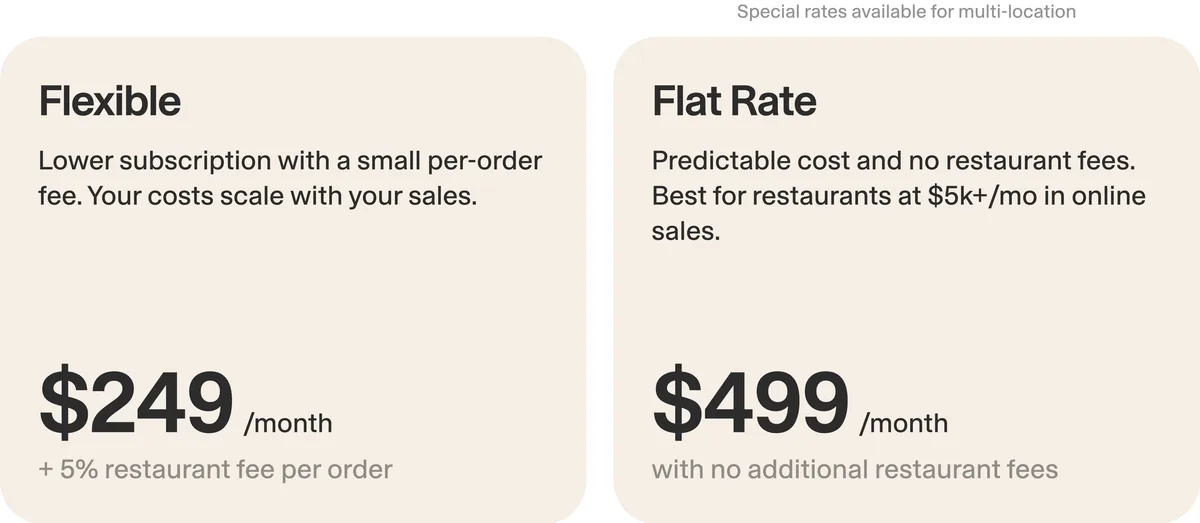
Owner.com's plan cards make a promise that its own frequently asked questions then qualify. The cards read: Flexible, $249 a month plus a 5% restaurant fee per order, and Flat Rate, $499 a month with no additional restaurant fees, described as best for restaurants at $5,000 or more a month in online sales.
Open the question headed what commissions do I pay as a restaurant, and the second half of the deal appears. On the Flat plan there is no additional restaurant fee. On the Flex plan there is a 5% restaurant fee. And on both plans, in the company's own words, guests pay a 5% order support fee that covers fulfillment and customer service.
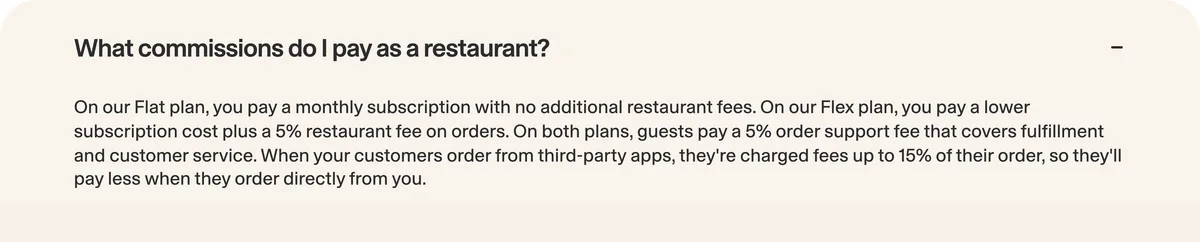
Nothing here is hidden and nothing here is unusual. Owner.com states the fee, and its point that a guest still pays less ordering direct than through a marketplace charging up to 15% is fair. What matters is that the fee exists on the plan sold as fee free, which means the two plans differ by less than the cards suggest, and that on the cheaper plan a single order carries two separate five percent charges pointed at two different people.
It matters commercially as well. If the reason you are moving orders onto your own website is that the guest experience should be better and cheaper there, then the number the guest sees at checkout is part of the product you are buying. Ask what it is before you sign, and ask whether it can be turned off, because that answer decides how your direct channel compares with the marketplace you are trying to leave. We wrote up what those marketplaces charge in our piece on delivery app fees and direct ordering, and the two articles are meant to be read against each other.
What a plan priced at zero actually costs
A $0 plan is a financing arrangement, and two vendors publish the terms clearly enough to do the sums. Square offers restaurant online ordering on four tiers: Free at $0 a month, Plus at $49, Premium at $149, and a custom Pro tier for businesses processing more than $250,000 a year. The tiers differ on features, and they also differ on rate. Free is 3.3% plus thirty cents on an online order. Plus and Premium are both 2.9% plus thirty cents.
That 0.4 of a percentage point is the price of the free plan. Divide the $49 subscription by it and the volume where the two land on the same number appears: $12,250 a month in online orders. Underneath that figure a restaurant is right to stay on Free. Past it, the plan with no monthly fee is quietly the more expensive of the two, and the penalty grows with every good month. We found the identical structure in gym management software, where one vendor's free tier carried the highest card rate on its page, so treat it as a pattern in this category rather than a quirk of one company. Our breakdown of what a gym website costs has that version of the sum.
The same test applied to the tier above produces a blunter answer. Premium costs $100 a month more than Plus and buys no improvement at all on the online rate, which stays at 2.9% plus thirty cents. Its only rate advantage is in person, 2.4% against 2.5%, a tenth of a point. You would need $100,000 a month in card payments taken at the table before that tenth of a point pays the extra $100. For most independents, Premium is a feature purchase, and it should be argued for on features.
SpotOn is built the same way. Its All-In plan is $0 a station a month with hardware included, at 2.79% plus twenty cents on a card present sale, and it carries a two year minimum term. Its POS Essentials plan is $55 a station a month, month to month, at 2.45% plus fifteen cents, with a Station 15 listed at $750 and a handheld at $297. The rate gap is 0.34 of a point plus five cents a transaction. On a $25 average check that is about thirteen and a half cents an order, so roughly 408 transactions a month, near $10,200 in card volume, before the $55 plan wins on rate alone. Hardware and the two year term sit on the other side of that trade, and they are the reason the free plan exists.
What each platform puts on its own page
Here is every price we could read, with the parts each company leaves out. The gaps are as informative as the numbers, because the missing figure is almost always the one that scales with your sales.
| Platform | Published price | Percentage on an order | What is not published |
|---|---|---|---|
| Owner.com | $249 a month, or $499 a month | 5% from the restaurant on the $249 plan, 5% from the guest on both | Any card processing rate |
| Square | $0, $49 or $149 a month per location | 3.3% or 2.9% plus thirty cents online | Nothing material for these tiers |
| SpotOn | $0 or $55 a station a month | 2.79% or 2.45% plus twenty or fifteen cents in person | Online card rates, implementation cost |
| Flipdish | Website from $119 a month billed annually, $149 monthly, per site | Not stated | Card processing rates, setup and hardware fees |
| Clover | Full service Starter $179 a month over 36 months, or $1,799 plus $89.95 a month | 2.3% plus ten cents tapped, 3.5% plus ten cents keyed | The price of the BentoBox website products |
| Toast | Starter Kit from $0, Point of Sale from $69 a month | Described only as a simple flat rate | The processing rate, and any price for Toast Websites |
| GloriaFood | Ordering free, POS $49 a month per location, payments module $29 a month | No commission per order | Nothing, though payments run through your own gateway |
| Menufy, Restaurant Engine, ChowNow, Popmenu | No price we could reach | Not stated | Everything |
Toast deserves a sentence of its own, because its page is the most opaque of the set. Its pricing page, marked last updated 20 August 2026, contains exactly four dollar figures across the entire document: $0, $69, $90 and $9. Payment processing appears as a feature row reading simple flat rate, with no rate. Toast Websites is listed inside a suite called Digital Storefront Pro, which appears in the comparison chart with no price anywhere on the page. You cannot cost a Toast website from Toast's website.
How long the advertised price is committed for
Compare terms before you compare monthly figures, because several of these prices are only available if you sign away one to three years. This is the column that turns a cheap quote into an expensive one, and it is rarely in anybody's comparison table.
Notice the pattern. Owner.com, whose subscription is the highest number on this page, is the one committing to nothing: month to month, no long-term contracts, no cancellation fees, in its own words. Clover's $179 is a 36 month subscription price, and the alternative it offers is $1,799 up front plus $89.95 a month. SpotOn's zero dollar plan carries a two year minimum term while its $55 plan does not. Flipdish's $119 is the annual rate and the monthly rate is $149, which is about 25% more for the right to leave.
None of that is wrong. Long terms fund hardware and onboarding, and a business that knows it is staying should take the discount. The mistake is comparing a three year price with a monthly price as though they were the same thing, which is what every quote you receive will invite you to do.
Your point of sale now picks your website
One of the most recommended restaurant website companies in the market will not sell to you at all any more unless you buy a till from its parent. BentoBox spent a decade as the design-led answer for independent restaurants. Its own home page now opens with the line BentoBox is now Clover, and its frequently asked questions are blunter than that.
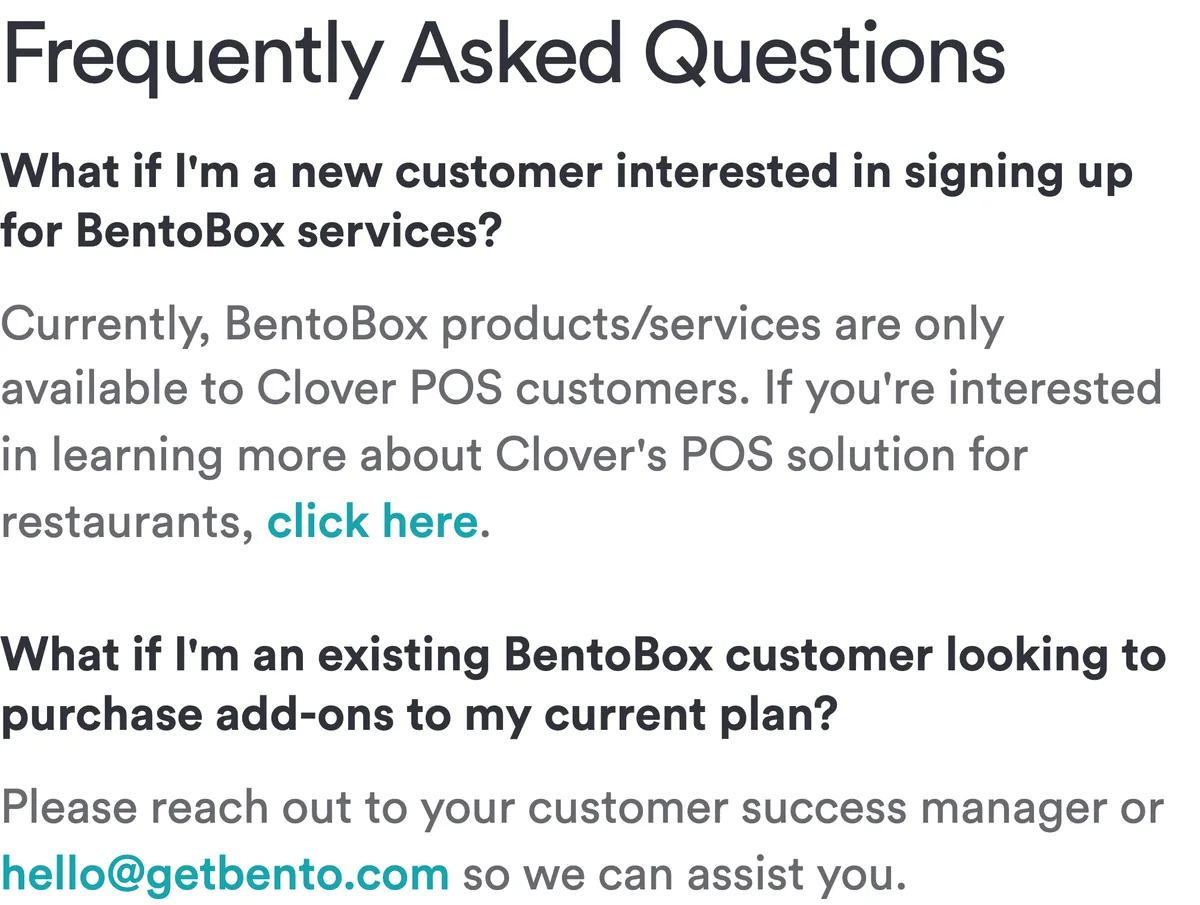
The advice available to a buyer has not caught up. We searched for the best restaurant website builders of 2026 on 27 August 2026 and took the seven pages returned. Six were readable to us and the seventh returned nothing we could parse. Three of the six recommend BentoBox: one ranks it third overall, one quotes a monthly range of $119 to $479 for it, and one files it under restaurant operations specialists. Not one of the six mentions Clover anywhere on the page. A buyer following the top of these results is shopping for something that is no longer sold on the terms described.
Take the practical consequence rather than the sentiment. Choosing a restaurant website is increasingly a downstream effect of choosing a point of sale, because the site, the ordering flow, the menu data and the payment rate now ship together from one company. That is genuinely convenient. It also means the decision that sets your card rate for the next three years is being made at the moment you pick a piece of countertop hardware, usually by whoever is most persuasive in the room.
So do the two decisions separately, at least on paper. Write down what you would pay for the point of sale alone, what you would pay for the website and ordering alone, and what the bundle costs. If a vendor cannot break the bundle into those parts, that is worth knowing before you find out which half of it you dislike.
What is riding on the ordering page
The reason any of this is worth an afternoon is that the takeout counter is now most of the business. In its 2025 Off-Premises Restaurant Trends report the National Restaurant Association put nearly 75% of all restaurant traffic off premises, meaning close to three in four orders leave the building. Mobile ordering had been used recently by 57% of adults, rising to 74% of millennials and 65% of Gen Z adults. Sixty-five percent of limited-service operators offered delivery, and off-premises accounted for a larger share of sales than in 2019 for 58% of limited-service and 41% of full-service operators.
Read those numbers next to a percentage and the stakes land differently. If three quarters of your orders travel, the page that takes them is not brochure ware with a menu on it. It is the counter. A tenth of a point on a card rate, or five cents in the dollar taken from a guest, applies to the majority of what you sell, every day, without an invoice ever arriving to prompt a review.
When your menu stops being marketing
If you operate twenty or more locations, the menu on your website is a regulated document, and a surprising number of growing groups cross that line without noticing. The Food and Drug Administration's menu labeling rule at 21 CFR 101.11 defines a menu to include, in its own words, electronic menus and menus on the Internet. Your website menu is inside the definition, not adjacent to it.
The rule reaches a covered establishment, defined as a restaurant or similar retail food establishment that is part of a chain with twenty or more locations doing business under the same name and offering for sale substantially the same menu items, regardless of the type of ownership. Individually owned franchises count toward the twenty. So do the locations you opened last year while the website stayed on the plan you bought when there were six of you.
What the rule then requires is specific and it is a build detail, not a legal footnote. Calories go next to each standard menu item. Two statements have to appear as well: the succinct statement, worded 2,000 calories a day is used for general nutrition advice, but calorie needs vary, which must appear at the bottom of each page of the menu; and the statement additional nutrition information available upon request, which the regulation says must be on all forms of the menu or menu board. A content management system that cannot place two persistent lines under a paginated menu, in a type size no smaller than the calorie figures, has a real problem the day your twentieth location opens.
Two footnotes worth carrying into the vendor conversation. The rule has a voluntary registration route at paragraph (d): an operator below twenty locations can elect to be covered, and doing so replaces non-identical state and local nutrition labeling requirements with one federal standard, which is occasionally the cheaper answer for a group operating across several jurisdictions. And none of this is your platform's duty. It is yours, which is why the question to ask is not whether the vendor is compliant but whether the template lets you comply.
What we charge, and where we are the wrong call
We sell one thing and it has no percentage attached, on your side or your guest's: a monthly partnership at $1,000, $2,500 or $5,000 a month. Billed monthly in advance, no minimum, pause or cancel anytime, and the site is yours to keep either way. Our pricing page sets out what each plan includes. Once your content and photography are in hand, a focused build is typically live in 14 business days, and a partnership request gets a reply inside 48 hours.
Now the honest half. If you need a till that talks to a kitchen display, a menu that syncs to four delivery integrations, tableside handhelds, payroll, and one support number for all of it at two in the morning, buy a platform. Owner.com, Toast, Square, SpotOn and Clover are selling something we do not sell, and the percentage in their pricing is what funds the parts we would have to bolt together for you. At real volume those platforms are also cheap per order. We would rather say that than pretend a design studio replaces a point of sale.
Call us when the website itself is the part that is failing you. When your food photography is doing nothing for you, when the reservations page loses people on a phone, when your private dining and group booking pages sit three clicks below the fold, when your brand looks like the template it was built from. That is the kind of problem we solved for Cornerstone Healing Center, whose redesign lifted website conversions by 20%, and for Eden Digital, which grew revenue tenfold on a site we built. Past 200 projects have gone out of this studio and not one of them was a point of sale, which is the disclosure that belongs next to the rest.
The decision aid: price one order, both sides
Every quote in this market becomes comparable once you push a single order through it and write down two answers instead of one: what leaves your account, and what leaves your guest's. Take a real order at your real average check, at your real monthly volume, and fill this in for each vendor. Twenty minutes of arithmetic reorders most shortlists.
| One order, at your average check | Vendor A | Vendor B | Vendor C |
|---|---|---|---|
| Menu price of the order | |||
| Monthly subscription, divided by your monthly orders | |||
| Percentage charged to you, in dollars | |||
| Card processing, percentage and flat cents | |||
| What you keep | |||
| Percentage charged to the guest, in dollars | |||
| What the guest pays | |||
| Months you are committed for |
Four rules keep it honest. Use your current volume, not the volume the salesperson is projecting, because the subscription row is the one that flatters you as you grow and punishes you if you do not. Leave any row blank that the vendor will not fill in, and treat the blank as a number you will discover on a statement later. Run the table twice, once at today's volume and once at double, since the ranking often flips between the two. And put the term in the last row rather than in the footnotes, because a rate you cannot leave is not the same product as a rate you can.
Worked on the published figures above, at 400 orders a month averaging $25, Owner.com's Flexible plan costs you $249 plus $500 in restaurant fees before any card processing appears, its Flat Rate plan costs $499, and your guest is charged $1.25 an order in either case. Square's Free plan on the same volume is $450 all in and charges the guest nothing. Those three numbers describe genuinely different businesses, and no range containing all of them tells you anything.
The order we would build it in
Build the things a hungry person needs at 6pm before the things that photograph well. The order below is the one that survives contact with a real service, and it holds whether we build the site or your platform does.
The menu comes first, as real text on a real page, with prices, in the page's own HTML rather than in a PDF or a picture of a menu. It is what almost everybody came to the site for, and it is the thing most often published in a format that a search engine or an AI assistant reads badly. Then hours and location, correct and structured, including the hours that differ on holidays. Then the ordering path, tested on a phone with one thumb, timed from the menu to a confirmed order. Then reservations or waitlist, if you take them, without a second login. Then the pages that carry your bigger tickets: private dining, catering, gift cards, events. Then photography, which is worth real money once everything above works and is worth nothing while the menu is a PDF.
The decision that costs the most later is not any of those. It is ownership. Settle who holds the domain, where the menu data lives, whether the customer list can be exported, and what becomes of your ordering URLs the day you leave, which we set out in what to check before you sign a web design contract. On a deal priced as a share of every order, for a term measured in years, the cost of not being able to walk away compounds one ticket at a time.
Frequently asked questions
It depends on how much you sell through it, because most of this market prices a percentage rather than a project. Owner.com publishes $249 a month plus a 5% restaurant fee per order, or $499 a month flat, with a 5% guest fee on both plans. Flipdish starts at $119 a month billed annually. Square gives you the ordering site at $0, $49 or $149 a month and takes 3.3% or 2.9% plus thirty cents on each online order. Our own plans are monthly and published, at $1,000, $2,500 or $5,000 a month, with no percentage on either side of the transaction. Price a single order through each option before you compare monthly figures.
Usually not, though the commission is often real and it has simply moved. SpotOn describes its ordering product as commission free and sells it inside a Core Bundle priced at $50 a month plus 20 basis points of gross payment volume, capped at $200. Square charges no marketplace commission and recovers the software through the card rate. Owner.com charges no restaurant fee on its Flat plan and still applies a 5% order support fee to the guest. Ask which of the four places the percentage sits before accepting the phrase.
It might, and it is worth asking directly, because the fee will not appear on any invoice you receive. Owner.com states on its own pricing page that on both plans guests pay a 5% order support fee covering fulfillment and customer service. Square publishes no guest-side fee on its ordering tiers. Since the argument for direct ordering is usually that it is better and cheaper for the guest, the checkout total your customer sees is part of what you are buying.
Only below a volume you can calculate exactly. Square's Free tier is $0 a month at 3.3% plus thirty cents online, and its $49 Plus tier is 2.9% plus thirty cents. The gap is 0.4 of a percentage point, so $49 divided by 0.004 gives $12,250 in monthly online orders as the point where the two cost the same. Underneath that figure Free is the cheaper plan. Past it, the plan with no monthly fee is the more expensive one, and the penalty grows as you do.
Increasingly you may not have a choice, so make the two decisions separately on paper first. BentoBox, long recommended as a standalone restaurant website builder, now states that its products and services are only available to Clover point of sale customers. Write down what the till costs alone, what the website and ordering cost alone, and what the bundle costs. A vendor who cannot break the bundle into those parts is asking you to buy a card rate you have not priced.
Yes, if you are part of a chain with twenty or more locations under the same name offering substantially the same items. The Food and Drug Administration's rule at 21 CFR 101.11 defines a menu to include electronic menus and menus on the Internet, so your website is covered. Calories go beside each standard item, the succinct statement about 2,000 calories a day goes at the bottom of each menu page, and the line about additional nutrition information being available on request must appear on all forms of the menu. Franchised locations count toward the twenty.
Anywhere from one month to three years, and the cheapest advertised prices tend to carry the longest terms. Owner.com says month to month with no cancellation fees. SpotOn's month to month plan is $55 a station while its $0 plan carries a two year minimum term. Flipdish's $119 rate is billed annually and costs $149 if paid monthly. Clover's $179 a month for a full service restaurant system is a 36 month subscription. Put the term in the same table as the monthly price or the comparison means nothing.
A menu published as real text on a real page, with prices, rather than as a PDF or a photograph. It is what most visitors arrived for, and it is the item most often published in a format that search engines and AI assistants read badly. After that, accurate hours and location, an ordering path you have timed on a phone with one thumb, and only then reservations, catering pages and photography. Photography is worth real money once the menu works and close to nothing while it does not.
 Development
Sep 7, 2026 · 17 min
Staffing Agency Website Cost in 2026: What 46 Agency Sites Actually Run
We measured 46 staffing agency websites and found that a staffing firm is buying two websites, not one. Here is what each half costs, who supplies it, and which one carries your legal obligations.
 Development
Sep 2, 2026 · 17 min
How Much Should a Mortgage Broker Website Cost in 2026?
Published plans run from $619 to $12,963 in the first year, and the design is not what separates them. On a lending site the rules decide the copy, the layout and how long you keep every version.
 Development
Aug 31, 2026 · 17 min
How Much Should a Church Website Cost in 2026?
The website is the cheap part. Tithely publishes one at $19 a month and Planning Center gives one away. The expensive part is the 2.15% to 3.00% coming off every gift the site collects, which is worth $2,465 a year on a $250,000 offering.